
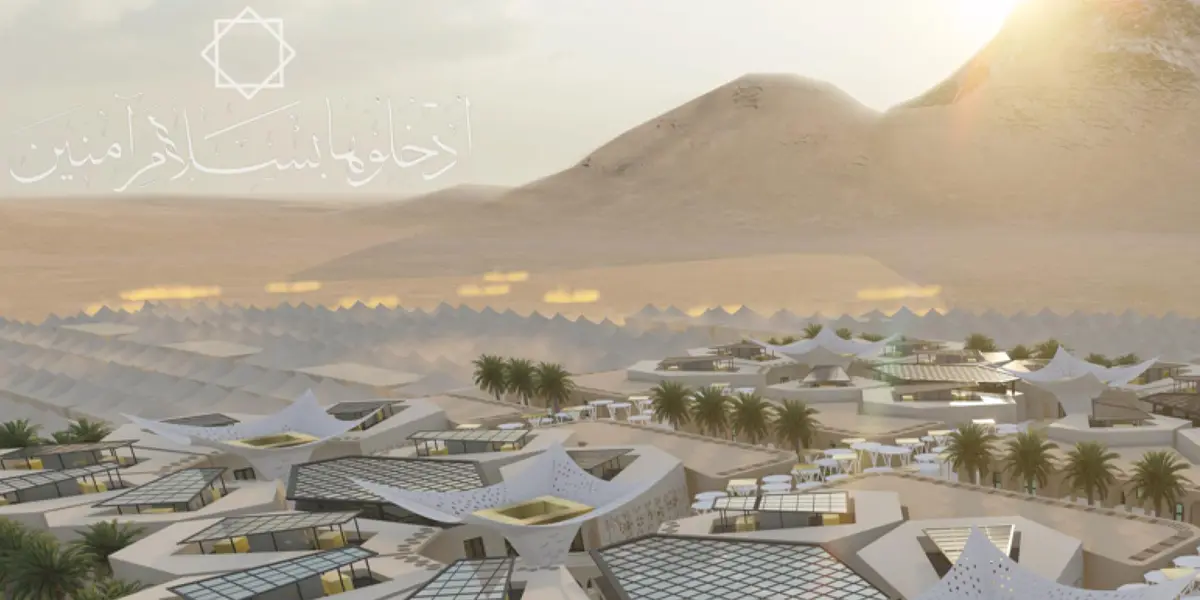
Recreating tent housing for hajj pilgrims in the city of Mina.
Results for ‘The White Land’ - Religious building Competition


The city of Mecca is considered the birthplace of the Prophet, and also the place where he received the message of Islam, which transformed Mecca into the holiest city in the Islamic world. Mecca (present-day Saudi Arabia) has been a sacred site since ancient times, it even served as a site of pilgrimage for the Arabs tribes of central and North Arabia.
Hajj is the pilgrimage to Mecca, which every Muslim is expected to visit at least once in their lifetime if they can. It is a religious duty that is central to the Muslim belief and is one of the Five pillars of Islam.
The occurrence of recorded pilgrimage can be traced back to The Kaaba, tradition holds that it was a simple unroofed rectangular sanctuary in pre-Islamic times.
The Saudi government has an ambitious plan for the Vision 2030 agenda. The vision has several important thrust areas including making Saudi Arabia a major trade and cultural intersection between the west and east worlds. This document details the entire vision. This vision not only expands the lengths and breadths of inclusivity and advancement but also looks at expanding the Hajj pilgrim bandwidth to more than 10 million pilgrims. The goals here are not only quantitative but qualitative as well.
With rising pilgrims, a lot of Hajj facilities are being expanded to accommodate this new growth of visitors and provide them with clean, healthy experiences. Several upgrades have already rolled in (Like mosque expansion and transportation upgrades) to meet these expectations.
The question however was, are all parts of the journey ready for this growth?
World’s largest tent city: Mina
Pilgrims in masses set out from Mecca to the sprawling tent city of Mina after their seven rounds at Mecca, Safa, and Murah. The journey towards Mina is covered on foot or by buses and cars. Situated 12 kilometers outside Makkah, Mina is a small city located inside a valley. The stay in the city signifies the importance of the day spent before the day of sacrifice.
Present-day Mina serves for 5-6 days of every year continuously. It hosts almost 100,000 tents, with increasing numbers of pilgrims each year. The tents create an entire settlement on land that remains deserted the other time of the year.
Currently, more than 2 million Muslims from around the world are stated to attend the five-day Hajj pilgrimage annually in Mecca. The figure is speculated to grow to 5- 10 million visitors in the coming decades which is sure to push the current system designs to their limits.
The problem doesn't lie in handling so many visitors, but this huge influx of visitors for 5 days and the system remains vacant for the next 360 days. This is where it requires meticulous planning of resources and infrastructure for managing this pilgrim surge.
Hajj is a predominant source of livelihood for the majority of the population of Mecca. The place serves 5 days of pilgrims that constitutes a lot of hospitality, tourism, transportation, food & beverage, retail, and a lot of small businesses to begin with. This dependence is especially visible in the context of 2020.
Last year the entire pilgrim journey was called off due to the outbreak of the pandemic. Only a few were permitted to attend the holy journey, which caused a major disruption in the financial stability and well-being of the people in the city.
Can there be a better alternative to the current systems of tent-based housing with a more comprehensive solution? If horizontally the tent city is landlocked; can we see a new realm of vertical space making? Can covid-19 concerns and such medical emergencies be worked upon for healthy living for the elderly? With such a huge surge, taking the elderly population coming in from various walks of life and educational backgrounds, how can we ensure safe crowd management for Hajj pilgrims when the capacity rises manifold in the coming decades?
Brief: The design challenge was to conceive a modular solution for housing Hajj pilgrims in the city of Mina.
The stay duration is aimed at 6 days of air-cooled living, cost-effective, fireproof, hygienic, and incremental to begin with, and can go as much as elevating pilgrim experience with whichever means found imperative.
The jury for the competition consisted of esteemed designers, professionals and academicians from around the world. The Lead Jurors for the competitions were as follows:
Ibrahim Joharji, Founder, INJ Architects, Saudi Arabia
Walaiporn Nakapan, Architect/Computational Designer, Thailand
Ala Hason, Principal, Director of the MENA Region, HKS Architects, Dubai, United Arab Emirates
Mohamed Al Assam, Founder and Executive Chairman, Dewan Architects + Engineers, Dubai, UAE
Diego Martin Aceto, Arquitecto, Estudio Arqtipo, Buenos Aires, Argentina
Martin Pool, Partner, Pool Leber Architekten, Germany

Some of the Best competition projects are as follows:
Winning Project: WADI MINA’S HOUSE OF RESPITE
By: Adam Yuraselan, Iqbal Hashim, Salehin Ks & Ismail Rahim

Fig: 1 Cover image
Description: Wadi Mina’s House of Respite offers comfortable lodgings for the pilgrim jamaah around the Day of Arafah and Jumrah stonings. This will be the place where the pilgrim jamaah can seek refuge. It is in the House of Respite that their individual needs and ibadah can be performed within their private space.
Jury Comments: The Fractal and Fragmental design approach, as inspired by traditional "Mashrabiya" is a good outset of the project. However, the final architectural language and use of materials appeared rather alienated from the local environment. Well attention to the blend of accommodation units, with hygiene and retail function, but the dense clustering of the units would have benefited from some gentle treatment of the in-between public areas.
-----------------
Runner-Up: The Viable Mina
By: Kawar Salih, Suzan Saddun, Zaid OSaeed & Alaa Kadhim
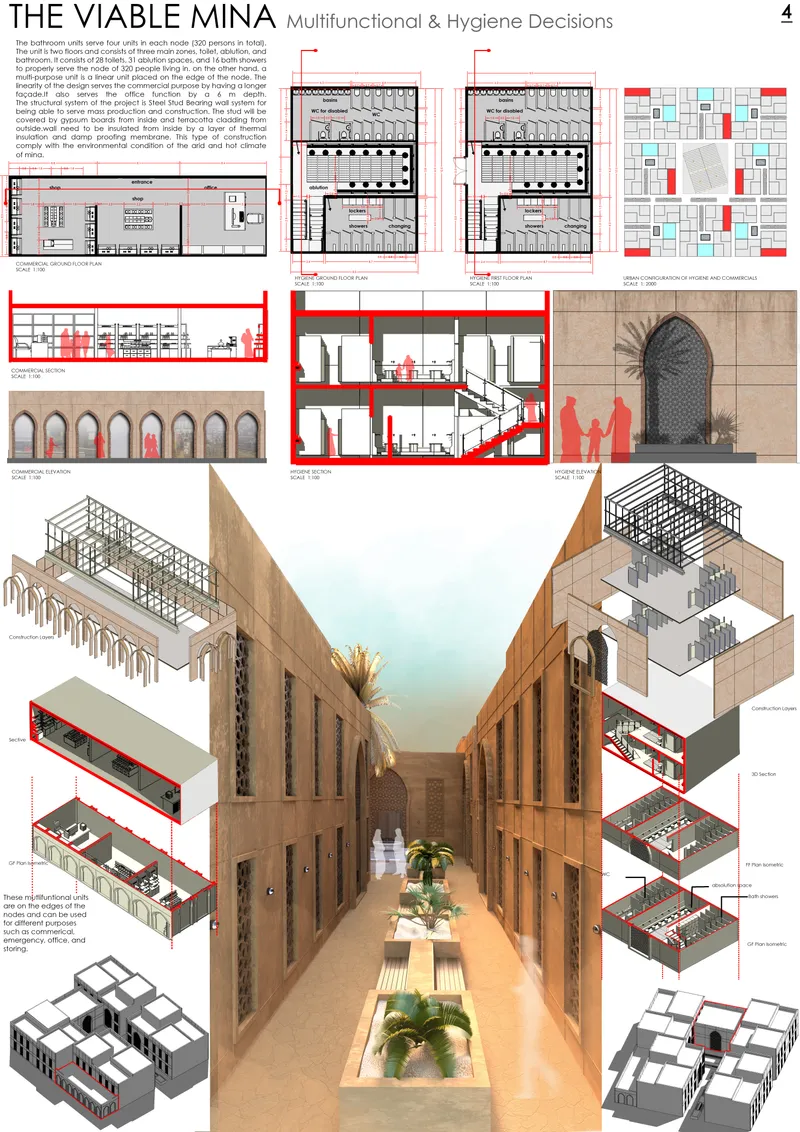
Fig:2 Elevation and Section Plan
Description: Mina is part of the most prominent religious gathering in the world which is Haj. The first questions that come to mind while designing the project are how to create an executable module, hygienic, and crowd controllable. Other dimensions in the project are also necessary to consider, such as religious, cultural, sustainable, functional, and aesthetical.
Jury Comments: Nice approach, with clustering accommodation units and blending them with commercial, hygiene, and well treated landscaped public areas in between. References to traditional cities are clearly achieved, with its delicate proportions between solids and voids, providing self-shading units, and gentle transient from the public, semi-public/private to private areas. However, the architectural language remains too conventional, despite the successful use of sustainable materials, PVs, and modular structure systems. This proposal could be successfully developed for and extended use beyond the holy Hajj period.
----------------------
Honorable Mention: DAR SALAM
By: Zaid OSaeed, Kawar Salih, Yuser Abdulmunim & Marwa Aram

Fig: 3 View of Interior design
Description: The proposal envisions the future of Mina region in alignment with the 2030 vision of the Saudi Arabia government to develop the Haj experience.
Jury Comments: Good clustering approach for the accommodation units and well-treated common public areas in between, with clear references to traditional patterns. The stacking of sleeping beds on two levels, is questionable, as well as the vertical circulation in the units. The proposal could be successfully developed for and extended use beyond the holy hajj period
-------------------
People’s Choice: The Hajj Eco-Tent
By: Riham Faragallah

Fig: 4 Clustered Plan, Floor Plan, and Detailed Section Plan
Description: The Hajj eco-tent is a promising future experience for pilgrims that visit Mina city through the design of a comfortable multifunctional living module applying different environmental treatments and hygienic precautions to avoid the spread of COVID-19 which makes Mina city ready for the growth of pilgrims in the future.
Jury Comments: Good concept with reference to the "Tent" legacy of Mina, allowing for future growth and challenges of any health-threatening issues (like the current Covid 19) with good health and hygiene and distancing measures. Design and graphic presentation if developed would have served the proposal concept significantly and made it shine. As for the space planning, it seems questionable to mix the food storage and ablution areas at the same place, to avoid cross-contamination.
------------------------
Editor’s Choice: REVISITING MINA
By: Muhammad Danish

Fig: 5 Interior view
Description: The main idea behind revisiting MINA is to give a feeling of connection of MINA with KABAH through a tent to elevate the experience of Hajj to another level. Mina is the place where prophet Ibrahim fulfilled his dream of sacrificing his son Ismail. Staying in Mina is a part of Hajj.
Jury Comments: Good concept based on Islamic doctrine and pillars. While the design outcome appeared as a rigid interpretation and missed inherent sensitive detailing and care for the materials, as well as for the space planning and treatment of the in-between public areas. The stacking of sleeping beds on two levels, and the use of lifts in the ancillary units is questionable
---------------------
Editor’s Choice: The White Modules
By: Renato Peron & Daniel Mosca

Fig: 6 Concept image
Description: The design challenge is to conceive a modular solution to host Hajj pilgrims in the city of Mina. The modular structure allows you to optimize spaces and, in this case, with the creation of two-story buildings, it gives the possibility to accommodate a greater number of users, offering them greater comfort.
Jury Comments: While this proposal concept draws clear references from local and historical architecture and patterns, the design output appeared simple, and many aspects of the design needed further elaboration. The Space program and a number of sleeping slots per accommodation module look overcrowded and not as per the competition brief.
------------------------
Editor’s Choice: Mina's Revival
By: Mina's Revival & Siyue Hu

Fig: 7 Site Plan, Bottom view & Facades and key conceptual sections
Description: Located in The Mina Tent City, next to Mecca, Saudi Arabia, the project is a place to house pilgrims during the Islamic Hajj pilgrimage.
Jury Comments: A thorough typological and environmental study of the project area's ceremonies and history, this was a potential resource to develop a good design output. Despite the very good graphic presentation and documentation, the design output and space program didn't illustrate the design requirements in terms of aesthetics, area requirements per worshiper, and other amenities. Structural systems, building materials and sustainability requirements, were also missing in this proposal
 Follow us on social media: Facebook | Instagram | LinkedIn | Twitter | Youtube
References (3)


Popular Articles
Popular articles from the community


David Macias Steps a Doorless Stone and Plaster House Down a Tropical Colombian Hillside
In the humid hills of Colombia, Threshold House replaces the front door with an open void and terraces its 850 m² down the slope instead of fighting it.

David Ortega Stacks a Two-Story Mexico City Penthouse Around a Steel Stair and a Pergola-Shaded Roof Terrace
In Colonia Roma, a 300 m² penthouse uses oak joinery, a planted steel stair and a slatted roof pergola to make a new-build apartment feel like a house.

Jaramillo Van Sluys Arquitectura and Urbanismo Turn a Demolished Registry Lot in Quito into an Orchard Plaza
In Quito's Centro Histórico, a 2,800 m² plaza exposes the San Agustín convent wall and redraws its lost Augustinian orchard in volcanic stone.

LT2A and OPEN Architectes Thread a Brick and Glass High School Through a Wooded Belgian Campus
In Braine-l'Alleud, a 3,000 m² wing for Collège Cardinal Mercier pairs pale brick with a glazed colonnade, deferring to a small chapel and a dense wood.

Similar Reads
You might also enjoy these articles


Aquadapt: An Underwater Habitat That Rewrites Its Rooms by the Hour
Curved modules ring the seabed while one shell shifts from breakfast room to cinema, farm and football pitch as residents' needs change.

Play: Fragments of Their World: Remembered Architecture Rebuilt as a Modular Playground for Refugee Camps
Tom Gardner abstracts domes, arches and towers from the homelands of displaced families into a kit of child-scaled play parts for camp settlements.
REBIRTH: A Circular Settlement Where Afghan Widows and Their Children Rebuild Life Together
A shortlisted Resile entry turns the circle into a protective ring of timber and brick, gathering homes, classrooms and gardens around a shared landscape.
The Main Dream: A Recycled Plastic Kit That Lets Refugee Children Build Their Own Playground
Thirty-centimetre interlocking cubes that connect on three axes turn play into construction, letting children author the spaces they occupy.


Comments (0)
Please login or sign up to add comments
No comments yet. Be the first to comment!