

Nano Nest: Passive House Principles Meet Multi-Generational Living in Dense Dhaka
A Tetris-inspired modular courtyard home channels cross-ventilation, daylighting, and cultural memory into a narrow plot in Puran Dhaka.


Stack a grandmother's ground-floor courtyard beneath a child's sky-lit bedroom and thread a living tree through the gap between them. That vertical act of care is the organizing principle behind Nano Nest, a compact housing prototype that applies passive house strategies to one of the densest residential fabrics on Earth: Puran Dhaka. Rather than treating small footprint as a constraint to be tolerated, the design treats it as a provocation to rethink how air, light, and family relationships can circulate through a single narrow plot.
Designed by Ishmam Faiyaz Chowdhury xyz and Dishan xyz for UNI, the project was a shortlisted entry in the Nano Nest 2020 competition on uni.xyz. Sited on a constricted lot amid the congested lanes of old Dhaka, the proposal confronts the city's hot, humid climate head-on with cross-ventilation corridors, operable skylights, and perforated brick facades, all arranged around a central courtyard that reinterprets the traditional Bengali courtyard house in vertical form.
Tetris Logic, Climate Intent
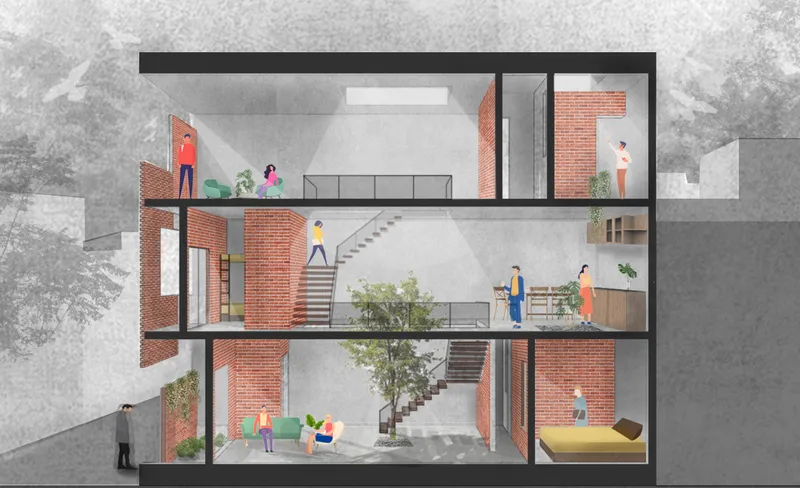
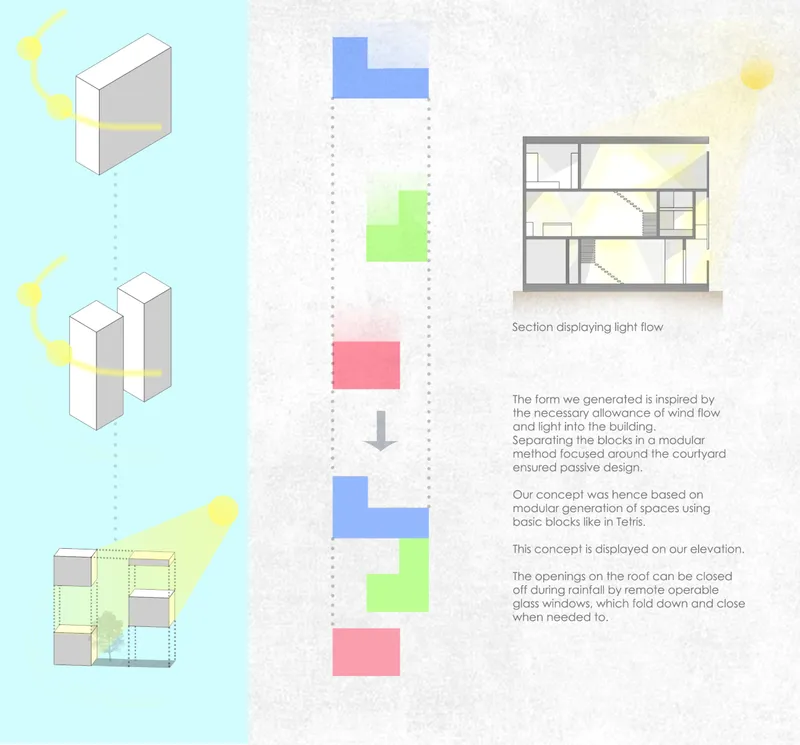
The section drawing lays bare how the home stacks three generations across three floors while maintaining visual and thermal continuity. Exposed brick walls absorb and re-radiate heat slowly, moderating indoor temperatures through mass alone. Between the modular volumes, intentional gaps function as ventilation corridors and light shafts, channeling airflow from ground level up through the section. The accompanying diagram annotates these strategies explicitly: arrows trace cross-ventilation paths, dashed lines mark daylighting zones, and the Tetris-derived block arrangement reveals how each programmatic unit locks into place around the central void.
What makes this modular approach more than a formal exercise is its climatic adaptability. Remote-controlled windows on the roof can close during monsoon rains, while operable skylights and shaded balconies adjust the interior microclimate seasonally. The ground floor, reserved for grandparents, offers the most direct courtyard access and the coolest temperatures. The upper floor accommodates children and the master bedroom, each with private balconies oriented for prevailing breezes. The middle floor sits between these poles, hosting semi-private and shared spaces that encourage intergenerational contact without eroding acoustic comfort.
A Courtyard Extruded Upward
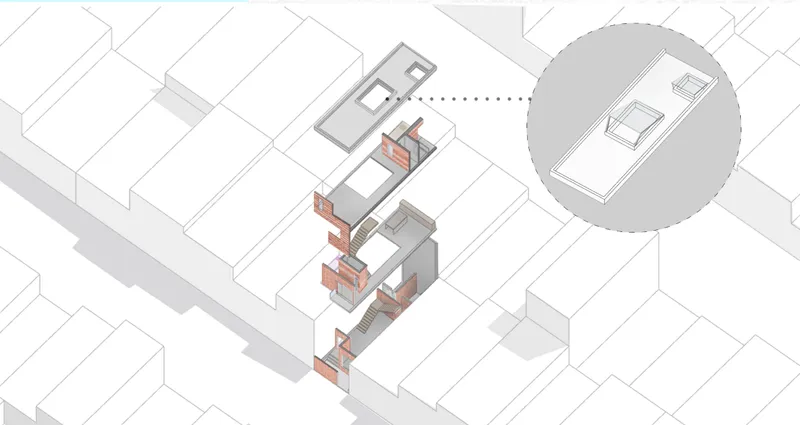
The axonometric drawing places the building firmly within its urban context: brick cores cluster around a narrow central void that reads less like a light well and more like a courtyard stretched vertically through three stories. Historically, subcontinental courtyard homes used these open centers as communal gathering spaces for extended families. Here, that tradition survives land scarcity by rotating ninety degrees. The courtyard still gathers the household, but it does so in section rather than in plan, connecting levels through sightlines, shared air, and the presence of a tree growing through the open core.
The material palette reinforces this cultural grounding. Local brick and concrete keep the structure legible within the existing urban texture of Puran Dhaka. The perforated brick screen, visible wrapping portions of the facade, filters both light and air, echoing a climatic intelligence embedded in traditional Bengali construction. It is a contemporary building that does not need to announce its modernity; its innovation lives in the environmental performance and spatial generosity it extracts from a constrained site.
Light, Brick, and a Living Anchor
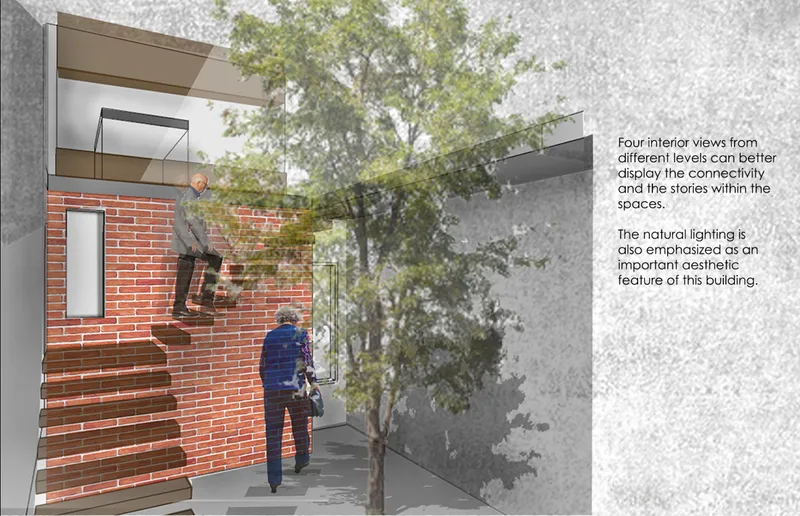
The interior perspectives reveal the experiential payoff of all that diagrammatic rigor. In the stairwell view, a figure descends past a textured red brick wall toward a tree visible beyond the landing. The tree is not decorative afterthought; it is, in the designers' words, "a living anchor connecting the stories above and below," a biophilic element that gives each floor a shared point of orientation and seasonal change. Light enters at oblique angles, modulated by the courtyard's proportions and the perforations in the surrounding walls.
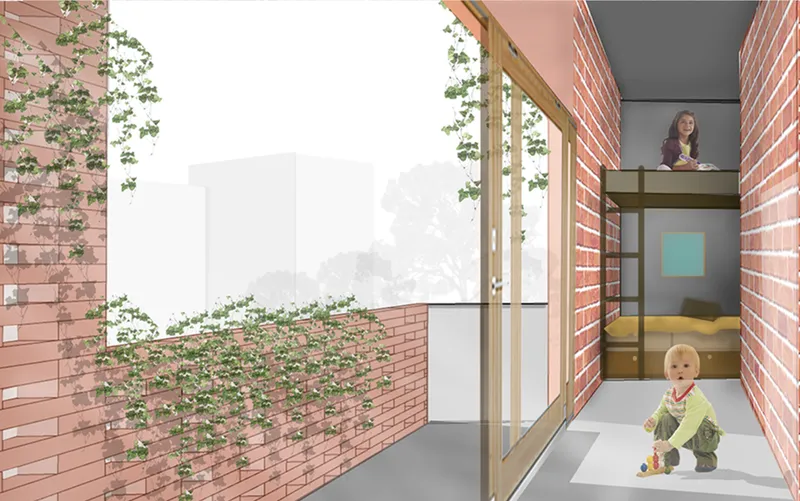
The balcony perspective deepens this reading. Glazed timber doors swing open to a planted courtyard where climbing vines colonize the brick surfaces. The boundary between interior and exterior dissolves here, not through expansive glass curtain walls, but through a careful sequence of thresholds: door, balcony, vine, courtyard, sky. Natural light dances across multiple levels, and interior views across floors allow family members to maintain a sense of shared presence. Children playing, grandparents resting, parents working: each activity occupies its own acoustic zone while remaining visually connected to the life of the house.
Why This Project Matters
Nano Nest is persuasive because it refuses the false choice between environmental performance and cultural identity. Passive strategies like cross-ventilation corridors, thermal mass walls, and operable skylights are not imported technologies layered onto a local typology; they are drawn directly from the climatic logic that produced Bengali courtyard houses in the first place. The Tetris-inspired modularity gives the scheme a replicable geometry that could adapt to other narrow plots across Dhaka and similar cities in the Global South, making it a genuine prototype rather than a one-off gesture.
More importantly, the project embeds social ambition inside its spatial logic. Assigning the ground floor to grandparents, threading a tree through the section, calibrating privacy gradients from shared courtyard to private balcony: these are not programmatic bullet points but design decisions that shape daily life. In a competition field focused on nano-living, Chowdhury and Dishan demonstrated that small footprint housing does not have to mean diminished experience. Spatial hierarchy, visual connectivity, and thermal comfort can coexist, even on the narrowest lot in old Dhaka.
View the Full Project
About the Designers
Designers: Ishmam Faiyaz Chowdhury xyz, Dishan xyz, UNI
Enter a Design Competition on uni.xyz
uni.xyz runs architecture and design competitions year-round that reward proposals with spatial conviction and real site intelligence.
Project credits: Nano Nest by Ishmam Faiyaz Chowdhury xyz, Dishan xyz, UNI Nano Nest 2020 (uni.xyz).


Popular Articles
Popular articles from the community


LT2A and OPEN Architectes Thread a Brick and Glass High School Through a Wooded Belgian Campus
In Braine-l'Alleud, a 3,000 m² wing for Collège Cardinal Mercier pairs pale brick with a glazed colonnade, deferring to a small chapel and a dense wood.

U.GA Architects Wraps an Oval Rooftop Pool in Curved Board-Formed Concrete on Busan's Jeollidan-gil
In Busan's Jeonpo-dong, a 454 m² mixed-use block stacks a neighborhood facility, guest rooms and an oval rooftop pool inside spiraling concrete walls.

David Macias Steps a Doorless Stone and Plaster House Down a Tropical Colombian Hillside
In the humid hills of Colombia, Threshold House replaces the front door with an open void and terraces its 850 m² down the slope instead of fighting it.

Cube Design Draws an Ecological Corridor Between Two Shenzhen Hills with the Nankai Building
Beside Shenzhen's container docks, the Nankai Building pairs stacked balconies with a climbing green screen to connect two hillsides across its height.

Similar Reads
You might also enjoy these articles


Vereda Arquitetos Renovates a 40-Square-Meter Apartment Inside Niemeyer's Copan Building
A compact unit in São Paulo's most iconic residential tower gets a material overhaul that pairs exposed concrete with bold blue Formica.

Shakur's House: Exposed Brick as an Interior Organiser in a 168 m² Mashhad Residence
Brick moves indoors in this Mashhad residence, where masonry walls, glass partitions and teal planes sequence a compact home without closing it off.

Day and Night Park: A Time-Based Urban Newsstand in Beijing
A temporary urban newsstand in Beijing blending travel, light, and reading through poetic colors, compact form, and community-focused design.

Modernist Patio Renovation in El Masnou, Barcelona by Oliver Segura Arquitectura + Cebrià Arquitectura
Modernist patio renovation blending tradition and innovation with a movable pool, leveled floors, and Catalan materials in El Masnou.


Comments (0)
Please login or sign up to add comments
No comments yet. Be the first to comment!