
Arqbag Merges Two 19th-Century Terrassa Row Houses into a Single Bioclimatic Home
Compacted earth blocks, chimney-effect ventilation, and a reworked party wall cut energy use 60 percent below Spanish code limits.


In the expansion districts that ringed Terrassa at the turn of the twentieth century, narrow row houses packed tight between party walls were the default dwelling. Two such houses, built in the late 1800s and early 1900s, sat side by side on practically rectangular plots oriented southeast along their long axis. They shared a masonry wall and all the usual problems of the typology: dark interiors, poor cross-ventilation, and rigid linear circulation that left the center of each home as dead space. Arqbag, a cooperative architecture practice, saw those deficiencies not as obstacles but as the raw material for a fundamentally different kind of renovation.
Rather than gut and rebuild, the team punched strategic openings through the shared party wall, collapsing two separate floor plans into what they call an "indeterminate matrix" of interconnected rooms across ground floor, first floor, and attic. A central core, threaded vertically through the combined plan, houses bathrooms, skylights, and a ventilated walkway on the first floor. Two motorized windows at its top guarantee chimney-effect airflow and pull daylight deep into the formerly lightless middle of the block. The result is a 931 square meter home that uses 60 percent less energy than the Spanish building code requires, achieved almost entirely through passive means.
Street Presence and Material Honesty
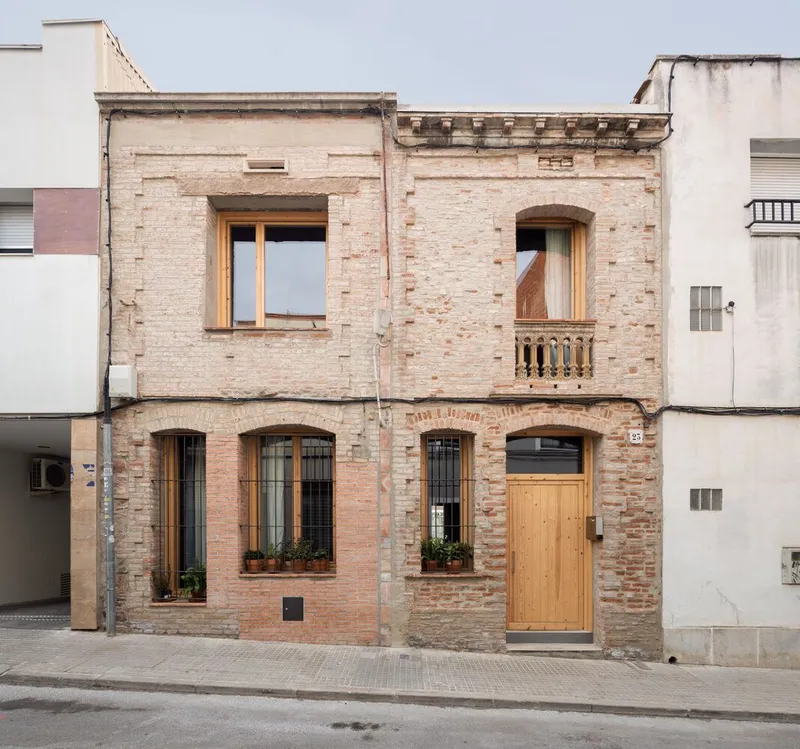
The street facade keeps its existing ceramic brick exposed, framed by timber window surrounds and a small balustrade balcony that signals the domestic scale of the original buildings. There is no applied cladding, no render, no attempt to mask age. What Arqbag adds is restraint: the color palette stays within the warm tones of fired clay and oiled wood, and new insertions read clearly against old surfaces without competing with them.
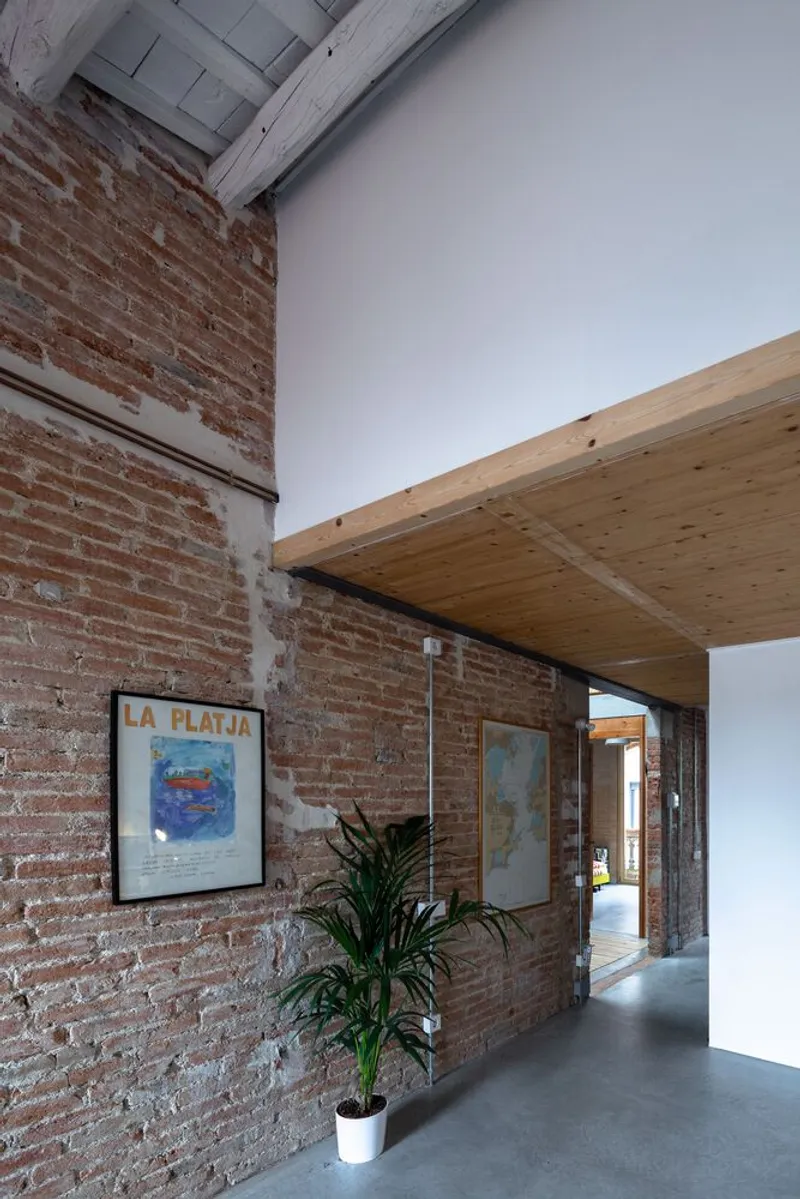
Inside the corridors, the same discipline holds. Exposed brick walls run alongside timber ceiling panels, and a framed poster or a potted plant becomes the only furnishing a passage needs. The thinness of the intervention is the point. By retaining the original masonry, the architects inherit thermal mass for free, a quality they then augment with compacted earth block (BTC) partitions elsewhere in the plan.
Earth Blocks and Hygroscopic Comfort
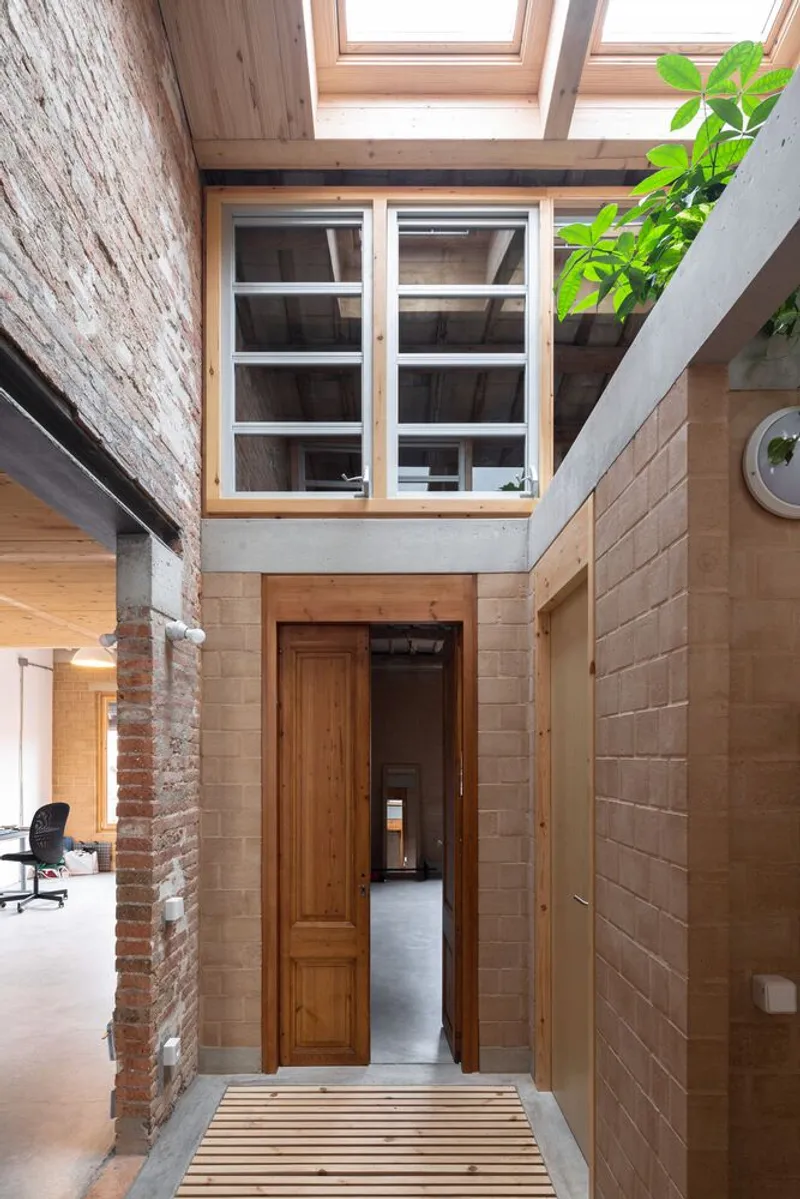
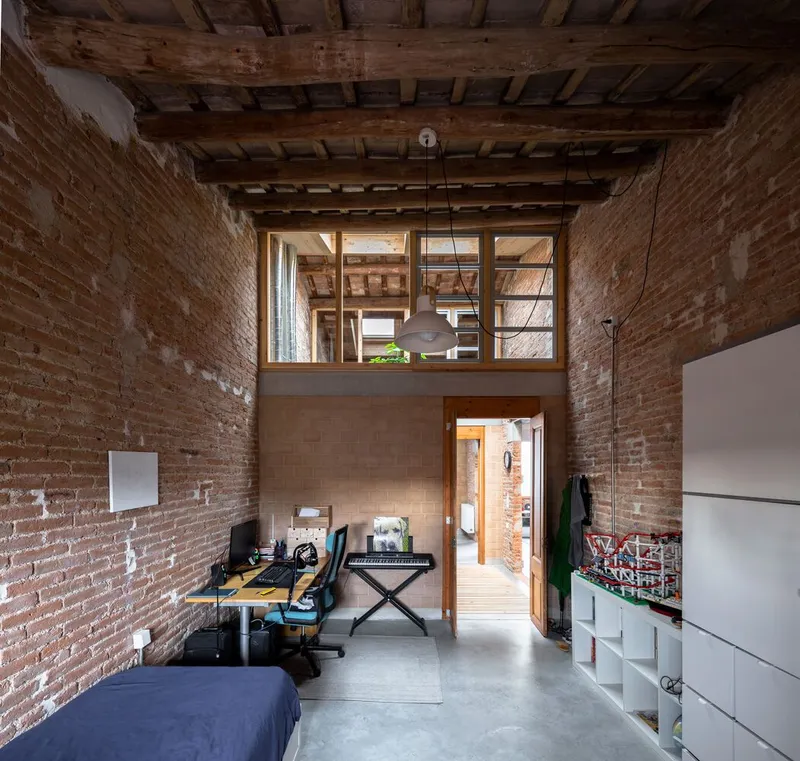
The compacted earth blocks deserve attention because they do something ceramic brick cannot: regulate indoor humidity passively. BTC absorbs and releases moisture as ambient conditions shift, smoothing out the peaks and troughs that mechanical systems typically handle. In a Mediterranean climate with warm, humid summers, this is not a niche benefit. It is the difference between a house that breathes and one that sweats.
Combined with insulation applied to the roof, facades, and ground slab, the BTC partitions create an envelope that stores heat in winter and sheds it in summer. The south facade collects solar energy directly, while a shading system prevents overheating during peak months. It is a layered, redundant strategy: thermal inertia, hygroscopic control, insulation, and ventilation all overlap so that no single system carries the load alone.
The Central Core as Climate Engine
The most consequential move in the plan is the central core. In the original houses, this zone was the darkest, most stagnant part of the floor plate. Arqbag turns it into the primary driver of environmental performance. Skylights at the roof feed daylight downward; motorized windows at the top create a stack effect that draws air up through the building; a ventilated walkway on the first floor distributes that airflow laterally into the rooms on either side of the former party wall.
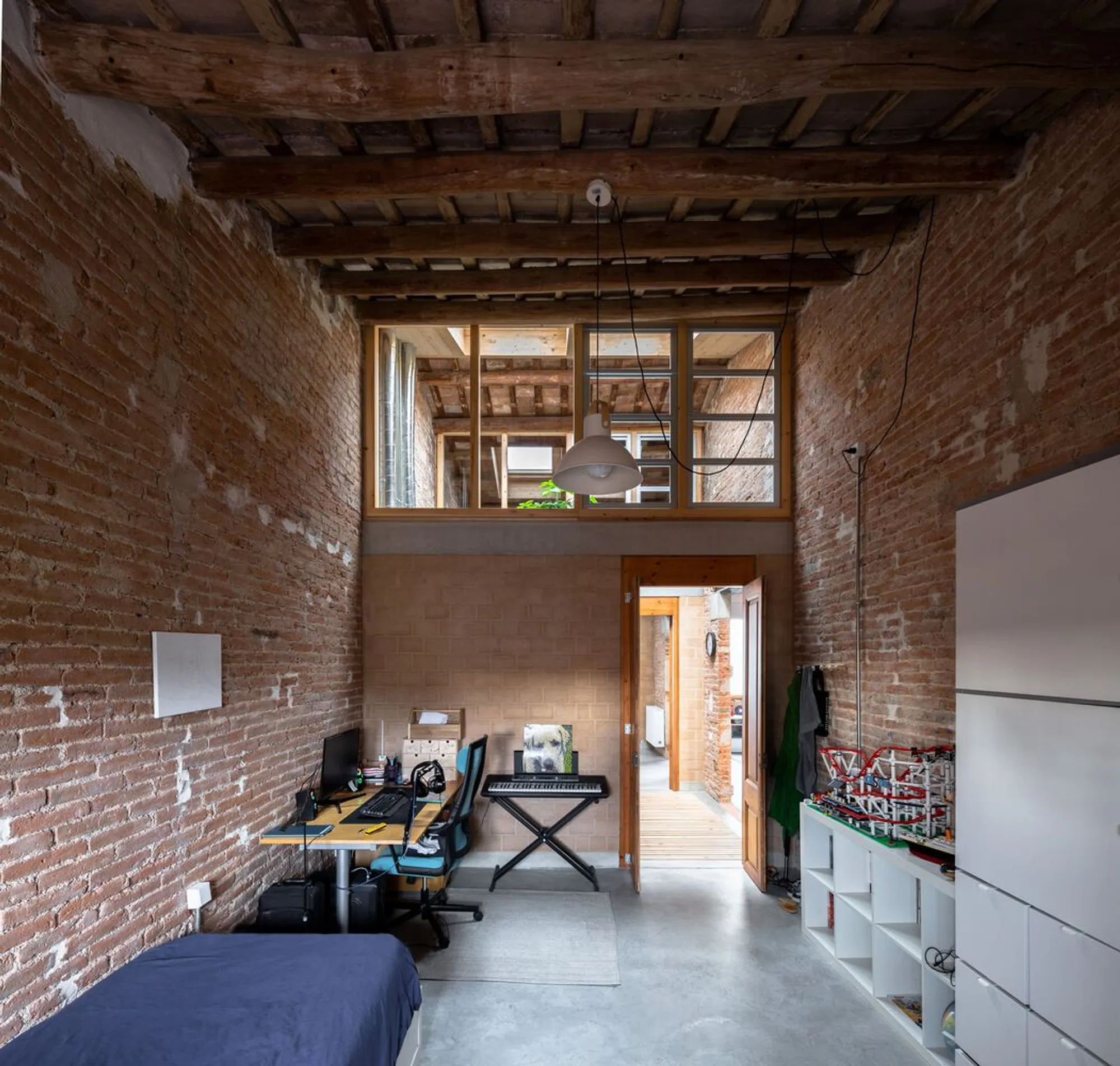
The double-height space visible in the interior captures this logic. Exposed timber beams span overhead, a mezzanine window opens onto the workspace below, and light washes the brick walls from above. It is simultaneously a room and a piece of infrastructure. The core also consolidates bathroom fixtures, differentiated by use, which simplifies plumbing runs and keeps wet services out of the perimeter rooms where passive strategies work best.
Courtyard and Garden: Extending the Interior Outward
The interior courtyard, visible through a timber door beneath overhead skylights, connects the conditioned interior to the garden space at the heart of the city block. A potted plant and a patch of exposed brick wall are all that separate inside from outside, and that porosity is deliberate. By conditioning the courtyard as a transitional zone, Arqbag extends the usable area of the house without adding fully heated volume. The garden becomes a buffer that moderates extremes before air enters the living spaces.
Domestic Warmth Without Decoration
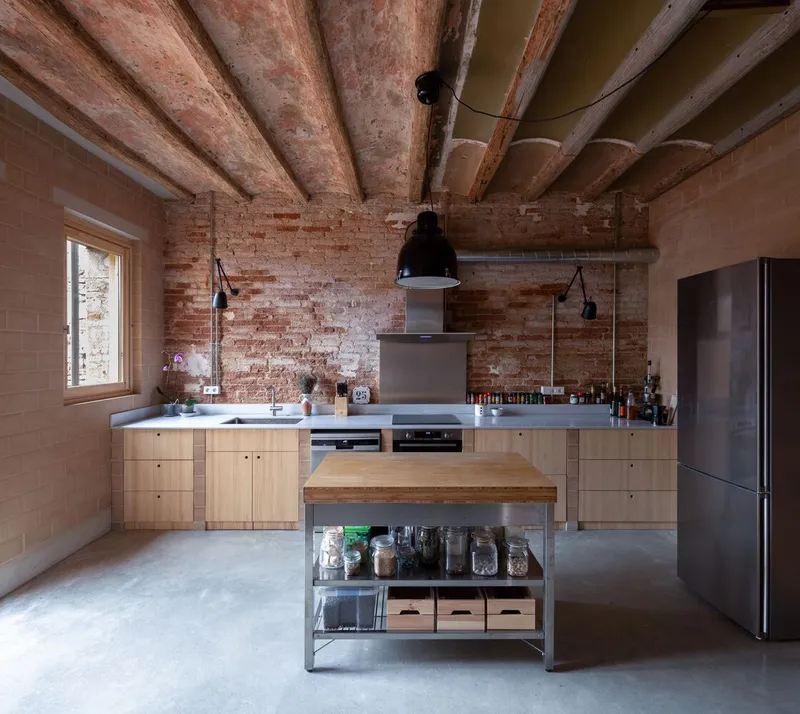
The kitchen tells the tonal story of the whole project. Timber cabinetry lines the walls beneath exposed wooden ceiling beams, and a central island doubles as open shelving. There is no stone countertop, no statement backsplash. The warmth comes from the wood grain and the patina of reused structure, not from applied finish. It is a kitchen that looks like the house it belongs to, not a showroom insert.
Across every room, the palette stays consistent: brick, timber, earth. That material discipline is what holds the indeterminate matrix together spatially. Without it, the openness created by breaking through the party wall could easily feel chaotic. Instead, the repetition of texture and tone gives the interconnected rooms a family resemblance that reads as coherence rather than monotony.
Plans and Drawings
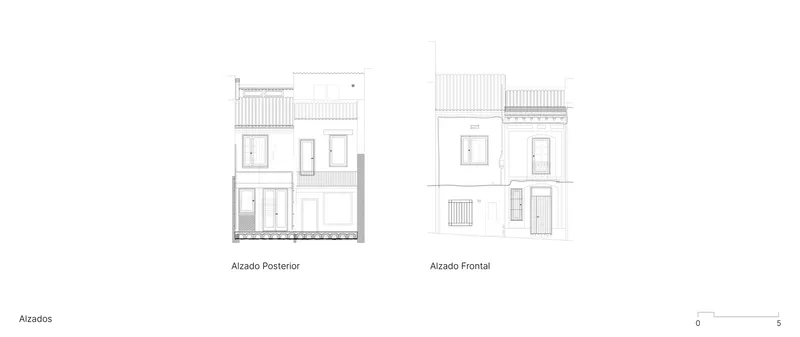
The elevation drawings reveal the proportional logic of the two original houses and the rooftop additions that accommodate the skylight infrastructure of the central core. The rear facade, facing the interior courtyard, opens up more generously than the street side, reflecting the bioclimatic strategy of controlled solar gain on the south-facing surfaces while maintaining a restrained public face.
Why This Project Matters
Dense European cities are full of row houses that nobody knows how to renovate well. The typical approach is either preservation theater, where the facade stays and everything behind it gets replaced, or wholesale demolition dressed up as urban renewal. Arqbag offers a third path: keep the walls, keep the structure, and redesign the environmental performance of the building from the inside out. The party wall, traditionally an obstacle to light and air, becomes the hinge that connects two houses into one thermally massive, passively ventilated whole.
The 60 percent energy reduction is the headline number, but the real achievement is how it was reached. No photovoltaic arrays, no ground-source heat pumps, no complex building management systems. Just earth, brick, timber, insulation, and intelligent openings placed where physics says they should be. If this approach scales, and there is no material reason it cannot, the historic row house districts of southern Europe have a genuinely low-carbon future waiting inside their existing walls.
Renovation of Two Historic Houses Between Party Walls by Arqbag, in collaboration with BBG estructures, recerca i rehabilitació. Terrassa, Spain. 931 m². Completed 2022.
About the Studio
Share Your Own Work on uni.xyz
If projects like this are the kind of work you want to make, uni.xyz is a place to publish your own, find collaborators, and enter design competitions.



Popular Articles
Popular articles from the community


Riyadh For All: Intergenerational Urban Design for Active Aging in Rabat
Riyadh For All reimagines urban design in Rabat with intergenerational co-living, adaptive courtyards, and Moroccan cultural exchange today.

The Earth Pod: 3D Printed Homes for Resilient Refugee Communities
The Earth Pod reimagines refugee housing through 3D printed homes made from clay, combining resilience, self-sufficiency, and rapid shelter.

Co-Life: Senior Housing Design That Reconnects Older Adults With the City
Co-Life reimagines senior housing design through healing gardens, shared streets, workshops, and a sustainable community across generations.

The Ocean Hive: Sustainable Architecture for a Self-Sufficient Civilization at Sea
The Ocean Hive imagines sustainable architecture at sea, where modular habitats, algae, wave power and ocean waste sustain a growing colony.

Similar Reads
You might also enjoy these articles


Hodi-Mandai Geram
Project Function: Preservation and revitalization of the Intangible heritage and socio-spatial identity of the Hodi by Housing, Cultural Memory Center, Sacred Grove, landscape, local tourism economy


Olio Towers: A Mid-Rise for Performers That Fuses Housing, Rehearsal, and Stage
Located blocks from Houston's Theater District, this modular tower stacks living units around a central performance atrium.

Oasis: Modular Green Housing Carved into Dhaka's Urban Fabric
A shortlisted Plugin Housing entry reclaims unauthorized settlements in Dhaka with stepped concrete volumes, green roofs, and ventilation-driven design.

Black Hole: A Floating Megastructure for the Post-Physical Era
Emiliano Mazzarotto envisions a spherical, self-scaling arena where e-sports, digital hotels, and holographic stadiums replace traditional public space.


Explore Architecture Competitions
Discover active competitions in this discipline



Challenge to reimagine the Iron Throne


Photograph architecture without architects


Illustrate the lost glory of Angkor Wat - Render Challenge


Design challenge to reuse E-waste
Comments (0)
Please login or sign up to add comments
No comments yet. Be the first to comment!