
SANAA Steps a Cluster of Glass and Limestone Pavilions Down a Sydney Hillside Toward the Harbour
The Sydney Modern Museum transforms the Art Gallery of New South Wales with 40,000 square metres of galleries, tanks, and terraces above wartime ruins.


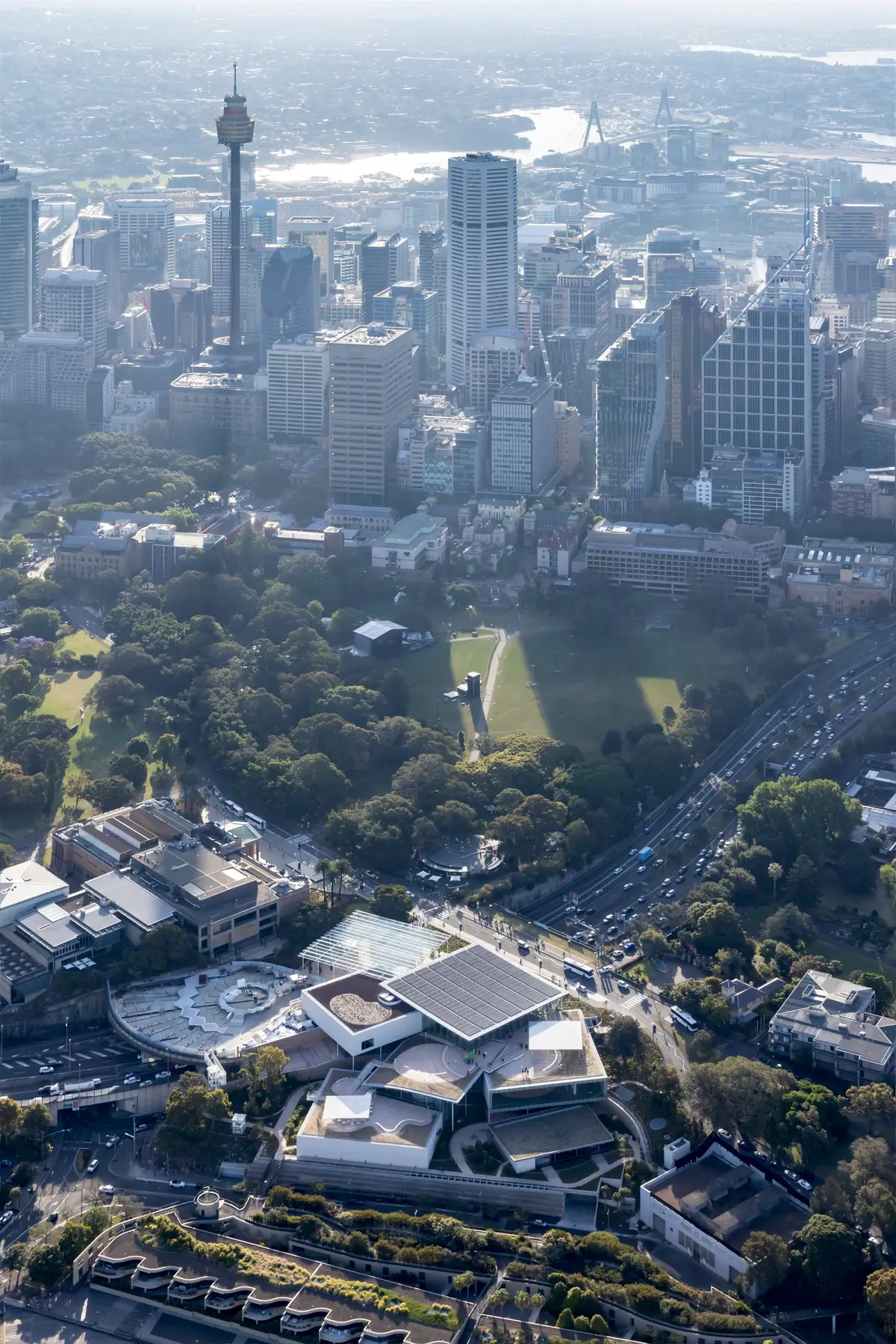
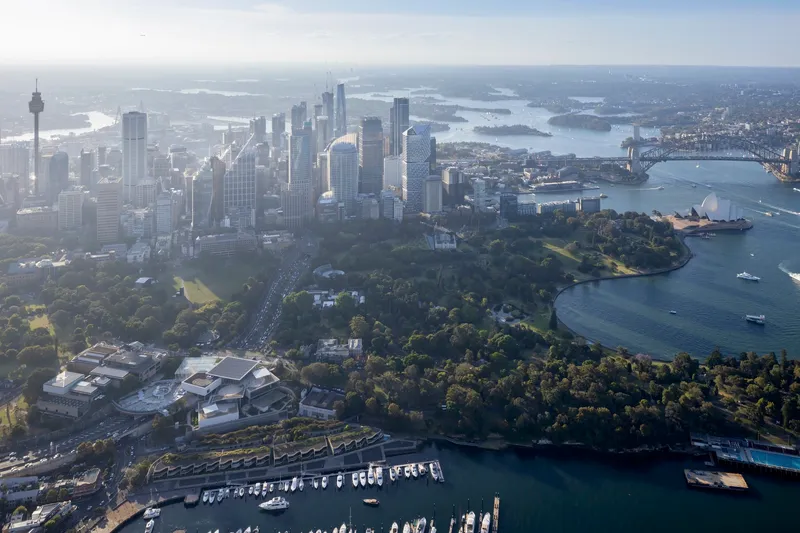
For an office that has made its reputation on weightlessness, SANAA's Sydney Modern Museum is an unusually geological project. Seven interlocking pavilions descend a 20-metre slope between the Domain parkland and Woolloomooloo Bay, landing on a pair of decommissioned World War II naval oil tanks that once fuelled Garden Island. Roughly 70 percent of the new building sits atop existing structures: a late-1990s land bridge over the Cahill Expressway and the concrete-columned tank bunkers below grade. The topographic section, not the plan, is the real drawing here.
What makes the project genuinely interesting is the negotiation between SANAA's trademark lightness and the extreme density of its site constraints. The 151-year-old Art Gallery of New South Wales, a neoclassical stone edifice, sits uphill to the west. A freeway runs beneath the middle of the site. Two Moreton Bay Fig trees could not be moved. Eighty thousand tonnes of material had to be excavated. The answer is a building that barely announces itself from any single vantage point, choosing instead to spread laterally and absorb its surroundings. At 40,000 square metres, the museum nearly doubles the gallery's exhibition space to 16,000 square metres, yet from harbour level it reads as a series of low terraces rather than an institution.
Pavilions in the Canopy
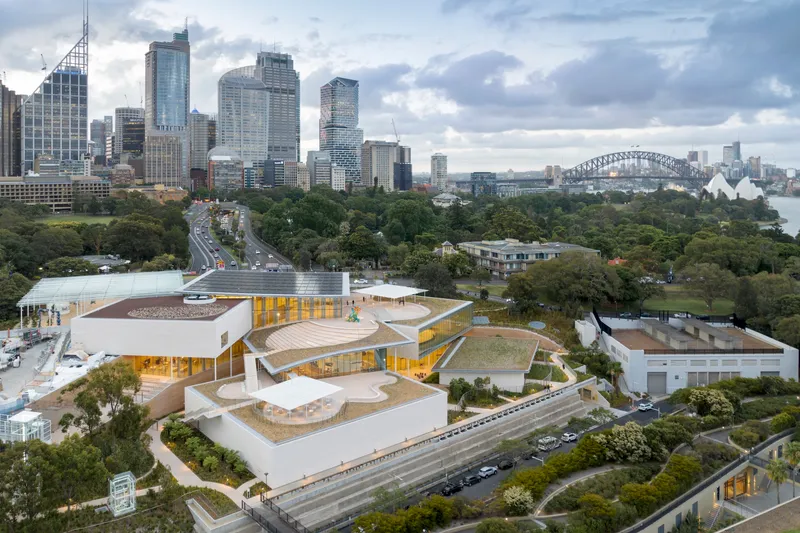
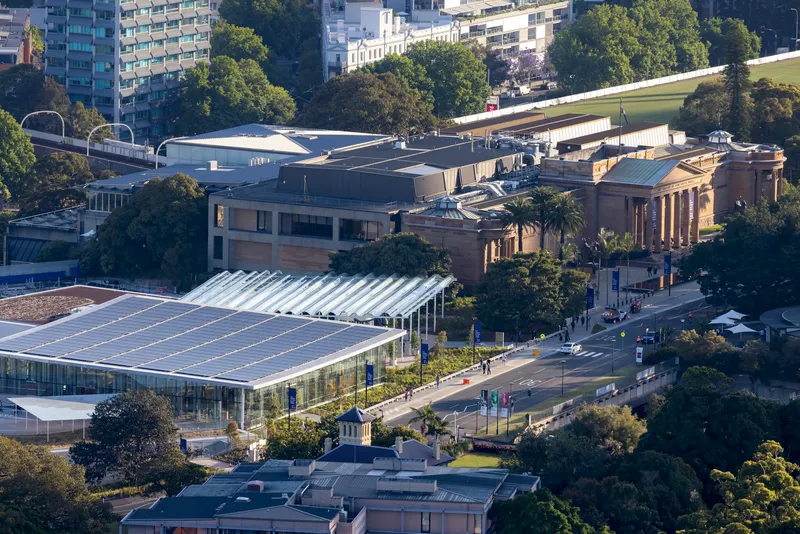
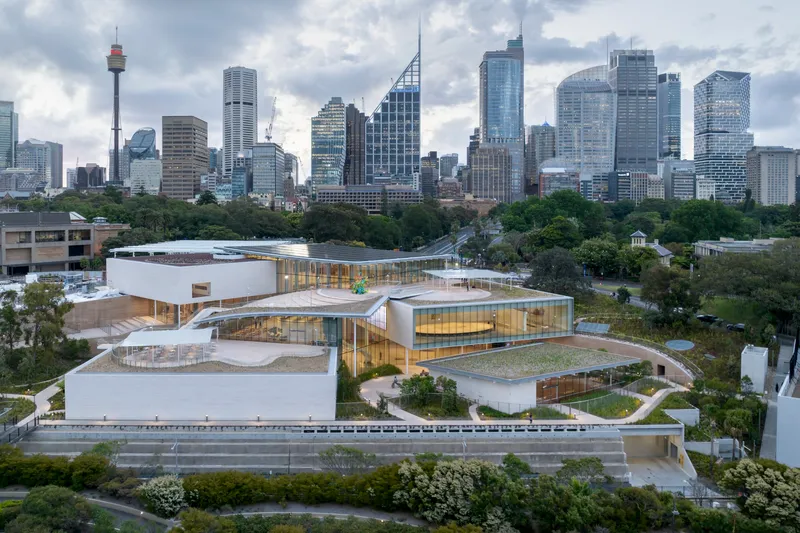
From the air, the building's strategy is legible at once: slender rectangular volumes, each oriented to a different compass heading, slip between existing trees and step down the hillside in staggered increments. The angular metal roofs sit low enough that the adjacent neoclassical building retains its civic prominence. SANAA's pavilions do not compete with the sandstone columns next door; they defer to them while quietly doubling the institution's footprint.
Materiality plays a critical role in this camouflage. Portuguese limestone, hand-cut and hand-laid in 50,000 individual bricks, clads the gallery volumes. The stone reads warm but restrained, close enough to the sandy tones of the park to recede into its context. Overhead, the folded metal roofs are finished in a matte tone that shifts under cloud cover, as if the building were calibrated to Sydney's famously changeable coastal light.
The Welcome Plaza and Entrance Threshold
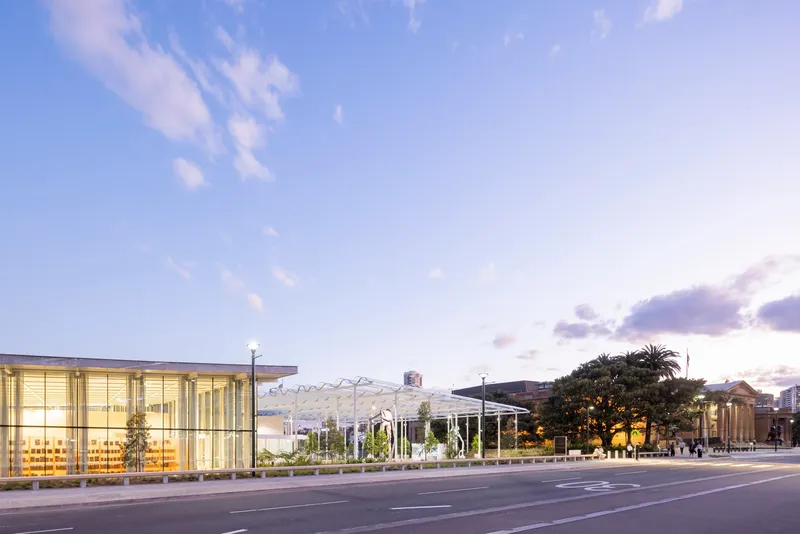
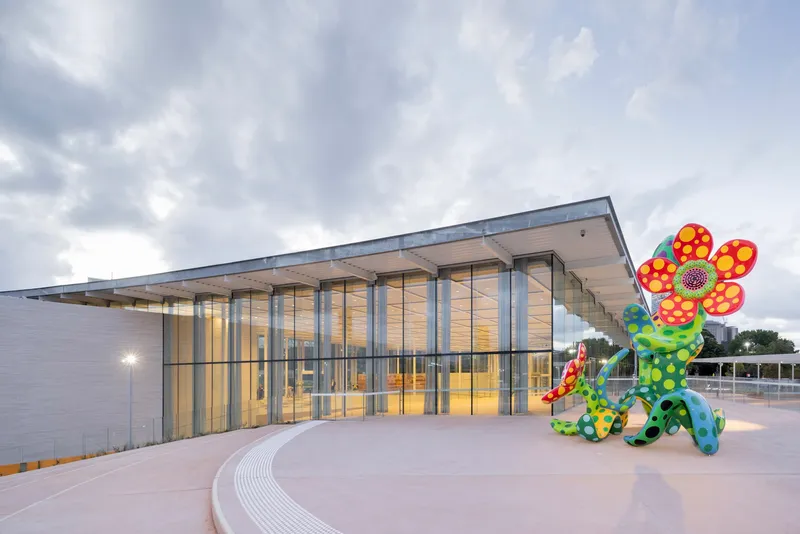
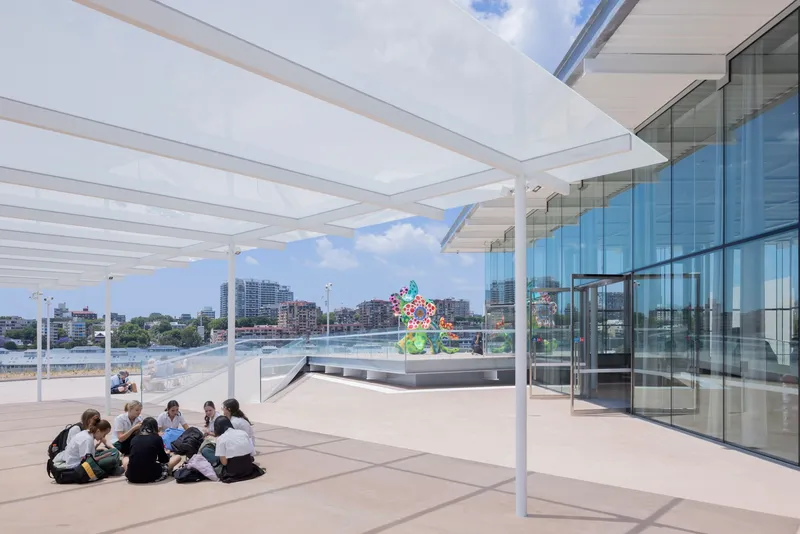
The entry sequence is set beneath a gently undulating canopy made from 108 sheets of foam-cast glass inlaid with ceramic fritting. As daylight shifts, the fritting casts patterned shadows onto the plaza below, making the threshold itself a kind of slow-motion installation. The generous overhang provides shade while keeping the transition between park and museum as porous as possible. A colorful sculptural work on the plaza signals arrival without the need for a monumental portico.
The glass-walled entrance pavilion is almost anti-heroic. Its lattice roof structure is visible from the street at dusk, glowing softly. SANAA has resisted the temptation to create a singular facade; instead, the building opens on multiple sides, drawing visitors along different routes depending on whether they arrive from the Botanic Garden, the existing gallery, or the waterfront below.
Vertical Circulation and the Atrium Core
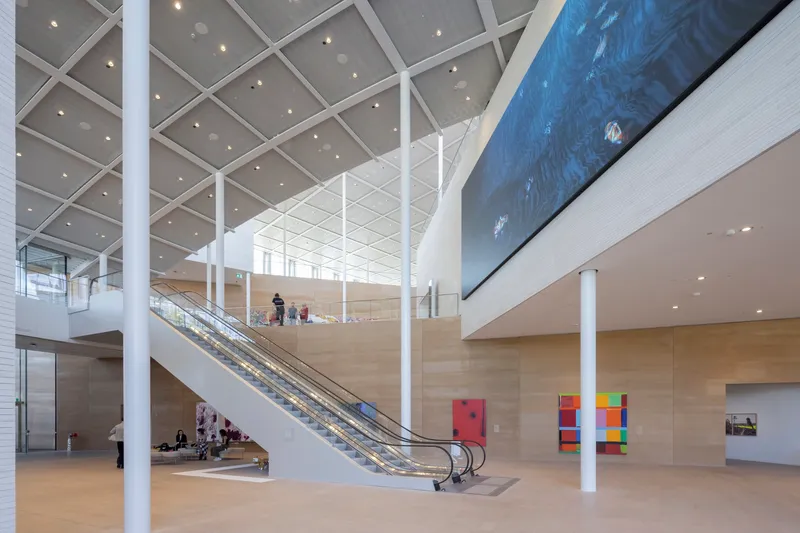
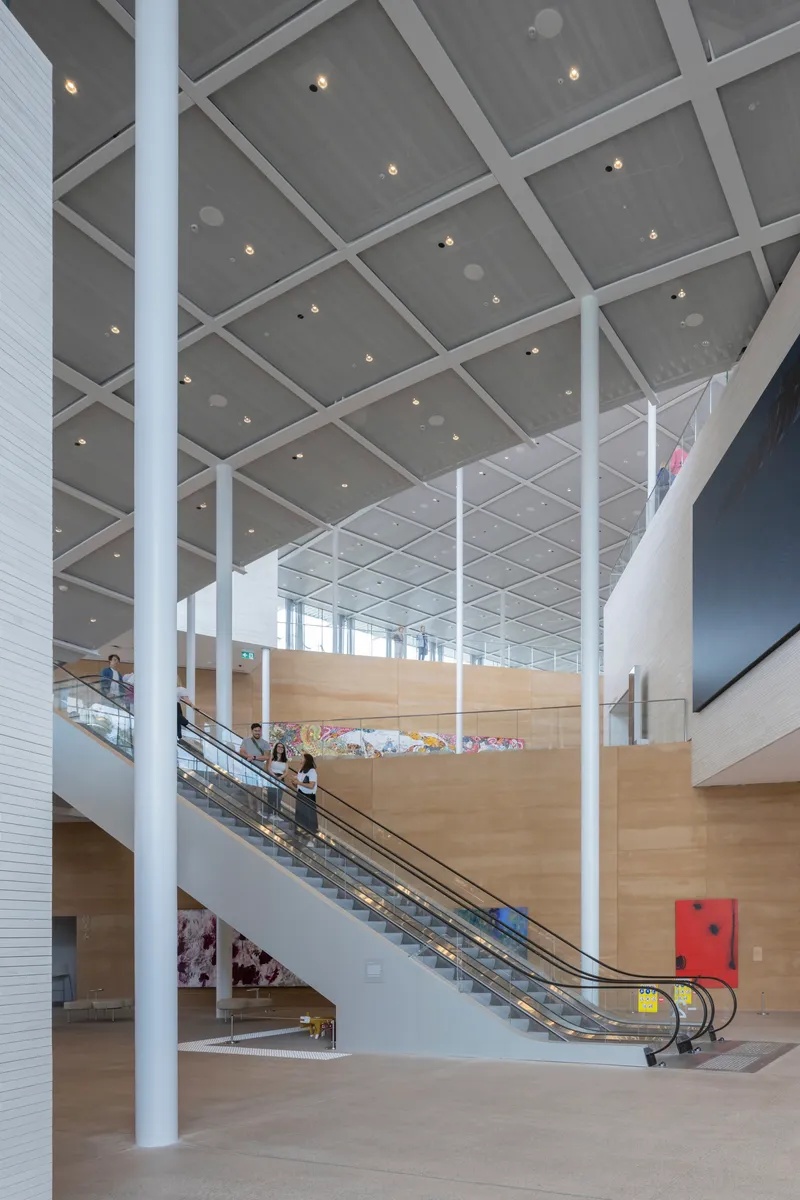
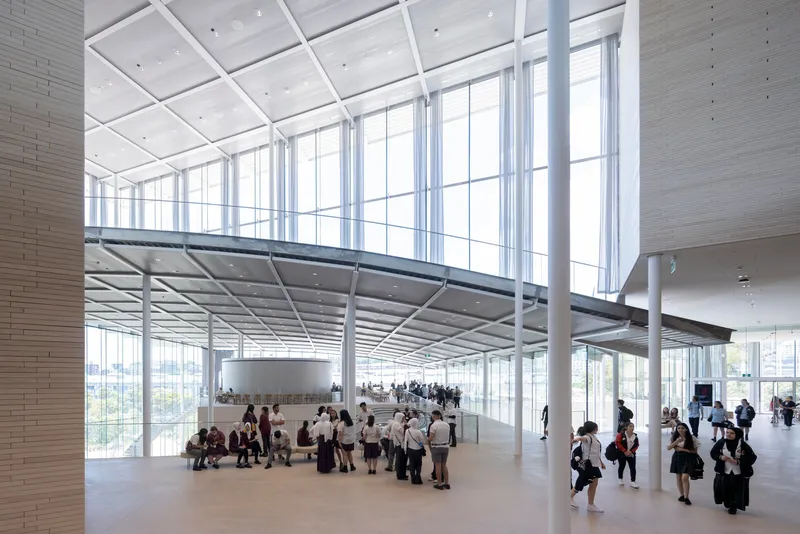
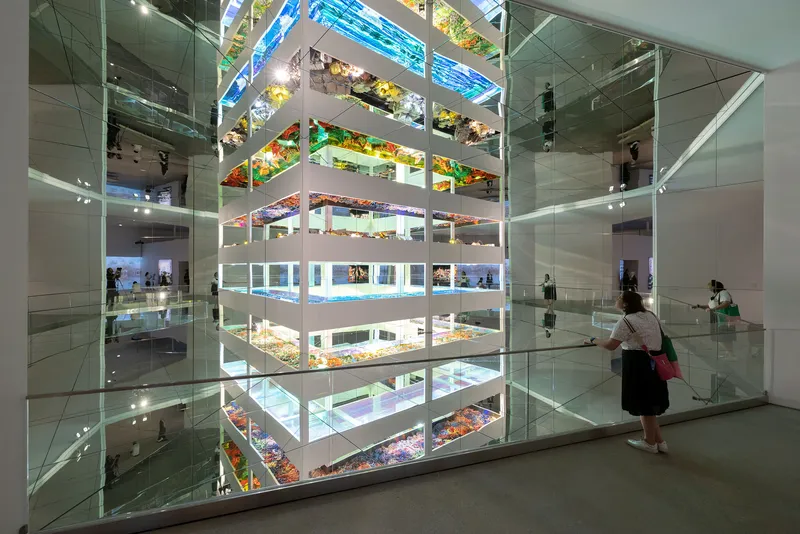
The central atrium, over 11 metres tall at its highest point, is the circulatory spine that stitches the pavilions together vertically. White columns, escalators, and a grey coffered ceiling establish a rhythm that is restrained almost to the point of austerity. The coffered grid is not ornamental; it conceals mechanical services while distributing natural light evenly across the multi-level interior. Escalators rise between slender columns, keeping the visual field open so that visitors on one level can always orient themselves relative to the floors above and below.
Floor-to-ceiling glazing on the upper levels turns the harbour and the park canopy into a continuous backdrop. The effect is less about framing a view and more about collapsing the boundary between gallery and landscape, a move SANAA has refined across decades of museum work, from Kanazawa to the Louvre-Lens. Here, the stakes are higher because Sydney's light is stronger and the topography more dramatic, but the principle holds: keep the enclosure transparent, let the context do the heavy lifting.
Gallery Interiors and Curatorial Flexibility
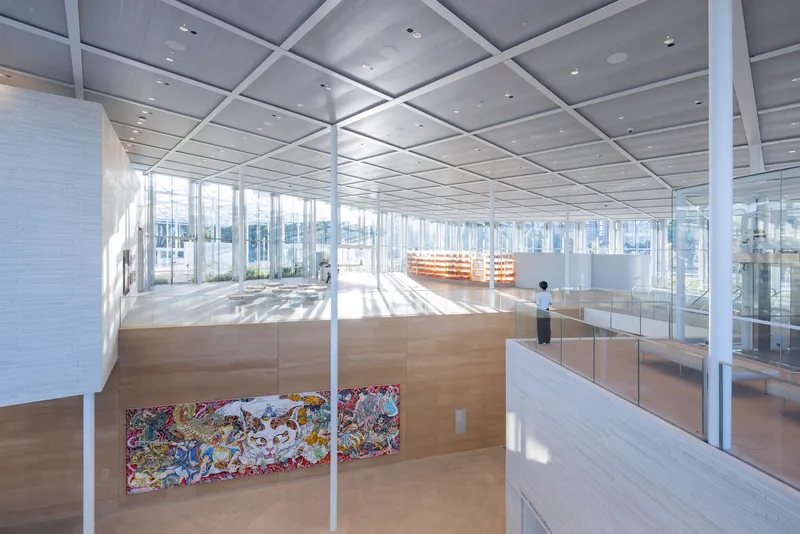
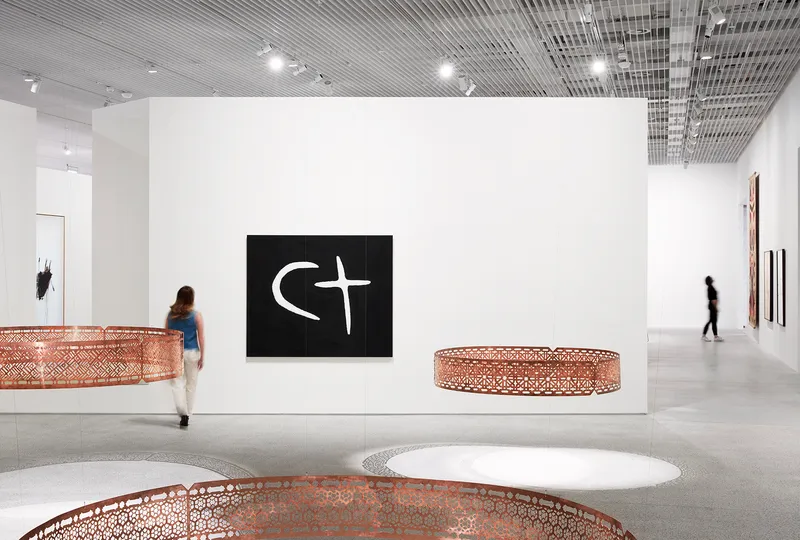
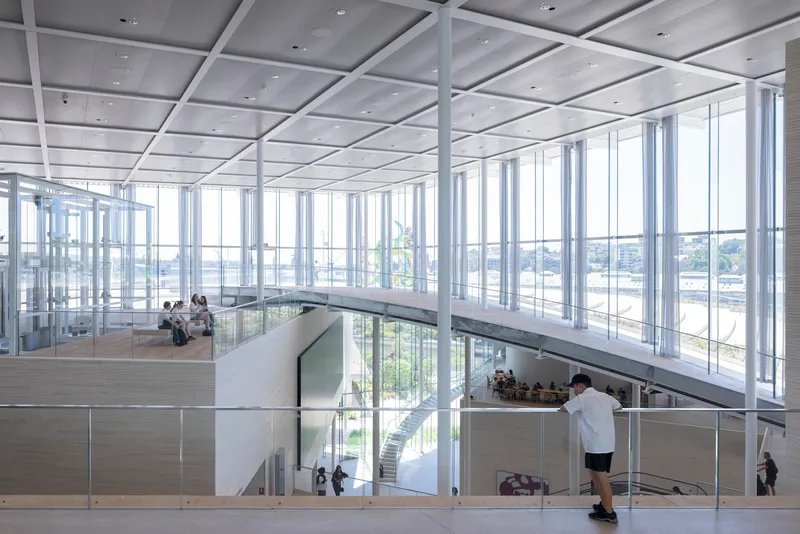
Inside the pavilions, SANAA has produced a range of gallery conditions rather than a single typology. One space features a white structural grid ceiling with timber-clad walls and gum wood flooring, creating an atmosphere closer to a refined domestic interior than a white cube. Another gallery exposes its perforated aluminum ceiling panels, giving a more industrial, loft-like character suited to contemporary installation work. A 1,100-square-metre column-free gallery provides the blankest possible canvas for large-scale commissions.
The upper-level galleries with floor-to-ceiling glazing deserve special mention. Daylight management in a museum is always a tightrope walk, and here the oversailing pavilion roofs do double duty as solar shading. The result is galleries flooded with diffused light, not the harsh glare that Sydney's latitude can produce. Each pavilion's unique orientation means curators can select rooms based on light quality as much as square footage.
The Tank: Repurposing Wartime Infrastructure
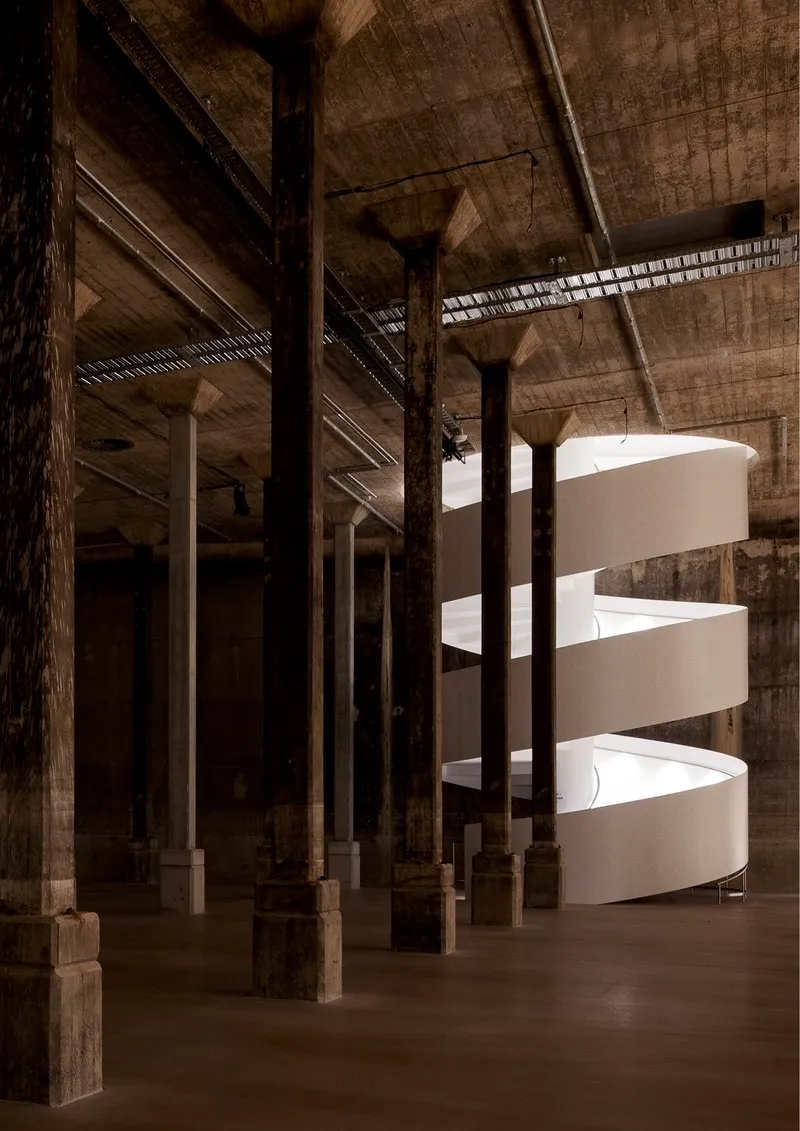
Below the new pavilions, SANAA has turned one of the WWII fuel bunkers into a 2,200-square-metre subterranean gallery called the Tank. The space retains its original concrete columns, 125 of them spaced every four metres, with seven-metre-high ceilings that give the room a cathedral-like intensity. One existing column was removed to insert a white helical staircase, lit by a clerestory slot, that spirals visitors down from the upper galleries into this raw, powerful volume.
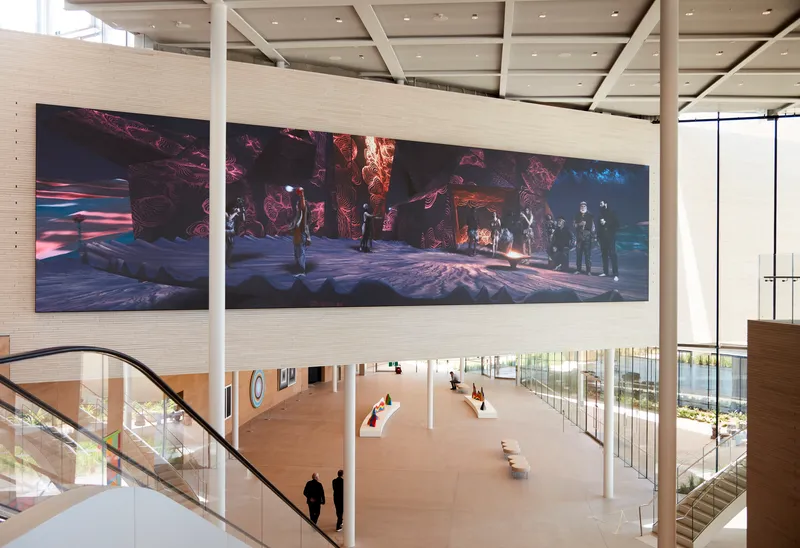
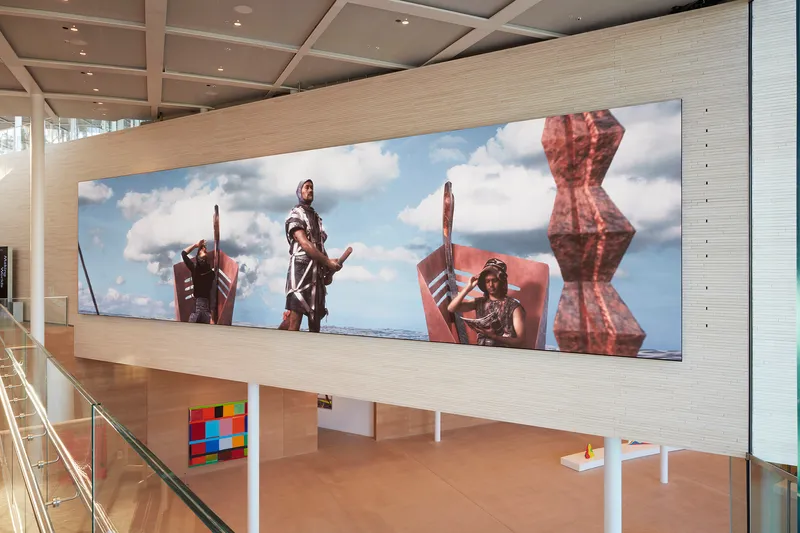
The contrast between the Tank and the pavilions above is the project's most potent spatial experience. Upstairs: lightness, glass, harbour views. Downstairs: concrete, silence, and the uncanny presence of wartime engineering. SANAA has wisely left the Tank largely unfinished, allowing its bunker-like quality to serve as both architectural material and curatorial provocation. The large horizontal video projections mounted in these spaces gain an almost cinematic gravity from the heavy ceilings and dim ambient light.
Landscape, Terraces, and the Planted Roof
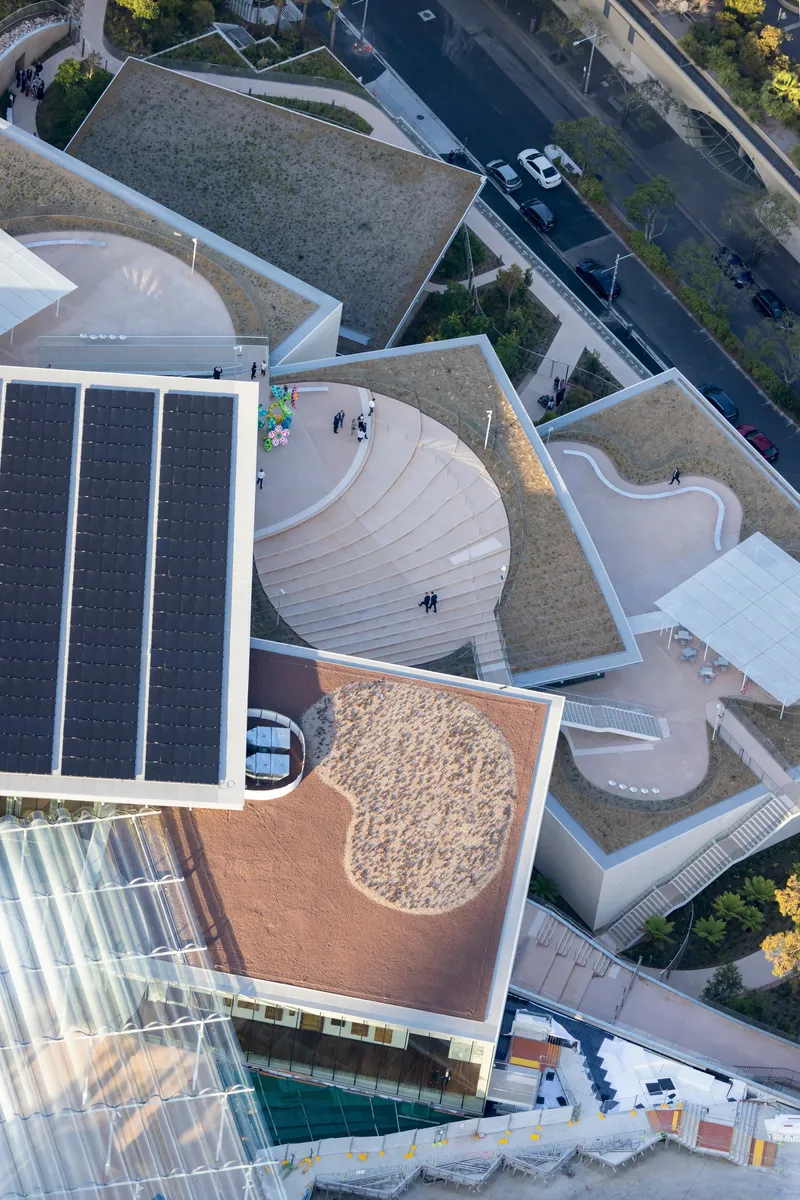
Landscape architects McGregor Coxall and Gustafson Guthrie Nichol designed 3,400 square metres of accessible outdoor space, including art terraces, courtyards, and a circular amphitheatre visible from above. The planted roofs and stepped terraces blur the line between building and park, making the museum a topographic event rather than a discrete object. The project adds 70 percent more trees to the site, reinstating endemic species and historic plantings that had been lost to freeway construction.
The six-star Green Star rating is backed by real performance metrics: the museum runs entirely on renewable energy, with 10 percent generated by rooftop solar panels. Rainwater is captured for irrigation and cooling towers. The 12,000 cubic metres of concrete used a formulation with 31 percent less Portland cement. These are not decorative sustainability gestures but integrated decisions that shaped the building's form and material palette from the start.
Plans and Drawings
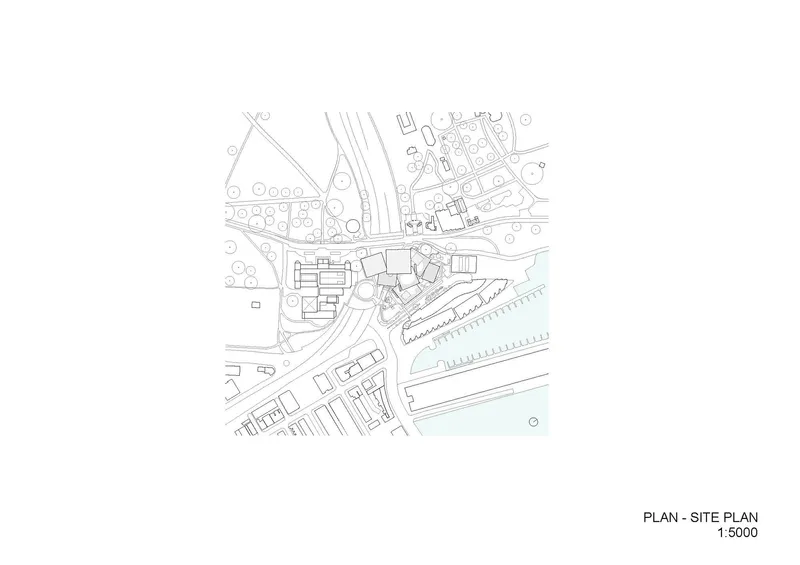
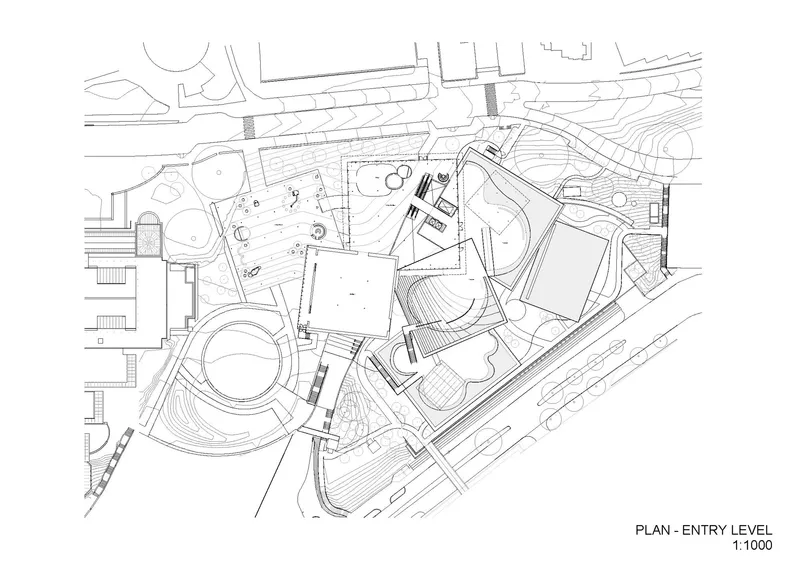
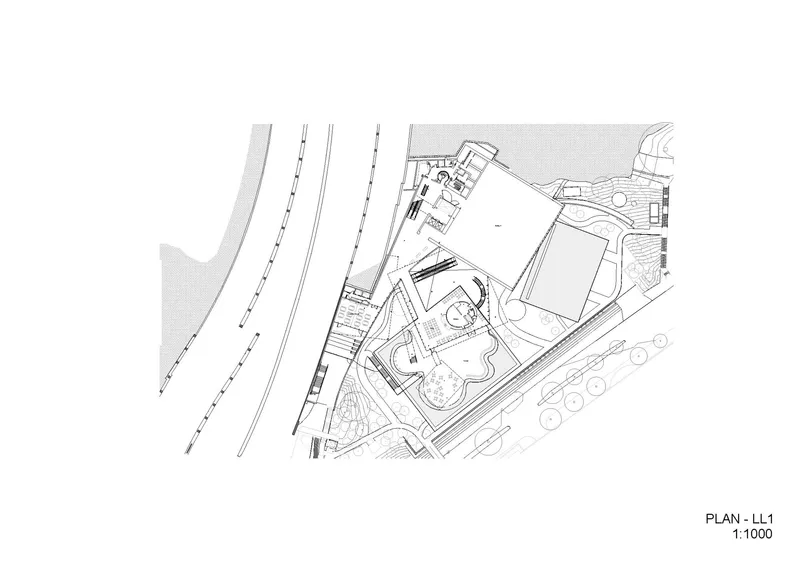
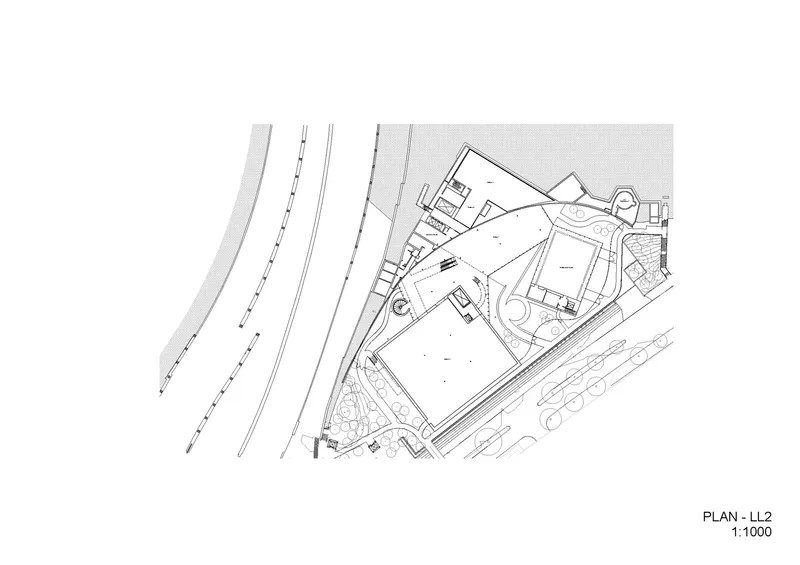
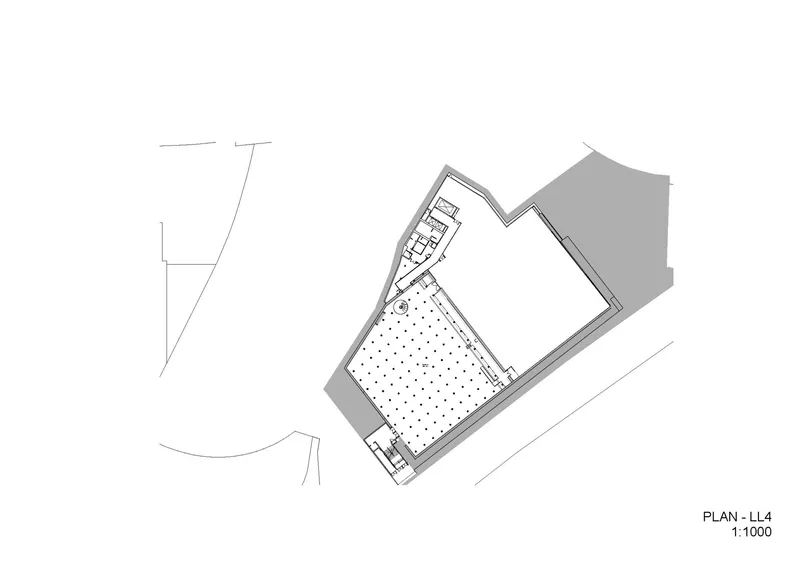
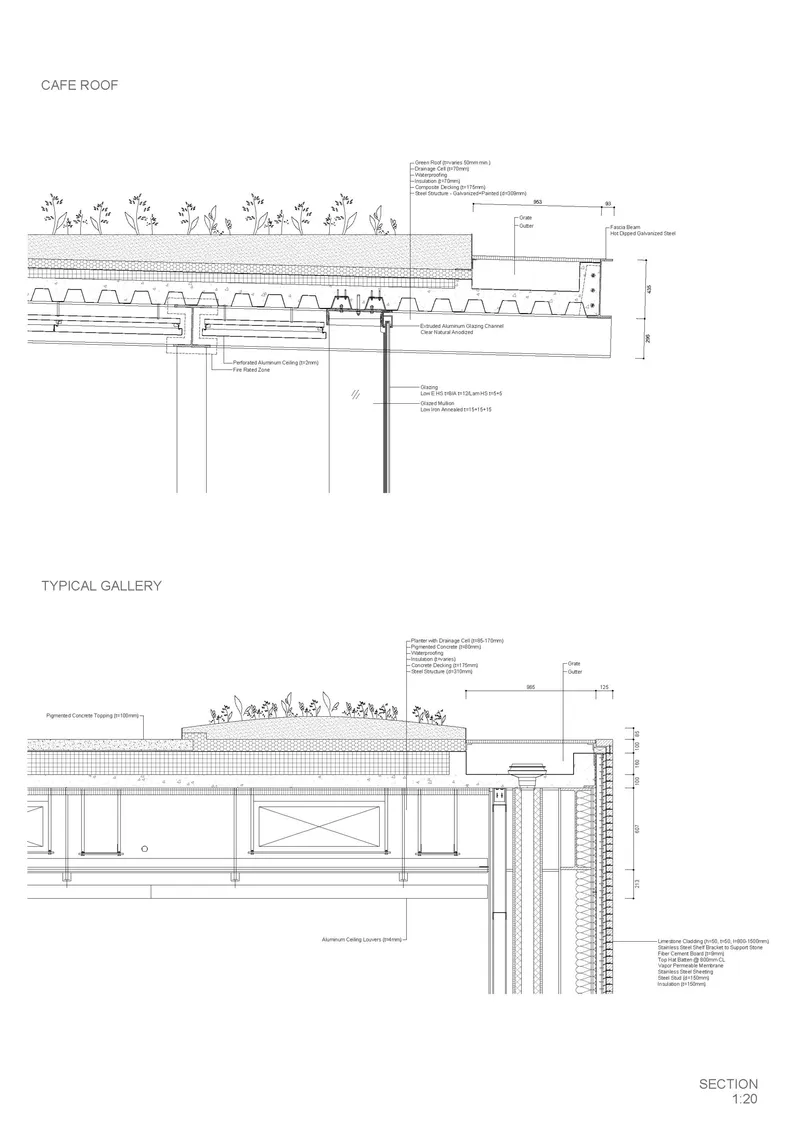
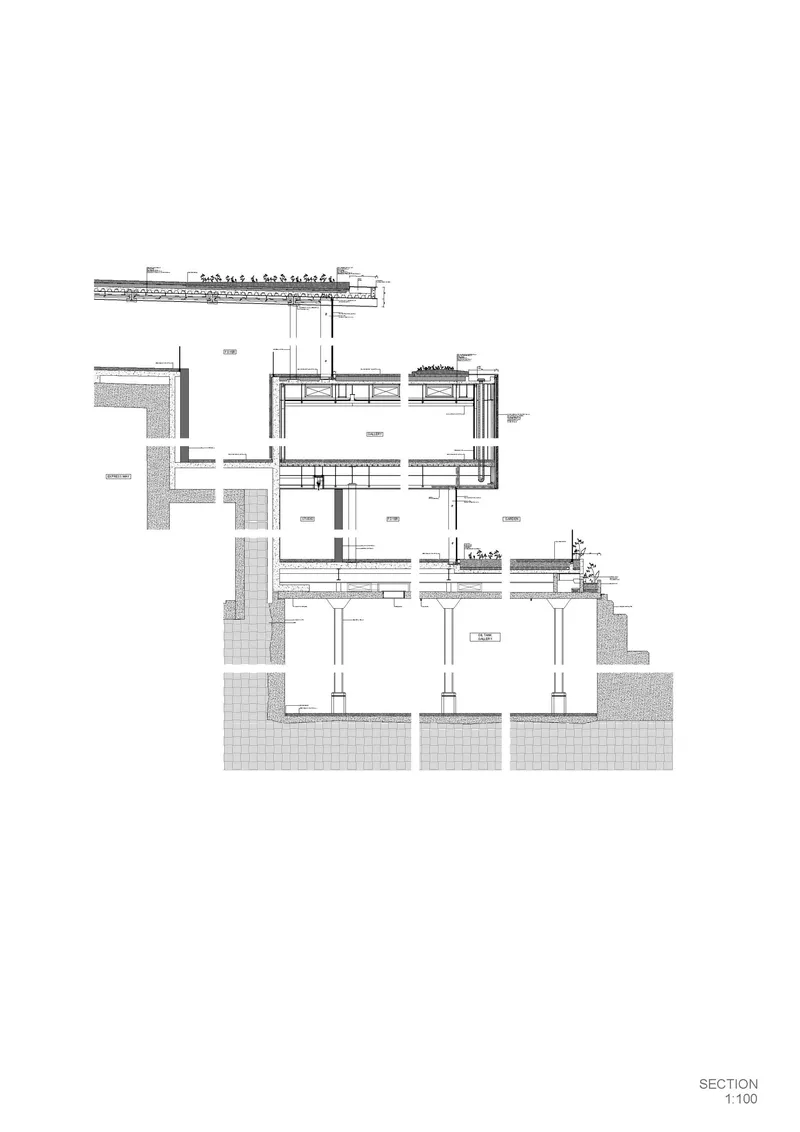
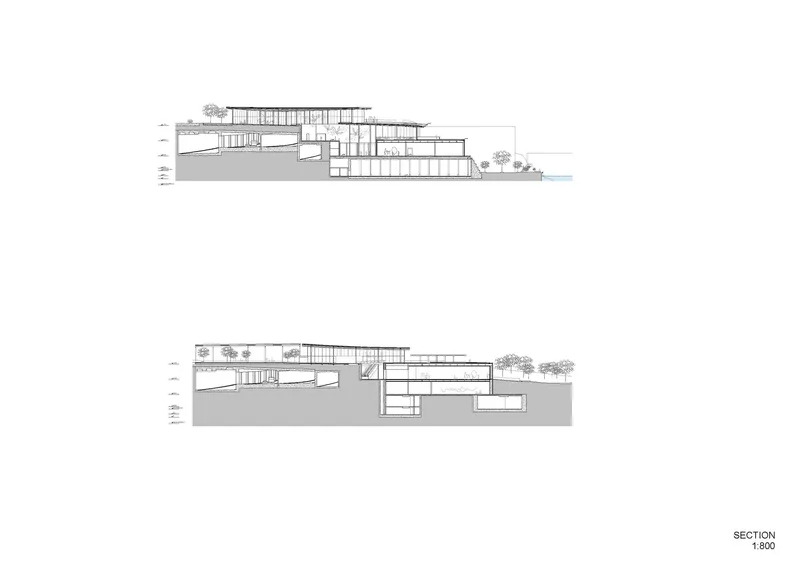
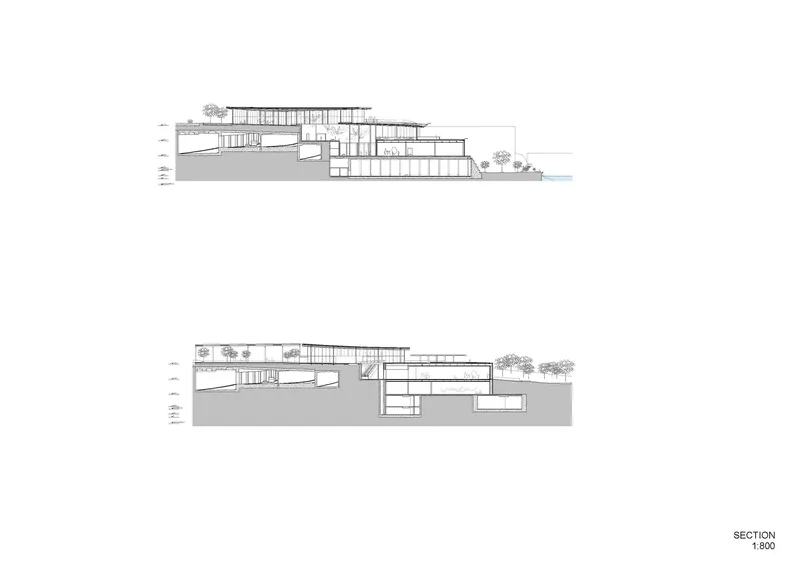
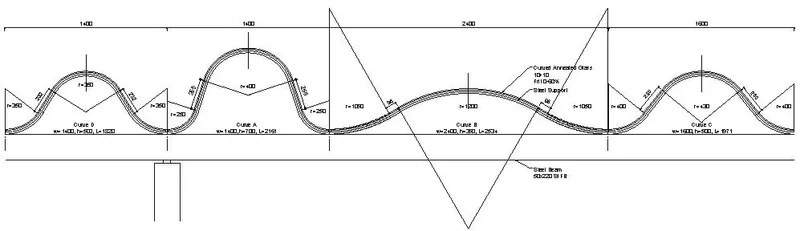
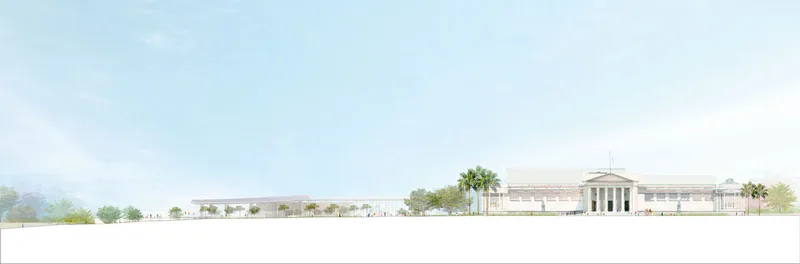
The section drawings are the most revealing documents in the set. They show how the terraced volumes negotiate the 20-metre elevation drop, stacking programme over the expressway land bridge and the oil tanks below. Each level is offset horizontally, producing the cascading profile visible from the harbour. The floor plans confirm that no two pavilions share the same orientation; their angular geometry responds to site boundaries, preserved trees, and views rather than to any single ordering grid.
The detail section through the cafe roof and gallery ceiling reveals the depth of the assembly: planted beds on the upper surface, acoustic and mechanical layers within, and the perforated aluminum panels below. The undulating wave-form elevation of the Welcome Plaza canopy, annotated with precise dimensions, shows the structural ambition concealed behind what reads at ground level as an effortless floating surface.
Why This Project Matters
SANAA's Sydney Modern Museum is significant not because it is the firm's largest building to date, though at 40,000 square metres it is, but because it demonstrates how institutional scale and topographic sensitivity can coexist. The building refuses the common museum strategy of consolidating programme under a single dramatic roof. Instead, it distributes galleries, tanks, terraces, and circulation across a hillside, using the section as the primary design instrument. The result is a museum that feels closer to a landscape than to a building, without ever sacrificing the controlled environments that art requires.
The deeper achievement is the relationship between the new and the old. The 19th-century gallery uphill is not diminished by the expansion; it is recontextualised as the formal, civic anchor of a campus that now extends all the way down to the harbour. The wartime oil tanks, once hidden and forgotten, become the project's most powerful interior spaces. SANAA has found a way to make infrastructure, history, and parkland legible simultaneously, and that layering gives the Sydney Modern a complexity that most new museums, content to be singular objects, never attempt.
Sydney Modern Museum by SANAA. Sydney, Australia. 40,000 m². Completed 2022. Photography by Iwan Baan and Jörg Baumann.
About the Studio
Share Your Own Work on uni.xyz
If projects like this are the kind of work you want to make, uni.xyz is a place to publish your own, find collaborators, and enter design competitions.


Popular Articles
Popular articles from the community


Play: Fragments of Their World
Familiar architecture becomes modular playground design, creating safe spaces where displaced children can learn, connect, imagine and play.

The Musturak Paradise: Senior Living Architecture for a Connected Future in Temara, Morocco
The Musturak Paradise reimagines senior living architecture in Temara via private homes, social spaces, culture, community, and shared care.

Co-Life: Senior Housing Design That Reconnects Older Adults With the City
Co-Life reimagines senior housing design through healing gardens, shared streets, workshops, and a sustainable community across generations.

Little Red Riding Hood: Architectural Design as a Journey Through Fear, Light, and Storytelling
Little Red Riding Hood reimagines the fairy tale through architectural design shaped by fear, light, scale, memory, uncertainty, and choice.

Similar Reads
You might also enjoy these articles

Bao Huynh Watercolor Atelier: A Serene Art Retreat in Hội An
Bao Huynh Watercolor Atelier in Hội An blends multifunctional art spaces, sustainable design, local materials, and family-friendly living in a serene environment.

Atelier Macri Concept Store Interior Design by CASE-REAL
Atelier Macri store features a "ko" counter, walnut wood details, cork displays, blending retail, gallery, and seamless customer experiences.

Manuel Vargas Izquierdo Stadium and High-Performance Sports Center: Architectural Excellence in Jalpa de Méndez
The Manuel Vargas Izquierdo Stadium blends sustainable design, inclusive sports facilities, and cultural-inspired architecture, revitalizing Jalpa de Méndez’s public spaces.

KAKR Buluh Awar Hall: Revitalizing Community and Ecology Through Bamboo Architecture
Community built bamboo hall revitalizes Buluh Awar village, empowering youth, restoring ecology, celebrating vernacular craftsmanship through sustainable architecture and culture.

Explore Museum Competitions
Discover active competitions in this discipline

Challenge to reimagine the Iron Throne

Photograph architecture without architects

Illustrate the lost glory of Angkor Wat - Render Challenge

Bring back Drive In's
Comments (0)
Please login or sign up to add comments
No comments yet. Be the first to comment!