
Schenker Salvi Weber Builds a Children's Art Laboratory That Grows Out of an Austrian Park
In Saint Pölten, a timber and concrete hybrid rises through the trees of Altoona Park as a new kind of cultural institution for children.


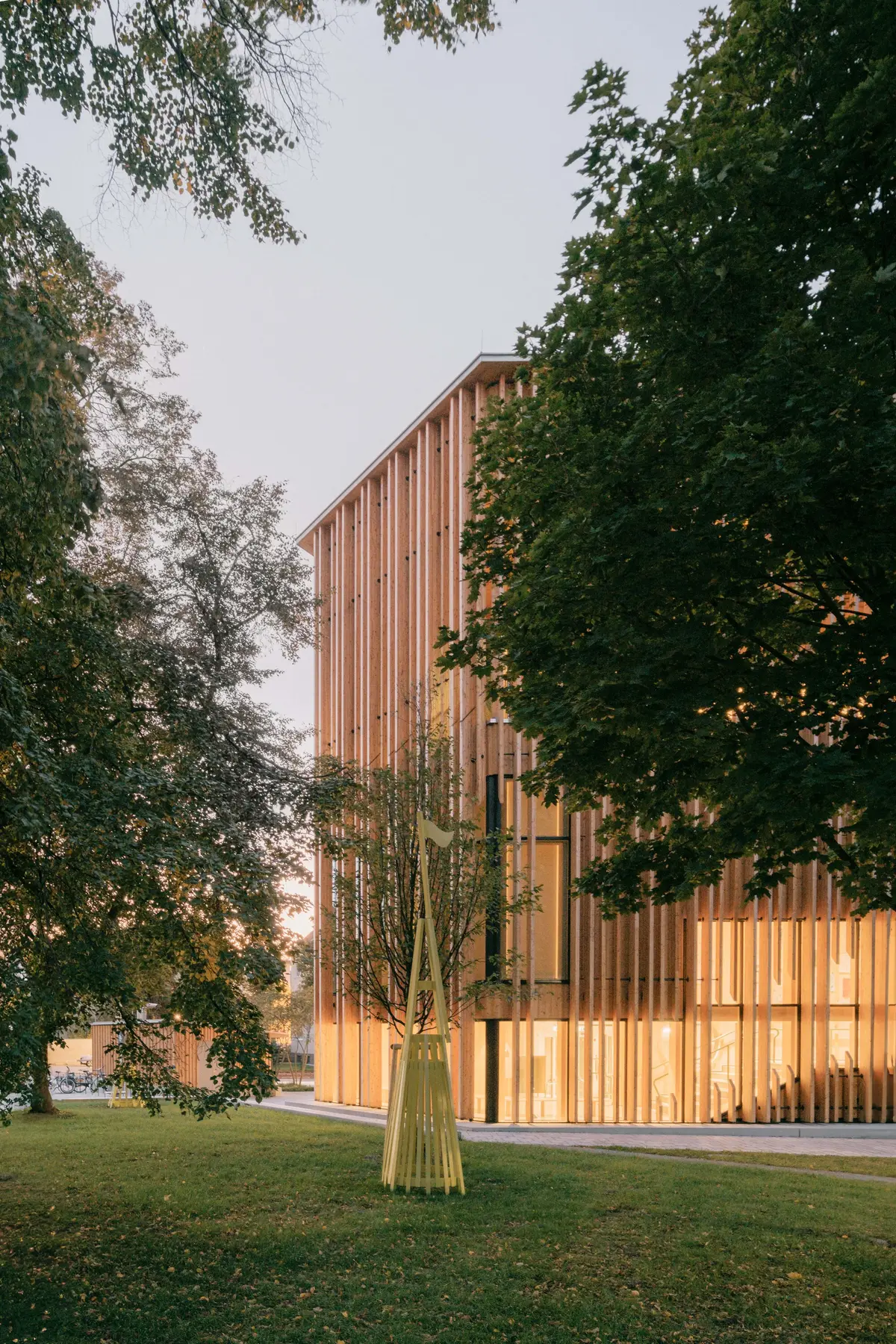
What do you call a building that is neither museum nor playground, neither school nor gallery, but somehow all of these at once? Schenker Salvi Weber Architekten had to answer that question when designing the KinderKunstLabor in Saint Pölten, Austria: a 2,957 square meter cultural institution built entirely from the perspective of children up to twelve years old. Completed in 2024 as part of the city's bid for European Capital of Culture, the building sits in the northwest corner of Altoona Park, positioned between the Baroque old town and the cultural district as a kind of urban hinge. It is a compact, four-storey solitaire wrapped in vertical timber louvres, rising through the canopy of mature trees with the quiet confidence of something that has always belonged there.
The truly interesting move here is not the program, which is novel enough on its own, but the degree to which the architecture itself was shaped by participatory design with children. Lead architects Andres Schenker, Michael Salvi, and Thomas Weber worked alongside a dedicated children's advisory board drawn from local kindergartens and schools. The result is a building where round windows sit at a child's eye level, where pipes run exposed on plaster so visitors can see how the house is built, and where the boundary between interior and park landscape is deliberately blurred. The architecture does not condescend. It simply takes a different client seriously.
A Timber Shell Woven Into the Canopy
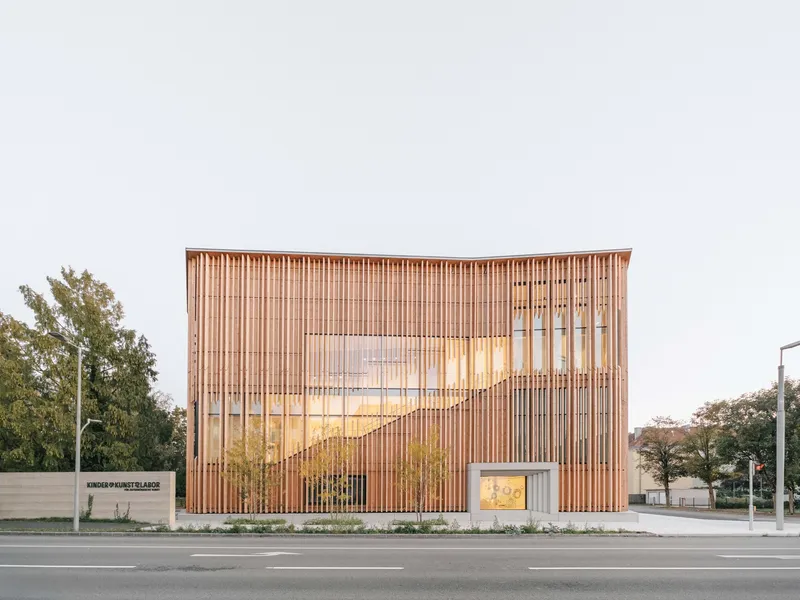
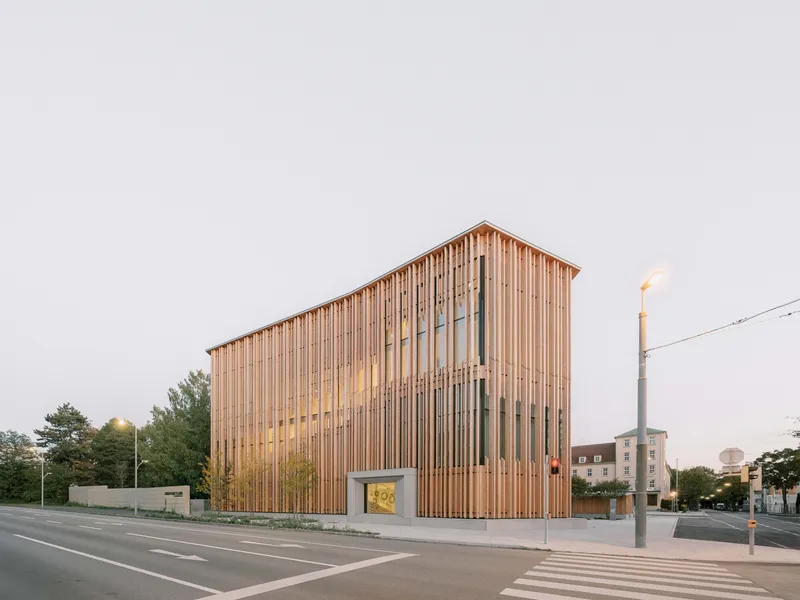

The facade is the building's first and most persistent gesture. A rear-ventilated curtain wall of suspended glulam louvres wraps the triangular volume, creating a porous skin that filters light, frames fragmentary views of the park, and casts overlapping shadow patterns that mingle with those of the surrounding trees. The effect is intentional: the building was conceived as a "built landscape" developing out of the park, and this latticework dissolves the hard line between architecture and arboreal canopy. At dusk, when interior lights glow through the slats, the volume reads less like a building and more like a lantern suspended in the branches.
Square glulam columns march along the perimeter, doubling as the external structural framework on which reinforced concrete ceiling slabs rest. Behind these columns sits a timber post-and-beam facade for the glazed surfaces, with irregular window openings punched through the louvre screen. Black metal hardware at these openings provides a crisp counterpoint to the warm timber. The whole assembly avoids cladding wherever possible, letting the structural logic remain legible from both inside and out.
The Central Column and Its Radiating Branches
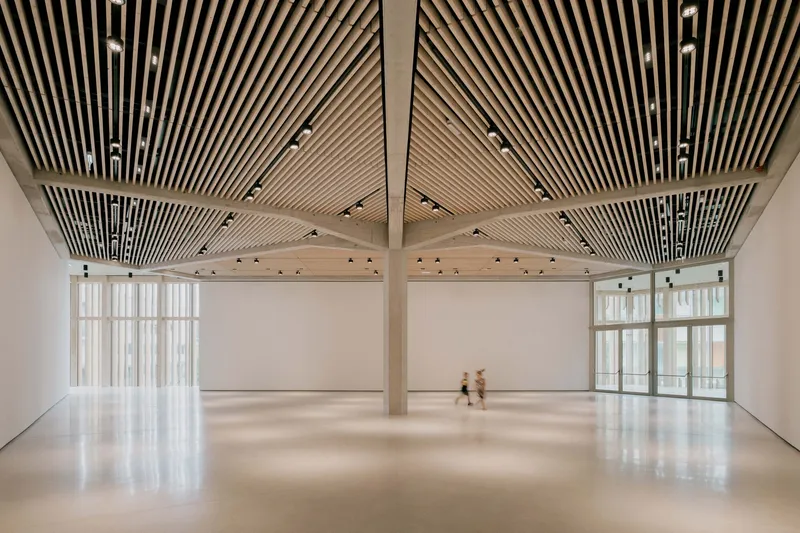
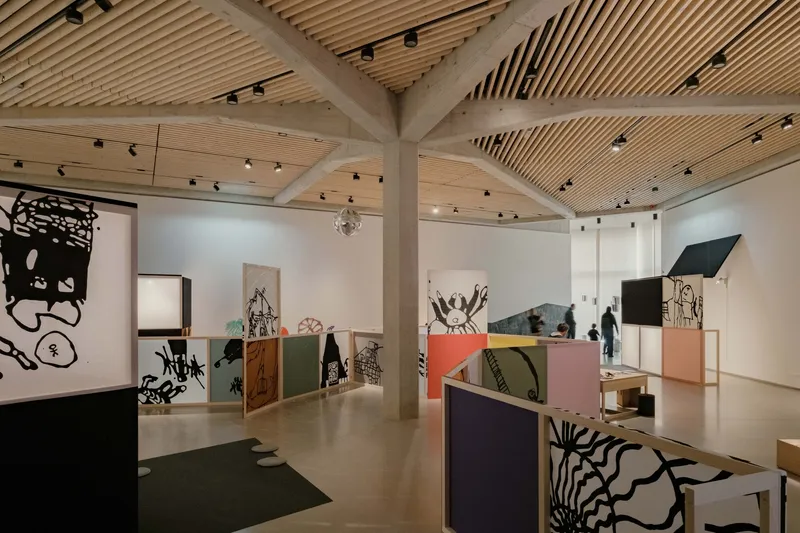

At the core of the building, developed in collaboration with Werner Sobek structural engineers, stands a hexagonal concrete column from which six star-shaped beams radiate outward. The metaphor is arboreal: a tree trunk with symbolic branches, anchoring a central hall that extends over several floors and is wrapped in reinforced concrete walls. It is a bold structural choice that organizes circulation, creates a legible spatial center, and gives the interior a gravitational pull that the open floor plates might otherwise lack.
The radiating timber slat ceiling visible in the gallery spaces extends this logic visually, drawing the eye outward from the core toward the glazed perimeter. Exhibition partitions and concrete columns punctuate the open floor plates, but the spatial reading always returns to that central hub. The recurring hexagonal motif, a consequence of the triangular plan with its slightly creased sides and chamfered corners, becomes a subtle geometric signature visible in floor patterns, ceiling layouts, and structural junctions.
Spaces Shaped by a Child's Logic
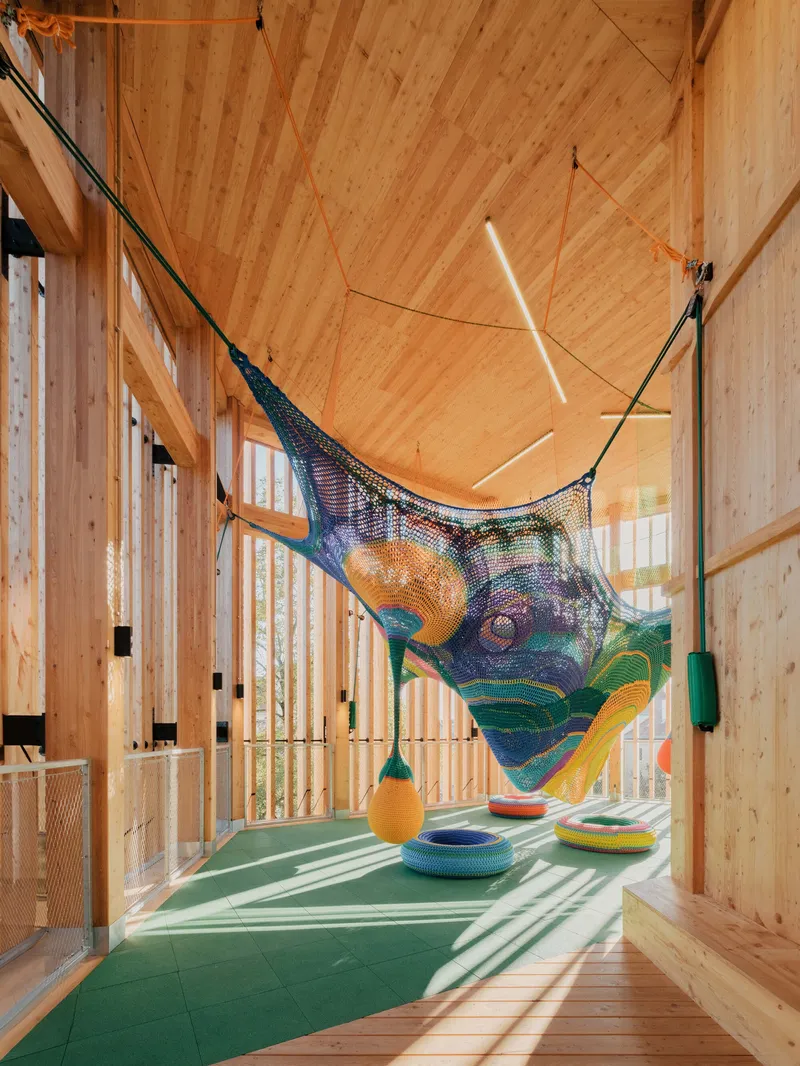
The most celebrated interior moment is Toshi's Gift, a suspended mesh net installation that spans two floors: six meters high, nine meters wide, five meters long. It hangs over green floor mats beneath an exposed timber ceiling, transforming vertical circulation into physical play. This is not an afterthought or an add-on. It is integrated into the section of the building as deliberately as the helix staircase that spirals around the central core, connecting the entrance foyer to the first-floor exhibition space and the indoor-outdoor labs on the second floor.
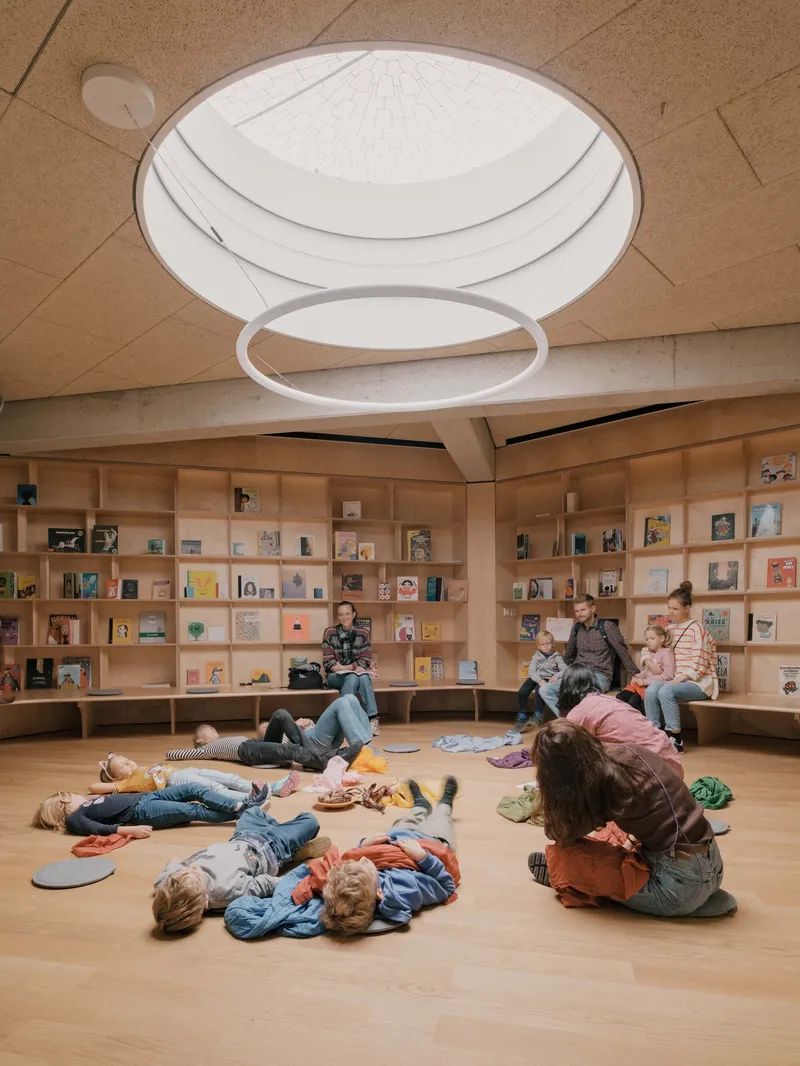
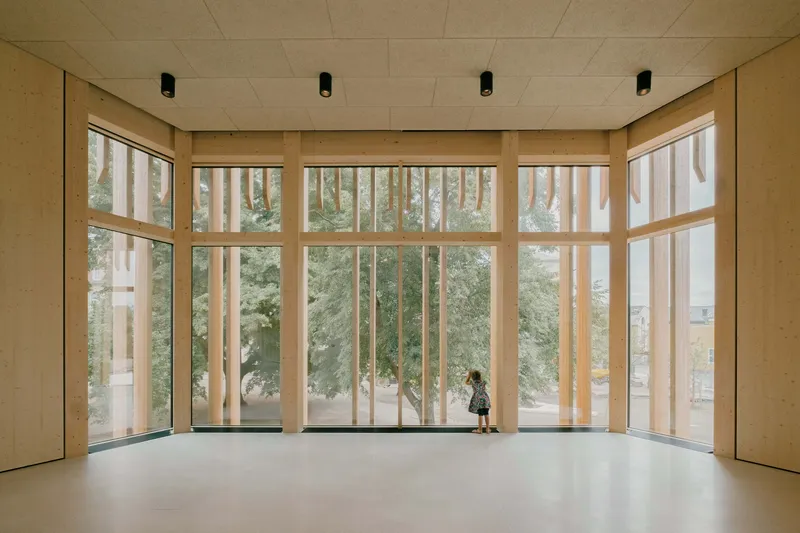
The library on the top floor, with its circular skylight and children sprawled across a wooden floor ringed by book-filled shelves, is a room of quiet generosity. Floor-to-ceiling windows in the lab spaces frame trees so close you could almost touch them, collapsing the distance between making art and sitting in a park. These are not grand architectural gestures. They are careful calibrations of scale, light, and proximity that only make sense when you remember the primary occupants are under four feet tall.
Honesty as a Pedagogical Strategy

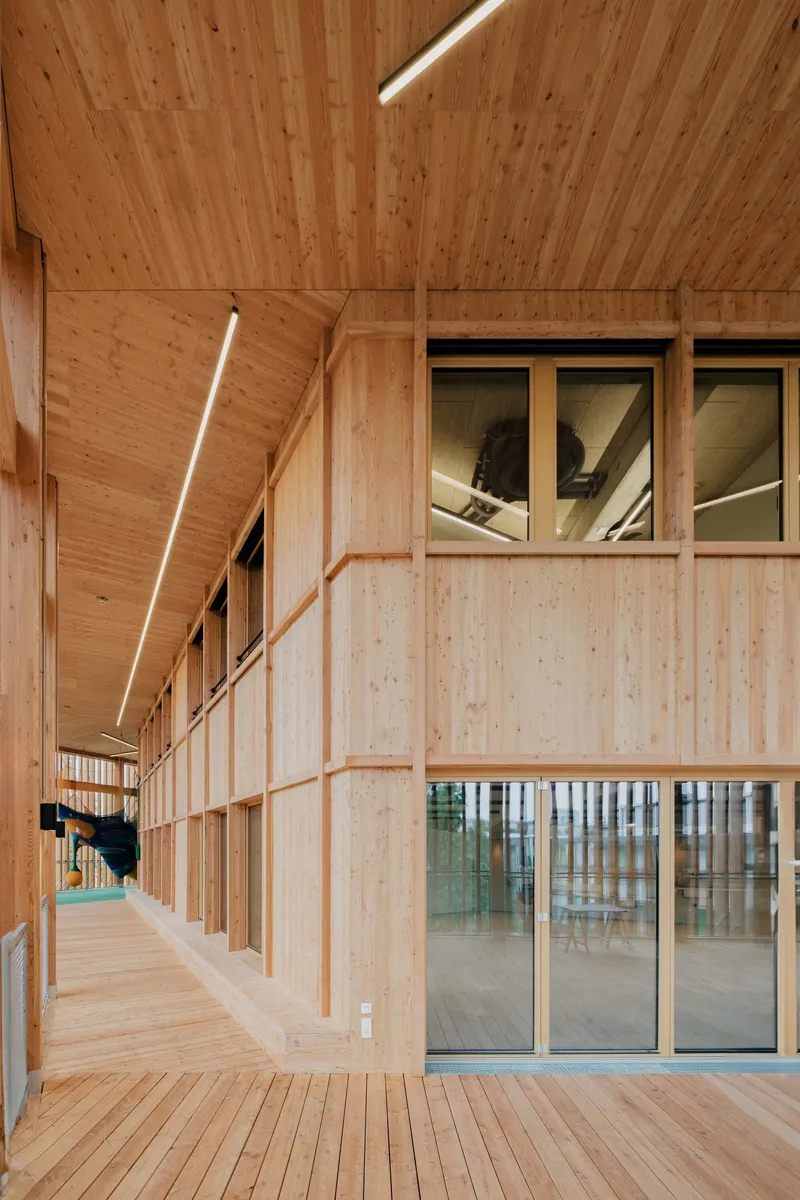
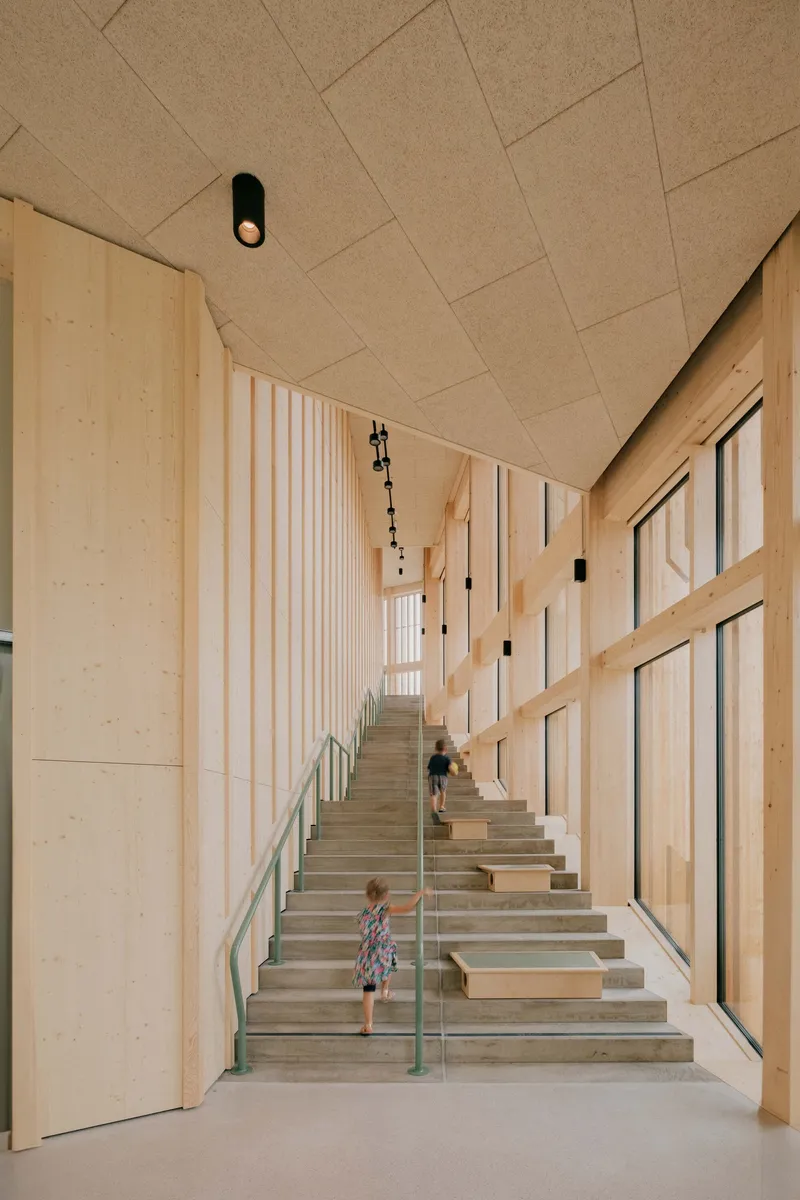
The architects made a deliberate choice to leave the building's systems and materials visible. Pipes run exposed on plaster. Cross-laminated timber walls and diagonal acoustic ceiling panels are left unclad. The children's washroom features perforated plywood pegboard against an exposed concrete ceiling with visible beams. Terrazzo screed, which covers two thirds of the floor area, meets polished concrete without concealment. The idea is that visitors should be able to see and recognize how the house is built, turning the architecture itself into a kind of exhibit.
This approach to material honesty aligns with the building's hybrid construction principle. Wood and concrete coexist without pretending to be something else. Glulam is glulam. Precast concrete is precast concrete. The helix staircase, a precast concrete element that spans between inner and outer timber facades, makes no effort to hide its joints or its mass. For a building dedicated to experimentation and making, this legibility is not an aesthetic preference but a pedagogical strategy.
Ground Floor as Urban Threshold
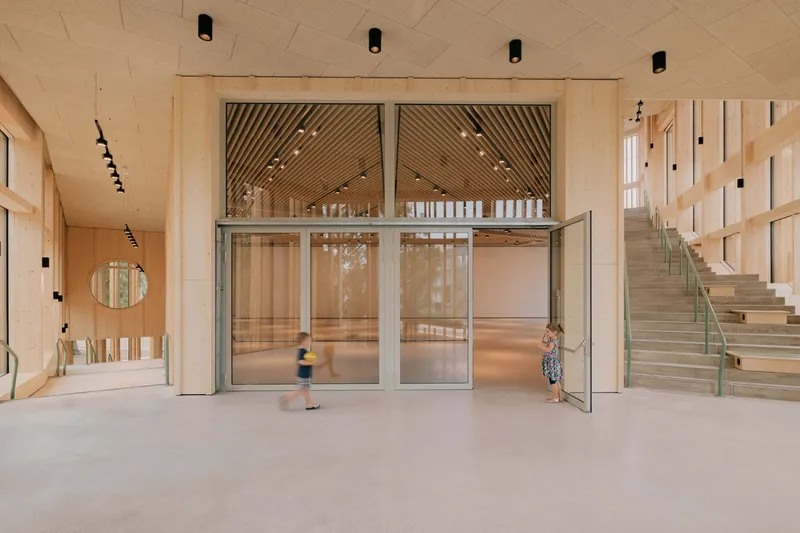
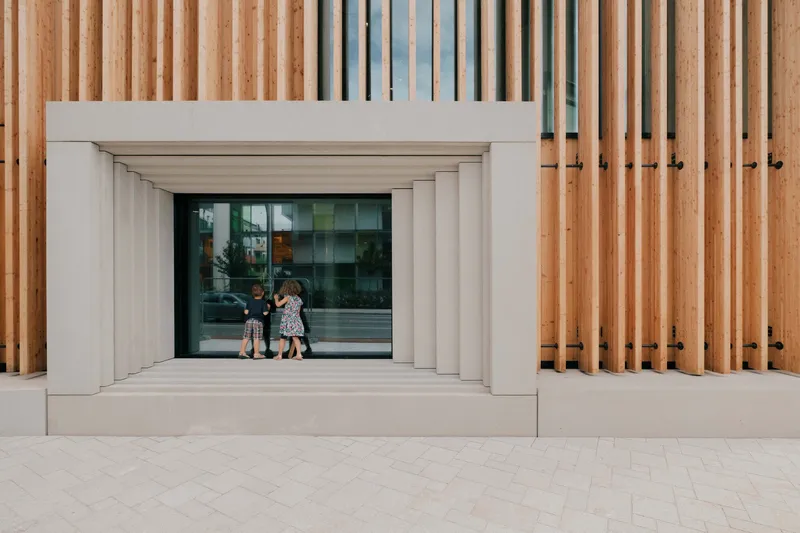
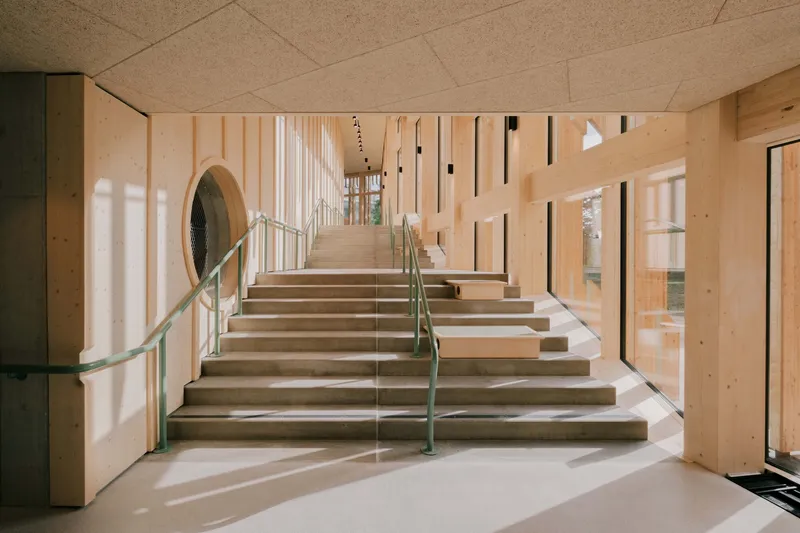
The ground floor functions as the building's public handshake with the city. A foyer with glass doors opens directly to the park, and children move freely through the polished concrete space between a play area and a cafe. The white stone portal framing the glazed entrance gives the threshold a civic weight that the timber louvres above might otherwise dissolve. It says: this is a public institution, not a garden shed.
From the foyer, the timber staircase with glass railings ascends through a naturally lit corridor lined with vertical wood slat walls. The transition from ground to upper floors is gradual and sensory: light shifts, materials change from polished concrete to warmer timber, and the views through the louvred skin become progressively more immersive as you climb into the tree canopy. The building's compact four-storey massing was chosen specifically to preserve a significant portion of the adjacent Altoona Park landscape, and the vertical stacking of program means the footprint remains modest relative to the 2,957 square meters of interior space.
Plans and Drawings
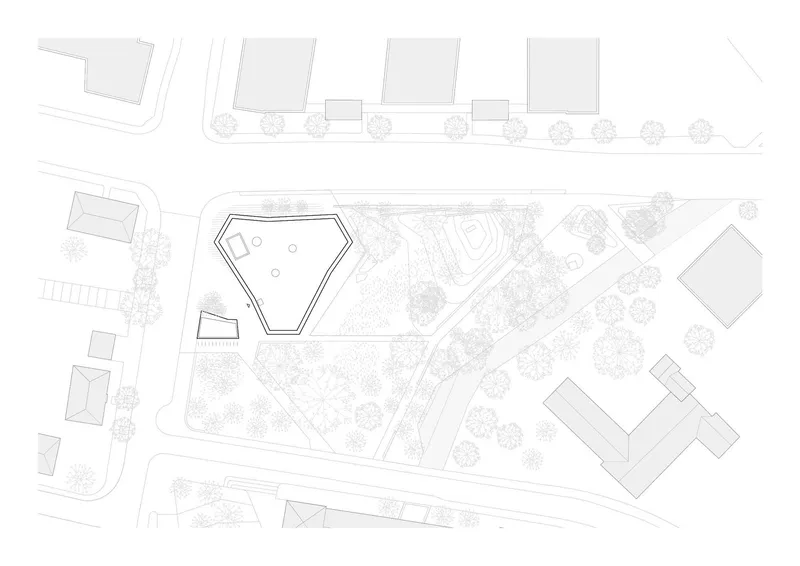
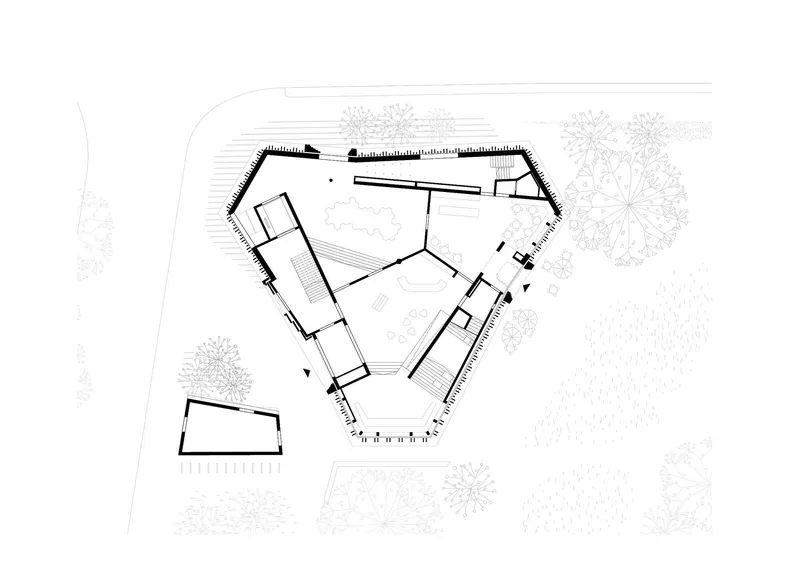
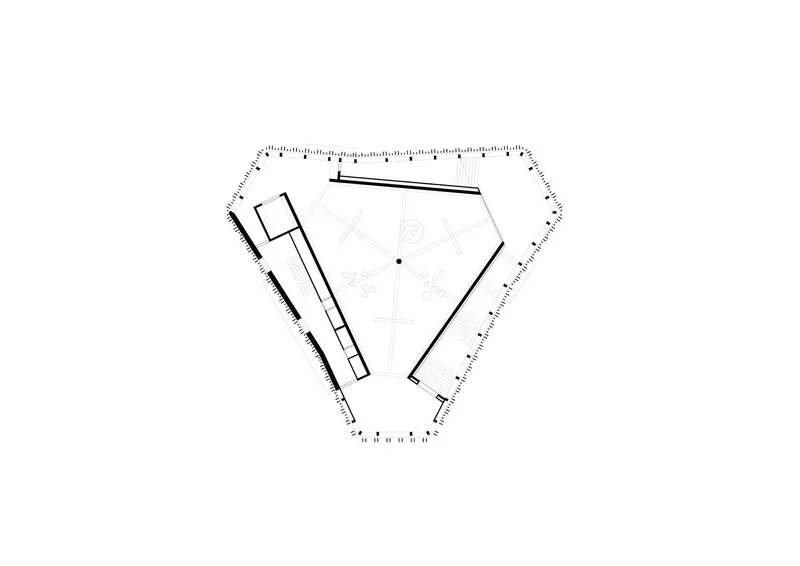

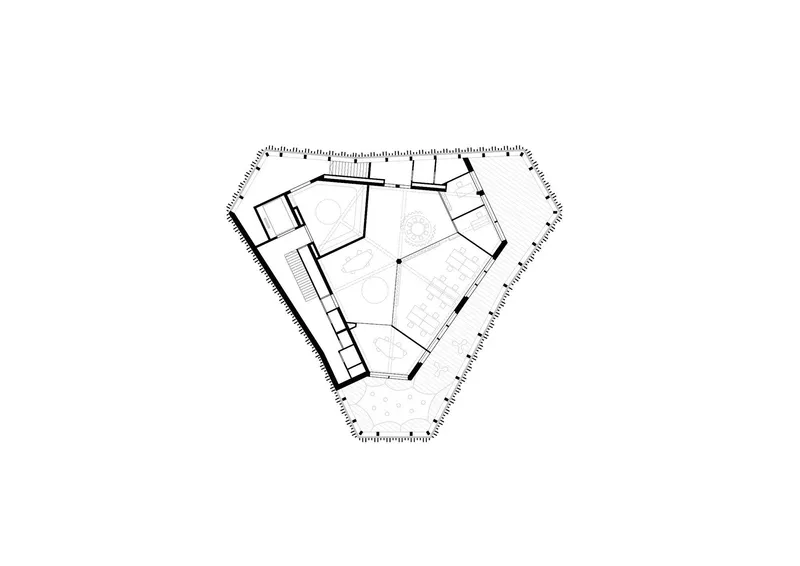
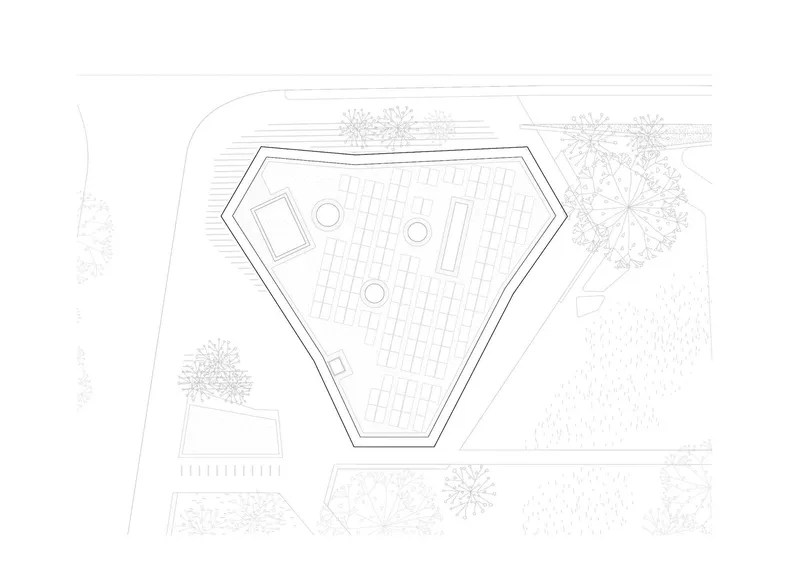
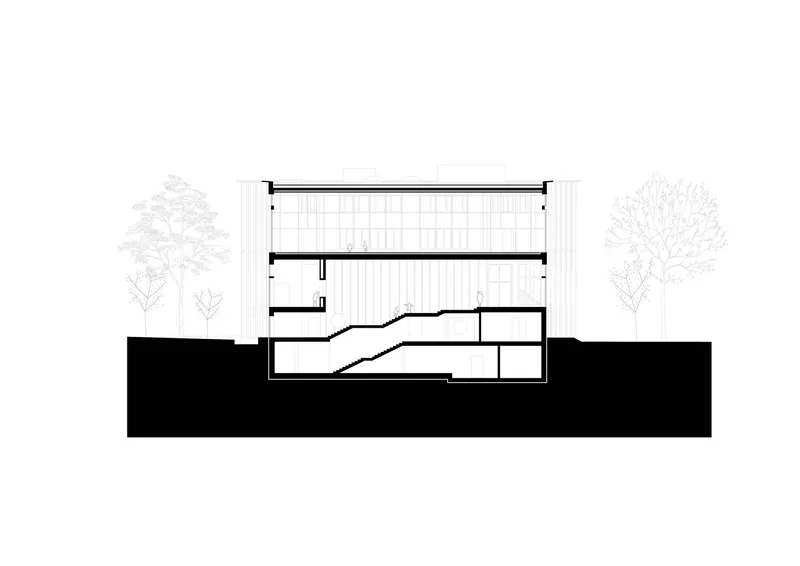
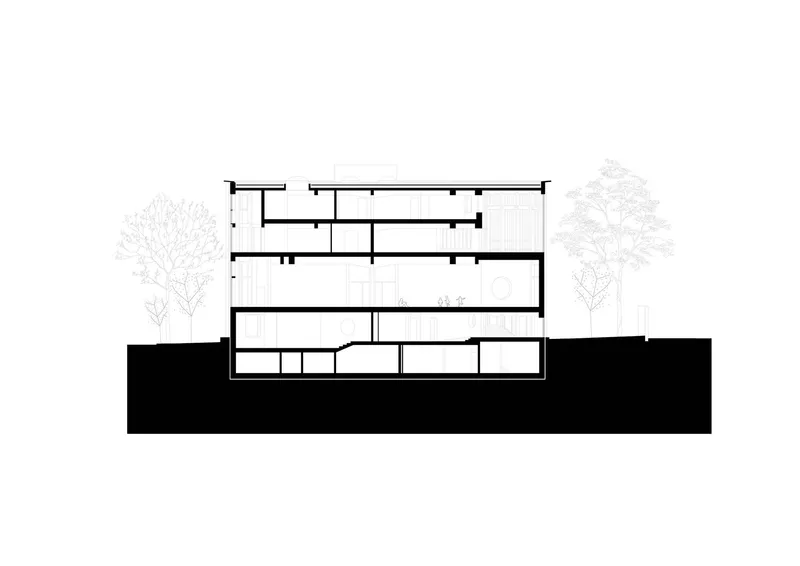
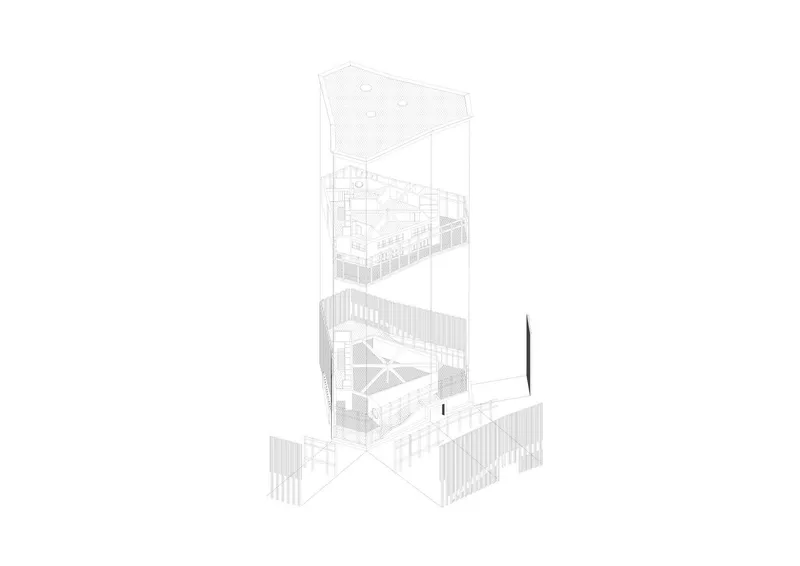
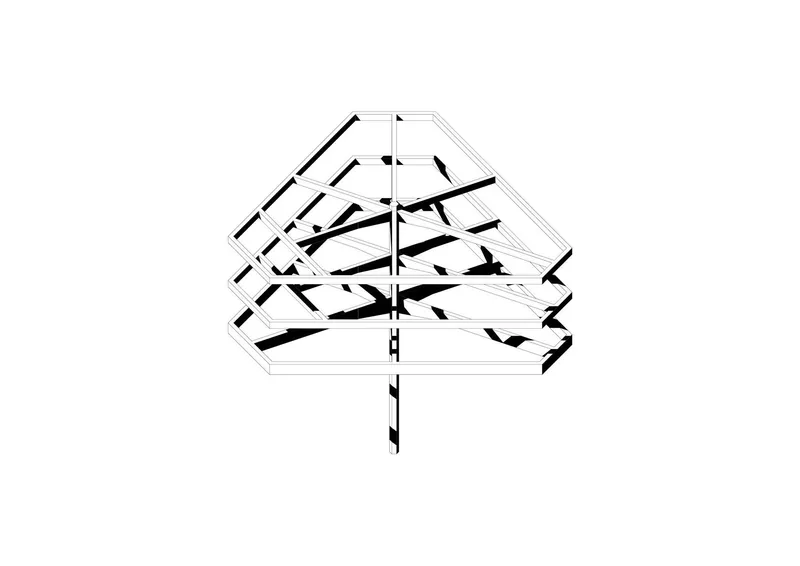
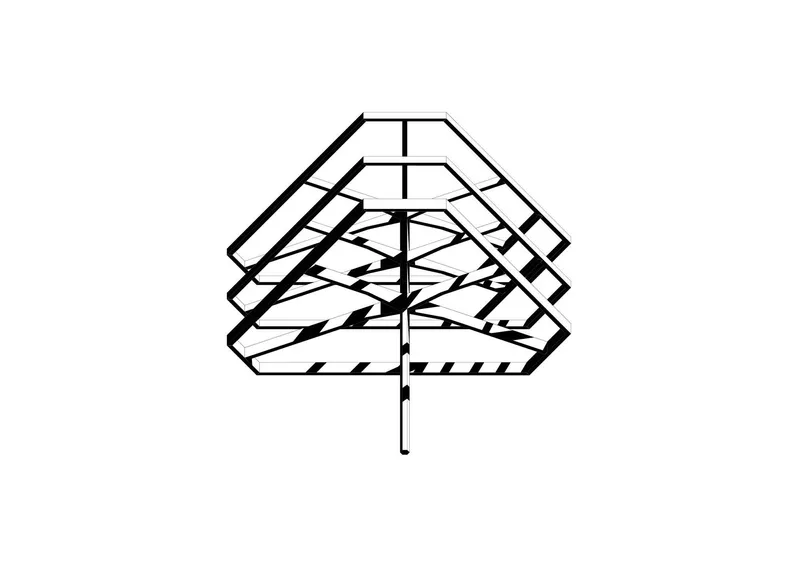
The plan drawings reveal the building's true geometry: not a simple triangle but a pentagonal footprint with slightly concave sides and chamfered corners that produce the hexagonal motif visible throughout the interior. The perimeter colonnade of glulam columns reads clearly on the ground floor plan, while upper floors show how the central concrete core and radiating beams organize increasingly subdivided lab and exhibition spaces. Section drawings confirm the split-level strategy and the helix staircase's path along the facade, spiraling from park level to the treetop offices and library.
The axonometric drawings are particularly revealing. They show how the slatted facade system operates as an independent layer wrapped around the structural frame, and how the stacked floor plates shift and overlap around the central circulation core. The roof plan, with its paving pattern and circular openings for the skylight above the library, completes the picture of a building designed as much in section as in plan. The physical model, which the architects used throughout the design process, clearly informed the way these drawings communicate spatial relationships that flat plans alone cannot capture.
Why This Project Matters
The KinderKunstLabor matters because it takes an almost impossible brief and resolves it with structural and material clarity rather than whimsy. A children's cultural laboratory could easily have become a cartoon building, all bright colors and novelty shapes. Instead, Schenker Salvi Weber produced a rigorous piece of hybrid timber-concrete construction where the playfulness emerges from spatial sequence, material honesty, and the careful placement of windows and nets and terraces. The participatory process with the children's advisory board was not a token consultation; it produced specific design decisions, from the height and location of circular peepholes to the decision to leave every pipe and beam visible.
More broadly, the project demonstrates that architecture for children does not require a separate formal language. It requires a different set of priorities: lower sightlines, legible structure, tactile materials, and a plan that treats vertical movement as adventure rather than utility. Saint Pölten now has a building that serves as both urban landmark and intimate interior world, bridging the Baroque old town and the cultural district while rooting itself in the existing landscape of Altoona Park. That balancing act, between civic ambition and the scale of a child reaching for a round window, is what makes this project genuinely rare.
KinderKunstLabor for Contemporary Art by Schenker Salvi Weber Architekten (Andres Schenker, Michael Salvi, Thomas Weber). Saint Pölten, Austria. 2,957 m². Completed 2024. Photography by Patrick Johannsen.
About the Studio
Share Your Own Work on uni.xyz
If projects like this are the kind of work you want to make, uni.xyz is a place to publish your own, find collaborators, and enter design competitions.


Popular Articles
Popular articles from the community


The Amber Palace Opera: A Geological Fiction Surfaces on Tallinn's Baltic Waterfront
Pierre Brillard reimagines a Baltic legend as a public landscape, opera house, and waterfront promenade rooted in Tallinn's coastal identity.

Tsunami Convergenics: Turning Catastrophic Ocean Forces into Underwater Housing Infrastructure
A speculative underwater settlement off the coast of Onagawa, Japan, treats tsunamis and typhoons as energy sources rather than threats.

Extended Shell: Retrofitting Kolkata's Balconies as Living Urban Thresholds
A modular retrofit system recovers the social and environmental intelligence of Kolkata's historic verandas for contemporary Park Street residents.

Faces of the Soviet Avant-Garde: Turning Moscow's Street Names into an Open-Air Museum
A network of sculptural installations across a Moscow residential district transforms forgotten architect names into spatial encounters with cultural memor

Similar Reads
You might also enjoy these articles

Bao Huynh Watercolor Atelier: A Serene Art Retreat in Hội An
Bao Huynh Watercolor Atelier in Hội An blends multifunctional art spaces, sustainable design, local materials, and family-friendly living in a serene environment.

Atelier Macri Concept Store Interior Design by CASE-REAL
Atelier Macri store features a "ko" counter, walnut wood details, cork displays, blending retail, gallery, and seamless customer experiences.

Manuel Vargas Izquierdo Stadium and High-Performance Sports Center: Architectural Excellence in Jalpa de Méndez
The Manuel Vargas Izquierdo Stadium blends sustainable design, inclusive sports facilities, and cultural-inspired architecture, revitalizing Jalpa de Méndez’s public spaces.

KAKR Buluh Awar Hall: Revitalizing Community and Ecology Through Bamboo Architecture
Community built bamboo hall revitalizes Buluh Awar village, empowering youth, restoring ecology, celebrating vernacular craftsmanship through sustainable architecture and culture.

Explore Art intervention Competitions
Discover active competitions in this discipline

Challenge to reimagine the Iron Throne

Photograph architecture without architects

Illustrate the lost glory of Angkor Wat - Render Challenge

Design challenge to reuse E-waste
Comments (0)
Please login or sign up to add comments
No comments yet. Be the first to comment!