
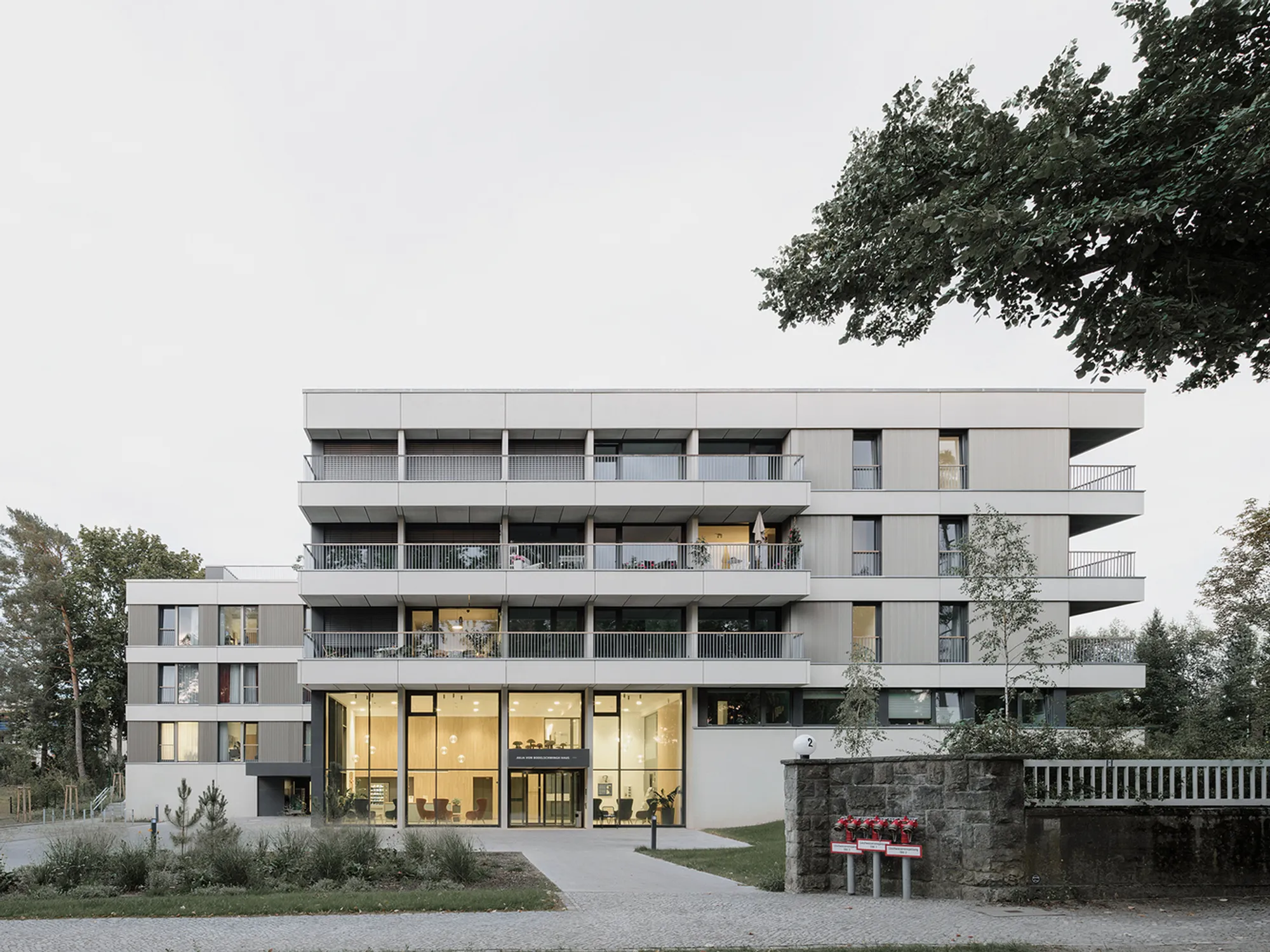
kontektum architektur Embeds a 72-Room Care Home into a Berlin Hillside Park
The Julia von Bodelschwingh Care House in Berlin-Westend bridges a hospital campus and a residential neighborhood with quiet precision.


Care homes rarely get praised for their architecture. They tend to be utilitarian boxes dressed in pastel, designed to meet code rather than elevate daily life. The Julia von Bodelschwingh Care House, completed in 2024 by kontektum architektur, pushes against that norm. Sited on a sloping plot in Berlin-Westend between the Malteser Hospital and a row of residential buildings, the 6,715 square meter facility manages to be both institutionally rigorous and genuinely residential in character. That tension, between the scale a care program demands and the intimacy its residents deserve, is the real subject of the project.
The building splits into three distinct volumes: a five-story main block fronting Pillkaller Allee, and two three-story residential wings extending northwest into the hillside. The arrangement is not arbitrary. It absorbs a significant grade change across the site while keeping the street-facing facade at a scale that reads as neighborhood architecture rather than healthcare infrastructure. Seventy-two rooms and thirteen barrier-free apartments are woven into a composition that prioritizes outdoor access, natural light, and communal gathering, all without telegraphing their institutional purpose.
Stitching Two Scales Together
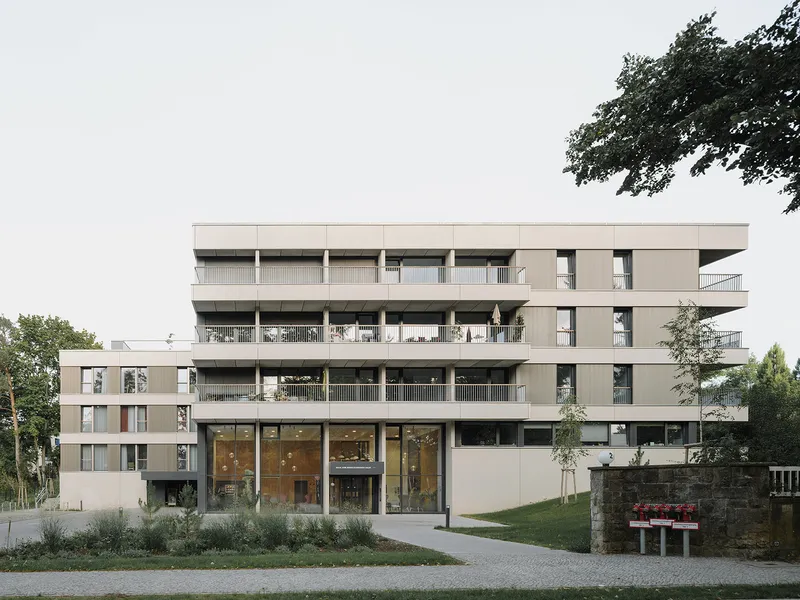
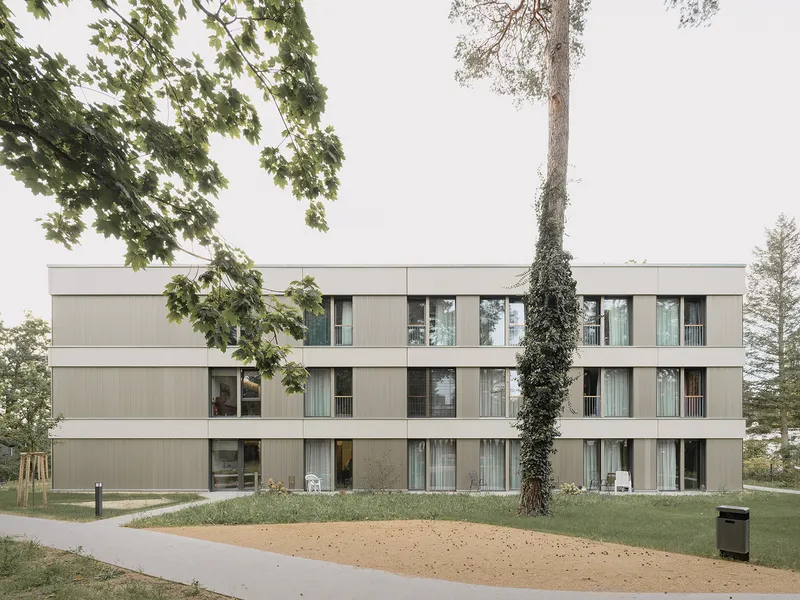
The project's most consequential move is topographic. To the south sits a major hospital; to the north, low-rise residential buildings. kontektum's response is to step the massing down the slope, with the tallest volume addressing the street and the shorter residential wings tucking into the landscape behind. The result is a building that mediates between two very different urban conditions without calling attention to itself. Horizontal cornice bands in precast concrete wrap the entire complex, tying these different volumes into a single reading.
The facade alternates between "open" zones of windows, balconies, and loggias and "closed" panels of rear-ventilated metal cladding. At dusk, the recessed balconies glow warmly against the grey panels, a rhythm that gives the building a domestic grain even at five stories. The old stone wall along the western boundary has been preserved, anchoring the new structure to the site's history.
A Foyer That Earns Its Name
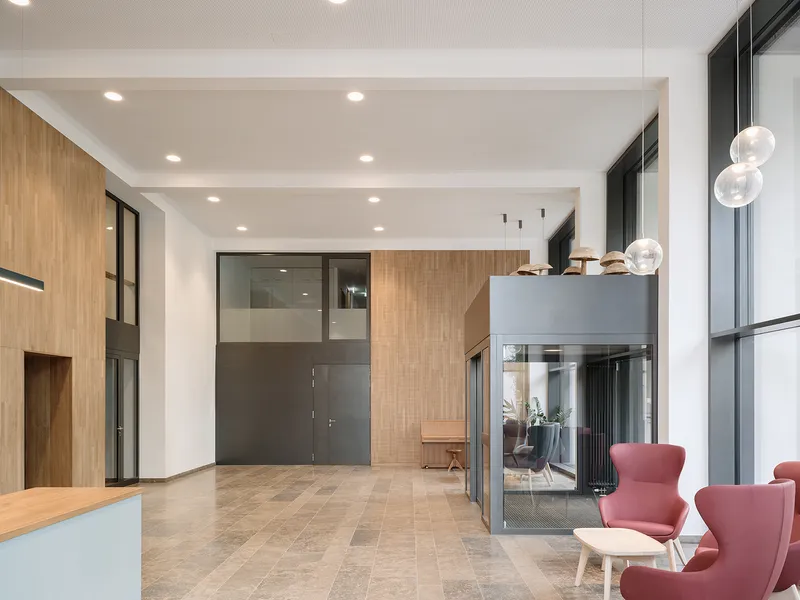
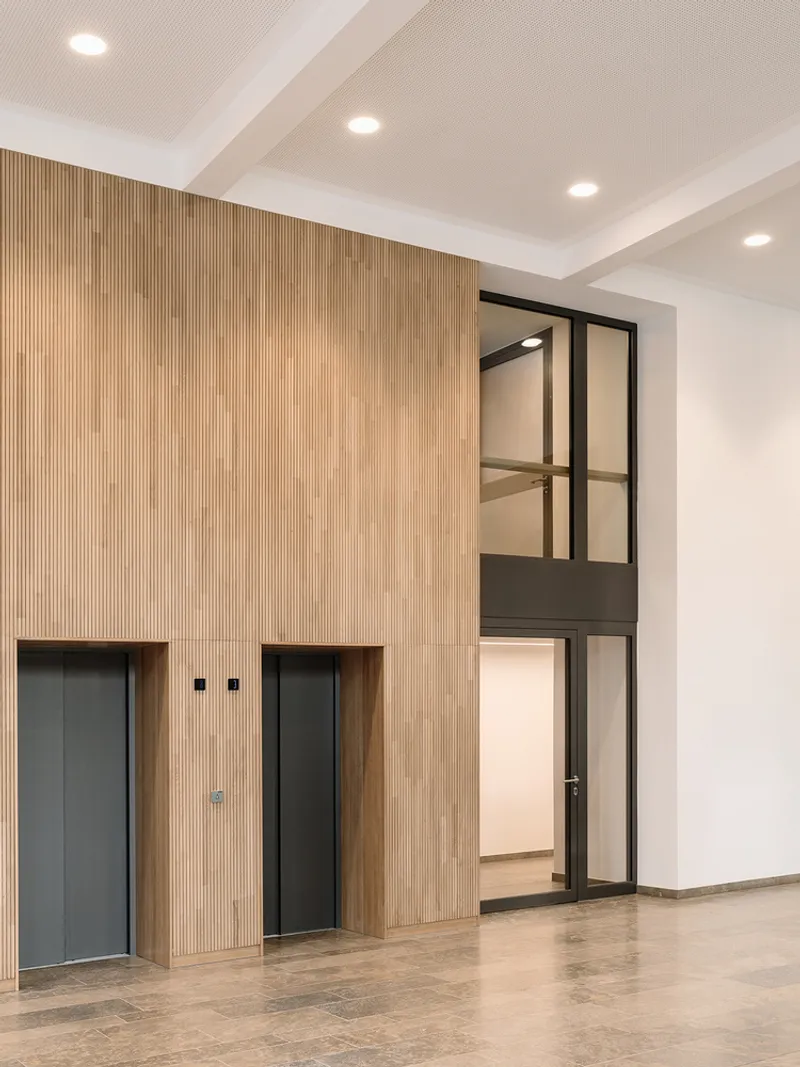
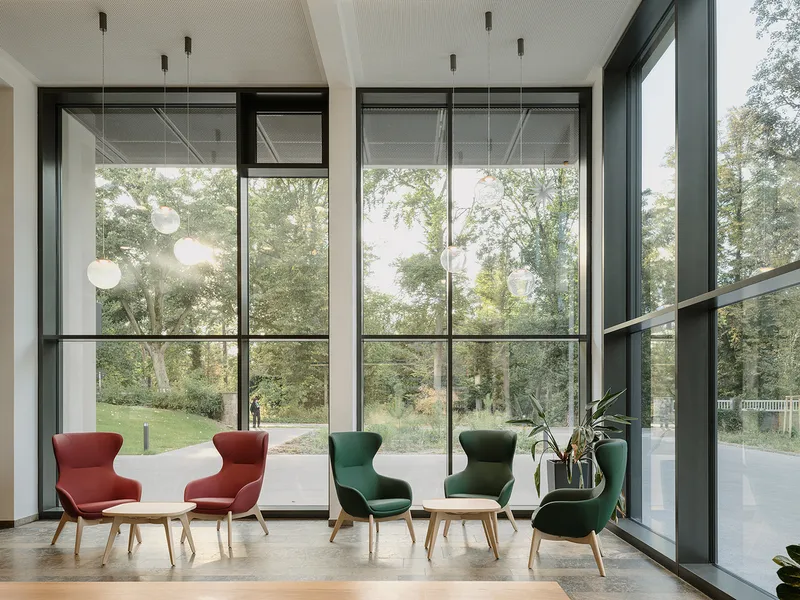
The double-height entrance hall, called the "Foyer am Birkenhain," is the social heart of the building. Clad in wooden acoustic panels with shelly limestone underfoot, it feels closer to a boutique hotel lobby than a care facility. Glass pendant lights hang at varied heights, and clusters of pink and colored upholstered seating create informal gathering zones. Administrative offices on the ground floor open onto the foyer through interior windows, a detail that keeps staff present without creating a surveillance atmosphere.
The foyer connects directly to a lounge with floor-to-ceiling steel-framed windows overlooking a green lawn. This space, with its generous proportions and careful material palette, is designed to host celebrations and community events. For residents whose world has contracted to a single building, the quality of these shared rooms matters enormously. kontektum treats them not as leftover circulation but as the project's most important interiors.
Living Rooms, Not Hospital Rooms
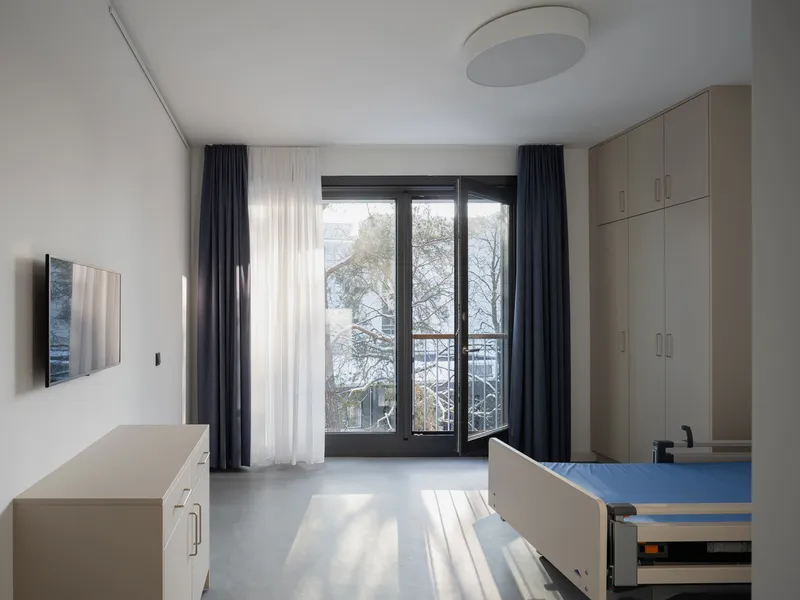
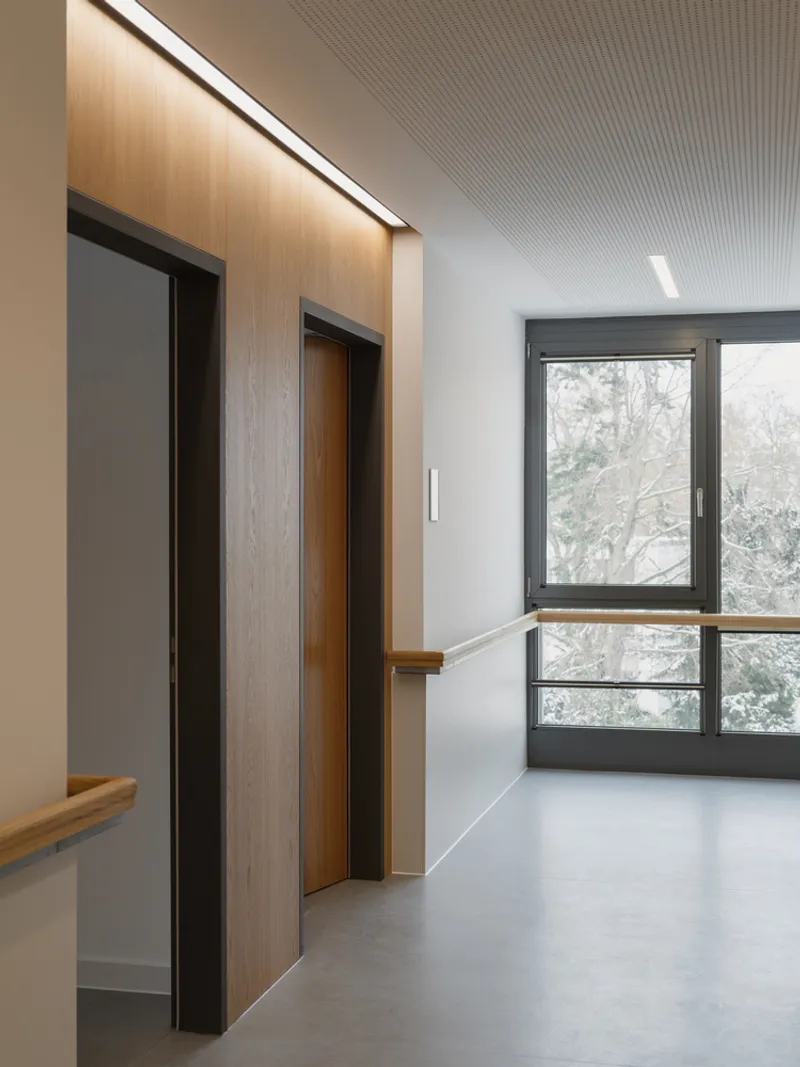
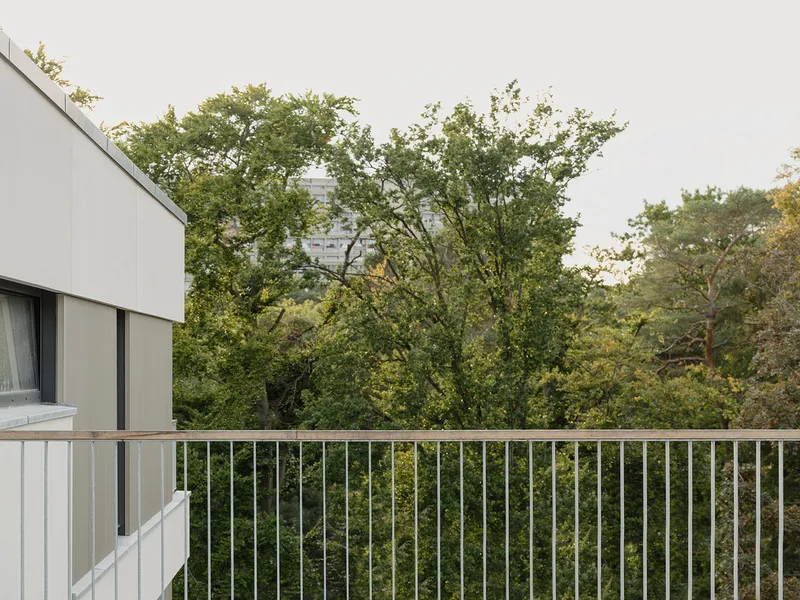
Each of the 72 resident rooms includes a private, barrier-free bathroom and direct access to the outdoors through balconies or winter gardens. The rooms themselves are compact but deliberately finished: built-in cabinetry, real wood veneer at apartment entrances, and large windows positioned so that even bedridden residents can see the sky and the surrounding pine trees. These are not luxury details; they are ethical ones. When a room is someone's entire world, the view from the pillow is an architectural decision with real consequences.
Corridors in the residential wings are wider than standard to accommodate walkers and wheelchairs, but they also expand at apartment entrances to create small threshold zones. This is a smart spatial tactic: it gives residents a moment of pause and orientation that a uniform hallway cannot provide. The timber handrails and framed views of trees through corridor windows reinforce a sense of place rather than transit.
Bathrooms as Dignified Spaces
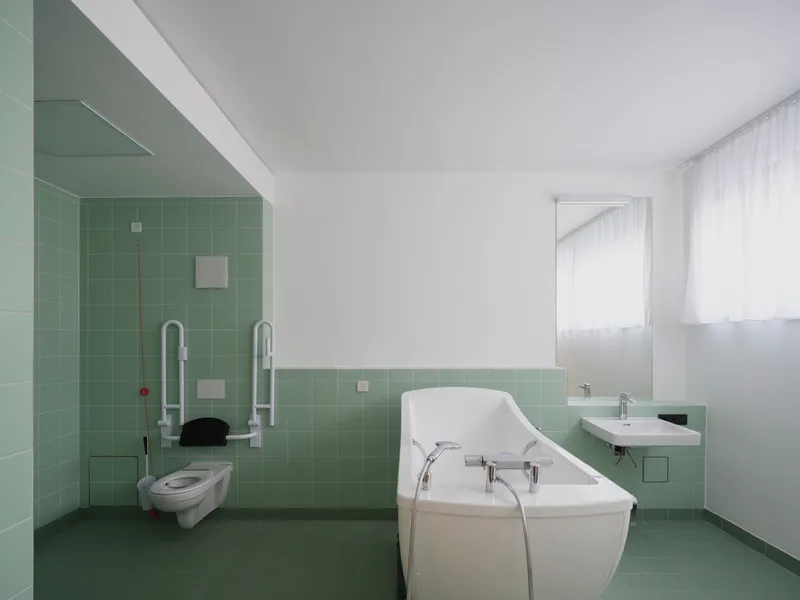
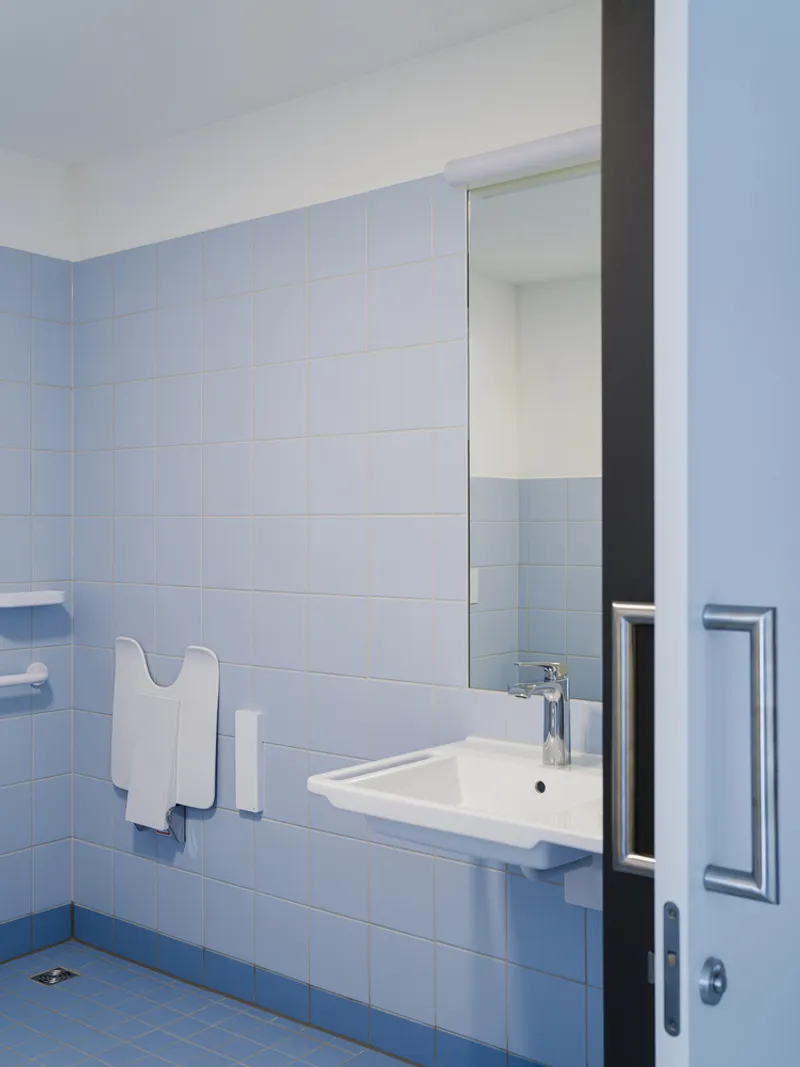
It is worth pausing on the bathrooms, because they reveal the architects' priorities. The mint green and light blue square tiles, freestanding bathtubs, and wall-mounted fixtures with integrated support rails treat accessibility as a design language rather than an afterthought. Sliding doors, grab bars, and open floor areas are all present, but they read as considered interior decisions rather than compliance checkboxes. For residents who may need daily assistance with bathing, the difference between a clinical wet room and a dignified bathroom is not trivial.
Landscape as Extension of Care
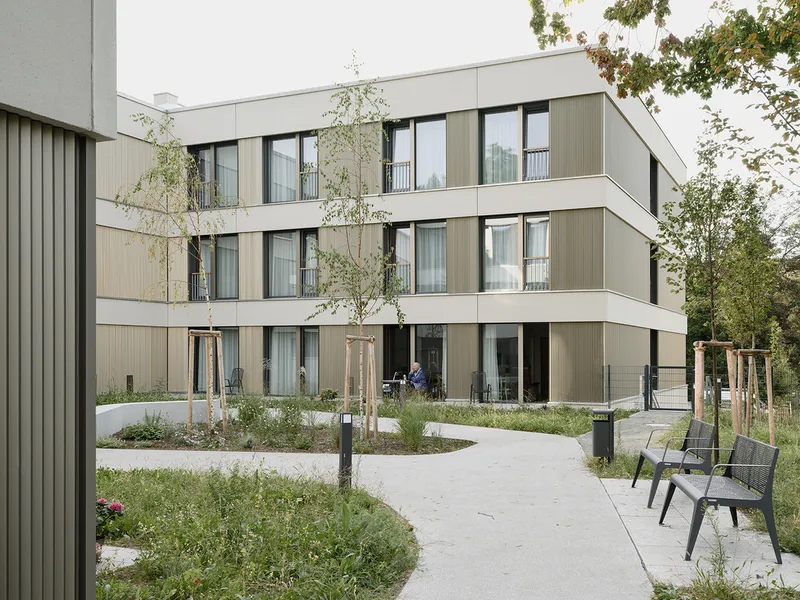
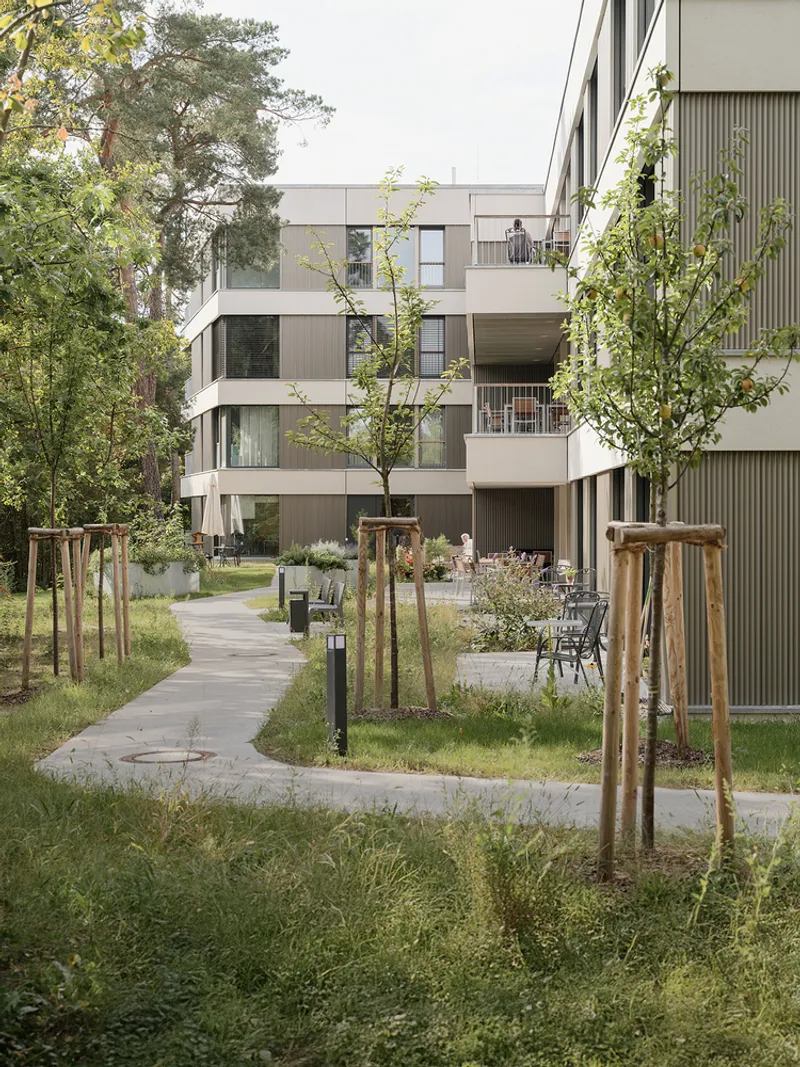
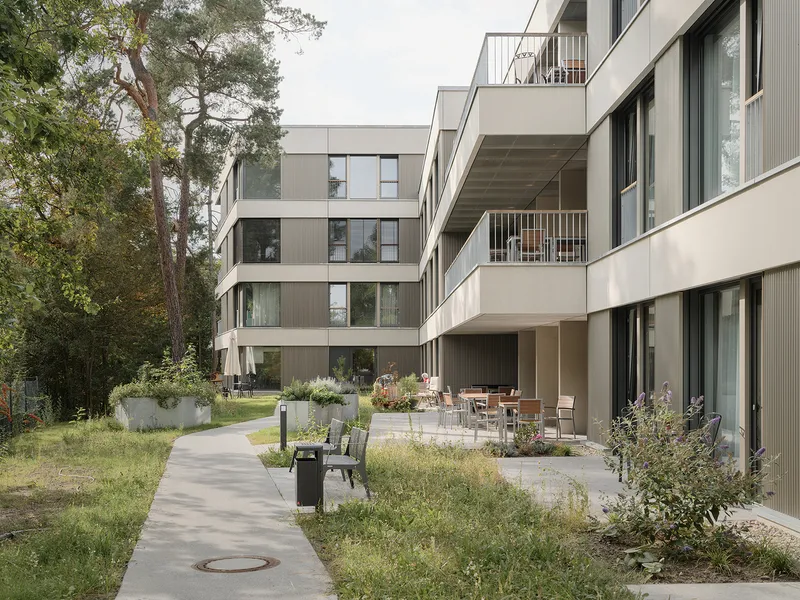
The building is nestled among pine trees and wrapped by a newly designed park with curved pathways, staked young trees, and planted beds. Ground-floor terraces open directly onto the landscape, blurring the line between indoor communal areas and the garden. A rooftop terrace on the upper floor offers views across the park toward the Corbusierhaus, giving residents a connection to the wider city that their mobility might otherwise deny them.
The courtyard between the two residential wings creates a protected outdoor room, with seating areas, planters, and a winding path that encourages slow, supported walks. The landscape is not decorative; it is programmatic. For residents with dementia or limited mobility, a safe and stimulating outdoor circuit is a form of therapy. kontektum and their landscape collaborators have designed one that feels like a park, not a perimeter.
Facade Tectonics and Material Logic
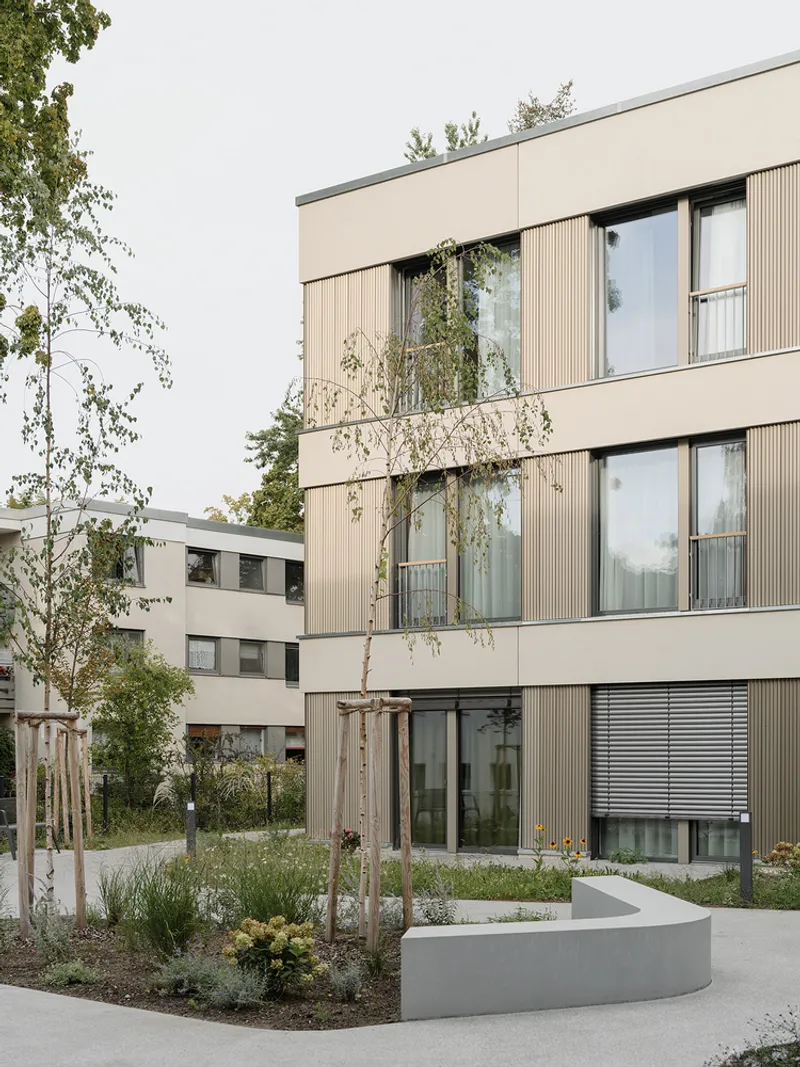
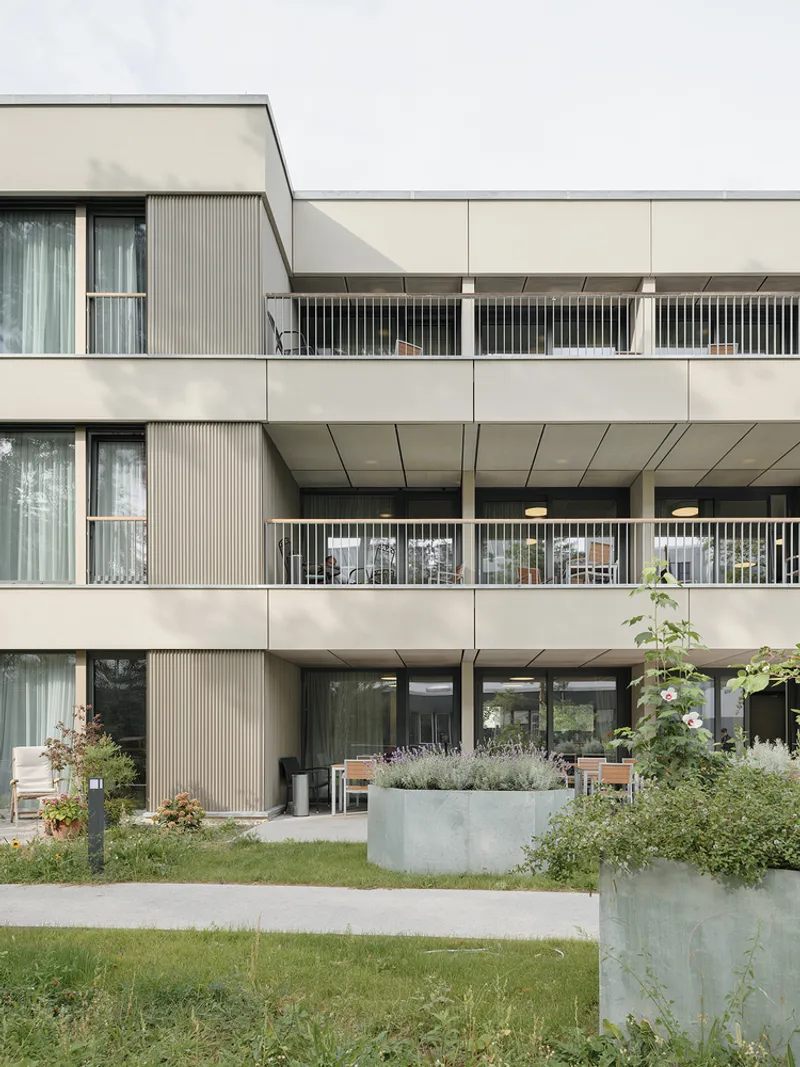
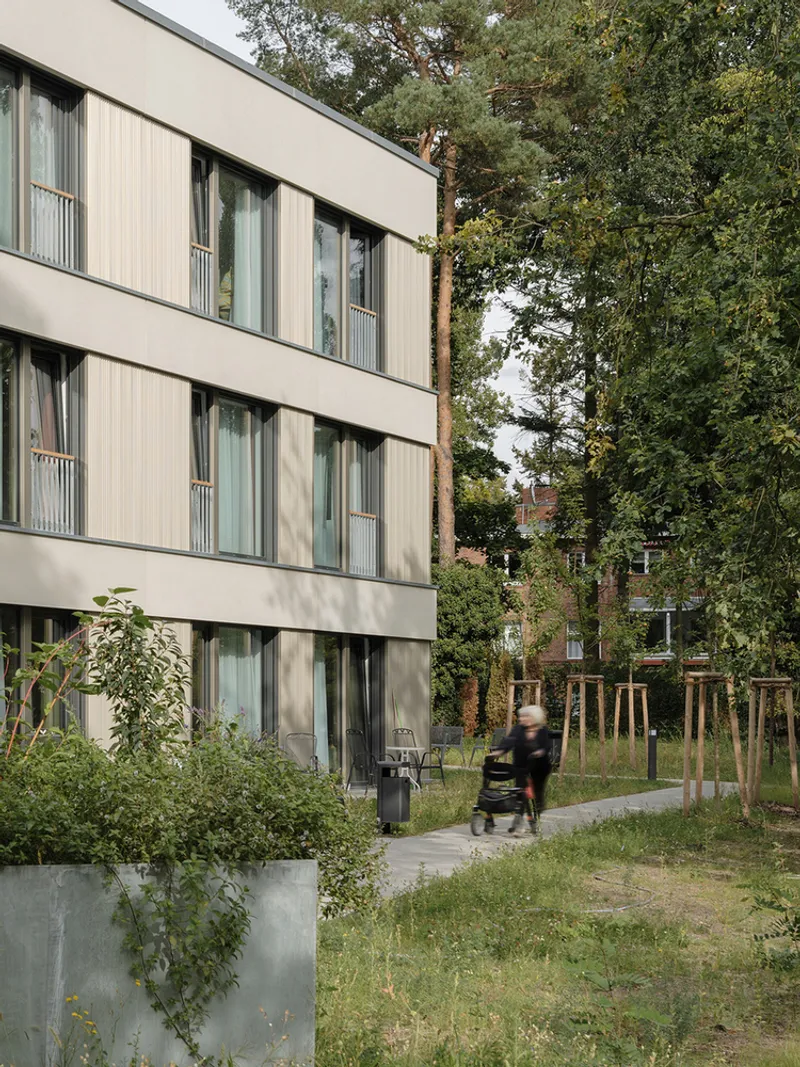
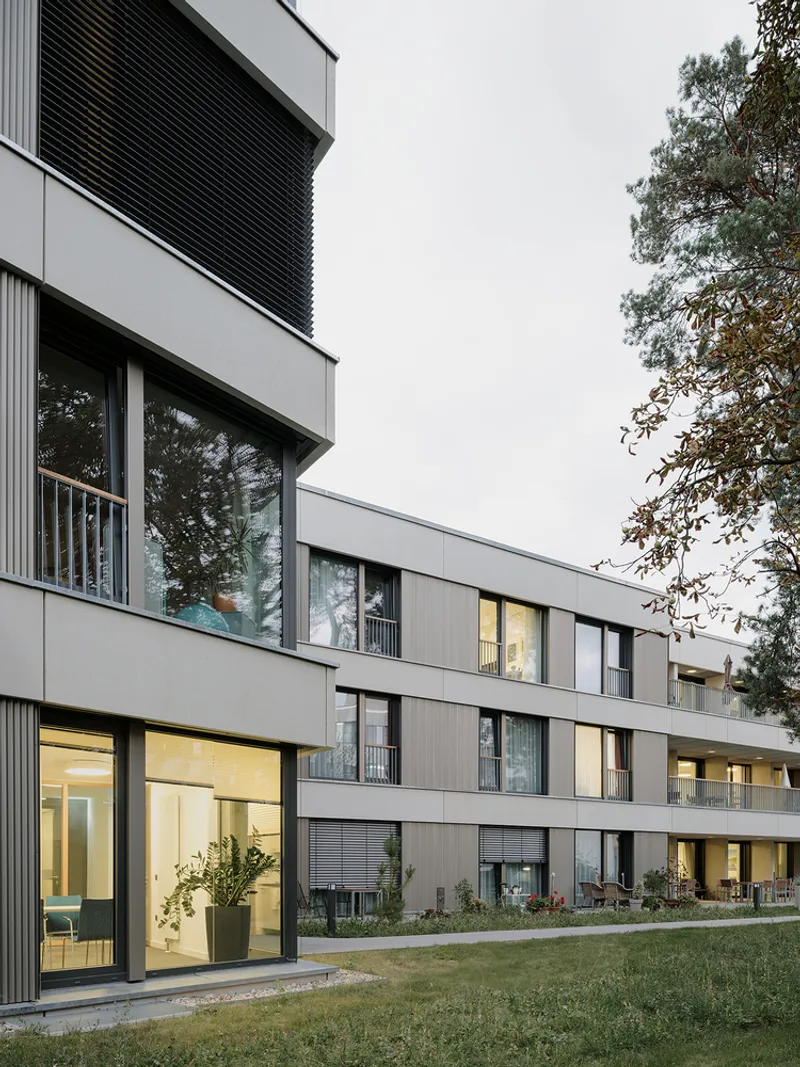
Up close, the facade reveals its logic. Vertical ribbed cladding panels define the closed sections, while the precast concrete cornices provide deep horizontal shadow lines that give the building its proportional order. Concrete planters at ground level, filled with lavender and grasses, soften the base and create a buffer between the public pathway and the private terraces above. The metal railings on the stacked balconies are slender and transparent, maximizing light and views for residents while maintaining the facade's layered depth.
This is not an expressive facade in the sculptural sense. Its ambition is coherence: to make a complex, multi-wing building with varied floor plates read as a single, calm composition. The material palette, precast concrete, metal panel, glass, and timber, is restrained but not austere. Each material does a specific job, and the result is a building that ages well visually, an important quality for a structure intended to serve its residents for decades.
Plans and Drawings
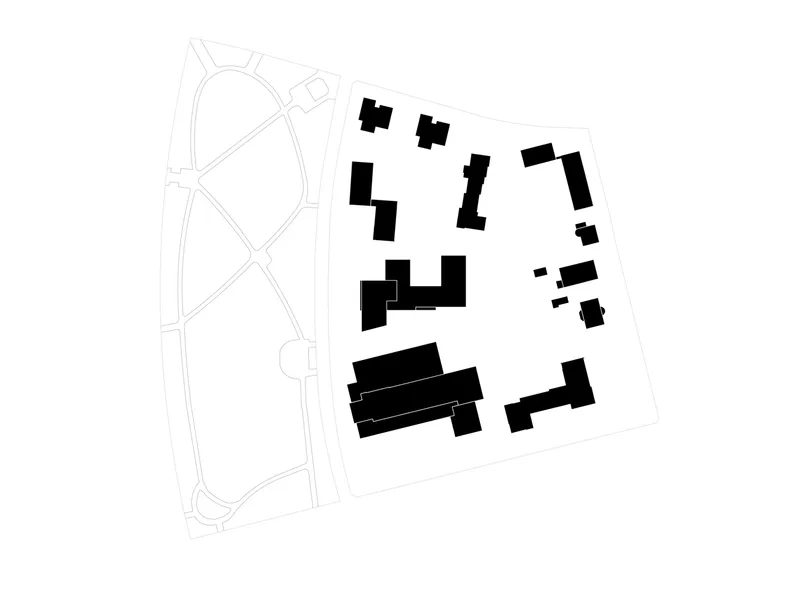
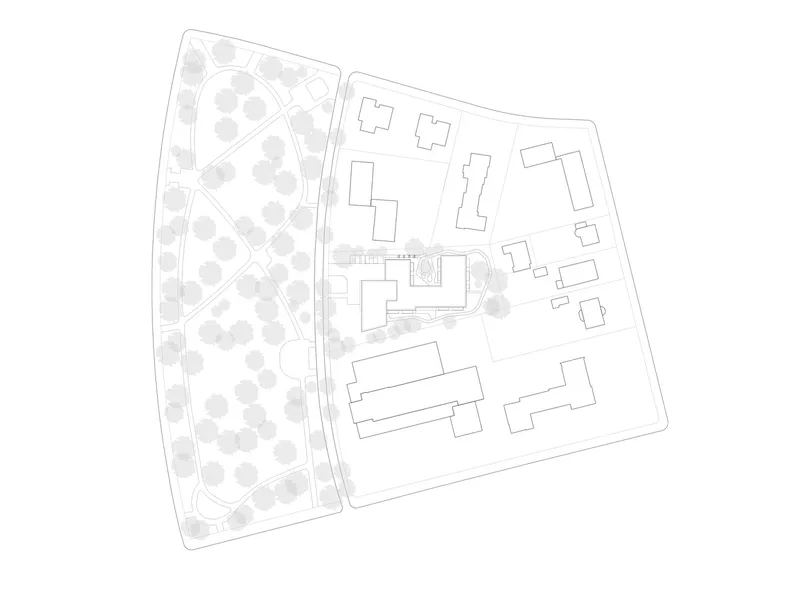
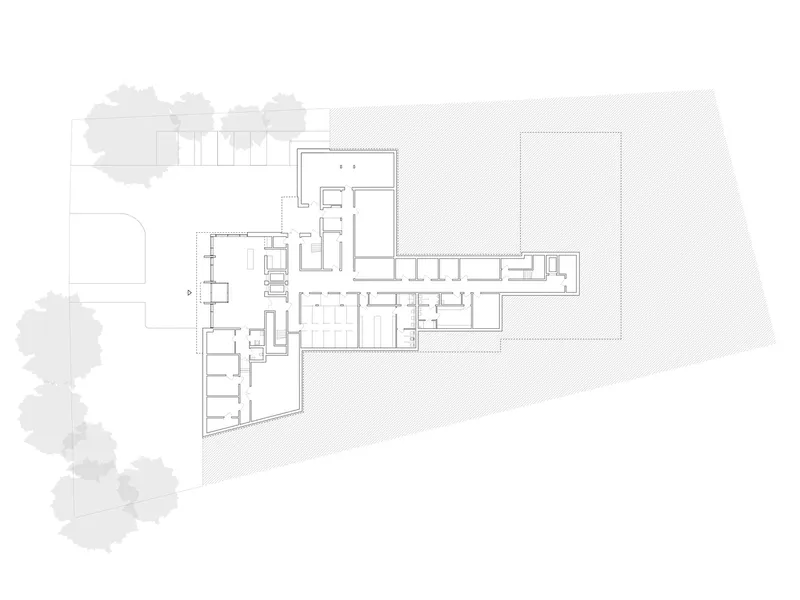
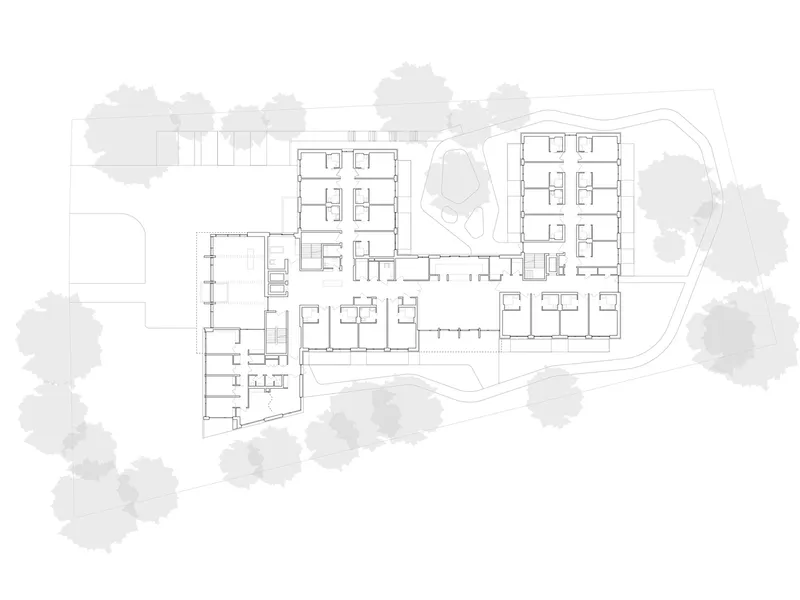
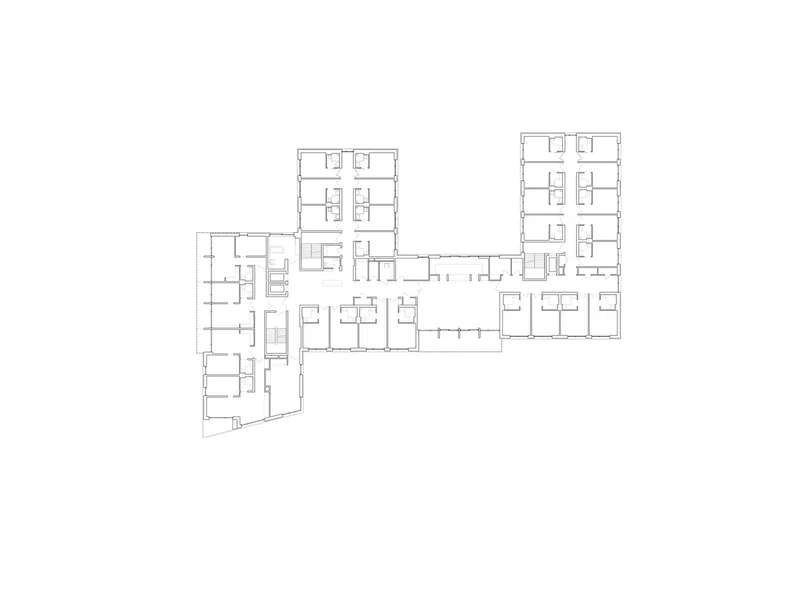
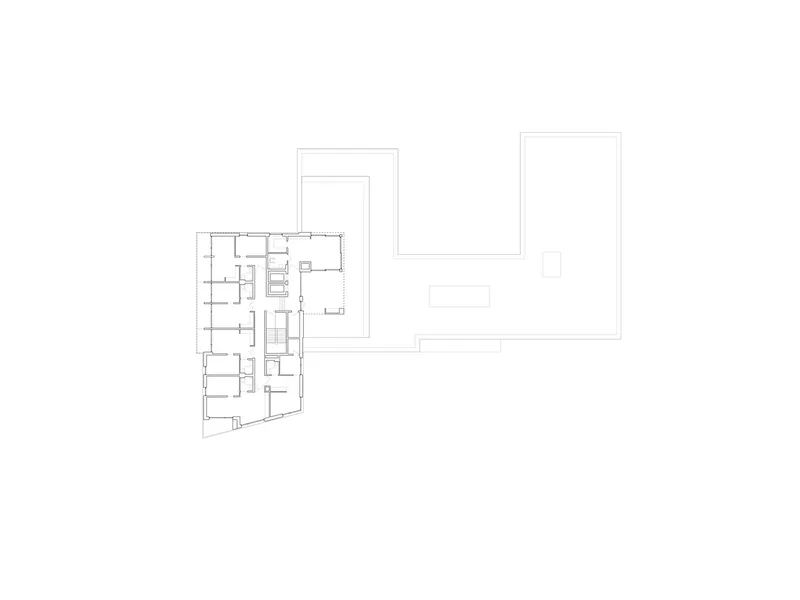
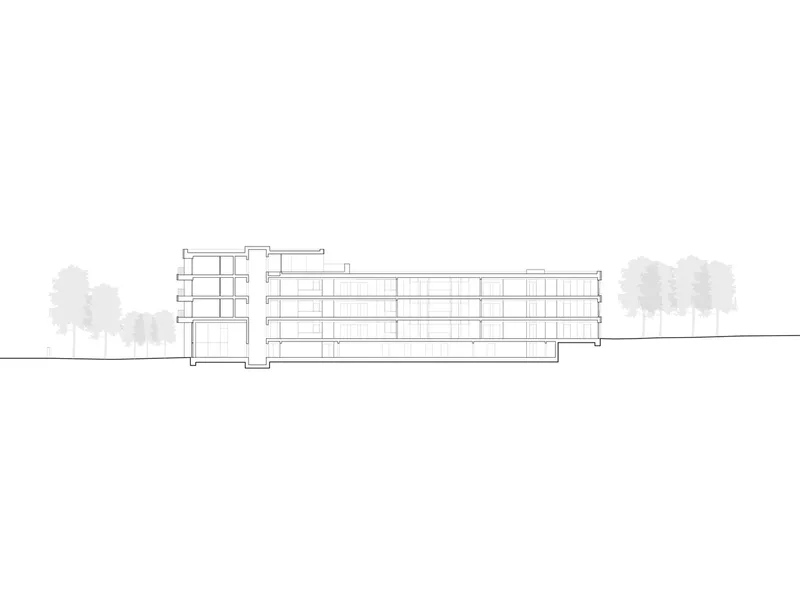
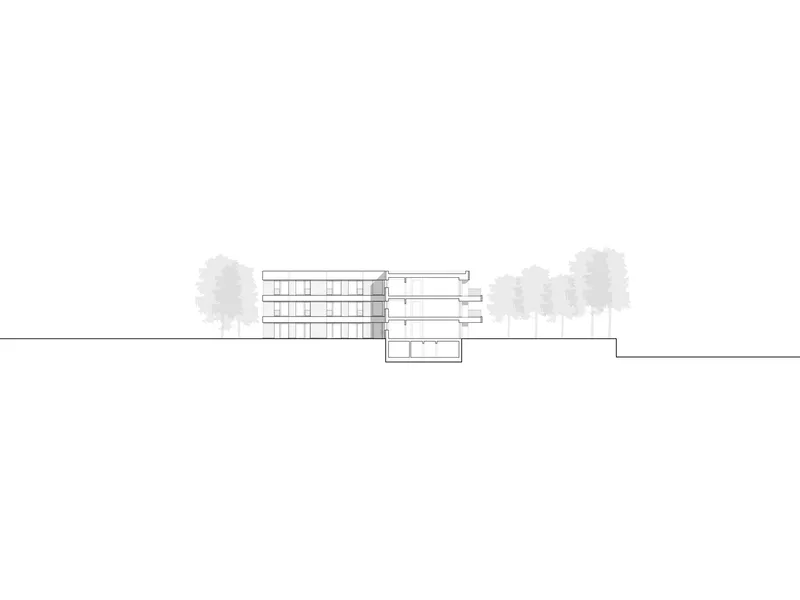
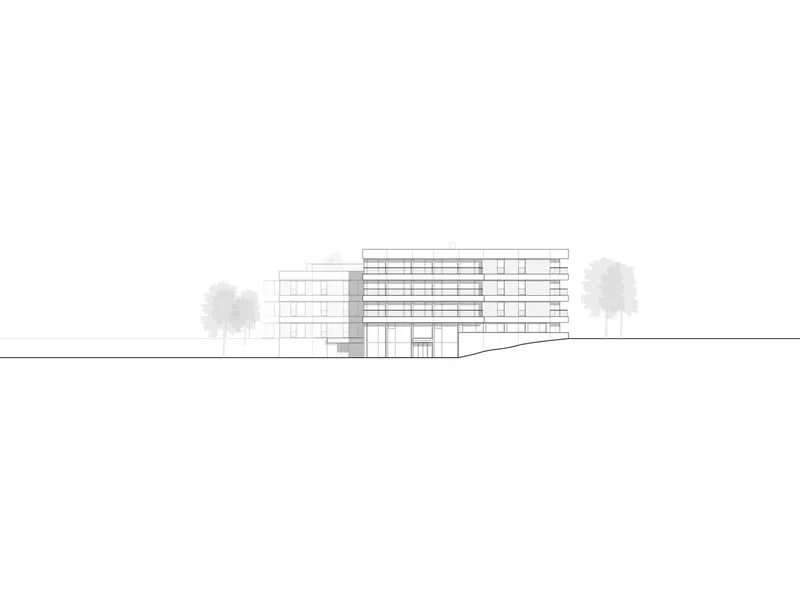
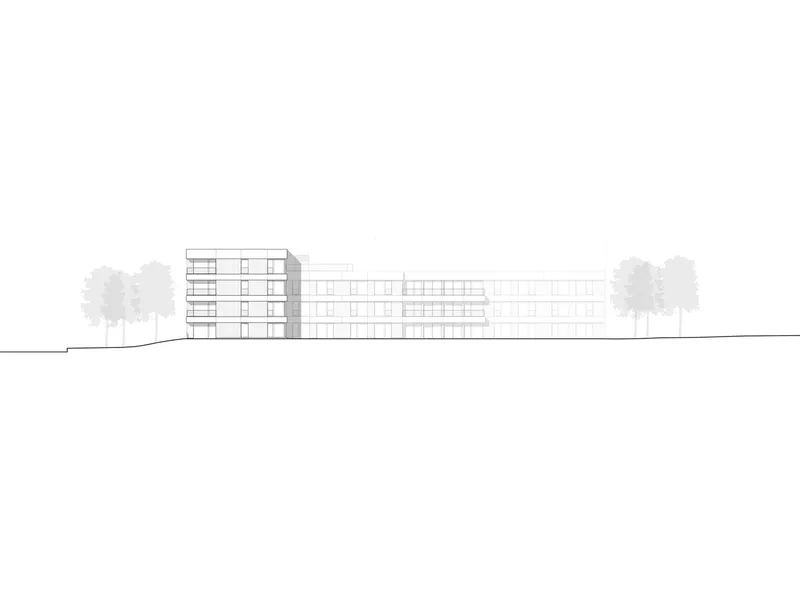
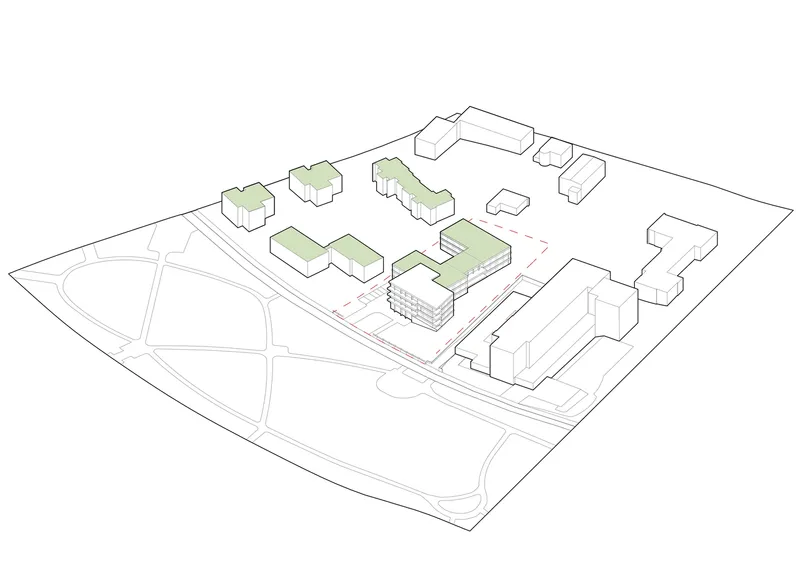
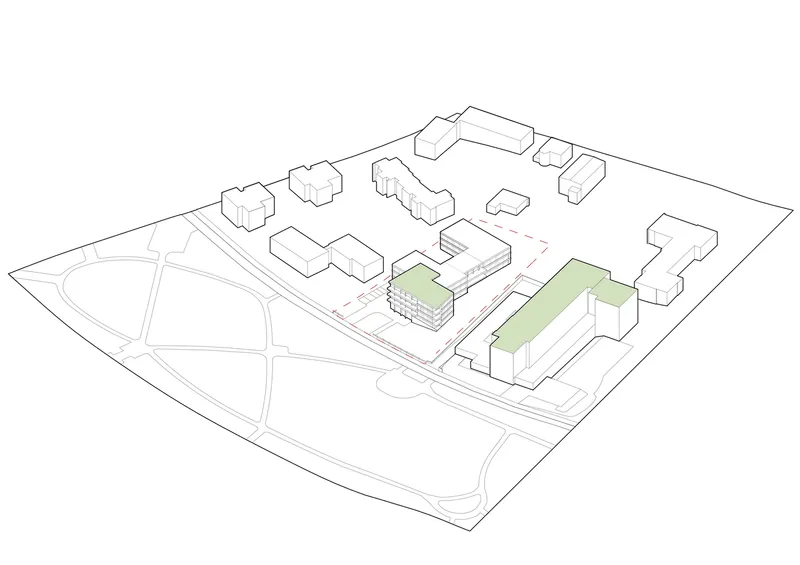
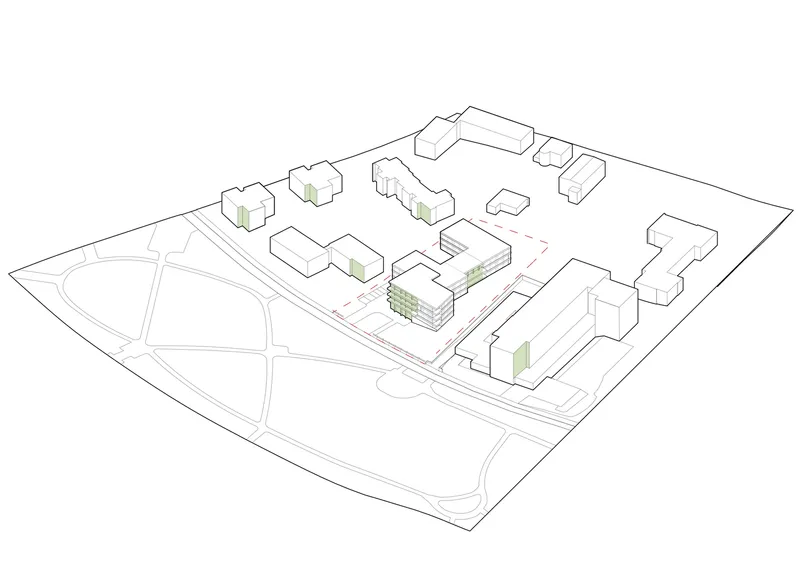
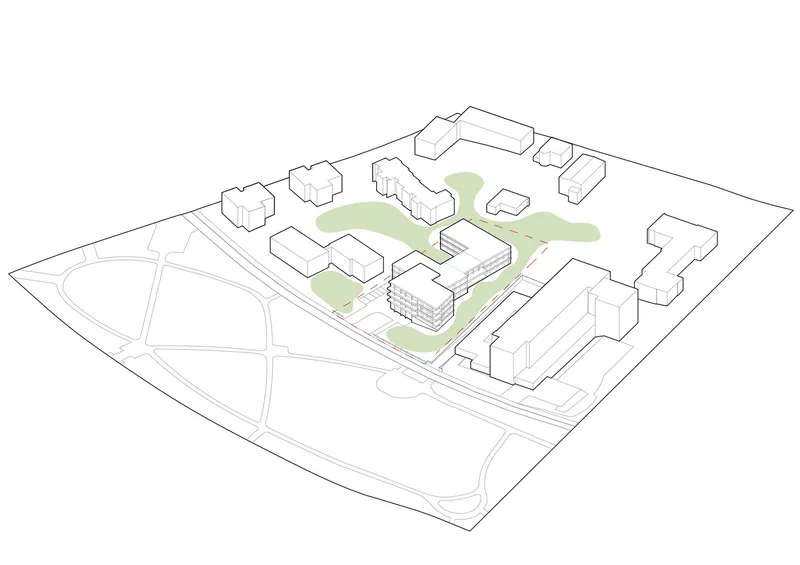
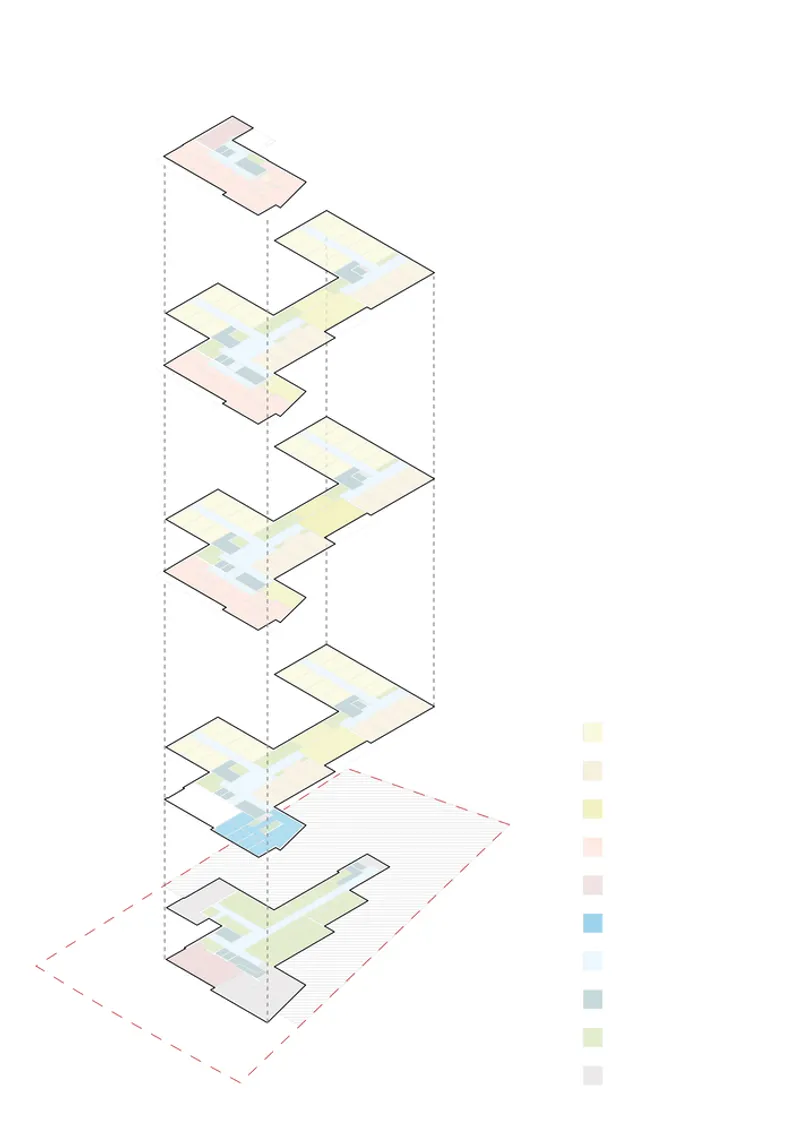
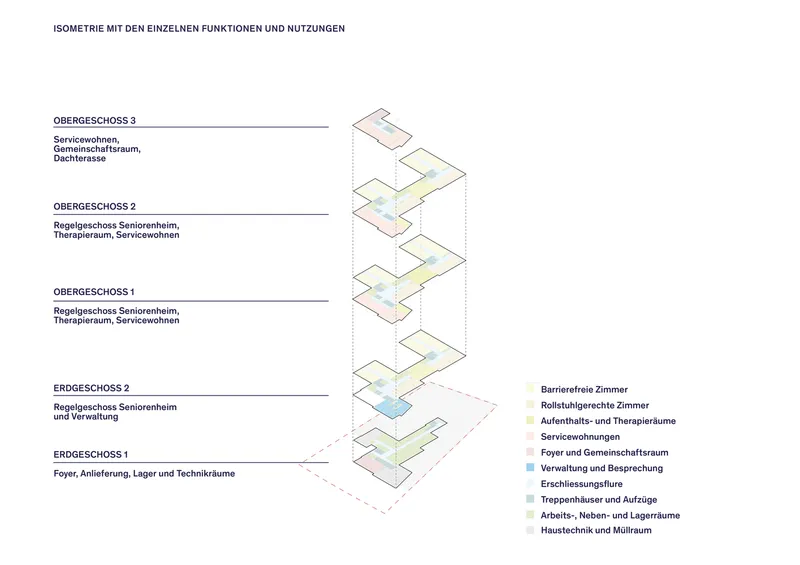
The drawings make legible what the photographs only suggest. The site plans show how the building's L-shaped footprint negotiates the slope and preserves existing trees, with the main block parallel to Pillkaller Allee and the residential wings angling back into the hillside. Floor plans reveal the twelve-room-per-floor arrangement in each residential wing, with communal living areas positioned at the junction point between them, a simple organizational decision that maximizes both privacy and sociability.
The sections are particularly instructive. They expose the building's engagement with topography: the basement is fully embedded in the slope, and the three-story residential wings step down behind the five-story street block. The exploded axonometric with color-coded program zones confirms that the architects thought carefully about the vertical distribution of functions, placing the most public spaces at ground level and the most private at the top, with communal terraces mediating between them.
Why This Project Matters
Senior care architecture is one of the building types where the gap between what people need and what they typically receive is widest. Most care homes are designed around operational efficiency, with resident experience treated as an optional upgrade. The Julia von Bodelschwingh Care House demonstrates that the two are not in conflict. Wide corridors that accommodate walkers also create generous threshold spaces. Acoustic panels that reduce noise also make the foyer feel warm. Large windows that bring in daylight also give bedridden residents a reason to look up. Every functional decision here doubles as a spatial one.
kontektum architektur has produced a building that refuses to announce itself as an institution. It sits quietly in its Berlin-Westend neighborhood, mediating between a hospital and a residential street, offering its residents dignity through material care and spatial generosity. In a sector that often settles for adequacy, this project makes a case for architecture that takes the last years of life as seriously as the first.
Julia von Bodelschwingh Care House by kontektum architektur. Berlin-Westend, Germany. 6,715 m². 2024. Photographs by Philipp Obkircher.
About the Studio
Share Your Own Work on uni.xyz
If projects like this are the kind of work you want to make, uni.xyz is a place to publish your own, find collaborators, and enter design competitions.




Popular Articles
Popular articles from the community


Conexión: Biophilic Design Reimagines High-Rise Living in Hong Kong
Conexión reimagines high-rise living in Hong Kong through biophilic design, green facades, shared spaces, daylight, water and nature within.

Hill & Cross Opera: Sculptural Opera House Architecture Shaped by Tallinn’s Landscape and Identity
Hill & Cross Opera reimagines opera house architecture in Tallinn through its sculptural hill, civic plaza, glass wave and a luminous cross.

The Ocean Hive: Sustainable Architecture for a Self-Sufficient Civilization at Sea
The Ocean Hive imagines sustainable architecture at sea, where modular habitats, algae, wave power and ocean waste sustain a growing colony.

Co-life: Sustainable Architecture for Age-Friendly Community Living
Co-life reimagines sustainable architecture for seniors through courtyards, rammed earth, shared gardens, and spaces designed for belonging.


Similar Reads
You might also enjoy these articles


Hodi-Mandai Geram
Project Function: Preservation and revitalization of the Intangible heritage and socio-spatial identity of the Hodi by Housing, Cultural Memory Center, Sacred Grove, landscape, local tourism economy


Olio Towers: A Mid-Rise for Performers That Fuses Housing, Rehearsal, and Stage
Located blocks from Houston's Theater District, this modular tower stacks living units around a central performance atrium.

Oasis: Modular Green Housing Carved into Dhaka's Urban Fabric
A shortlisted Plugin Housing entry reclaims unauthorized settlements in Dhaka with stepped concrete volumes, green roofs, and ventilation-driven design.

Black Hole: A Floating Megastructure for the Post-Physical Era
Emiliano Mazzarotto envisions a spherical, self-scaling arena where e-sports, digital hotels, and holographic stadiums replace traditional public space.


Explore Senior Living Competitions
Discover active competitions in this discipline


Challenge to design mud housing for contemporary communities


Challenge to reimagine the Iron Throne


Photograph architecture without architects


Illustrate the lost glory of Angkor Wat - Render Challenge
Comments (0)
Please login or sign up to add comments
No comments yet. Be the first to comment!