
Sens Architects Floats a Bronze Volume Over Rice Fields in Jiaxing's Flower Industry Park
A 20,000-square-meter exhibition center in Haining anchors public culture to agricultural landscape with cantilevered precision.


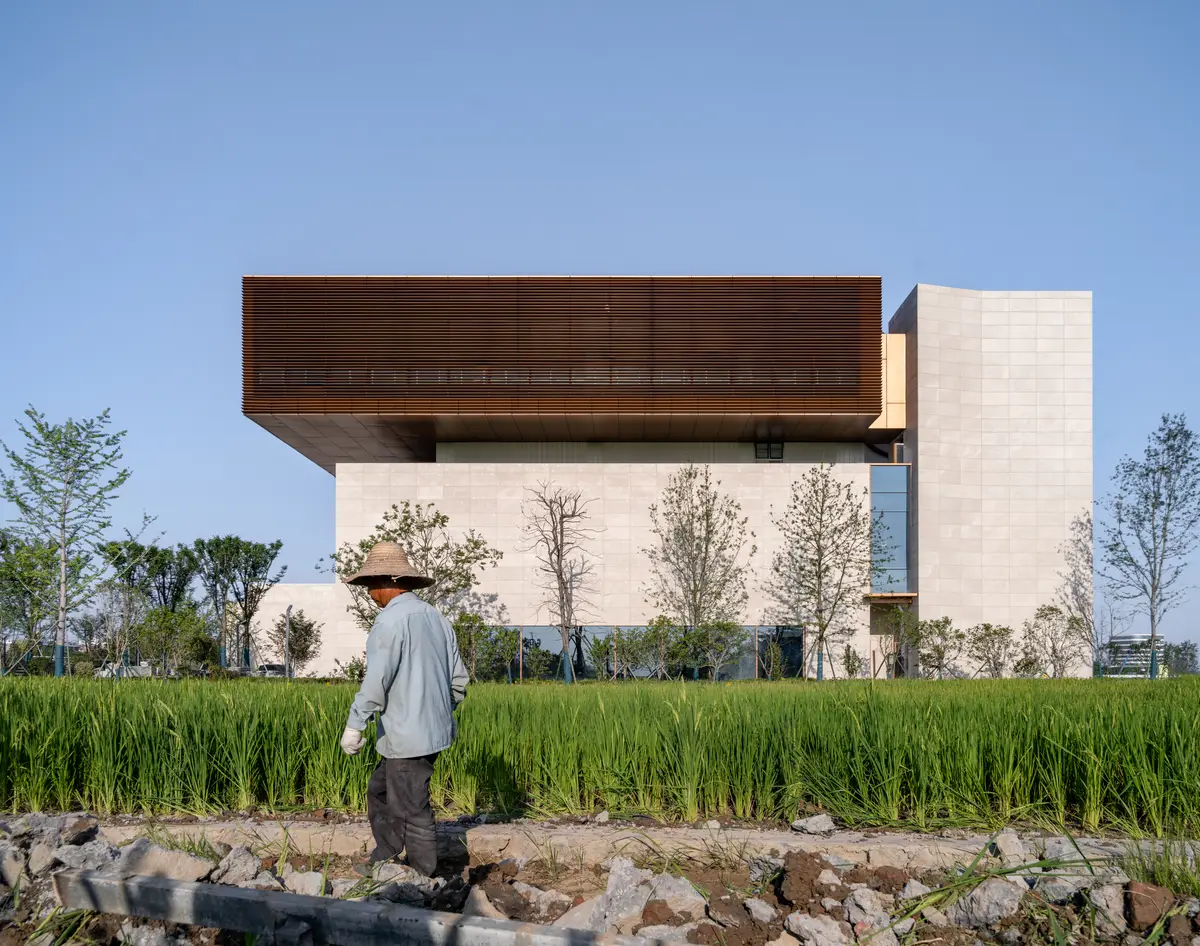
Buildings that serve agricultural industries rarely get this kind of architectural ambition. The Haining Natural Exhibition Center, designed by Sens Architects and led by Zhang Juntian and Sun Hongfei, sits inside the Haining International Flower Industry Park in Jiaxing, China. At 20,000 square meters, it is not a modest pavilion but a full-scale public institution: part exhibition hall, part conference venue, part cultural facility. Its program spans agricultural showcases, industry events, information exchange, and art exhibitions. What makes it compelling is the refusal to let that civic scale overwhelm the landscape it inhabits.
The building reads as two distinct registers stacked on top of each other. A heavy concrete base hugs the ground, anchoring the center to the flat terrain of rice paddies and flower fields. Above it, a bronze-clad volume cantilevers outward with startling confidence, hovering over water, steps, and open ground as if it were levitating. The tension between the grounded and the weightless is the project's central architectural idea, and it plays out convincingly from every angle, whether you approach from the paddy paths or catch it glowing at dusk across a field of red sorghum.
A Cantilever That Commands the Horizon


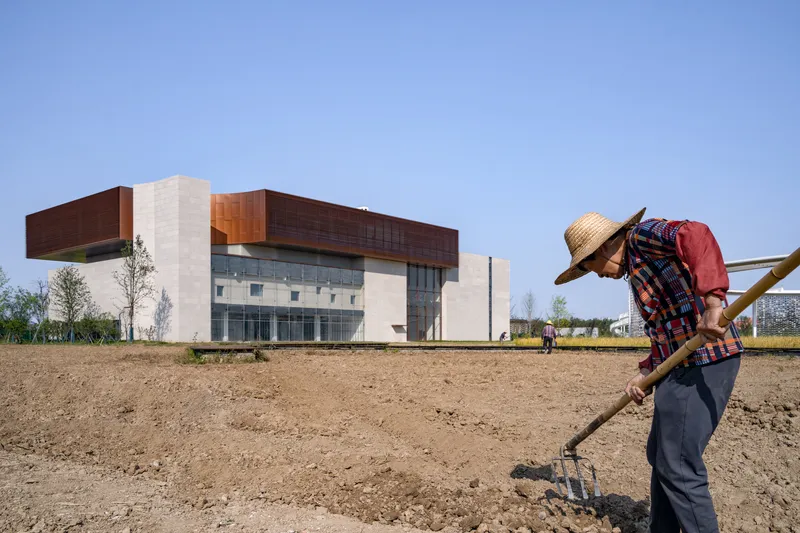
The defining gesture here is the cantilevered upper volume, and it is most powerful from a distance. Seen across a field of dry sorghum or from behind a farmer tilling bare earth, the building's horizontal bronze mass appears to float free of its base. The louver-clad skin catches light differently throughout the day, shifting from warm copper in direct sun to a deep, muted gold at twilight. Sens Architects clearly understood that a building in flat agricultural land has to hold its own against the vastness of the horizon, and the cantilever does exactly that: it gives the structure a decisive profile without resorting to height.
The concrete base, with its vertical fins and stepped landscaping, creates a more grounded, textured layer at eye level. It is the kind of material contrast that rewards proximity. From afar you see the drama of the hover; up close you engage with weight, grain, and shadow.
Landscape as Context, Not Ornament
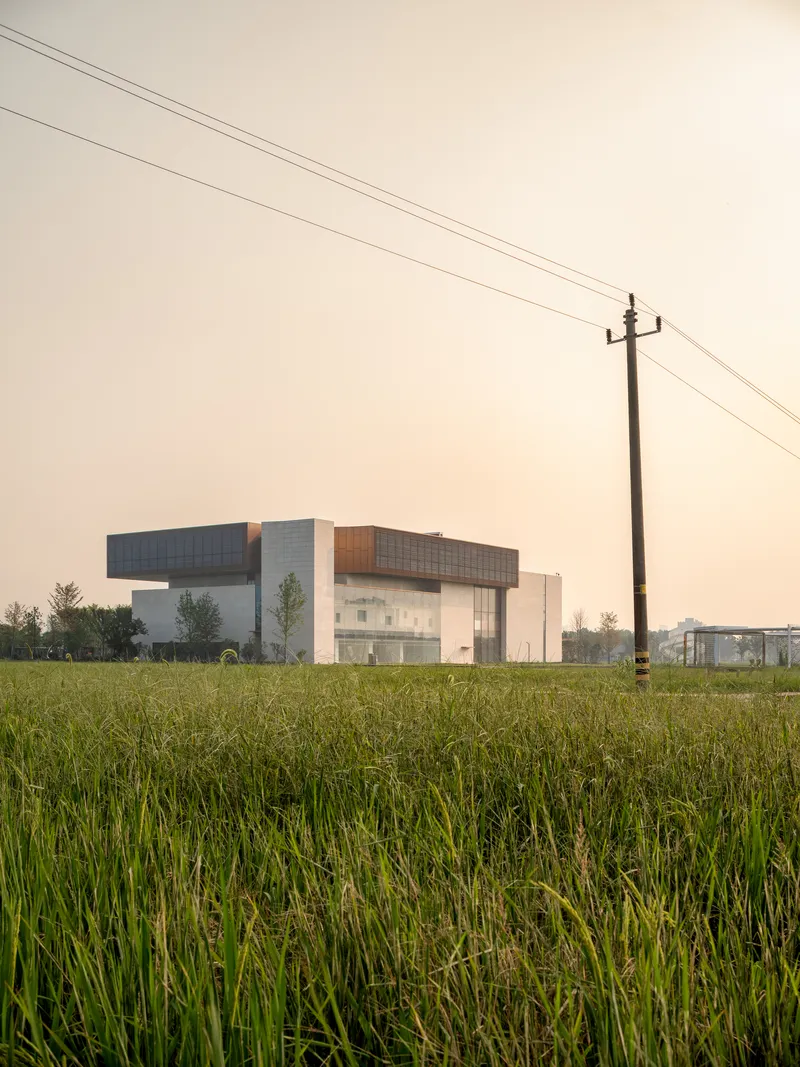


The aerial view makes it plain: this is a building that sits in active farmland, not a manicured park. Green fields stretch in every direction, punctuated by overhead power lines and the haze of morning light. Sens Architects sited the center so that its two connected volumes read as a deliberate interruption in the agricultural grid rather than a domination of it. The low massing, horizontal emphasis, and reflective water features all work to keep the building in dialogue with the flat terrain.
The stepped approach from the pond side is particularly well handled. A figure on the concrete steps encounters the cantilevered volume reflected in water, with the entire composition framed by dusk light. The building does not pretend to be invisible in the landscape. Instead, it earns its place by treating the surrounding fields as an equal partner in the experience.
Courtyards and Copper: The In-Between Spaces
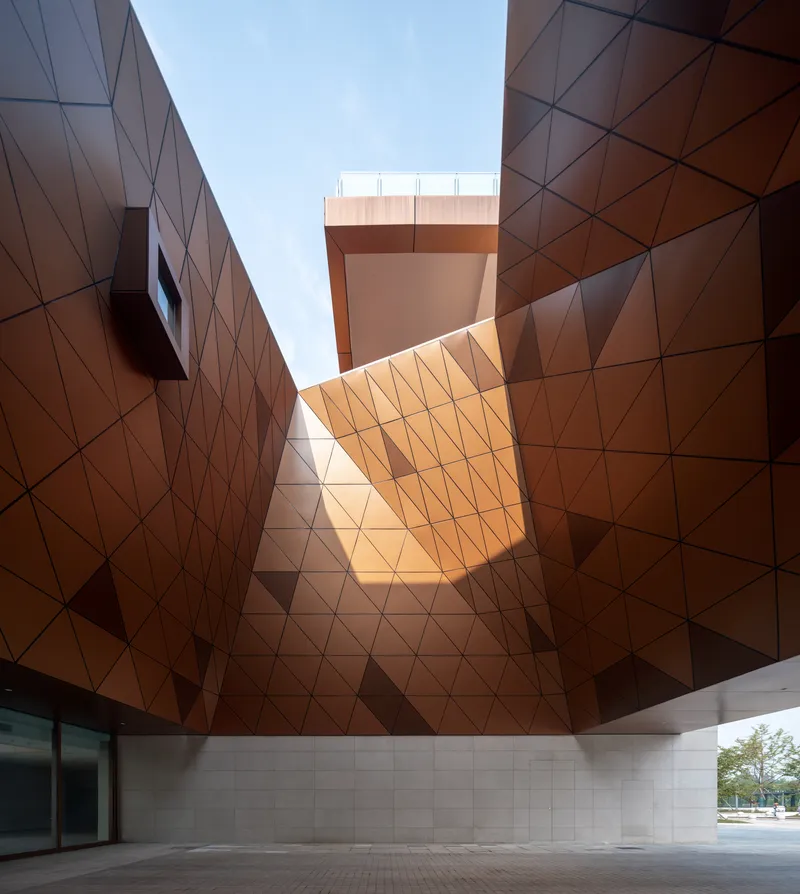


The courtyards are where the building's material palette comes together most intensely. Looking upward into the triangulated courtyard, copper cladding wraps the faceted surfaces while a cantilevered volume pushes overhead, compressing the space and directing your gaze to a narrow slice of sky. It is a move that transforms what could be a simple light well into a sculptural event. The multicolored triangular tile pavement in the central courtyard below adds a playful note to what is otherwise a restrained palette of concrete, bronze, and white.
Courtyard passages with vertical white fins below copper-clad overhangs create transitional zones that control light and movement. These are not leftover spaces between buildings; they are carefully calibrated thresholds that slow you down and redirect attention before you enter the next gallery or hall.
Light as Exhibition Tool
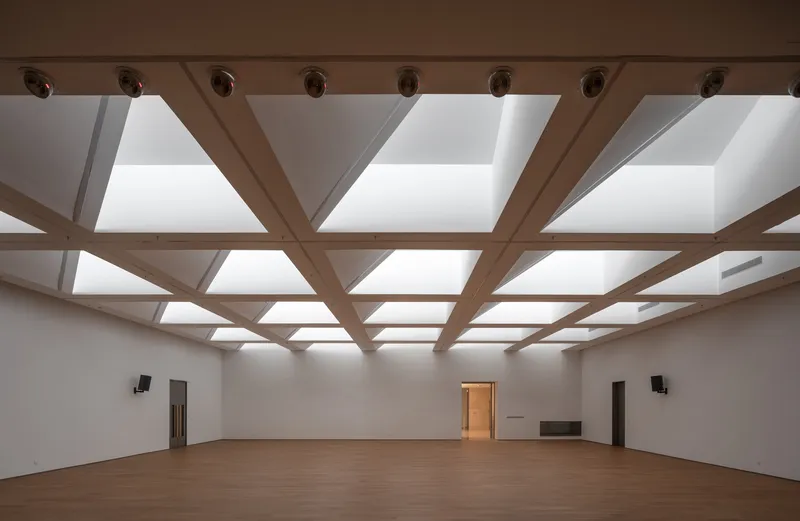

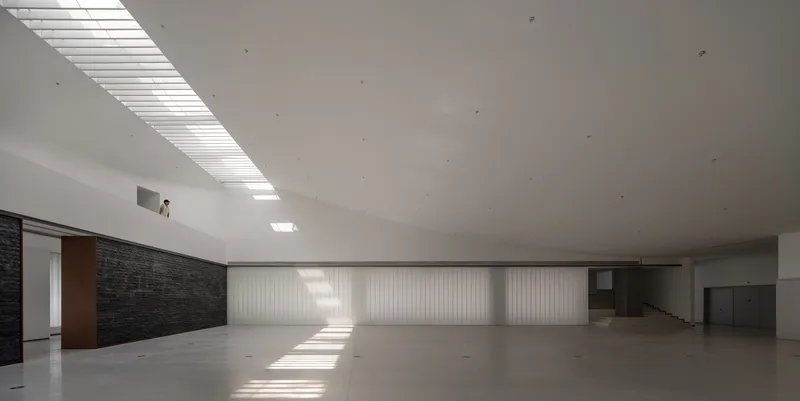
For a building whose primary function is exhibition, the quality of light is everything, and Sens Architects clearly invested serious effort here. The timber grid ceiling with backlit skylights in the main gallery delivers even, diffused illumination that flatters objects without casting harsh shadows. Elsewhere, slatted skylights throw colored light onto dark stone walls, turning a corridor into something closer to an installation than a circulation space. Linear clerestory openings create sharp diagonal shadows that move across polished concrete floors throughout the day.
Each gallery space deploys a different daylighting strategy. Narrow clerestory slits in the curved gallery, full-height glazing in the corridor overlooking trees, recessed ceiling coffers with angled surfaces: the variety means that curators have genuinely distinct environments to work with, rather than a single neutral box repeated at scale.
Circulation as Architecture
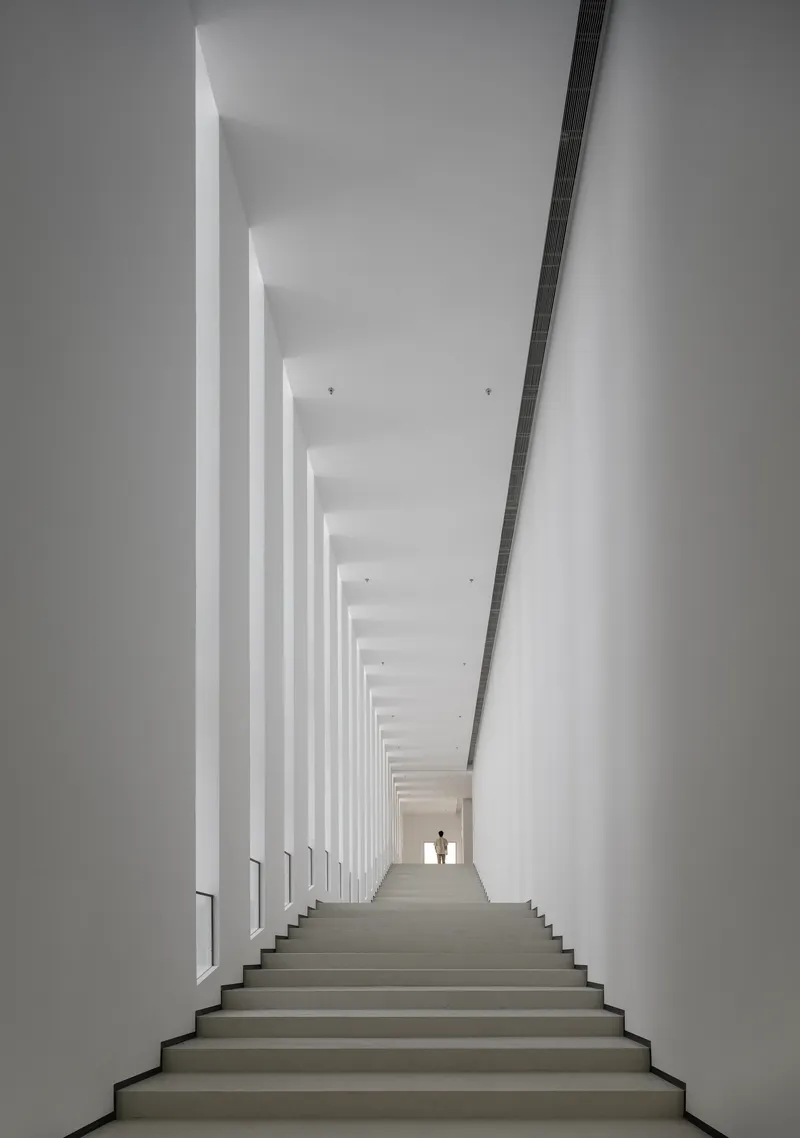

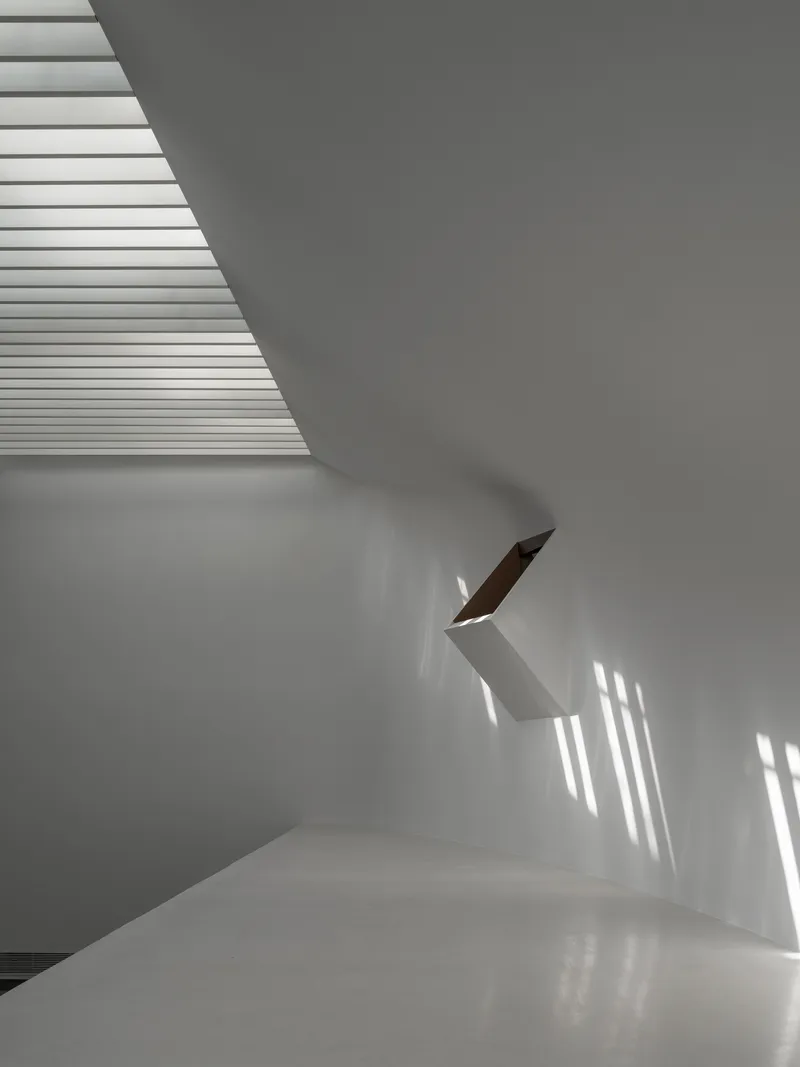
Staircases and ramps in this building do far more than connect floors. The white staircase flanked by vertical columns of daylight is one of the most striking spatial moments in the project: two silhouetted figures at the top are backlit by narrow slots of light, turning a functional element into a piece of theater. The curved copper-clad ramp crossing a double-height space introduces a sweeping gesture that bridges the upper and lower galleries, creating visual connections between levels and drawing visitors upward.
Timber handrails catch striped shadows from overhead louvers along secondary stairs, adding warmth and texture to what might otherwise be austere white volumes. The consistent attention to how light interacts with circulation elements suggests that moving through this building is meant to be as engaging as stopping to look at an exhibit.
Material Range and Interior Character
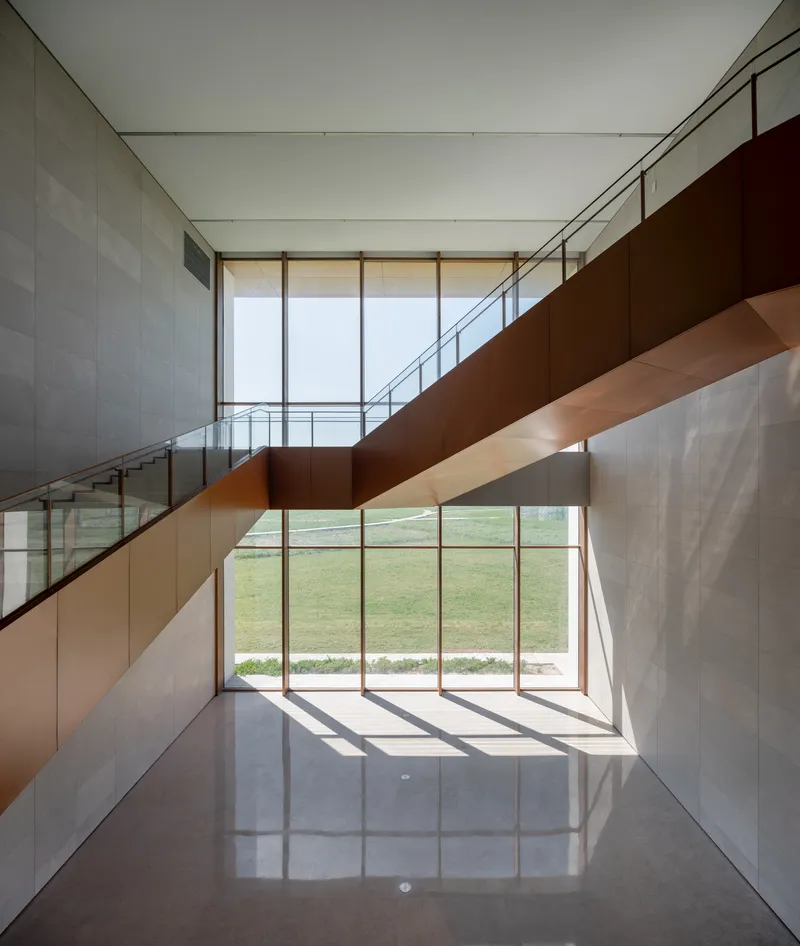

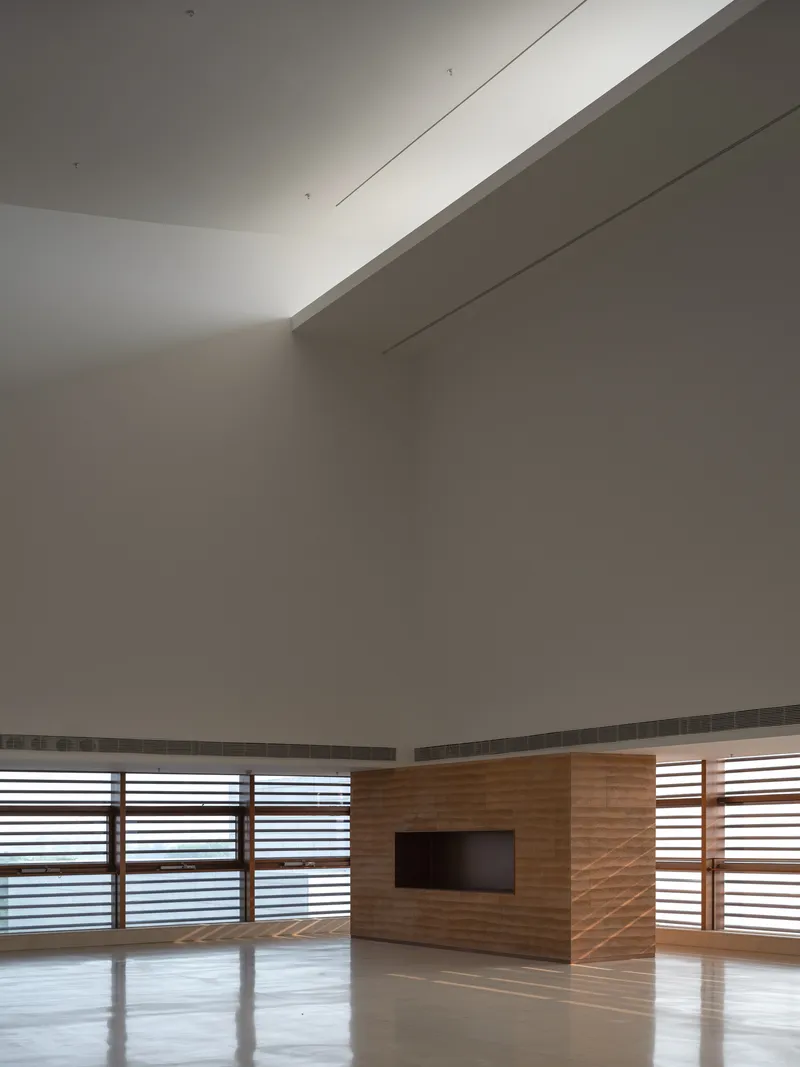
The interiors shift character room by room. The double-height lobby pairs a corten steel staircase with a fully glazed curtain wall that frames a green lawn, establishing an immediate connection between the institutional interior and the agricultural exterior. Elsewhere, an open-plan room with timber shelving grids, a stone floor, and ribbon windows feels more like a well-appointed library or workshop than a gallery. A wood-clad wall housing a recessed screen, combined with horizontal louvered windows, suggests spaces adapted for presentations and industry events.
This programmatic variety is the quiet achievement of the project. A 20,000-square-meter exhibition center could easily default to a monotonous sequence of white-walled rooms. Instead, each space carries its own material identity while remaining part of a coherent whole.
The Dusk Facade
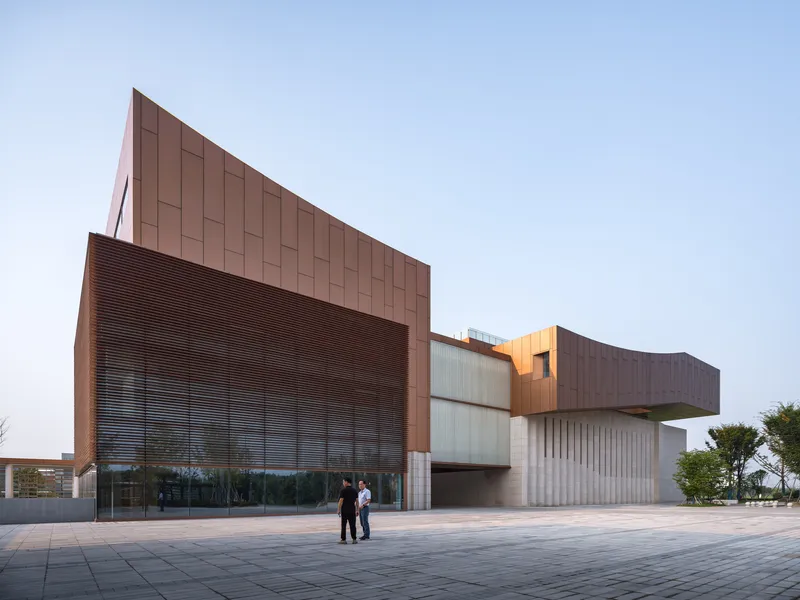
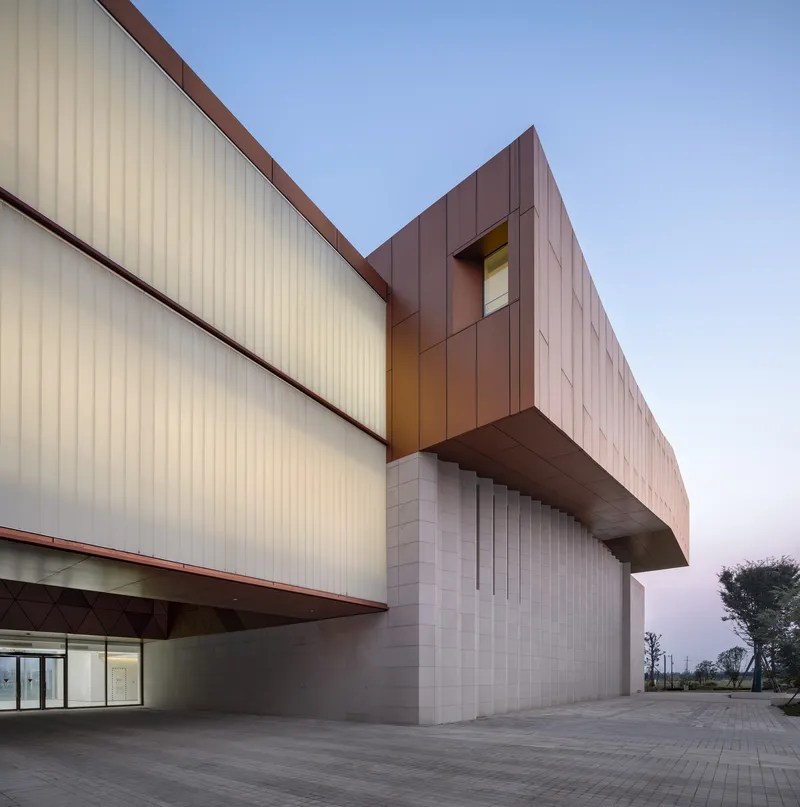
The building photographs exceptionally well at twilight, and that is not a coincidence. The stacked volumes clad in copper panels and vertical concrete fins take on a warm glow as artificial light fills the interiors and the sky fades. The junction between the light metal panel facade and the cantilevered bronze volume becomes especially legible at this hour, when the material contrast sharpens and the structural logic of the cantilever reads clearly against the darkening sky.
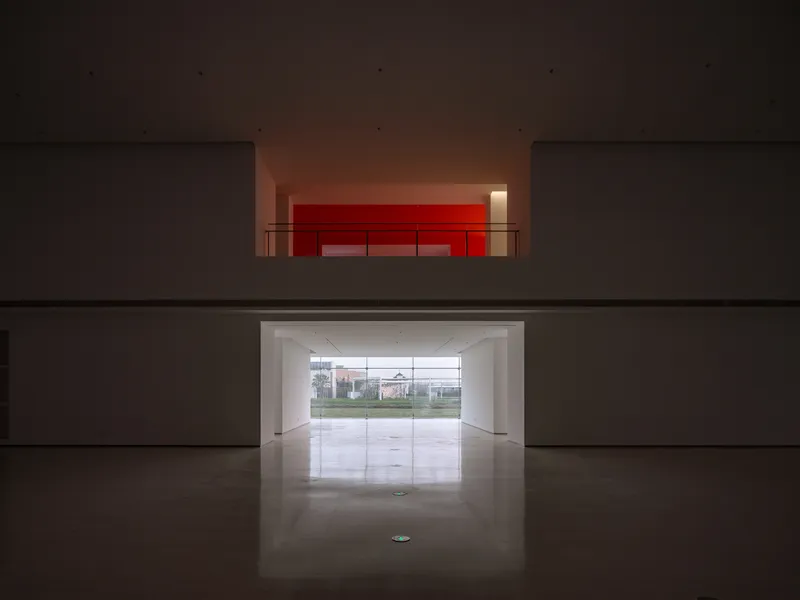
A view through the double-height void reveals a red-lit upper gallery above a ground-level glazed entrance that opens onto the landscape beyond. The layered transparency, with interior illumination filtering out through multiple planes of enclosure, gives the building a lantern-like quality after dark. For a facility that hosts evening events and conferences, this is not just atmospheric; it is functional generosity.
Plans and Drawings


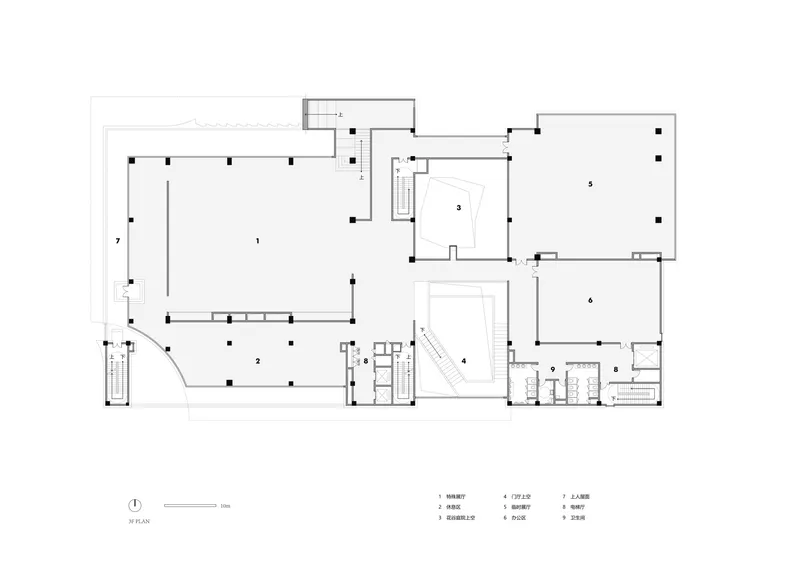
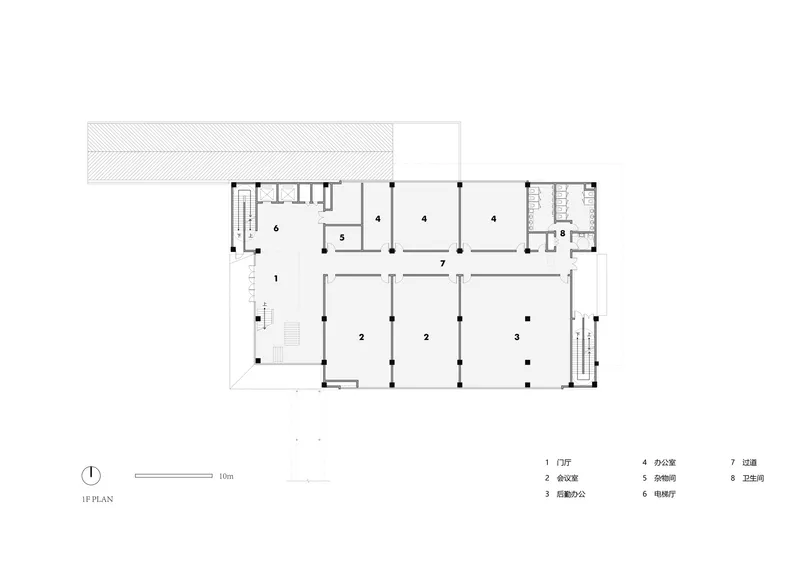


The section drawing reveals a sawtooth roof profile that explains the varied daylighting strategies encountered inside. The multi-level interior volumes step up and down, creating the double-height spaces, voids, and mezzanines that give the building its spatial richness. Ground floor plans show large open gallery spaces arranged around a central courtyard, with service zones pushed to the perimeter. Upper levels reduce in footprint, opening central voids that look down to the entry below and allowing light to penetrate deep into the plan.
The two sets of floor plans correspond to the two connected volumes visible in the aerial view, each organized differently. One prioritizes large, flexible open spaces suited to exhibitions; the other arranges smaller rooms around courtyards with staircases at corners and a terrace area, better suited to conferences and smaller gatherings. The south and west elevation drawings show the low, horizontal massing with a mix of brick, corrugated metal, and surrounding trees that reinforces the project's commitment to sitting modestly within its agricultural context.
Why This Project Matters
Agricultural exhibition centers occupy an odd spot in the typological hierarchy. They need the flexibility and scale of a convention hall, the atmospheric control of a museum, and the civic legibility of a cultural center, yet they typically serve regions and industries that are not associated with high-design ambition. The Haining Natural Exhibition Center challenges that expectation head-on. Sens Architects delivered a building that takes its program seriously without defaulting to the generic shed-plus-lobby formula that dominates this category.
The real lesson here is about engagement with site. A 20,000-square-meter building in flat farmland could have been an imposition, a glass and steel box dropped from another context. Instead, the project's material choices, its horizontal emphasis, its stepped relationship with water and ground, and its precise daylighting strategies all demonstrate that civic architecture in agricultural landscapes does not have to choose between ambition and sensitivity. It can, and should, pursue both.
Haining Natural Exhibition Center by Sens Architects (lead architects Zhang Juntian and Sun Hongfei), Jiaxing, China. 20,000 m². Completed 2025. Photography by Qingshan Wu.
About the Studio
Share Your Own Work on uni.xyz
If projects like this are the kind of work you want to make, uni.xyz is a place to publish your own, find collaborators, and enter design competitions.


Popular Articles
Popular articles from the community


Lunar Spiral: Space Architecture Shaped by the Mathematics of the Universe
Lunar Spiral reimagines space architecture through Fibonacci geometry, lunar regolith, levitating habitats, and self-sustaining Moon living.

ALGAL REALM: A Bio-Integrated Lunar Habitat Design for Life Beyond Earth
ALGAL REALM reimagines lunar habitat design with algae-powered life support, 3D-printed regolith, and vertical living for a lunar future.

Little Red Riding Hood: Architectural Design as a Journey Through Fear, Light, and Storytelling
Little Red Riding Hood reimagines the fairy tale through architectural design shaped by fear, light, scale, memory, uncertainty, and choice.

Hill & Cross Opera: Sculptural Opera House Architecture Shaped by Tallinn’s Landscape and Identity
Hill & Cross Opera reimagines opera house architecture in Tallinn through its sculptural hill, civic plaza, glass wave and a luminous cross.

Similar Reads
You might also enjoy these articles

Bao Huynh Watercolor Atelier: A Serene Art Retreat in Hội An
Bao Huynh Watercolor Atelier in Hội An blends multifunctional art spaces, sustainable design, local materials, and family-friendly living in a serene environment.

Atelier Macri Concept Store Interior Design by CASE-REAL
Atelier Macri store features a "ko" counter, walnut wood details, cork displays, blending retail, gallery, and seamless customer experiences.

Manuel Vargas Izquierdo Stadium and High-Performance Sports Center: Architectural Excellence in Jalpa de Méndez
The Manuel Vargas Izquierdo Stadium blends sustainable design, inclusive sports facilities, and cultural-inspired architecture, revitalizing Jalpa de Méndez’s public spaces.

KAKR Buluh Awar Hall: Revitalizing Community and Ecology Through Bamboo Architecture
Community built bamboo hall revitalizes Buluh Awar village, empowering youth, restoring ecology, celebrating vernacular craftsmanship through sustainable architecture and culture.

Explore Chinese Small Scale Architecture Competitions
Discover active competitions in this discipline

Comments (0)
Please login or sign up to add comments
No comments yet. Be the first to comment!