

Sher Maker Stitches a Textile Workshop from Corrugated Steel and Dyed Timber in Chiang Mai
Long Goy Studio treats its own facade like a garment, folding pleated metal and hand-dyed wood into a 200 m² workshop for Lanna street fashion.


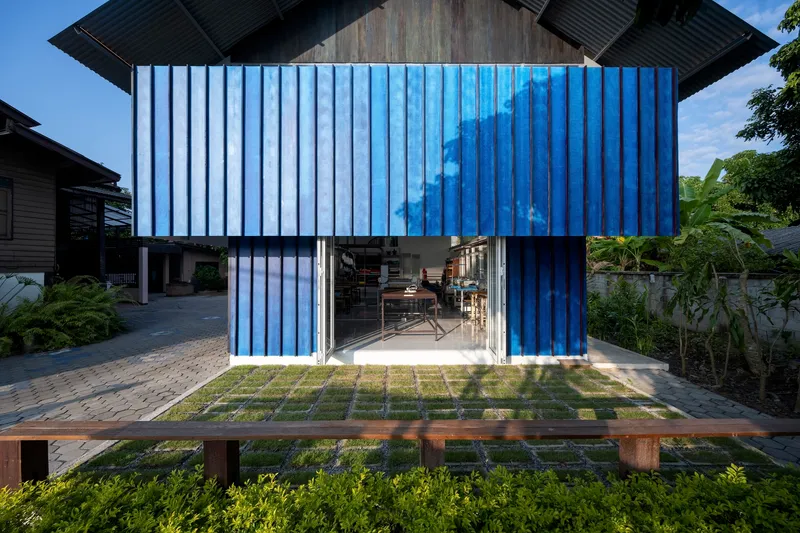
A fashion label that takes its name from the northern Thai phrase for "try it" deserves a building that does the same. Long Goy, a Lanna street fashion house rooted in Chiang Mai, commissioned Sher Maker to design a compact 200 m² studio and workshop that would hold every stage of the garment lifecycle under one roof: design, sewing, exhibition, storage, and distribution. The result is a blue corrugated volume that sits on the footprint of a demolished rice barn and borrows its proportions, its orientation parallel to the original house, and its relationship to a shared courtyard.
What makes Long Goy Studio genuinely interesting is not the material palette alone but the logic behind it. The facade is conceived as a garment turned inside out. Two-sided timber slats, dyed blue on one face and red on the other, are arranged in a pleating technique that mimics the flipped seams of textile sewing. Corrugated steel, glass block, and smart board panels are all sourced from local construction shops rather than specialty suppliers. The building performs the same resourceful improvisation that defines the clothes produced inside it.
A Rice Barn Recalled
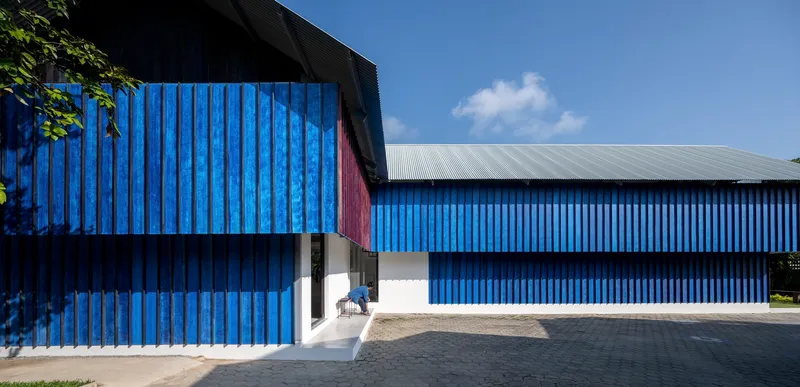
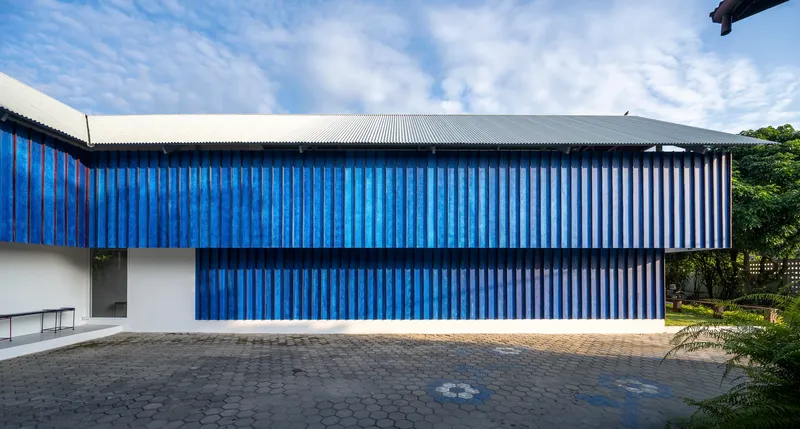
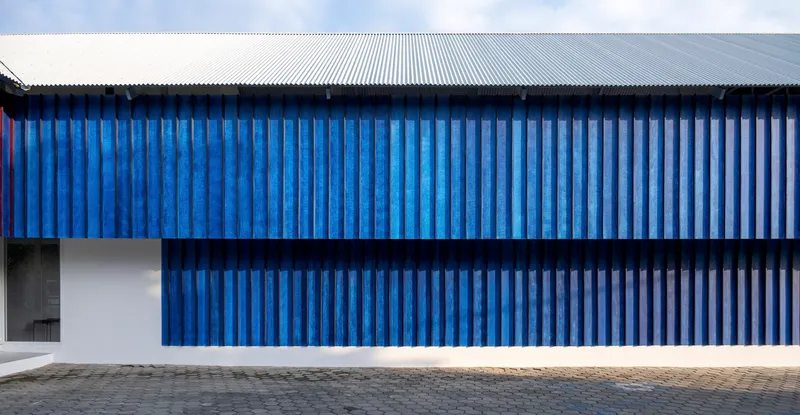
The long gabled volume reads from the street as a familiar northern Thai barn: pitched roof, vertical cladding, a modest footprint scaled to the domestic fabric around it. That reading is deliberate. The building occupies the precise location and proportions of a rice barn that once stood on site. Rather than erasing that memory, Sher Maker dismantled the original timber structure and reassembled it as a garden pavilion behind the new workshop, keeping the genealogy of the site legible.
From the street, the saturated blue corrugated metal and the tight horizontal banding give the volume a crispness that separates it from outright nostalgia. It is vernacular in silhouette, contemporary in surface, and deliberately ambiguous about where one ends and the other begins.
The Facade as Garment
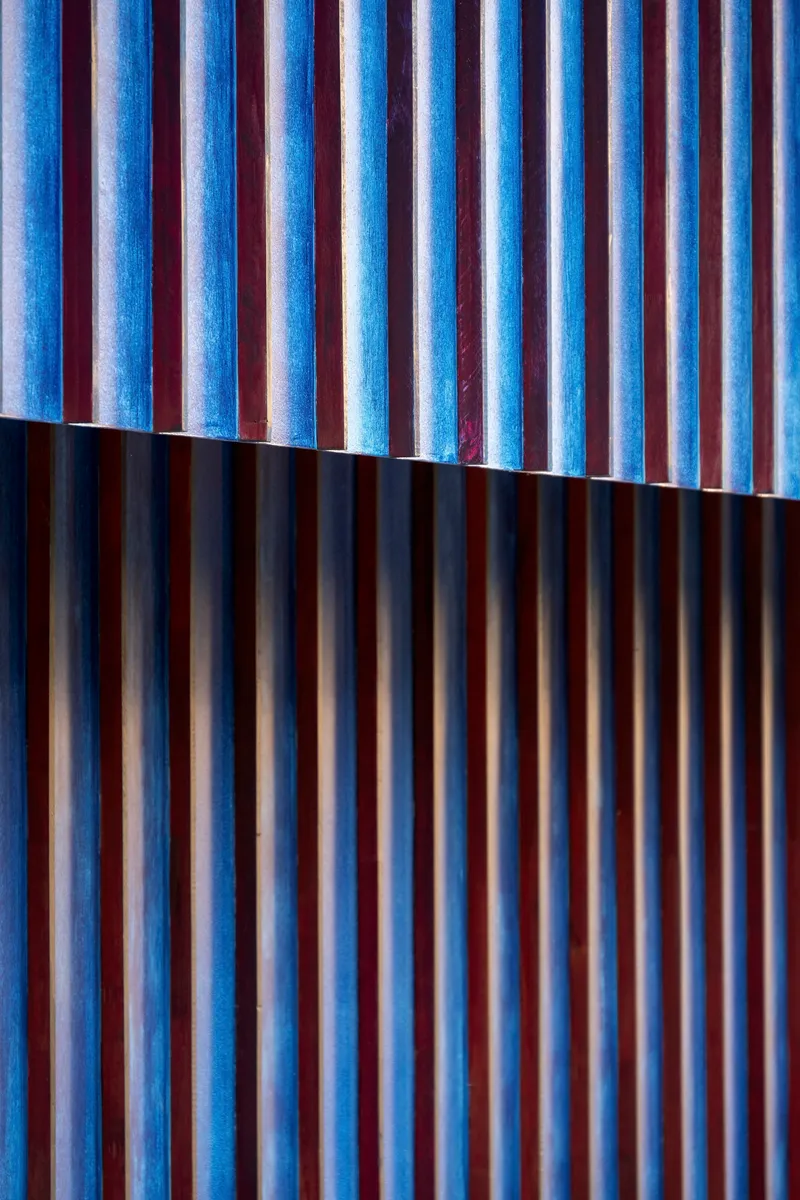
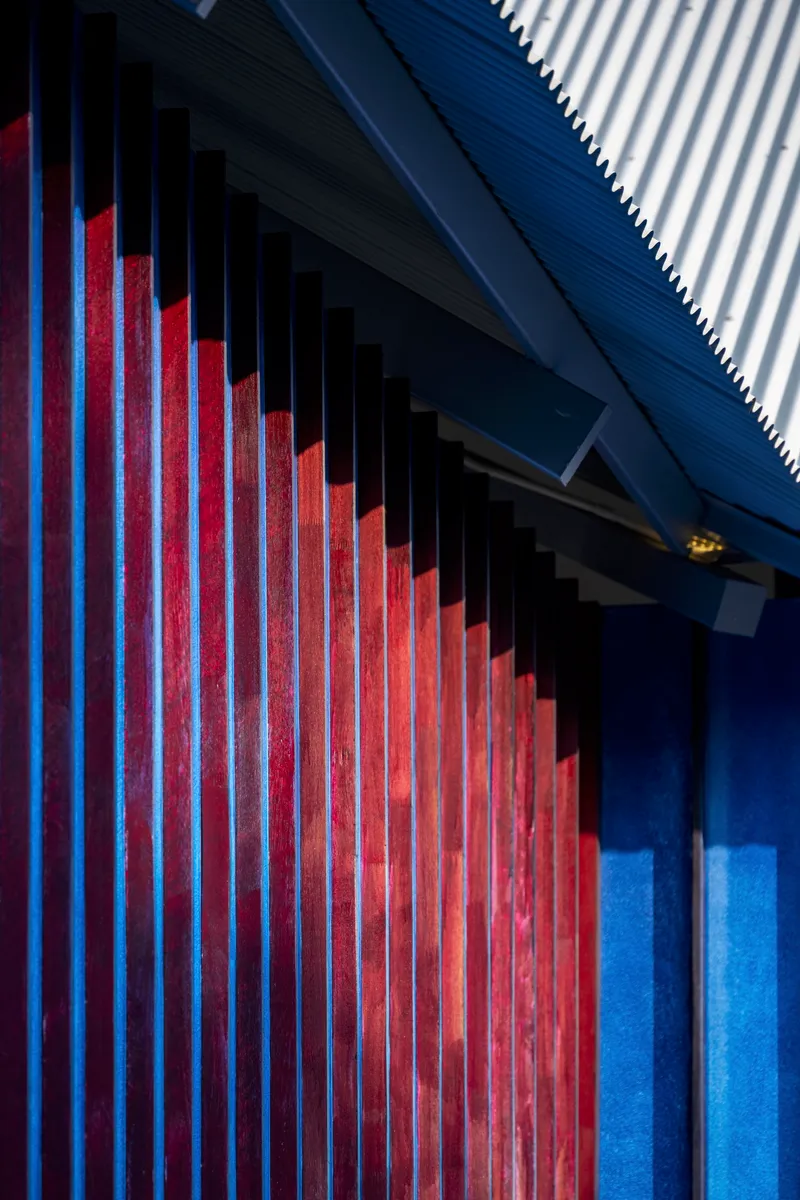
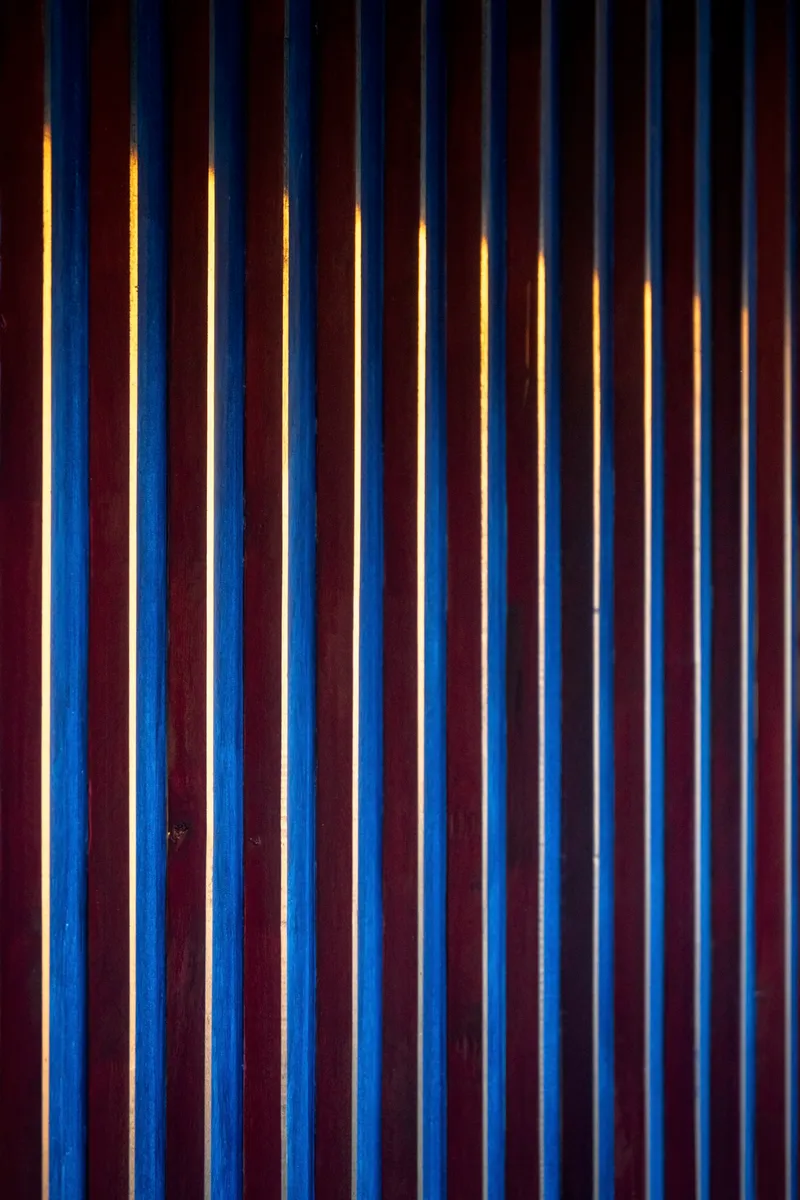
The building's signature move is its timber slat screen. Hardwood boards, each dyed blue on one side and red on the other, are fixed at alternating angles so that the color you see depends on where you stand. Walk along the facade and the wall shifts from cool blue to warm red, a kinetic effect achieved with zero moving parts. The technique directly references how a sewn seam reveals different fabrics when flipped, collapsing the distance between the building's skin and the textiles produced within.
At night, interior light bleeds through the gaps between slats, turning the screen into a lantern. During the day, tree canopies cast dappled shadows across it. The facade is never static, and that restlessness suits a studio where material experiments are constant.
Material Testing as Design Method
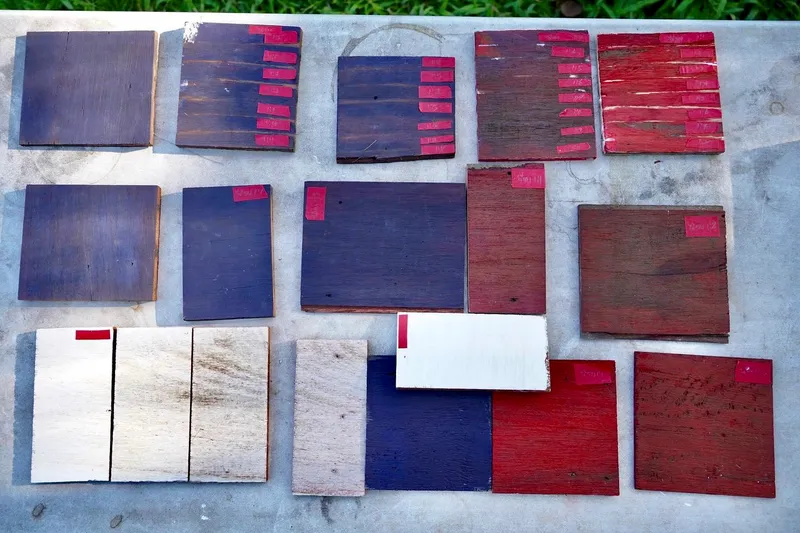
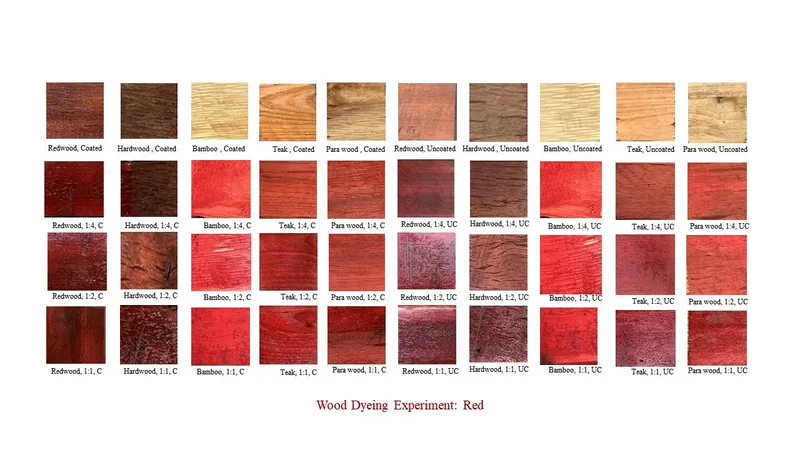
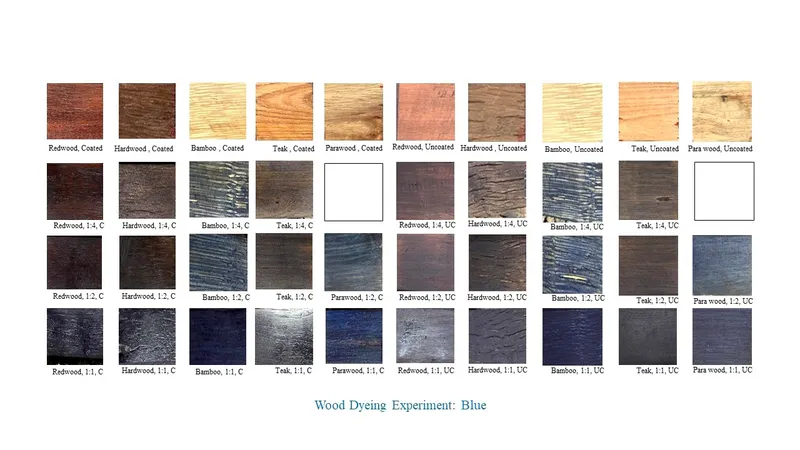
Sher Maker's process here borrows from the fashion studio's own methodology: sampling, dyeing, testing, iterating. Arrays of wood boards were stained with red and blue dyes across multiple species and coating variations before the final palette was selected. The evidence of that process, paint buckets and sample boards scattered across worktables, is itself a kind of exhibit within the building.
Every material was sourced from local construction shops in Chiang Mai. Corrugated steel, smart board panels, standard glass block: nothing here requires a specialty supplier or international shipment. The constraint is productive. It forces the architecture to derive richness from treatment and assembly rather than from expensive imported finishes.
Courtyard and Pavilion
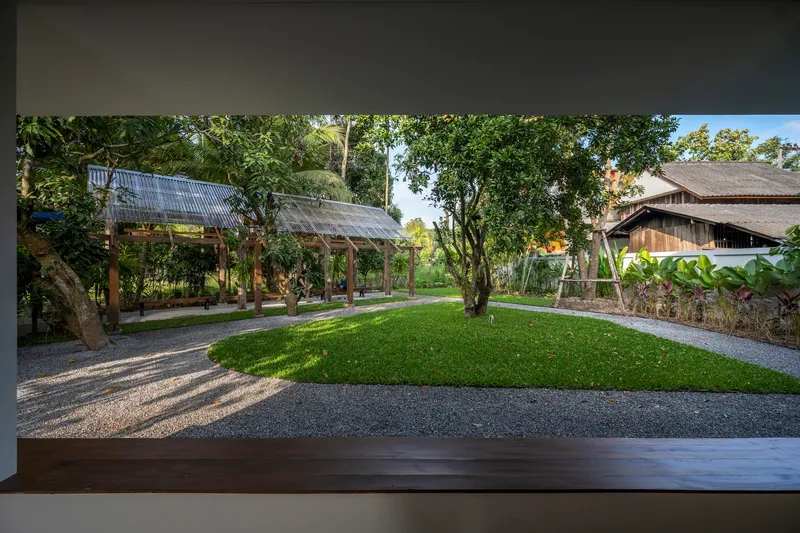
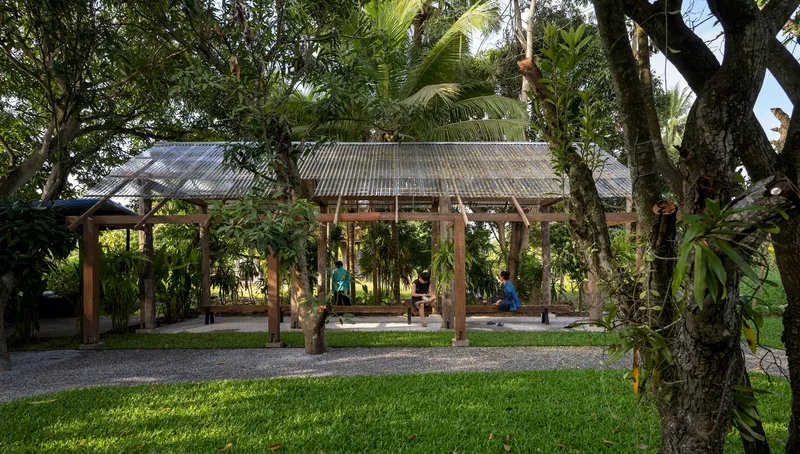
The new workshop and the existing house frame a courtyard between them, connected by grass pavers and gravel paths. A circular stone water feature anchors the middle ground, and the reassembled rice barn pavilion sits at the garden's edge under mature trees. The pavilion is open-sided and shelters an informal workspace, extending the productive floor area outdoors when the climate allows.
Folding glass doors along the workshop's courtyard face dissolve the threshold between interior and exterior. The sewing workshop opens directly to the garden, so the light, breeze, and vegetation become part of the daily working environment. It is a generous arrangement for a building that is, by square meters, quite small.
The Workshop Interior
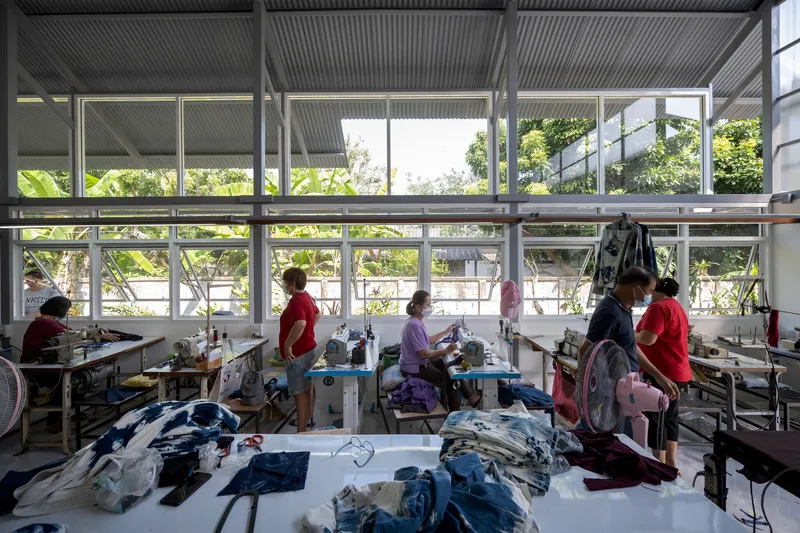
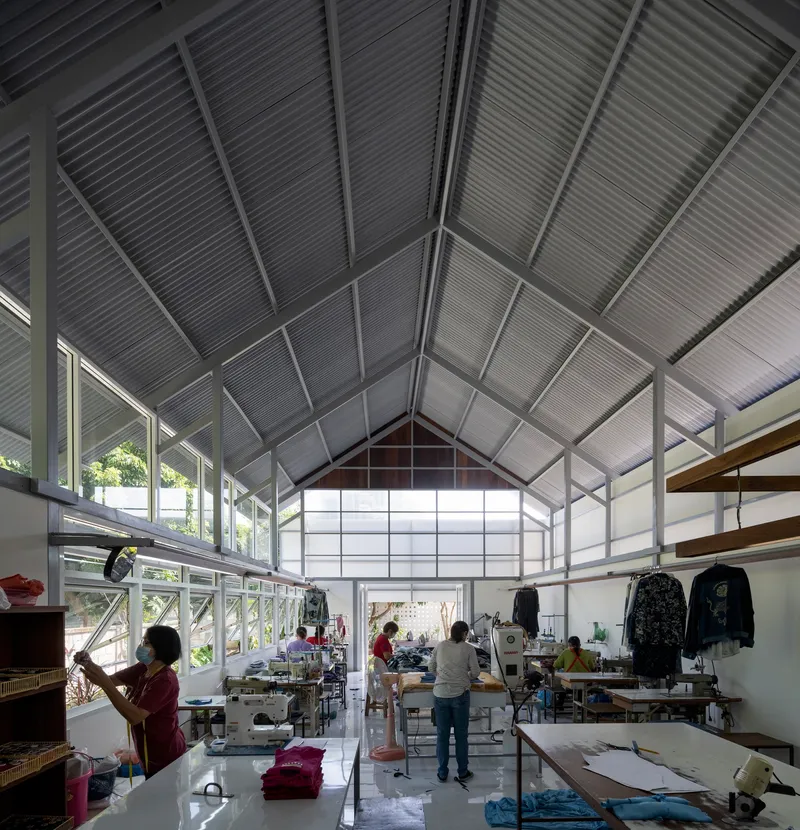
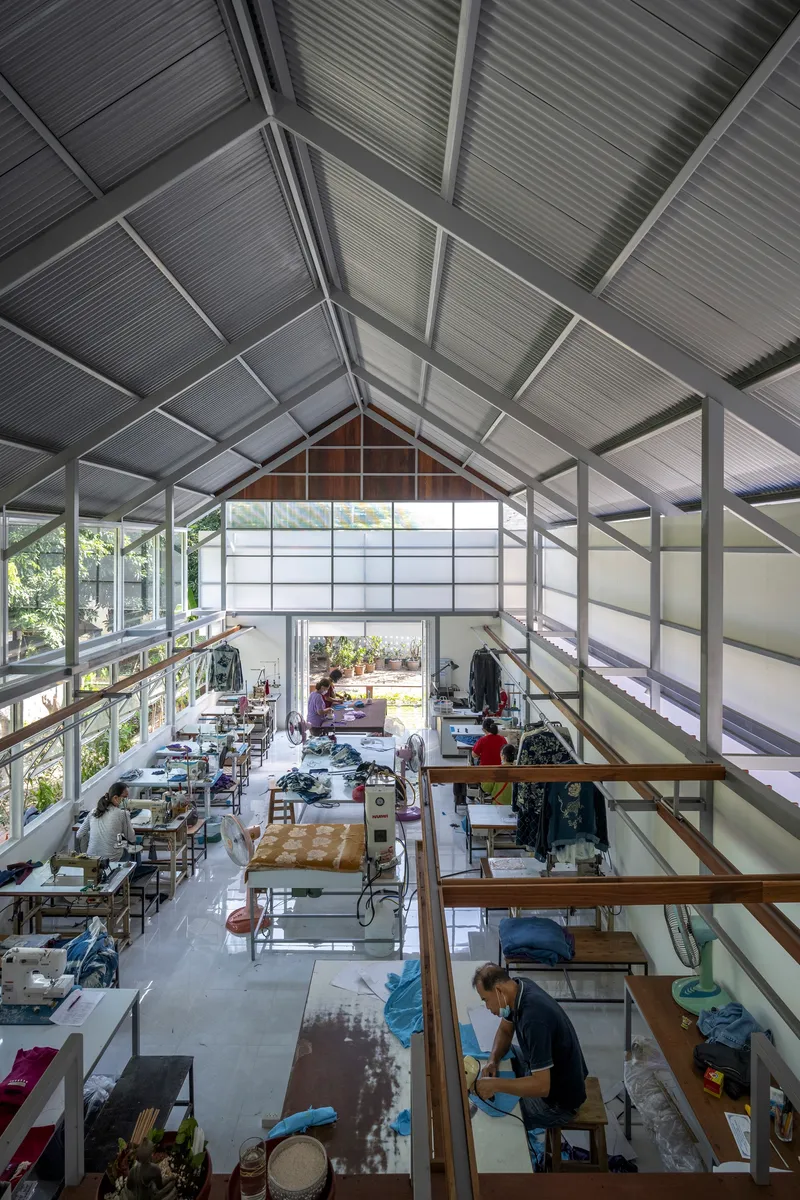
Inside, the sewing workshop takes up the majority of the plan. Workstations are arranged beneath a double-height gabled ceiling supported by exposed steel trusses. Translucent panels at the ridge let diffused light wash down while corrugated cladding wraps the walls. Glass openings on the north side pull in stable daylight without the heat penalty of southern exposure, where the overlapping solid facade provides protection.
The high atrium is not decorative. It drives passive ventilation during working hours, pulling warm air upward and out while cooler air enters at ground level. For a workshop where multiple sewing machines run simultaneously, thermal comfort is a practical priority, not a luxury.
Display and Retail Spaces
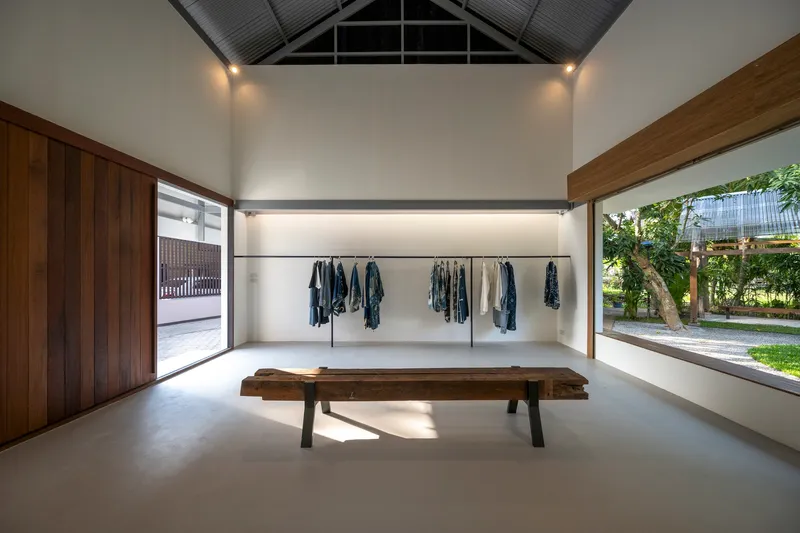
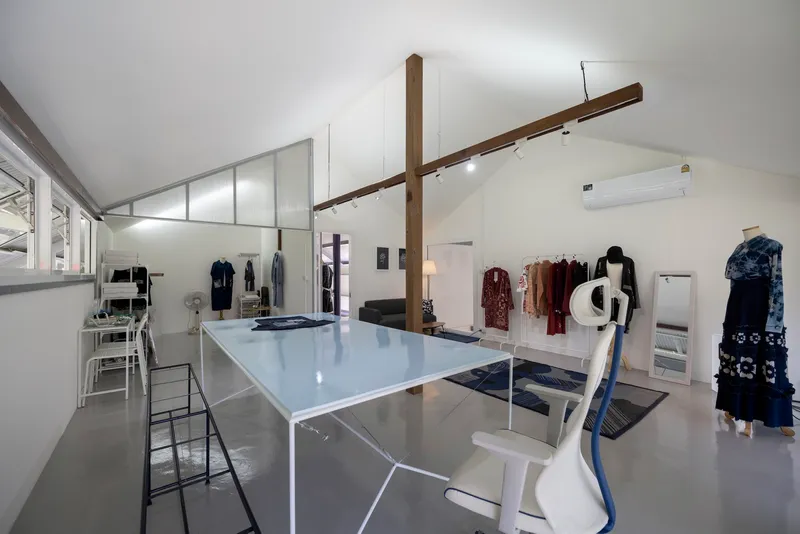
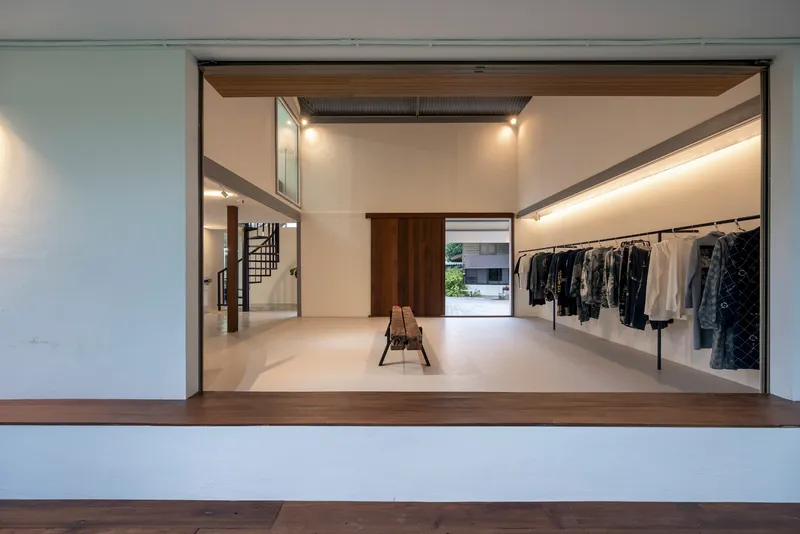
Adjacent to the production floor, smaller rooms handle exhibition and retail. Garments hang from racks and wall-mounted displays alongside fabric samples pinned to boards, blurring the line between showroom and studio. A timber bench runs below horizontal windows that frame the garden, grounding the retail experience in the same landscape that surrounds the making.
The spiral stair visible through a wide timber-framed opening connects the mezzanine level, which houses additional storage and workspace. Exposed timber beams cross overhead, reinforcing the barn vernacular even in the most programmatically contemporary zones.
Detail and Atmosphere at Dusk
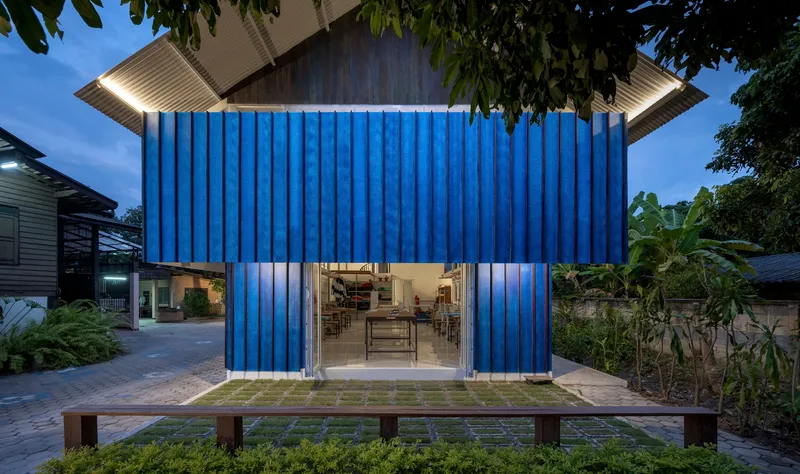
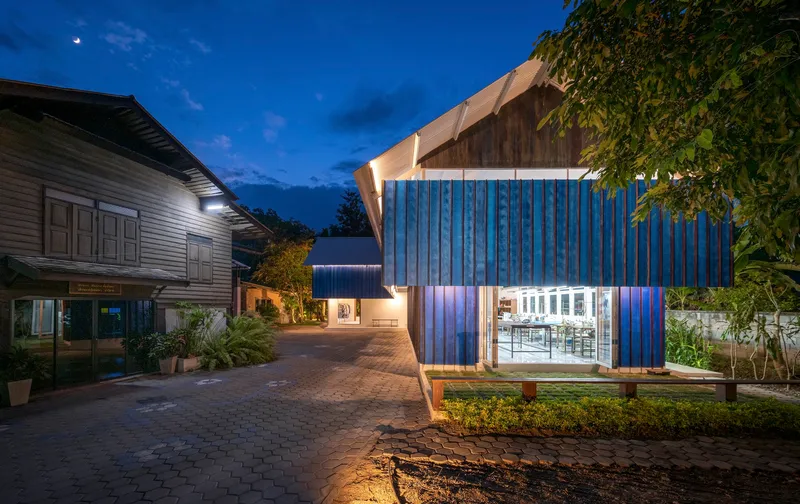
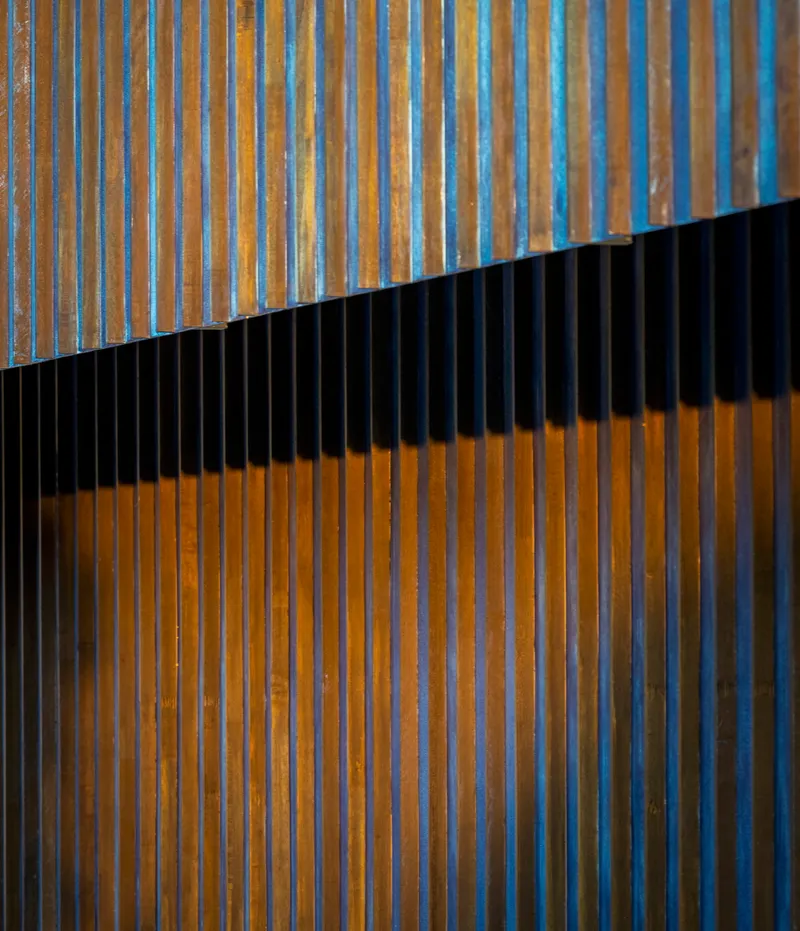
At dusk the building comes alive differently. Interior lighting transforms the glazed openings into warm frames set against the deep blue cladding, and the timber slat screens glow from within. The corrugated metal catches the last light, shifting from matte blue to near-black. The diagonal metal screen on one elevation casts long shadow lines across the vertical slats, adding a graphic layer that disappears entirely by midday.
These atmospheric effects are not incidental. They emerge from material decisions made earlier in the design process: the choice of a semi-transparent screen, the dual dye on timber, the deliberate mix of opaque and translucent surfaces. The architecture rewards time spent with it.
Plans and Drawings
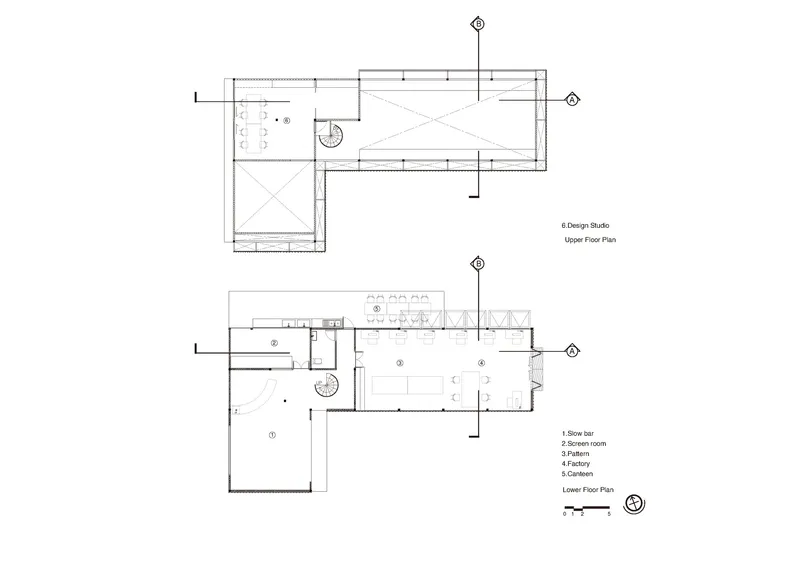
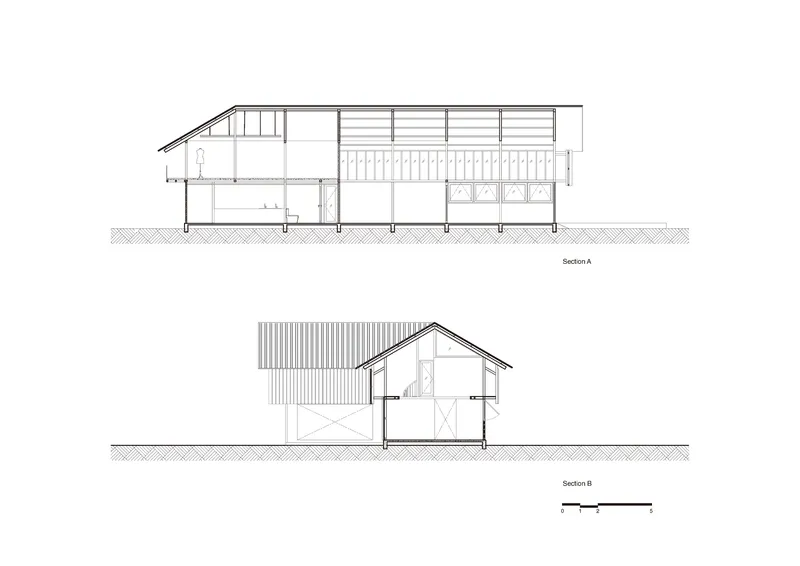
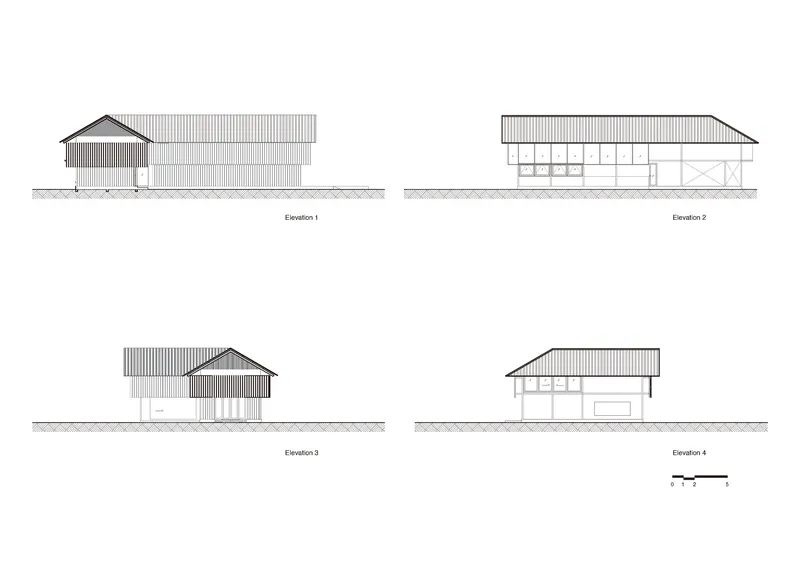
The floor plans confirm what the building communicates spatially: a simple long house organization with the sewing workshop occupying the dominant volume and smaller support rooms stacked at one end. The section drawings reveal the pitch of the gable and the height of the atrium, showing how the ridge rises well above the mezzanine level to create the ventilation stack. Elevations document the four faces of the building, each with a distinct window configuration calibrated to its solar orientation.
Why This Project Matters
Long Goy Studio and Workshop demonstrates that a building for making clothes can be designed with the same rigor and material intelligence that goes into the clothes themselves. Sher Maker's approach, sourcing locally, dyeing and testing materials obsessively, and grounding the form in the rice barn vernacular of northern Thailand, produces architecture that is specific to its place and its program in a way that generic industrial sheds never are.
At 200 square meters, the project is modest in scale. But its ambition is not. By treating the facade as a two-sided textile, by relocating the demolished barn as a pavilion, and by letting the courtyard and the workshop breathe into each other, the building argues that craft-based enterprises deserve architecture that takes their processes seriously. Long Goy means "try it." The building does.
Long Goy Studio and Workshop, designed by Sher Maker (lead architects: Patcharada Inplang, Thongchai Chansamak, Akapan Kanyen). Chiang Mai, Thailand. 200 m². Completed 2022. Photography by Rungkit Charoenwat.
About the Studio
Share Your Own Work on uni.xyz
If projects like this are the kind of work you want to make, uni.xyz is a place to publish your own, find collaborators, and enter design competitions.


Popular Articles
Popular articles from the community


The Amber Palace Opera: A Geological Fiction Surfaces on Tallinn's Baltic Waterfront
Pierre Brillard reimagines a Baltic legend as a public landscape, opera house, and waterfront promenade rooted in Tallinn's coastal identity.


ETEH Reworks the Shared Spaces of São Domingos School in Brazil Around Timber, Color and Hanging Plants
At São Domingos School in Brazil, 436 m² of hall, refectory and library are recast with timber joinery, a yellow and blue code and trailing greenery.

Aquadapt: An Underwater Habitat That Rewrites Its Rooms by the Hour
Curved modules ring the seabed while one shell shifts from breakfast room to cinema, farm and football pitch as residents' needs change.

FCC Arquitectura Expands a Portuguese Granite House with a Board-Marked Concrete Wing
In Portugal, JV House pairs a cleaned-up whitewashed and granite dwelling with a timber-shuttered concrete extension, courtyards and a garden pool.

Similar Reads
You might also enjoy these articles

LAVA Architecten Gives Vocational Education a Sawtooth-Roofed Face on a Mechelen School Campus
In Mechelen, Belgium, a 2,053 m² STEM school on a 6×6 m grid turns workshops and classrooms into rooms that can be rearranged as teaching changes.

KEMA Studio Turns a Derelict Marvila Attic into a 60 m² Lighthouse Apartment Above Lisbon
In Lisbon's Marvila district, a rebuilt roof, four skylights and two plywood volumes turn an unlivable attic into a bright home facing the Tagus.

Pixel Gardens: One Repeated Module Stacked Into a Terraced Social Housing Tower for Famagusta
Salem Bader's shortlisted housing tower builds a vertical neighbourhood from one repeated module, offsetting units to carve terraces, light and air.

Bao Huynh Watercolor Atelier: A Serene Art Retreat in Hội An
Bao Huynh Watercolor Atelier in Hội An blends multifunctional art spaces, sustainable design, local materials, and family-friendly living in a serene environment.

Comments (0)
Please login or sign up to add comments
No comments yet. Be the first to comment!