
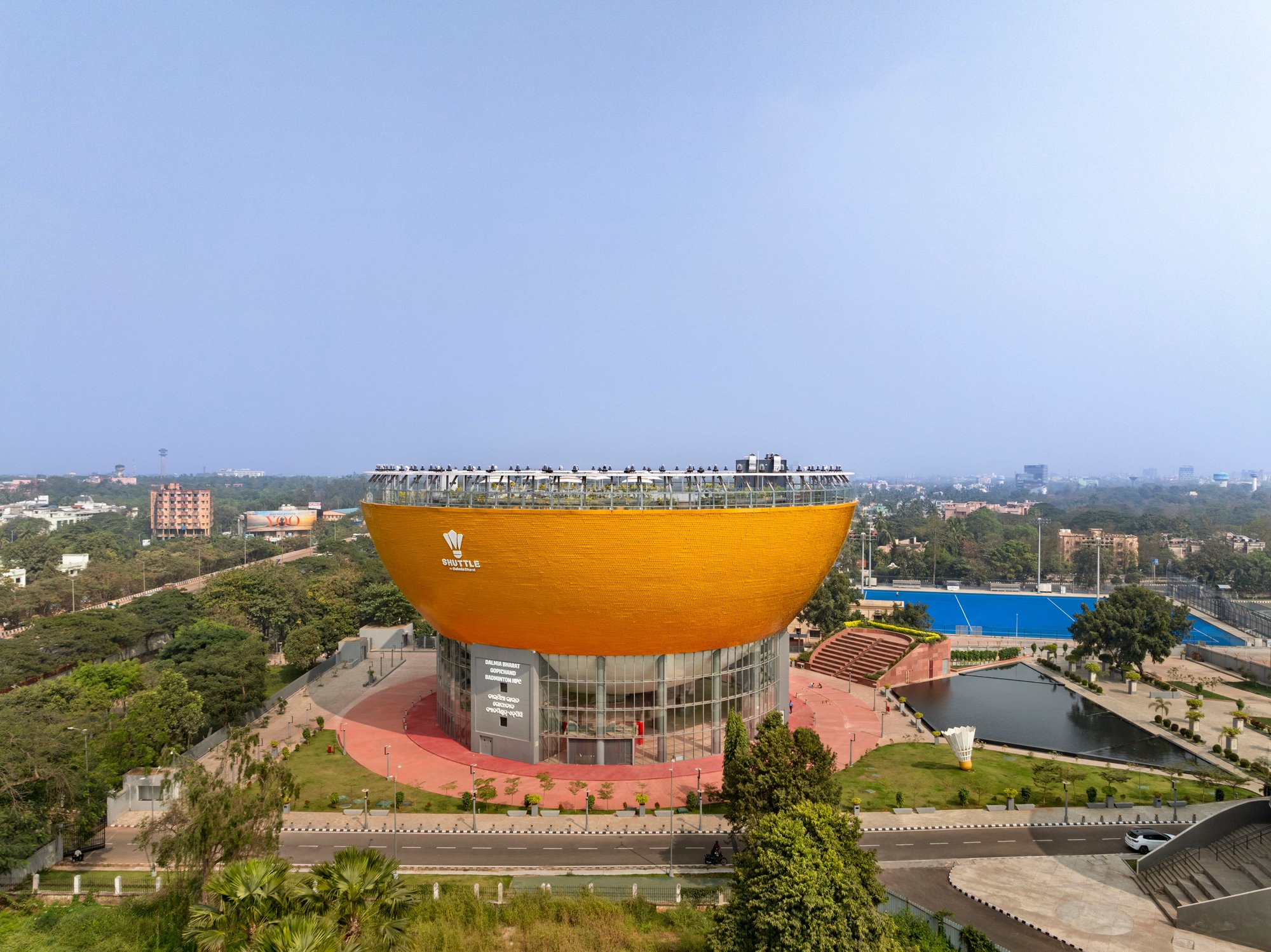
The Shuttle Badminton Academy by Studio Archohm
A golden bowl rises in Odisha to house India's next generation of badminton talent, merging sport infrastructure with civic ambition.

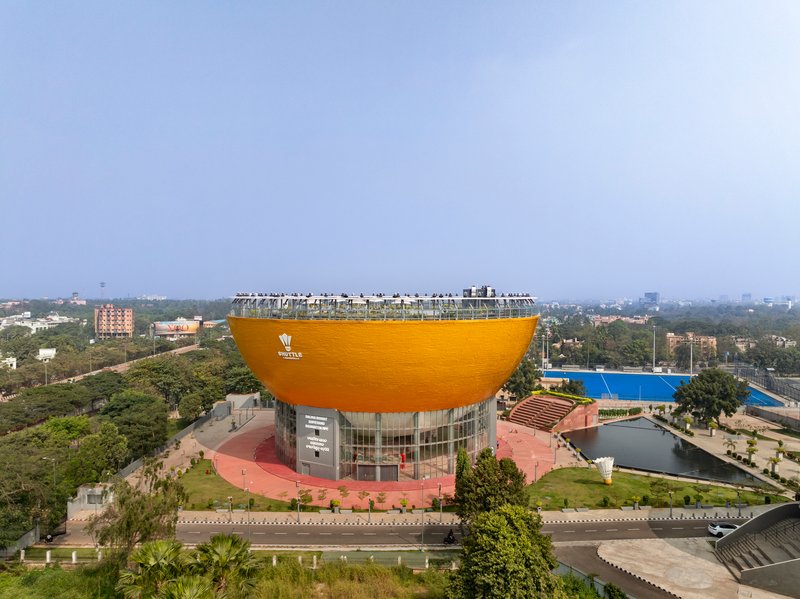
Sport in India rarely gets the architecture it deserves. Training facilities are typically utilitarian sheds, afterthoughts of municipal planning. The Dalmia-Gopichand Badminton Academy, known as The Shuttle, refuses that premise entirely. Designed by Studio Archohm under the lead of Sourabh Gupta, the 11,450 square meter complex in Odisha takes the form of an enormous golden bowl, a gesture so bold it turns a sports facility into a civic landmark.
What makes this project genuinely interesting is not merely its striking profile but the argument it makes about investment in athletic infrastructure. The building insists that spaces for sport can carry the same formal ambition as museums or concert halls. It lifts the playing courts into a dramatic volume, wraps them in color-coded interiors, and caps the whole composition with a public rooftop plaza. The result is a building that serves elite athletes and simultaneously gives something back to the neighborhood around it.
The Bowl That Lands
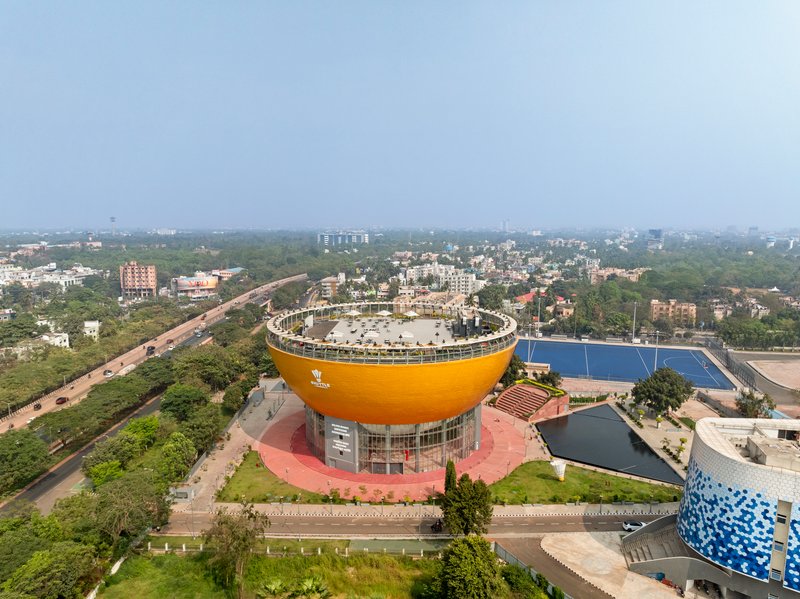
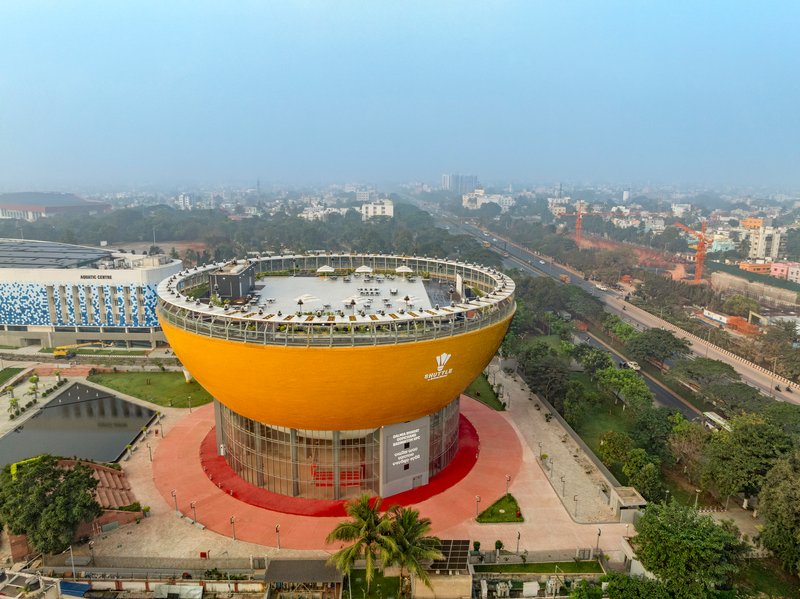
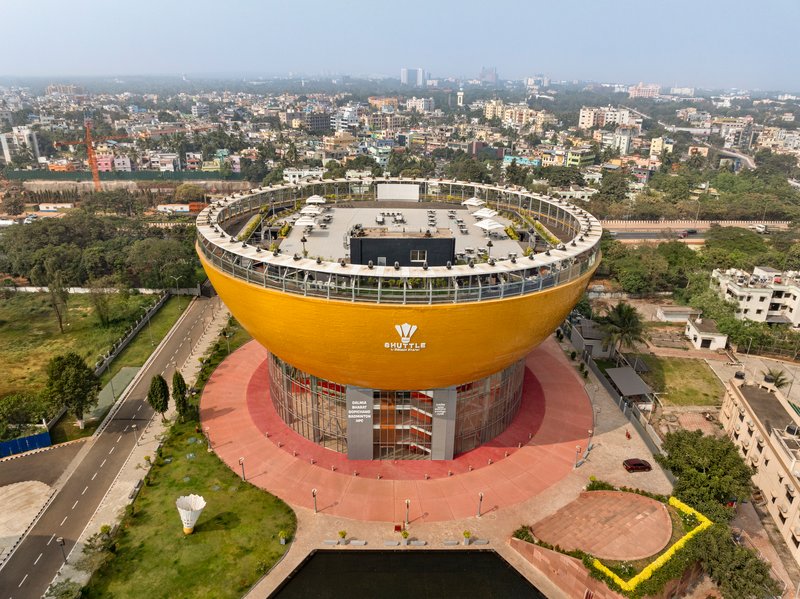
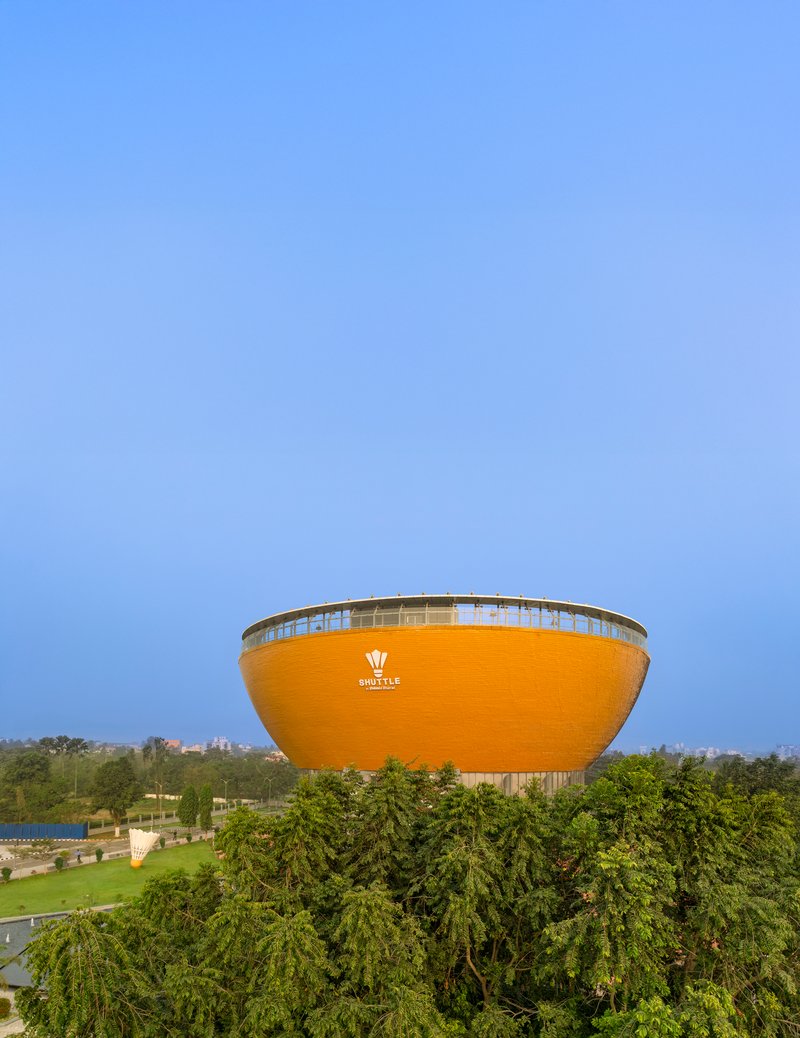
Seen from above, The Shuttle reads as a shuttlecock that has come to rest. The circular footprint tapers outward and upward, producing a bowl shape clad in yellow panels that catch the Odishan sun. A glazed colonnade rings the rooftop perimeter, making the crown of the building feel lighter than its hefty midsection. The form is legible from every approach: across the surrounding residential blocks, from the adjacent roads, even from an aircraft. It is unambiguously a destination.
The pink and red paved plaza at the base acts as a threshold between the everyday city and the athletic interior. Lawns buffer the building from its neighbors, but the composition never hides. This is architecture that wants to be found.
Color as Wayfinding
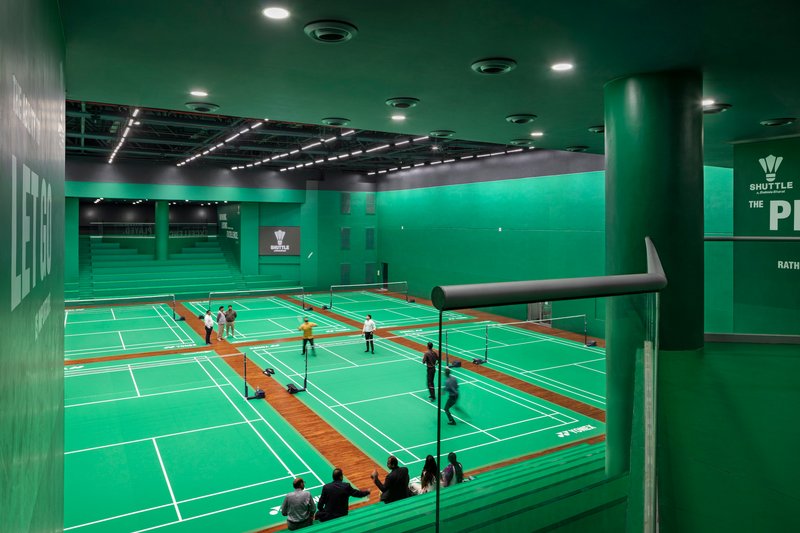
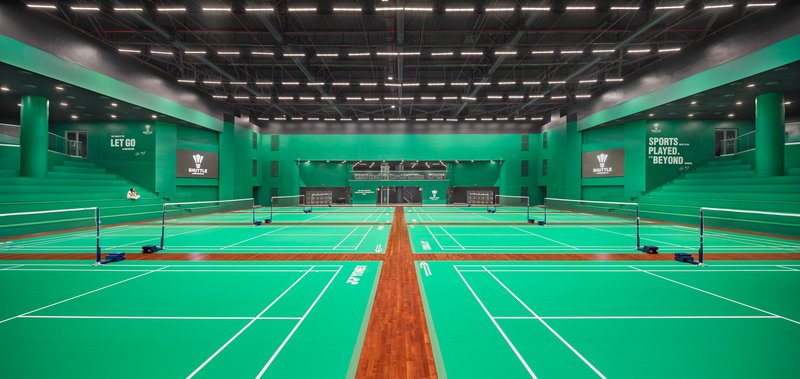
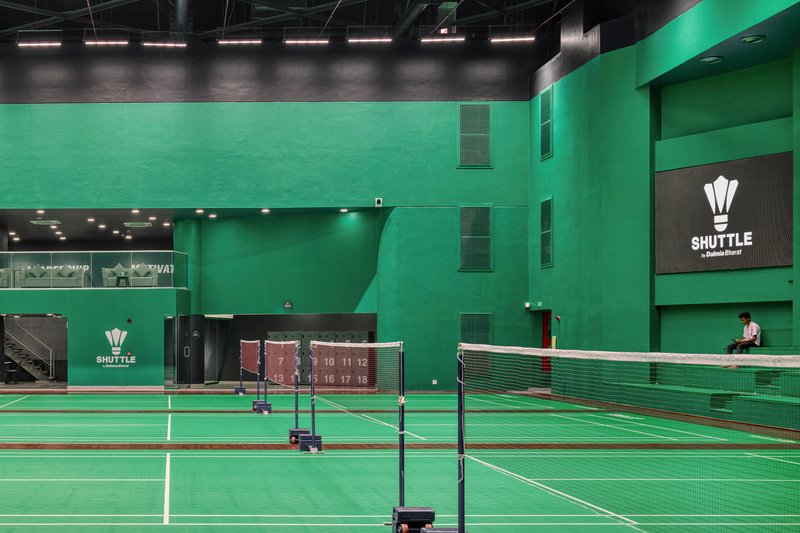
Step inside and the color palette shifts decisively. The badminton courts are wrapped in a vivid mint green, a choice that serves more than aesthetics. Green reduces eye fatigue during fast rallies and provides high contrast with the white shuttlecock, a practical decision dressed in confidence. The playing surfaces themselves are a deeper green, reinforcing the visual hierarchy.
Multiple court levels stack within the bowl's volume, allowing simultaneous training sessions across tiers. A lone figure on an upper balcony in image nine captures the spatial drama: the courts feel expansive yet contained, held within a black ceiling grid that absorbs light and keeps glare off the players below. The linear lighting is precise, calibrated for sport rather than spectacle.
Interior Life Beyond the Court
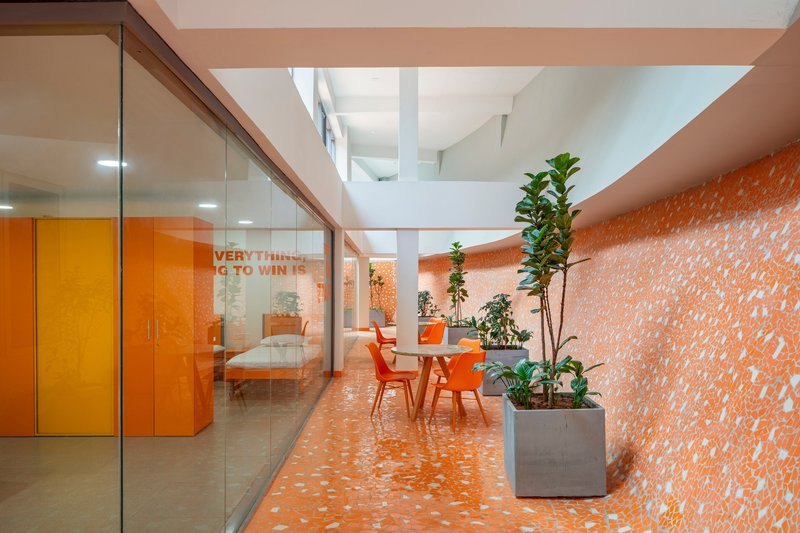
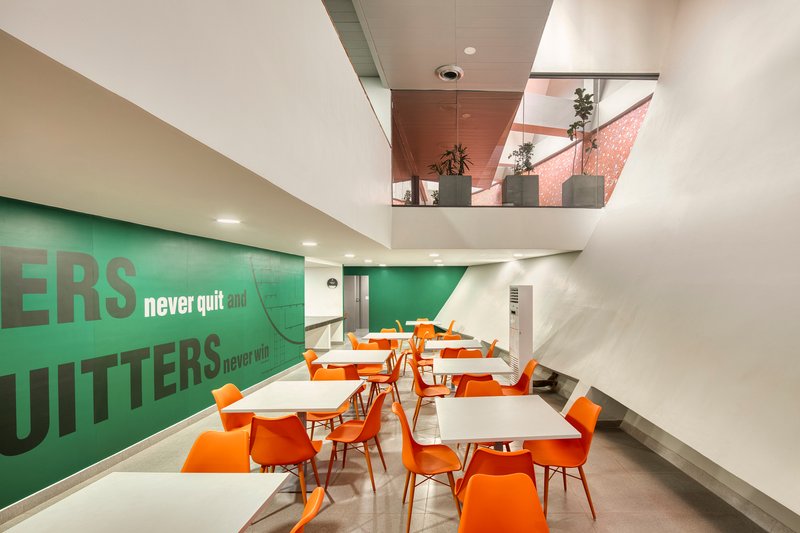
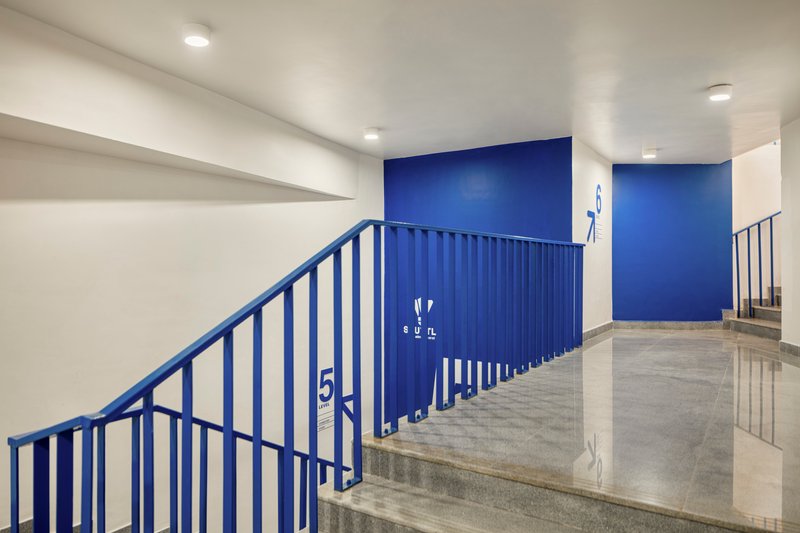
Athletes spend more hours recovering, eating, and studying than they do on court, so the supporting spaces deserve equal attention. Studio Archohm delivers. Corridors paved in orange terrazzo and lined with glazed office partitions feel more like a co-working campus than a gym hallway. Skylights bring natural light deep into the plan, and potted plants soften the hard surfaces.
A dining area uses the same orange seating alongside green wall graphics, continuing the building's distinctive palette. The skylit mezzanine above introduces planters that cascade toward the tables, a small gesture that signals care for daily wellbeing. Even the stairwells, with their blue metal railings and concrete walls, feel intentional rather than leftover.
Rooftop and Public Edge
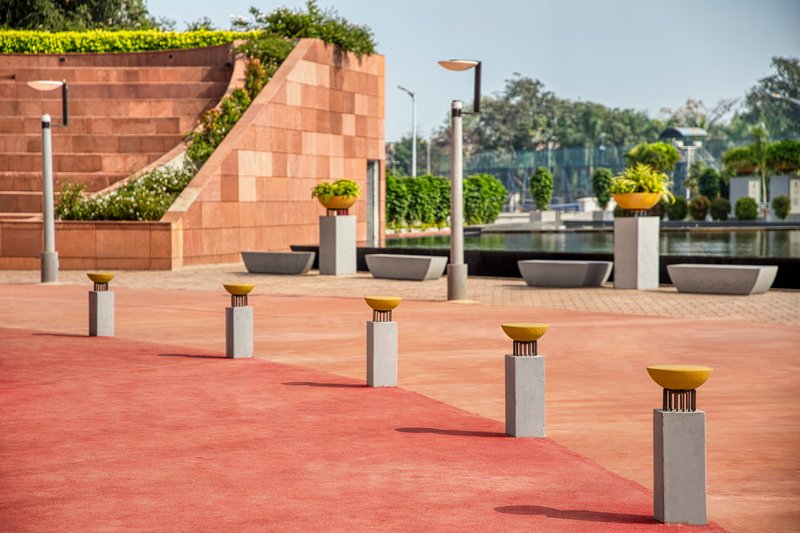
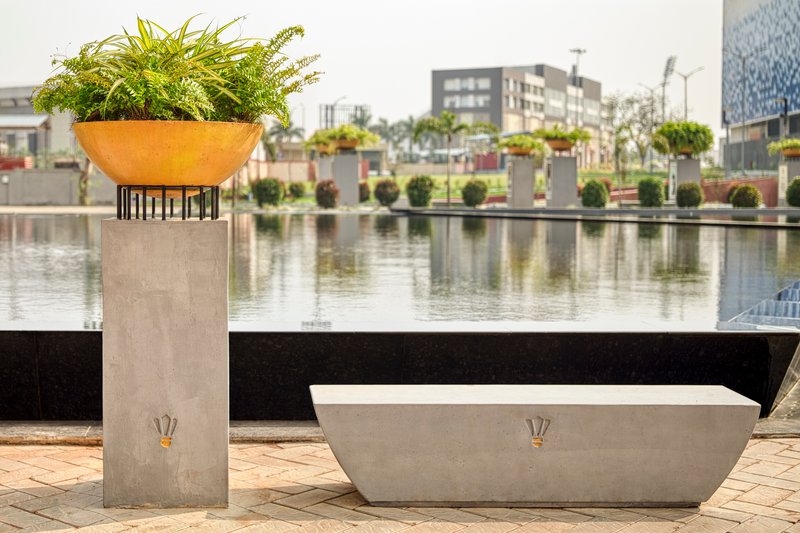
The rooftop terrace is the building's most generous civic move. Stepped sandstone seating and short concrete bollards capped with golden discs create informal gathering spots. A reflecting pool near the edge brings sky into the composition and cools the microclimate. These are not residual spaces; they are designed with the same rigor as the courts below.
By placing a usable public realm on top of a private sports facility, the project argues that athletic infrastructure need not wall itself off from the community. The rooftop colonnade doubles as a shaded promenade with views across Odisha's flat urban landscape, turning spectators into participants in the building's life.
Detail and Atmosphere
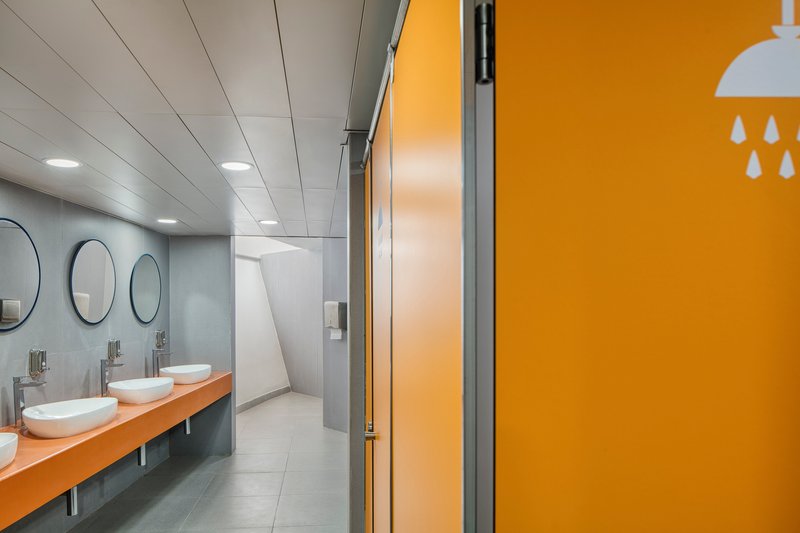
Quality in a sports building is often measured at the scale of the washroom sink and the parking lot light. The Shuttle holds up. Rounded mirrors, vessel sinks on timber counters, and yellow partition panels in the washrooms show a level of finish that most Indian sports complexes never approach. It is a small detail, but it communicates respect for the athletes who train here daily.
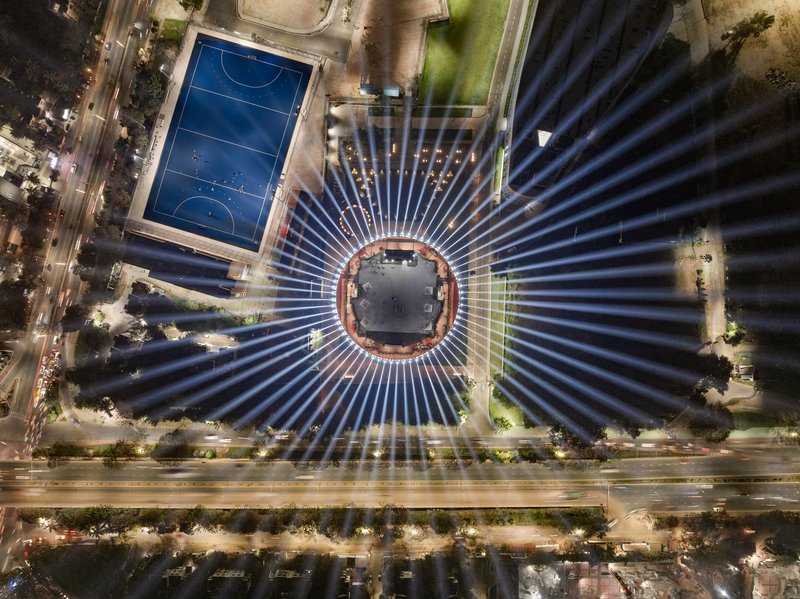
At dusk the building transforms. The golden cladding glows warmly above the treeline, and at night, radial beams of light emanate from the circular form like a beacon. The nocturnal image is almost theatrical, but it works because the daytime architecture has already earned the right to be dramatic.
Plans and Drawings
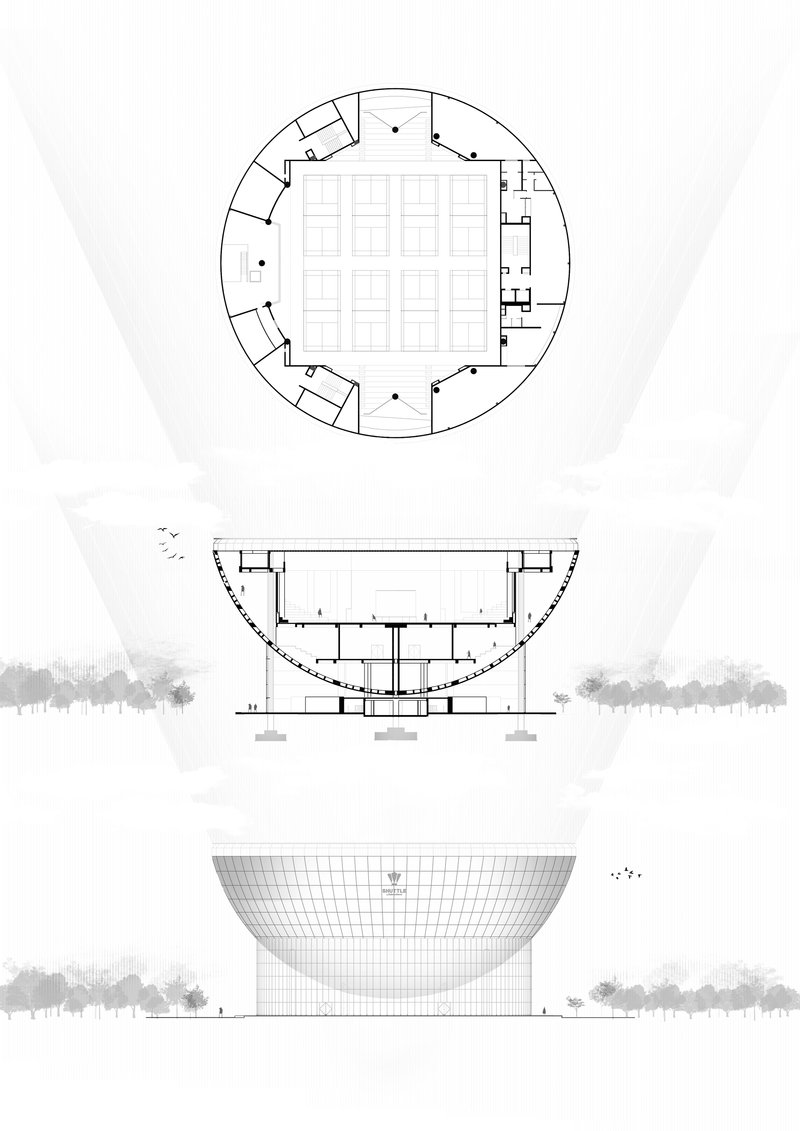
The floor plan, section, and elevation confirm what the photographs suggest: the bowl form is not a decorative shell but a structural logic. Courts are organized concentrically within the circular plan, with service and circulation pushed to the perimeter. The section reveals how the building flares outward as it rises, creating the inverted dome profile that defines its silhouette. The central void is kept open and column-free for uninterrupted court spans, while the perimeter ring handles everything else: stairs, offices, dining, mechanical systems.
Reading these drawings, the economy of the plan becomes clear. A single geometric move generates the entire building's identity, from structure to skin to spatial hierarchy. That is difficult to achieve and easy to admire.
Why This Project Matters
India's badminton stars have been competing at the highest global level for over a decade, yet the country's training infrastructure has lagged behind its talent. The Shuttle addresses that gap not with a generic multipurpose hall but with a purpose-built facility that takes its sport seriously enough to give it real architecture. The collaboration between Gopichand's coaching legacy and Studio Archohm's design ambition produces a building that could genuinely shift expectations for what athletic facilities in India look and feel like.
More broadly, the project demonstrates that formal invention and functional rigor are not at odds. The bowl shape is memorable, but it also organizes courts efficiently, shades the rooftop terrace, and gives the building a legible civic presence. In a landscape where sports architecture too often defaults to the utilitarian, The Shuttle makes a compelling case that aspiration, in architecture as in sport, is the whole point.
The Shuttle Badminton Academy (Dalmia-Gopichand Badminton Academy) by Studio Archohm, lead architect Sourabh Gupta. Located in Odisha, India. 11,450 m². Completed 2024.
About the Studio
Share Your Own Work on uni.xyz
If projects like this are the kind of work you want to make, uni.xyz is a place to publish your own, find collaborators, and enter design competitions.



Popular Articles
Popular articles from the community

Kawasaki Olympic Sports Center: Sports Complex Architecture Rooted in Community, Tradition, and Movement
Kawasaki Olympic Sports Center reimagines sports complex architecture as a civic park where tradition, training, and community meet locally.
Milan Crossover: Sustainable Architecture for a New Fashion Culture in Milan
Milan Crossover transforms fashion culture through sustainable architecture, linking material libraries, remake studios, and public runways.
CRACK: Winery Architecture Carved Into the Landscape
CRACK reimagines winery architecture as a buried path through vineyard terrain, linking production, tasting, lodging, landscape and culture.

Reincarnation Weaves a Three-Story Retreat into the Green Landscape of Rural Bangladesh
Ara Manor in Narsingdi dissolves the line between domestic architecture and its lush surroundings through screens, courtyards, and planted rooftops.


Similar Reads
You might also enjoy these articles
Freebird Residence by Alexis Dornier: A Tropical Modernist Sanctuary in Bali
Floating living pavilion above pool anchors H-shaped tropical villa, blending Japanese minimalism, sustainable strategies, lush landscape, and sculptural interiors.
127af Flips a Tiny Bagnolet Rowhouse Upside Down with a Handcrafted Roof Extension
A 55-square-meter terraced house on the edge of Paris gains a luminous upper living floor through lightweight timber and steel.
1.61 Design Workshop Wraps a 600-Square-Meter Café in Vietnam in Sculptural Burgundy Drama
Reden Café & Bistro pairs a helical staircase, mosaic floors, and deep red interiors to rethink Vietnamese hospitality space.

The Unbound Brain: A School Shaped by Cognitive Architecture
Cylindrical learning pods radiate like neurons from a central cortex, turning the floor plan into a spatial model of human thought.

Explore Educational Building Competitions
Discover active competitions in this discipline




The Global Benchmark for Architecture Dissertation Awards


The Global Benchmark for Graduation Excellence


Challenge to design a barrier free sports center


Challenge to design an outdoor ice-rink and park
Comments (0)
Please login or sign up to add comments
No comments yet. Be the first to comment!