

Side FX Arquitectura Wraps an Amazonian Day Center for the Elderly Around a Brick Courtyard
A 370-square-meter care facility in rural Ecuador replaces a warehouse with a U-shaped campus organized around contemplation and shade.


In the General Proaño district of Macas, a small settlement backed by the forested foothills of Ecuador's Morona Santiago province, the existing day center for elderly residents was, by all accounts, a warehouse. Not metaphorically. The building that served the community's older population offered little more than walls and a roof, with no spatial dignity, no climate response, and no sense of arrival. Side FX Arquitectura, led by Sebastián Benítez and José Pedro Vásconez, was tasked with replacing it under the government's Territorial Development Projects program, and the result is a 370-square-meter facility that treats care architecture not as a clinical problem but as a civic one.
What makes the project worth studying is how much it accomplishes with so little. The building is single story, its palette limited to red brick, black steel, concrete, and timber slats. Yet the architects extract a rich spatial sequence from a U-shaped plan that folds around an interior courtyard, stitching new construction to preexisting municipal structures and turning what could have been an institutional corridor into a place people actually want to sit. In the warm, humid Amazonian climate, every design decision reads as a negotiation between openness and shelter, between the public street and the private world of a dining room for forty.
A Threshold That Invites

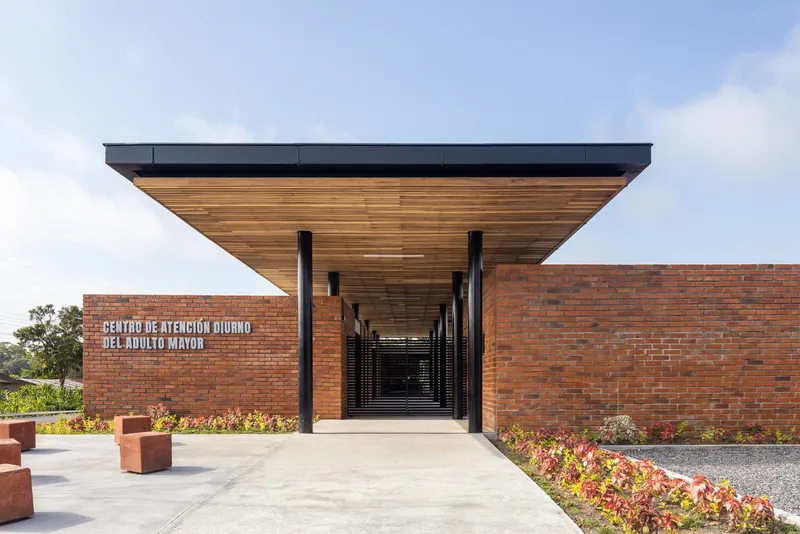
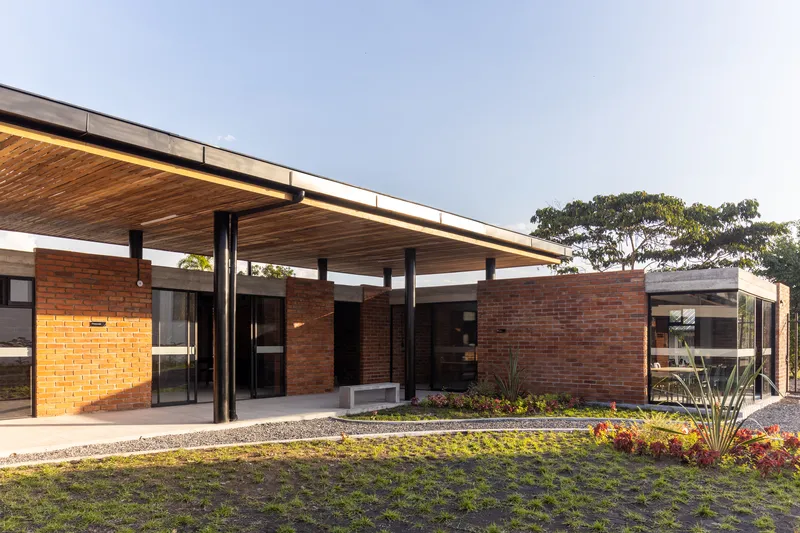
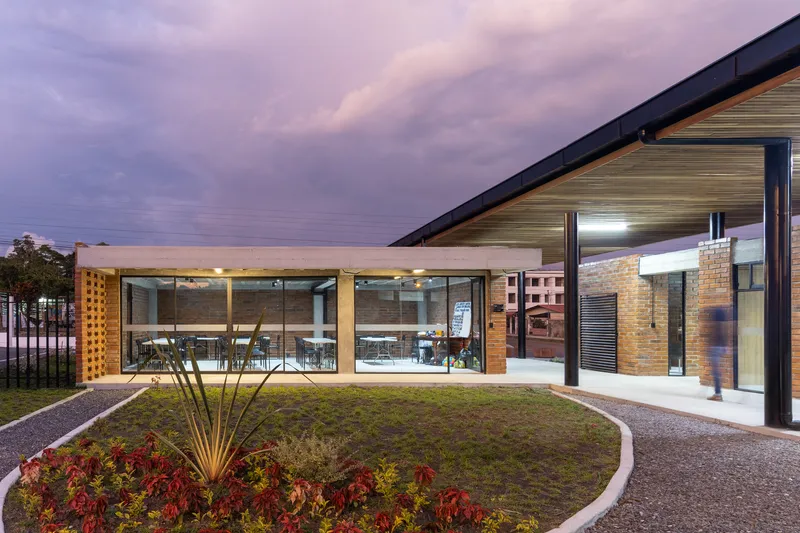
The entry sequence is the building's strongest gesture. A cantilevered timber canopy extends well beyond the brick wall plane, creating a deep zone of shade that belongs neither fully to the street nor to the interior. The overhang is generous enough to shelter a planted bed and a concrete plaza, signaling that the threshold is communal ground. Passersby can appropriate the front square without entering the center itself, a deliberate blurring of public and private that the architects use to embed the building in the daily life of the neighborhood rather than isolating it behind a locked door.
The roof's profile, inspired by surrounding vernacular structures, reads as familiar even as the detailing, black steel columns meeting brick at precise junctions, announces something more considered. At dusk, the slatted soffit glows against the sky, marking the entrance without the need for signage.
Brick, Steel, and the Logic of the Screen
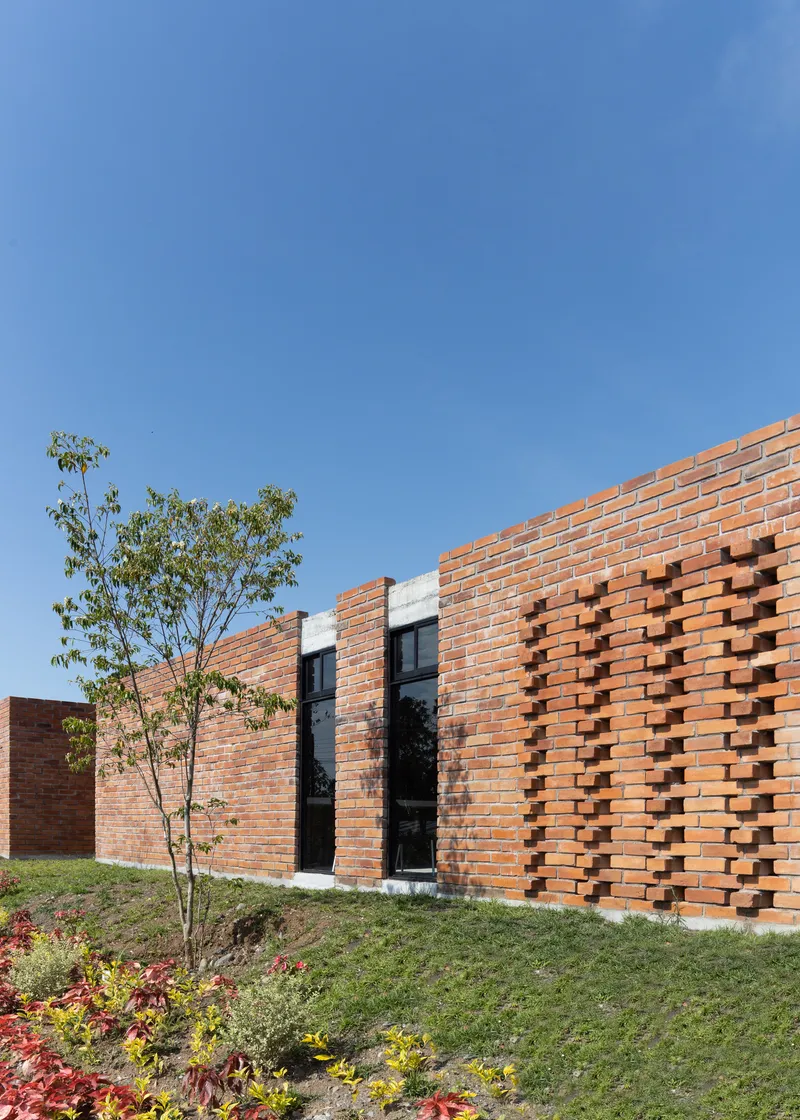


The exterior walls do double duty. Solid red brick masses provide thermal inertia and privacy for the medical and administrative rooms, while patterned ventilation openings perforate the facades where airflow matters most. The perforated brick panels are not decorative afterthoughts; they respond to the reality that mechanical cooling is neither affordable nor desirable in a publicly funded rural facility. Vertical slit windows punctuate the otherwise closed street facade, offering glimpses in without exposing the interior.
Seen through the mature trees that line the perimeter, the brick volume reads as a compact, grounded mass. It does not compete with the forested mountains behind it. The palette is restrained enough that the building recedes into its planted slope, an appropriate modesty for a project whose primary users are people who have lived in this landscape their entire lives.
The Courtyard as Social Infrastructure


The interior courtyard is the organizational heart of the project. By wrapping the new construction in a U around a landscaped open space, the architects create an outdoor room that serves as both circulation hub and gathering place. Concrete benches line the brick walls, positioned under the slatted timber canopy where shade is deepest. The courtyard connects the dining room, the multipurpose workshop, and the medical offices without forcing anyone through a corridor, an important distinction for elderly users who may have mobility limitations.
The decision to place the courtyard at the entrance, where it is shared between the day center and the adjacent Autonomous Government headquarters, means the space also functions as a civic forecourt. Visitors arriving for either building pass through the same planted, shaded enclosure. It is a small move that collapses the distinction between healthcare architecture and public space, making the center feel less like a clinic and more like a neighborhood commons.
Corridors as Living Rooms
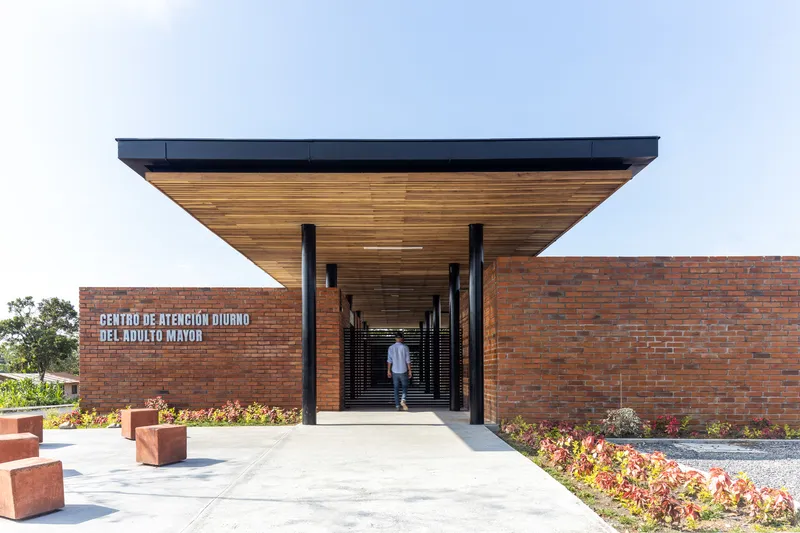


The covered walkways that connect the building's wings are among its most successful spaces. Slatted timber ceilings filter light into rhythmic stripes across the concrete floor. Black steel columns establish a steady cadence that draws you forward without hurrying you. Glazed doors along one side open onto the courtyard, so the corridor is never a tunnel; it is always a veranda, always half outside.
For a day center serving elderly residents, the quality of circulation space matters enormously. These are the paths people walk several times a day, between a medical appointment and lunch, between a workshop and the garden. By treating them as inhabitable rooms rather than leftover space between walls, the architects acknowledge that the journey through the building is as important as any single destination within it.
Interior and Material Detail


Inside, exposed concrete ceiling joists and polished concrete floors establish a cool, durable base that can withstand the humidity of the Amazonian climate and the daily wear of a public facility. The red brick walls carry through from exterior to interior, maintaining material continuity and reducing the psychological shift between outside and in. The waffle slab ceiling in certain rooms adds visual texture without requiring a dropped ceiling, keeping the spaces open and breathable.
At the junctions where steel columns meet brick walls and concrete beams, the detailing is precise but not fussy. The black steel reads as a structural frame holding the heavier masonry masses apart, creating clearances for glass and air. It is an honest construction language that does not pretend to be anything other than what it is: affordable, available materials assembled with care.
Inhabiting the Edges


The building's perimeter spaces, covered porches with concrete benches, slatted overhangs casting dappled light, horizontal wood doors alongside perforated brick screens, are designed for occupation, not just passage. Two visitors seated on a bench under the timber canopy confirm what the drawings suggest: these edges are where life happens. The architects understood that elderly users in a warm climate will gravitate toward shaded, breezy thresholds rather than enclosed rooms.
The horizontal wood door set against the perforated brick wall creates a layered filter between inside and out. Open it and you have full ventilation. Close it and you still have airflow through the brick screen, plus privacy. This kind of graduated porosity is essential in Amazonian Ecuador, where the choice is rarely between sealed and open but between degrees of openness.
Landscape and Context


The drone views reveal the compound's relationship to its neighborhood: a compact, low-profile presence tucked among residential buildings and lush vegetation, with the dense Amazonian forest climbing the mountains directly behind. The building does not assert itself as a landmark. It slots into the existing grain of streets, trees, and small-scale structures, which is exactly appropriate for a facility intended to serve a rural elderly population.
The green roof courtyard visible at twilight, with its glass-walled dining area and landscape lighting, shows another dimension of the project. At night, the center transforms into a lantern, its illuminated interior courtyard visible through the glazed walls. The dining space for forty opens directly onto the garden, dissolving the boundary between eating and being outdoors. For a population accustomed to life lived largely outside, this is not a luxury but a basic act of respect.
Plans and Drawings


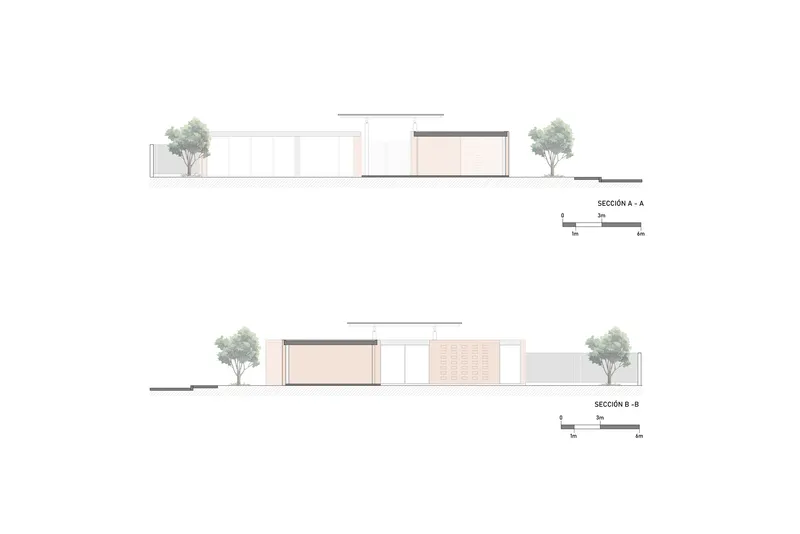
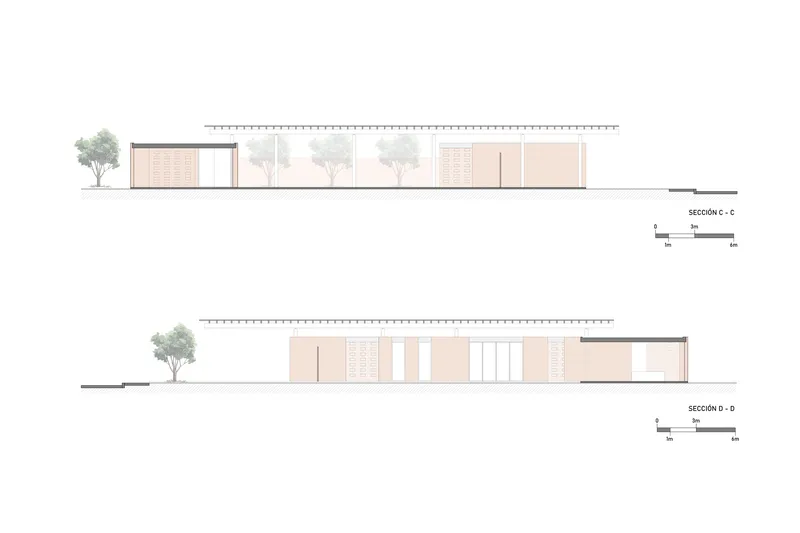


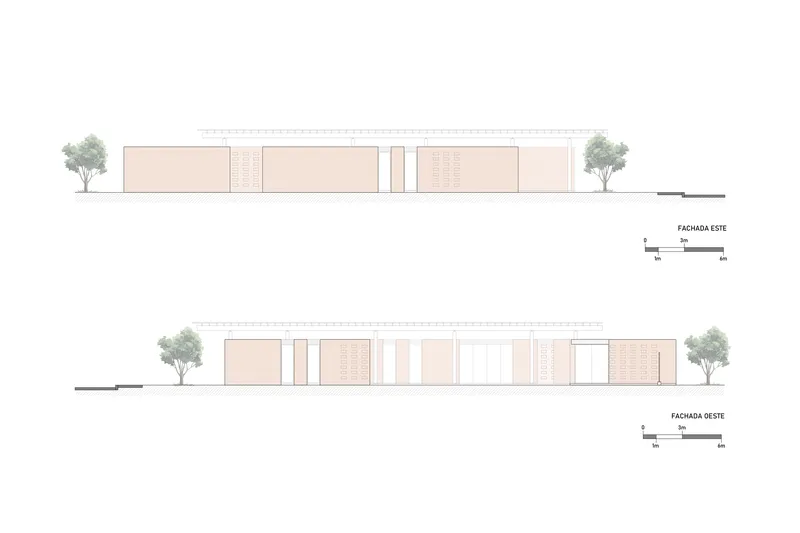
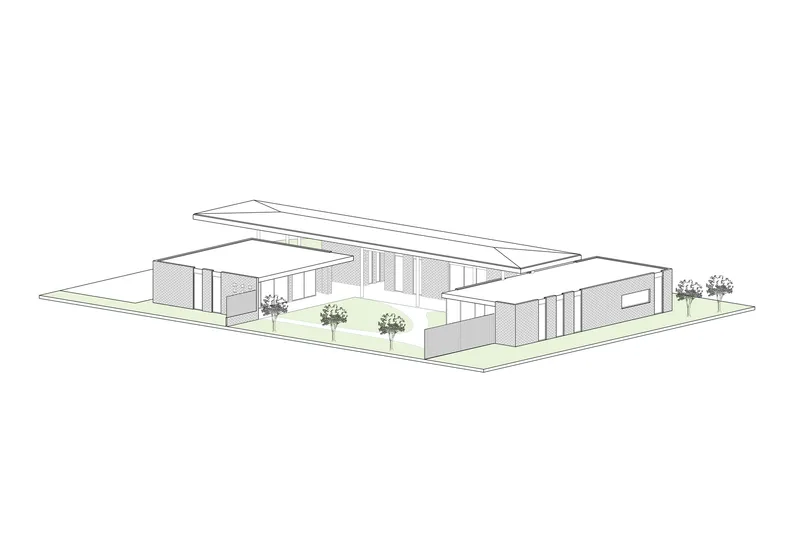
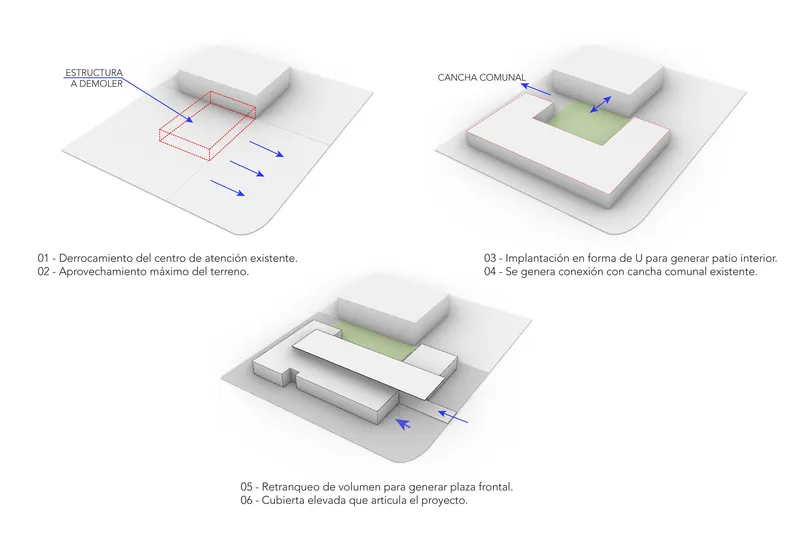
The floor plan confirms the U-shaped organization, with the courtyard at the center and the program distributed around it in a clear hierarchy: public and social spaces closest to the entrance, medical and administrative offices on the quieter wings. The section drawings reveal a building that barely rises above its context, its flat and gently vaulted roofs sitting low enough that the surrounding trees overtop it. Clerestory openings and perforated screens in the sections explain the cross-ventilation strategy that keeps the interiors livable without mechanical systems.
The axonometric diagrams and the design process diagram are particularly instructive. They show how the architects worked backward from a demolition of the existing warehouse through the formation of the courtyard void to the final massing, a subtractive logic that treated the open space as the primary design move and the built volumes as its consequence. The programmatic axonometric makes legible how each function, dining, workshop, clinic, administration, occupies its own discrete volume beneath the unifying sheltering roof.
Why This Project Matters
The New Day Center for the Elderly matters because it demonstrates that dignified public architecture for vulnerable populations does not require an extraordinary budget or a signature form. It requires, instead, a commitment to getting the basics right: shade where shade is needed, ventilation where walls would suffocate, social space where isolation would otherwise take hold. Side FX Arquitectura's building is not flashy. It is simply correct, in the way that a well-fitted joint between steel and brick is correct, in the way that a bench placed exactly where the afternoon shadow falls is correct.
In a broader context, the project offers a counterargument to the tendency in government-funded social infrastructure toward generic, replicable boxes. The architects responded to a specific climate, a specific site, and a specific population. They used the courtyard typology not as a stylistic gesture but as a device for organizing care, circulation, and community around a single shared void. For 370 square meters in rural Ecuador, that is a quietly radical proposition.
The New Day Center for The Elderly by Side FX Arquitectura (lead architects Sebastián Benítez and José Pedro Vásconez), General Proaño, Macas, Morona Santiago, Ecuador. 370 m², completed 2022. Photography by Nicolás Provoste C.
About the Studio
Share Your Own Work on uni.xyz
If projects like this are the kind of work you want to make, uni.xyz is a place to publish your own, find collaborators, and enter design competitions.


Popular Articles
Popular articles from the community


Singing Woman: An Opera House That Performs Before the Curtain Rises
Ovidiu Cristian Pavel's conceptual opera house translates Estonia's choral identity into a sculpted waterfront landmark facing the Baltic Sea.

Temporary Home for Dogs: A Reversed Zoo Rethinks Animal Shelter Architecture
In Bucharest, a sinuous corridor and freed landscape flip the logic of containment, designing a shelter that works to make itself unnecessary.

Faces of the Soviet Avant-Garde: Turning Moscow's Street Names into an Open-Air Museum
A network of sculptural installations across a Moscow residential district transforms forgotten architect names into spatial encounters with cultural memor

Opera on the Sea: Driftwood Logic Shapes a Timber Opera House on Estonia's Coast
Trevor Orgill's opera house translates the entangled drift of floating timber into a civic building where wood, water, and music converge.

Similar Reads
You might also enjoy these articles

Pixel Gardens: One Repeated Module Stacked Into a Terraced Social Housing Tower for Famagusta
Salem Bader's shortlisted housing tower builds a vertical neighbourhood from one repeated module, offsetting units to carve terraces, light and air.

Bao Huynh Watercolor Atelier: A Serene Art Retreat in Hội An
Bao Huynh Watercolor Atelier in Hội An blends multifunctional art spaces, sustainable design, local materials, and family-friendly living in a serene environment.

Atelier Macri Concept Store Interior Design by CASE-REAL
Atelier Macri store features a "ko" counter, walnut wood details, cork displays, blending retail, gallery, and seamless customer experiences.

Manuel Vargas Izquierdo Stadium and High-Performance Sports Center: Architectural Excellence in Jalpa de Méndez
The Manuel Vargas Izquierdo Stadium blends sustainable design, inclusive sports facilities, and cultural-inspired architecture, revitalizing Jalpa de Méndez’s public spaces.

Explore Community Center Competitions
Discover active competitions in this discipline

Challenge to reimagine the Iron Throne

Photograph architecture without architects

Illustrate the lost glory of Angkor Wat - Render Challenge

Design challenge to reuse E-waste
Comments (0)
Please login or sign up to add comments
No comments yet. Be the first to comment!