
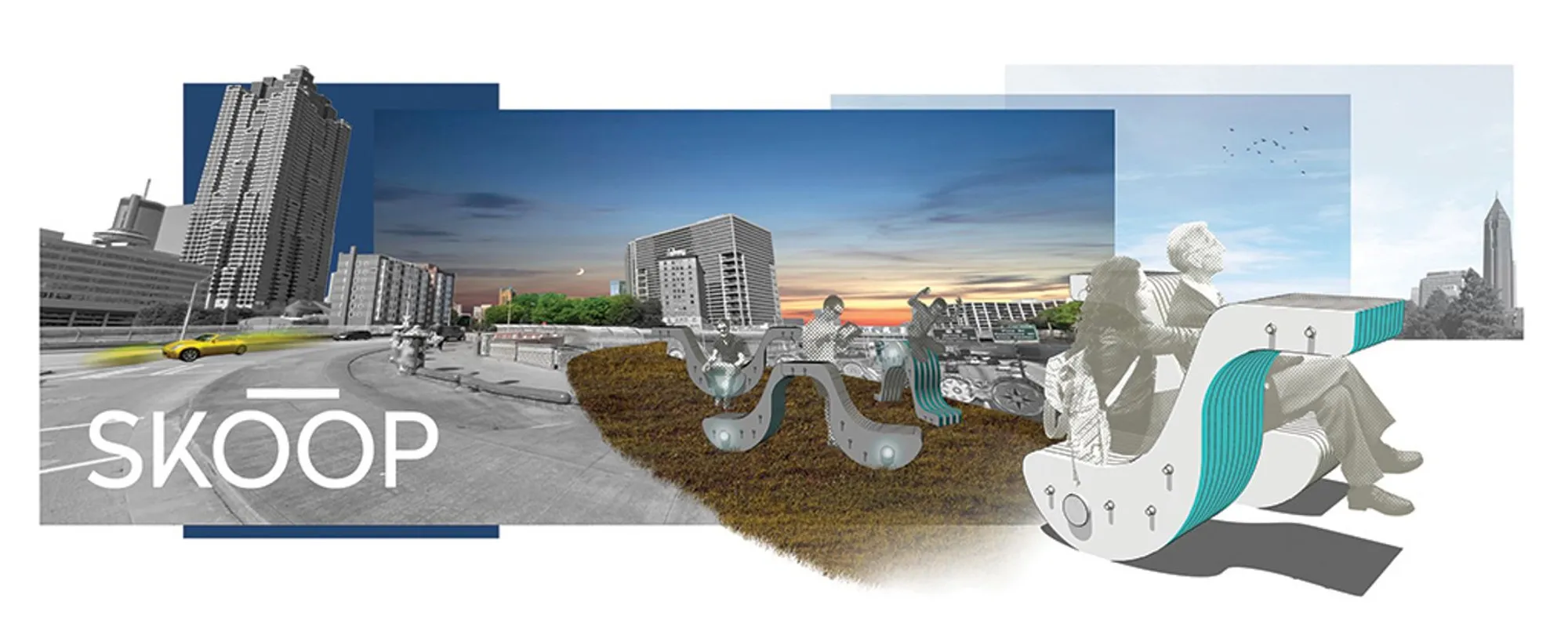
Skoop: Turning Construction Waste into Glowing Urban Furniture for Atlanta
A modular seating system built from discarded drywall and photoluminescent concrete transforms overlooked sites into social gathering spaces.


The U.S. generates nearly 160 million tons of construction and demolition waste every year. Most of it ends up in landfills. Skoop proposes a different destination: the public realm. The project reimagines discarded drywall as the primary structural material for modular urban seating, layered with glass-fiber mesh and coated in photoluminescent concrete that glows after dark. It is a compact, provocative argument that waste streams and public life can feed each other.
Designed by Laura Sherman and Phebe Tam, Skoop received an Honorable Mention at Urbanscape 2018. The project is sited at the intersection of Ralph McGill Blvd, Courtland Street, and I-85 in Atlanta, GA, a city that ranked fourth nationally for housing permits in 2017 with over 36,000 issued. That construction boom generates enormous waste volumes, and Skoop positions itself directly within that material cycle, proposing a closed loop from demolition site to streetscape.
Five Configurations for Five Types of Gathering

Skoop is not a single bench but a family of modular configurations, each tuned to a distinct social behavior. The diagram maps five modes: swinging, playing, chatting, rocking, and mingling. Each arrangement repositions the same CNC-cut drywall module into a different spatial relationship, creating environments that serve residents with children and pets, commercial pedestrians and shoppers, and tourists looking for distinctive public spaces. The versatility is key. Rather than designing one fixed object, Sherman and Tam designed a system that can populate underutilized urban land with varied programmatic intensity.
From Landfill to CNC Bed: A Five-Step Fabrication Process
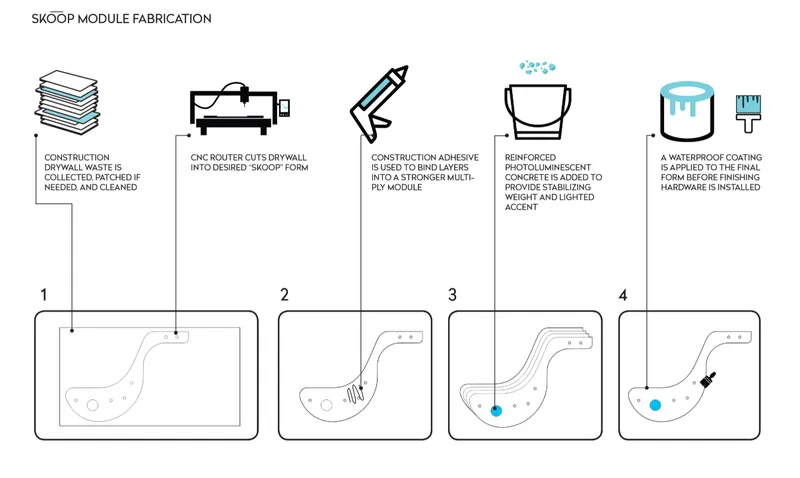
The fabrication sequence is illustrated step by step: waste drywall is collected, patched, and cleaned before being precision-cut on a CNC router into ergonomic forms. Adhesive bonds the cut layers into a composite block with real structural depth. Photoluminescent concrete is then applied as reinforcement, adding both stability and a soft nighttime glow that improves safety without electrical infrastructure. A final waterproof coating seals the assembly for outdoor durability. What could easily read as a speculative material experiment is presented here as a repeatable production workflow, one that any fabrication shop with CNC access could replicate.
Layered Assembly: Metal Dowels, Waste Drywall, and Fluorescent Aggregate
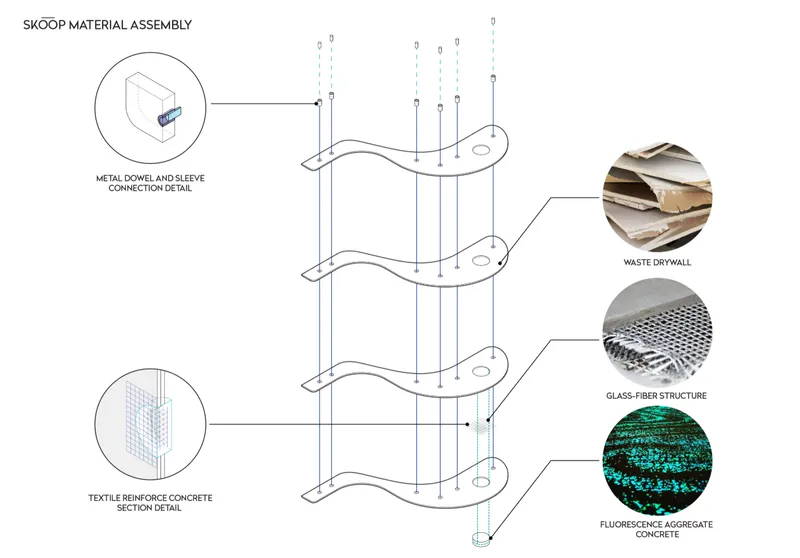
The exploded axonometric drawing breaks the module into its constituent layers: metal dowels that pin the assembly together, stacked waste drywall sheets forming the bulk of the mass, glass-fiber mesh that provides tensile reinforcement, and an outer shell of fluorescent aggregate concrete. Each layer has a clear structural or performative role. The glass-fiber mesh, in particular, bridges the inherent brittleness of gypsum board, while the photoluminescent concrete transforms the module into an ambient light source after sundown. The material palette is lean, purposeful, and entirely grounded in salvaged or low-impact inputs.
Ergonomic Precision on a Dimensional Grid

The elevation and plan drawings reveal that Skoop's curves are not arbitrary. Ergonomic annotations map reclined body positions against the module's profile, ensuring that the geometry supports comfortable sitting and lounging postures. A dimensional grid underlies the layout, allowing modules to snap into varied arrangements while maintaining consistent spatial relationships. The drawings demonstrate a level of rigor that lifts the project beyond the conceptual: these are buildable forms calibrated to the human body, not sculptural gestures.
Why This Project Matters
Skoop makes a persuasive case that sustainable design does not have to look austere or feel like a compromise. By starting with one of the most unglamorous waste products in the construction industry, drywall, and ending with a glowing, ergonomically tuned piece of street furniture, Sherman and Tam demonstrate that material innovation and public delight can coexist. The photoluminescent concrete is the standout move: it eliminates the need for powered lighting while turning each module into a soft beacon that marks gathering space after dark.
More broadly, the project challenges the disposability logic that drives rapid urban expansion. Atlanta's construction boom is a test case, but the waste arithmetic applies to every growing city. Skoop suggests that the byproducts of development can be redirected into the very public infrastructure that development often neglects. It is a circular proposition, modular enough to scale and specific enough to sit in.
View the Full Project
About the Designers
Designers: Laura Sherman, Phebe Tam
Enter a Design Competition on uni.xyz
uni.xyz runs architecture and design competitions year-round that reward proposals with spatial conviction and real site intelligence.
Project credits: Skoop by Laura Sherman, Phebe Tam Urbanscape 2018 (uni.xyz).




Popular Articles
Popular articles from the community


Hill & Cross Opera: Sculptural Opera House Architecture Shaped by Tallinn’s Landscape and Identity
Hill & Cross Opera reimagines opera house architecture in Tallinn through its sculptural hill, civic plaza, glass wave and a luminous cross.
EW PARK: Sustainable Architecture Reimagines the Future of Urban Parking
EW PARK reimagines city parking as a modular wooden tower combining automation, solar energy, electric mobility, and adaptable urban design.

The Earth Pod: 3D Printed Homes for Resilient Refugee Communities
The Earth Pod reimagines refugee housing through 3D printed homes made from clay, combining resilience, self-sufficiency, and rapid shelter.

Co-life: Sustainable Architecture for Age-Friendly Community Living
Co-life reimagines sustainable architecture for seniors through courtyards, rammed earth, shared gardens, and spaces designed for belonging.


Similar Reads
You might also enjoy these articles

Bao Huynh Watercolor Atelier: A Serene Art Retreat in Hội An
Bao Huynh Watercolor Atelier in Hội An blends multifunctional art spaces, sustainable design, local materials, and family-friendly living in a serene environment.

Atelier Macri Concept Store Interior Design by CASE-REAL
Atelier Macri store features a "ko" counter, walnut wood details, cork displays, blending retail, gallery, and seamless customer experiences.

Manuel Vargas Izquierdo Stadium and High-Performance Sports Center: Architectural Excellence in Jalpa de Méndez
The Manuel Vargas Izquierdo Stadium blends sustainable design, inclusive sports facilities, and cultural-inspired architecture, revitalizing Jalpa de Méndez’s public spaces.

KAKR Buluh Awar Hall: Revitalizing Community and Ecology Through Bamboo Architecture
Community built bamboo hall revitalizes Buluh Awar village, empowering youth, restoring ecology, celebrating vernacular craftsmanship through sustainable architecture and culture.


Explore Urban Furniture Competitions
Discover active competitions in this discipline



Challenge to merge furniture with learning

Design challenge to equip cities with modern furniture

Competition to design a workstation for architects

Packaging challenge - Design meets sustainability
Comments (0)
Please login or sign up to add comments
No comments yet. Be the first to comment!