

Snøhetta Turns a Brutalist Theater Outside Paris into a Glowing Urban Lantern
The Nanterre-Amandiers renovation folds park, city, and public life into a 10,000 m² glass-and-concrete stage for cultural democracy.


A circus tent on a hillside west of Paris. That was the origin of the Nanterre-Amandiers National Drama Center, founded in 1965 on a slope called La Côte-des-Amandiers for the first Nanterre Dramatic Arts Festival. The tent gave way to a makeshift warehouse, then to a permanent concrete theater designed by Jacques Kalisz and inaugurated in 1976. Over the decades, the building earned its reputation as one of France's most important stages for experimental theater, but the architecture grew opaque and inward-looking, its relationship to the surrounding André Malraux park and the city of Nanterre increasingly strained. Snøhetta, working with associate architect SRA Architectes, scenographer Kanju, and landscape collaborator Atelier Silva Landscaping, has spent eight years correcting that disconnect.
What makes the renovation genuinely interesting is the hierarchy it imposes: architecture retreats so that scenography, public life, and landscape can step forward. Snøhetta describes the result as a "tool-building," restrained and practical, and that functional modesty is precisely what allows the 10,000 m² complex to operate as something more generous than a theater. A new tilted-glass Grand Hall replaces the old foyer, extending upward with a new roof and downward through a sunken plaza, stitching together two grade levels and turning the entire section into a threshold between park and city. By day, natural light animates raw concrete and timber. By night, the fully glazed walls glow, transforming the building into a lantern visible from the pedestrian paths threading through the park toward La Défense.
The Lantern Effect
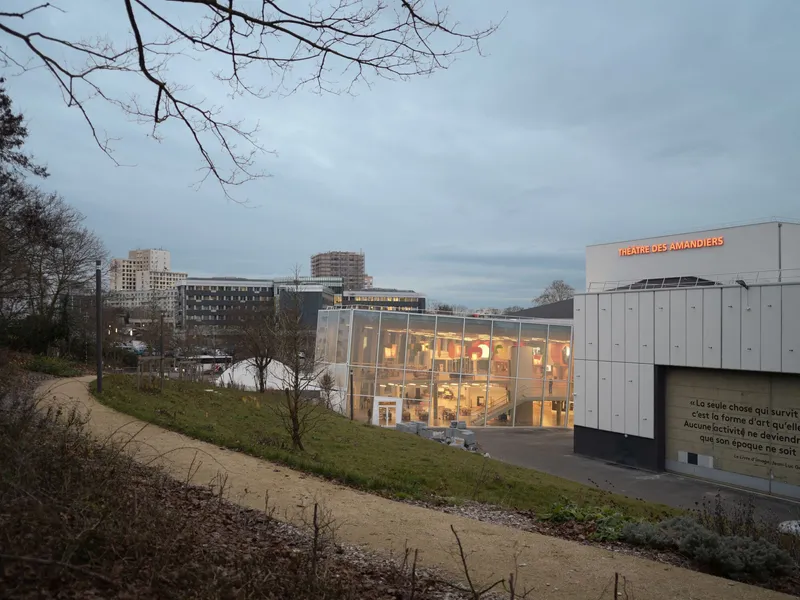


The most memorable move here is also the simplest. By wrapping the expanded Grand Hall in floor-to-ceiling glass, Snøhetta converts a formerly closed foyer into a broadcast signal for the cultural institution. Seen from the park paths at dusk, the building reads as a single luminous volume, its interior life on full display: people on staircases, diners at timber tables, colored banners drifting from the mezzanine. The metal panel cladding on the upper volumes grounds the composition, keeping it from tipping into pure spectacle.
Light-Cibles handled the lighting design, and the results are calibrated rather than theatrical. The interior brightness is even enough to register from a distance without washing out the architectural geometry. It is an old trick, the inhabited vitrine, but its deployment here solves a real problem: Nanterre-Amandiers was historically difficult to find at the end of a winding park path. Now you see it before you reach it.
Landscape as Infrastructure
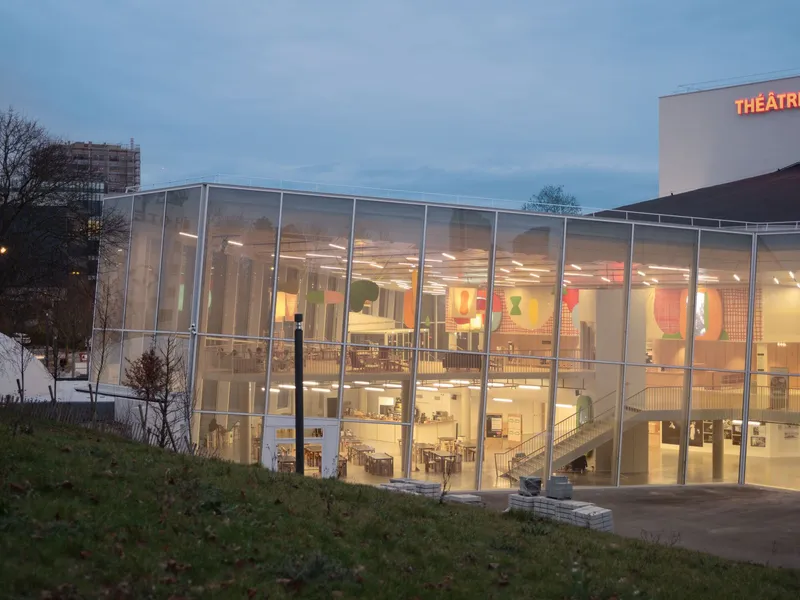
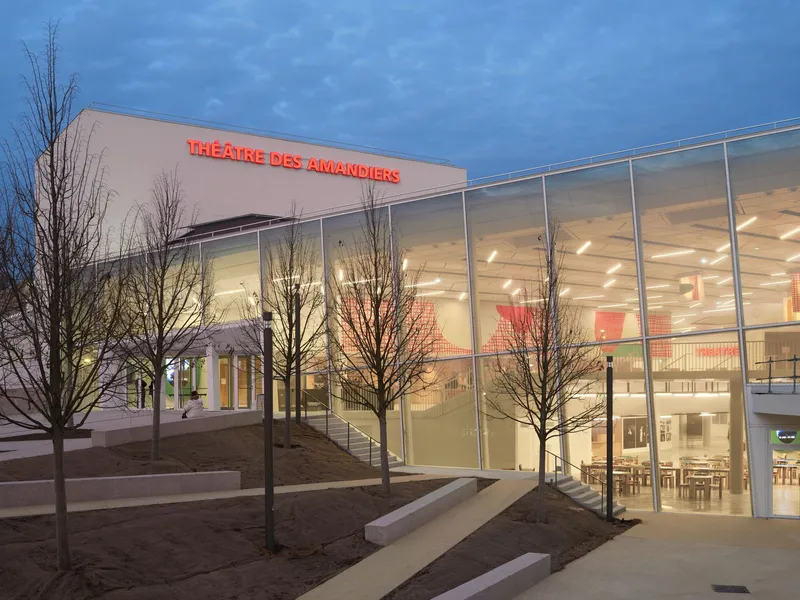
The site section is where much of the architectural intelligence resides. The theater sits at a significant level change between the park above and a lower forecourt below. Snøhetta and Atelier Silva Landscaping reshaped existing slopes, re-profiled embankments, and opened visual corridors through vegetation so that the building is approachable from both elevations. A sunken courtyard absorbs the grade difference and creates a stepped plaza that doubles as informal outdoor gathering space. Young trees planted on the sloped forecourt will eventually filter views of the glass facade, softening the transition from parkland to institution.
The strategy treats landscape not as ornament but as connective tissue. Arriving from the upper park, you descend through planting toward the glass hall. Arriving from the city side, you ascend a stepped plaza. In both cases, the building is discovered gradually rather than confronted, which suits a theater that has always valued the experimental over the monumental.
The Grand Hall as Public Room
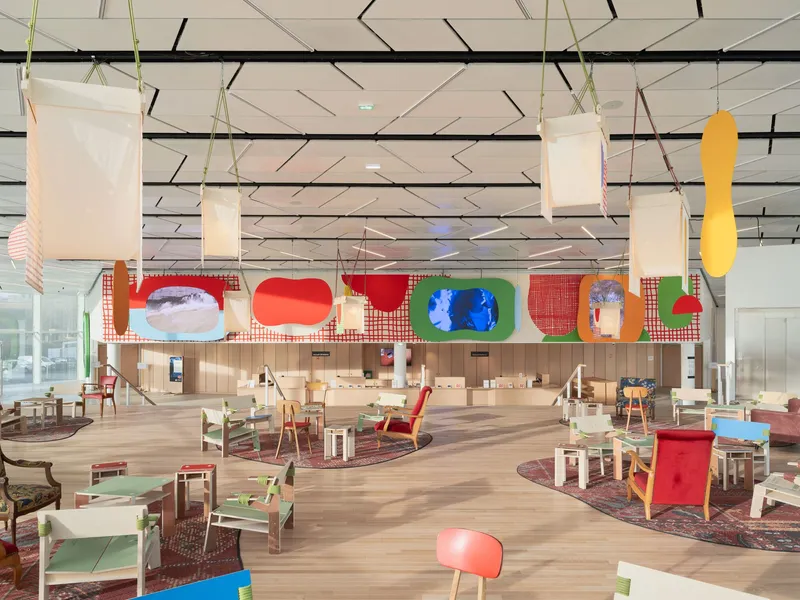
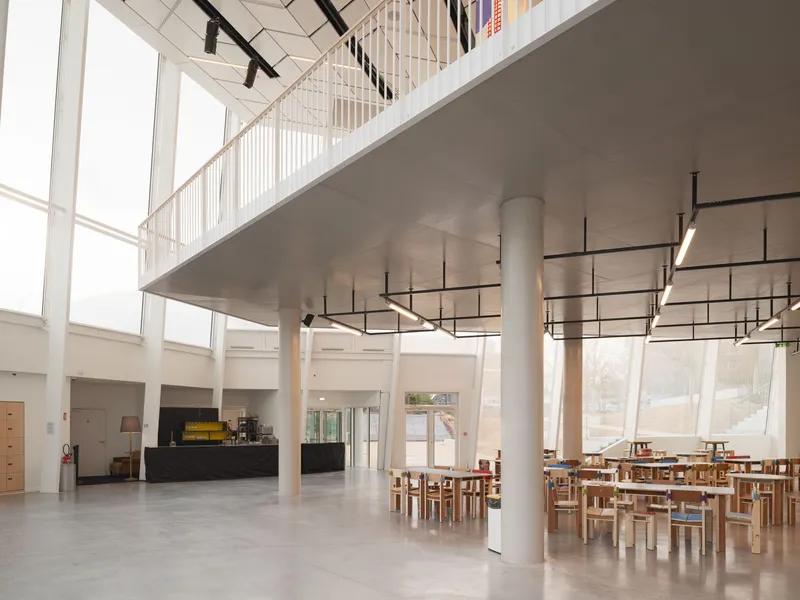

The expanded Grand Hall occupies the footprint of the theater's previous foyer but inhabits a completely different spatial register. Where the old lobby channeled visitors toward the auditorium, the new hall invites lingering. A sunken floor and a new roof give it double-height volume. White cylindrical columns organize the space without fragmenting it. Timber dining furniture, suspended fabric panels in orange and green, and a mezzanine hung with colorful artworks turn the hall into something closer to a cultural living room than a circulation corridor.
The wide timber staircase is a generous gesture, broad enough for sitting, and it connects directly to the mezzanine that provides secondary access into the two auditoria. A restaurant and bookshop are reorganized within this volume, so the hall serves a purpose even when no performance is scheduled. The ceiling integrates stage equipment, meaning the entire space can be reconfigured for events, installations, or performances that spill out of the formal theaters.
Faceted Ceilings and Filtered Light
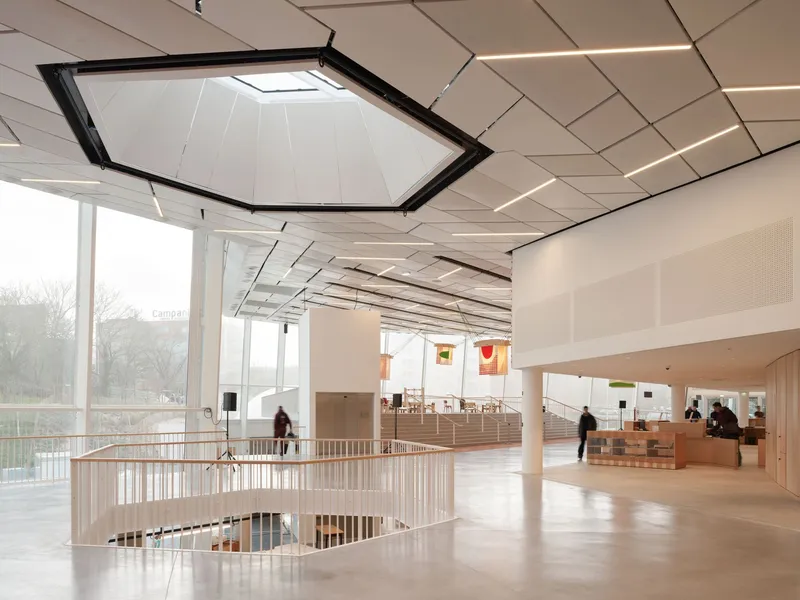
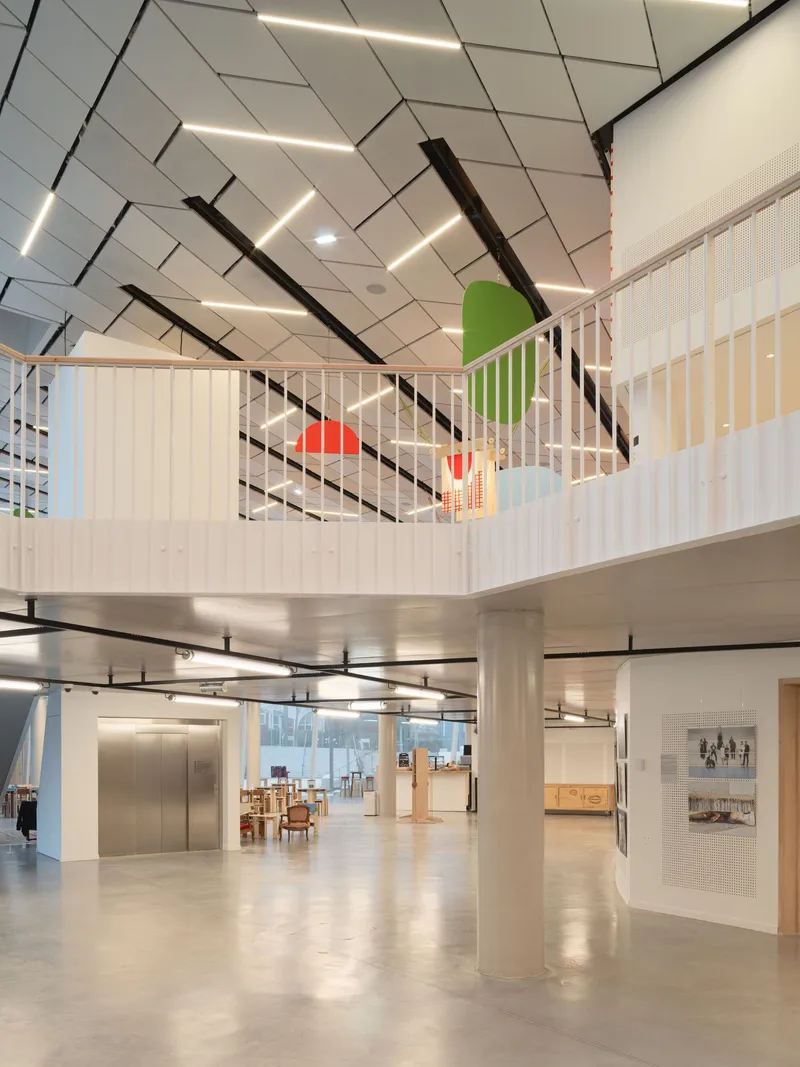

Snøhetta's ceiling treatment deserves specific attention. Throughout the public spaces, angular white panels fold and facet overhead, creating a geometric topography that diffuses natural light entering through the glass walls and a hexagonal skylight. The effect is restrained: no parametric excess, just enough articulation to give each zone a distinct character while maintaining visual continuity across the floor plate.
Suspended fabric screens in warm tones add a softer layer beneath the hard ceiling geometry. These panels function as acoustic baffles and spatial dividers, breaking up the large hall volume into more intimate zones without requiring walls. The interplay between rigid ceiling planes and loose hanging textiles gives the interior a quality that is both precise and provisional, which mirrors the theater's programming philosophy.
Two Auditoria, Maximum Flexibility

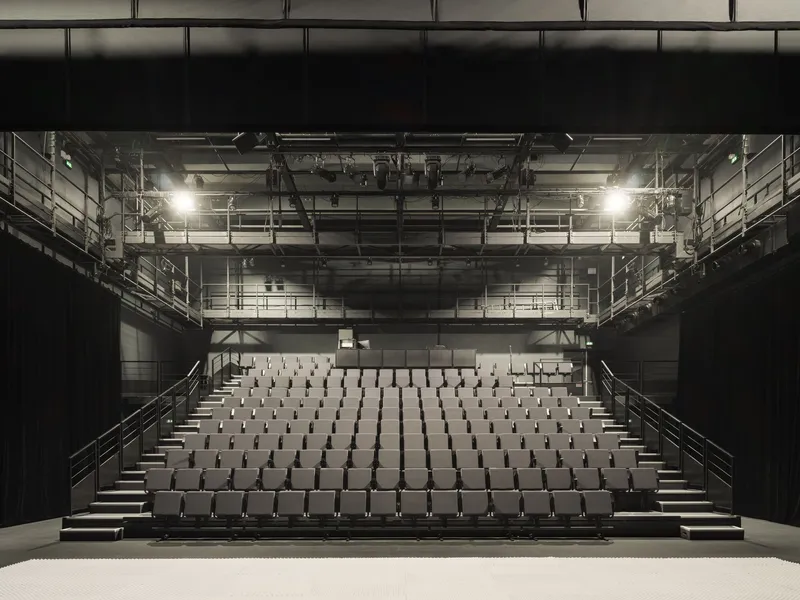
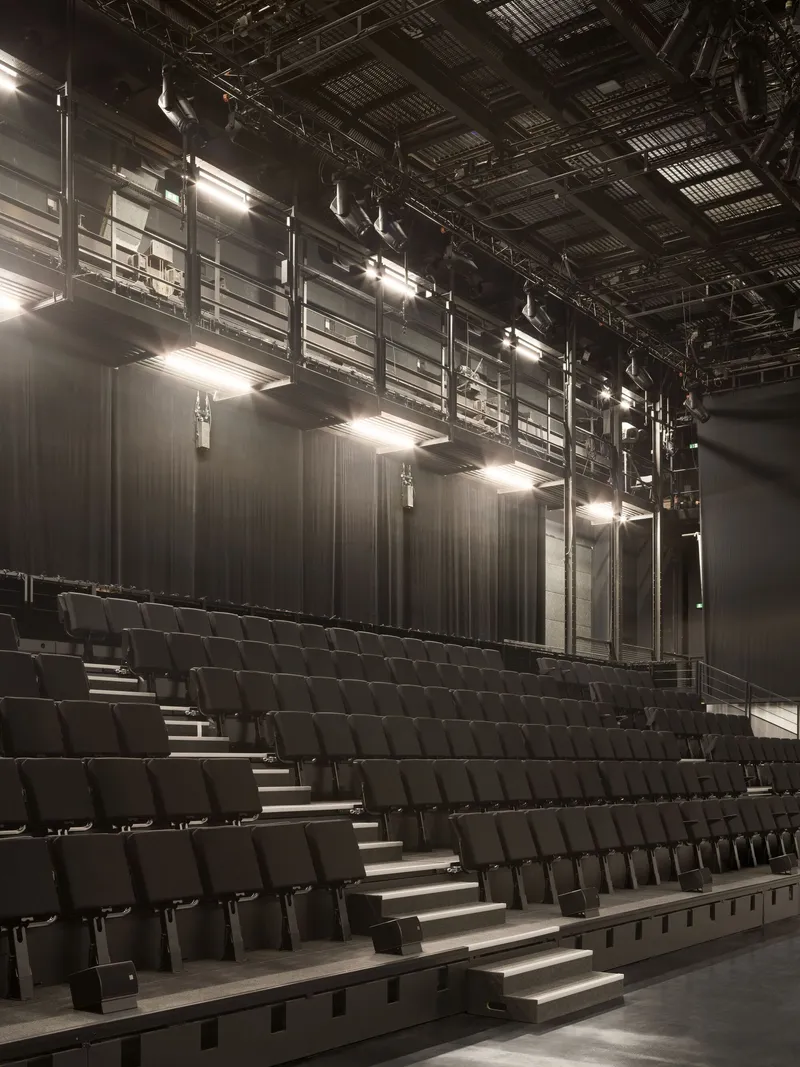
The main 800-seat auditorium retains its tiered red seating but gains improved sightlines and accessibility, along with a fully updated lighting rig. Exposed steel trusses remain visible overhead, an honest structural expression that suits the theater's identity as a laboratory for experimental work. The rigging infrastructure is dense and flexible, capable of supporting the kind of ambitious scenography that Nanterre-Amandiers is known for.
A new 200-seat theater introduces motorized telescopic seating and motorized platforms, designed to accommodate staging configurations that the original building could never have anticipated. Both spaces benefit from the acoustic expertise of Studio DAP and the structural work of Khephren Ingénierie. The key idea across both halls is that the architecture does not impose a single mode of performance. It provides a framework, then gets out of the way.
Transparency and Threshold


The tall glass curtain wall with vertical mullions is the building's dominant material gesture, and it works hardest in the transitional spaces. Corridors lined with floor-to-ceiling glazing dissolve the boundary between interior and park, while vertical white fins create a screen wall that modulates privacy and views beside staircases. On overcast days, the glass reflects bare winter trees and low clouds, momentarily camouflaging the building within its landscape.
EGIS Concept and their Elioth division handled the envelope and environmental design, and the transparency strategy serves a climate purpose alongside its aesthetic one. Fully glazed walls maximize daylight penetration into the public spaces, reducing artificial lighting loads during the day. Materials were selected to reflect changing light conditions, so the building reads differently through the seasons, from bright winter beacon to dappled summer volume.
Inhabiting the In-Between


A glass-walled upper floor activity room with suspended fabric screens and views into misty trees beyond captures the renovation's best quality: every space, however secondary, is treated as habitable. The dining area with its timber tables and geometric linear lighting fixtures is not a cafeteria but a room with architectural ambition. These are not afterthoughts or service spaces. They are the places where the theater's relationship with its community is maintained between performances.
Snøhetta's restraint here matters. The palette of concrete, wood, and glass is deliberately limited. Surfaces are raw or lightly finished. The architecture provides structure, light, and connection, then lets the theater's own visual culture, those hanging banners, the artworks on the mezzanine, the changing stage sets glimpsed through open doors, supply the color and incident. It is a building that trusts its occupants to complete it.
Why This Project Matters
Renovating a national drama center is a political act as much as an architectural one. Nanterre has experienced profound urban and social transformation since the 1960s, and the Amandiers theater has been a cultural anchor through all of it. Snøhetta's decision to make the building radically transparent, to open it to the park, to lower its threshold of entry with a sunken plaza and a public hall that functions as a living room, is a statement about who the theater is for. It is for the neighborhood, not just the ticket holders.
The project also demonstrates that major institutional renovation does not require architectural ego. By preserving existing volumes and reorganizing them around a newly composed Grand Hall, by letting scenography take center stage while the architecture provides the frame, Snøhetta has produced a building that is more useful, more legible, and more generous than its predecessor without erasing the history that Jacques Kalisz embedded in the original concrete. That combination of ambition and deference is harder to achieve than any signature form.
Nanterre-Amandiers National Drama Center Renovation and Rehabilitation by Snøhetta with SRA Architectes (associate architect), Kanju (scenographer), and Atelier Silva Landscaping (landscape architect). Nanterre, France. 10,000 m². 2026. Photography by Jared Chulski Lighting.
About the Studio
Share Your Own Work on uni.xyz
If projects like this are the kind of work you want to make, uni.xyz is a place to publish your own, find collaborators, and enter design competitions.


Popular Articles
Popular articles from the community


Jaramillo Van Sluys Arquitectura and Urbanismo Turn a Demolished Registry Lot in Quito into an Orchard Plaza
In Quito's Centro Histórico, a 2,800 m² plaza exposes the San Agustín convent wall and redraws its lost Augustinian orchard in volcanic stone.

Architekt Andreas Gruber Scatters 23 Dark Timber Chalets Across a South Tyrolean Forest Edge
In Molini di Tures, Amonti Chalets breaks a resort into a hamlet of gabled timber houses, with parking, storage and services pushed into the slope.

Cube Design Draws an Ecological Corridor Between Two Shenzhen Hills with the Nankai Building
Beside Shenzhen's container docks, the Nankai Building pairs stacked balconies with a climbing green screen to connect two hillsides across its height.

GROUP A Strips a 1969 Rotterdam Harbor Headquarters to Its Frame and Wraps It in Timber Louvers
In Rotterdam's M4H harbor district, Ferro Offices reuses a 1969 frame, adds one timber storey and reaches BREEAM-NL Outstanding.

Similar Reads
You might also enjoy these articles


LAVA Architecten Gives Vocational Education a Sawtooth-Roofed Face on a Mechelen School Campus
In Mechelen, Belgium, a 2,053 m² STEM school on a 6×6 m grid turns workshops and classrooms into rooms that can be rearranged as teaching changes.

KEMA Studio Turns a Derelict Marvila Attic into a 60 m² Lighthouse Apartment Above Lisbon
In Lisbon's Marvila district, a rebuilt roof, four skylights and two plywood volumes turn an unlivable attic into a bright home facing the Tagus.

Pixel Gardens: One Repeated Module Stacked Into a Terraced Social Housing Tower for Famagusta
Salem Bader's shortlisted housing tower builds a vertical neighbourhood from one repeated module, offsetting units to carve terraces, light and air.

Bao Huynh Watercolor Atelier: A Serene Art Retreat in Hội An
Bao Huynh Watercolor Atelier in Hội An blends multifunctional art spaces, sustainable design, local materials, and family-friendly living in a serene environment.


Comments (0)
Please login or sign up to add comments
No comments yet. Be the first to comment!