
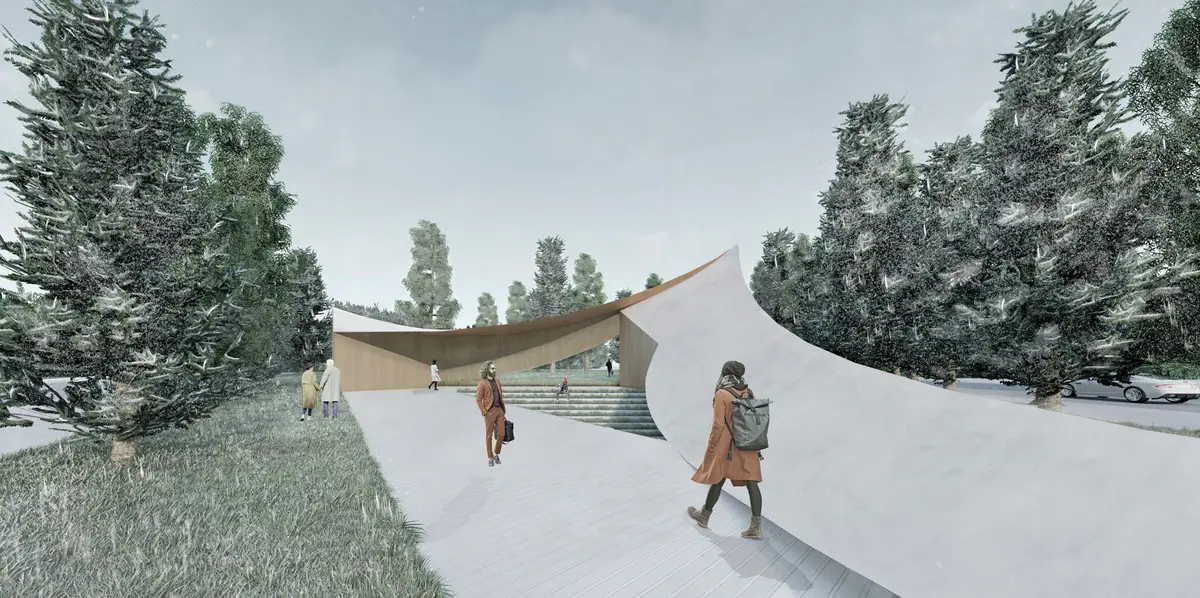
Solarium: A Cave-Like Library That Harvests Light in Oslo's Darkest Months
A central open courtyard called the patium anchors this sustainable library, pulling daylight and greenery into a curved timber shell built for Norway's ex


What happens when a library borrows its logic from a cave? In Oslo, where freezing temperatures and months of limited daylight test every architectural decision, the answer is a building that turns inward to find light. The Solarium Library, designed by Gabriella Felicioni, uses a large central open courtyard, called the patium, as its primary organizing device. Rather than fighting Oslo's harsh climate with brute-force insulation alone, the design channels daylight, air, and vegetation through this void at the building's core, creating a living heart that changes character with each season.
The project is a winner entry of Solarium, a competition challenging designers to rethink sustainable public architecture for extreme climates. Felicioni's response reframes the library as more than a repository of knowledge: it becomes a communal sanctuary and ecological landmark where architecture and nature overlap. Rooted in the metaphor of a cave, the building offers protection while fostering a persistent connection to the outside world, reflecting the deep relationship Norwegians maintain with their forests.
A Triangular Footprint Carved Around a Central Courtyard
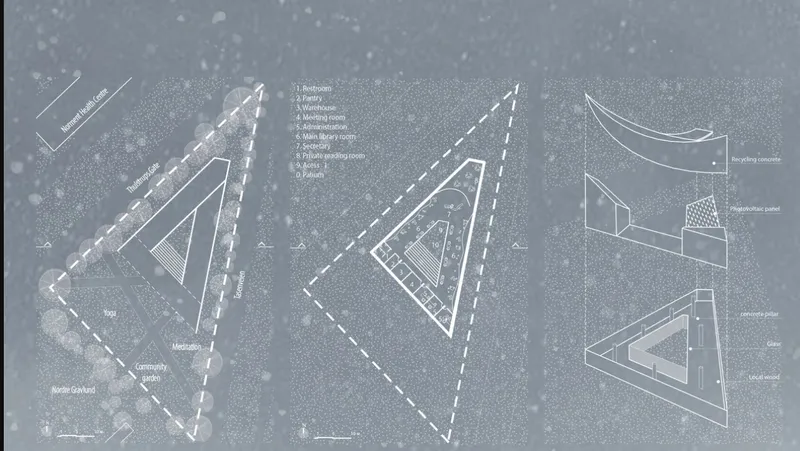
The site plan reveals a triangular building footprint surrounded by landscape, with construction details that clarify how the structure meets the ground. The patium sits at the geometric center, pulling light and ventilation deep into the floor plate. Entry into the library occurs through a lush linear garden that acts as a filter, a transitional space that narrates the experience of moving from external cold into an inviting interior. This sequence is deliberate: the building does not simply shelter, it stages a procession from exposure to warmth.
The section drawings show how the building integrates renewable energy and ecological systems at every level. Photovoltaic solar panels, rainwater harvesting, passive cross-ventilation, recycling areas, and waste collection points are woven into the architecture rather than appended to it. The result is a building whose sustainability credentials are structural, not cosmetic.
A White Shell Among Conifers
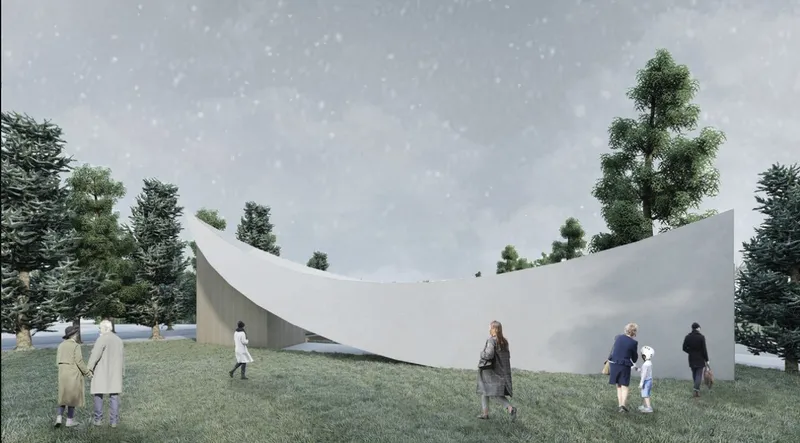
The exterior rendering shows the curved white shell roof rising gently among conifer trees, with visitors walking through a landscape that feels continuous with the building itself. The shell reads as both geological and manufactured: its form recalls the cave metaphor that drives the concept, while its clean curvature signals precision. The surrounding landscape is not ornamental; the trees and planting reinforce the biophilic principles that run through the entire project. The building sits in its site rather than on it.
Curved Timber Ceilings That Pull Light Through Snowfall
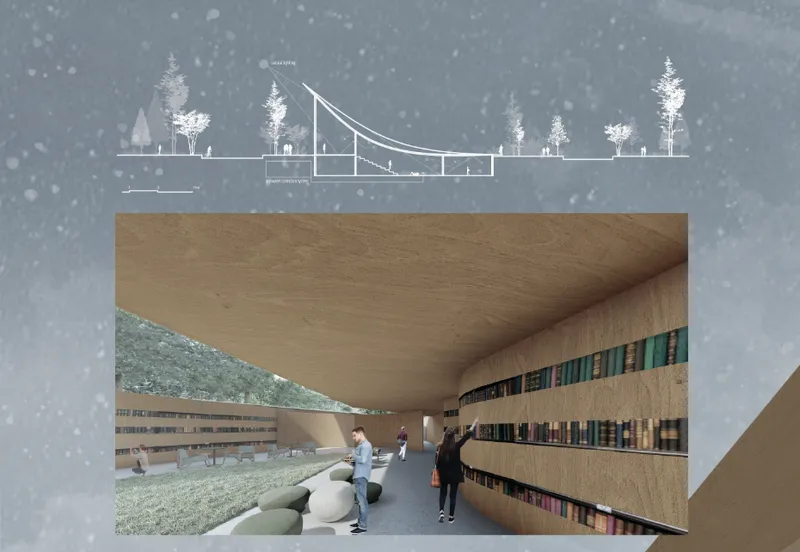
A sectional drawing paired with an interior rendering captures the library's spatial logic during winter. Curved timber ceiling planes sweep overhead while snow falls beyond the glass, and the patium draws daylight into the reading spaces below. Bookshelves line the walls, but the dominant experience is one of light and warmth, not enclosure. The curved wooden forms, combined with natural light and interior greenery, stimulate the senses and promote calm. The patium, bathed in daylight even during winter months, produces changing visual and tactile experiences shaped by shifting light, seasonal colors, and subtle movements of air and foliage.
An Interior Amphitheater for Gathering and Reflection
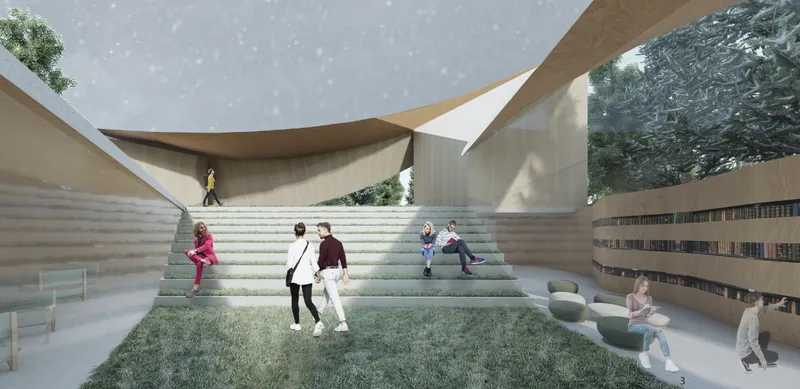
The final interior view reveals amphitheater-style seating beneath flowing timber ceiling planes, with visitors sitting, reading, and walking through the space. This is where the library's identity as a communal sanctuary becomes most tangible. The stepped seating encourages informal gathering, lecture, and quiet observation in equal measure. The architecture here does not prescribe behavior; it accommodates a range of uses, from focused study to collective event, within a single generous volume.
The dynamic interplay between the timber structure, diffused daylight from the patium, and the warmth of the interior materials fosters an environment built for learning, reflection, collaboration, and community. The space feels alive, shaped by the time of day and the season outside.
Why This Project Matters
The Solarium Library proposes a prototype for public buildings in cold climates that refuses to treat sustainability and comfort as competing goals. By centering the design on the patium, Felicioni creates a building whose most generous gesture, an open courtyard exposed to the sky, is also its most practical: it harvests daylight, drives cross-ventilation, and supports interior vegetation. Every passive energy strategy and biophilic element serves double duty, reducing the environmental footprint while enriching the experience of being inside.
At a moment when many sustainable buildings achieve their metrics at the expense of spatial generosity, the Solarium demonstrates that ecological performance and architectural ambition can share the same floor plan. The project invites a reconsideration of what public architecture can be in extreme climates: adaptive, inclusive, and intimately connected to the rhythms of the natural world. It is a library that does not merely store knowledge but embodies a particular kind of environmental intelligence.
View the Full Project
About the Designers
Designer: Gabriella Felicioni
Enter a Design Competition on uni.xyz
uni.xyz runs architecture and design competitions year-round that reward proposals with spatial conviction and real site intelligence.
Project credits: Solarium by Gabriella Felicioni Solarium (uni.xyz).


Popular Articles
Popular articles from the community


Cube Design Draws an Ecological Corridor Between Two Shenzhen Hills with the Nankai Building
Beside Shenzhen's container docks, the Nankai Building pairs stacked balconies with a climbing green screen to connect two hillsides across its height.


Opera on the Sea: Driftwood Logic Shapes a Timber Opera House on Estonia's Coast
Trevor Orgill's opera house translates the entangled drift of floating timber into a civic building where wood, water, and music converge.

The Amber Palace Opera: A Geological Fiction Surfaces on Tallinn's Baltic Waterfront
Pierre Brillard reimagines a Baltic legend as a public landscape, opera house, and waterfront promenade rooted in Tallinn's coastal identity.

ETEH Reworks the Shared Spaces of São Domingos School in Brazil Around Timber, Color and Hanging Plants
At São Domingos School in Brazil, 436 m² of hall, refectory and library are recast with timber joinery, a yellow and blue code and trailing greenery.

Similar Reads
You might also enjoy these articles

Vereda Arquitetos Renovates a 40-Square-Meter Apartment Inside Niemeyer's Copan Building
A compact unit in São Paulo's most iconic residential tower gets a material overhaul that pairs exposed concrete with bold blue Formica.

Shakur's House: Exposed Brick as an Interior Organiser in a 168 m² Mashhad Residence
Brick moves indoors in this Mashhad residence, where masonry walls, glass partitions and teal planes sequence a compact home without closing it off.

Day and Night Park: A Time-Based Urban Newsstand in Beijing
A temporary urban newsstand in Beijing blending travel, light, and reading through poetic colors, compact form, and community-focused design.

Modernist Patio Renovation in El Masnou, Barcelona by Oliver Segura Arquitectura + Cebrià Arquitectura
Modernist patio renovation blending tradition and innovation with a movable pool, leveled floors, and Catalan materials in El Masnou.


Comments (0)
Please login or sign up to add comments
No comments yet. Be the first to comment!