
IMK Architects Stacks a Timber-Lined Tower and Amphitheater into a South Indian University Campus
Sona University's new centre and library in Salem, Tamil Nadu, weaves vertical louvres, stone terraces, and a soaring atrium into campus life.

Indian campuses rarely get architecture that treats the library as the social center of gravity. At Sona University in Salem, Tamil Nadu, IMK Architects have built precisely that: a stacked composition of reading rooms, amphitheaters, terraces, and a commanding tower that anchors a sprawling campus while inviting students to linger on its steps. The building is both landmark and living room, a vertical campus within the campus.
What makes the project genuinely interesting is how it negotiates between the monumental and the intimate. The tower rises high enough to register against the Shevaroy Hills on the horizon, yet at ground level the building dissolves into wide stone steps, preserved trees, and shaded courts where students sit cross-legged with laptops. The design resolves the tension between a civic gesture and a usable everyday space, and it does so with a material palette of white vertical louvres, textured stone panels, and generous timber interiors that feel warm rather than institutional.
A Tower That Earns Its Height
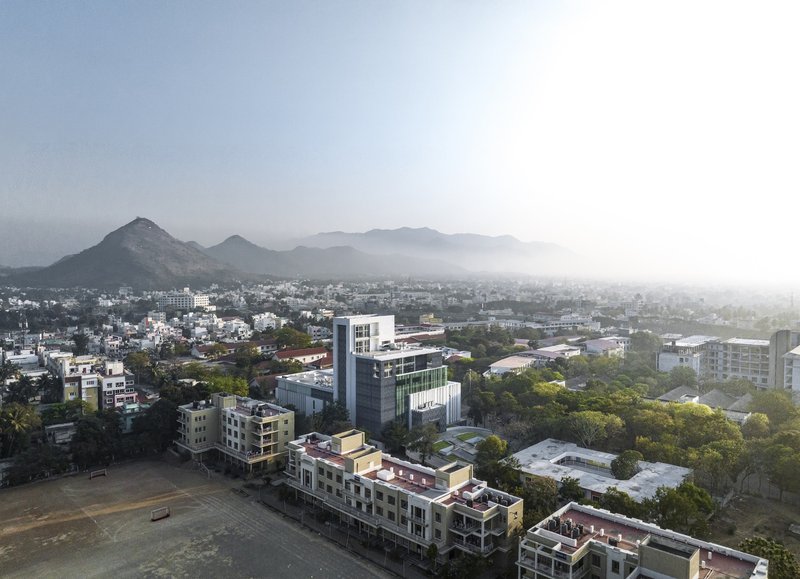
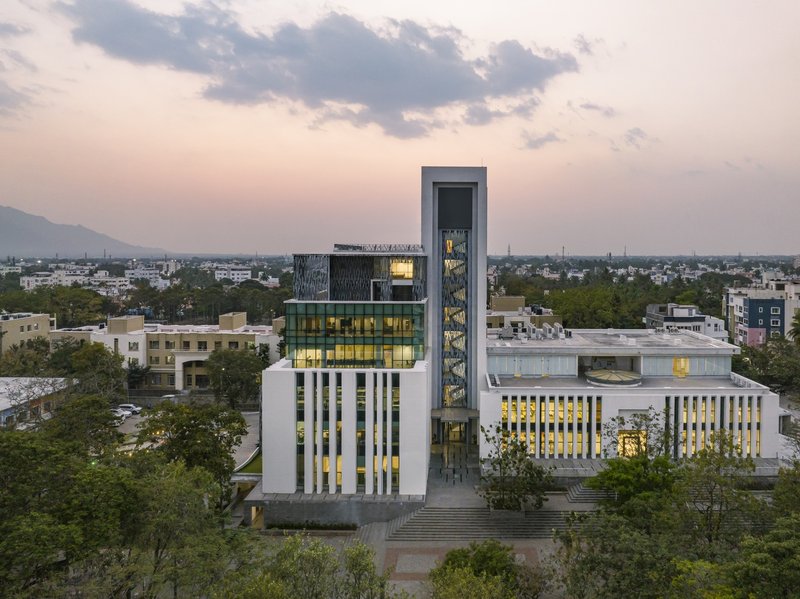
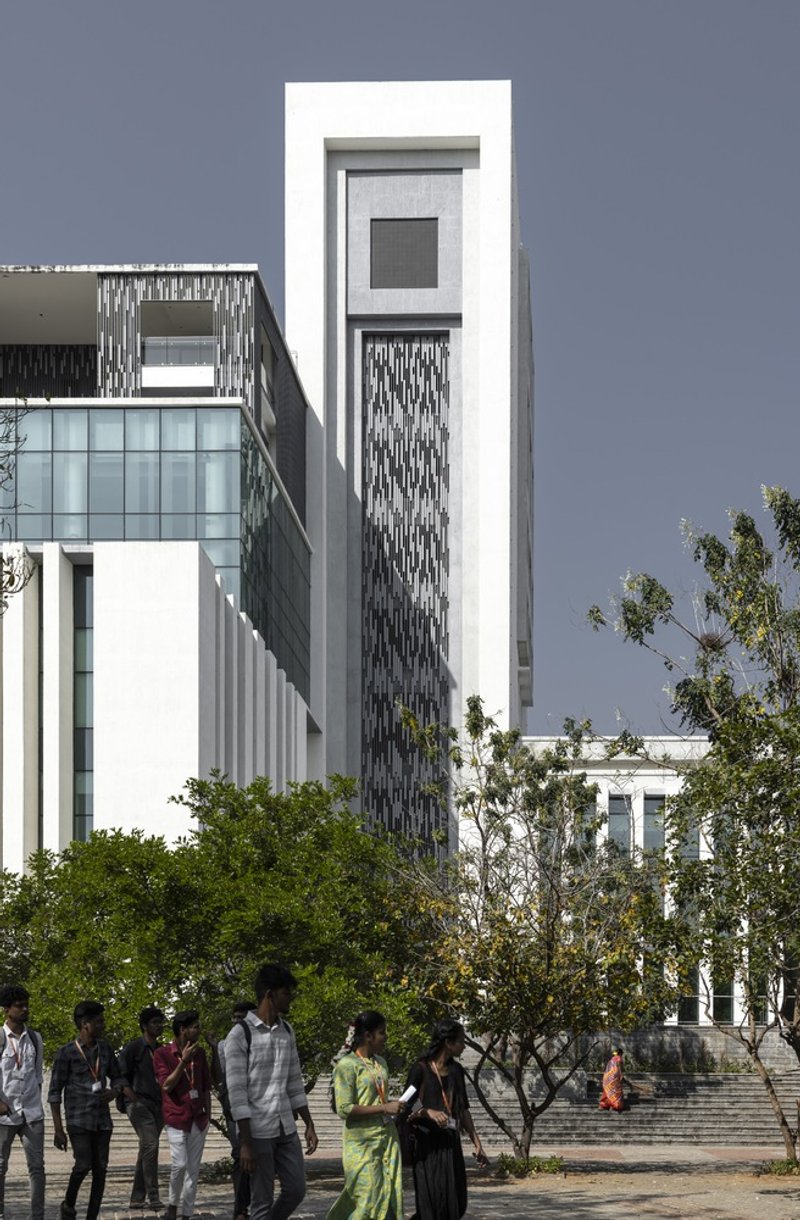
Tall buildings on low-rise campuses can feel aggressive. Here the tower justifies itself by doing more than asserting presence: its alternating bands of white vertical fins and textured panels break the mass into legible horizontal registers, each corresponding to a distinct interior program. Seen from a distance, particularly in the morning haze with the mountains behind, the tower reads as a slender marker rather than a slab. At dusk, when the interior light washes through the louvres, it becomes a lantern for the campus.
The decision to stack programs vertically, rather than spread them across the site, preserves the mature tree canopy and open ground at the base. It is a land-use argument as much as an aesthetic one, and it pays off in the generous landscape that wraps the building at grade.
Louvres, Screens, and Climate Response
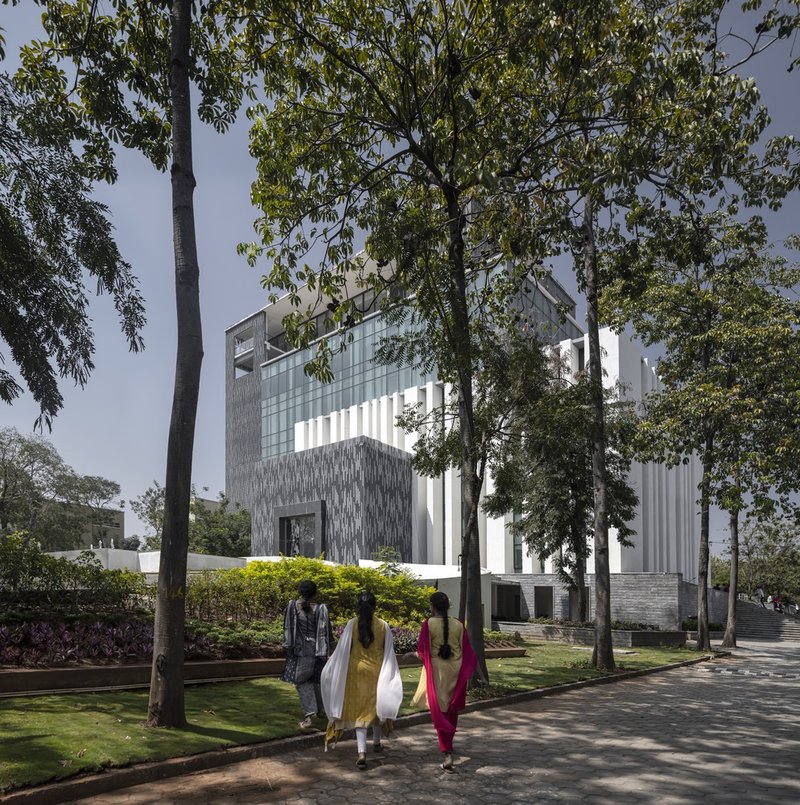
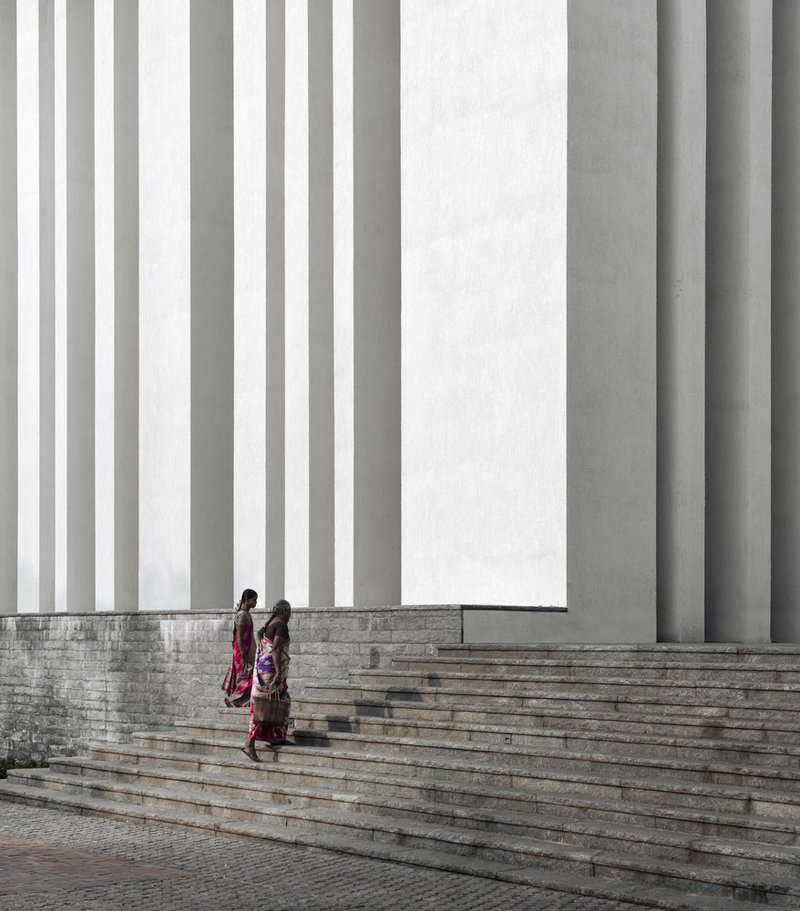
Salem sits in a hot, semi-arid belt where direct sun is the enemy of comfortable reading. IMK's facade strategy deploys tall vertical louvres across the most exposed elevations, filtering light while allowing cross-ventilation. The louvres are not uniform: white and grey columns alternate in rhythm, giving the facade a textile quality when seen up close. Patterned metal screens appear on other faces, calibrated to orientation. The result is a building that looks different from every angle, yet maintains a coherent language of vertical rhythm.
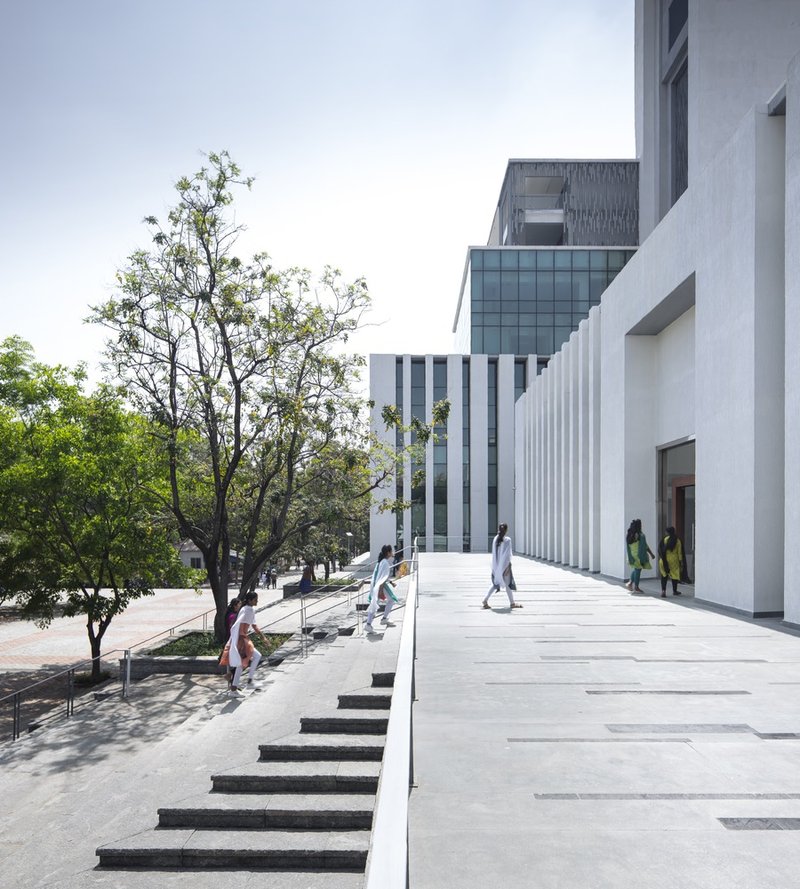
At the entrance level, the vertical elements are scaled up to near-monumental proportions, framing a colonnade that channels breezes into the ground floor. Two women ascending the stone steps beneath these columns give a sense of the scale: the louvres dwarf them, but the shadows they cast create a cool, dappled threshold that eases the transition from hot pavement to air-conditioned interior.
The Timber Atrium as Campus Commons
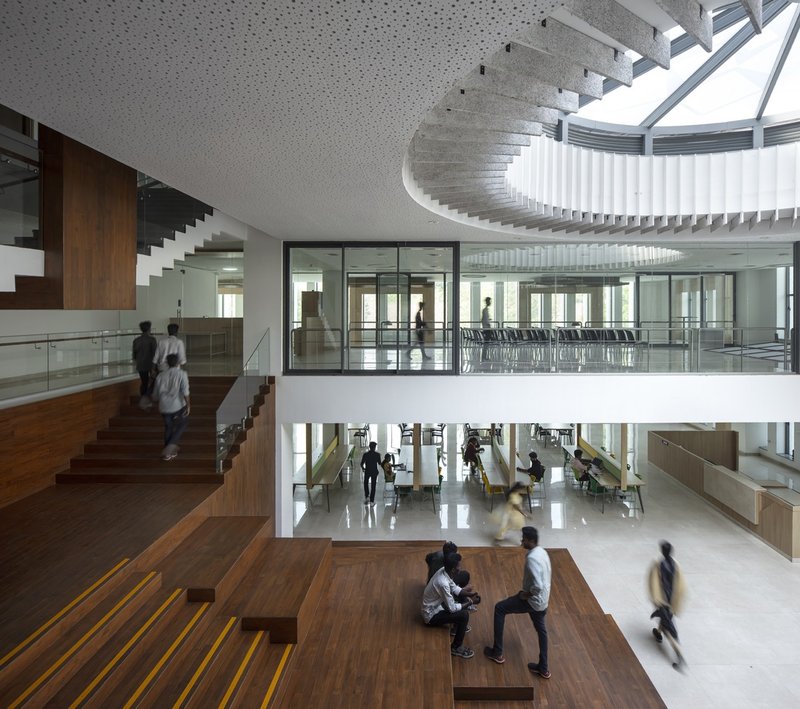
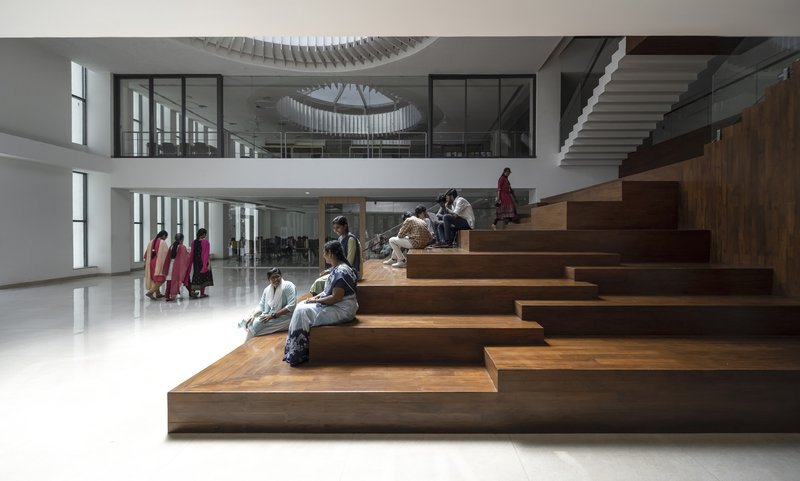
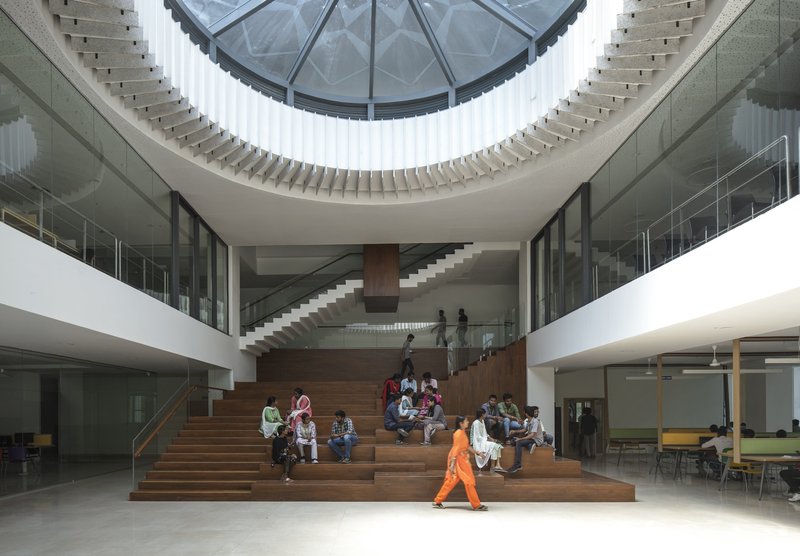
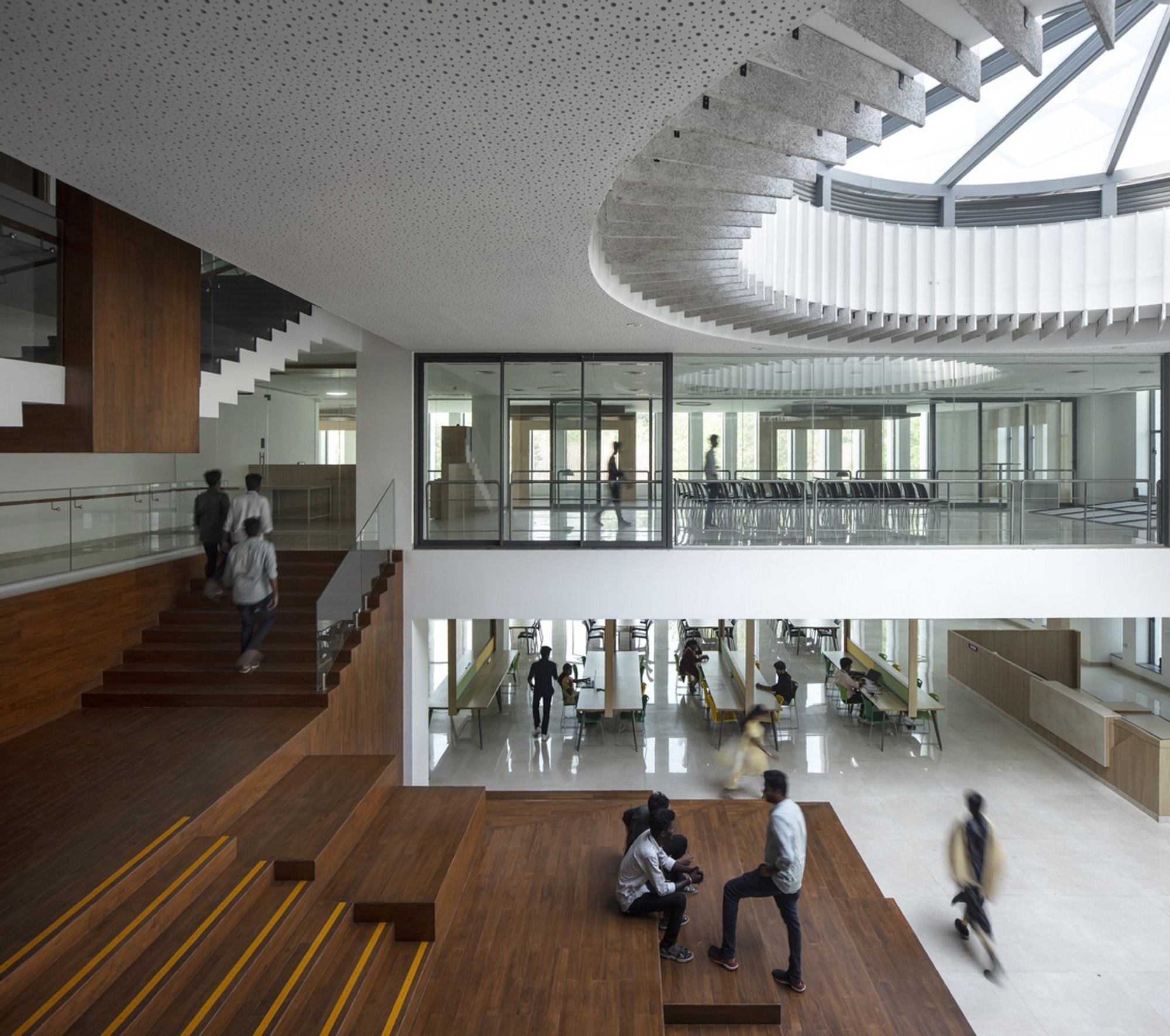
The interior surprise is a multi-story atrium lined in timber, its wide stairs doubling as amphitheater seating. A circular skylight at the top floods the space with diffused light that changes character throughout the day. Students cluster on every tier: some studying, some talking, some just watching the activity below. The space functions less like a conventional library lobby and more like a town square turned on its side.
Timber cladding is an unusual choice for institutional buildings in Tamil Nadu, where concrete and tile dominate. Here it pays off by absorbing sound and lending warmth to what could easily have been an echoing concrete canyon. The stepped seating platforms are wide enough for a laptop, a backpack, and a friend, which is the minimum viable unit for student life.
Ground Plane: Steps, Trees, and Social Life
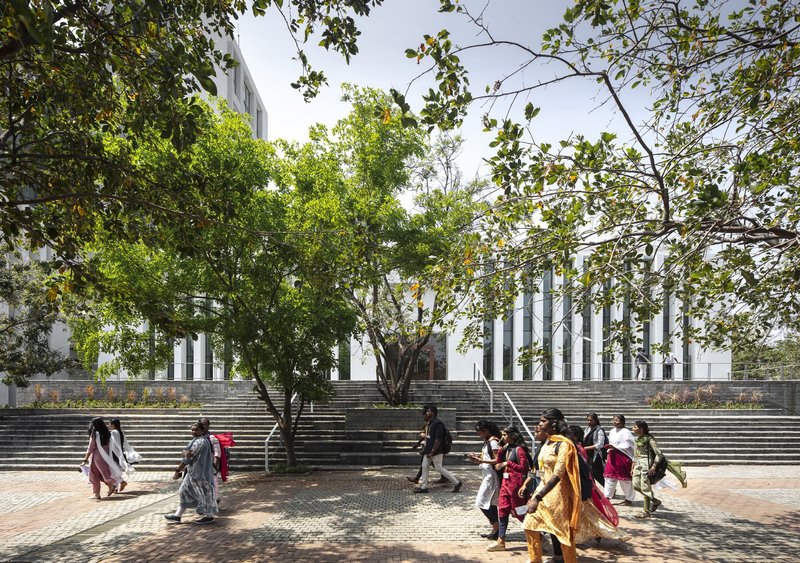
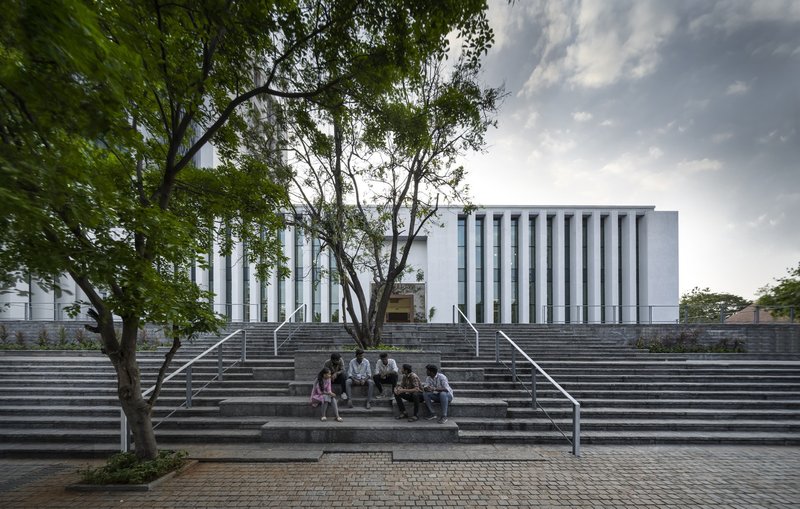
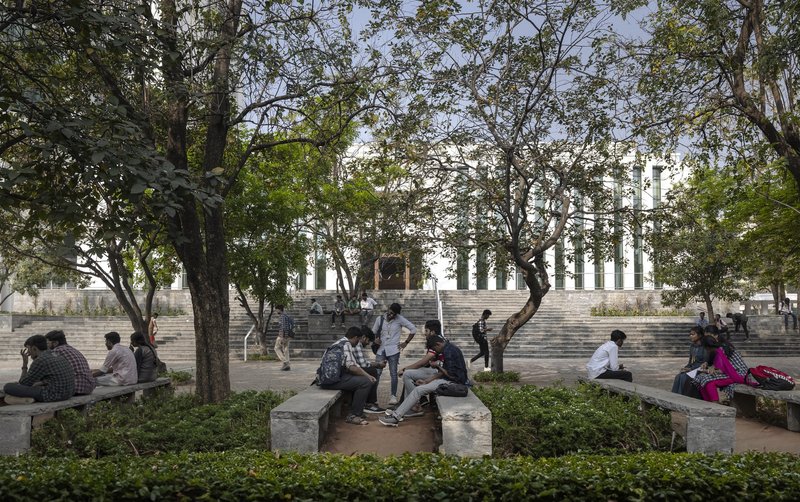
The building meets the ground through broad stone steps that cascade outward, blurring the line between architecture and landscape. Existing mature trees have been preserved within and around the terraces, their canopies providing shade that no louvre can match. At dusk the steps fill with students, the stone still warm from the day's sun, the vertical facade behind them glowing softly. It is a simple move, executed with enough generosity of dimension to actually work.
Concrete seating blocks under deciduous trees create smaller, more intimate gathering nodes in the adjacent courtyard. These are the kind of programmatically humble gestures that determine whether a building is merely photographed or actually used. From the evidence, this one is used.
Courtyards and Terraces Above Grade
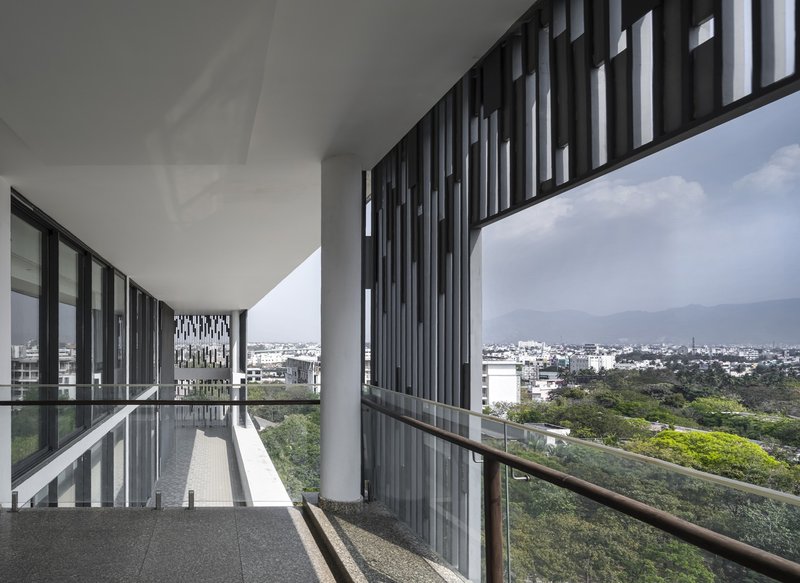
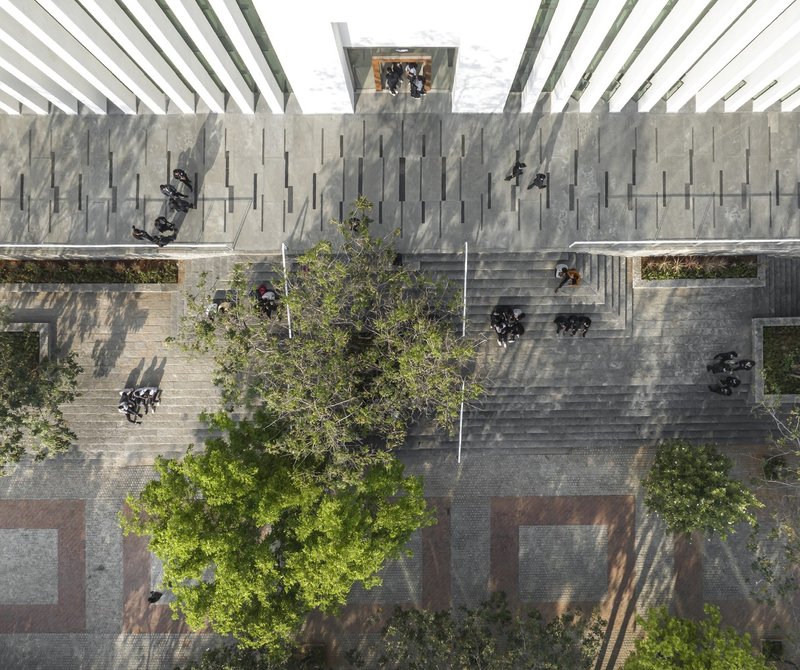
The building's section is not simply a stack of floors. Courtyards are carved out at multiple levels, bringing daylight deep into the plan and creating outdoor rooms at elevation. A covered terrace with dark vertical fins frames views over the tree canopy toward the city. A patterned courtyard at an upper level, paved with geometric tiles, catches sunlight and shadow in equal measure. These are not leftover voids; they are deliberately composed outdoor rooms, each with a distinct character.
The reflecting pool on the uppermost terrace is a small luxury that does real environmental work, cooling the air before it enters the adjacent reading spaces. It also gives students a reason to climb all the way up, which is half the battle with vertical campus buildings.
Campus Context and the Oval Amphitheater
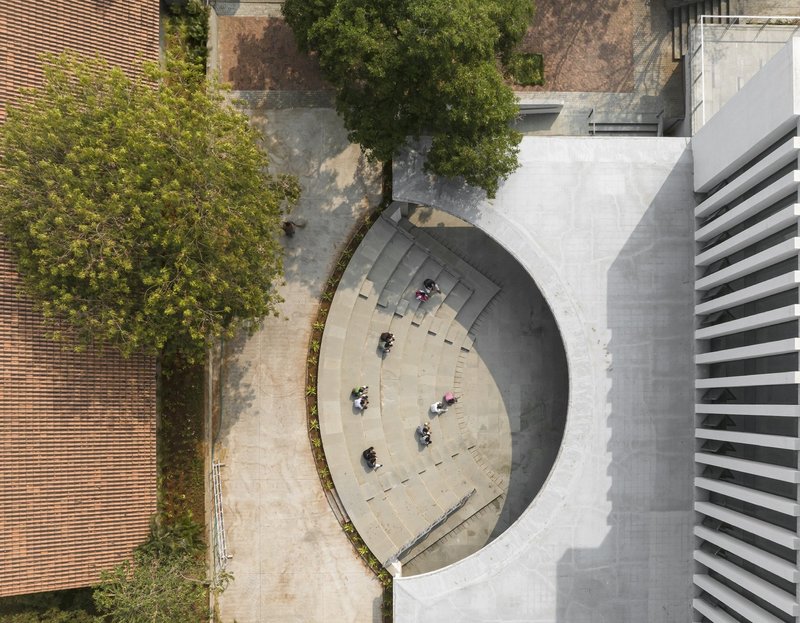
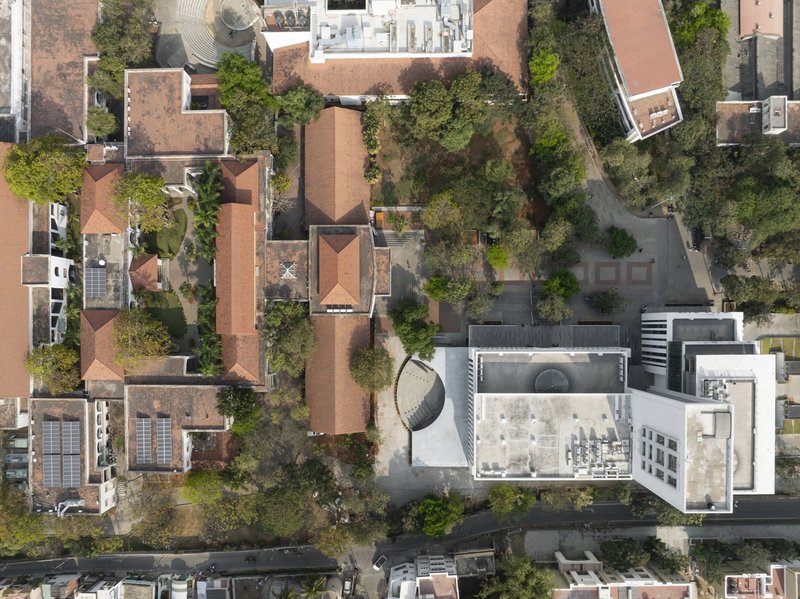
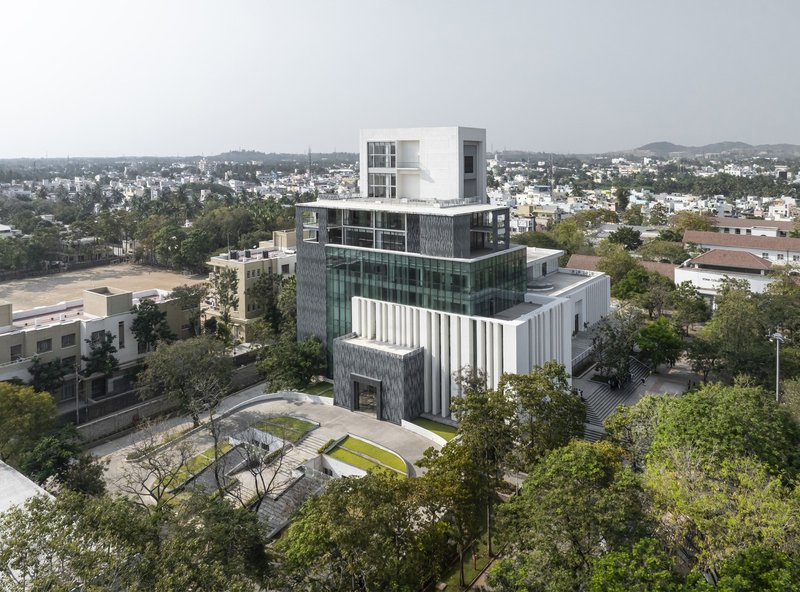
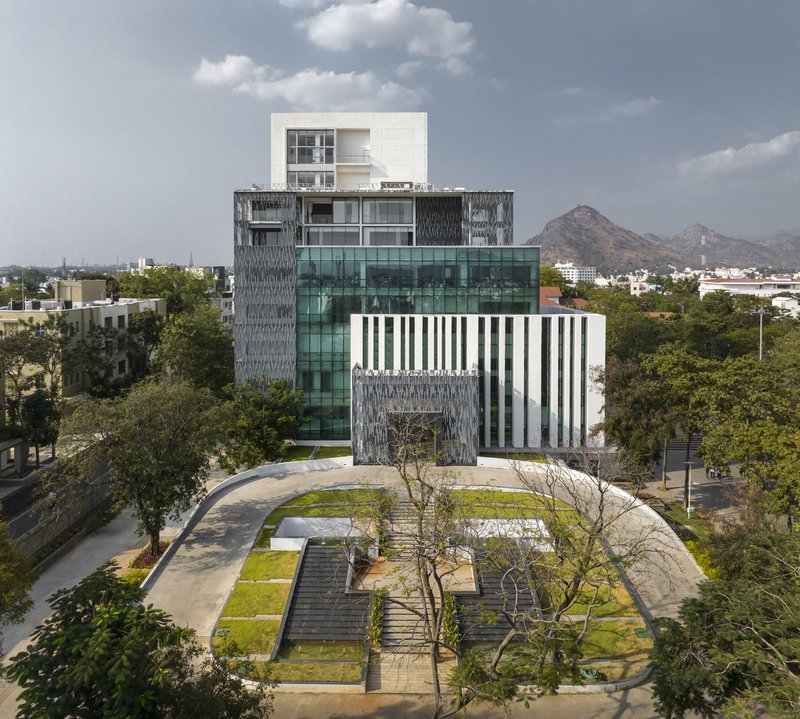
From above, the relationship between the new building and the existing campus becomes clear. Terracotta-roofed historic structures sit alongside the white volumes, and a curved plaza with an oval amphitheater mediates between them. The amphitheater, with its concentric rows of seating, introduces a formal gathering space that the campus previously lacked. It is oriented to catch afternoon shade from the building itself, a small but telling piece of environmental logic.
The aerial views reveal the extent to which the design preserves and enhances the existing tree cover. Rather than clear-cutting and replanting, IMK worked around the established canopy, letting trees push up through terraces and courtyards. The result is a building that looks as though it landed among the trees rather than displacing them.
The Entrance Sequence
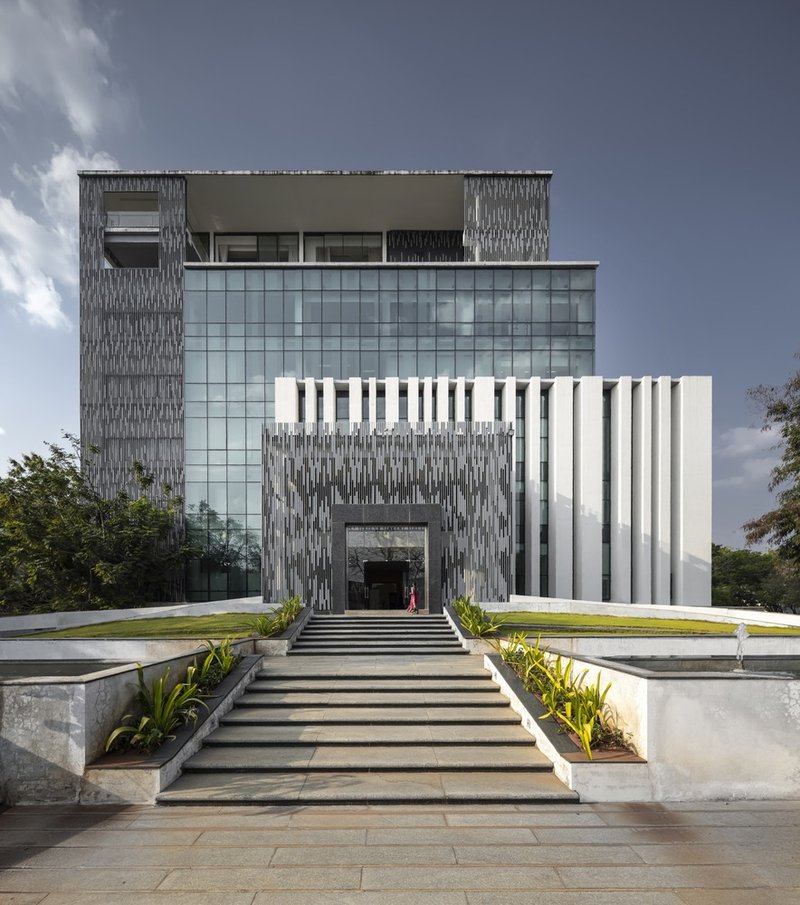
The main approach leads up a central staircase flanked by planted beds to a facade that layers glass, patterned metal screens, and solid panels. It is a deliberate compression of scale: the wide, open steps narrow into the screened threshold before releasing into the soaring atrium beyond. The sequence builds anticipation without resorting to grand porticos or symmetrical axes. It is processional but informal, which suits a university building where the dress code ranges from kurtas to lab coats.
Plans and Drawings
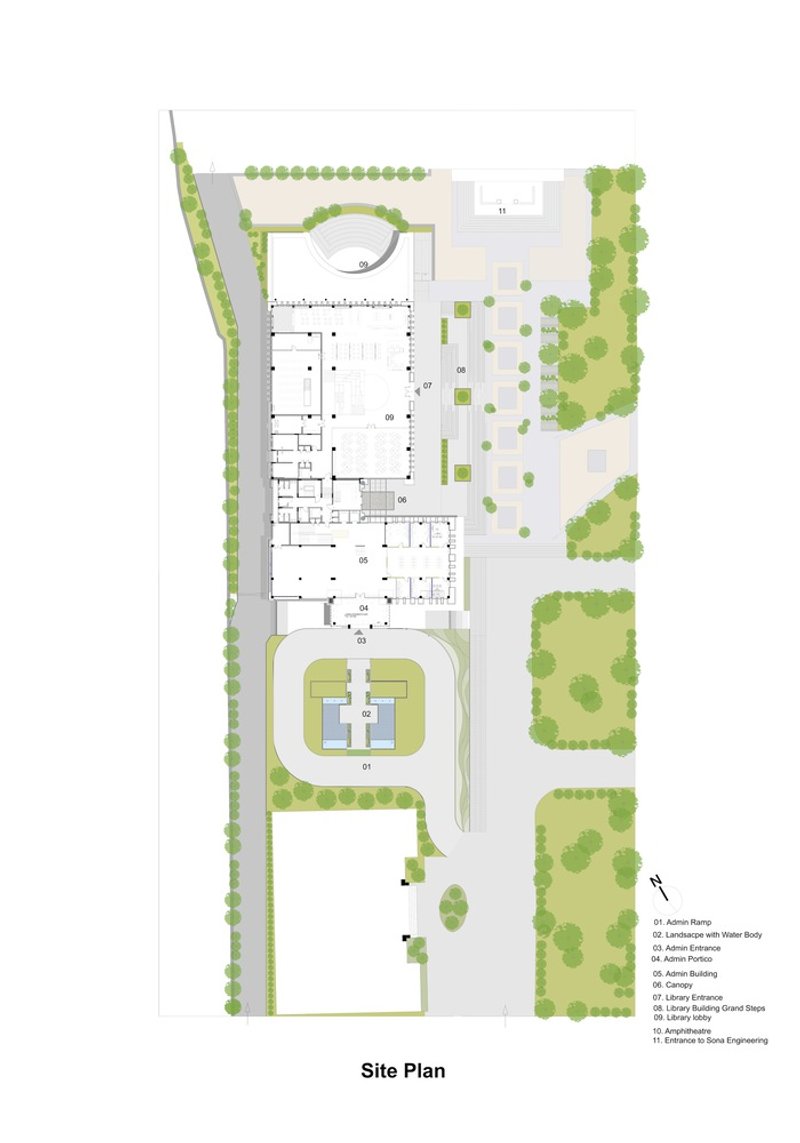
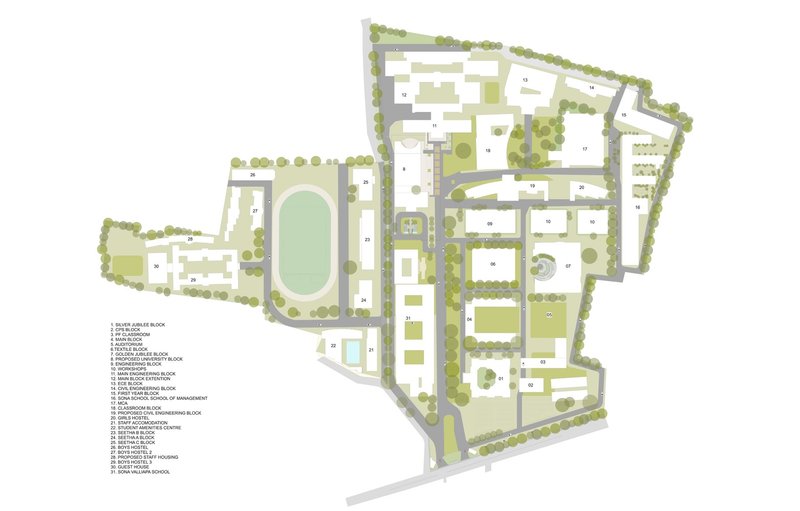
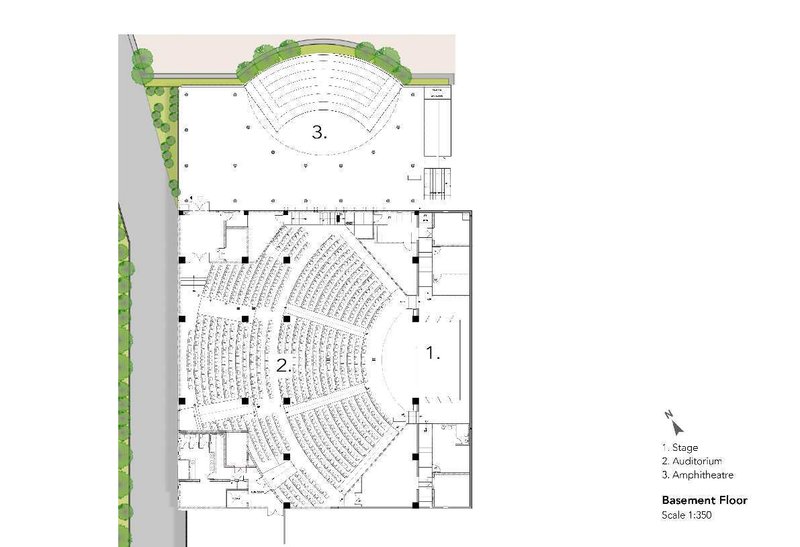
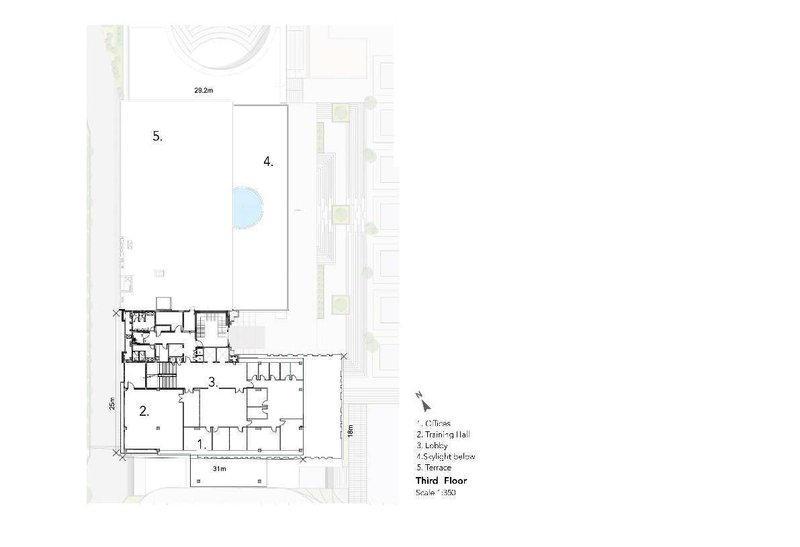
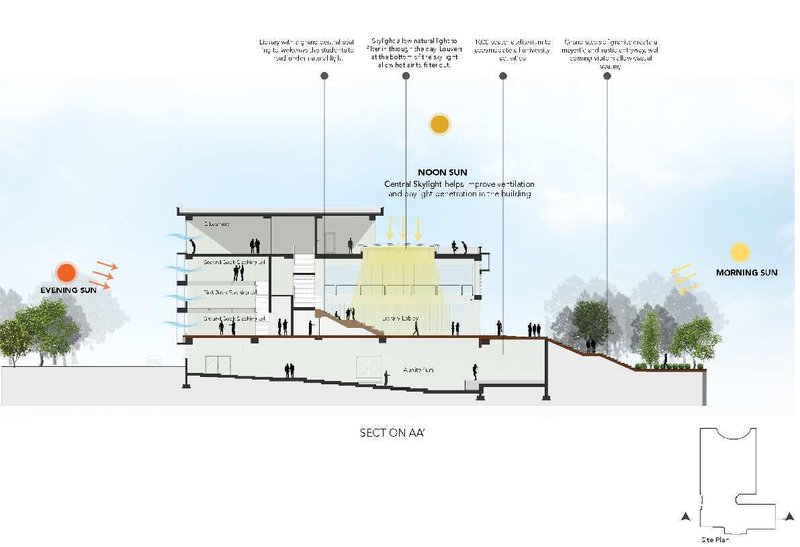
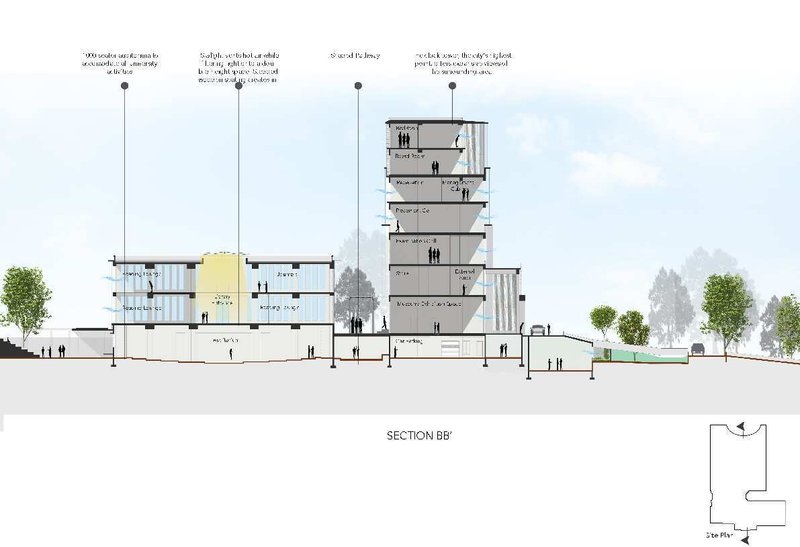
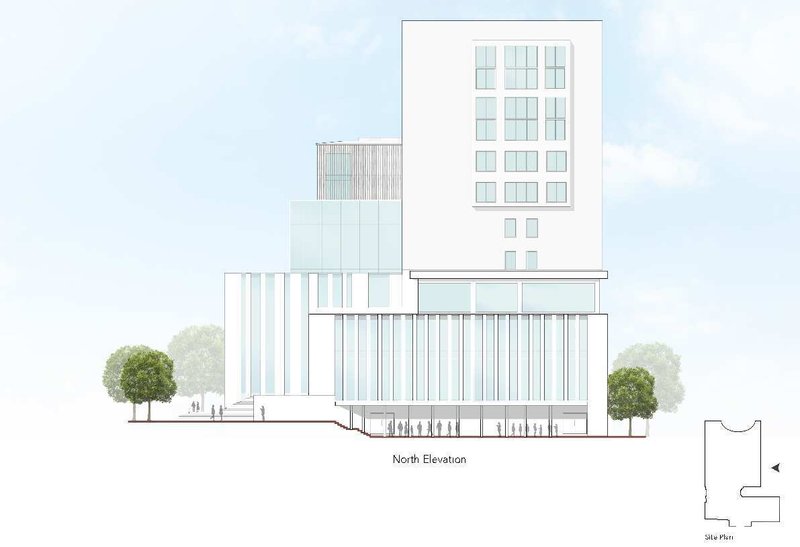
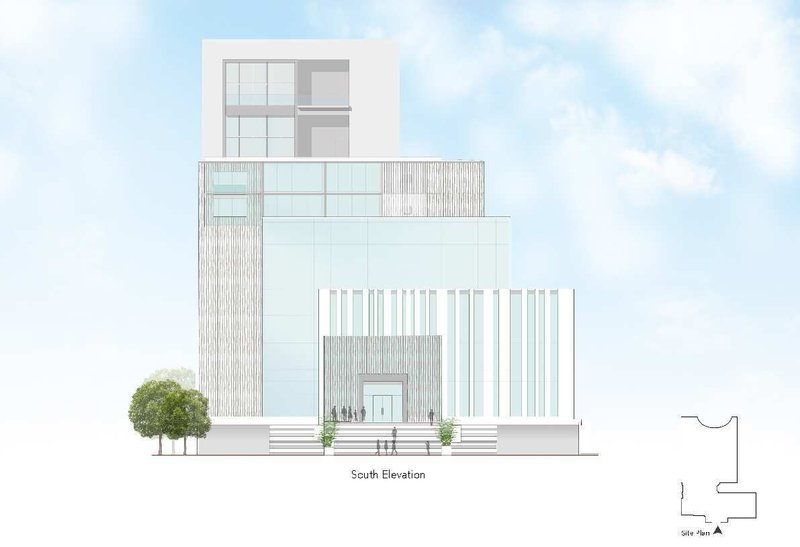
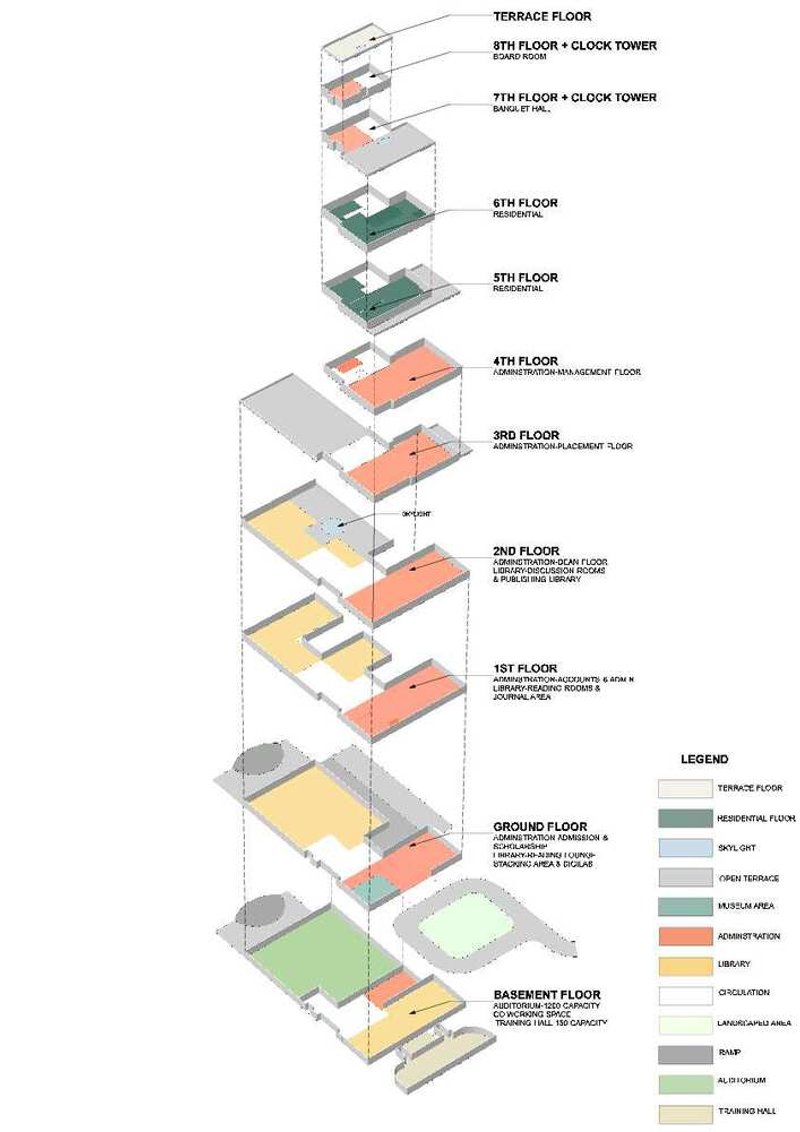
The drawings reveal the organizational logic beneath the composed facades. A fan-shaped auditorium occupies the basement, its seating geometry visible in the amphitheater courtyard above. Upper floors open onto terraces and the central skylit atrium. The section drawings illustrate the solar orientation strategy, with trees and louvres working in concert to shade the most exposed faces. An exploded axonometric color-codes the program from basement to roof terrace, showing how distinct functions, auditorium, library, study halls, terraces, are stacked and interlocked rather than simply layered.
The site and master plans show how the building anchors a broader campus strategy, with green corridors and circulation paths linking it to existing academic buildings. The elevations confirm the facade's calibrated asymmetry: the north and south faces are not mirror images but distinct responses to sun angle and context.
Why This Project Matters
Indian universities are in the middle of a building boom, and too much of it defaults to generic glass boxes or overwrought concrete fantasies. Sona University's Centre and Library offers a third path: a building that is climatically responsive without being preachy about it, formally ambitious without sacrificing usability, and contextually grounded without imitating the vernacular. The timber atrium alone would justify attention, but it is the quality of the ground plane, the terraces, the preserved trees, and the social spaces on every level that make this a genuinely good piece of campus architecture.
IMK Architects have demonstrated that a library building in a mid-tier Indian city can aspire to the spatial richness and material intelligence that we usually associate with flagship projects in larger metros. The tower marks the campus on the skyline; the steps and courts make it part of daily life. That combination is harder to achieve than either gesture alone, and it is why this project deserves sustained attention.
Sona University Centre and Library by IMK Architects, Salem, Tamil Nadu, India. Photography by Niveditaa Gupta.
About the Studio
Share Your Own Work on uni.xyz
If projects like this are the kind of work you want to make, uni.xyz is a place to publish your own, find collaborators, and enter design competitions.



Popular Articles
Popular articles from the community

MIDW Casts a Pavilion Roof from the Earth Itself at the 2025 Osaka Expo
On a fragile reclaimed island, excavated soil becomes formwork for a concrete canopy that will eventually disappear into wisteria.
Atelier LAI Scatters a Timber Resort Across a Terraced Anhui Valley
Nanshan Junning Resort uses wood joinery and topographic sensitivity to settle 6,700 square meters into a ten-meter slope near Hefei.
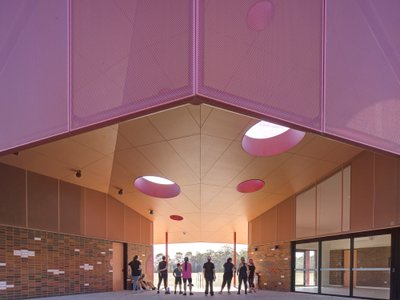
Sam Crawford Architects Anchors a Sports Pavilion in 10,000 Years of Indigenous History
A V-shaped brick and steel pavilion in southwest Sydney translates ancient clay ovens and gathering traditions into civic architecture.
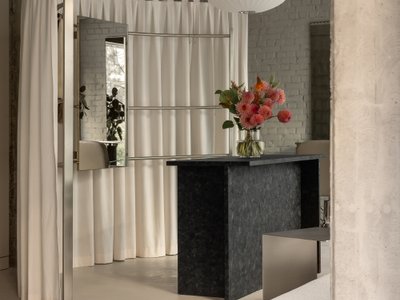
MAVA Design Turns a Column-Riddled Shell into a Serene Hair Extension Salon in Kyiv
Inside a former motorcycle factory campus, a 110 square metre beauty atelier treats structural obstacles as spatial anchors.


Similar Reads
You might also enjoy these articles

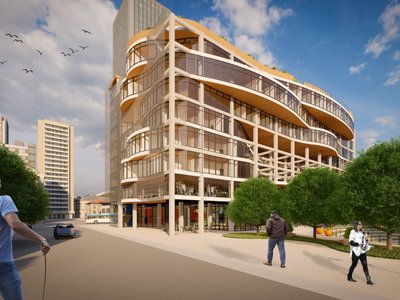
Olio Towers: A Mid-Rise for Performers That Fuses Housing, Rehearsal, and Stage
Located blocks from Houston's Theater District, this modular tower stacks living units around a central performance atrium.
Oasis: Modular Green Housing Carved into Dhaka's Urban Fabric
A shortlisted Plugin Housing entry reclaims unauthorized settlements in Dhaka with stepped concrete volumes, green roofs, and ventilation-driven design.

Black Hole: A Floating Megastructure for the Post-Physical Era
Emiliano Mazzarotto envisions a spherical, self-scaling arena where e-sports, digital hotels, and holographic stadiums replace traditional public space.
Compact & Sustainable Living in Piraeus: A Four-Level Family Home Built Around Light and Air
A narrow townhouse in one of Greece's densest port cities uses a central atrium and passive strategies to house three generations under one roof.


Explore Architecture Competitions
Discover active competitions in this discipline




The International Standard for Design Portfolios


The Global Benchmark for Architecture Dissertation Awards


The Global Benchmark for Graduation Excellence


Challenge to reimagine the Iron Throne
Comments (0)
Please login or sign up to add comments
No comments yet. Be the first to comment!