

Stacked Living: Cubes of Domestic Life Rise in São Paulo's Dense Urban Fabric
A modular co-living prototype for a multigenerational family stacks program into discrete cubes that blur indoor and outdoor boundaries.


What if the unit of domestic architecture were not the room but the cube? In São Paulo, where density presses against livability, a housing prototype called "Stacked" takes that question literally: each function of a multigenerational home occupies its own discrete volume, offset and layered to pull daylight, airflow, and greenery through the gaps between them. The result is a vertical dwelling that refuses to treat compactness as deprivation, instead using spatial constraint to amplify communal life.
Designed by Rungpairin Suttichote and No Ra, the project was shortlisted in the Nano Nest 2020 competition. Sited in São Paulo's tropical climate, the scheme houses a single mother, her three children, and grandparents within a stacked system of prefabricated modules, while also opening parts of the ground floor to the neighborhood through a street-level coffee shop and semi-open cooking spaces.
Offset Volumes and the Space Between
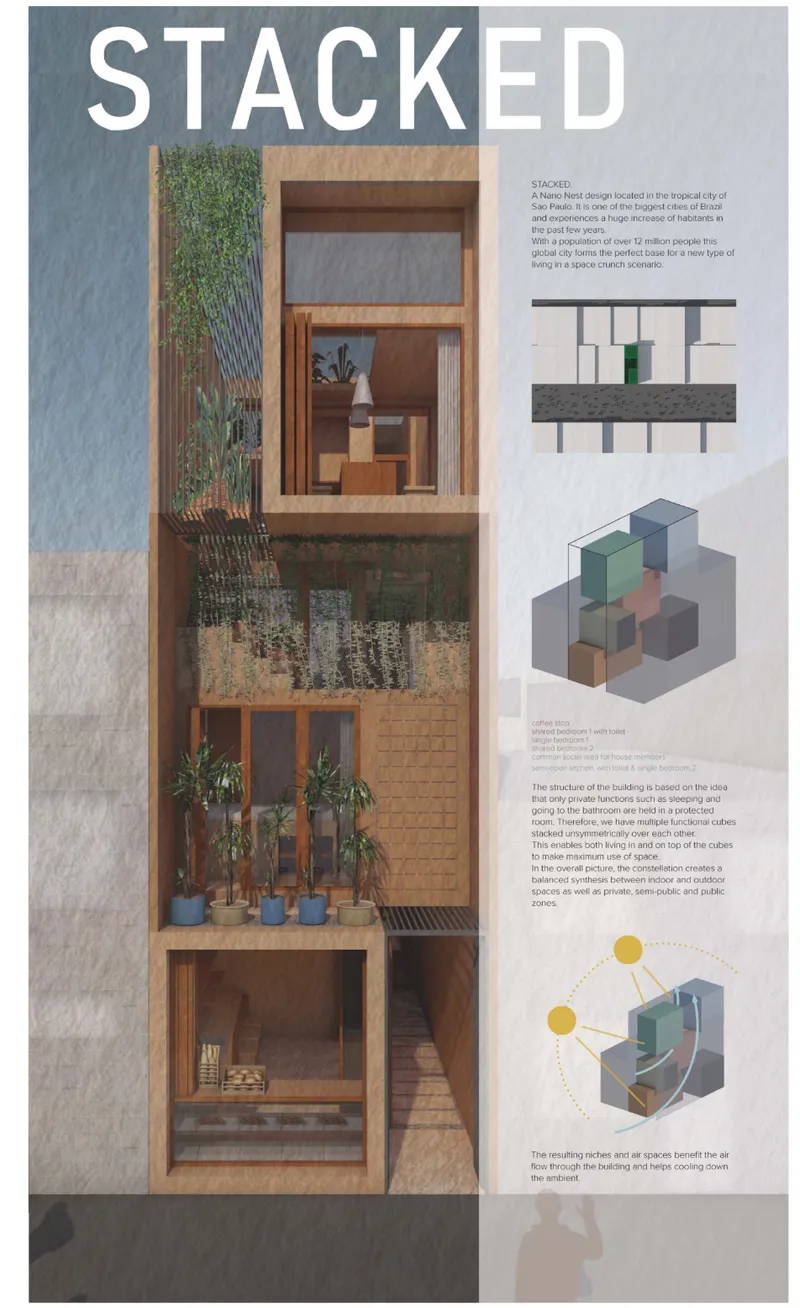
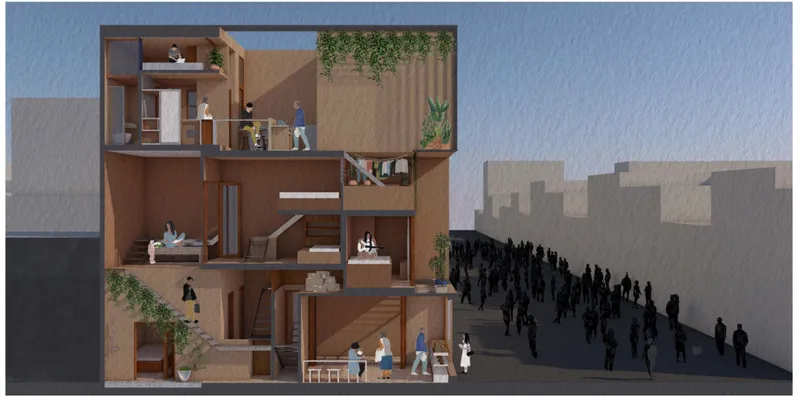
The sectional and axonometric drawings reveal the core logic: cubes are not simply stacked but staggered, creating voids where planted terraces, balconies, and open-air circulation carve pockets of outdoor life into the building's section. Timber framing holds the volumes together while keeping the structure legible, each cube readable as a distinct programmatic unit. The offset geometry is not decorative; it generates cross-ventilation and shields interior zones from direct tropical sun, performing climatically while giving the building its distinctive silhouette.
Green facades and vertical gardens wrap into the gaps between modules, contributing cooling, runoff management, and a visual softness that ties the structure to the surrounding streetscape. The rooftop greensystem adds herb beds and biodiversity overhead, turning the roof into productive landscape rather than dead space.
A Multigenerational Section, Not a Floor Plan
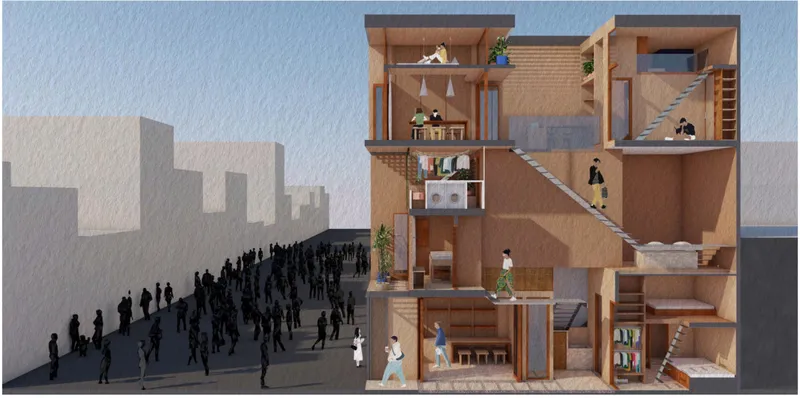
The cutaway section exposes how the building distributes its residents vertically according to need. Grandparents occupy the ground floor for ease of access. A teenage son and his mother share a vertically split cube, maintaining proximity without sacrificing privacy. The eldest daughter inhabits a mezzanine level above the communal kitchen, borrowing the social energy of shared cooking space while retreating upward to sleep. At ground level, silhouetted figures gather at the coffee shop, a reminder that the building's social contract extends beyond the family to the neighborhood.
This layered modularity allows zones to shift between sleeping, working, cooking, and resting as the family's needs evolve over time. The arrangement is less a fixed floor plan and more a sectional argument: proximity creates community, and the vertical stacking of cubes makes that proximity legible and intentional.
Timber, Bamboo, and the Material Language of São Paulo
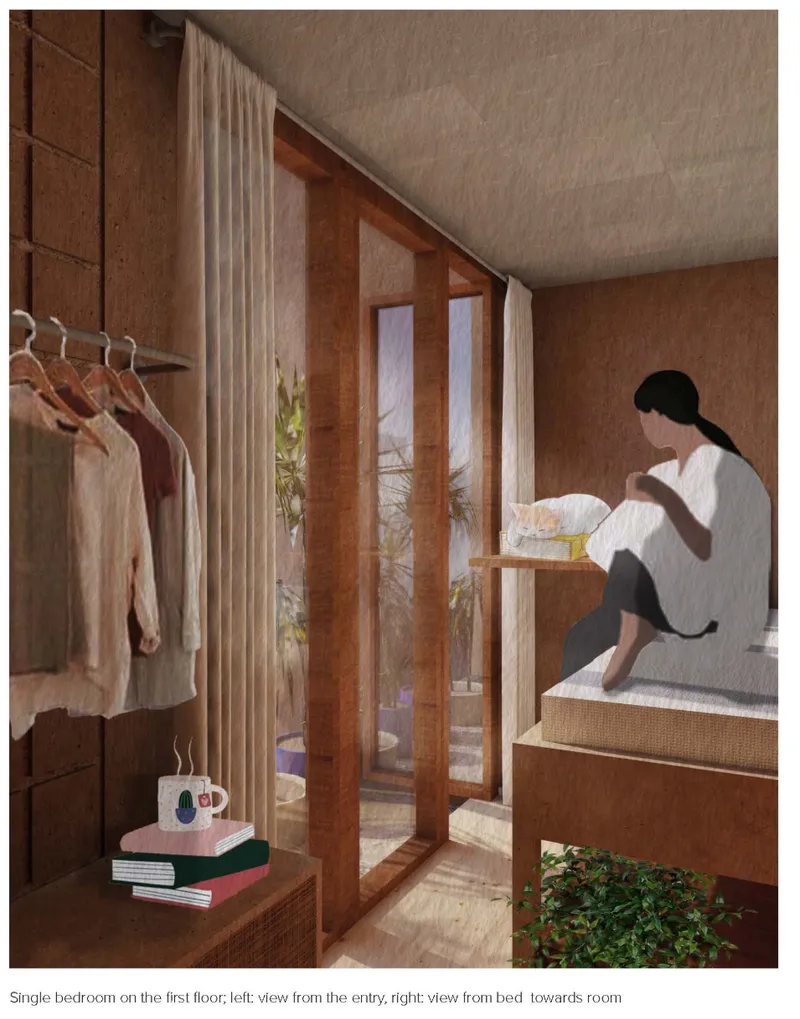
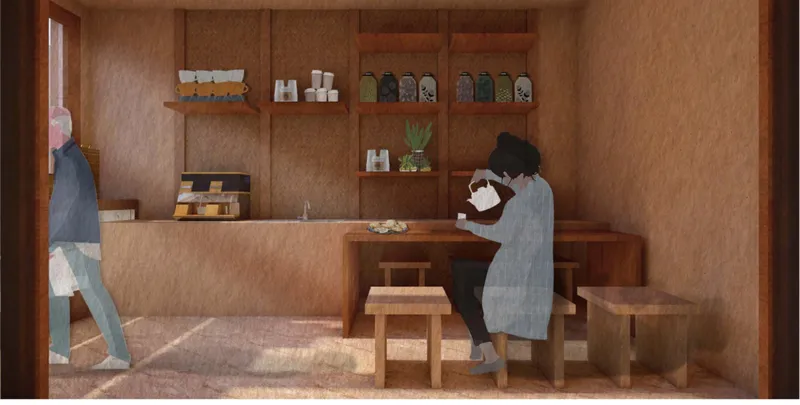
Inside the cubes, the material palette narrows to warm, local, and affordable: timber-lined walls, vertical slat partitions, woven platform beds, and ceramic storage jars. The bedroom view shows how timber slats filter light and subdivide space without fully enclosing it, maintaining visual permeability within small volumes. Patterned tiles, drawn from the aesthetic vocabulary of São Paulo's favelas, ground the project in its cultural context rather than importing a generic minimalist language.
The kitchen counter space reinforces this approach. Open timber shelving replaces closed cabinetry, keeping objects visible and within reach while reducing material use. Concrete, bamboo, and tile form the structural and finish palette, all sourced locally. The use of prefabricated modular units is designed to cut construction time, cost, and carbon footprint, making the prototype potentially replicable across São Paulo's underserved neighborhoods.
Why This Project Matters
"Stacked" makes a precise argument: that density need not mean anonymity, and that small private spaces can coexist with generous communal ones if the architecture is organized around connection rather than isolation. The cube-stacking system is structurally simple enough to be prefabricated, culturally specific enough to belong in São Paulo, and programmatically flexible enough to accommodate a family whose composition will change over decades.
What distinguishes the project from other tiny house prototypes is its refusal to treat the dwelling as a self-contained capsule. By embedding a coffee shop, social terraces, and semi-open cooking spaces into the building's section, Suttichote and No Ra position the home as a node in a larger urban network. The shift from possession to participation, from enclosed rooms to offset cubes with planted voids between them, suggests a model of domesticity that is generous precisely because it is compact.
View the Full Project
About the Designers
Designers: Rungpairin Suttichote, No Ra
Enter a Design Competition on uni.xyz
uni.xyz runs architecture and design competitions year-round that reward proposals with spatial conviction and real site intelligence.
Project credits: STACKED - living in and out of cubes by Rungpairin Suttichote, No Ra Nano Nest 2020 (uni.xyz).


Popular Articles
Popular articles from the community

Cloaked Colonization: A Mobile Underwater Habitat That Moves Like a Fish
Micah Abaya's shortlisted EHC Pacific entry reimagines ocean settlement as a dispersed network of self-sustaining architectural organisms.
Opera by the Sea Estonia: Three Shells Dissolving Architecture into Tallinn's Coastline
A winning opera house proposal replaces monumental form with interconnected shells that blur the boundary between building, park and Baltic Sea.
Faces of the Soviet Avant-Garde: Turning Moscow's Street Names into an Open-Air Museum
A network of sculptural installations across a Moscow residential district transforms forgotten architect names into spatial encounters with cultural memor

The Amber Palace Opera: A Geological Fiction Surfaces on Tallinn's Baltic Waterfront
Pierre Brillard reimagines a Baltic legend as a public landscape, opera house, and waterfront promenade rooted in Tallinn's coastal identity.

Similar Reads
You might also enjoy these articles

Day and Night Park: A Time-Based Urban Newsstand in Beijing
A temporary urban newsstand in Beijing blending travel, light, and reading through poetic colors, compact form, and community-focused design.

Modernist Patio Renovation in El Masnou, Barcelona by Oliver Segura Arquitectura + Cebrià Arquitectura
Modernist patio renovation blending tradition and innovation with a movable pool, leveled floors, and Catalan materials in El Masnou.

Alto Residencial Coop: Cooperative Housing Development in Santiago de Compostela by Carbajo Barrios Arquitectos
A linear cooperative housing complex blending white volumes and perforated metal façades, enhancing community living, natural light, privacy, and urban integration.
Vil Genis School by BPA ARCHITECTURE – Massy, France
Vil Genis School in Massy, France, features sustainable design, south-facing classrooms, community integration, accessible spaces, and modern educational architecture.


Comments (0)
Please login or sign up to add comments
No comments yet. Be the first to comment!