
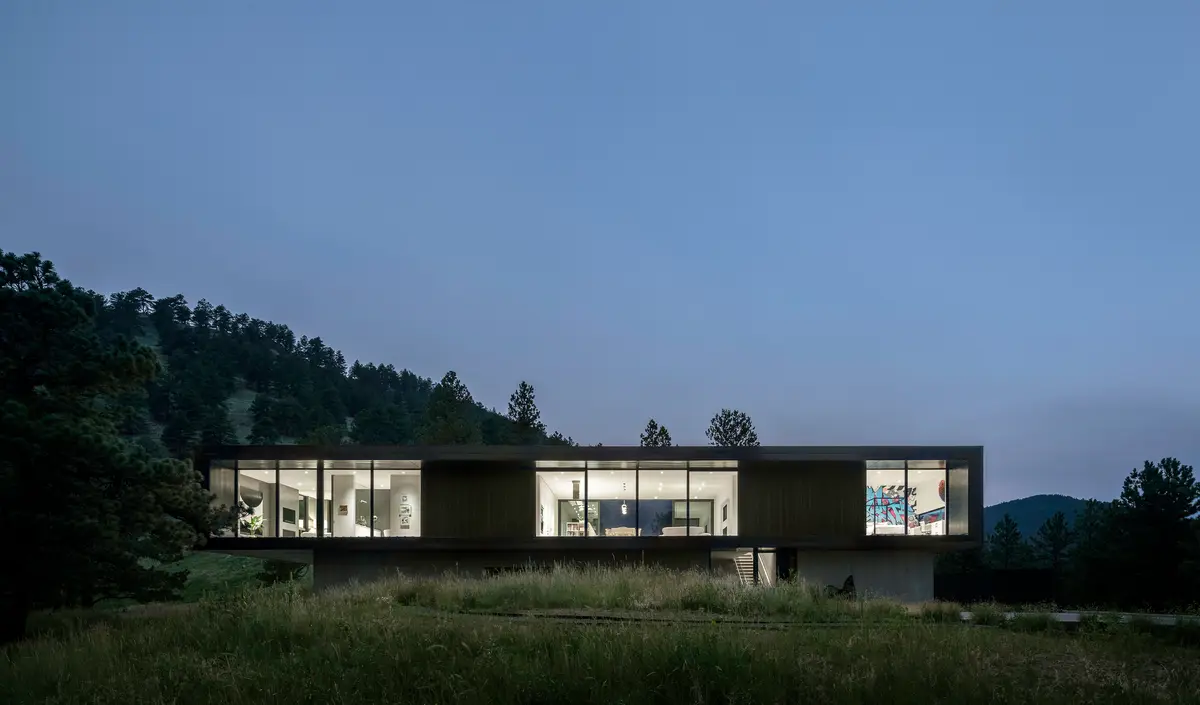
Studio B Wraps a Dark Metallic Box Around Light and Landscape on 42 Acres Above Boulder
Blur House sinks into a Colorado hillside on a concrete plinth, reflecting sky and forest in its glossy metal skin.


Most mountain houses announce themselves. They stack stone, spread timber, and generally perform the role of rugged shelter with conspicuous effort. Blur House, designed by Studio B Architecture and Interiors for a family of art consultants on a 42-acre site in the foothills above Boulder, Colorado, takes the opposite approach. It disappears. A dark, glossy volume hovers six inches above grade on a raw concrete plinth, its metal cladding absorbing and reflecting the landscape so completely that the house seems to shimmer between solid and void depending on the time of day.
What makes the project genuinely interesting is not the vanishing act itself but how deliberately it is constructed. The house is aligned parallel to a distant rock outcropping across the valley, its concrete base echoing the gray granite formations that punctuate the site. A long driveway weaves through existing trees, following the mountain's contours, so the building never quite reveals itself until you arrive. The name says it all: Blur is a house that refuses to sit still in your perception.
A Plinth Carved from the Hillside
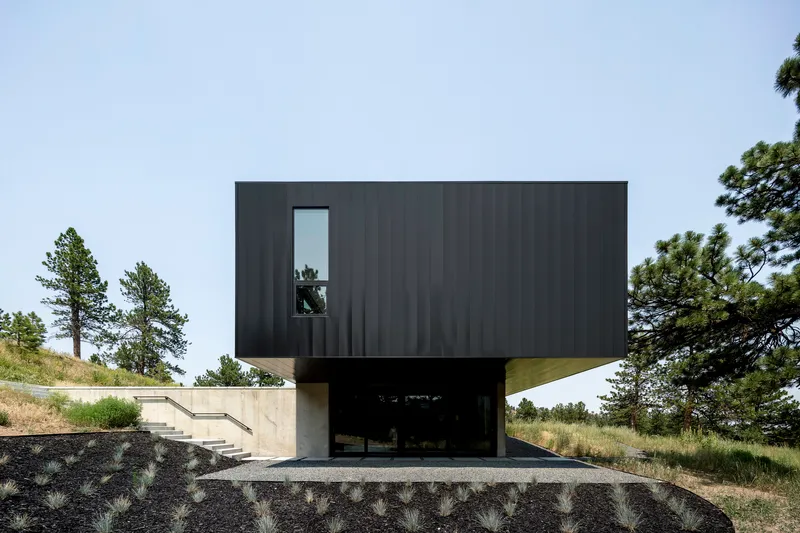
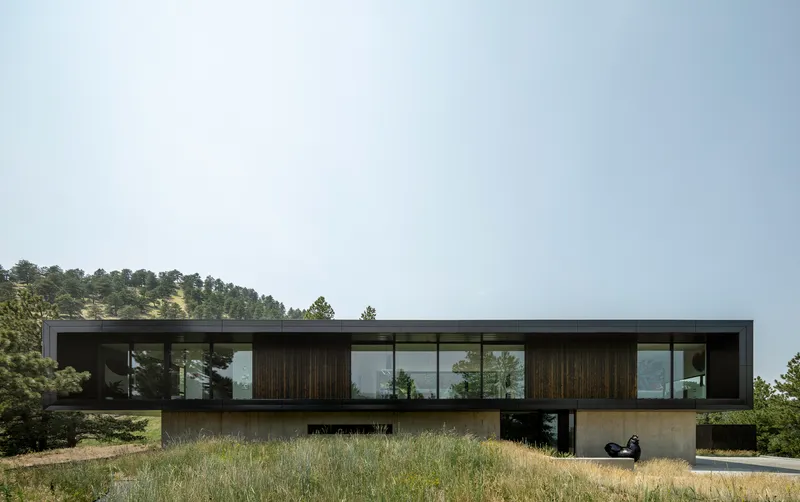
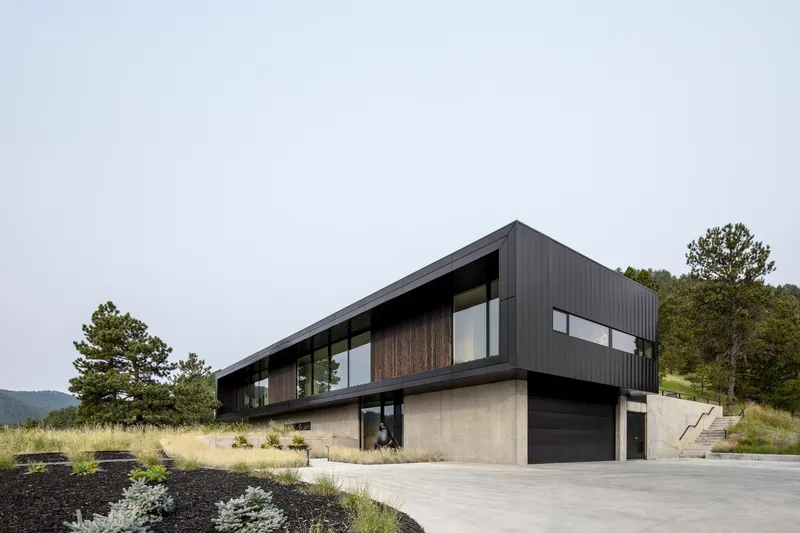
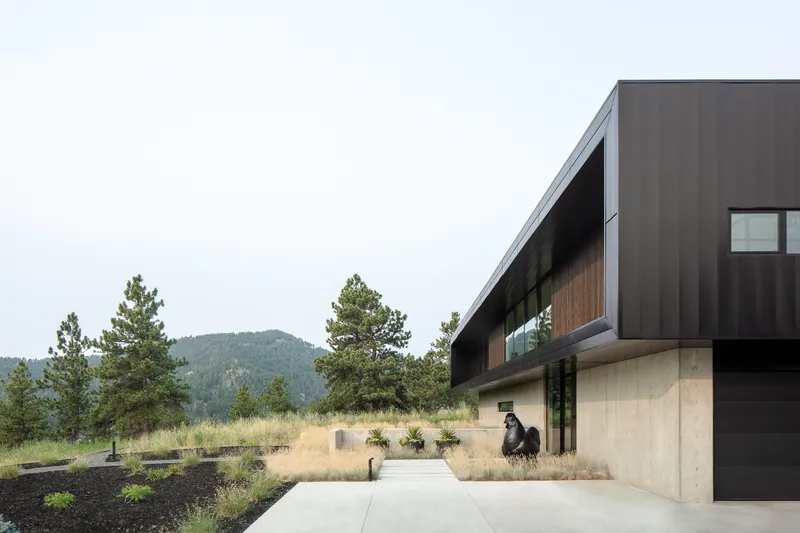
The sectional strategy here is direct. The lower level is sunk into the hillside, reducing the visual mass of the building and anchoring it into the terrain like a geological feature rather than an architectural one. The concrete plinth is not merely structural; it is rhetorical. It tells you the house grew out of the mountain, and the dark upper volume is something lighter, something that landed on top. The carport is cut cleanly into this base, treating the car as part of the geology.
This two-part logic, heavy base and floating bar, is familiar from mid-century precedent. But Studio B pushes it further by making the upper volume genuinely dark, clad in glossy metal panels and charred wood, so the contrast between the matte concrete and the reflective skin becomes the primary visual event. The house reads differently from every angle: a silhouette from the west, a bright glass lantern from the south, a monolithic bar from the approach.
The Threshold Between Inside and Out
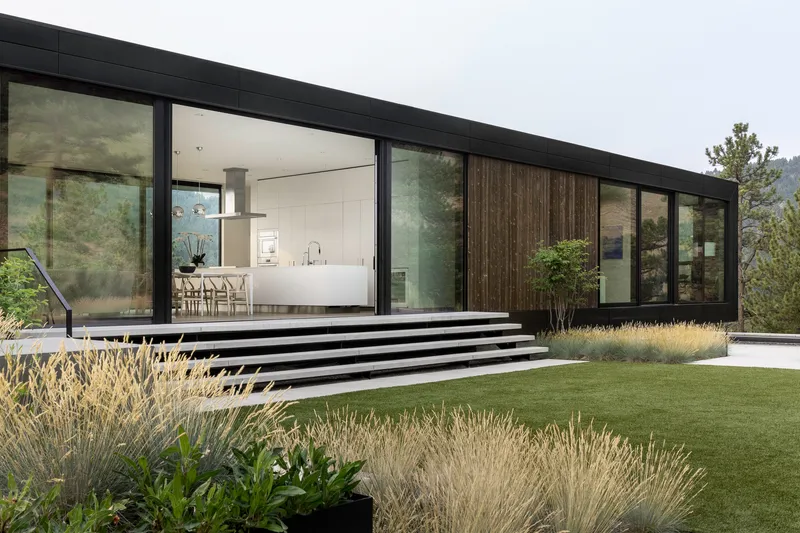
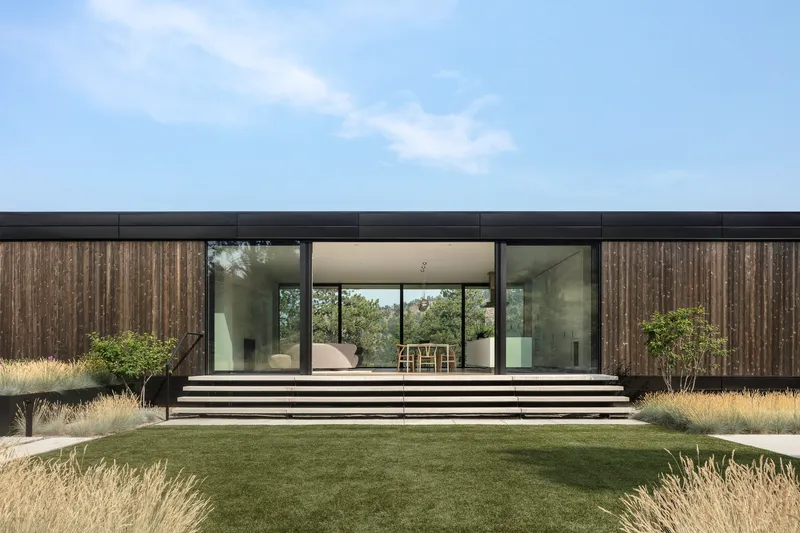
The wide concrete steps leading to the glazed facade deserve close attention. They are scaled generously enough to sit on, a deliberate nod to Mies van der Rohe's precast concrete pavers. This is not mere circulation; it is an inhabited edge. Ornamental grasses push up against the steps, softening the geometry and making the transition from landscape to interior feel gradual rather than abrupt.
The approach from the driveway side is more compressed, with the cantilevered black metal volume casting deep shadow over the entry. The shift from shade to the light-filled interior amplifies the sense of arrival. Pocket doors vanish entirely into walls, so the boundary between living room and terrace can dissolve on a warm day, turning the concrete plinth into a continuous floor plane that runs from kitchen to pool deck.
Living in a Gallery
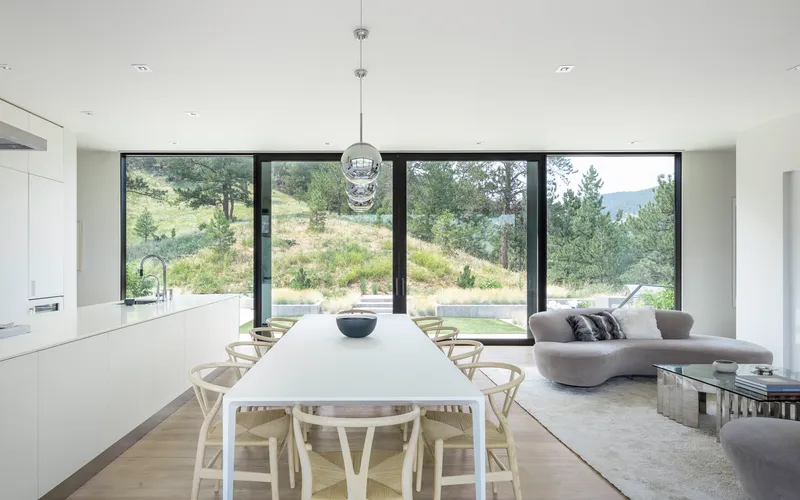
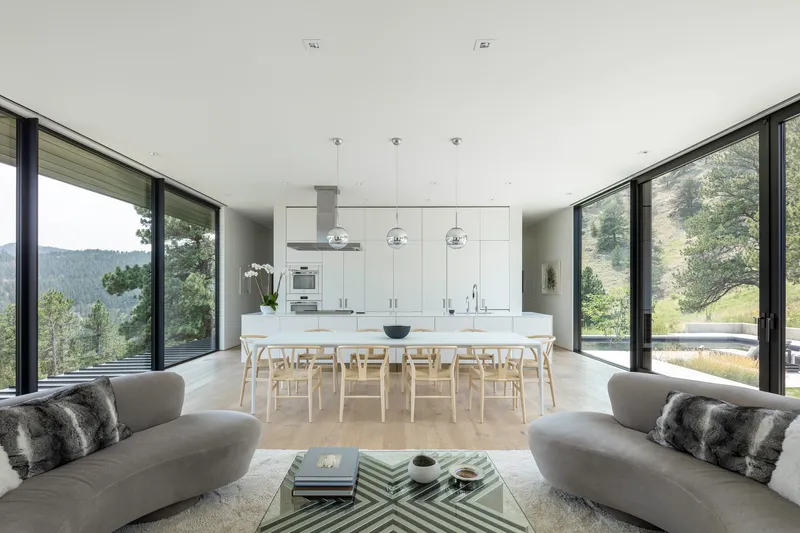
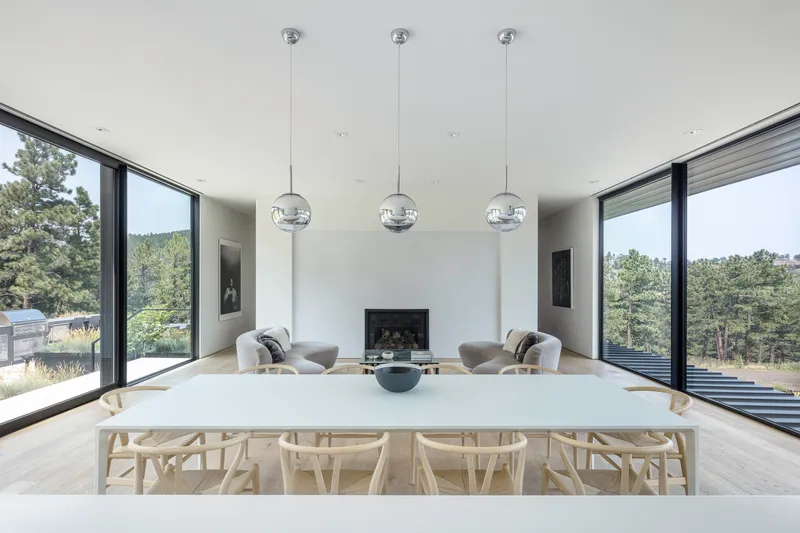
The clients, both art consultants, wanted the simplicity of a gallery. The main level delivers on that brief with an almost symmetrical plan: children's bedrooms at one end, primary bedroom at the other, and a central open core of kitchen, living, and dining space. Walls are white, floors are washed white oak, and the furniture is restrained enough to let the views dominate. Three globe pendants over the dining table are one of the few decorative gestures in a room where the landscape does most of the work.
Floor-to-ceiling glazing on both long sides of the main level means the central living space is effectively a glass tube framing two different views: forested hills to the north, open sky and pool terrace to the south. The effect is immersive without being theatrical. You are always aware of where you are on the mountain.
Concrete as Texture and Structure
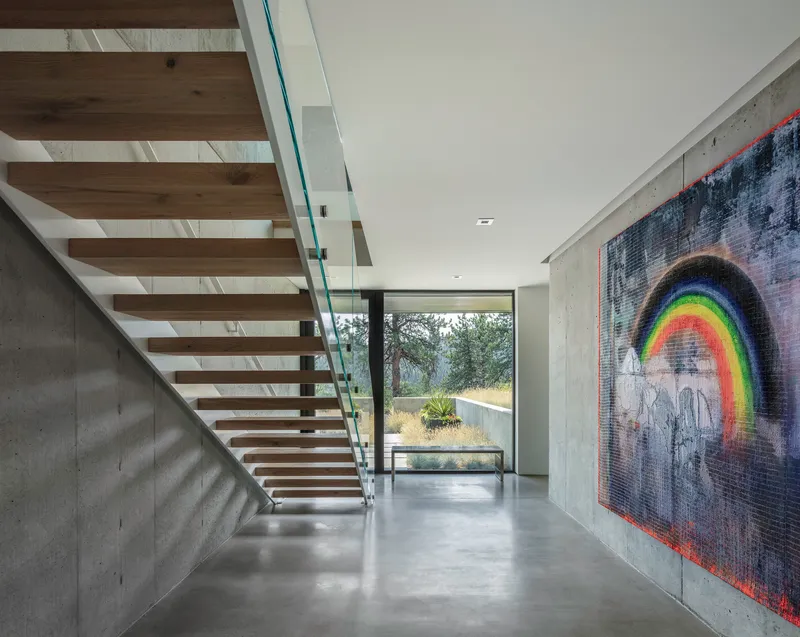
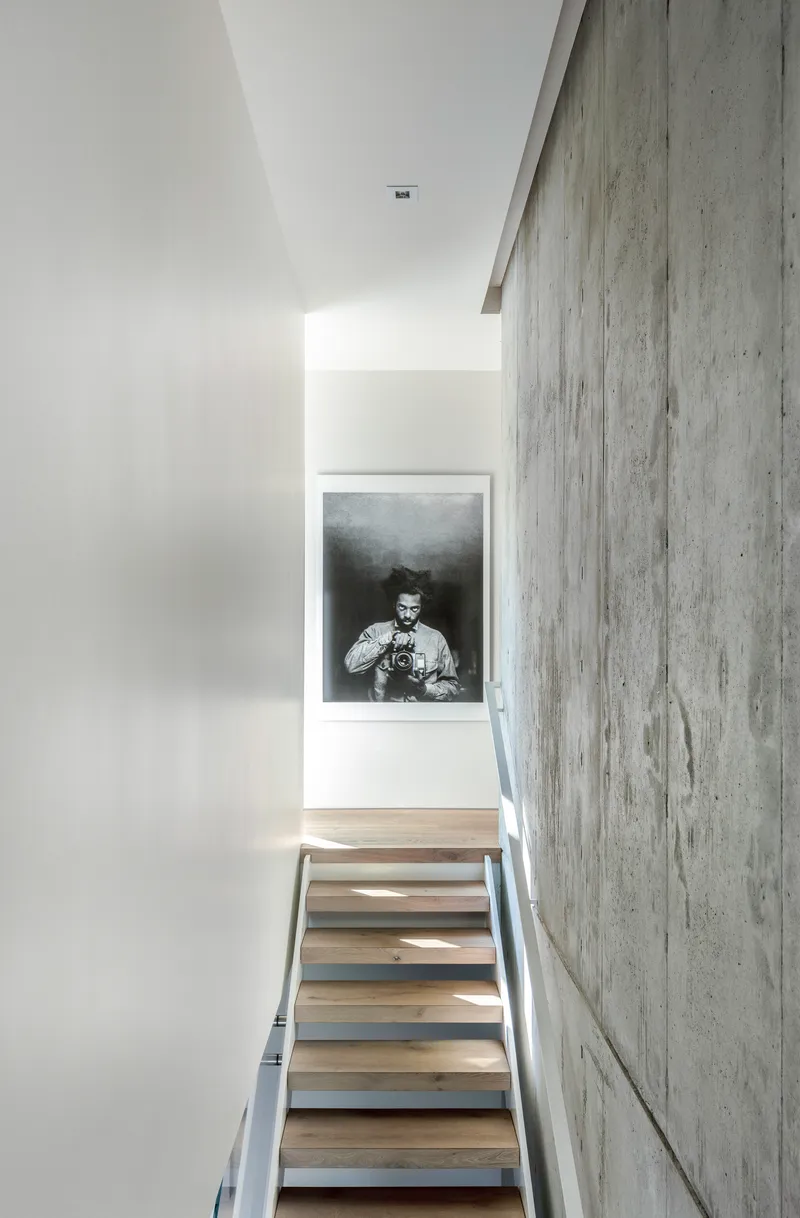
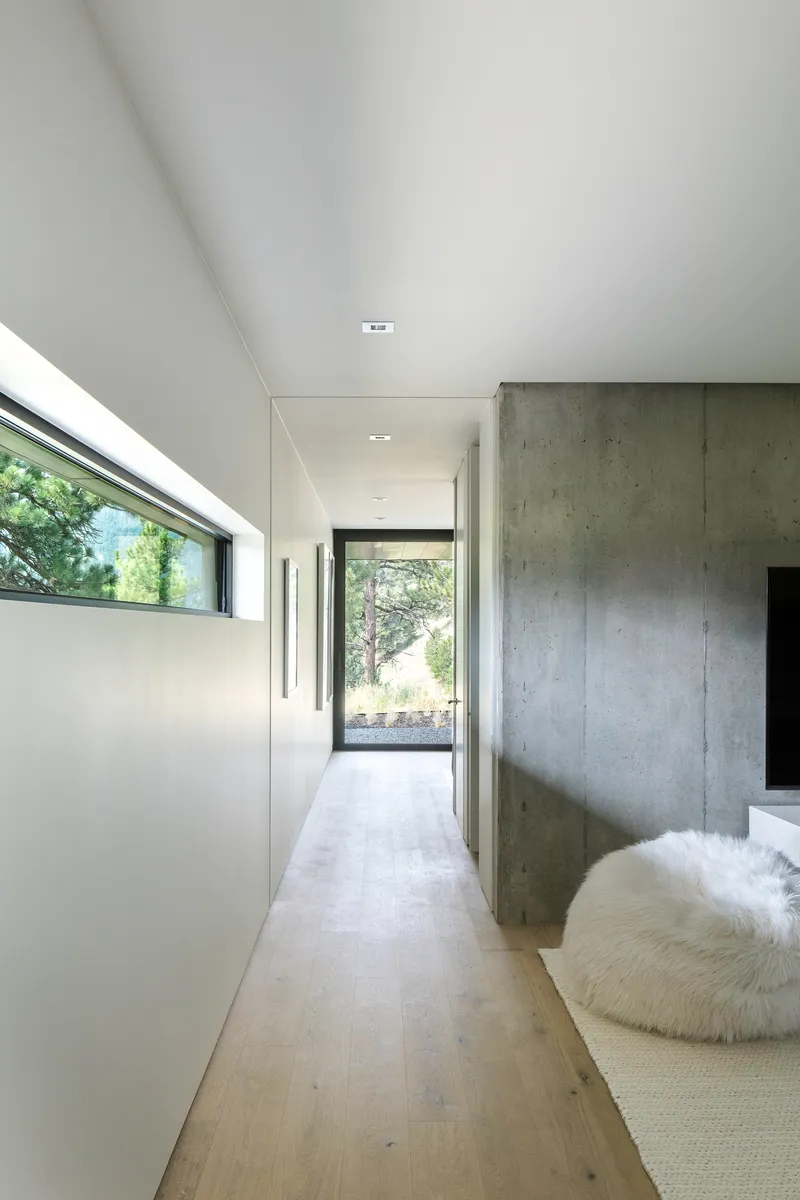
Board-formed concrete runs through the interior as a recurring material accent, providing lateral bracing for the structure while doubling as an exhibition surface. A rainbow tapestry hangs on one concrete wall beside the open-tread staircase; a framed photograph sits against another. The grain of the formwork is left raw and visible, a deliberate contrast to the smooth white planes that surround it.
The staircase itself is a quiet set piece: floating timber treads, a glass balustrade, and the rough concrete wall creating a material sequence of warm, transparent, and heavy. Clerestory glazing at the top of corridors washes the concrete in raking light, revealing the texture of the boards used to cast it. These are the moments where the house rewards close looking.
Bedrooms That Open to the Mountain
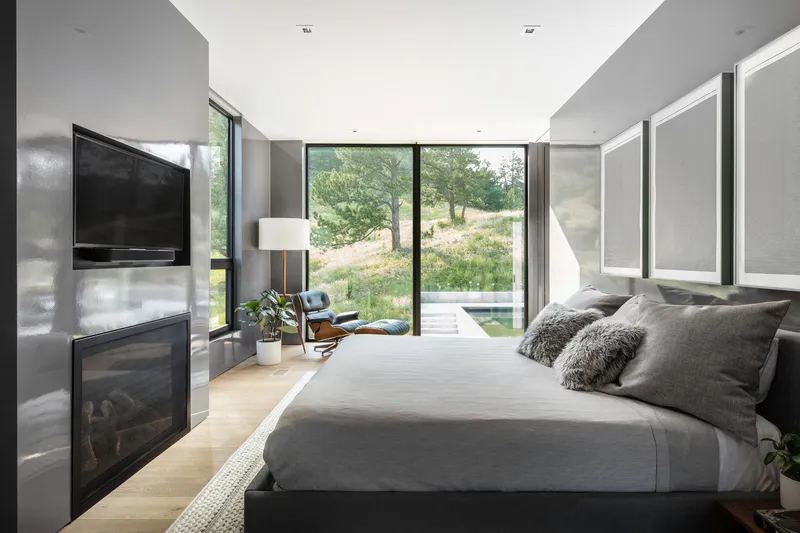
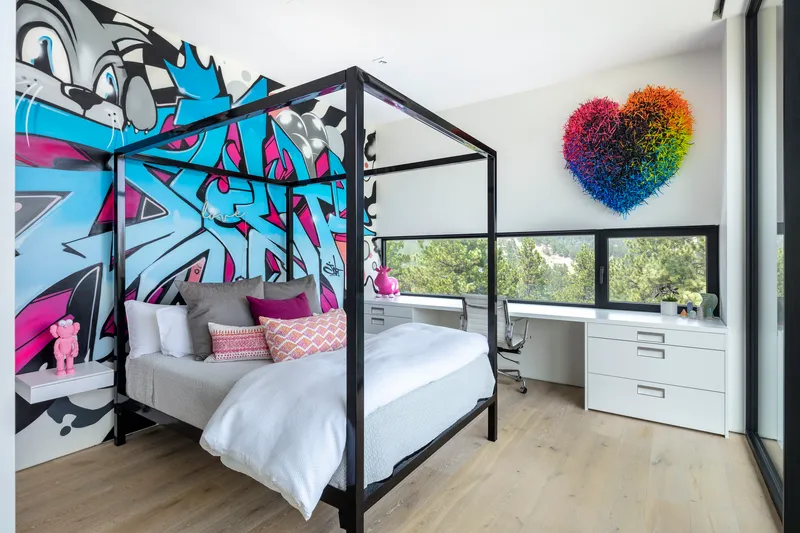
The bedrooms are positioned at the extremities of the plan, each with its own character. The primary bedroom floats over the pool, with operable glass doors that theoretically allow you to dive directly from the house into the water. A children's bedroom features a graffiti mural as a headboard, a pointed counterpoint to the minimalist restraint elsewhere. These rooms are not afterthoughts; they are where the house relaxes its gallery discipline and lets personality in.
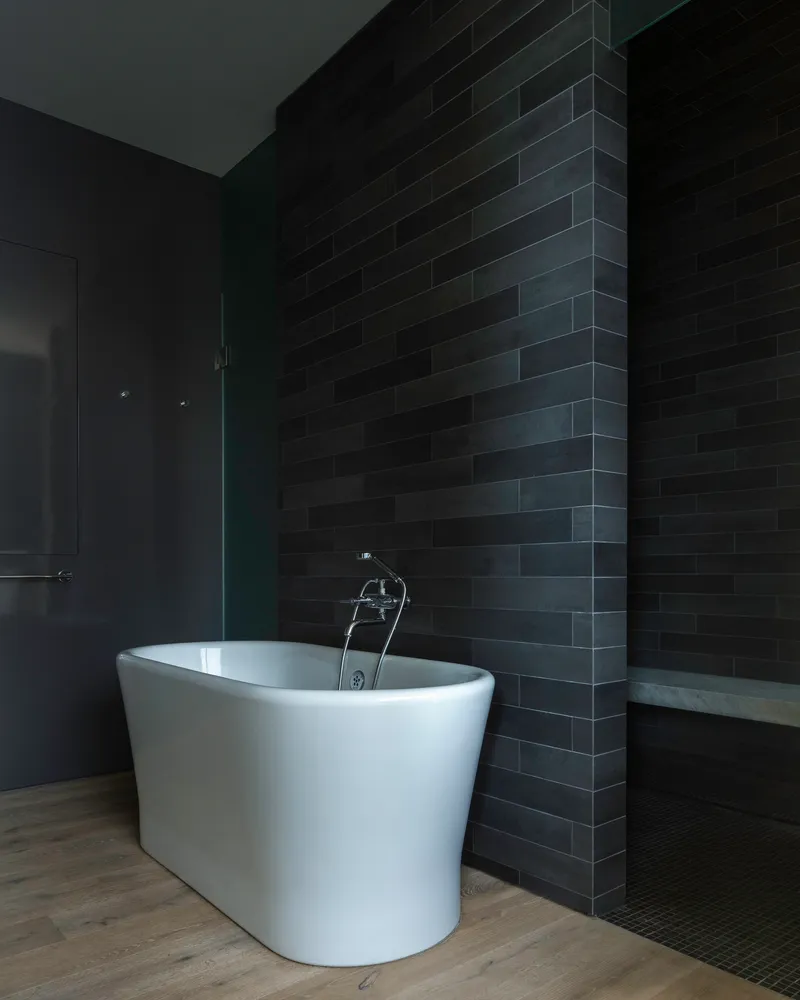
The bathroom, with its freestanding white tub against a dark brick tile wall, is the most atmospherically controlled space in the house. Natural light is restricted to a narrow aperture, making the room feel like a grotto carved from the same hillside the plinth sits on. Stone finishes and Porcelanosa Krion countertops reinforce the sense of mineral solidity.
The Kitchen Corridor and Domestic Practicality
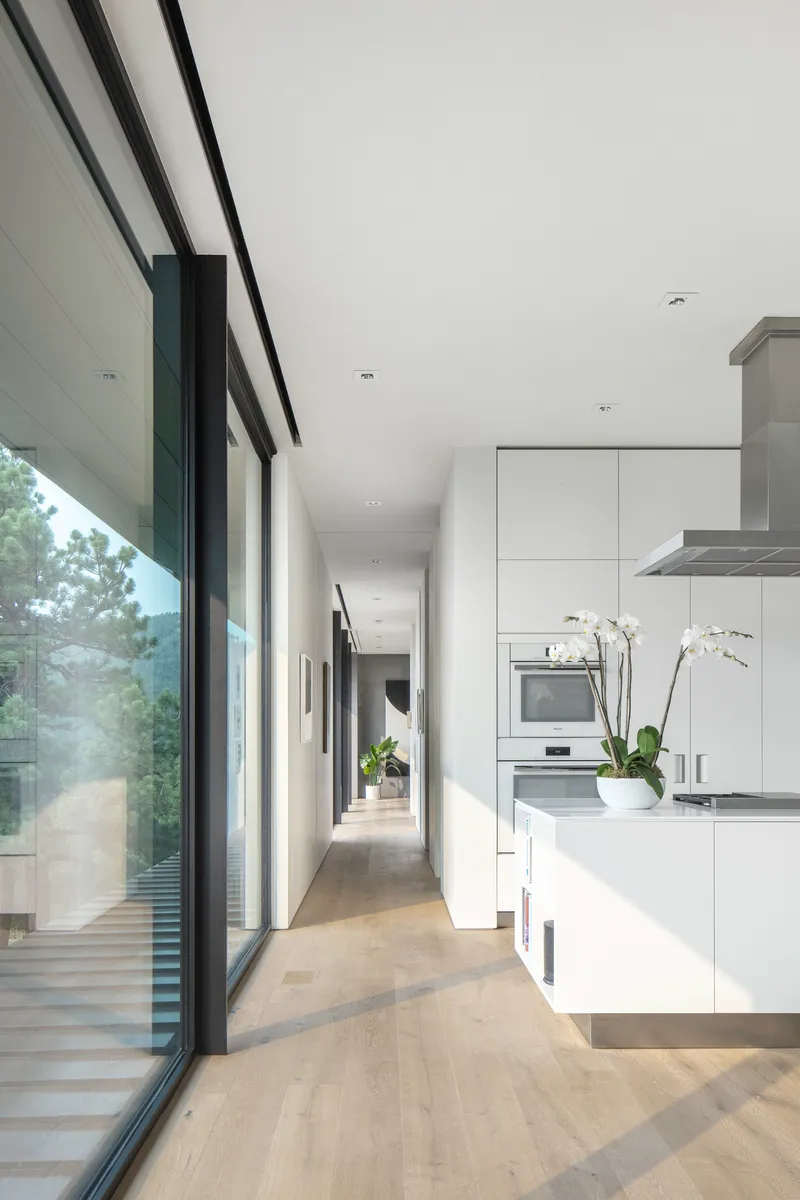
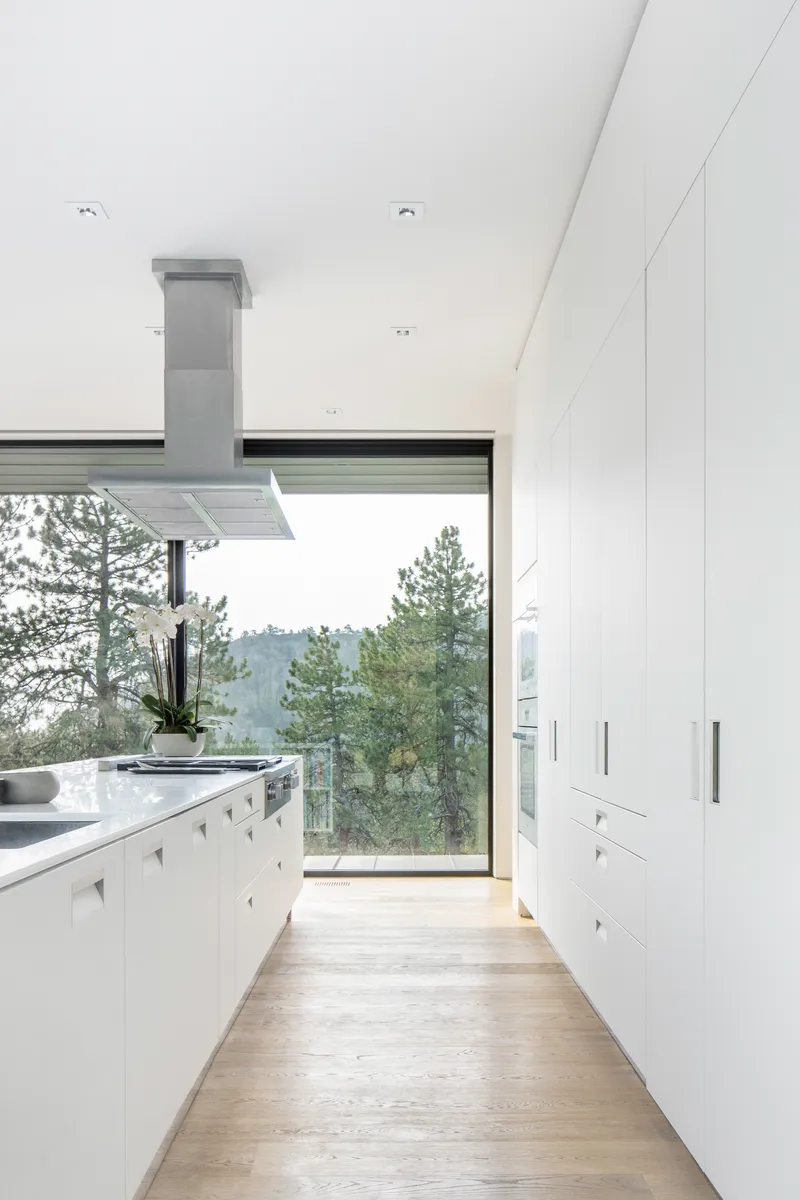
A galley kitchen lined with white cabinetry runs along one edge of the plan, its continuous glazing looking out into the pines. It is a working space rather than a showpiece, and the decision to keep it linear and efficient rather than inflating it into an island-centric social hub is refreshingly practical. A stainless steel range hood and a clerestory window above the countertop confirm that this is a room designed for cooking, not performing.
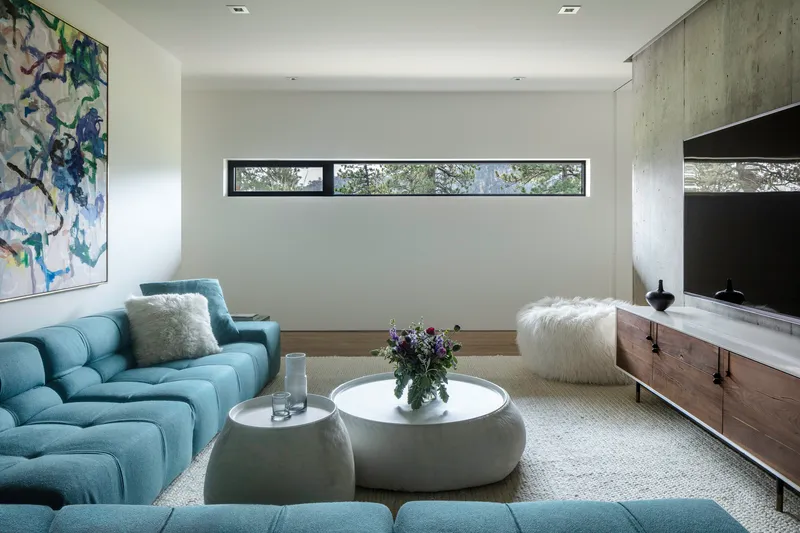
The adjacent living room, with its board-formed concrete accent wall and horizontal ribbon window framing nothing but foliage, is where the house's dual identity, gallery and home, comes into sharpest focus. The concrete is raw and muscular; the window is precisely cut to compose a single horizontal band of green. It is a room that knows exactly what it wants you to see.
After Dark
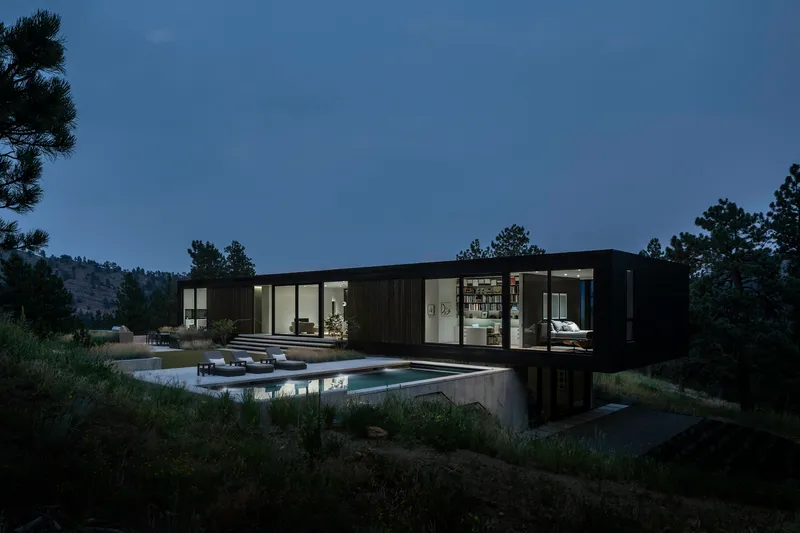
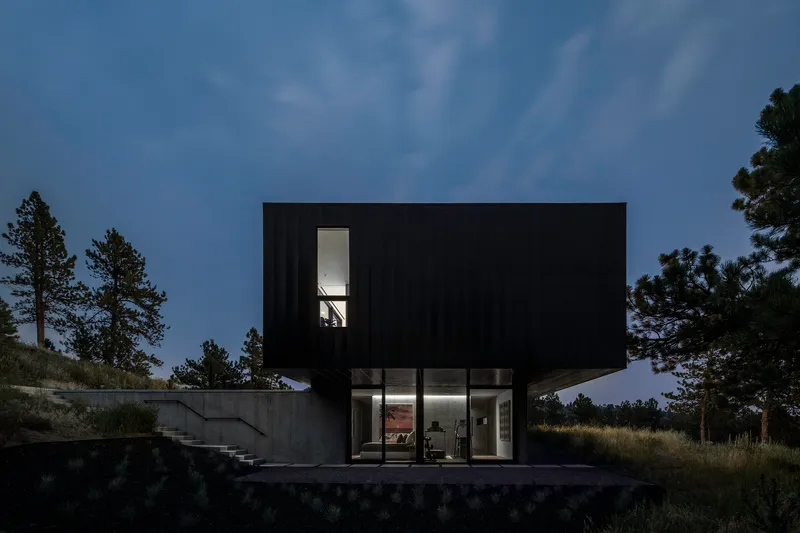
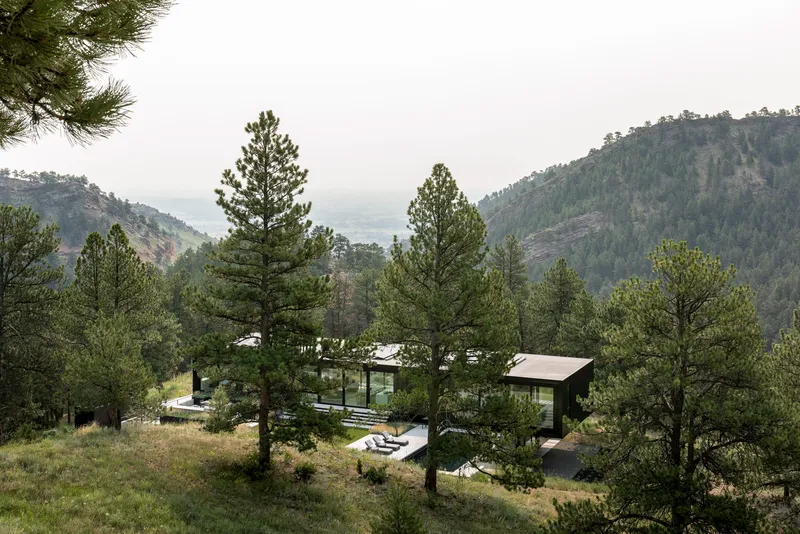
At twilight, the house reverses its daytime logic. The glossy metal cladding that absorbed the landscape during the day turns opaque and dark, while the glazed openings glow warm from within, revealing the life of the house to the valley below. The reflecting pool at the base catches the illuminated facade and doubles the composition. The effect is cinematic: a lantern on a mountainside, framed by pines and the silhouette of the Front Range.
Seen from the hillside, the horizontal volume reads as a single bright bar set into the meadow. The fire-resistant metal facade, selected for durability in Colorado's harsh mountain climate, takes on a different beauty at this hour, no longer camouflaged but fully declared. Wild turkeys, deer, and mountain lions reportedly visit the 42-acre property. At night, the house watches the landscape as much as the landscape watches the house.
The Pool Terrace and Landscape Integration
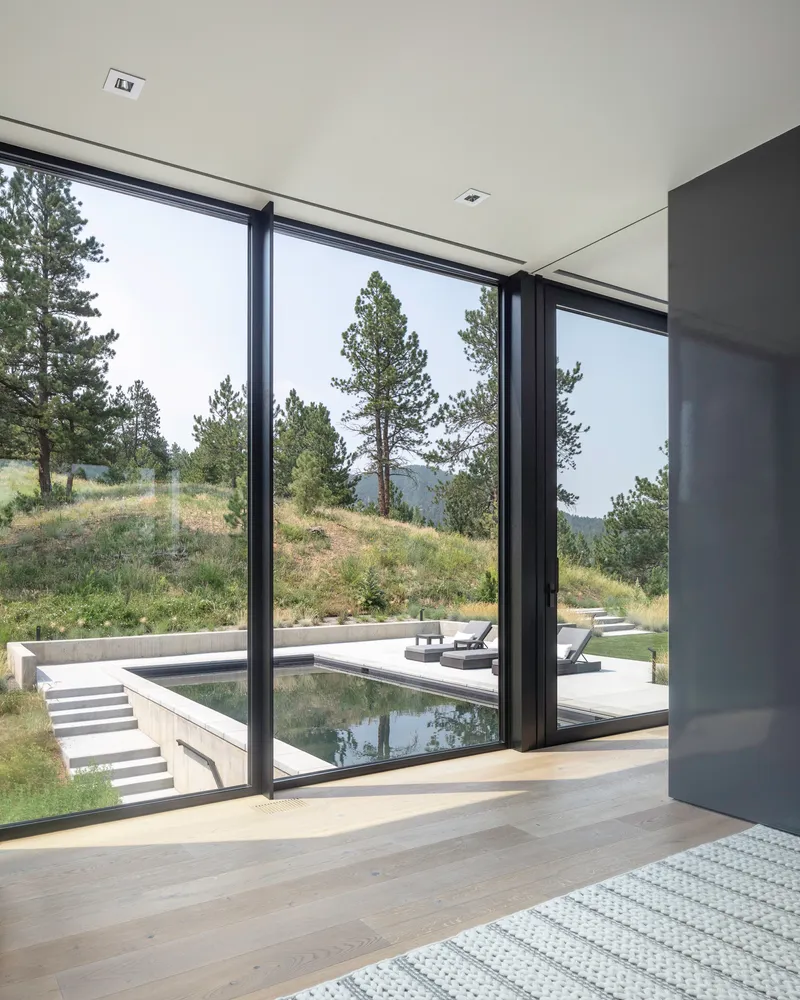
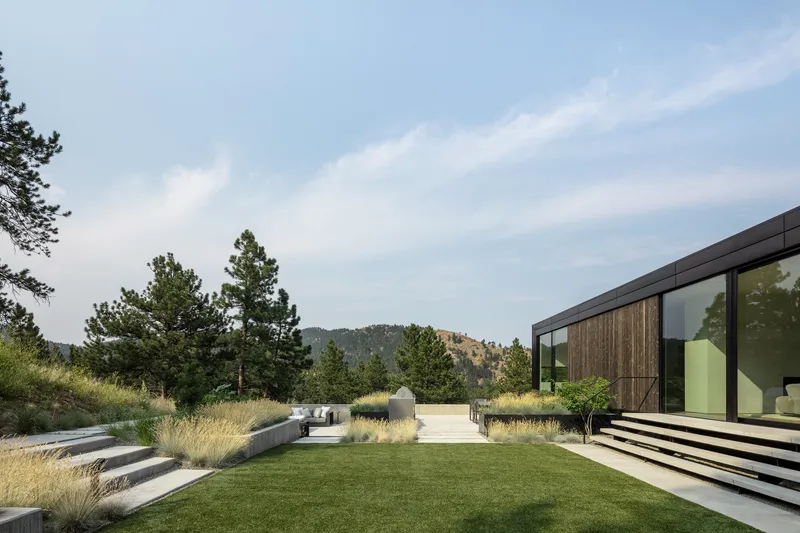
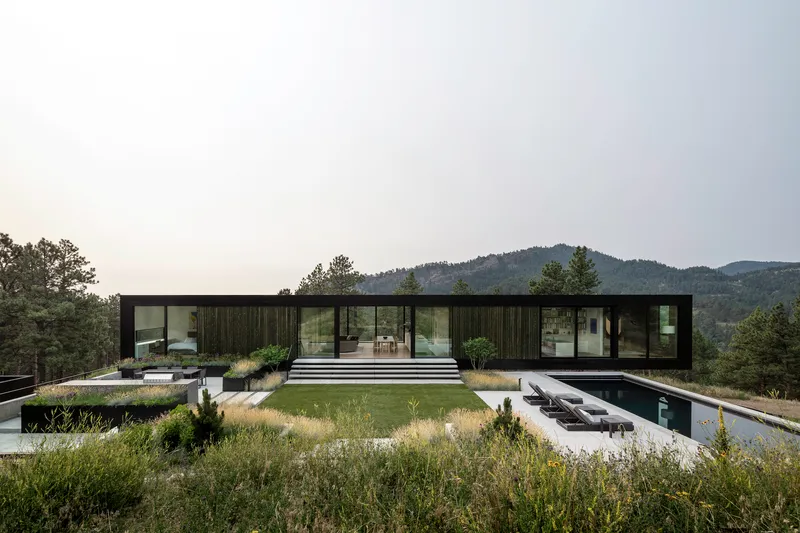
The south yard, with its pool and large flat terrace, is a direct extension of the concrete plinth. Stepping out of the great room, you move from interior floor to exterior deck without a change in material or level, only a shift in enclosure. The pool sits beneath the cantilevered office and primary bedroom, creating a shaded swimming space that feels sheltered without being enclosed. Pine trees frame the far edge, and the gravel pathways through native grasses connect the house to a broader network of trails across the property.
The landscape design, by JB Fieldworks, resists the temptation to manicure the 42 acres. Beyond the immediate terrace, the site remains wild: dry grassland, existing trees, a waterfall somewhere out of sight. The house is precise where it touches the ground; everything beyond that boundary is left alone. It is a sensible and increasingly rare restraint.
Plans and Drawings
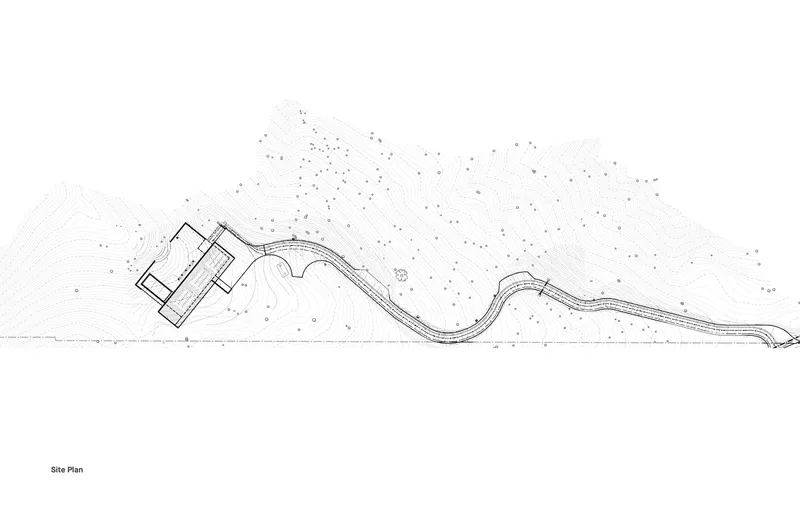
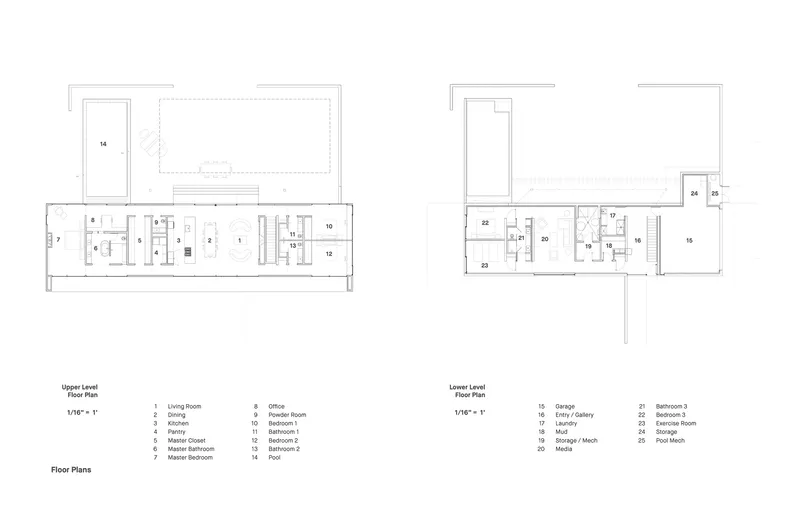
The site plan reveals the full scope of the project's landscape strategy: the driveway curves through topographic contours and vegetation to reach the house, which sits like a ruled line against the organic terrain. The floor plans confirm the near symmetry of the upper level, with bedrooms flanking the central living core and circulation pushed to the perimeter where it can capture views. The lower level tucks service and utility spaces into the hillside, keeping the main level free for open living.
Why This Project Matters
Blur House succeeds because it takes a familiar typology, the modernist box on a plinth, and adapts it to a specific site with genuine conviction. The alignment to a distant rock formation, the material logic of concrete-as-geology and metal-as-sky, the six-inch hover above grade: these are not stylistic gestures but disciplined responses to a 42-acre property that demanded something precise. The house is neither timid nor loud. It occupies its site the way a good sentence occupies a page, with nothing extraneous.
For architects working in mountain environments, Blur House offers a useful counterargument to the twin temptations of conspicuous rusticity and glazed spectacle. You do not need to stack logs or maximize panoramic views to make a building belong. Sometimes the most powerful move is to make a building that can barely be seen, one that blurs into the terrain until it catches the light and reminds you it was designed, carefully and completely, by someone who understood the mountain.
Blur House, designed by Studio B Architecture and Interiors. Located in Boulder, United States. 4,931 m². Completed in 2018. Photography by James Florio.
About the Studio
Share Your Own Work on uni.xyz
If projects like this are the kind of work you want to make, uni.xyz is a place to publish your own, find collaborators, and enter design competitions.


Popular Articles
Popular articles from the community

Extended Shell: Retrofitting Kolkata's Balconies as Living Urban Thresholds
A modular retrofit system recovers the social and environmental intelligence of Kolkata's historic verandas for contemporary Park Street residents.
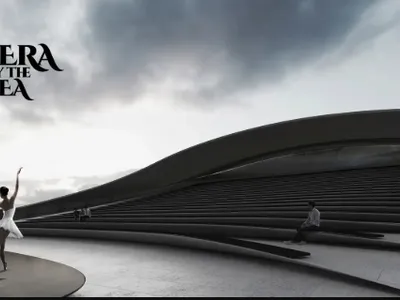
Opera by the Sea Estonia: Three Shells Dissolving Architecture into Tallinn's Coastline
A winning opera house proposal replaces monumental form with interconnected shells that blur the boundary between building, park and Baltic Sea.

Opera on the Sea: Driftwood Logic Shapes a Timber Opera House on Estonia's Coast
Trevor Orgill's opera house translates the entangled drift of floating timber into a civic building where wood, water, and music converge.

The Amber Palace Opera: A Geological Fiction Surfaces on Tallinn's Baltic Waterfront
Pierre Brillard reimagines a Baltic legend as a public landscape, opera house, and waterfront promenade rooted in Tallinn's coastal identity.

Similar Reads
You might also enjoy these articles

Bao Huynh Watercolor Atelier: A Serene Art Retreat in Hội An
Bao Huynh Watercolor Atelier in Hội An blends multifunctional art spaces, sustainable design, local materials, and family-friendly living in a serene environment.

Atelier Macri Concept Store Interior Design by CASE-REAL
Atelier Macri store features a "ko" counter, walnut wood details, cork displays, blending retail, gallery, and seamless customer experiences.

Manuel Vargas Izquierdo Stadium and High-Performance Sports Center: Architectural Excellence in Jalpa de Méndez
The Manuel Vargas Izquierdo Stadium blends sustainable design, inclusive sports facilities, and cultural-inspired architecture, revitalizing Jalpa de Méndez’s public spaces.
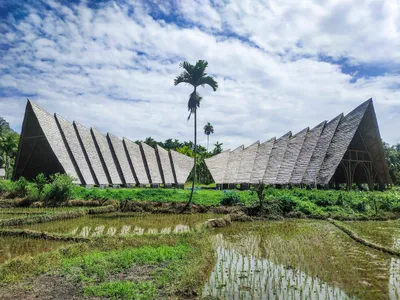
KAKR Buluh Awar Hall: Revitalizing Community and Ecology Through Bamboo Architecture
Community built bamboo hall revitalizes Buluh Awar village, empowering youth, restoring ecology, celebrating vernacular craftsmanship through sustainable architecture and culture.

Explore Blurring the boundaries Competitions
Discover active competitions in this discipline

Challenge to design mud housing for contemporary communities

Challenge to reimagine the Iron Throne

Photograph architecture without architects

Illustrate the lost glory of Angkor Wat - Render Challenge
Comments (0)
Please login or sign up to add comments
No comments yet. Be the first to comment!