
Studio MBM Wraps a New York Denim Brand's Identity Around a Reflective Central Showroom
DL1961's Manhattan headquarters places product at the literal center of daily operations, clad in aluminum and polycarbonate.


The most telling thing about a fashion brand's headquarters is what it puts at its center. For DL1961, the premium denim label known for its sustainability-forward manufacturing, Studio MBM made that decision literal: the showroom sits at the core of the floor plate, and everything else, offices, meeting rooms, workspaces, is carved from its perimeter. The product is not tucked away behind a reception desk or siloed into a separate wing. It occupies the gravitational center of the operation.
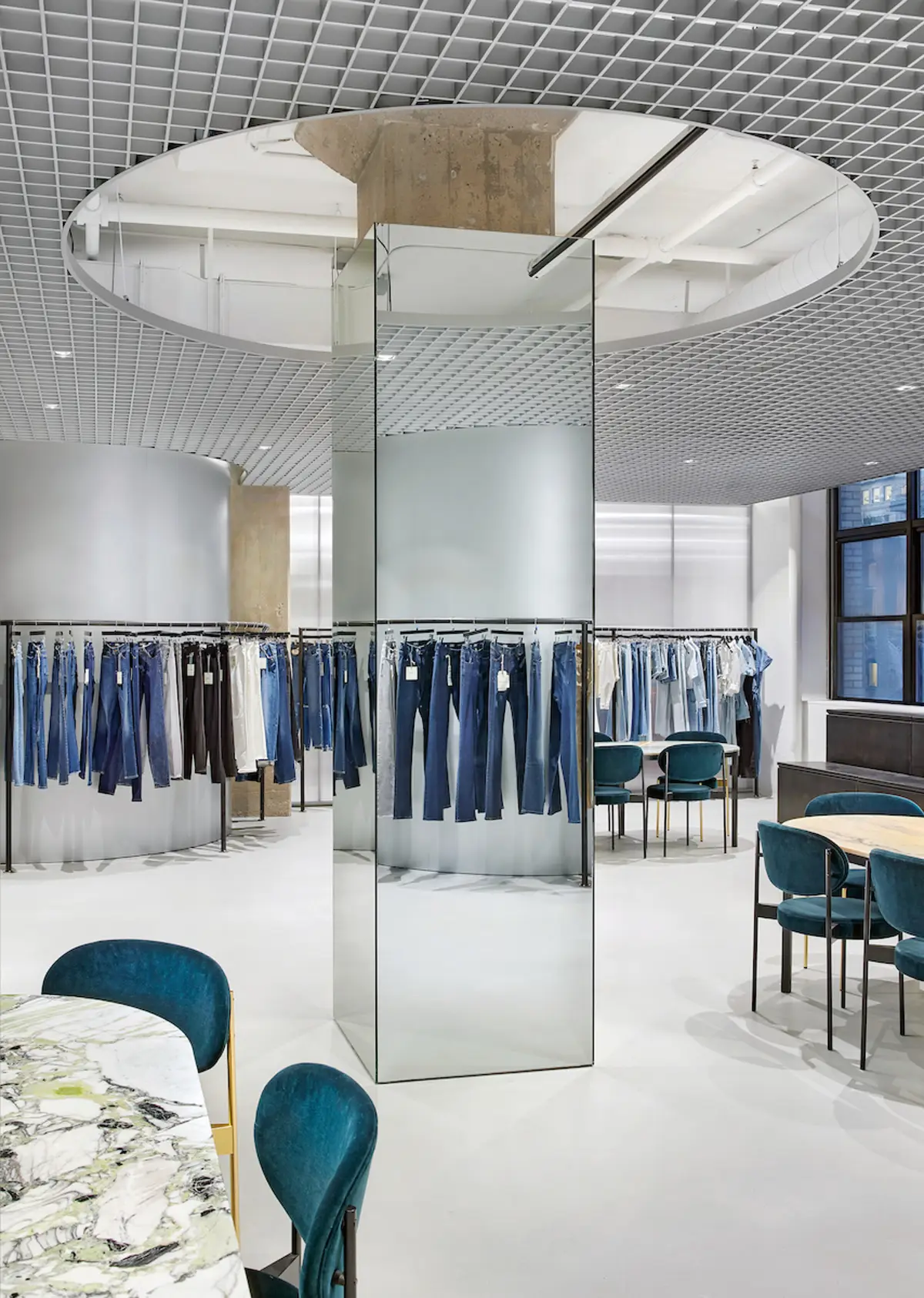
Designed by Maurizio Mattioli and completed in 2019, the project is a gut renovation of a former industrial printing press in New York. That lineage matters. The existing column grid structures the plan, and the raw bones of the building, exposed concrete columns, high ceilings, give the space an honesty that the design amplifies rather than conceals. What Studio MBM layered onto that skeleton is a precise material language of aluminum, polycarbonate, and marble that turns the showroom into a reflective chamber, bouncing light and image across surfaces in a way that keeps the clothing perpetually in view.
The Showroom as Nucleus
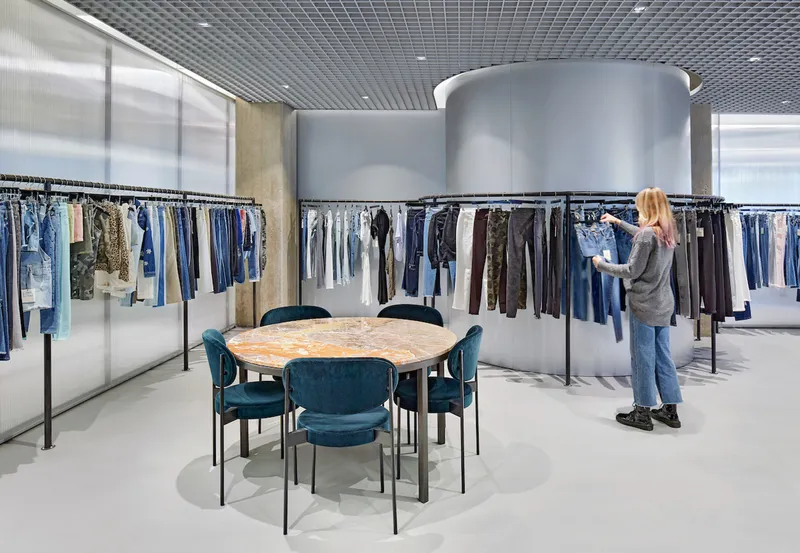
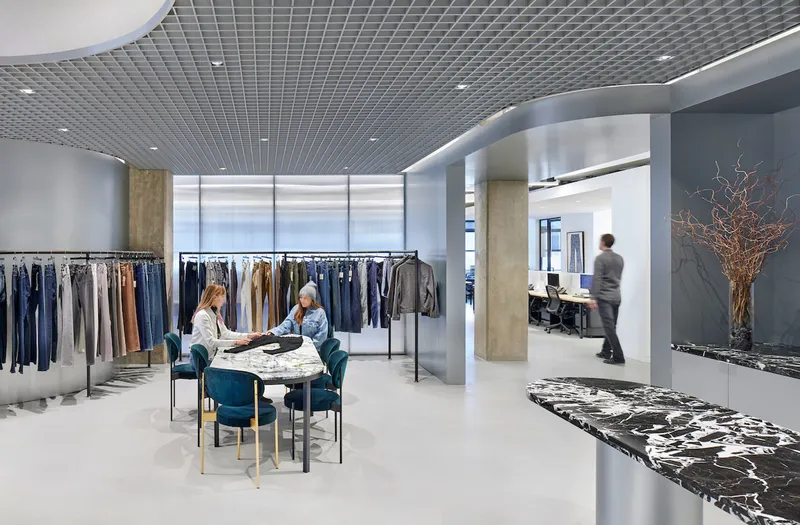
The central showroom operates as a single open volume punctuated by silver cylindrical volumes and chrome racks that suspend denim garments from exposed conduit. There is no hierarchy among the displays: product is arrayed at eye level, within reach, integrated into the spatial flow rather than elevated behind glass. A marbled reception desk anchored by a dried branch arrangement introduces texture without competing with the clothing.
The strategy is deceptively simple. By making the showroom the object around which every other function orbits, Studio MBM ensures that anyone walking through the headquarters, whether a buyer, a designer, or an accountant, encounters the product constantly. It collapses the distance between making and selling, which aligns neatly with a brand that markets the transparency of its supply chain.
Reflective Surfaces and Light Distribution

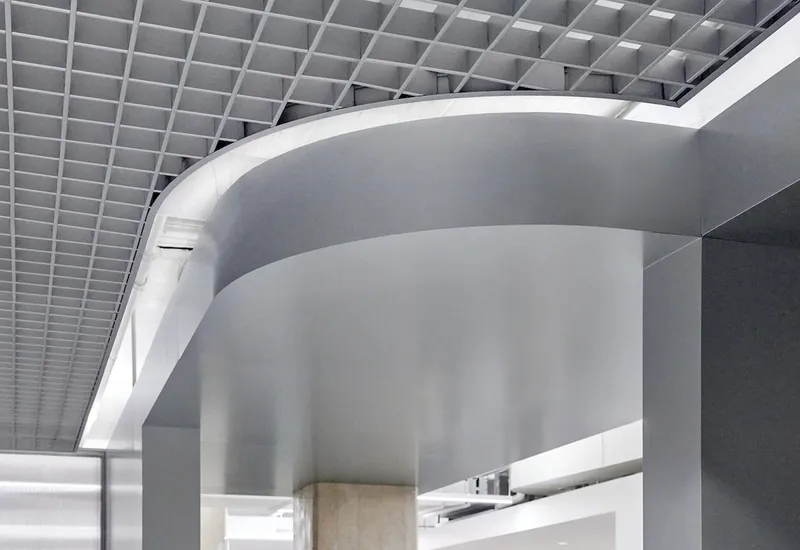
The most striking moment in the project is the circular ceiling oculus above a mirrored column clad in polished metal panels. It reads almost like a skylight, but it functions as a light multiplier: natural light entering from the perimeter bounces off aluminum and polycarbonate surfaces, gets caught by the mirrored column, and radiates back into the showroom. The effect is a luminous core that glows even on overcast days.
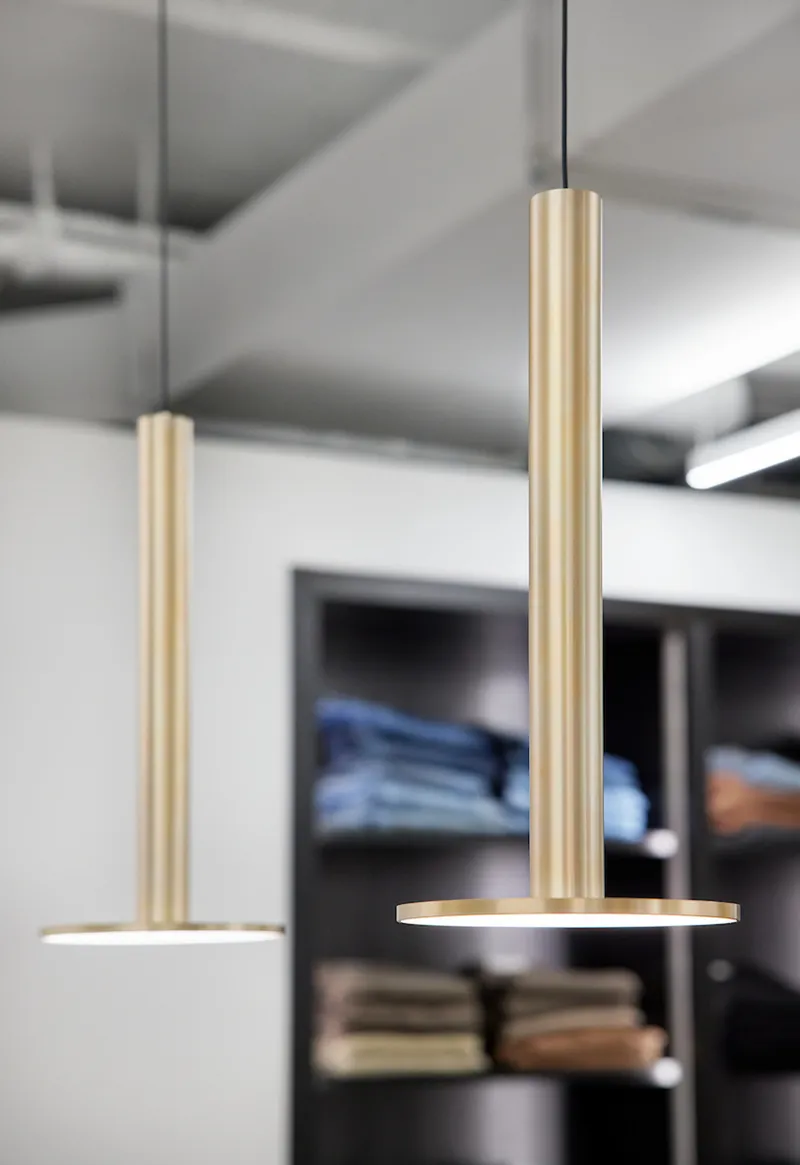
Brass cylindrical pendants add warmth in specific zones, but the dominant lighting strategy is reflective rather than direct. Polycarbonate walls and aluminum lattice ceilings create a diffuse, almost photographic quality of light. For a space that exists to present clothing, this is not decorative indulgence; it is functional infrastructure. Denim needs even, generous light to read correctly, and these surfaces deliver it without the harshness of overhead fluorescents.
The Aluminum Lattice Ceiling
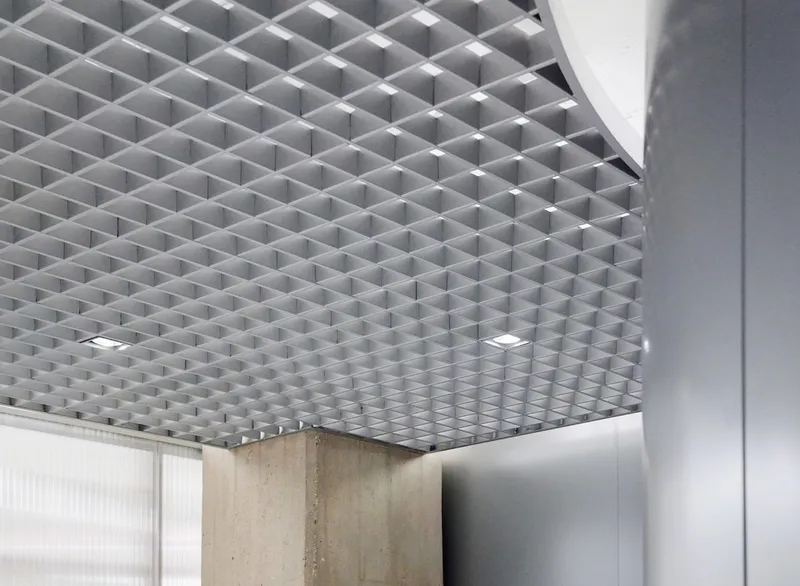

Look up in this project and you find one of its quietest but most consequential decisions: the aluminum lattice ceiling. It is a three-dimensional egg-crate grid that wraps the entire showroom, absorbing acoustics, concealing services, and creating a continuous datum that unifies the plan. Where it meets the peripheral spaces, light reveals open up along the soffits, drawing a clean line between the central volume and the carved rooms at its edges.
The ceiling also does significant work as a wayfinding device. Its geometry shifts subtly, with curved white soffits and angled black metal signage marking transitions between zones. The effect is legible without being didactic. You know when you have left the showroom and entered the office wing because the ceiling tells you so.
Peripheral Workspaces and Meeting Rooms
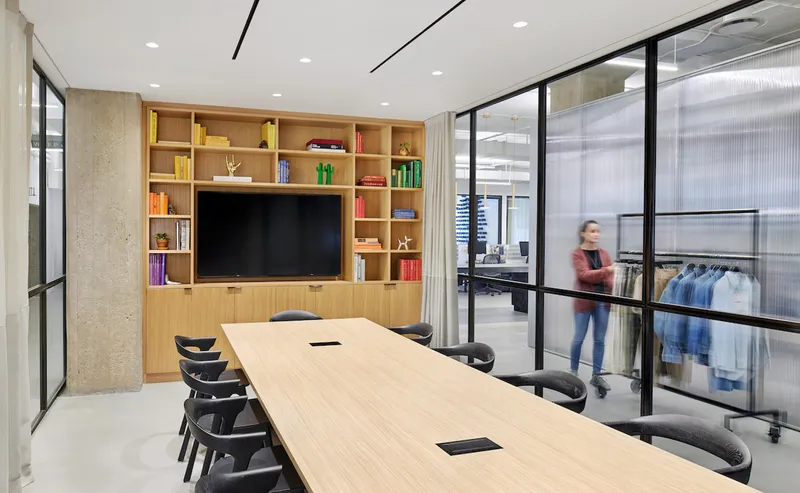

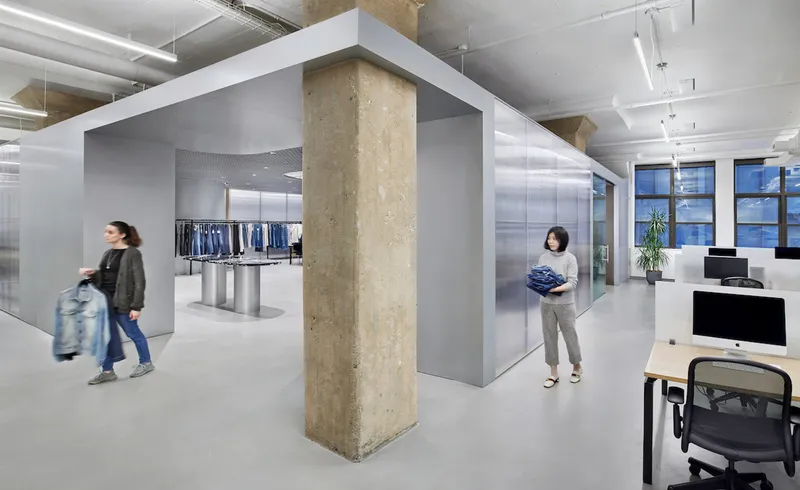
The rooms carved from the showroom's perimeter are pragmatic and restrained. A conference room with built-in wood shelving and glass walls maintains visual connection to the clothing displays below. A meeting nook with a yellow table sits adjacent to a translucent sliding glass partition and cork pinboard wall, offering a more intimate scale for design reviews and sample sessions. The open office floor uses exposed concrete columns framed by grey partitions to create rhythm without enclosure.
What holds these varied spaces together is a consistent material palette. Grey partitions, dark millwork storage walls, and the omnipresent lattice ceiling create a neutral backdrop that never competes with the product. The yellow table in the meeting nook is one of the few chromatic accents, and it reads as deliberate rather than arbitrary, a signal that this space serves a different function.
Material Details and Craft
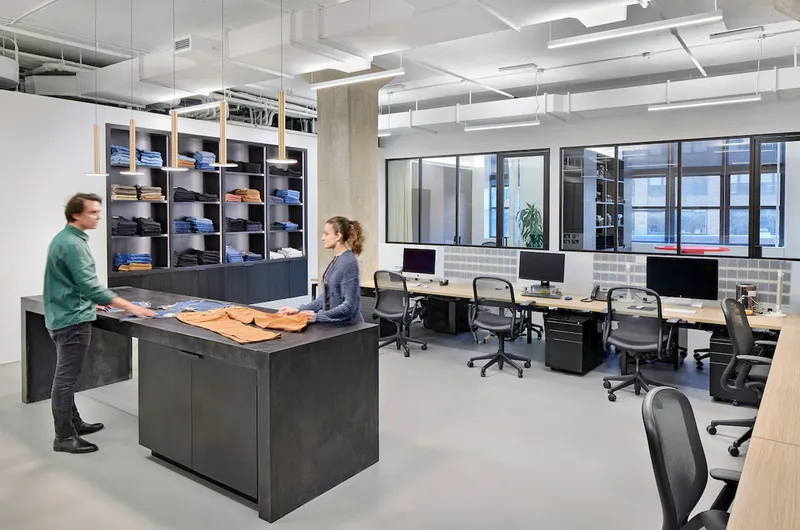

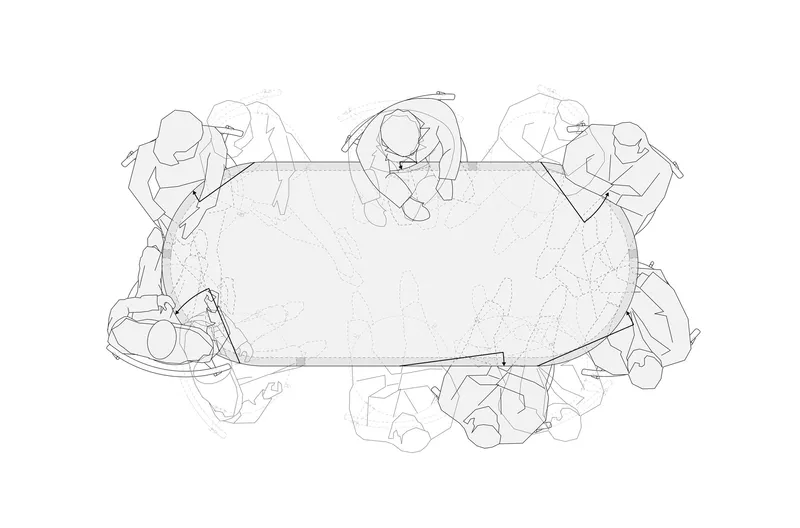
Studio MBM designed custom furniture for the project, including marble-topped tables with slender legs that appear in both the showroom and meeting areas. The elevation and plan sketches of an oval table reveal the care taken at the object scale: five legs, an egg-shaped top, a proportion that seats eight comfortably without dominating the room. These are not afterthoughts. They are integral to the spatial logic, scaled to the column grid and finished in materials that echo the broader palette.
The workspace with its dark millwork storage wall shows a similar discipline. Every surface serves double duty, combining display with storage, branding with function. For a brand that markets its environmental credentials, the choice of aluminum and polycarbonate, both recyclable, both durable, reads as more than aesthetic. It is a quiet alignment of design values with corporate ones.
Plans and Drawings


The floor plan confirms what the photographs suggest: the showroom is a single continuous space at the center of the plate, with meeting rooms, offices, and workstations arranged along the perimeter. Curved interior partitions create fluid transitions between zones, avoiding the corridors and dead ends that plague most office renovations. The rendered plan introduces figures and yellow accent elements that hint at the project's intended atmosphere: casual, populated, active.
Reading the plan alongside the sections, you can see how the geometry of the carved peripheral spaces generates the light reveals at the ceiling line. It is a clever move: the plan is not just a functional diagram but a generator of spatial effects. Every subtraction from the showroom volume produces a corresponding gap at the top where light enters, so the architecture rewards the act of making rooms rather than penalizing it.
Why This Project Matters
Corporate interiors for fashion brands too often fall into one of two traps: either a blank gallery box that treats the product as sacred artifact, or a branded funhouse that prioritizes Instagram moments over daily utility. Studio MBM's DL1961 headquarters avoids both by making the showroom a working center of gravity rather than a display case. People pass through it on the way to their desks. Meetings happen with product in peripheral vision. The design does not worship the clothing; it integrates it into the rhythm of the workday.
The project also offers a compact lesson in how material selection can do organizational work. Aluminum and polycarbonate are not just chosen for their look; they distribute light, define boundaries, and reinforce the hierarchy of center over edge. In a renovation where the column grid and floor plate were inherited constraints, Studio MBM turned those limitations into a clear spatial logic. The result is a headquarters that feels specific to its brand without being branded, a space that works because its priorities are legible in every surface and sightline.
DL1961 Showroom + Office Headquarters by Studio MBM / Maurizio Mattioli, New York, United States. Completed 2019. Photography by John Muggenborg Photography.
About the Studio
Share Your Own Work on uni.xyz
If projects like this are the kind of work you want to make, uni.xyz is a place to publish your own, find collaborators, and enter design competitions.


Popular Articles
Popular articles from the community


LT2A and OPEN Architectes Thread a Brick and Glass High School Through a Wooded Belgian Campus
In Braine-l'Alleud, a 3,000 m² wing for Collège Cardinal Mercier pairs pale brick with a glazed colonnade, deferring to a small chapel and a dense wood.

Cube Design Draws an Ecological Corridor Between Two Shenzhen Hills with the Nankai Building
Beside Shenzhen's container docks, the Nankai Building pairs stacked balconies with a climbing green screen to connect two hillsides across its height.

David Ortega Stacks a Two-Story Mexico City Penthouse Around a Steel Stair and a Pergola-Shaded Roof Terrace
In Colonia Roma, a 300 m² penthouse uses oak joinery, a planted steel stair and a slatted roof pergola to make a new-build apartment feel like a house.

Juan García Correa, John González and Claudia Rueda Sink a Circular Amphitheater into a Manizales Engineering Building
On the La Nubia campus in Manizales, Colombia, the S1 Building folds labs and offices into a hillside of ramped lawns that double as a campus route.

Similar Reads
You might also enjoy these articles


LAVA Architecten Gives Vocational Education a Sawtooth-Roofed Face on a Mechelen School Campus
In Mechelen, Belgium, a 2,053 m² STEM school on a 6×6 m grid turns workshops and classrooms into rooms that can be rearranged as teaching changes.

KEMA Studio Turns a Derelict Marvila Attic into a 60 m² Lighthouse Apartment Above Lisbon
In Lisbon's Marvila district, a rebuilt roof, four skylights and two plywood volumes turn an unlivable attic into a bright home facing the Tagus.

Pixel Gardens: One Repeated Module Stacked Into a Terraced Social Housing Tower for Famagusta
Salem Bader's shortlisted housing tower builds a vertical neighbourhood from one repeated module, offsetting units to carve terraces, light and air.

Bao Huynh Watercolor Atelier: A Serene Art Retreat in Hội An
Bao Huynh Watercolor Atelier in Hội An blends multifunctional art spaces, sustainable design, local materials, and family-friendly living in a serene environment.

Comments (0)
Please login or sign up to add comments
No comments yet. Be the first to comment!