
Studio RE + N Perch a Steel Pavilion Above 500 Meters of Tea Terraces in Zhejiang
An 85-square-meter prefabricated viewing platform lands on a Songyang hilltop without heavy machinery, tracing ancient tea-picking paths.


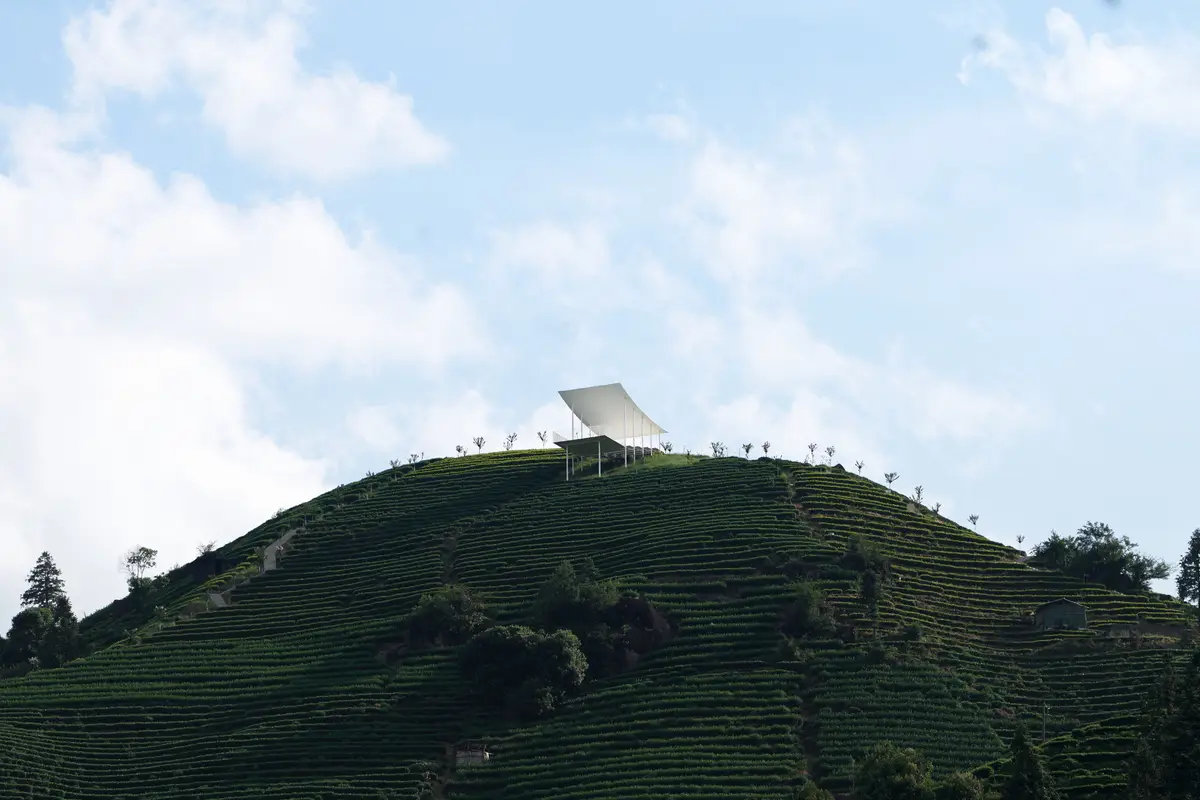
Roughly 30 kilometers from the nearest urban center in Songyang County, a white steel canopy hovers above rows of organic tea at the summit of a terraced hill. The Floating Pavilion, designed by Studio RE + N under the direction of lead architects Yuting Zhang and Pu Zhang, is an 85-square-meter intervention that manages to be both conspicuous and deferential. Commissioned by the town government of Xinxing, it gives visitors a destination and gives tea farmers an upgraded route to their fields, granite steps now replacing the narrow picker paths that were the only prior access.
What makes the project genuinely interesting is not the form, though the curved sandwich roof is elegant, but the construction logic. Every steel component was prefabricated off-site and hauled up the hillside on carts and cable systems along agricultural paths. No heavy machinery touched the ground. Ecological restoration followed completion. The result is a structure that reads as weightless precisely because its makers went to extraordinary lengths to keep it that way.
Arriving at 500 Meters
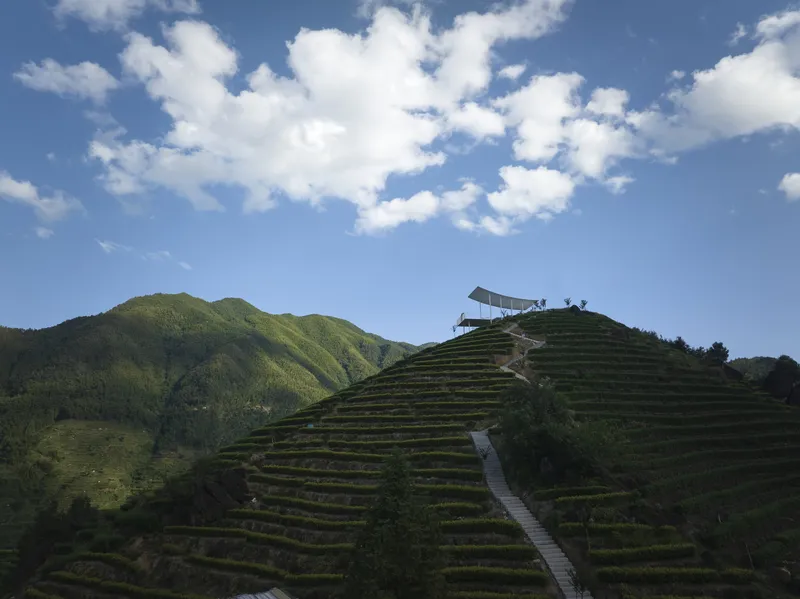
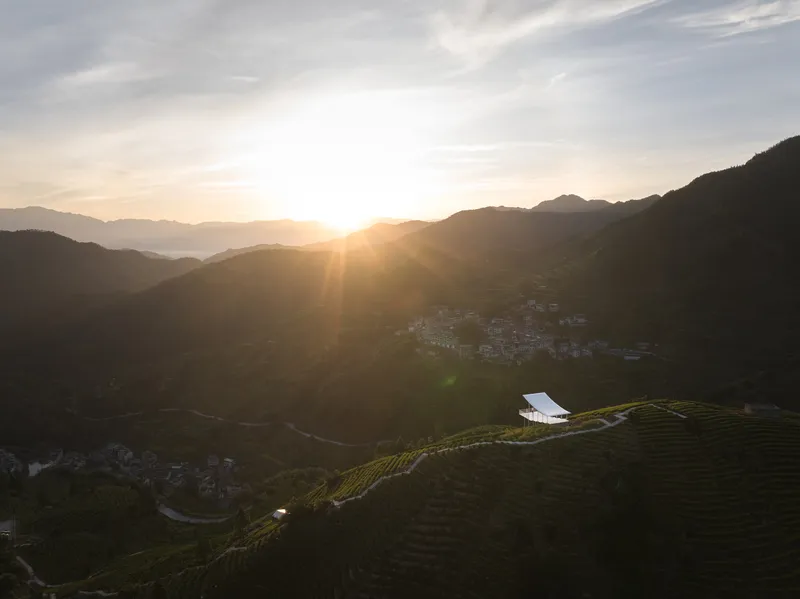
The approach is choreographed as cinema. A zigzag path of granite steps traces the contours of the hill, deliberately making the pavilion appear and disappear behind ridges and rows of tea plants. At 500 meters above sea level, mist regularly blankets the slopes, and the structure phases in and out of visibility. On clear days, cumulus clouds stack behind the mountain backdrop. On overcast mornings, the pavilion is a pale ghost against a monochrome hillside.
The granite steps serve double duty. They are not decorative landscape architecture but functional agricultural infrastructure, improving access for tea pickers during harvest season. That dual mandate, tourism and labor, is a small but important ethical detail that distinguishes this from a pure spectacle play.
The Roof as Topographic Echo
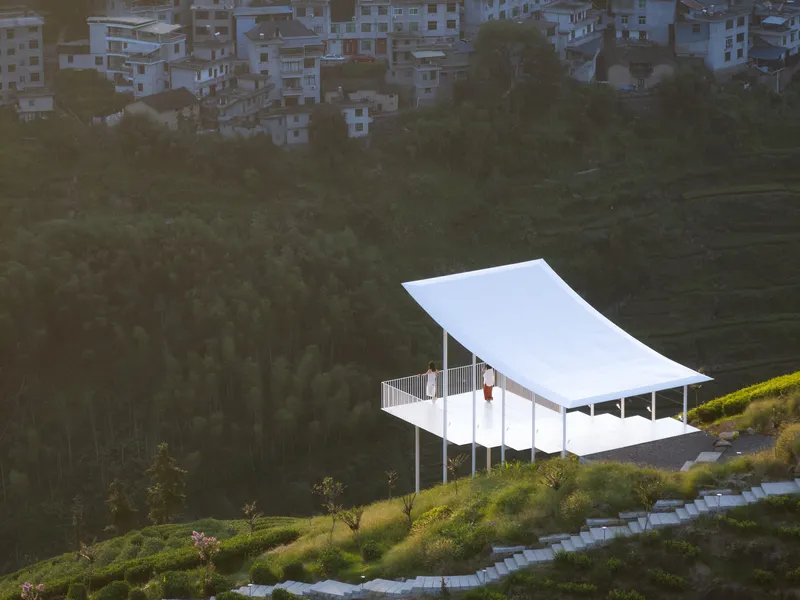
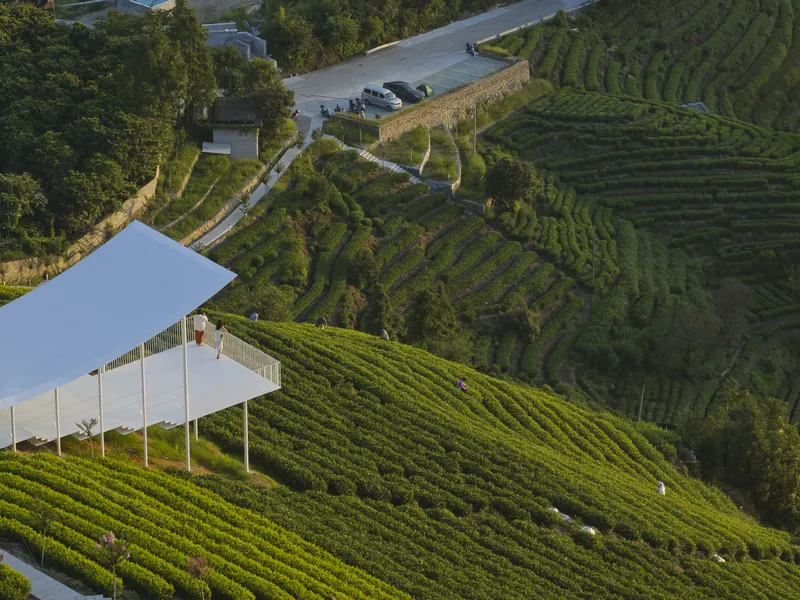
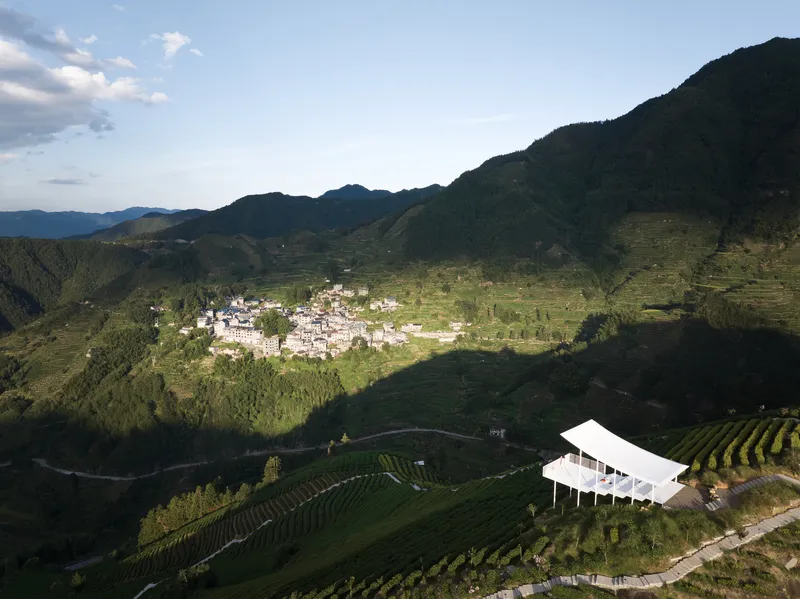
From the air, the roof reads as a white contour line that mimics the hill's own curvature. The composite sandwich construction, a steel grid pressed between upper and lower steel plates with a tapered profile, achieves a slender section that belies its span. It descends toward the entry edge, compressing the threshold, then lifts dramatically as visitors move down the internal tiers and the panorama opens up.
The curve is not arbitrary. It follows the hillside's gradient, integrating drainage into the formal geometry so that water runs off the lower edge rather than pooling. The profile also ensures that from most downhill vantage points, the structure appears to skim the treetops rather than dominate the ridge. It is a pavilion that knows its place in the terrain hierarchy.
Structure on Slender Legs
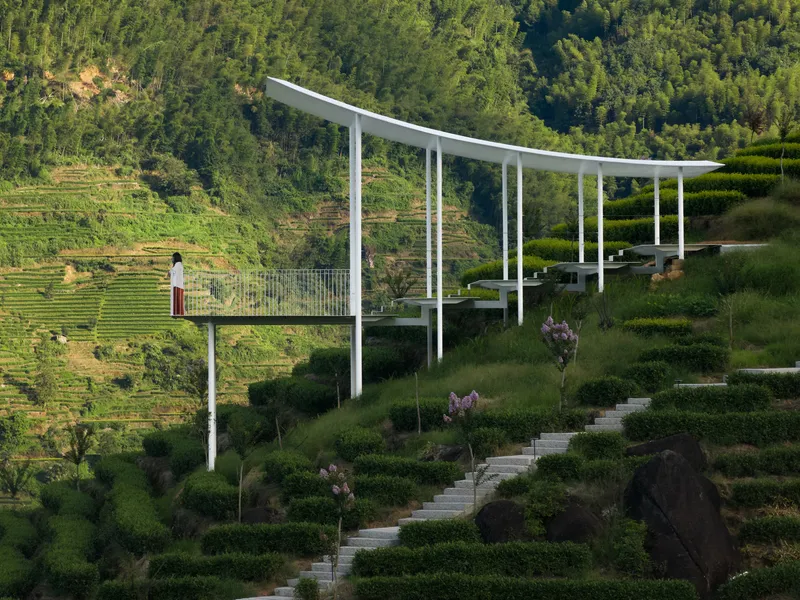
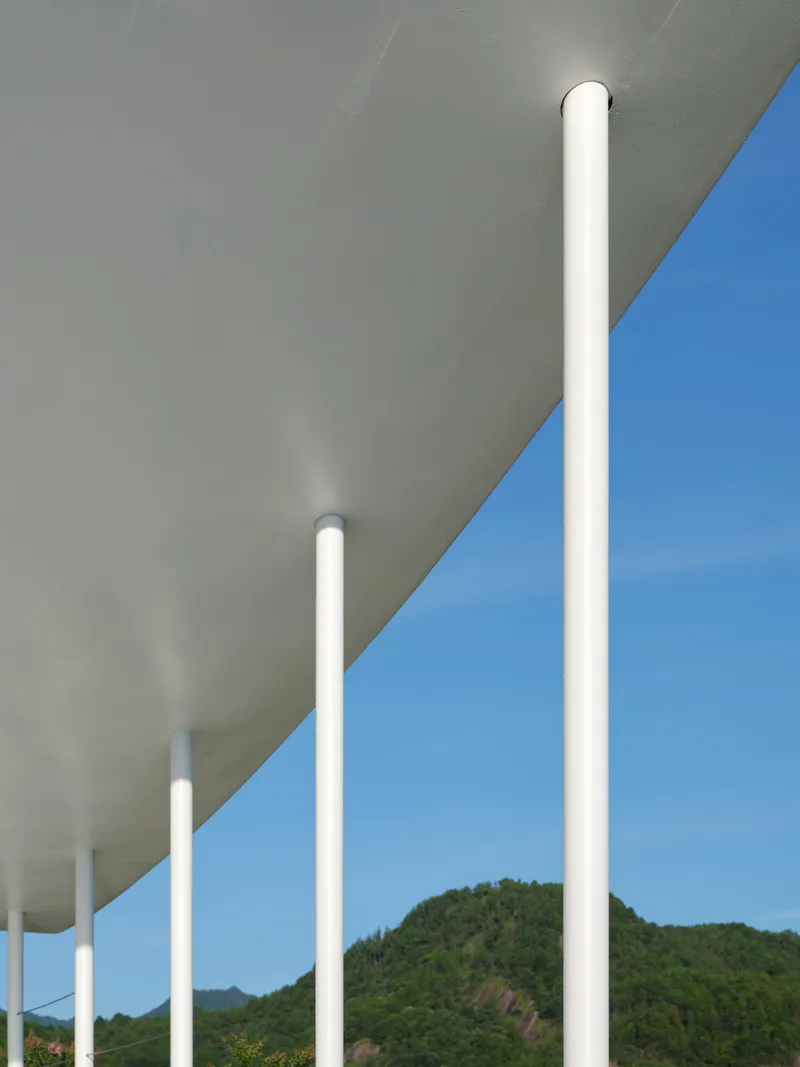
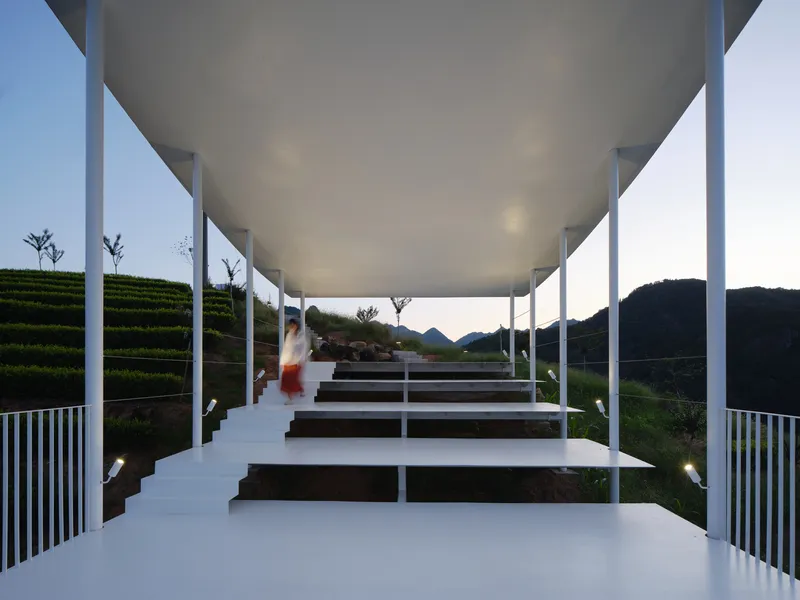
The structural concept relies on a single transverse beam supporting the deck, from which wedge-shaped stiffeners extend to create the stepped platforms. Slender cylindrical columns carry the roof, and tension cables run between them to brace laterally without adding visual mass. The deliberate separation between platform edges and columns produces semicircular voids at ground level, allowing daylight to wash up from the earth and creating the illusion that the floor is levitating above the slope.
There is a tautness to the engineering that gives the whole assembly a tension-cable logic, even where gravity loads dominate. The columns are thin enough to read as vertical rods rather than structural members, and the absence of diagonal bracing within the visible frame keeps sightlines uninterrupted.
Inside the Canopy
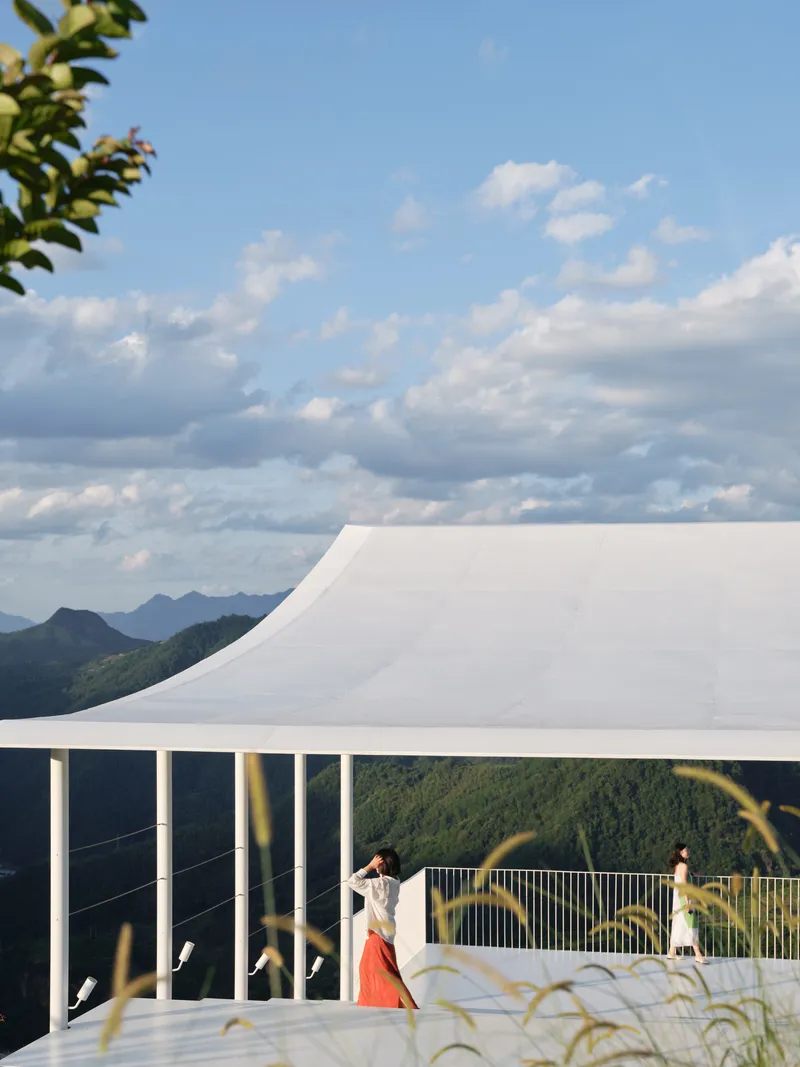
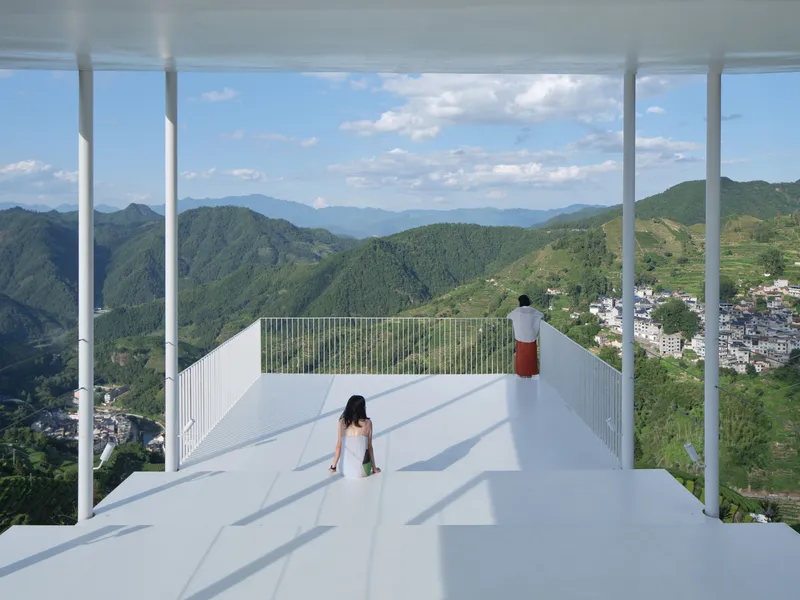
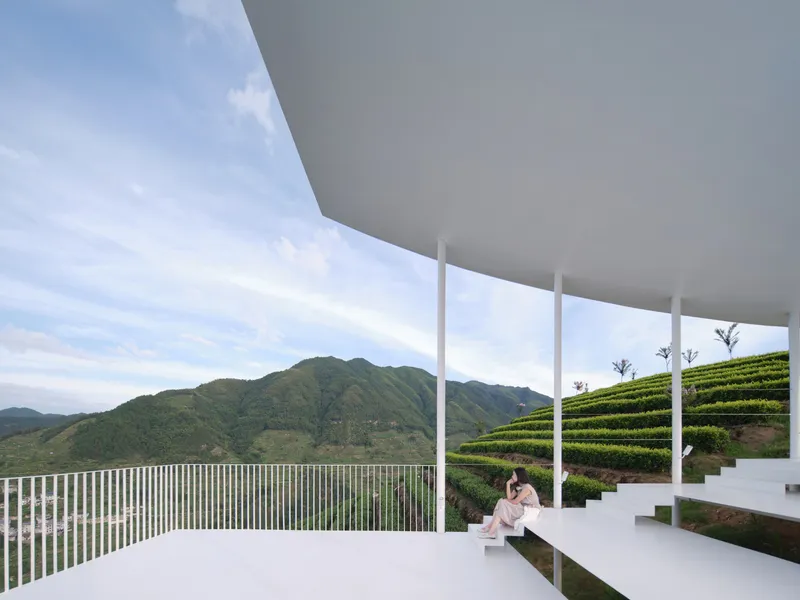
Once under the roof, the experience inverts. The compressed entry gives way to a generous deck where benches and stepped tiers create an informal amphitheater oriented toward the valley. Vertical steel louvers form a railing that filters the view into slices, shifting as you move. The effect is closest to looking through a slowly turning zoetrope: the mountain panorama reassembles itself with each step.
The spatial sequence rewards lingering. You sit on timber-topped platforms, the canopy overhead shielding from sun and rain, while the open sides admit the full force of wind and moisture rising off the terraces. It is a shelter that refuses to be enclosed, an architectural threshold between the cultivated slope below and the open sky above.
The Railing as Screen
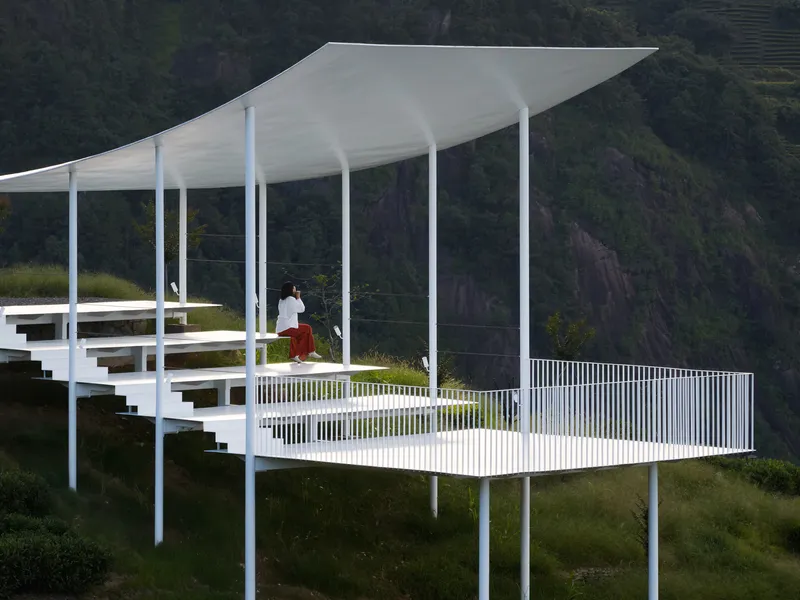
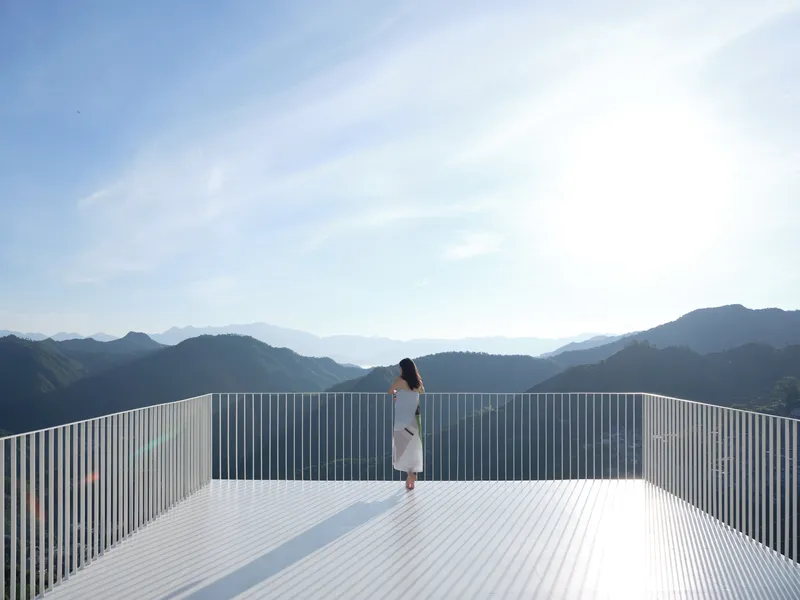
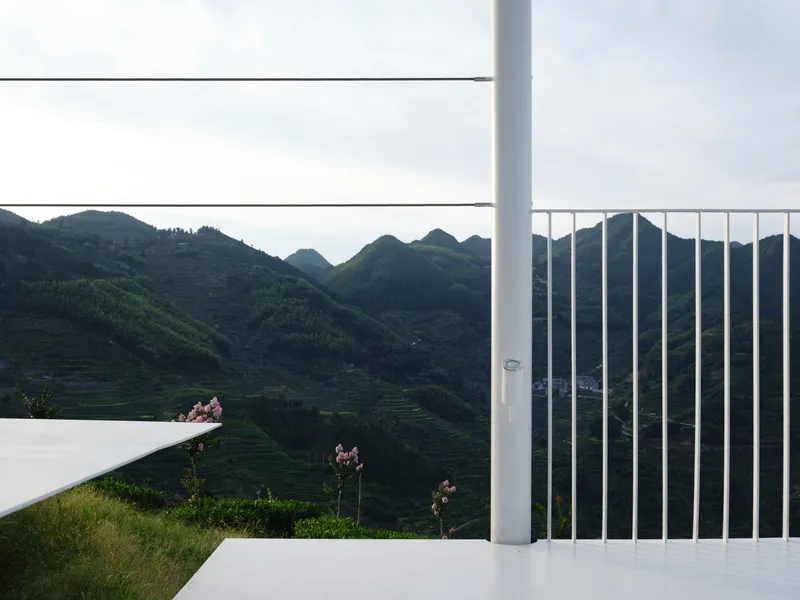
The vertical louver railing deserves its own mention because it does more than protect visitors from a fall. Its rhythm and density are calibrated so that standing close blurs the landscape into an impressionist wash, while stepping back sharpens the view. Horizontal cable rails at the base and mid-height provide structural continuity without competing with the vertical cadence. The railing becomes an optical instrument, not a barrier.
After Dark
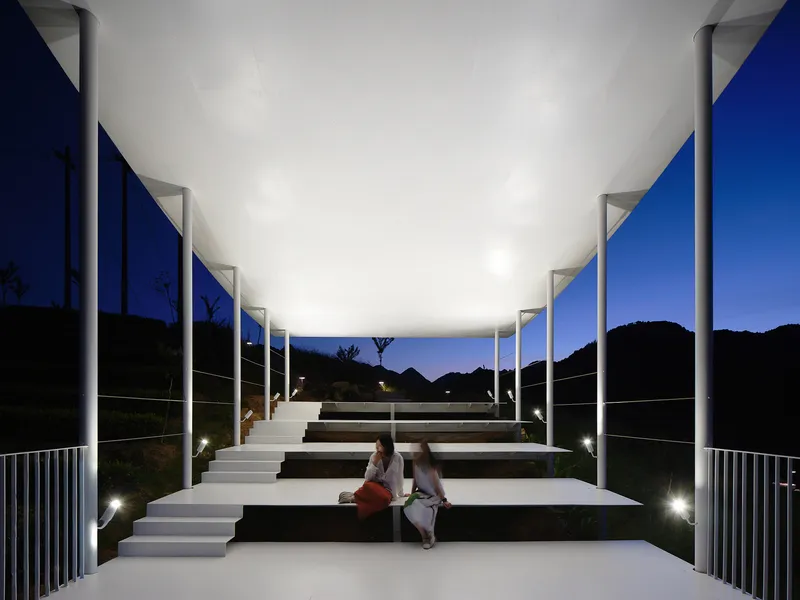
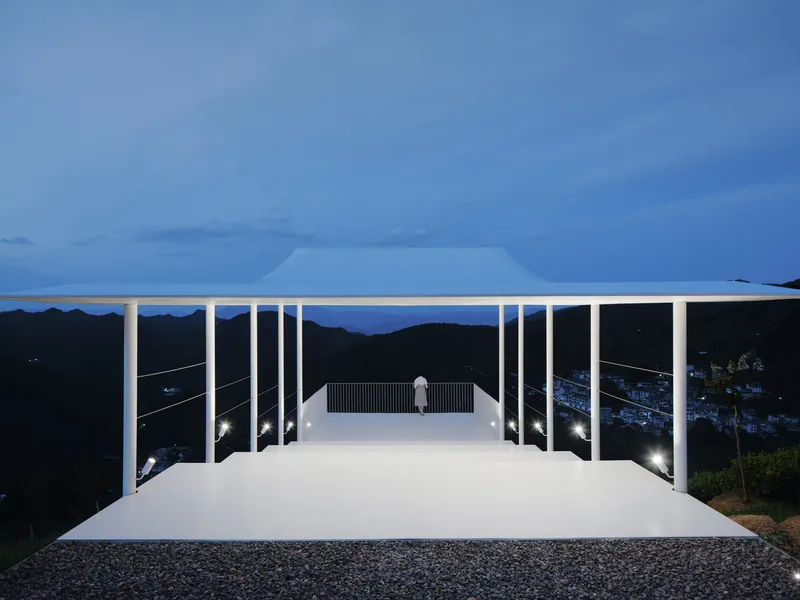
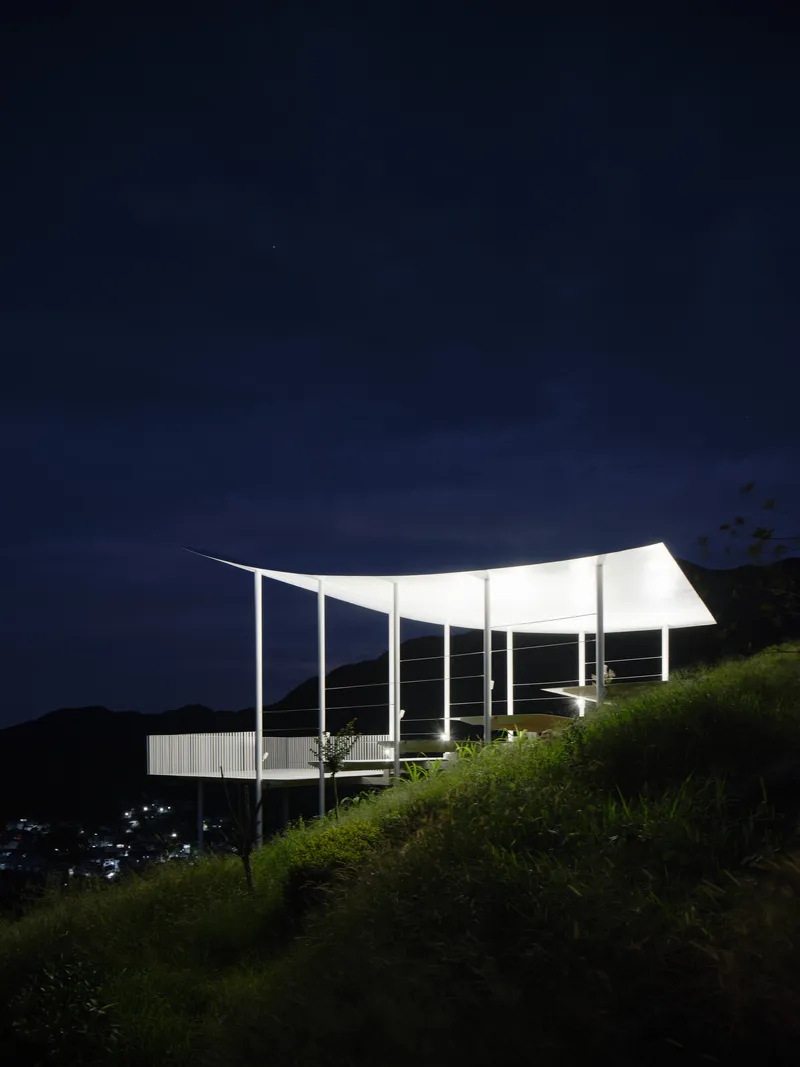
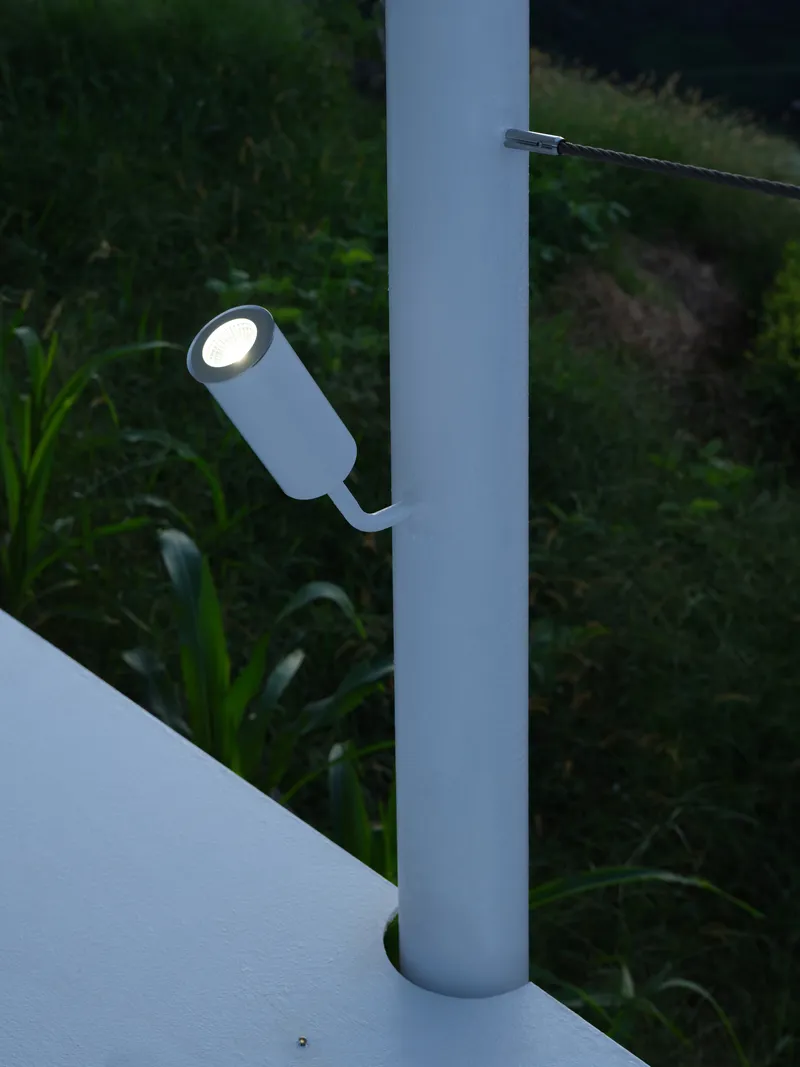
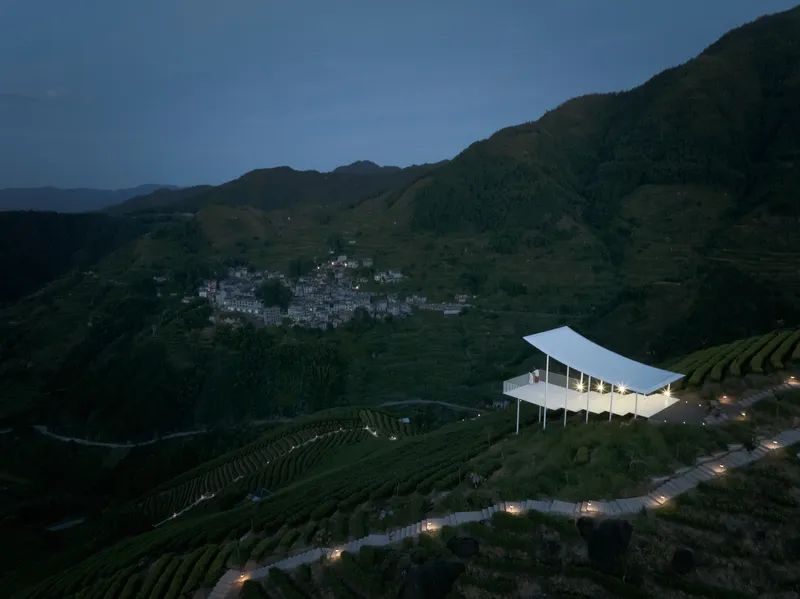
Custom cylindrical luminaires mounted at the base of each column project light upward, washing the underside of the curved roof and turning the canopy into a lantern visible from the valley below. At night the pavilion's identity flips: by day it defers to the landscape, by night it signals across it. The tiered seating, illuminated from below, acquires the quality of an amphitheater stage, and the pair of visitors captured sitting together on the steps suggest the kind of quiet social use the architects clearly intended.
The lighting detail at image 16 shows how neatly the cylindrical fixture integrates with the column diameter. It does not clip on; it belongs. That level of resolution in a remote hilltop installation, where most clients would accept a generic bollard, signals a design team that treated every component with the same seriousness as the overall form.
Landscape and Settlement
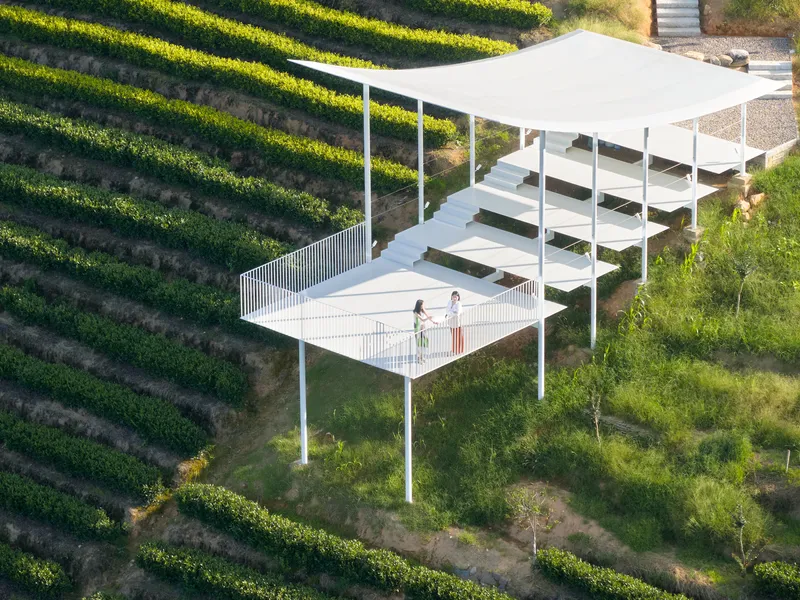
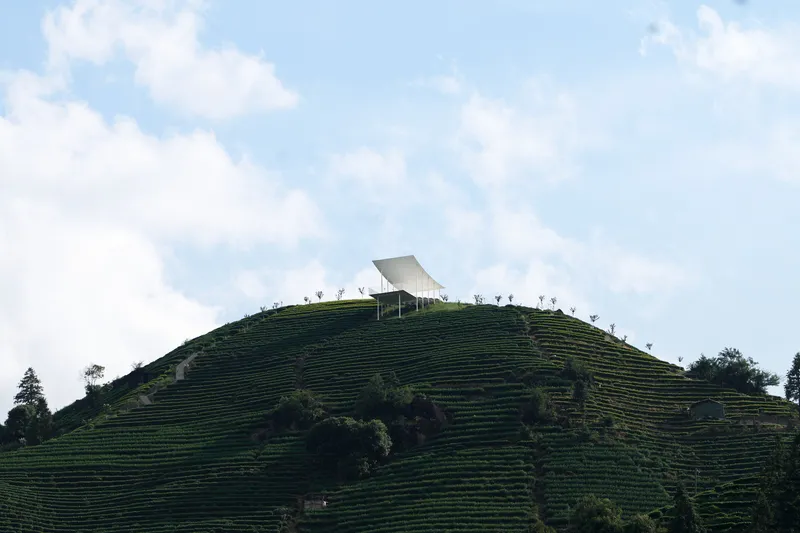
The aerial views reveal what ground-level photography cannot: the pavilion occupies a hilltop that is itself a small island in a sea of parallel tea rows. The cultivated landscape is not backdrop but active participant. Tea plants crowd the base of the columns, wildflowers and grasses push against the gravel threshold. The architects specified minimal excavation and post-construction ecological restoration, and the photographs suggest that promise has been kept. The hill reads as continuous, with the pavilion simply resting atop it.
In the wider territorial view, the settlement of Xinxing sits in the valley below, its rooftops a reminder that this is not wilderness but a working agricultural landscape. The pavilion mediates between the scale of the village and the scale of the mountain range, giving both a middle-ground object against which to register depth.
Plans and Drawings
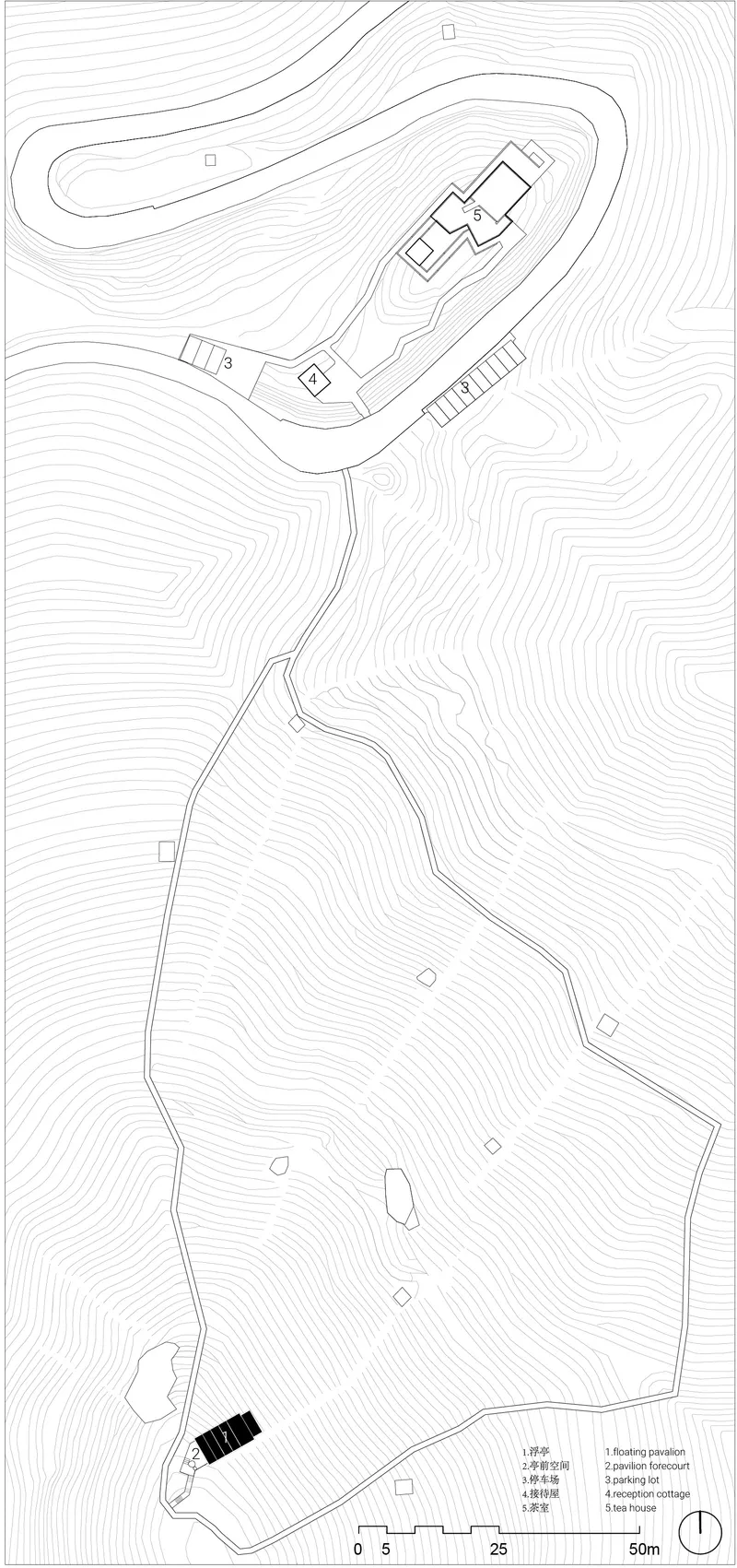
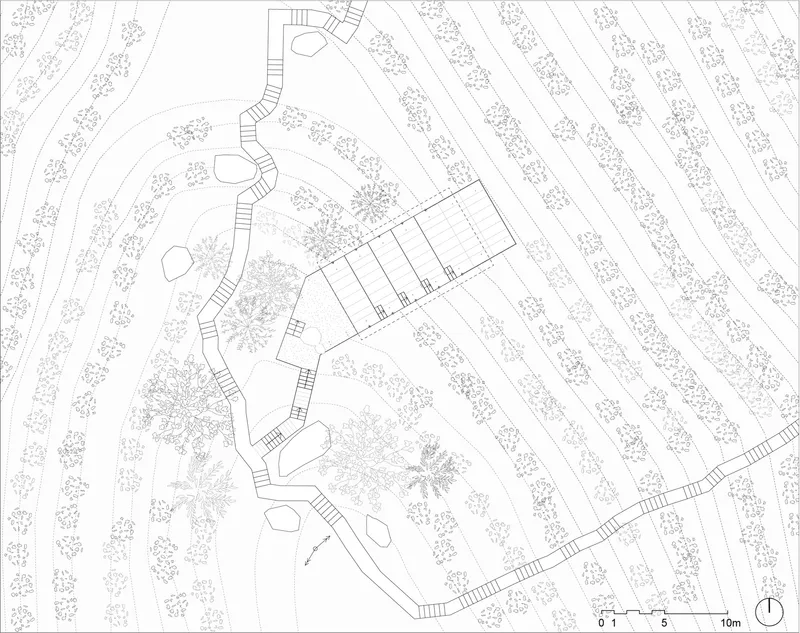
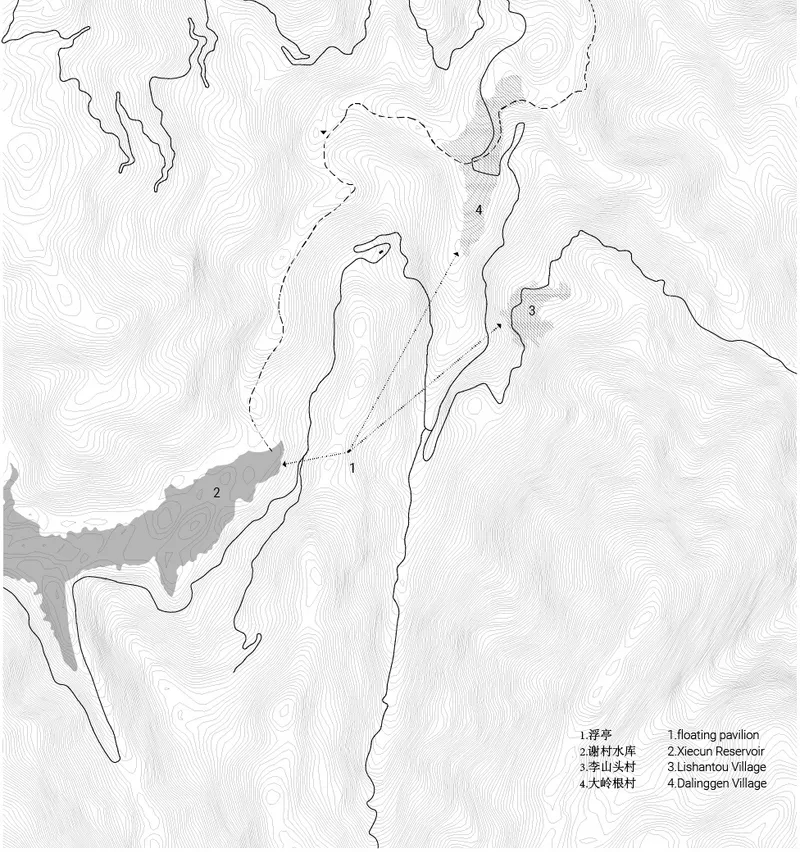
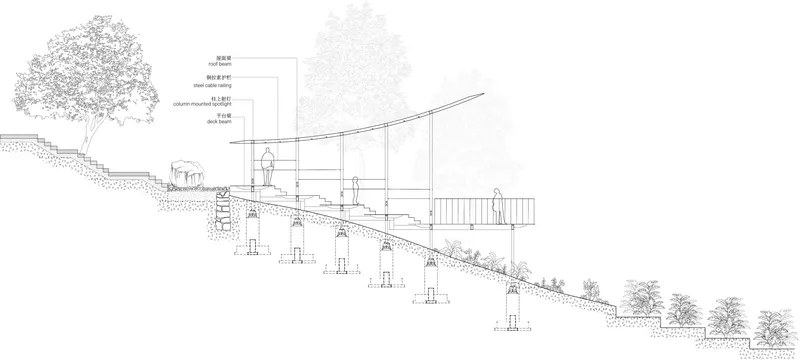
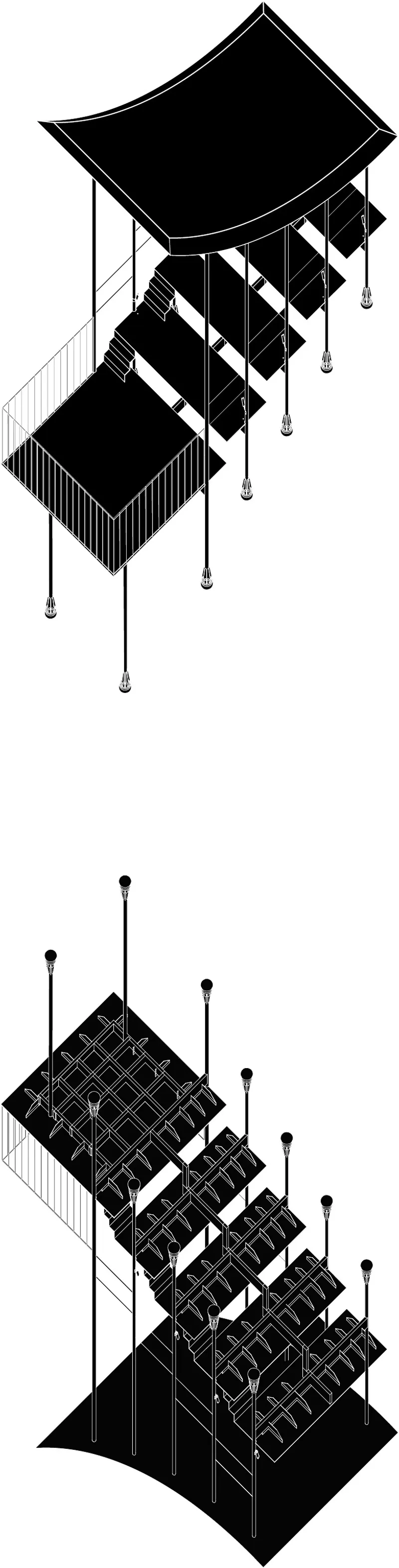
The topographic site plans situate the pavilion within a network of contour lines, reservoirs, and village boundaries, confirming its role as a territorial marker rather than an isolated object. The section drawing is the most revealing: it shows the cantilevered roof projecting well beyond the deck edge, the stepped platforms cascading down the slope, and a minimal footprint of concrete strip footings touching the ground. Human figures provide scale and reinforce how compressed the entry condition is relative to the expansive view opening beyond.
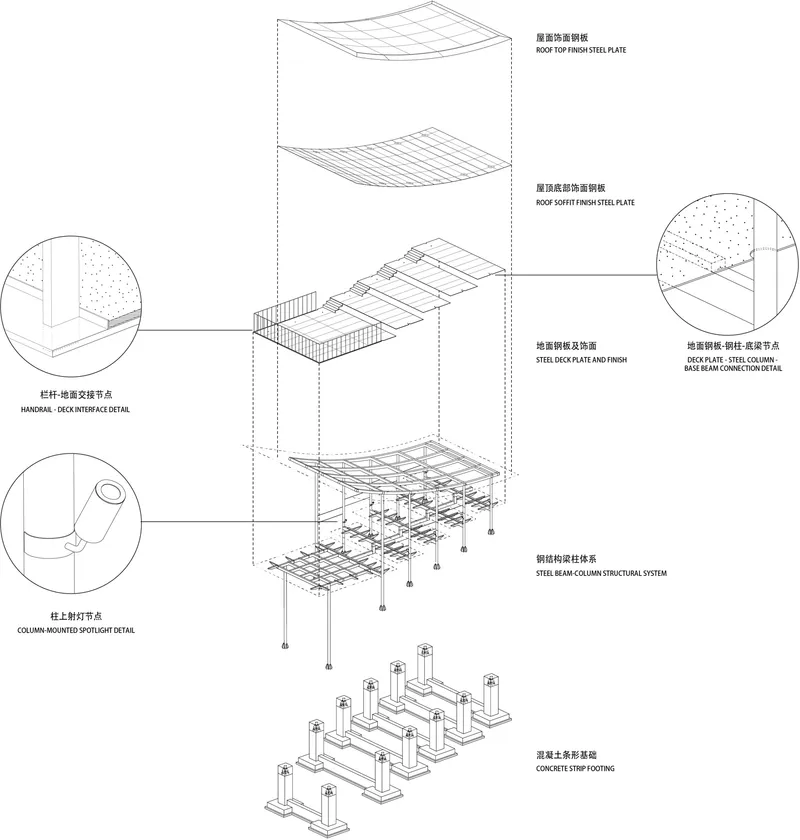
The exploded axonometric is where the construction logic becomes legible. The curved roof plates, the steel grid sandwiched between them, the column assemblies with their integrated luminaire sleeves, and the wedge-shaped deck stiffeners are all clearly separated. You can see how prefabrication enabled the no-machinery installation: each piece is a manageable module, bolt-connected on site. The drawing is as much a logistical diagram as an architectural one.
Why This Project Matters
Rural China is littered with viewing platforms and cultural pavilions that impose urban construction practices on fragile landscapes. The Floating Pavilion takes a different position. Its prefabricated, no-machinery delivery method is not a gimmick but a genuine operational constraint that shaped the design from first principles. The dual-use granite path, the ecological restoration protocol, the integration of farmer access into a tourist infrastructure: these are decisions that treat a working landscape as a collaborator rather than a canvas.
Studio RE + N have produced a small building with an outsized lesson. At 85 square meters, it does not need to justify itself through program complexity. Instead, it demonstrates that precision in engineering, restraint in siting, and honesty about construction logistics can yield an architecture that feels both inevitable and generous. The best pavilions disappear into the experience they frame. This one comes close.
Floating Pavilion by Studio RE + N. Lishui, Zhejiang Province, China. 85 m². Completed 2025. Photography by Kejia Mei.
About the Studio
Share Your Own Work on uni.xyz
If projects like this are the kind of work you want to make, uni.xyz is a place to publish your own, find collaborators, and enter design competitions.


Popular Articles
Popular articles from the community


Co-life: Sustainable Architecture for Age-Friendly Community Living
Co-life reimagines sustainable architecture for seniors through courtyards, rammed earth, shared gardens, and spaces designed for belonging.

Co-Life: Senior Housing Design That Reconnects Older Adults With the City
Co-Life reimagines senior housing design through healing gardens, shared streets, workshops, and a sustainable community across generations.

Play: Fragments of Their World
Familiar architecture becomes modular playground design, creating safe spaces where displaced children can learn, connect, imagine and play.

Lunar Spiral: Space Architecture Shaped by the Mathematics of the Universe
Lunar Spiral reimagines space architecture through Fibonacci geometry, lunar regolith, levitating habitats, and self-sustaining Moon living.

Similar Reads
You might also enjoy these articles

Bao Huynh Watercolor Atelier: A Serene Art Retreat in Hội An
Bao Huynh Watercolor Atelier in Hội An blends multifunctional art spaces, sustainable design, local materials, and family-friendly living in a serene environment.

Atelier Macri Concept Store Interior Design by CASE-REAL
Atelier Macri store features a "ko" counter, walnut wood details, cork displays, blending retail, gallery, and seamless customer experiences.

Manuel Vargas Izquierdo Stadium and High-Performance Sports Center: Architectural Excellence in Jalpa de Méndez
The Manuel Vargas Izquierdo Stadium blends sustainable design, inclusive sports facilities, and cultural-inspired architecture, revitalizing Jalpa de Méndez’s public spaces.
KAKR Buluh Awar Hall: Revitalizing Community and Ecology Through Bamboo Architecture
Community built bamboo hall revitalizes Buluh Awar village, empowering youth, restoring ecology, celebrating vernacular craftsmanship through sustainable architecture and culture.


Comments (0)
Please login or sign up to add comments
No comments yet. Be the first to comment!