

Studio RE + N Turn a Forgotten Rooftop Between Housing Blocks into a Red Steel Commons
In Songyang County, a cracked second-floor platform becomes a vibrant public stage for 1,300 square meters of play, sport, and gathering.


Between two concrete residential blocks in Songyang County, Zhejiang Province, a second-floor platform sat abandoned for years. Cracked pavement, a deteriorated public restroom, no clear way up, and no reason to go there anyway. The community surrounding it was built between 2015 and 2017, but this elevated slab never found a purpose. Studio RE + N saw something different: a gap in the social fabric wide enough to stage an entirely new kind of public life.
Youth Commons is the result, and what makes it genuinely interesting is not the program (play structures, a sports court, a canopy for gatherings) but the economy of means. A light-steel frame in signal red, canvas panels for shade, painted court markings on the existing surface, and a spiral stair to solve the access problem. The total area is 1,300 square meters, but the intervention itself is lean, almost parasitic. It does not replace the roof; it colonizes it. The minimum material yields maximum public life, and the proof is in the images: kids climbing, adults playing table tennis, an audience watching an outdoor film screening at dusk.
A New Street Where There Was None


The original platform had a fundamental problem: you couldn't reach it easily, and even if you could, there was no reason to stay. The architects solved both issues simultaneously. A red spiral staircase, wrapped in perforated metal mesh, bolts onto the exterior tile facade of the residential block and creates a legible, almost celebratory entrance from the street below. It reads less as infrastructure and more as invitation.
At the top, a new west edge establishes a street-like interface. The red canopy frame with its translucent canvas panels defines a threshold that is neither fully inside nor outside. Children stream through it without hesitation. The striped staircase with its pastel risers amplifies the sense that ascent is part of the experience, not just a means to an end. Access becomes spectacle.
Red Steel as Social Infrastructure
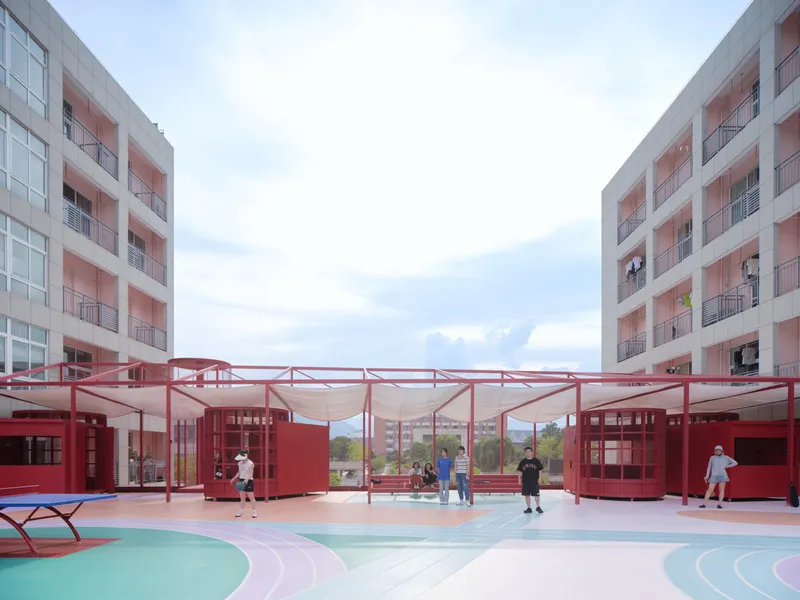
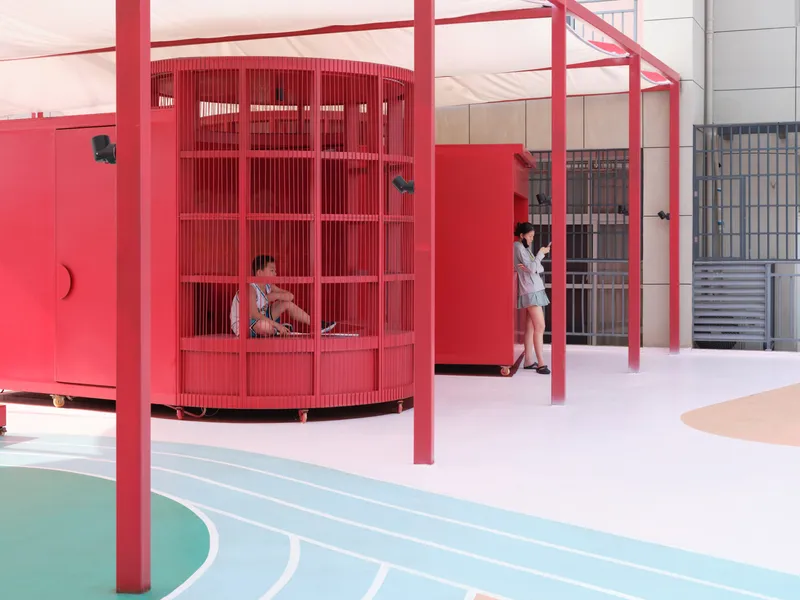

The choice of red for the light-steel structures is deliberate and effective. Against the grey-beige monotony of the surrounding residential facades, the pavilions, canopies, and screens register instantly as communal property. They belong to no one apartment and therefore to everyone. A cylindrical storage pavilion with vertical slats, a roller-shutter opening that frames the courtyard beyond, modular volumes tucked beneath the canopy: each element is legible and distinct, yet the color unifies them into a single civic gesture.
The material palette stays deliberately narrow. Red-painted steel, perforated metal panels, corrugated cladding, and canvas. Nothing precious. The structures could be disassembled or rearranged without mourning. That provisional quality is the point: it signals that the space is alive and mutable, not a monument dropped from above.
The Painted Ground
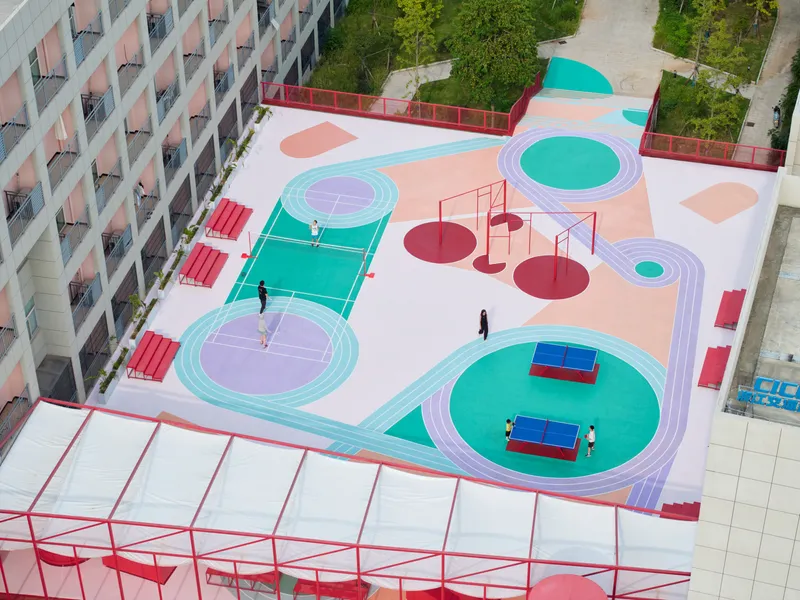


Much of Youth Commons' energy comes not from the structures but from the floor. Concentric circles in turquoise and pink, pastel stripes, and bold geometric paving patterns transform the previously cracked surface into a graphic landscape. The painted markings overlay multiple programs onto a single plane: badminton courts, running loops, gathering zones. None of these functions are fixed. The paint suggests rather than dictates.
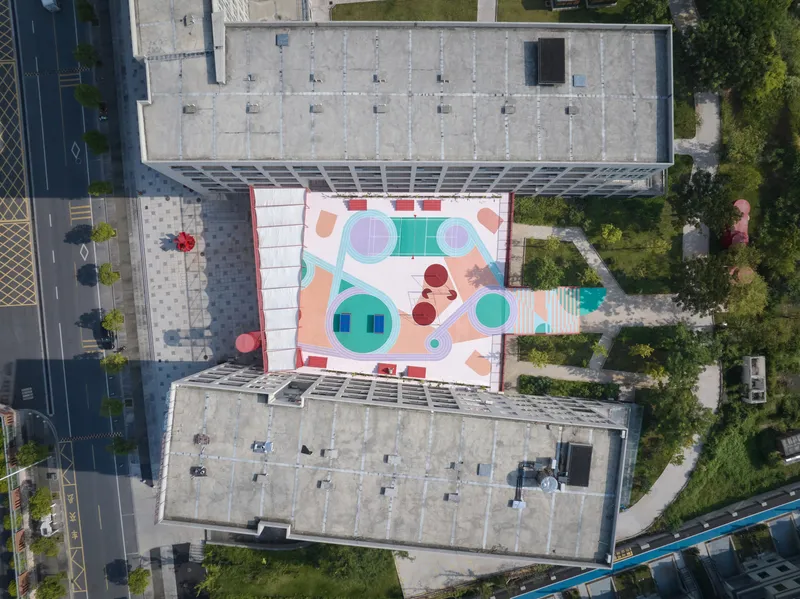
From above, the effect is striking. Wedged between the two linear housing blocks, the rooftop reads as an abstract painting, its colors intensified by the neutral context. Circular turf patches for table tennis tables, curved pathways, and scattered play equipment all respond to the same graphic logic. The ground does as much architectural work as the canopy above it.
Play as Program


The play structures are inventive without being overwrought. A tilted red sculpture with a circular opening doubles as a climbing frame. Perforated partitions with circular cutouts become vertical play surfaces. Blue table tennis tables sit on circular turf islands. Each piece is scaled to children but legible to adults, and none of them require instructions. The design trusts its users to figure out what something is for.
What separates this from a conventional playground is the absence of zoning. Play bleeds into sport, sport bleeds into gathering, and gathering bleeds back into play. A child climbs above a partition while adults chat below. The lack of fences or cordoned-off zones means that risk and sociability coexist, which is how outdoor space actually works when designers resist the urge to over-program.
Canopy and Dusk
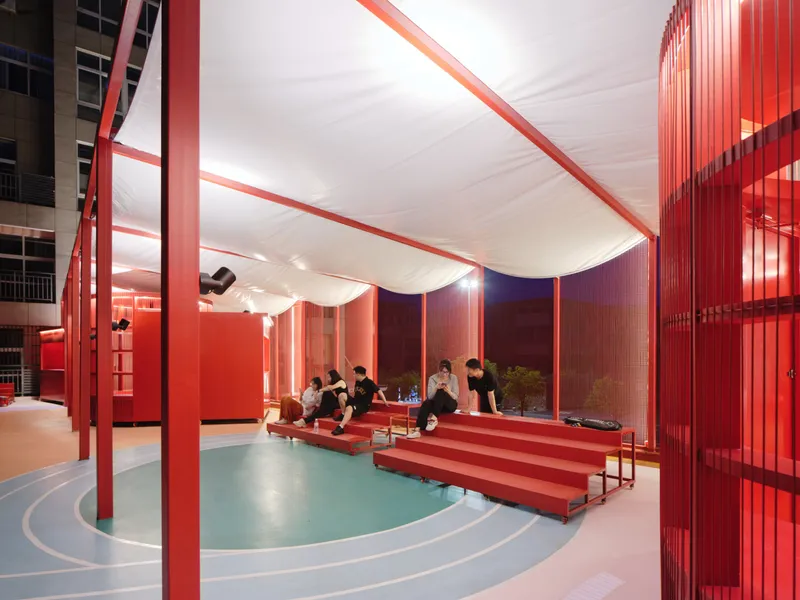


The project comes fully alive at night. A pavilion with red steel columns and a white fabric canopy shelters stepped benches that face the open court. At dusk, the sawtooth roof of an adjacent structure glows from within, casting warm light across the courtyard. The space becomes a theater, not by design but by disposition. An outdoor film screening draws an audience onto the multicolored court surface, chairs pulled up informally, the surrounding apartments forming a natural amphitheater wall.
The canvas panels that modulate light during the day become luminous screens after dark. The architects understood that a commons earns its name in the evening hours, when work is done and the threshold between private and public softens. The lighting is not theatrical; it is warm, functional, and incidental, which makes the gatherings feel spontaneous rather than curated.
Restroom as Architecture
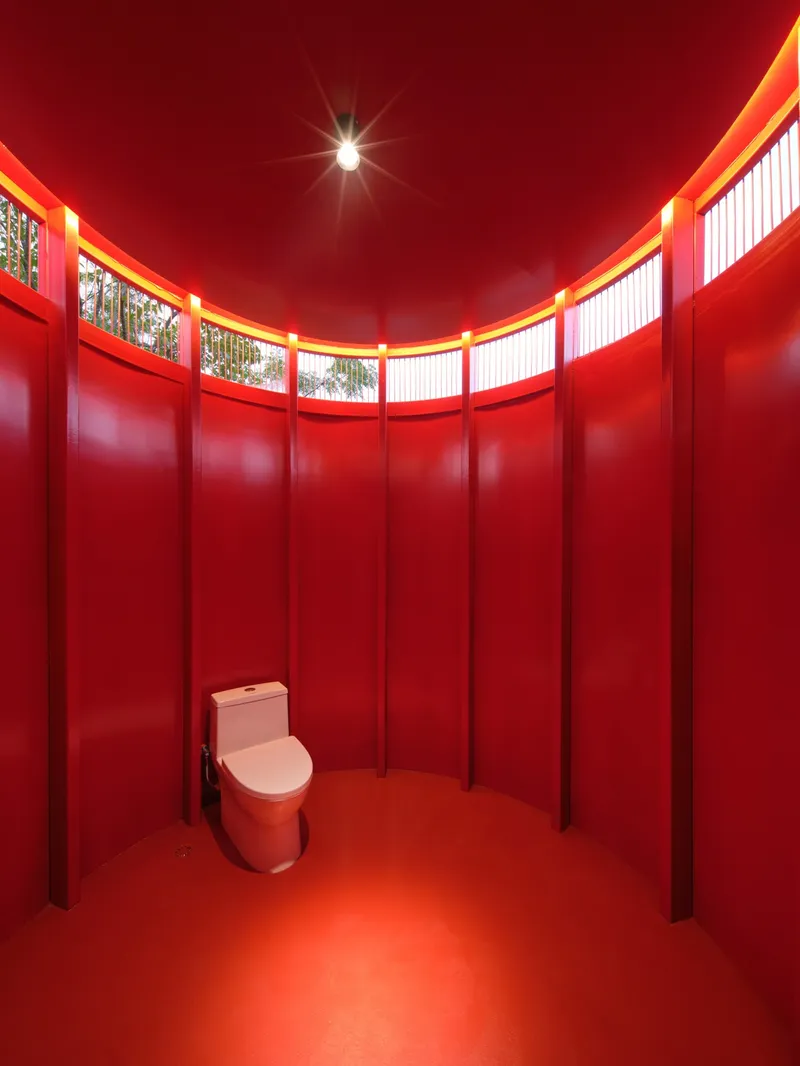


The original restroom on the platform had deteriorated into a liability. The replacement is one of the project's quiet triumphs. A circular plan wrapped in red corrugated wall panels, topped by a clerestory band that wraps the curved ceiling and lets in diffuse natural light. The washroom interior, with its central basin counter framed by views to a green courtyard beyond, is generous without being extravagant.
Too many community projects treat service spaces as afterthoughts. Here, the restroom gets the same material attention and spatial ambition as the pavilions. The curved clerestory window, the perforated wall panels admitting filtered light, the continuity of the red palette: all of it signals that civic dignity extends to the most utilitarian rooms.
Context and Compression

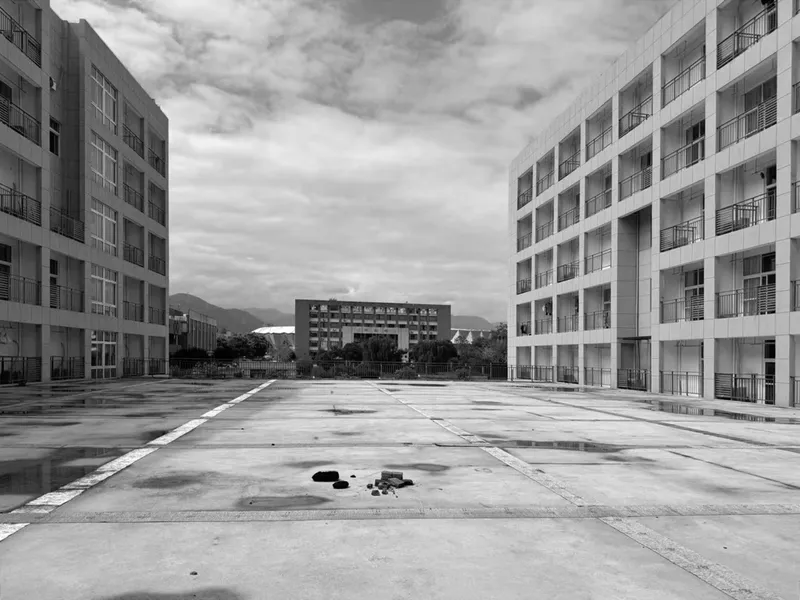
The before-and-after is quietly devastating. The courtyard below, with its patterned stone pavers flanked by repetitive concrete residential blocks, is the baseline condition of countless Chinese housing developments built in the last decade: functional, inoffensive, lifeless. The wet concrete plaza stretching toward distant mountains is almost poetic in its emptiness. These are the spaces that communities are handed and expected to inhabit.
Seen from above, the contrast is stark. The intervention is compressed into the gap between buildings, a narrow strip of color and steel jammed into a void. It does not try to remake the housing or reform the master plan. It works with the leftover, the overlooked, the residual. That constraint is the source of its energy.
Plans and Drawings
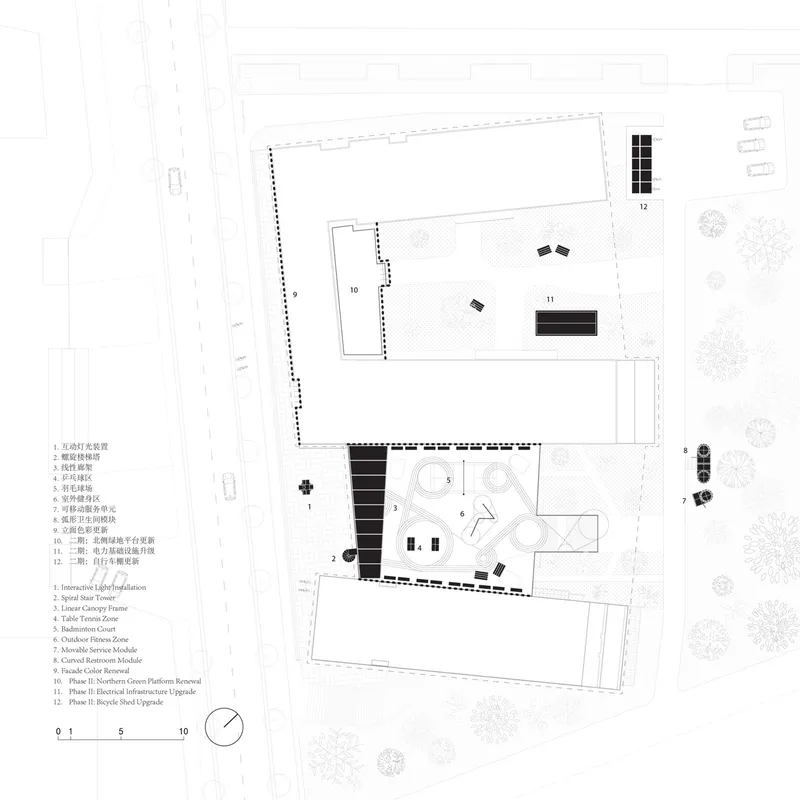




The drawings reveal the full scope of the strategy. The site plan shows how the two angled residential volumes define the void that the commons occupies. The roof plan maps the circular and curvilinear play elements scattered across the surface, confirming that the arrangement is deliberate rather than random. Sections clarify the level change: the rooftop platform sits above a service level, with the steel truss canopy hovering above and the spiral stair bridging the gap to grade.
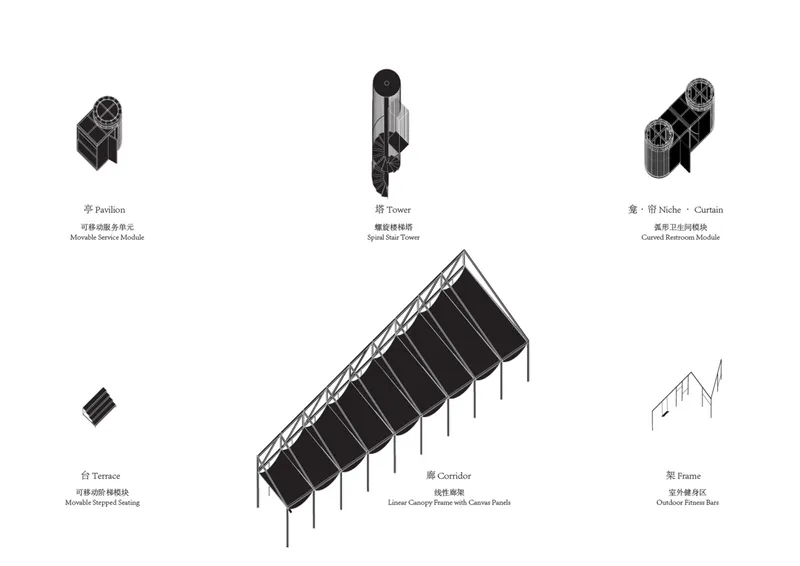
The axonometric drawing is the most instructive. It decomposes the project into modular components: spiral tower, curved canopy corridor, pavilion modules. Each element is self-contained and repetitive, which explains the project's visual coherence despite its apparent informality. The capsule structure drawing, with its two circular volumes flanking a central core, shows how even the smallest units follow a geometric discipline. The composite site plan, populated with human figures, makes the case that architecture here is less about objects and more about the social patterns they enable.
Why This Project Matters
Youth Commons is a corrective to two tendencies in contemporary Chinese urbanism. The first is the habit of treating the spaces between residential blocks as finished once the landscaping goes in. The second is the assumption that community infrastructure requires a dedicated building with a dedicated budget and a dedicated program. Studio RE + N demonstrate that a light-steel frame, some paint, and a clear idea about public life can do more than a purpose-built civic center ever could, precisely because the intervention is calibrated to the gap it fills.
The broader lesson is about ambition and restraint coexisting in the same project. The architects did not attempt to fix the housing or redesign the neighborhood. They found the forgotten slab, made it reachable, made it colorful, and gave it enough structure to host the full range of communal life, from table tennis to film screenings to children climbing through circular holes in red steel. That is not a modest achievement. It is a proof of concept for thousands of similar platforms sitting empty across China's new towns, waiting for someone to notice them.
Youth Commons, designed by Studio RE + N. Shuinan Sub-district, Songyang County, Lishui, China. 1,300 m². Completed 2025. Photography by Kejia Mei.
About the Studio
Share Your Own Work on uni.xyz
If projects like this are the kind of work you want to make, uni.xyz is a place to publish your own, find collaborators, and enter design competitions.


Popular Articles
Popular articles from the community


LT2A and OPEN Architectes Thread a Brick and Glass High School Through a Wooded Belgian Campus
In Braine-l'Alleud, a 3,000 m² wing for Collège Cardinal Mercier pairs pale brick with a glazed colonnade, deferring to a small chapel and a dense wood.

GROUP A Strips a 1969 Rotterdam Harbor Headquarters to Its Frame and Wraps It in Timber Louvers
In Rotterdam's M4H harbor district, Ferro Offices reuses a 1969 frame, adds one timber storey and reaches BREEAM-NL Outstanding.

Juan García Correa, John González and Claudia Rueda Sink a Circular Amphitheater into a Manizales Engineering Building
On the La Nubia campus in Manizales, Colombia, the S1 Building folds labs and offices into a hillside of ramped lawns that double as a campus route.

Cube Design Draws an Ecological Corridor Between Two Shenzhen Hills with the Nankai Building
Beside Shenzhen's container docks, the Nankai Building pairs stacked balconies with a climbing green screen to connect two hillsides across its height.

Similar Reads
You might also enjoy these articles


LAVA Architecten Gives Vocational Education a Sawtooth-Roofed Face on a Mechelen School Campus
In Mechelen, Belgium, a 2,053 m² STEM school on a 6×6 m grid turns workshops and classrooms into rooms that can be rearranged as teaching changes.

KEMA Studio Turns a Derelict Marvila Attic into a 60 m² Lighthouse Apartment Above Lisbon
In Lisbon's Marvila district, a rebuilt roof, four skylights and two plywood volumes turn an unlivable attic into a bright home facing the Tagus.

Pixel Gardens: One Repeated Module Stacked Into a Terraced Social Housing Tower for Famagusta
Salem Bader's shortlisted housing tower builds a vertical neighbourhood from one repeated module, offsetting units to carve terraces, light and air.

Bao Huynh Watercolor Atelier: A Serene Art Retreat in Hội An
Bao Huynh Watercolor Atelier in Hội An blends multifunctional art spaces, sustainable design, local materials, and family-friendly living in a serene environment.


Comments (0)
Please login or sign up to add comments
No comments yet. Be the first to comment!