
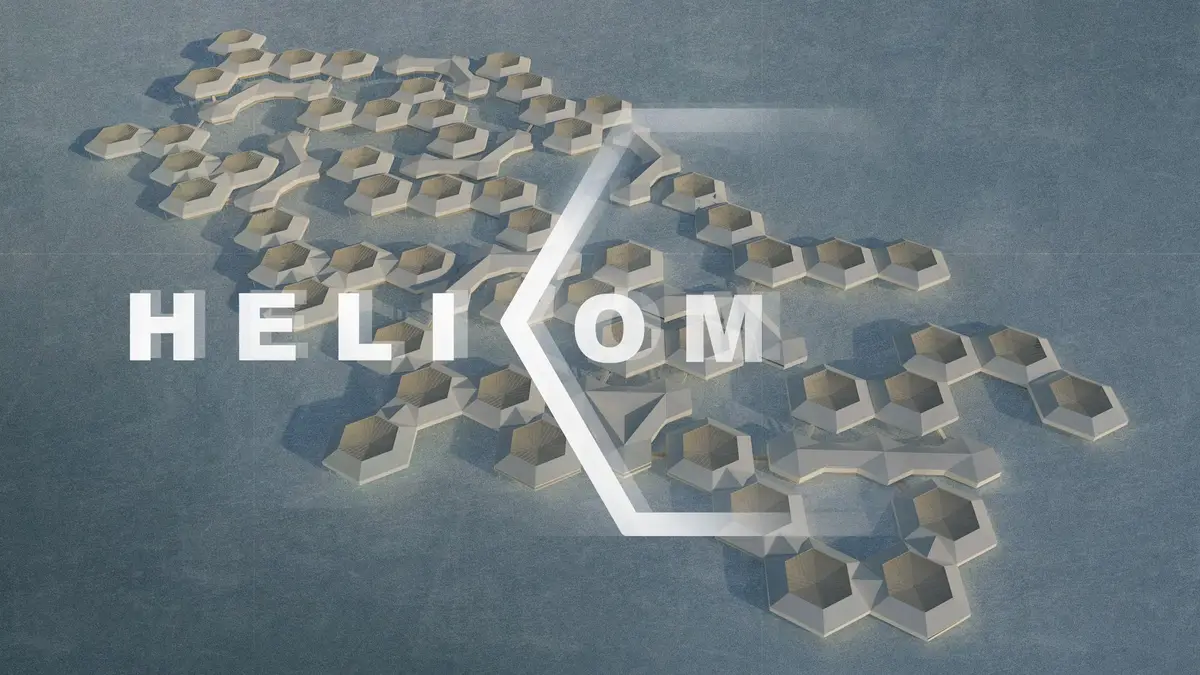
Helicom Habitat: Hexagonal Modules That Learn From Arctic Ice Floes
A biomimetic research settlement uses tessellated geometry and renewable energy systems to sustain life at the frozen edge of the world.


What if the most hostile landscape on the planet could teach us how to build? Helicom HabitatNow takes its cues from the self-organizing patterns of polar ice floes, translating their geometry into a cluster of hexagonal modules that lock together, resist brutal winds, and capture every available watt of solar energy. The result is a settlement that doesn't just survive the Arctic; it performs like part of its ecosystem.
Designed by Wioletta Dębicka, Kamila Suszek, Robert Czajka, and Alicja Kowalewska, the project was recognized as a People's Choice Award finalist in the EHC - Arctic Competition. It proposes a net-zero energy research habitat for scholars, scientists, and transient inhabitants, addressing the Arctic's twinned problems of extreme climate and profound isolation through an interdisciplinary framework that weaves together climatology, material science, and urban ecology.
Low Profiles Against Polar Winds

The exterior rendering immediately communicates the settlement's strategy: stay low, stay curved, stay together. Structures with softly arched roofs hug the snow-covered ground, presenting minimal surface area to the polar vortex winds that scour the site. People walk with dogs across a sheltered plaza between buildings, a detail that quietly insists on the design's central claim: this is not just a survival pod but a place where daily life unfolds outdoors, even in the cold. The curved roof profiles are not merely aesthetic; they serve an aerodynamic function, deflecting wind loads over and around the inhabited volumes rather than catching them broadside.
Timber, Light, and the Social Interior

Step inside and the palette shifts to warm timber slat partitions and exposed ceiling beams, materials chosen to counter the psychological weight of months-long darkness. The communal space shown here functions as one of the habitat's knowledge-sharing hubs: a place where researchers sit at shared tables, exchange findings, and simply coexist. In an environment where isolation is as dangerous as frostbite, these socio-spatial decisions carry real weight. The slatted partitions allow visual permeability between zones, encouraging chance encounters while still offering acoustic separation. It is interior design driven by the understanding that in extreme environments, community cohesion is infrastructure.
Tessellation Under the Aurora
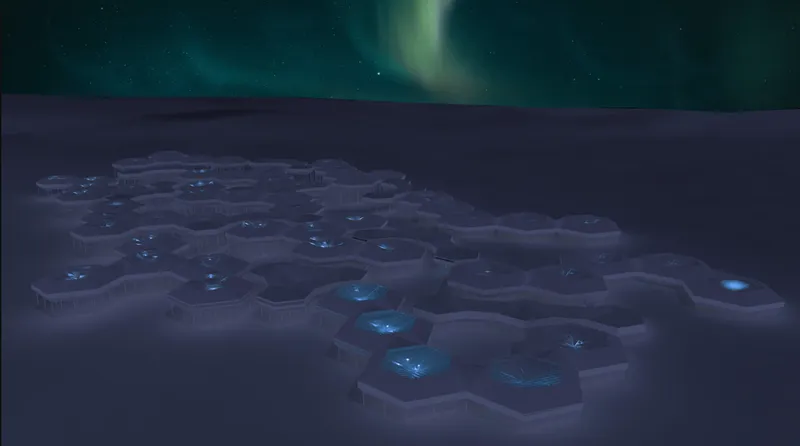
Seen from above at dusk, the hexagonal cluster reads as a single organism. The modules tessellate tightly, minimizing exposed exterior wall area and creating protected microclimates in the interstitial spaces between units. Geometric tessellation is not just a formal choice here; it is a thermodynamic one. Shared walls reduce heat loss. The compact cluster shortens the distances people must travel between functions. And the modular logic means the settlement can grow incrementally as research populations expand, with new hexagons clicking into place without disrupting the energy or circulation systems of the existing whole.
A Central Courtyard Organizes Everything

The floor plan reveals the settlement's organizational logic: hexagonal units radiate outward from a central courtyard, a communal void that anchors orientation and social life simultaneously. Wall section callouts on the drawing hint at the layered thermal envelope required to make habitation viable, though the designers wisely keep the focus on spatial relationships rather than getting lost in construction details alone. The courtyard acts as both a gathering space and a thermal buffer, concentrating body heat and blocking wind from penetrating deeper into the plan. Every module connects to this center, ensuring that no inhabitant is more than a few steps from shared public space.
Systems Thinking From Ice to Energy to Food
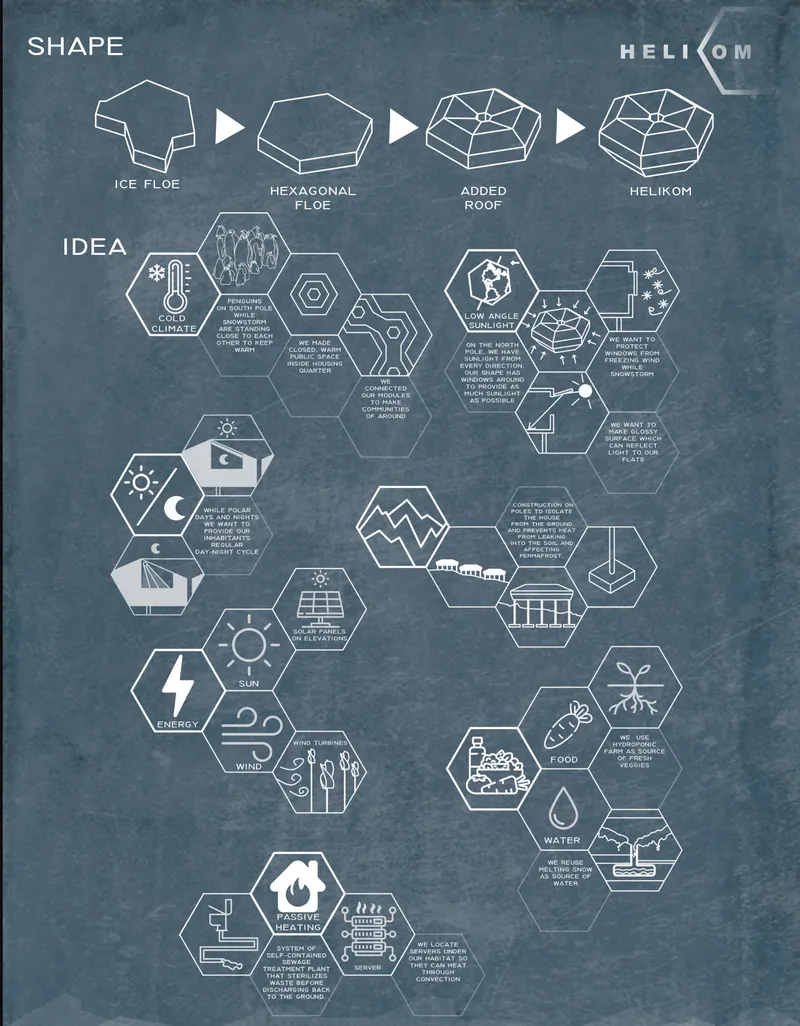
The concept evolution diagram lays bare the integrated sustainability systems that underpin the project. Photovoltaic arrays, vertical-axis wind turbines, and geothermal heat exchange form a renewable energy matrix designed to push the settlement toward net-zero performance. High-albedo surface treatments reflect solar radiation strategically, while passive solar principles orient glazing and mass to maximize thermal retention during the Arctic's brief daylight hours. Beyond energy, the diagram maps water cycling and food production loops, suggesting a closed-system approach where waste from one process feeds another. It is the kind of holistic systems thinking that separates speculative Arctic design from rigorous Arctic design.
Why This Project Matters
Helicom HabitatNow matters because it refuses to treat Arctic architecture as a problem of insulation alone. By grounding its formal language in biomimetic logic, its energy strategy in redundancy and renewables, and its social program in genuine community-building, the project offers a scalable model for habitation in climatically volatile territories. The hexagonal module is not a novelty; it is a decision with thermal, structural, and social consequences that the designers have thought through at every scale.
For a student team working in the realm of speculative competition design, the level of systemic integration here is noteworthy. Dębicka, Suszek, Czajka, and Kowalewska have produced a proposal that moves beyond imagery and into methodology, contributing meaningfully to the evolving conversation about how architecture might not just endure extreme environments but actively belong to them.
View the Full Project
About the Designers
Designers: Wioletta Dębicka, Kamila Suszek, Robert Czajka, Alicja Kowalewska
Enter a Design Competition on uni.xyz
uni.xyz runs architecture and design competitions year-round that reward proposals with spatial conviction and real site intelligence.
Project credits: HabitatNow by Wioletta Dębicka, Kamila Suszek, Robert Czajka, Alicja Kowalewska EHC - Arctic (uni.xyz).


Popular Articles
Popular articles from the community


ALGAL REALM: A Bio-Integrated Lunar Habitat Design for Life Beyond Earth
ALGAL REALM reimagines lunar habitat design with algae-powered life support, 3D-printed regolith, and vertical living for a lunar future.

The Ocean Hive: Sustainable Architecture for a Self-Sufficient Civilization at Sea
The Ocean Hive imagines sustainable architecture at sea, where modular habitats, algae, wave power and ocean waste sustain a growing colony.

Little Red Riding Hood: Architectural Design as a Journey Through Fear, Light, and Storytelling
Little Red Riding Hood reimagines the fairy tale through architectural design shaped by fear, light, scale, memory, uncertainty, and choice.

Co-life: Sustainable Architecture for Age-Friendly Community Living
Co-life reimagines sustainable architecture for seniors through courtyards, rammed earth, shared gardens, and spaces designed for belonging.

Similar Reads
You might also enjoy these articles

Day and Night Park: A Time-Based Urban Newsstand in Beijing
A temporary urban newsstand in Beijing blending travel, light, and reading through poetic colors, compact form, and community-focused design.

Modernist Patio Renovation in El Masnou, Barcelona by Oliver Segura Arquitectura + Cebrià Arquitectura
Modernist patio renovation blending tradition and innovation with a movable pool, leveled floors, and Catalan materials in El Masnou.

Alto Residencial Coop: Cooperative Housing Development in Santiago de Compostela by Carbajo Barrios Arquitectos
A linear cooperative housing complex blending white volumes and perforated metal façades, enhancing community living, natural light, privacy, and urban integration.
Vil Genis School by BPA ARCHITECTURE – Massy, France
Vil Genis School in Massy, France, features sustainable design, south-facing classrooms, community integration, accessible spaces, and modern educational architecture.

Comments (0)
Please login or sign up to add comments
No comments yet. Be the first to comment!