

HOM: Genesis of Libraries: A Warsaw Library Built as a Row of Books on a Shelf
Karin Kundratova lines up white book-like towers in Mokotów, giving each volume a function so the library keeps the shape of books even if they vanish.


What happens to a library when the book stops being an object? Most speculative libraries answer by dissolving into screens and servers. HOM: Genesis of Libraries does the opposite. It turns the book into architecture itself: a row of tall, slender volumes standing upright like spines on a shelf. If physical copies disappear one day, the building will still carry their silhouette.
Designed by Karin Kundratova and published as a project on uni.xyz, HOM sits in Warsaw's Mokotów district on an elongated site. That long, narrow plot drives the linear organisation of the scheme, which leads visitors through a sequence of spaces rather than a single grand hall. The ambition reaches past the reading room. Kundratova frames the building as an urban condenser where education, culture and public life overlap, and she wraps it in an environmental agenda of responsive glazing, energy-harvesting cladding and an accessible green roof.
Standing Spines Along a Linear Site
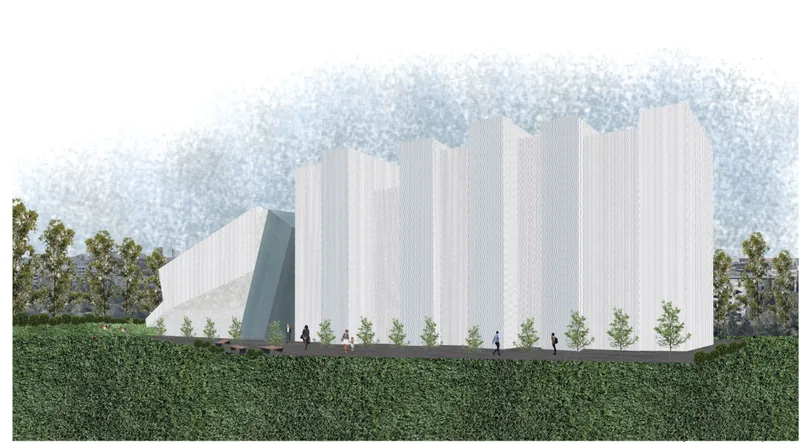
The side elevation makes the metaphor plain. A procession of tall white towers, each a distinct volume, stands beside a slanted glass mass, while trees and pedestrians along the green embankment set the scale. The governing rule is simple: different books tell different stories; different segments hold different functions. Library stacks, study areas, workshops, exhibition zones and relaxation spaces each claim their own spine, so the façade reads as an index of the programme.
This is the project's strongest move. The rhythm of the towers does real organisational work along the length of the site, so the building avoids sliding into kitsch. The risk with literal metaphors is that the form outlives its meaning. Here, though, the variation between segments maps directly onto use, and that keeps the shelf image honest.
A Stepped Section Cut Into the Hillside
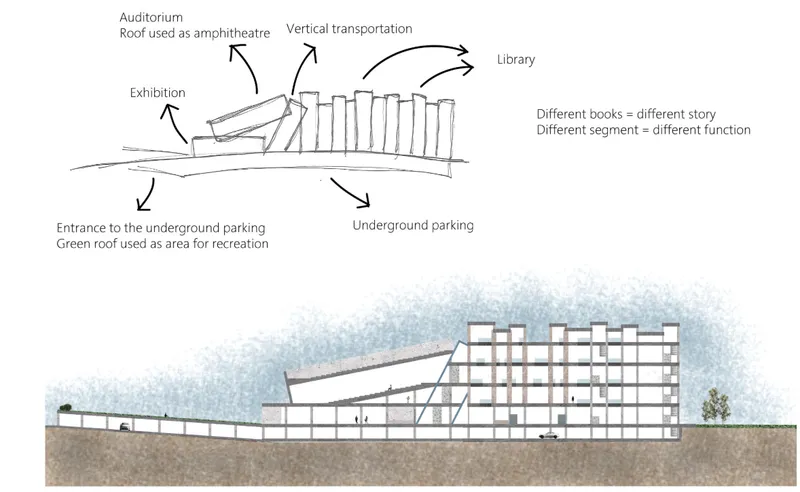
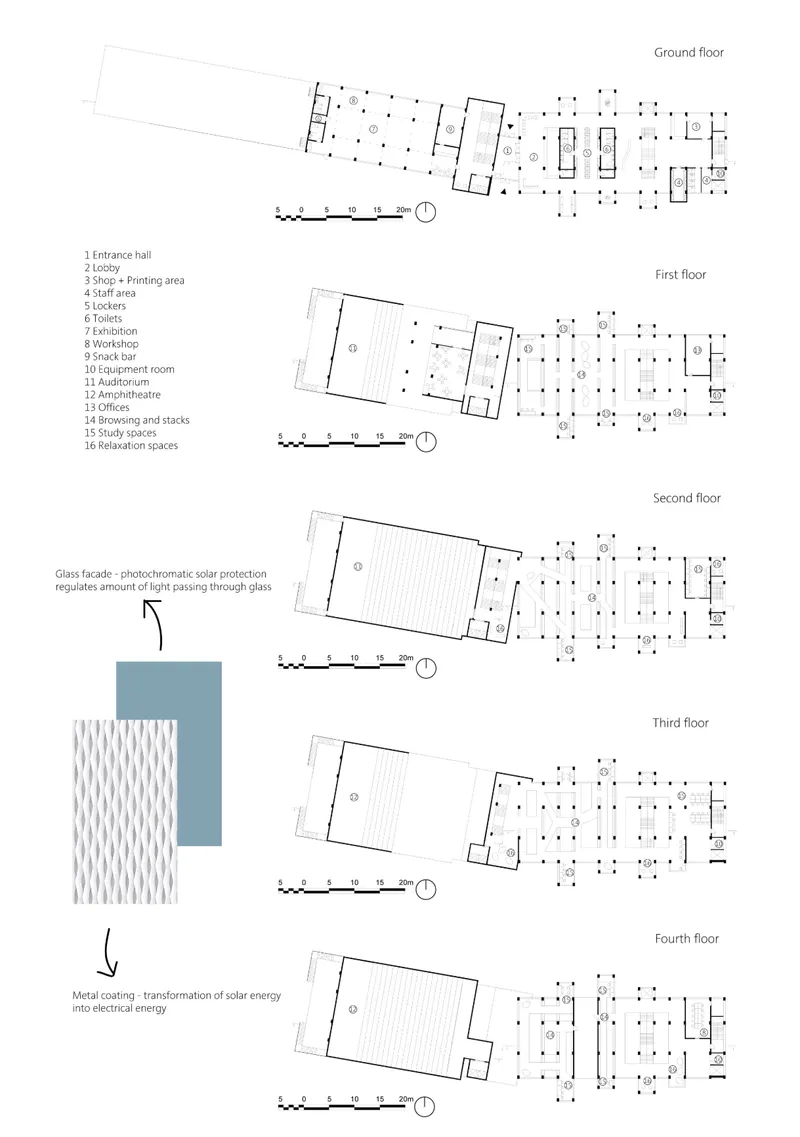
The concept sketch and section show how the building meets the ground. Rather than sitting on the slope, HOM steps into it, stacking auditorium, exhibition and library spaces above underground parking. The lower ground floor takes the service and operational load, which frees the upper levels for people. This sensible piece of zoning lets the public experience begin in daylight rather than in a basement.
The stacked plans, running from the ground floor to the fourth, trace a clear vertical logic. The ground level is transparent and open to the street. At the first floor the roof becomes a usable amphitheatre, so the building acts as a stage for the city as well as a container. Higher up, open-plan floors and a vertical circulation system encourage wandering between study and exhibition zones. Material swatches sit beside the drawings: photochromic glass that adjusts how much light enters, cutting glare and cooling loads, and a metal coating designed to convert solar energy into electricity. Placing these swatches next to the plans signals that the envelope is part of the design argument, not a finish applied afterwards.
A Plaza at the Foot of the Towers

At ground level the vertical drama gives way to something gentler. Curved wooden benches anchor a plaza at the base of the white towers, with pedestrians passing through and a man pausing to sit. The render is playful, down to the hot air balloons drifting overhead. Its point is serious, though: the library claims an outdoor room for Mokotów that anyone can use without entering.
Read alongside the amphitheatre roof and the accessible green roof, the plaza shows Kundratova treating every horizontal surface as public ground. The green roof in particular does double duty, improving insulation and easing the urban heat island effect while serving as a recreational landscape. In a typology often criticised for its closed, hushed interiors, these generous edges are a welcome correction.
Concrete, Wood and Climbing Ivy Inside

The reception lobby pairs raw concrete with warmer surfaces. A marble desk stands in front of a wood-clad wall carrying a large clock, and ivy spills down a concrete column. That clock is a quiet nod to the project's theme of memory and time. The palette is restrained, and the planting keeps it from feeling austere.
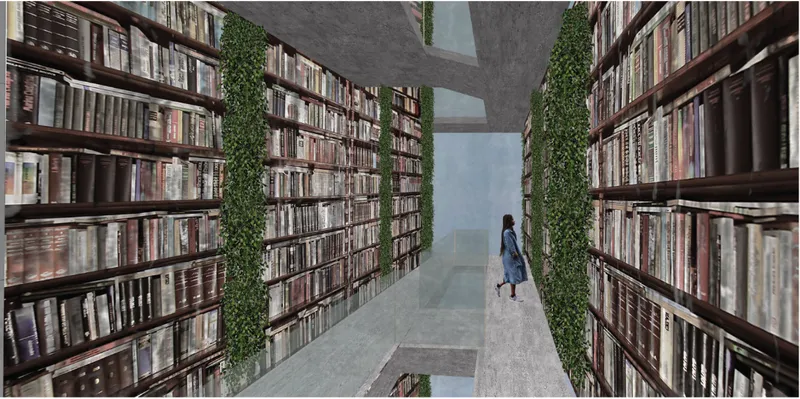
Deeper in, the experience narrows into reading corridors lined with towering shelves. In the final render, climbing ivy threads through the bookcases as a figure in a blue coat walks toward a glass-lit void. Vertical green walls and skylight openings pull diffused daylight far into the plan, which reduces the need for artificial lighting and gives readers a sense of orientation. The aisle feels like a canyon of books with light at its end, an apt spatial expression of a building that sees reading as a journey.
Why This Project Matters
HOM takes on a real question facing libraries: how to stay meaningful as knowledge goes digital. Kundratova does not answer with technology alone. She answers with form, letting the book's familiar proportions organise programme, façade and procession. The result is a building that will remain legible as a library whatever happens to the objects on its shelves, which is a more durable kind of memory than any archive.
The project would gain from more rigour on how the photochromic glass and energy-harvesting coating perform in Warsaw's climate, and on how the tower segments are built. Even so, it ties environmental systems, civic space and a clear conceptual idea into one coherent proposal. For a young designer, that synthesis is the achievement: a library that works as a landmark, a public stage and a shelf of stories all at once.
View the Full Project
About the Designers
Designer: Karin Kundratova
Enter a Design Competition on uni.xyz
uni.xyz runs architecture and design competitions year-round that reward proposals with spatial conviction and real site intelligence.
Project credits: HOM by Karin Kundratova.


Popular Articles
Popular articles from the community


Opera by the Sea Estonia: Three Shells Dissolving Architecture into Tallinn's Coastline
A winning opera house proposal replaces monumental form with interconnected shells that blur the boundary between building, park and Baltic Sea.

The Amber Palace Opera: A Geological Fiction Surfaces on Tallinn's Baltic Waterfront
Pierre Brillard reimagines a Baltic legend as a public landscape, opera house, and waterfront promenade rooted in Tallinn's coastal identity.

Faces of the Soviet Avant-Garde: Turning Moscow's Street Names into an Open-Air Museum
A network of sculptural installations across a Moscow residential district transforms forgotten architect names into spatial encounters with cultural memor

Opera on the Sea: Driftwood Logic Shapes a Timber Opera House on Estonia's Coast
Trevor Orgill's opera house translates the entangled drift of floating timber into a civic building where wood, water, and music converge.

Similar Reads
You might also enjoy these articles

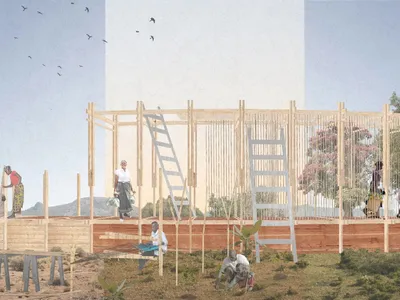
Healing Façade: A Modular Chapel System That Restores Ethiopia's Sacred Forests
Winner of the Eco-Chapel competition, this circular timber façade collects water from air to rebuild soil and reforest degraded Ethiopian landscapes.
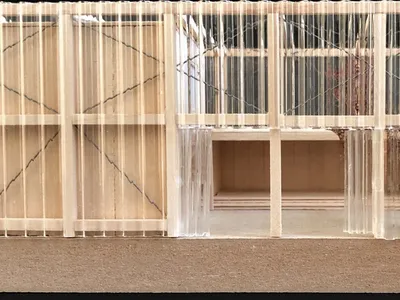
Kaffeebühnen: Where Coffee Shop Architecture Becomes a Civic Stage in Vienna
A linear sequence of timber boxes, transparent shells, and open yards turns the Viennese café tradition into a public performance space.
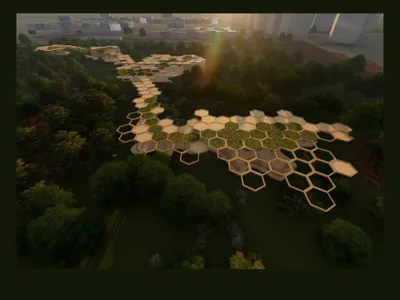
Eco Chapel: A Modular Forest Pavilion That Grows Like the Landscape It Protects
Hexagonal timber modules weave through existing trees, turning a chapel into a living system for prayer, education, and reforestation.


Urban Forest: A Vertical Ecosystem for 5,000 Workers in Singapore's Changi Business Park
Radially stacked pods and layered green decks turn a 7-acre plot into 47 acres of ecological workspace projected for 2040.

Explore Library Architecture Competitions
Discover active competitions in this discipline

Challenge to reimagine the Iron Throne

Photograph architecture without architects

Illustrate the lost glory of Angkor Wat - Render Challenge

Design challenge to reuse E-waste
Comments (0)
Please login or sign up to add comments
No comments yet. Be the first to comment!