
LOCALARCHITECTURE Builds a Straw-Insulated Sports Pavilion for a Swiss Village Football Club
In Daillens, Switzerland, 1,200 straw bales and local larch timber form a sports facility designed to be fully dismantled one day.


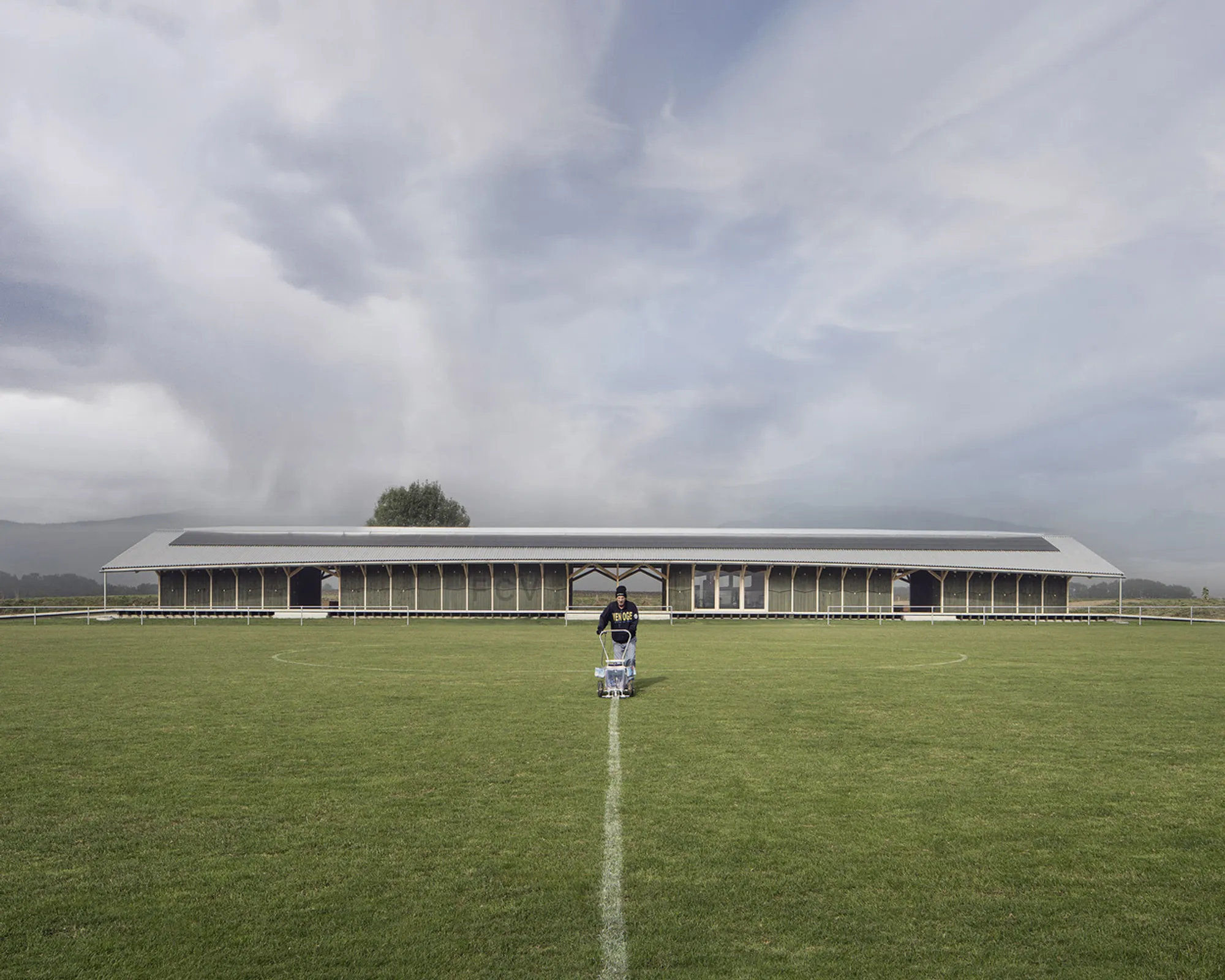
It takes a certain conviction to build a sports changing facility out of straw and still make it look inevitable. In Daillens, a small municipality in the canton of Vaud, LOCALARCHITECTURE has replaced an exhausted cluster of 1970s buildings with a long, low pavilion that serves FC Venoge, the local football team, and a village bowls club. The building stretches along the axis of the pitch like a grandstand that decided to become architecture: four heated volumes separated by covered outdoor spaces, all sheltered beneath a single corrugated metal roof whose concave ridge line echoes the Jura mountains behind it.
What makes the project genuinely interesting is not just the material palette, though 1,200 custom straw bales and lowland larch from nearby forests are hard to ignore. It is the discipline with which those materials govern every decision. The dimensions of a single straw bale determined the proportions of the prefabricated wall panels, which in turn set the rhythm of the 37 glulam frames that march along the length of the building. Nothing here is decorative sustainability. The straw is structural insulation, the timber is left exposed, and the whole thing is designed to come apart cleanly whenever its useful life ends. Reversibility, not permanence, is the real ambition.
A Roof That Belongs to the Landscape
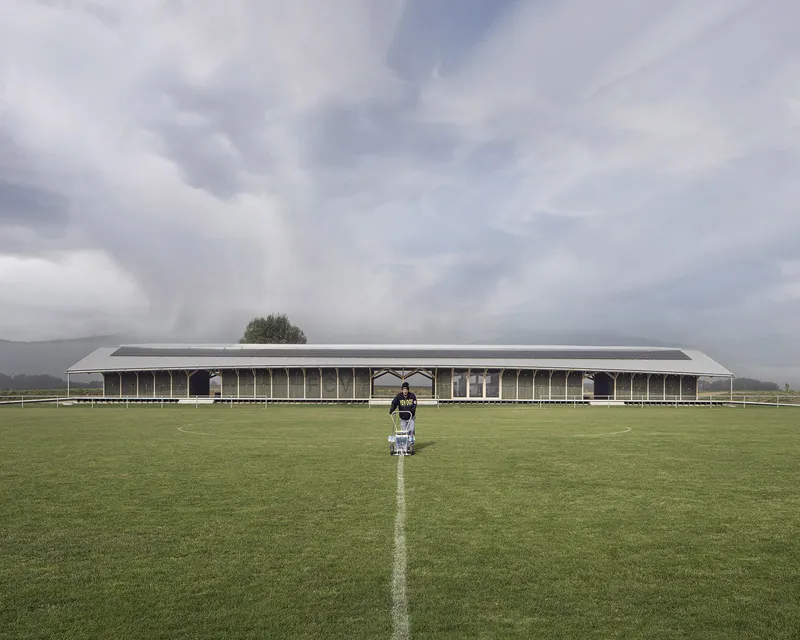
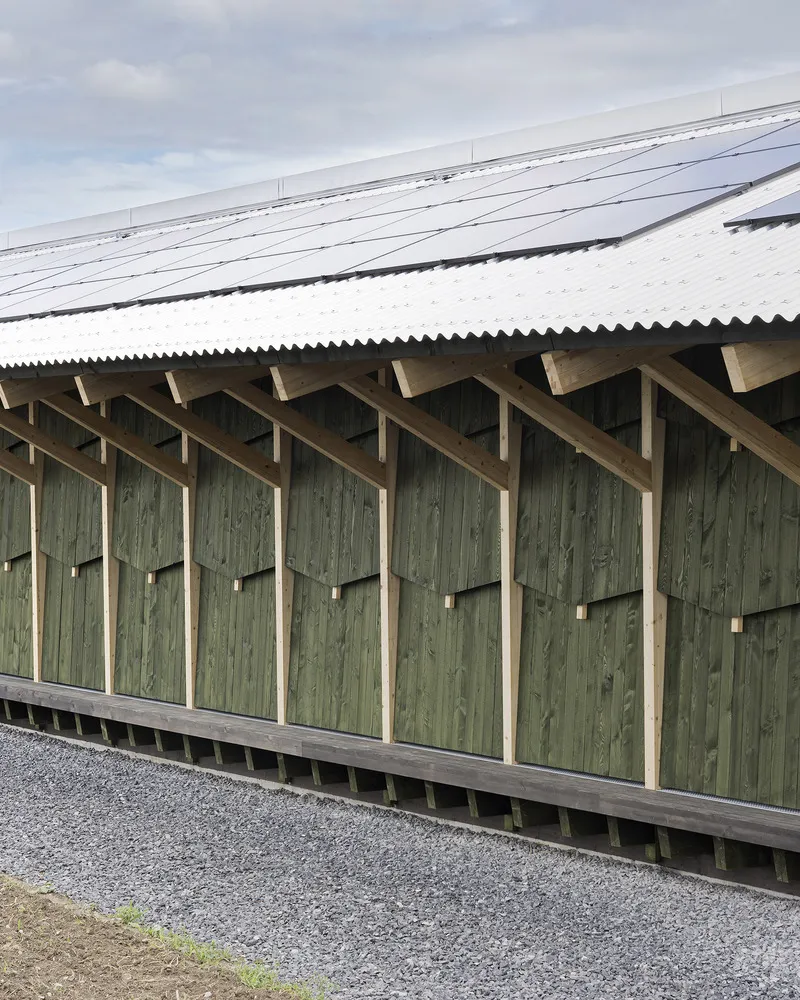
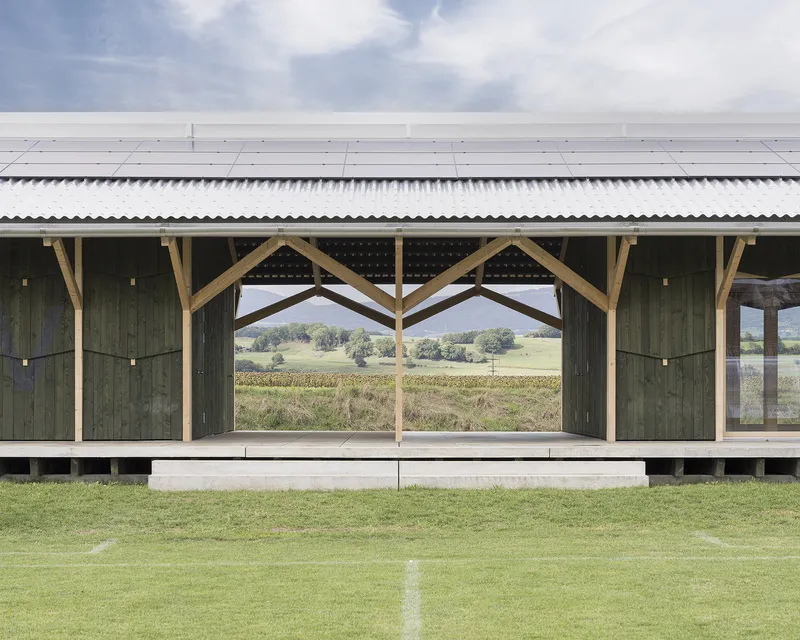
The roof is the building's most legible gesture. Its corrugated metal skin and broad overhangs reference the agricultural sheds that dot this stretch of farmland between sunflower fields and the pitch. But the profile does more than nod to barns. The concave curve slips the structure into the horizon line rather than competing with it, and the deep eaves create a colonnade of exposed rafter ends along every facade. Seen from the pitch, the repeating timber brackets produce a rhythmic elevation that feels both civic and rural, giving FC Venoge something more dignified than a shed but never so assertive that it upstages the landscape.
Straw as a Governing Module
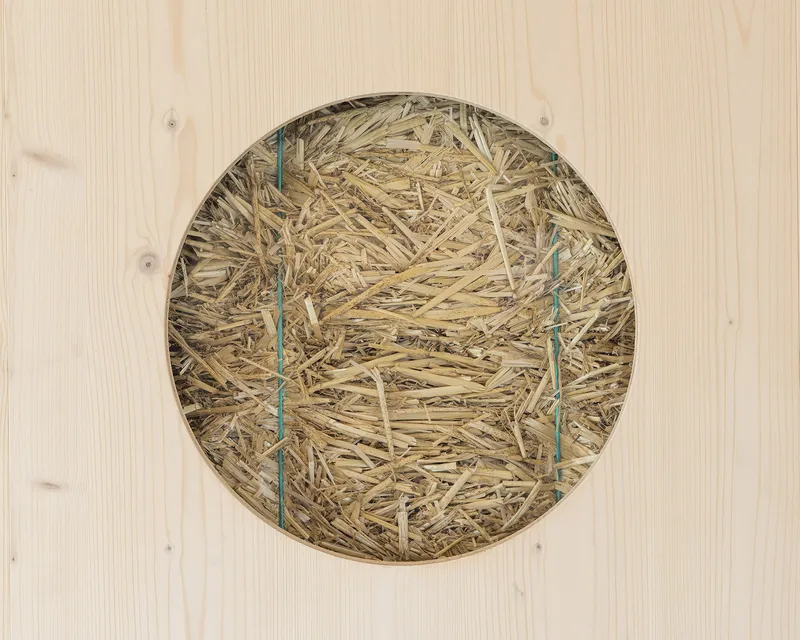
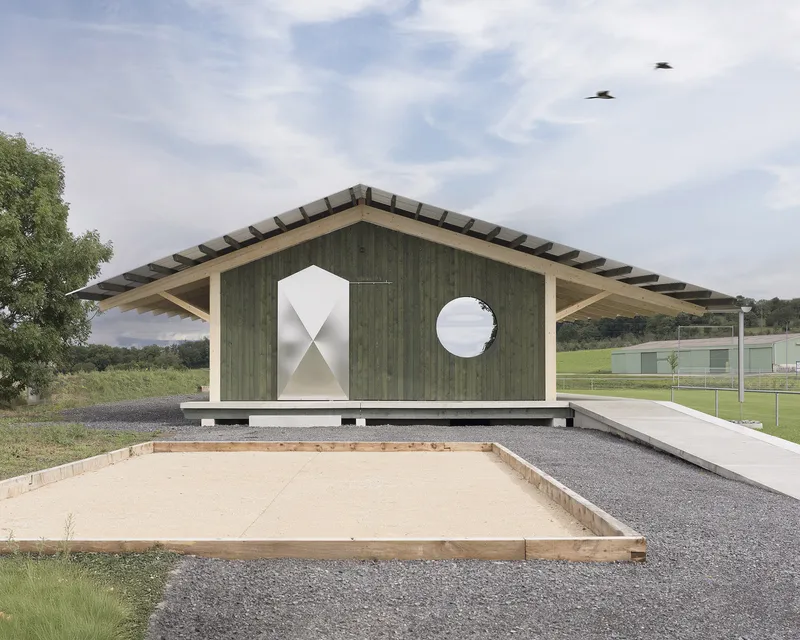
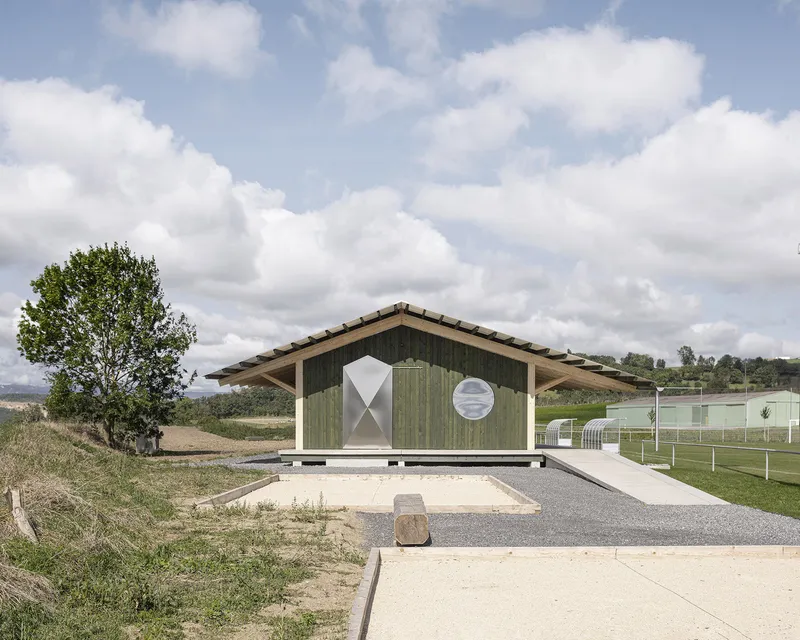
The circular opening packed with straw and wire ties tells you everything about the logic of this building. Village farmers supplied the bales, which were pressed to exact dimensions using vintage baling machines brought back into service for the project. Those dimensions became the module: every wall panel, every frame spacing, every proportion traces back to the size of a bale. It is a tight feedback loop between agriculture and architecture that keeps both honest.
The gable ends display this logic on their surfaces. Diamond and circular openings punch through green-stained larch battens, revealing the straw infill behind the cladding. These are not just ventilation ports or whimsical perforations. They make the wall construction legible from the outside, turning insulation into ornament without pretense. You see what the building is made of because the architects want you to understand how it works.
Covered Thresholds and the Social Center Line
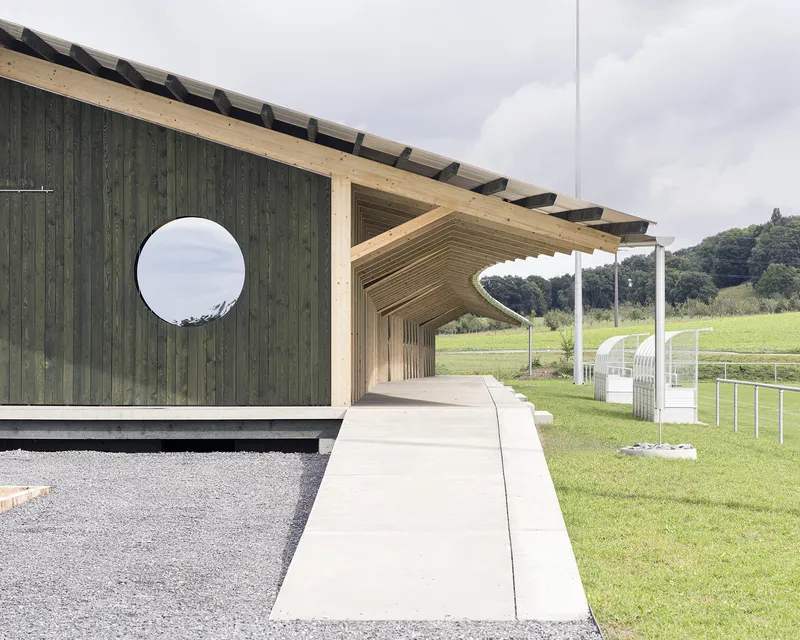
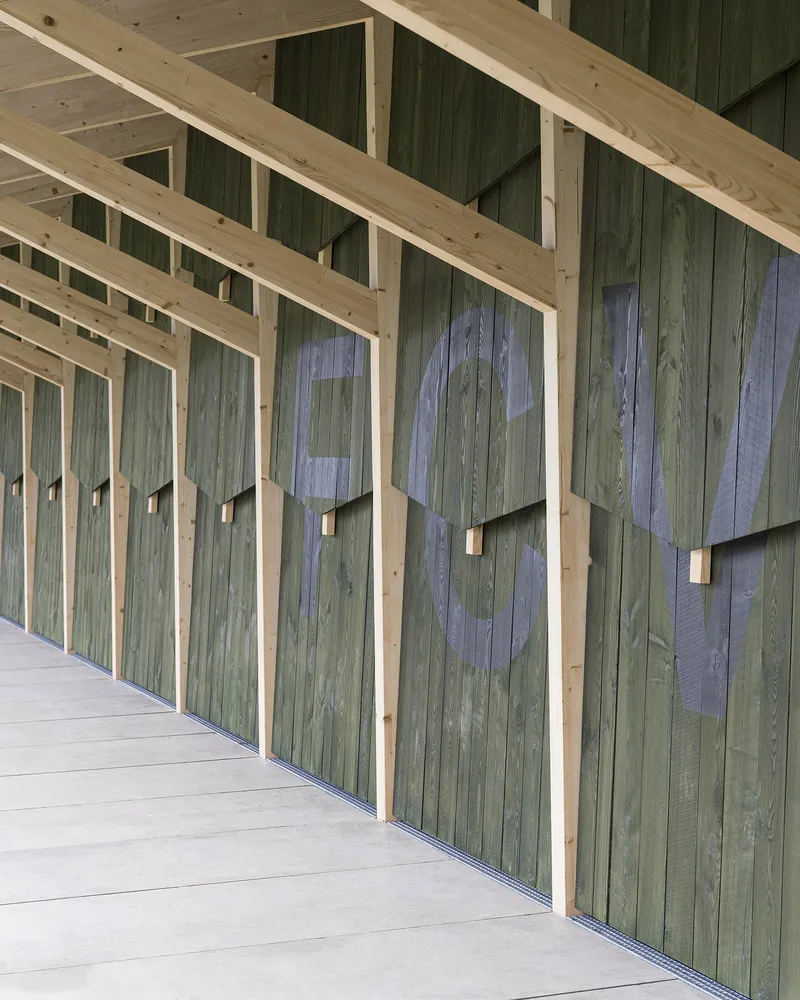
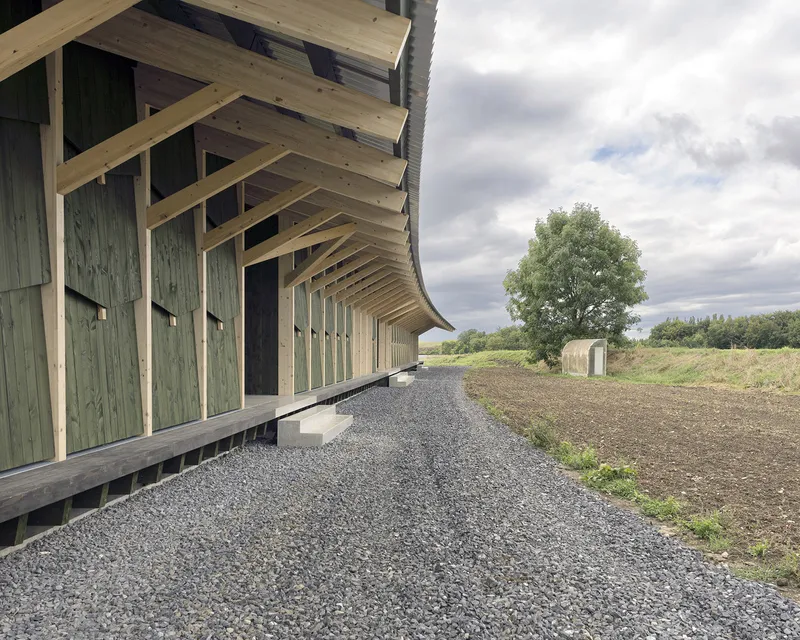
The four enclosed volumes, containing changing rooms, showers, a refreshment bar, and the bowls club, are arranged symmetrically on either side of the pitch's halfway line. Between them, covered outdoor spaces serve as gathering points where teams can assemble before and after matches. The central open area, anchored by the bar, becomes the social heart of the facility. It is a smart inversion: the most public function occupies the least enclosed space.
Long covered walkways extend the building's presence along both flanks. On the car park side, a passageway draws visitors through the structure toward the pitch. On the east side, a verandah overlooks the playing field, slightly raised from the ground to seating height on concrete piers. This simple move turns the building's perimeter into terracing, eliminating the need for separate spectator infrastructure.
The Timber Frame as Public Face
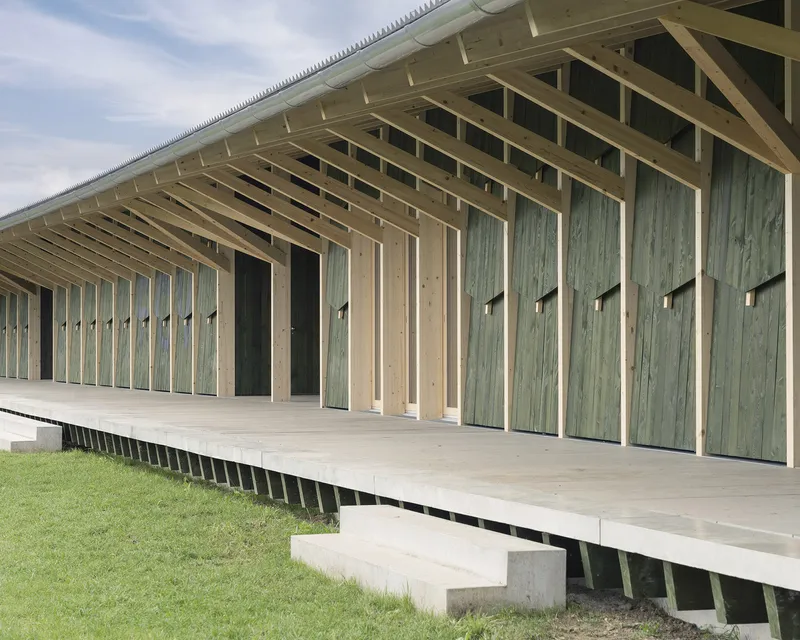
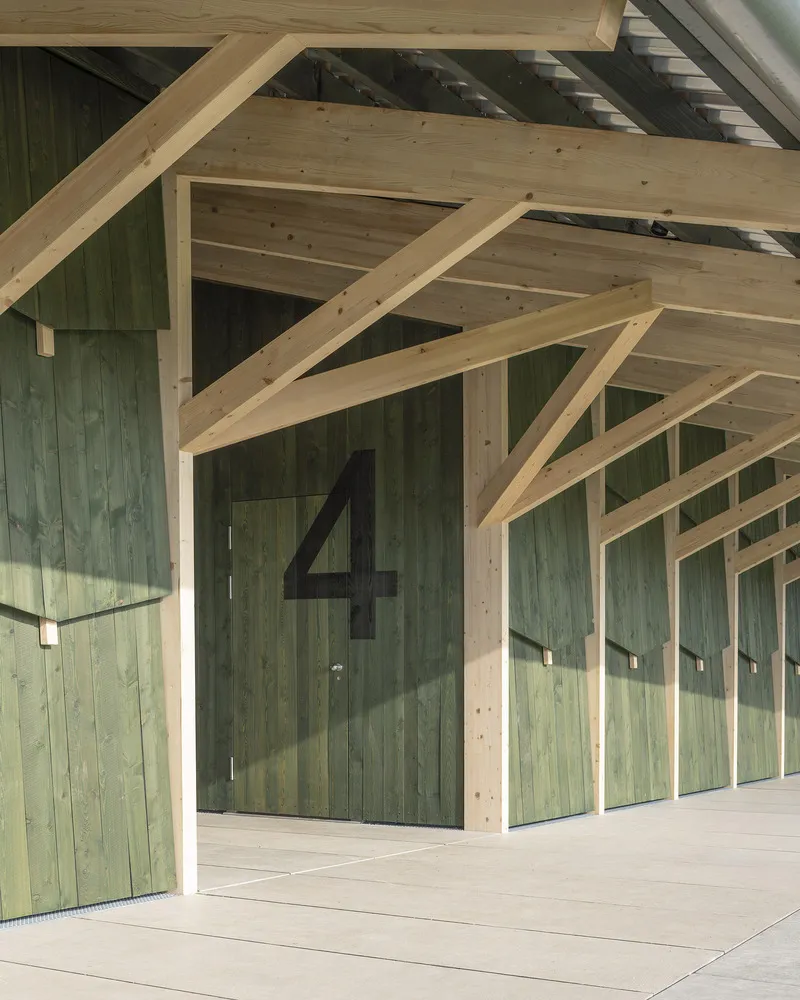
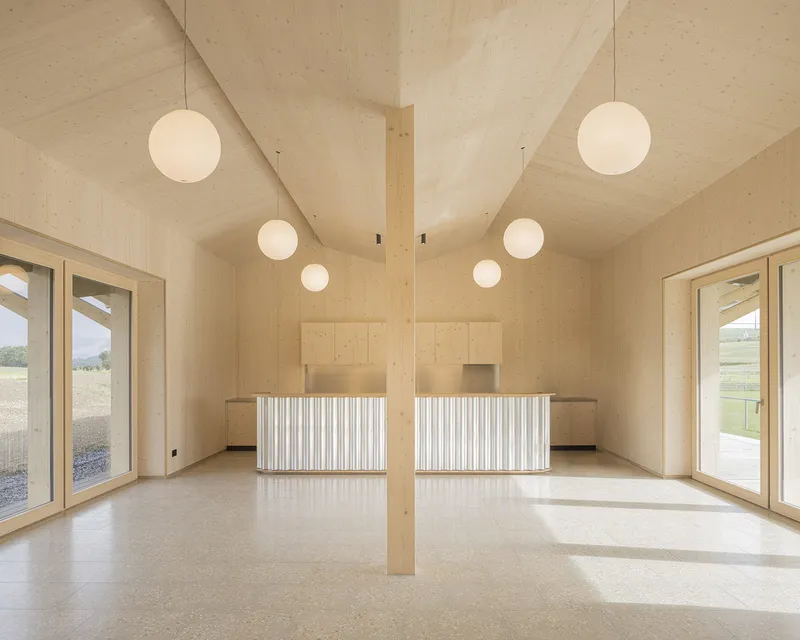
The 37 glulam frames do triple duty. Structurally, they carry the roof. Spatially, they define the colonnade and verandah. Visually, they give the building its character. Left exposed on the exterior, the fir frames project outward with brackets of varying lengths that support the battens and roofing, creating a layered depth that changes with the angle of light. The effect is closest to a long covered market or a railway platform: open, generous, and unapologetically repetitive.
Inside, the same frames organize the bar area and changing rooms. The vaulted ceiling and pendant sphere lights in the central gathering space lend an unexpected warmth to what is, after all, a building where people change muddy boots. Green-stained doors with numbered panels and metal hooks line the walkways, reinforcing the modular discipline while giving each team its own address within the structure.
Interior Pragmatism
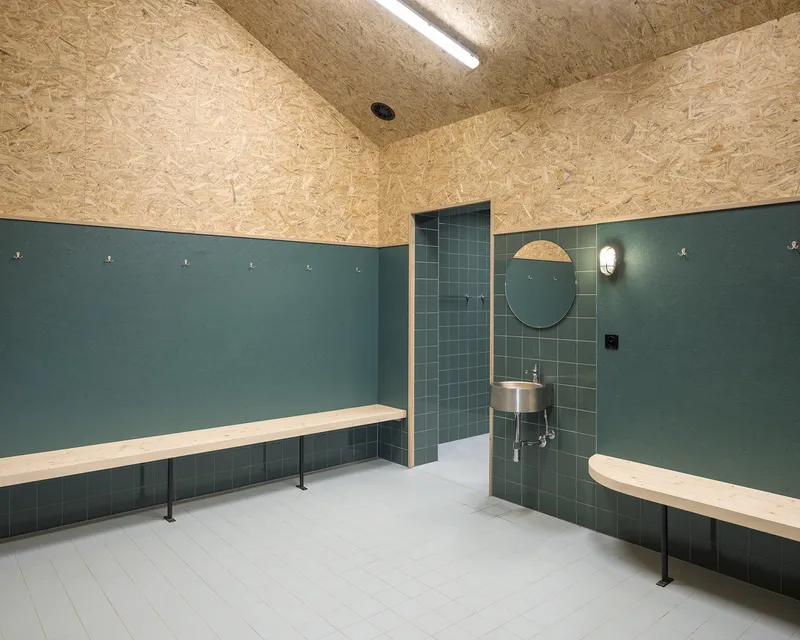
The changing rooms are straightforward and well-considered. Dark green tile wainscoting handles moisture and impact, OSB ceilings keep costs down while maintaining the warmth of the timber palette, and pale benches run beneath coat hooks in a layout any footballer would recognize. Mud scrapers are set into the floor, a detail that acknowledges the reality of Swiss league football played through autumn rain. Nothing here is precious; everything is buildable, cleanable, and replaceable.
The refreshment bar, with its fluted counter units and central column, occupies the most generous ceiling height in the building. It is the one space that gestures toward something more than utility, a gathering room where the post-match drink carries as much social weight as the match itself.
Plans and Drawings
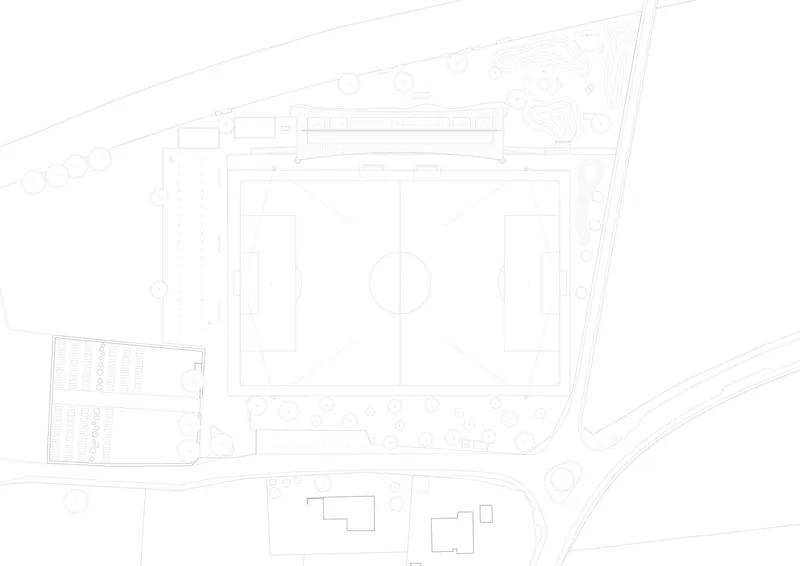
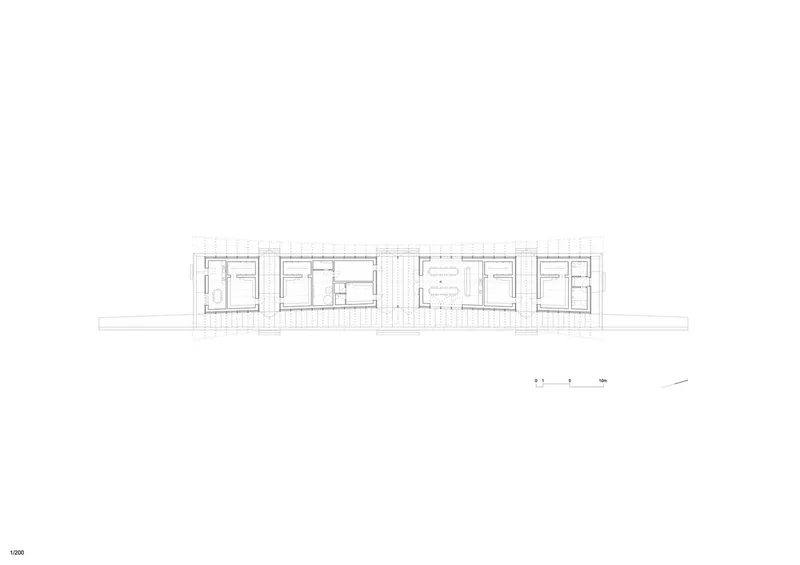
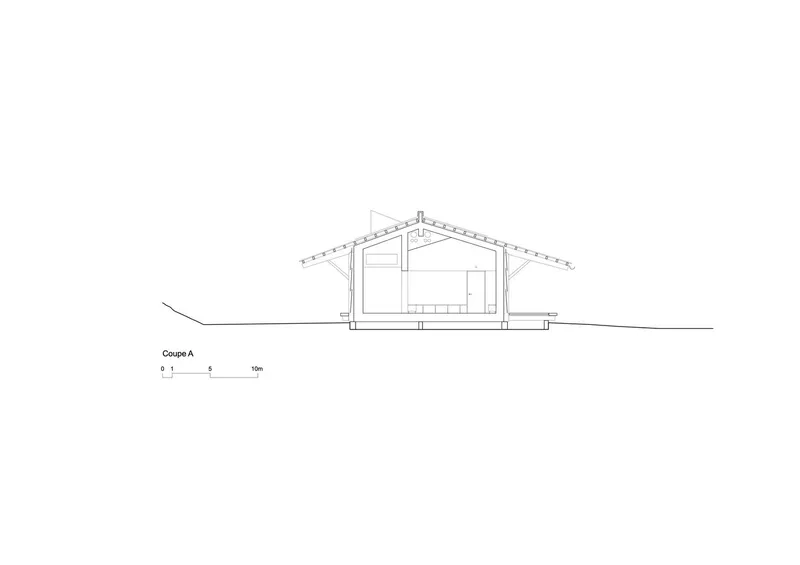
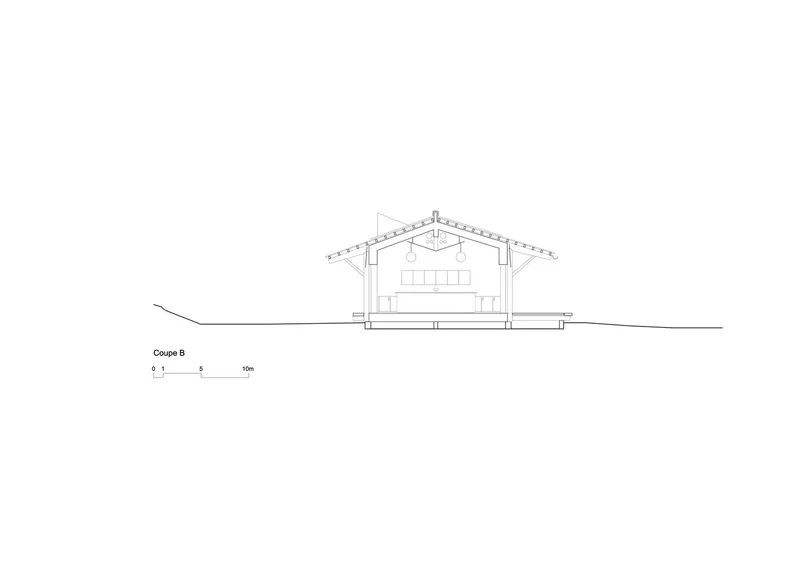
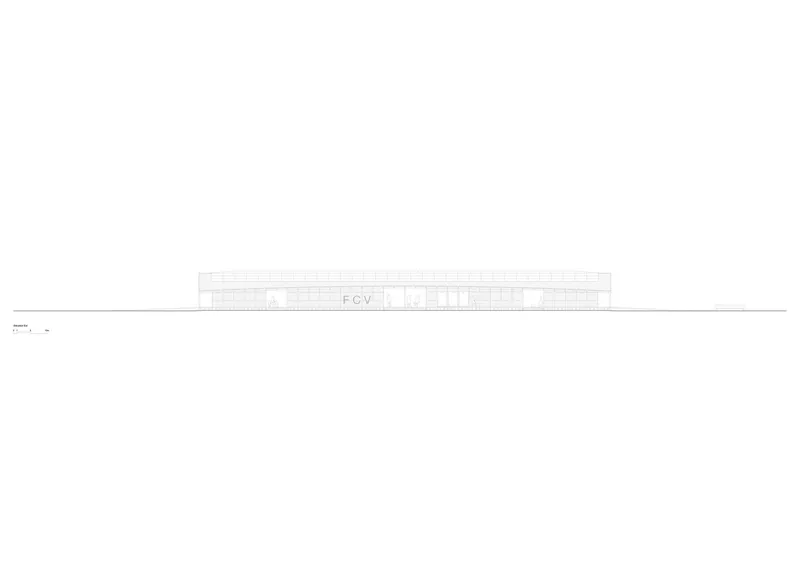
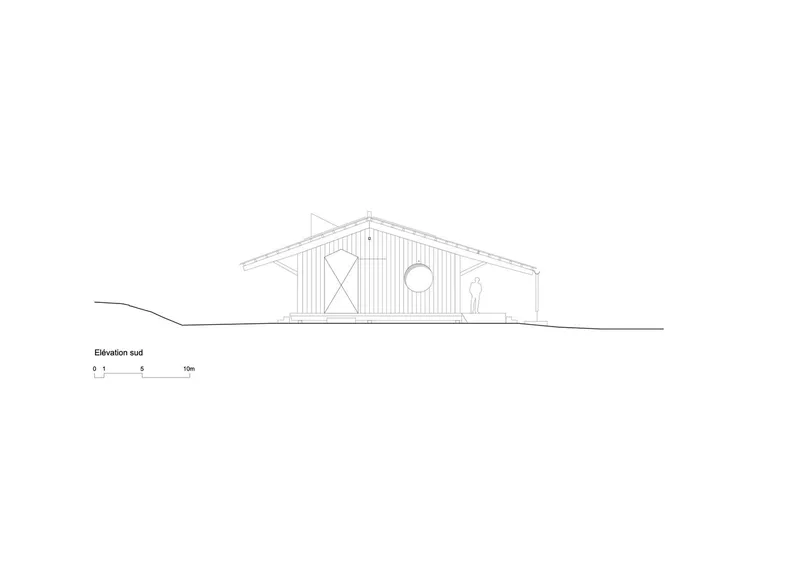
The site plan confirms the building's alignment with the pitch axis, stretching the pavilion into a thin bar that mediates between the playing field and the car park. Longitudinal and cross sections reveal the subtle play of roof geometry: the concave curve is visible in section, along with the way the frames rise and fall to create differentiated ceiling heights across the four volumes. The elevations show how the green-stained larch cladding, circular openings, and exposed rafter ends compose a facade that reads as agricultural vernacular from a distance but reveals its precision at closer range.
Why This Project Matters
Daillens is not a wealthy commune with a showcase budget. The sports facility succeeds precisely because it operates within tight constraints: local timber, farmer-supplied straw, prefabricated panels assembled in a workshop, concrete limited to strip foundations. These are not limitations dressed up as virtues; they are genuine economies that produced a building with a small environmental footprint and a coherent architectural identity. The emphasis on reversibility, designing every joint so the structure can be dismantled and its materials reused, goes further than most sustainability claims in contemporary practice.
For architects working on small civic projects, Daillens offers a useful lesson. You do not need to invent new materials or import complex systems to build responsibly. You need to look at what is already available within the local economy, let those materials set the rules, and follow the logic all the way through. LOCALARCHITECTURE has done exactly that, producing a sports pavilion that feels at home between the sunflower fields and the Jura, and that could, one day, return to both without leaving a trace.
Daillens Sports Facility by LOCALARCHITECTURE. Daillens, Switzerland. Less than 400 m². Completed 2024. Photography by Matthieu Gafsou.
About the Studio
Share Your Own Work on uni.xyz
If projects like this are the kind of work you want to make, uni.xyz is a place to publish your own, find collaborators, and enter design competitions.



Popular Articles
Popular articles from the community


Play: Fragments of Their World
Familiar architecture becomes modular playground design, creating safe spaces where displaced children can learn, connect, imagine and play.

Conexión: Biophilic Design Reimagines High-Rise Living in Hong Kong
Conexión reimagines high-rise living in Hong Kong through biophilic design, green facades, shared spaces, daylight, water and nature within.

Riyadh For All: Intergenerational Urban Design for Active Aging in Rabat
Riyadh For All reimagines urban design in Rabat with intergenerational co-living, adaptive courtyards, and Moroccan cultural exchange today.

The Earth Pod: 3D Printed Homes for Resilient Refugee Communities
The Earth Pod reimagines refugee housing through 3D printed homes made from clay, combining resilience, self-sufficiency, and rapid shelter.

Similar Reads
You might also enjoy these articles


Hodi-Mandai Geram
Project Function: Preservation and revitalization of the Intangible heritage and socio-spatial identity of the Hodi by Housing, Cultural Memory Center, Sacred Grove, landscape, local tourism economy


Olio Towers: A Mid-Rise for Performers That Fuses Housing, Rehearsal, and Stage
Located blocks from Houston's Theater District, this modular tower stacks living units around a central performance atrium.

Oasis: Modular Green Housing Carved into Dhaka's Urban Fabric
A shortlisted Plugin Housing entry reclaims unauthorized settlements in Dhaka with stepped concrete volumes, green roofs, and ventilation-driven design.

Black Hole: A Floating Megastructure for the Post-Physical Era
Emiliano Mazzarotto envisions a spherical, self-scaling arena where e-sports, digital hotels, and holographic stadiums replace traditional public space.

Explore Architecture Competitions
Discover active competitions in this discipline



Challenge to reimagine the Iron Throne


Photograph architecture without architects


Illustrate the lost glory of Angkor Wat - Render Challenge


Design challenge to reuse E-waste
Comments (0)
Please login or sign up to add comments
No comments yet. Be the first to comment!