
Tabuenca & Leache Stack a Sports Court Over a Pool in San Sebastián's Altza Neighborhood
A 10,500 square meter municipal sports center uses stepped sections and 66-meter trusses to fit a massive program into a compact Basque neighborhood.


Replacing a structurally compromised predecessor on the same site, the Altza Municipal Sports Center packs swimming pools, a gymnasium, changing rooms, offices, and a traditional Basque pelota court into a single compact volume that reads as neighborhood architecture rather than civic infrastructure. Designed by Tabuenca & Leache with Chocarro and Herranz, the building sits on the footprint of the old Toschi-Ibérica uralite factory site in Donostia-San Sebastián, reusing existing retaining walls and portions of the original foundations. It opened in April 2022.
What makes the project worth studying is its cross-section. The architects stacked the sports court above the indoor pools, freeing the western edge of the site for a public entrance plaza and outdoor courts. Two 66-meter-long Warren trusses span the length of the building, carrying the roof while doubling as north-facing clerestory skylights. The result is a stepped profile that breaks the building's considerable mass into a series of scaled volumes, each one calibrated to the residential fabric around it. Section, not plan, drove every major decision here.
Facade as Texture
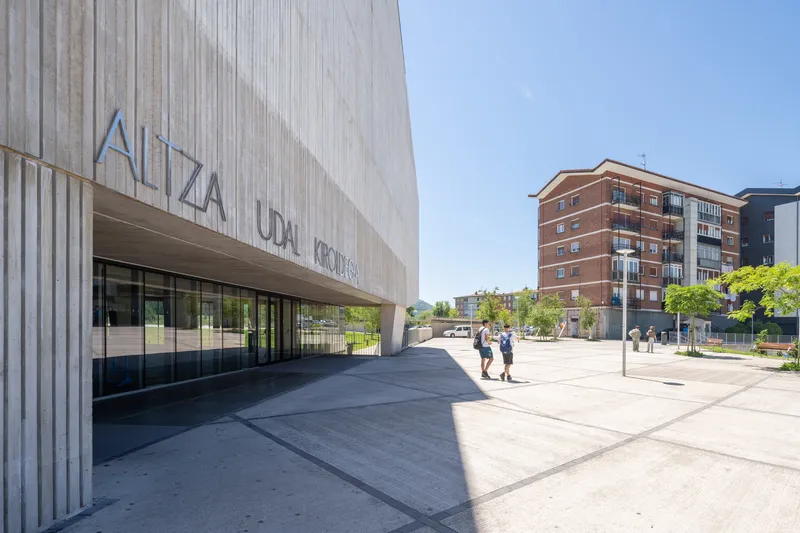
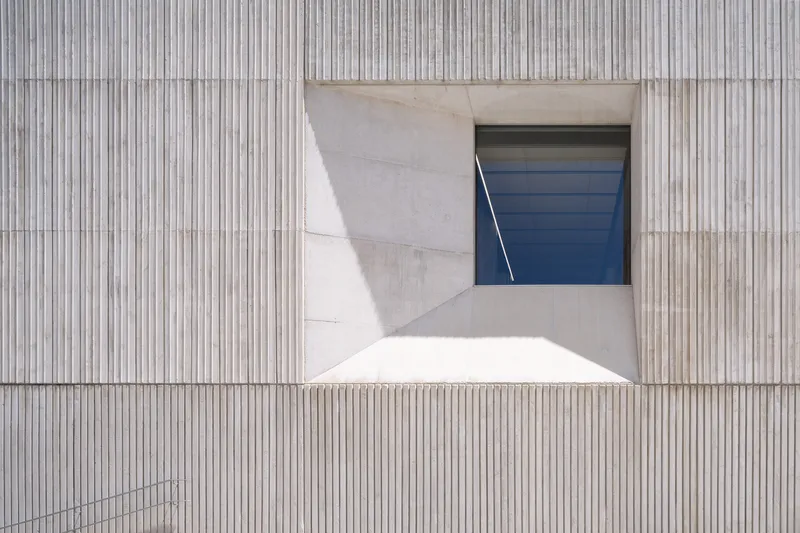
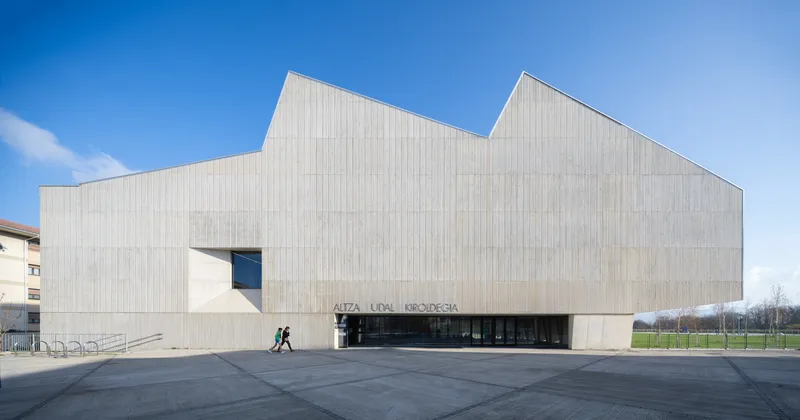
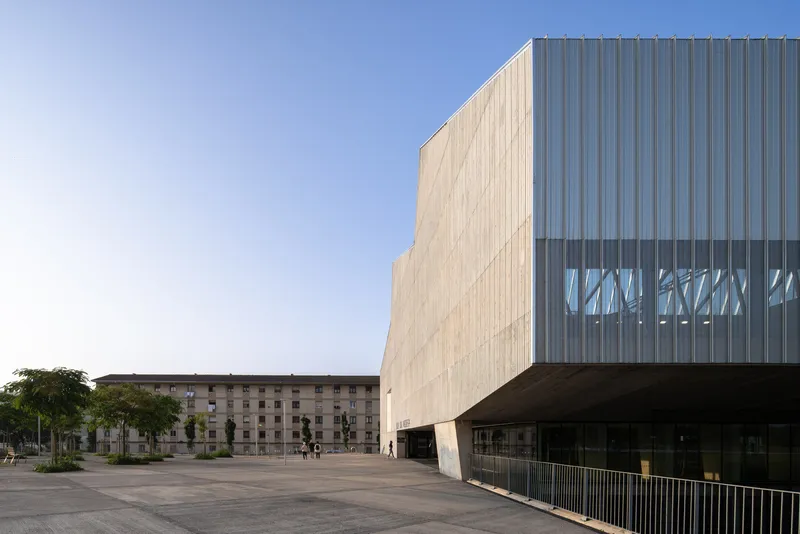
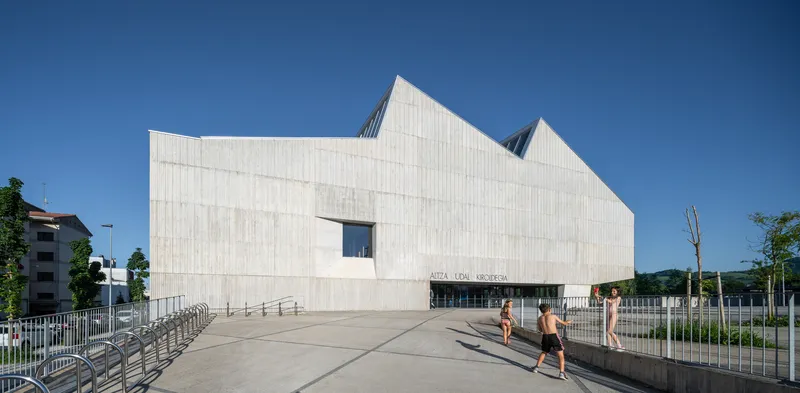
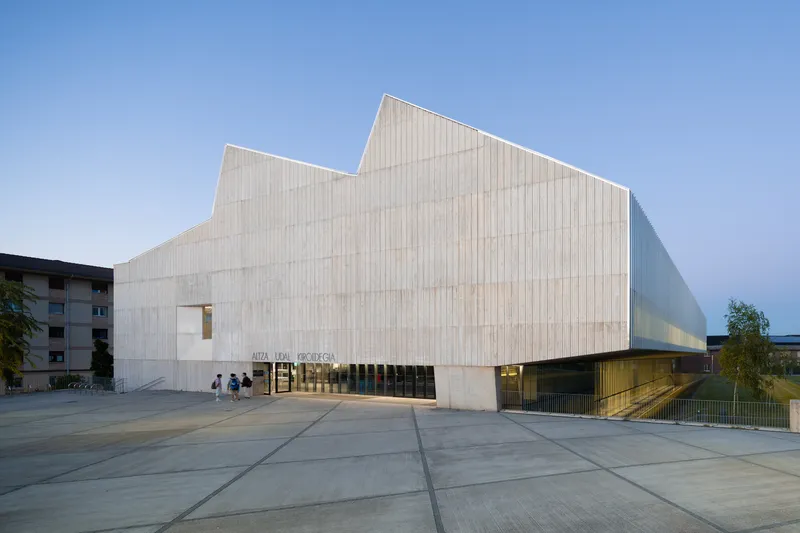
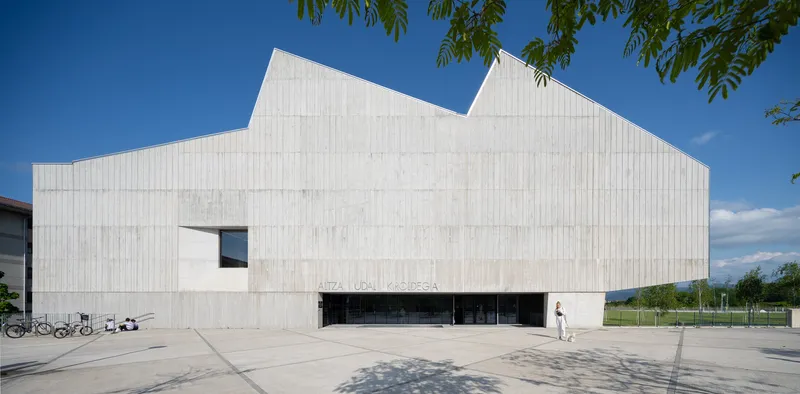
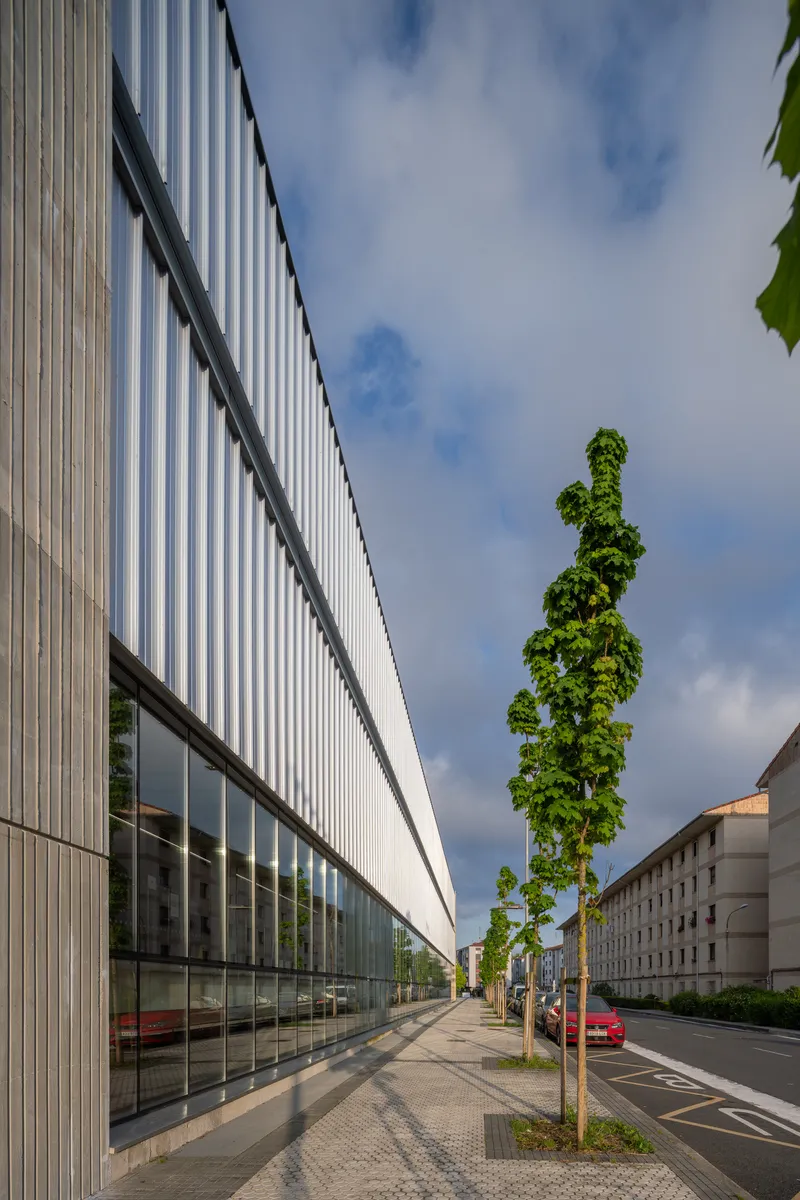
The primary facade facing the plaza is vertically ribbed concrete, a treatment that gives the building a pronounced grain without relying on decorative gesture. Deep ribs cast shifting shadows across the surface throughout the day, breaking down what would otherwise be a blank wall of considerable height. Punched openings are minimal and precisely placed: a single recessed window here, a horizontal entrance slot there. The restraint is deliberate. A building of this program has very little need for fenestration on its public face, and the architects do not pretend otherwise.
The entrance itself is a glazed recess at ground level, pulled back beneath the ribbed wall so that the volume appears to float. It is not a grand civic portal but a matter-of-fact opening that lets the facade remain continuous. The horizontal proportions of the entry slot contrast with the vertical rhythm of the ribs, creating a quiet tension that draws you in.
The Perforated South
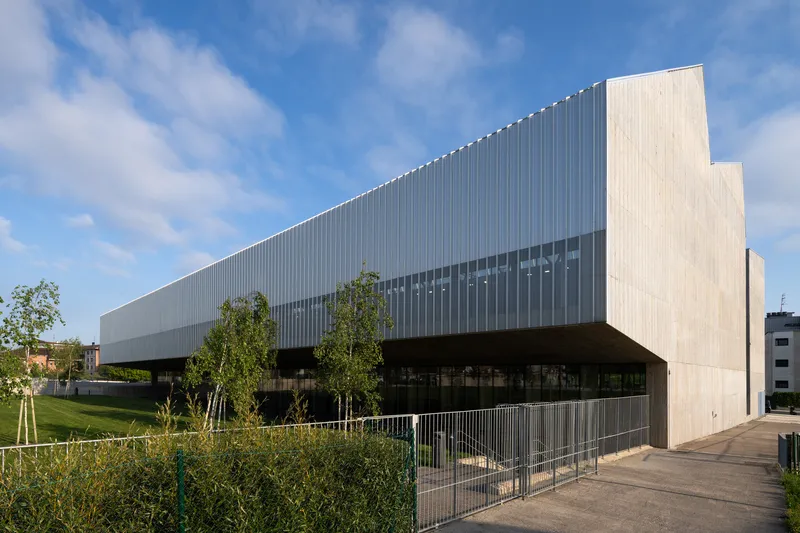
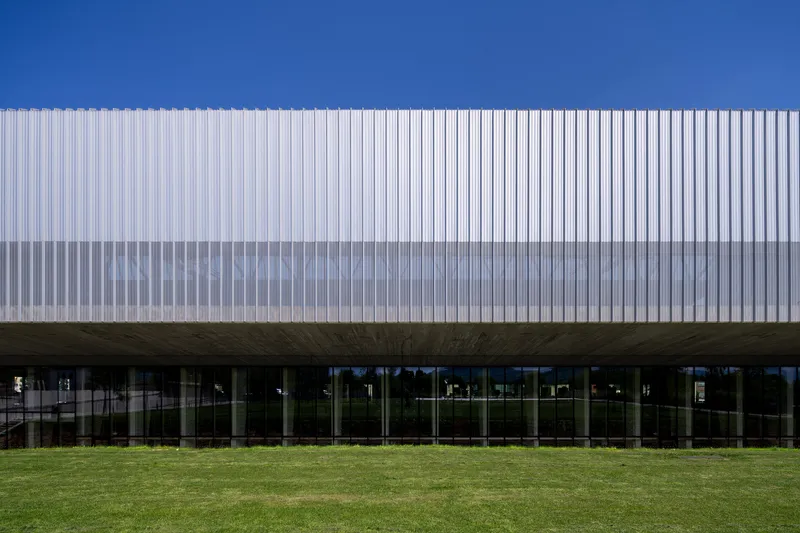
The south facade tells a different story. Here, a perforated metal screen wraps the upper volume, filtering sunlight into the sports hall while the indoor pool area is set back behind a large concrete cantilever. The cantilever does double duty: it blocks high summer sun and allows low winter sun to penetrate the glazing below. An exterior maintenance gallery runs along this facade, originally intended for servicing but also functioning as a free-cooling channel for nocturnal summer ventilation.
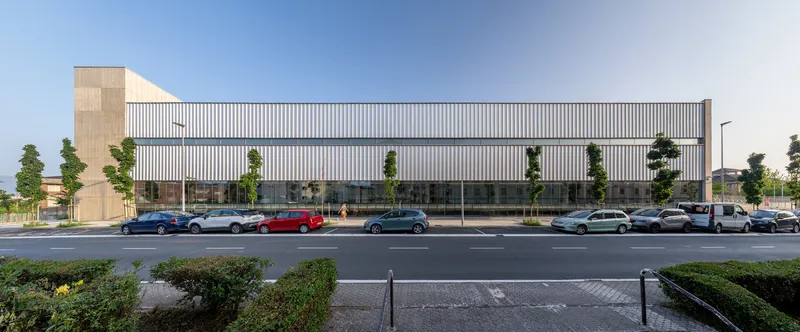
The vertical metal fins that clad the upper volume read as a lighter, more open counterpart to the concrete ribs on the west. Against the lawn and the views toward the mountainous horizon to the south, the building transitions from heavy masonry base to lightweight, almost translucent screen. It is a convincing demonstration that a single building can present multiple faces without losing coherence.
Swimming in Concrete Light
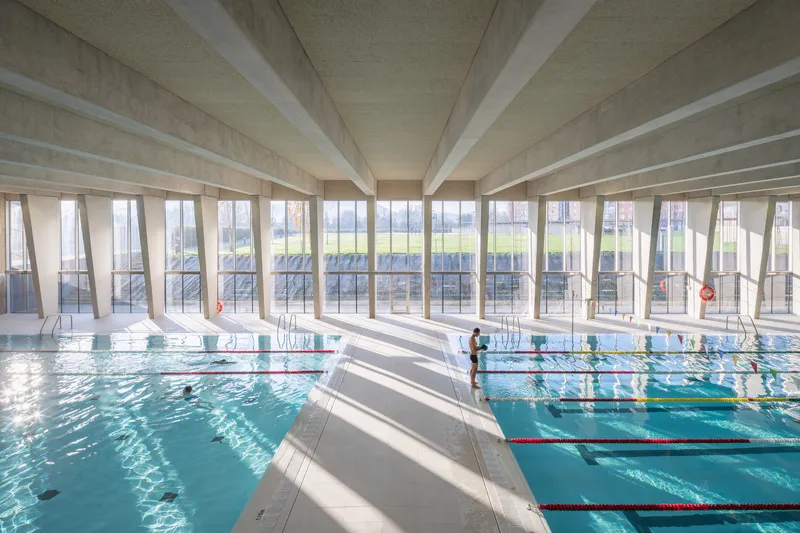
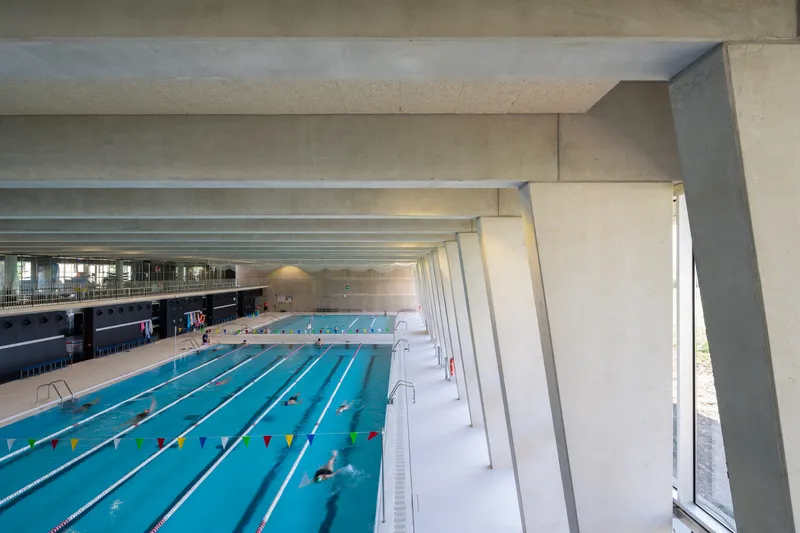
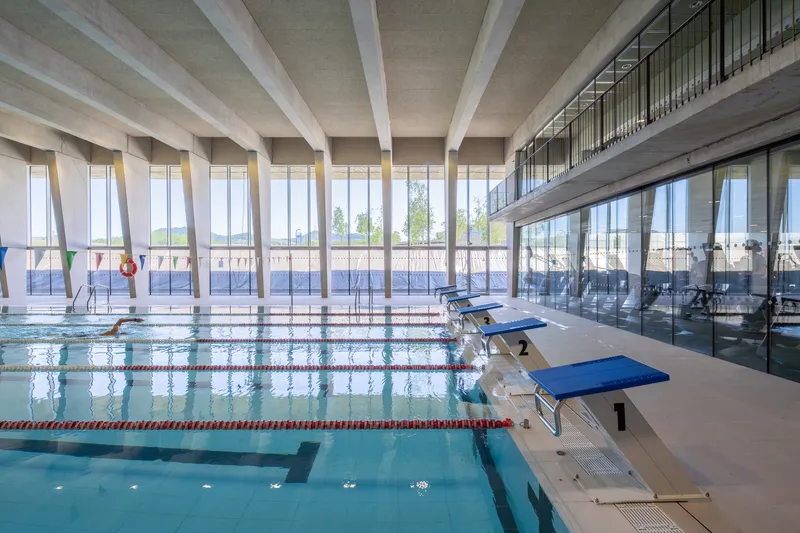
The indoor pool level occupies the lower portion of the building, beneath the sports court. Angled concrete beams define the ceiling, creating a rhythmic sequence of structural bays that frame ribbon windows and full-height glazing toward the outdoor terraces and solarium. The effect is serene without being spa-like: exposed concrete, clear water, and controlled daylight entering from the south through that deep cantilever.
The competition pool with its starting blocks opens directly onto the outdoor terrace through floor-to-ceiling glass. Swimmers in lanes see sky and green; spectators on the terrace see the pool. The setback of the south facade reduces the heated interior volume, a pragmatic energy move that also gives the pool area a sense of shelter beneath the overhanging sports hall above. It is a section that works thermally, structurally, and experientially all at once.
The Sports Hall and the Trusses
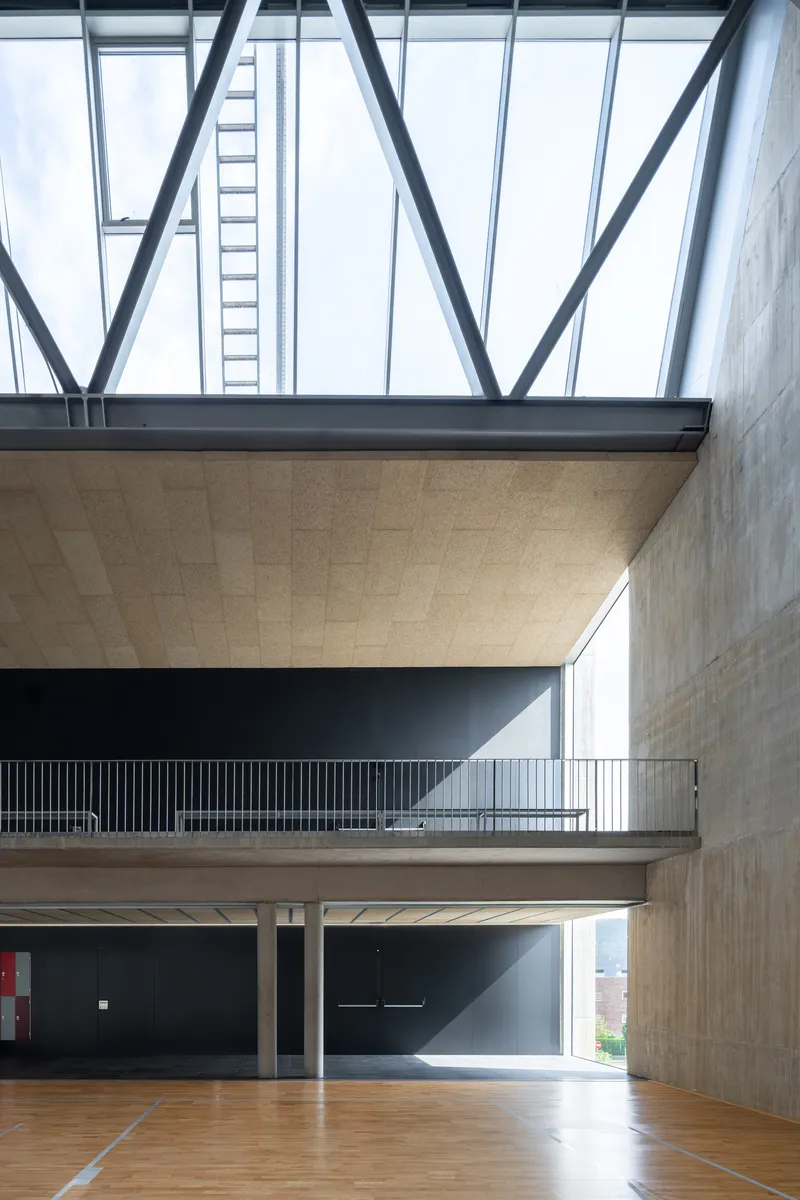
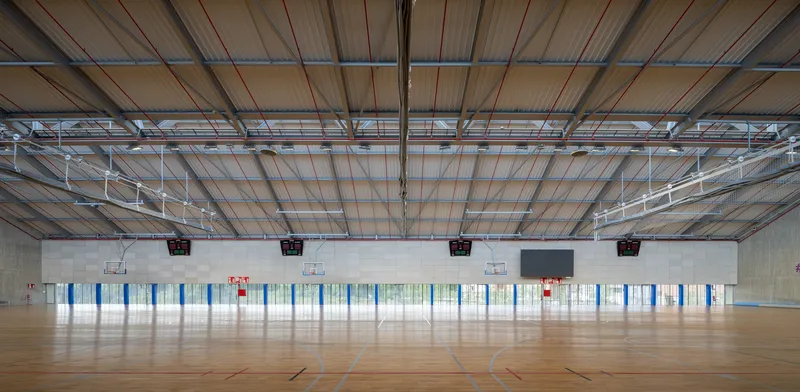
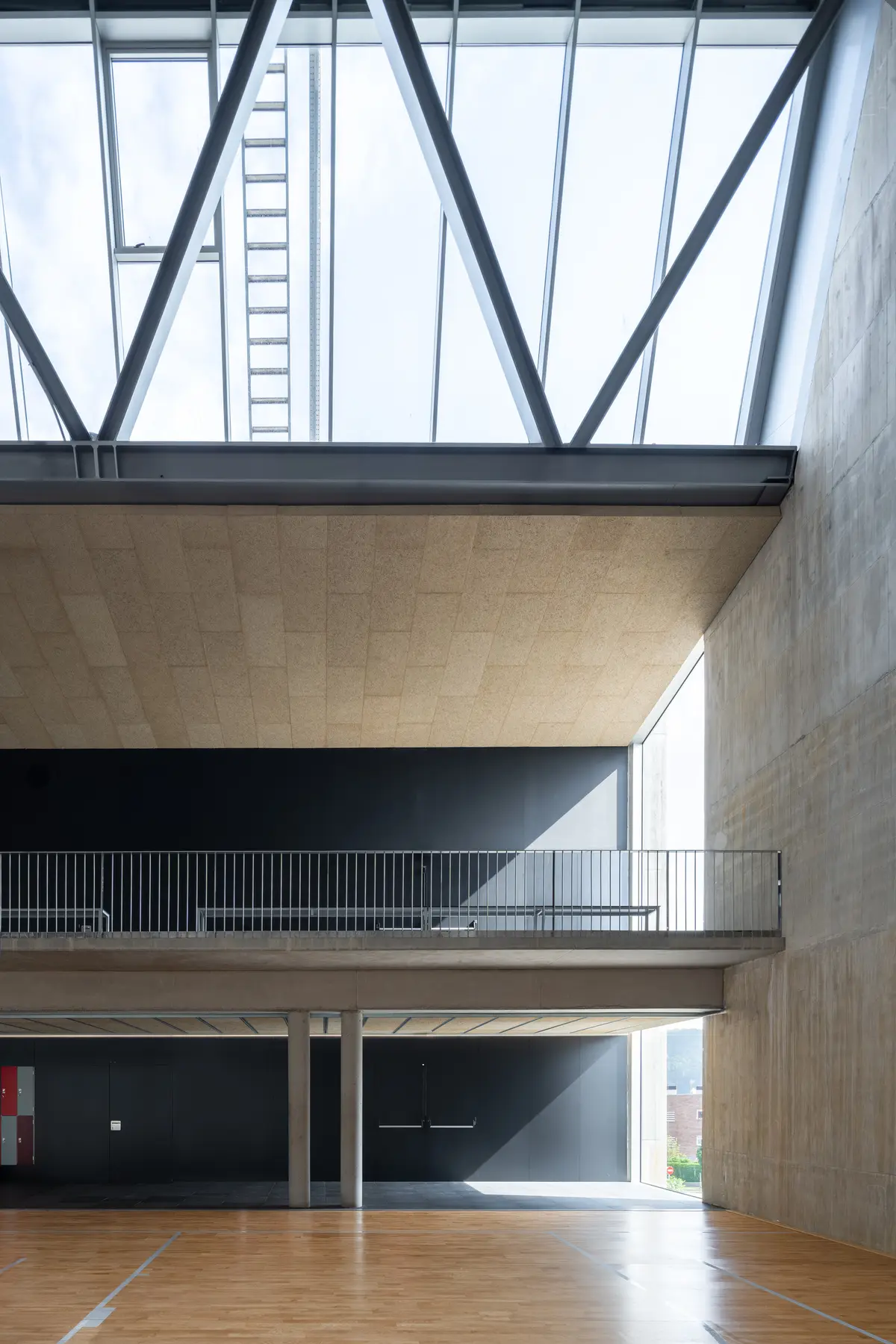
The gymnasium on the upper level is the building's most dramatic interior. Two 66-meter Warren trusses run longitudinally, supported by concrete walls at the east and west ends. This orientation is unusual: trusses of this span are typically arranged across the short dimension. Here, the longitudinal arrangement was driven by the need for 10 meters of clear height (required for rhythmic gymnastics) combined with municipal plan restrictions on building height. Running the trusses the long way allowed the architects to integrate north-facing clerestory skylights into the truss depth itself.
The result is a hall bathed in even, diffused light from above. Diagonal steel members of the trusses are left exposed, their geometry giving the ceiling a kinetic quality. Timber-clad walls and ceiling panels warm the space, and translucent striped wall panels on one side glow softly. An exposed concrete balcony provides spectator seating, cantilevered out over the court. The palette is honest: concrete, steel, timber, light.
Plaza and Neighborhood Scale
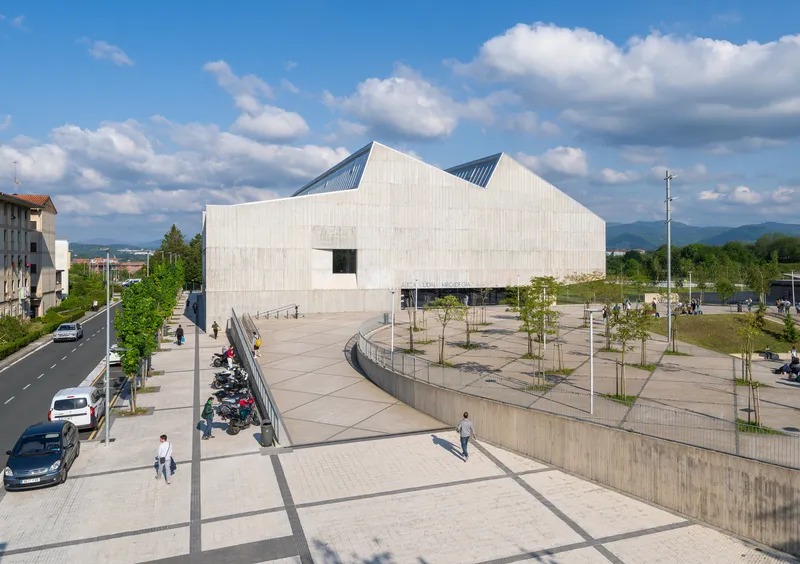
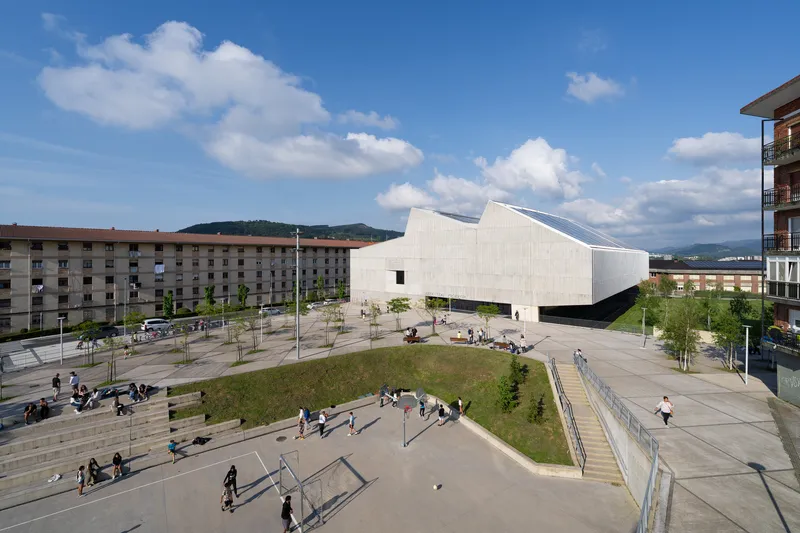
From the elevated view, the building's angular volumes and the surrounding plaza with its stepped seating areas reveal the site strategy. The entrance plaza to the west accommodates new outdoor courts and a small frontón, the traditional Basque pelota court, embedding a regional sport into the civic landscape. Young trees are planted in a grid that will eventually soften the hardscape and provide shade.
The stepped cross-section is legible from the street: each program layer registers as a distinct volume with its own cladding, height, and setback. The building never reads as a monolith. From the parking lot to the north, the long horizontal volume with vertical metal cladding looks almost industrial, appropriate given the site's factory history. From the plaza, it reads as public architecture. The architects calibrated each facade to its audience.
Thresholds and Circulation
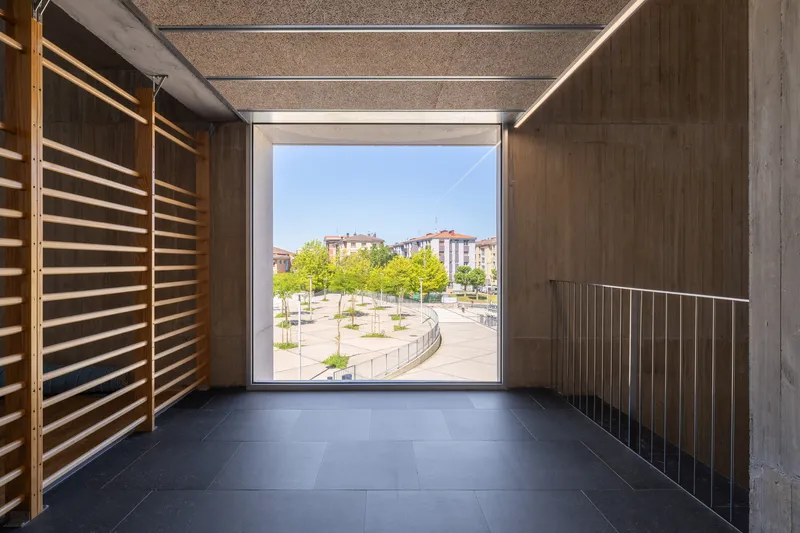
The timber-lined passageway framing a view of the tree-lined plaza is one of the building's quieter moments, and one of its best. The square opening acts as a viewfinder, compressing the transition between interior and exterior into a single controlled frame. Access corridors run along the north side of the building, receiving natural light from the facade and distributing users to the various program elements: changing rooms, activity rooms, offices.
Main and service-emergency circulation cores are placed at either end of the northern band, a straightforward organizational move that keeps the large sports volumes free of vertical intrusions. The corner view at dusk, with its small square window punched into the faceted concrete, shows the architects' willingness to treat even utilitarian moments with care. Every opening is an intentional gesture.
The Sawtooth at Dusk
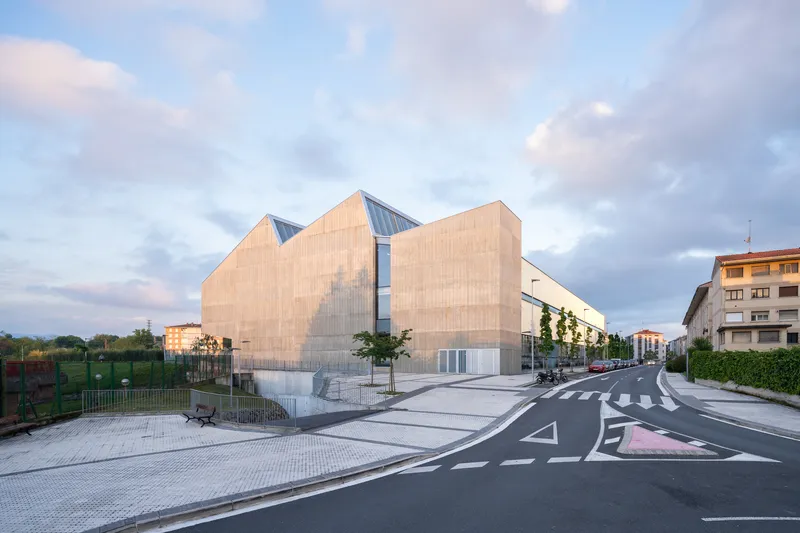
At dusk, the sawtooth clerestory profile emerges most clearly, glowing from within as the north-facing skylights transmit artificial light outward. The silhouette against the cloudy Basque sky is unmistakably industrial in its logic, a nod to the factory typology that once occupied this site. But the timber cladding and the careful stepping of volumes keep it from feeling like a shed. It occupies a productive territory between utilitarian structure and civic presence.
Plans and Drawings
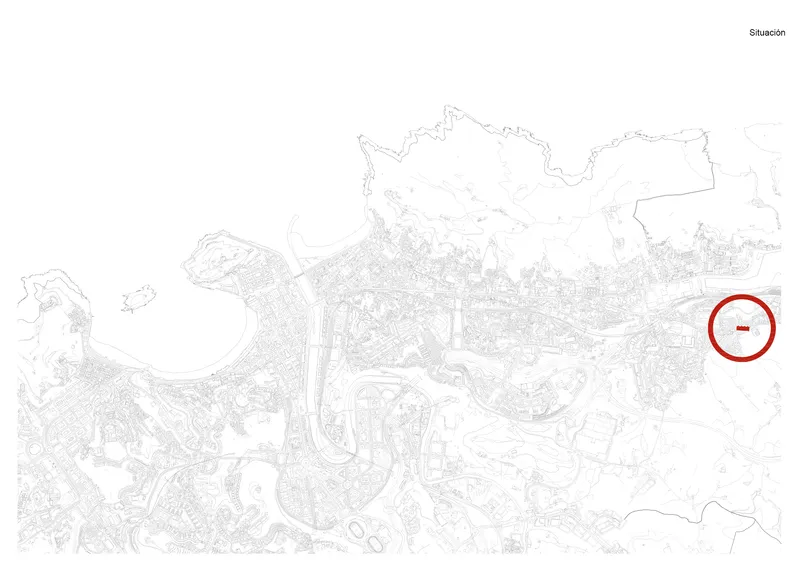
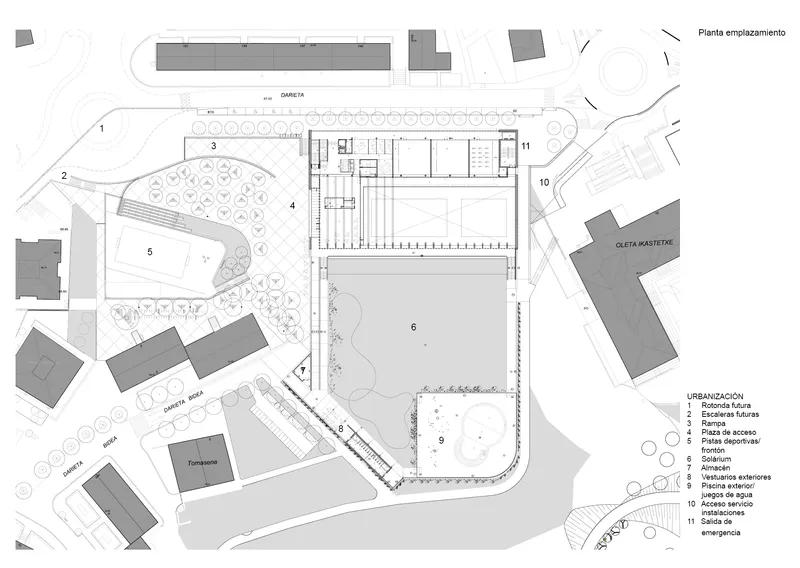
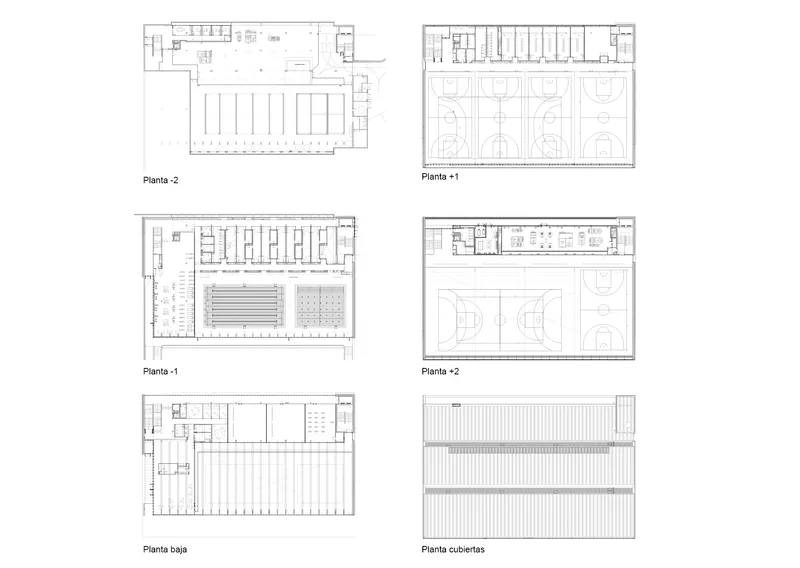
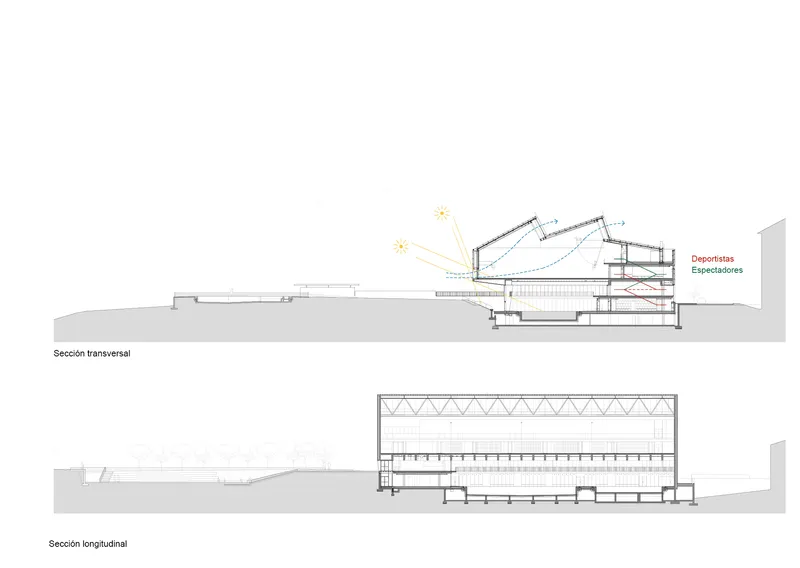
The drawings confirm what the photographs suggest: section was the generative tool. The transverse cut through the sports hall shows the Warren truss riding above the pool level, with the concrete cantilever projecting south. The longitudinal section reveals the full 66-meter span of the trusses and the way the clerestory skylights integrate into their depth. Six floor plans lay out the stacking logic: pools and changing rooms below, sports court and spectator areas above, with a northern service band threading everything together.
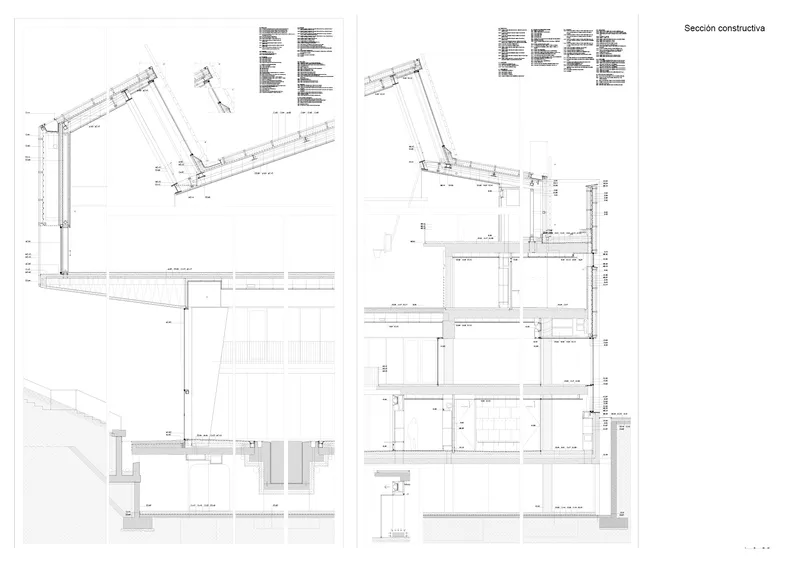
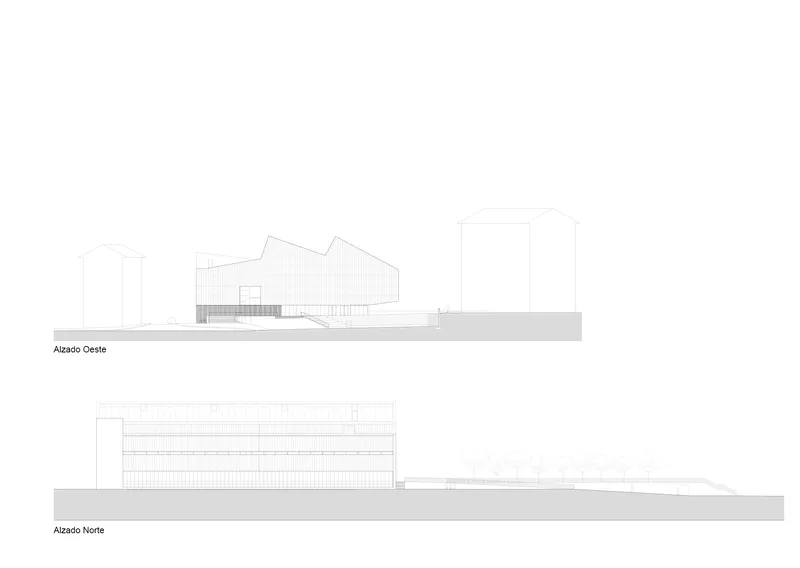
The site plan situates the building within Altza's residential fabric, making clear how much of the former site has been returned to public use as plaza and outdoor sports space. Construction details of the roof assembly and wall junctions show the layered approach to the envelope: concrete structure, insulation, cladding rails, and the perforated metal screen as a final weather and solar filter. The elevations, drawn with adjacent residential buildings for context, demonstrate how effectively the stepped section reduces the building's apparent bulk.
Why This Project Matters
Municipal sports centers are among the most thankless building types. Their programs demand enormous spans and volumes, their budgets are tight, and their neighborhoods rarely welcome the scale they require. The Altza Municipal Sports Center does not solve these tensions by disguising them. It stacks program vertically, steps sections horizontally, and uses the resulting profile as its primary architectural expression. The 66-meter Warren trusses are not hidden but celebrated as light-giving infrastructure. The concrete cantilever is not merely structural but thermally strategic. Every move does at least two things.
What sets this project apart from the growing catalog of sports facilities wrapped in flashy skins is its disciplined integration of structure, environment, and urban context. Tabuenca & Leache, Chocarro, and Herranz have produced a building that earns its considerable footprint through generosity: a public plaza with a frontón, a solarium open to the southern mountains, corridors filled with daylight, and a gymnasium lit from the sky. In a neighborhood that lost a sports center to structural failure, this is a building engineered to last and designed to give back more than it takes.
Altza Municipal Sports Center, designed by Tabuenca & Leache, Chocarro, and Herranz. Located in Donostia / San Sebastián, Spain. 10,500 m². Completed 2022. Photography by Rubén P. Bescós.
About the Studio
Share Your Own Work on uni.xyz
If projects like this are the kind of work you want to make, uni.xyz is a place to publish your own, find collaborators, and enter design competitions.


Popular Articles
Popular articles from the community


The Amber Palace Opera: A Geological Fiction Surfaces on Tallinn's Baltic Waterfront
Pierre Brillard reimagines a Baltic legend as a public landscape, opera house, and waterfront promenade rooted in Tallinn's coastal identity.

Singing Woman: An Opera House That Performs Before the Curtain Rises
Ovidiu Cristian Pavel's conceptual opera house translates Estonia's choral identity into a sculpted waterfront landmark facing the Baltic Sea.

Aquadapt: An Underwater Habitat That Rewrites Its Rooms by the Hour
Curved modules ring the seabed while one shell shifts from breakfast room to cinema, farm and football pitch as residents' needs change.


graciastudio Turns a Viewless Tijuana Lot Inward Around a Courtyard of Concrete, Timber and Trees
In Tijuana, Jorge Gracia's GA2 House stacks a timber-clad private floor over exposed concrete and replaces a missing view with a planted interior patio.

Similar Reads
You might also enjoy these articles

LAVA Architecten Gives Vocational Education a Sawtooth-Roofed Face on a Mechelen School Campus
In Mechelen, Belgium, a 2,053 m² STEM school on a 6×6 m grid turns workshops and classrooms into rooms that can be rearranged as teaching changes.

KEMA Studio Turns a Derelict Marvila Attic into a 60 m² Lighthouse Apartment Above Lisbon
In Lisbon's Marvila district, a rebuilt roof, four skylights and two plywood volumes turn an unlivable attic into a bright home facing the Tagus.

Pixel Gardens: One Repeated Module Stacked Into a Terraced Social Housing Tower for Famagusta
Salem Bader's shortlisted housing tower builds a vertical neighbourhood from one repeated module, offsetting units to carve terraces, light and air.

Bao Huynh Watercolor Atelier: A Serene Art Retreat in Hội An
Bao Huynh Watercolor Atelier in Hội An blends multifunctional art spaces, sustainable design, local materials, and family-friendly living in a serene environment.

Explore Sports Center Competitions
Discover active competitions in this discipline

Challenge to design a barrier free sports center

Challenge to design an outdoor ice-rink and park
Comments (0)
Please login or sign up to add comments
No comments yet. Be the first to comment!