

Tabula Rasa: Demolishing Colonial Memory to Rebuild Connaught Place from Scratch
A radical proposal replaces Delhi's decaying colonial centerpiece with a modular concrete skeleton that residents fill in over time.


What if the most radical act of preservation is demolition? That is the provocation at the center of Tabula Rasa, a proposal that would level Connaught Place, one of Delhi's most recognizable urban landmarks, and replace it with an inhabitable concrete skeleton designed to be gradually occupied, adapted, and completed by its users. The project refuses the assumption that colonial-era structures deserve permanence simply because they are old. Instead, it treats the site as a clean slate for democratic architecture: a framework of local stone, concrete, and timber that prioritizes usability, inclusivity, and evolution over historical mimicry.
Designed by Romain Conti-Granteral, this shortlisted entry for the Neo Delhi competition reframes urban regeneration as both critique and creative act. Connaught Place, for all its heritage status, is described here as a fossilized ruin whose architecture no longer serves the people functionally. Rather than patching and preserving the unsalvageable, the proposal argues for what it calls a "mega-rewrite": total replacement with a modular structure that reflects contemporary Delhi's needs rather than its colonial past.
A Curving Grid Opens Onto a Sandstone Piazza
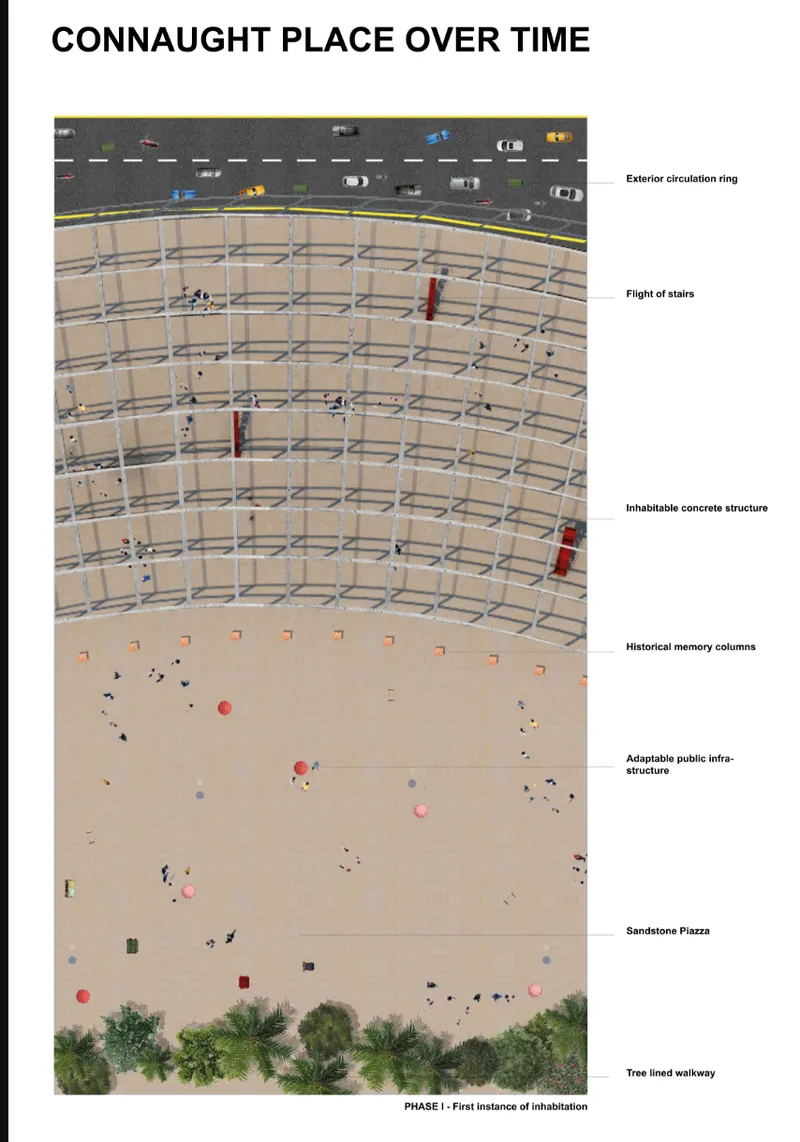
The aerial plan reveals the proposal's spatial logic at a glance. The existing exterior circulation ring is retained, but the interior is completely reimagined as an expansive pedestrian zone paved in sandstone. A tree-lined walkway bisects the site from east to west, forming a strong visual and functional corridor that stitches the development into Delhi's broader urban fabric. At the center sits a large water pool that doubles as both a reflective surface and a community gathering point, anchoring the piazza with a space for interaction and play.
Scattered across the ground plane are the small, essential pieces of urban infrastructure that enable a public space to actually function: benches, drinking fountains, bike racks, market carts, parasols, and lamp posts. These are not decorative. They are the connective tissue of a redesigned Connaught Place, supporting spontaneous gatherings, informal economies, and the kind of social friction that makes cities worth inhabiting.
Phased Inhabitation: A Skeleton That Grows With Its People
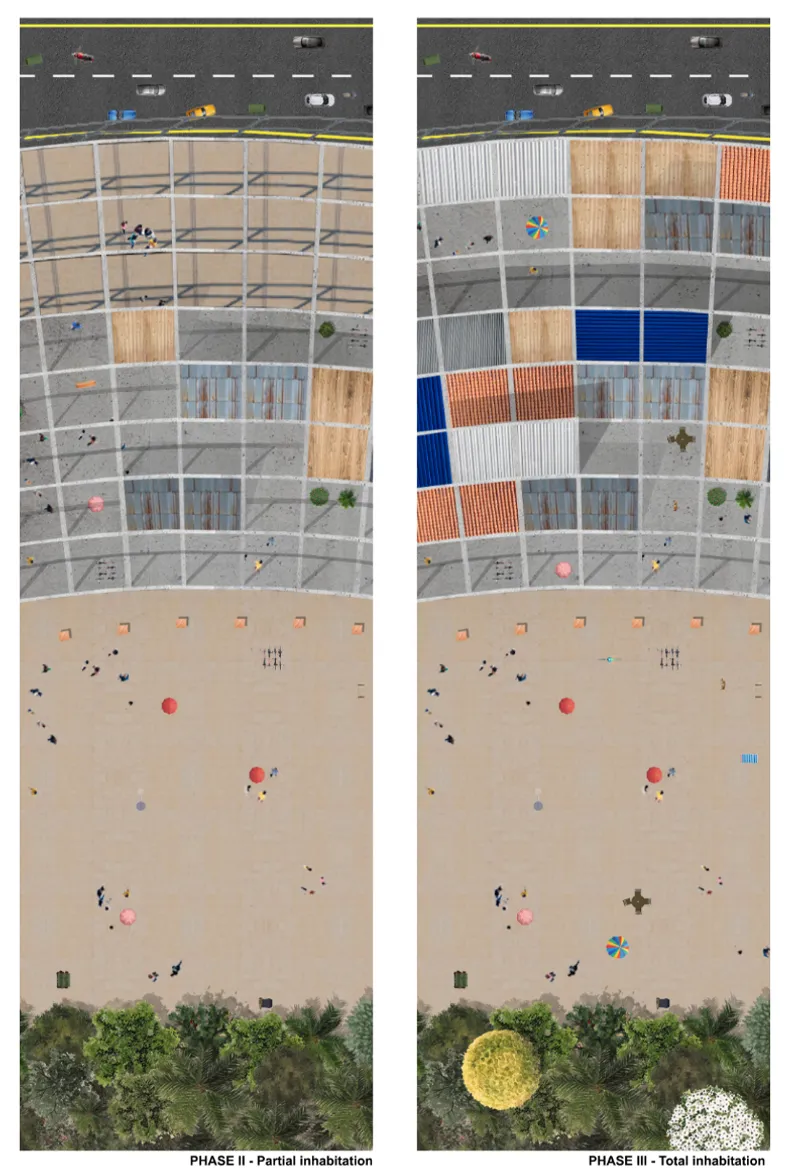
The sequential diagrams above tell the story of how Tabula Rasa is meant to come alive. The concrete skeleton is introduced as a non-invasive framework, a bare structure that occupants fill in over time with varied material panels and spatial configurations. Whether a unit serves a single user, a family, or a communal living arrangement, it can grow vertically and horizontally within the grid. The result is something closer to an organism than a building: a structure that accommodates individual expression while maintaining a cohesive architectural language across the whole development.
This phased approach is central to the project's argument about what urban regeneration architecture should look like. Rather than delivering a finished product, the proposal offers a platform. The framework holds the line on structural integrity and spatial order; the inhabitants make decisions about enclosure, materiality, and programme. It is an architecture of invitation, not imposition.
Exposed Concrete and Red Steel at Ground Level
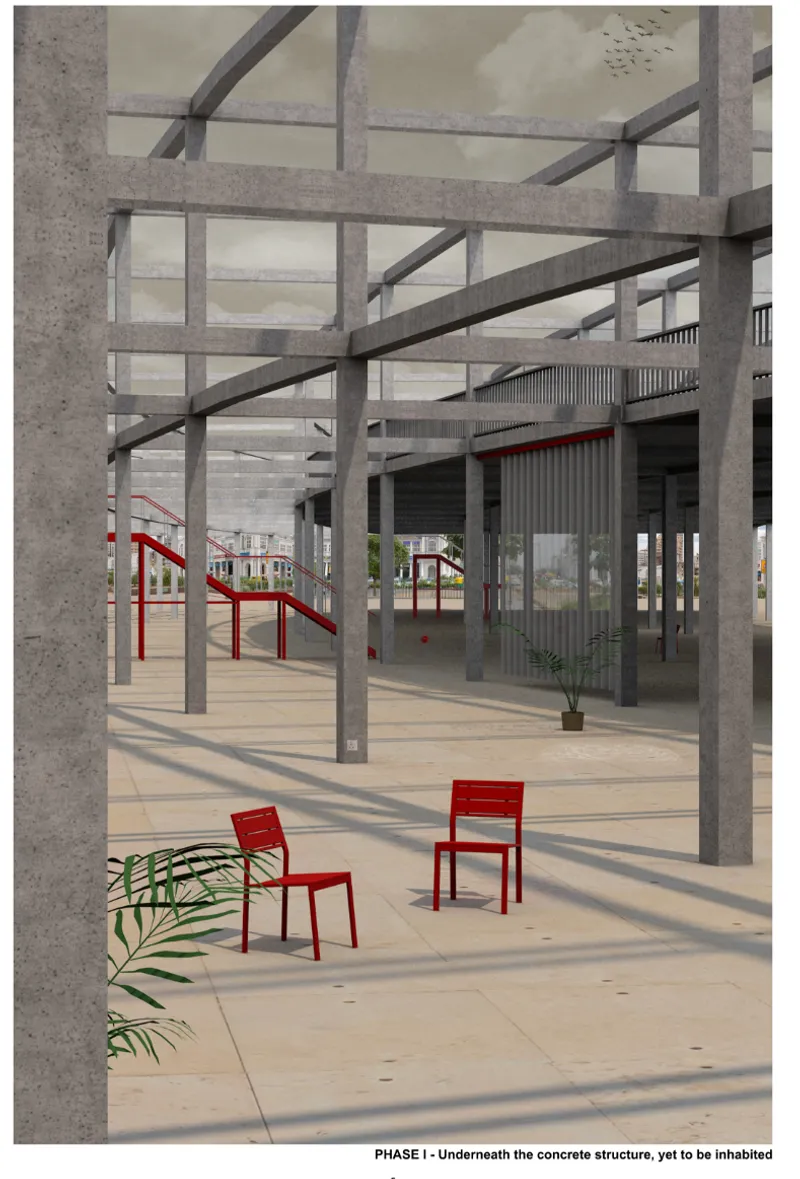
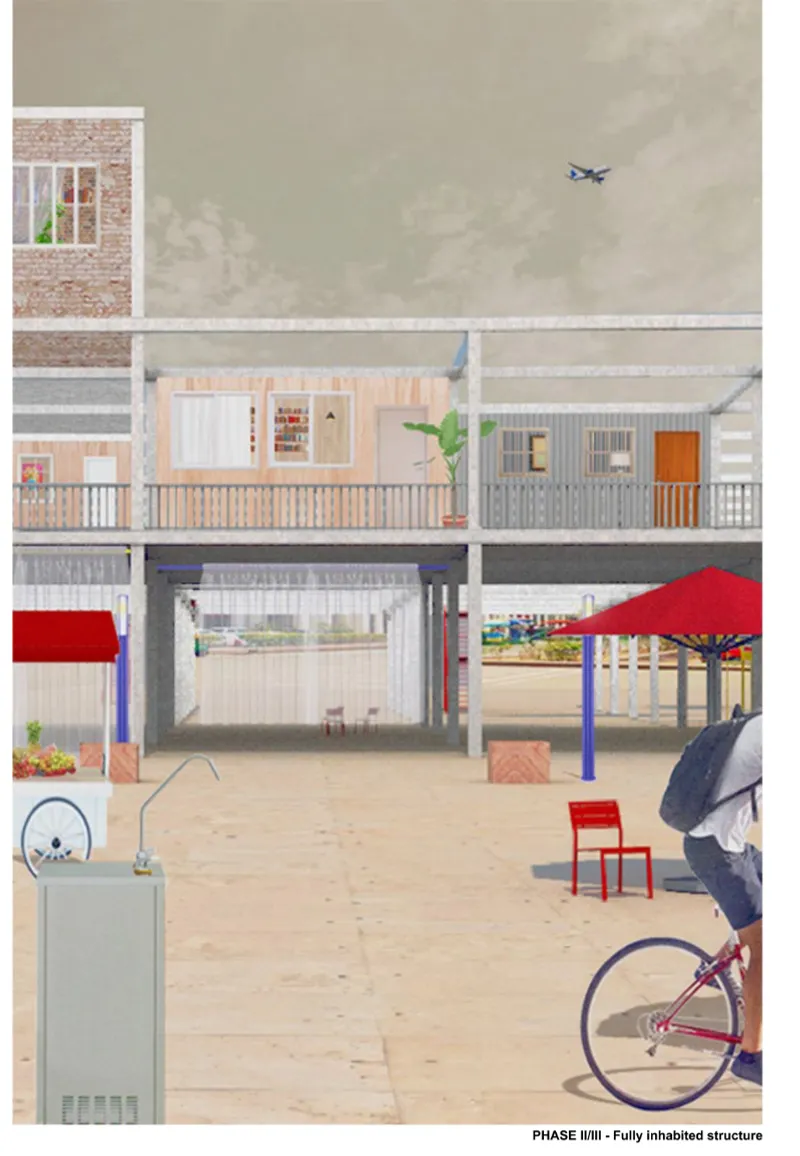
Beneath the inhabited upper levels, the ground plane reads as open, porous, and thoroughly public. Exposed concrete columns and diagonal bracing define a generous covered space punctuated by red metal staircases and planted greenery. The section perspective confirms the layering: an open ground-level plaza flows freely beneath residential and working units clad in a patchwork of locally sourced materials. The lower level is accessible via multiple staircases, ensuring the structure never becomes a walled enclave.
The material palette is deliberately humble. Local stone, concrete, and timber are deployed in open-ended ways that resist the polished finish of speculative development. The varied cladding visible in the section, from corrugated panels to timber screens, signals self-built interventions rather than top-down specification. Above, life unfolds at a human scale; below, the city circulates.
Communal Life Under Red Umbrellas
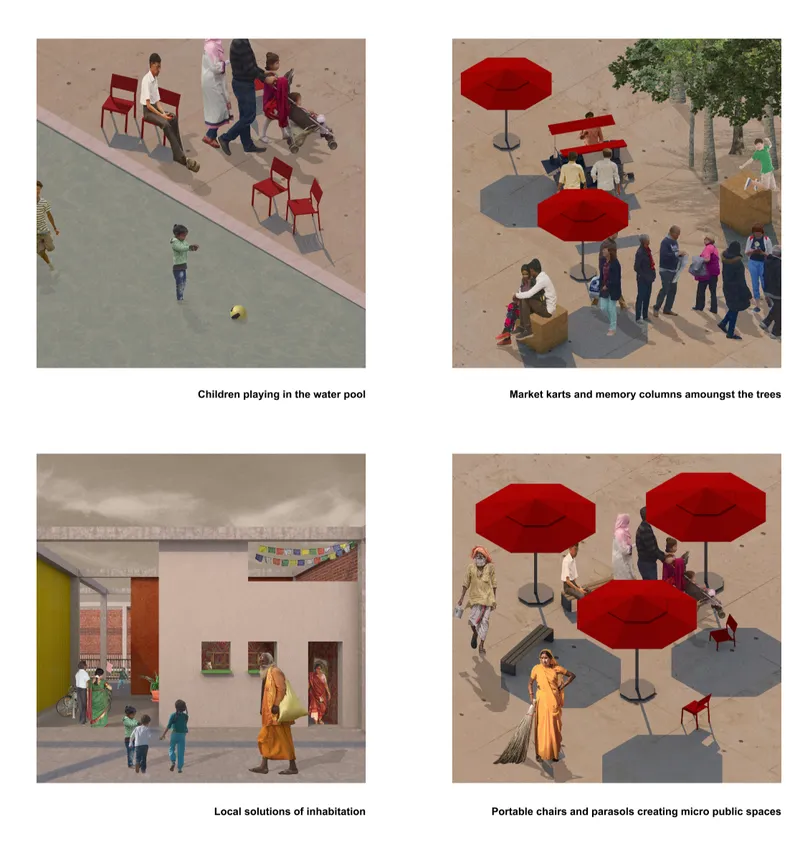
The four rendered vignettes capture the atmosphere the proposal is chasing. People gather under red umbrellas, move through shaded communal passages, sit, talk, trade. These are not hero shots of empty architecture; they show the structure as a backdrop for daily life. The scenes emphasize shade, sociability, and informality, qualities that Connaught Place in its current state struggles to provide despite being one of Delhi's most central locations.
Memory is not entirely erased, even in a project called Tabula Rasa. Select heritage elements, such as the original colonnades, are abstracted and reinterpreted as structural "memory columns" dispersed throughout the site. They act as silent witnesses to the past without dictating the future, a subtle acknowledgment that wiping the slate clean does not mean forgetting what was written there.
Why This Project Matters
Tabula Rasa is not an easy proposal to accept. Calling for the demolition of a heritage landmark will always provoke strong reactions, and it should. But the value of this project lies precisely in the discomfort it creates. It forces a question that heritage discourse often sidesteps: when a building's symbolic weight is inseparable from a history of colonial submission, and its physical fabric is in irreversible decay, who benefits from its preservation? The answer, this project argues, is not the people who actually live and work in Delhi.
What Conti-Granteral proposes instead is a resilient, flexible, and genuinely inclusive urban framework, one that treats architecture as infrastructure for future life rather than a monument to past power. The modular concrete skeleton, the phased inhabitation strategy, the humble material palette, and the generous public ground plane all point toward an urban regeneration architecture that trusts its users more than its designers. In a city as layered and contested as Delhi, that trust is itself a radical gesture.
View the Full Project
About the Designers
Designer: Romain Conti-Granteral
Enter a Design Competition on uni.xyz
uni.xyz runs architecture and design competitions year-round that reward proposals with spatial conviction and real site intelligence.
Project credits: Tabula Rasa by Romain Conti-Granteral Neo Delhi (uni.xyz).


Popular Articles
Popular articles from the community

Temporary Home for Dogs: A Reversed Zoo Rethinks Animal Shelter Architecture
In Bucharest, a sinuous corridor and freed landscape flip the logic of containment, designing a shelter that works to make itself unnecessary.

Cloaked Colonization: A Mobile Underwater Habitat That Moves Like a Fish
Micah Abaya's shortlisted EHC Pacific entry reimagines ocean settlement as a dispersed network of self-sustaining architectural organisms.

Opera on the Sea: Driftwood Logic Shapes a Timber Opera House on Estonia's Coast
Trevor Orgill's opera house translates the entangled drift of floating timber into a civic building where wood, water, and music converge.

Extended Shell: Retrofitting Kolkata's Balconies as Living Urban Thresholds
A modular retrofit system recovers the social and environmental intelligence of Kolkata's historic verandas for contemporary Park Street residents.

Similar Reads
You might also enjoy these articles

Shakur's House: Exposed Brick as an Interior Organiser in a 168 m² Mashhad Residence
Brick moves indoors in this Mashhad residence, where masonry walls, glass partitions and teal planes sequence a compact home without closing it off.

Day and Night Park: A Time-Based Urban Newsstand in Beijing
A temporary urban newsstand in Beijing blending travel, light, and reading through poetic colors, compact form, and community-focused design.

Modernist Patio Renovation in El Masnou, Barcelona by Oliver Segura Arquitectura + Cebrià Arquitectura
Modernist patio renovation blending tradition and innovation with a movable pool, leveled floors, and Catalan materials in El Masnou.

Alto Residencial Coop: Cooperative Housing Development in Santiago de Compostela by Carbajo Barrios Arquitectos
A linear cooperative housing complex blending white volumes and perforated metal façades, enhancing community living, natural light, privacy, and urban integration.

Comments (0)
Please login or sign up to add comments
No comments yet. Be the first to comment!