

Team MIMO Builds a Glue-Free Timber Housing Prototype for the Solar Decathlon in Wuppertal
A compact two-storey research building made of solid wood modules tests how minimal material impact can yield maximum communal output.


Competitions like the Solar Decathlon tend to produce two kinds of entries: polished corporate showcases that feel like trade-fair booths, and scrappy student builds held together by idealism and zip ties. The House Demonstration Unit by Team MIMO and the University of Applied Sciences Düsseldorf sits in a rare middle ground. Assembled from 17 compact solid-wood modules on the grounds of a 1905 warehouse in Wuppertal, the prototype packs 13 apartments for 29 residents into a 10-meter-square, seven-meter-tall block. It placed fourth at the Solar Decathlon Europe finals in June 2022, and the reason it deserves attention has less to do with the ranking than with the thinking behind the construction.
The guiding idea is captured in the project's motto: Minimal Impact, Maximum Output. Every significant decision, from the glue-free timber joinery to the climate shell of movable photovoltaic glass slats, follows that logic. The building is not an experiment in formal spectacle. It is an experiment in sufficiency: how little material, how little energy, how little disruption can still produce dignified, flexible urban housing. That question matters more each year, especially in the densely populated Rhein-Ruhr metropolitan region where the prototype sits.
Glue-Free Timber and the Logic of Assembly
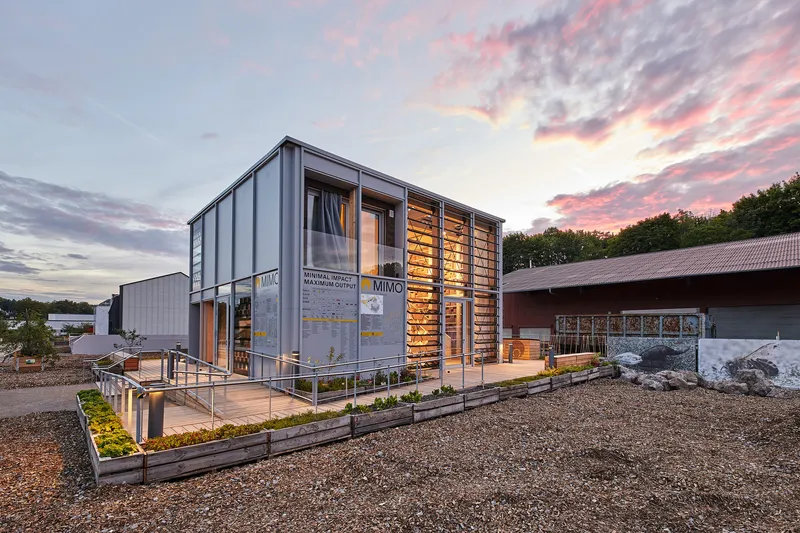
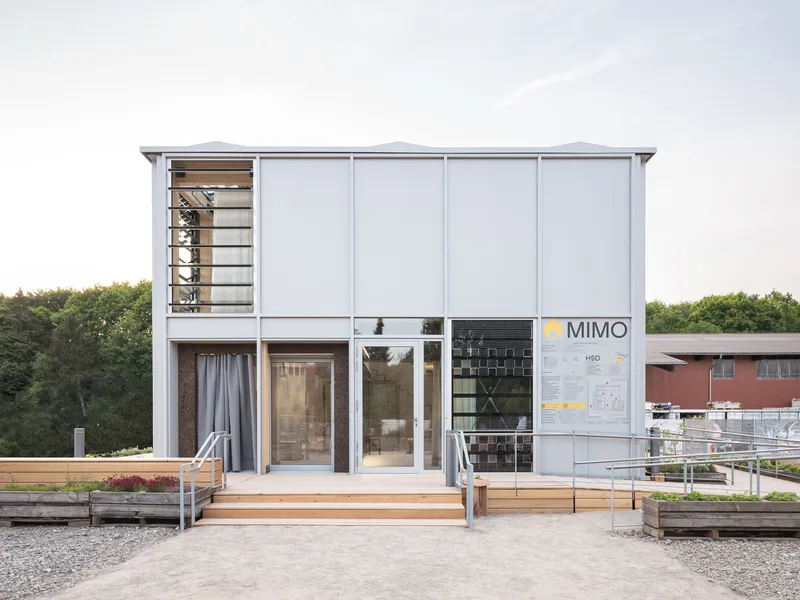
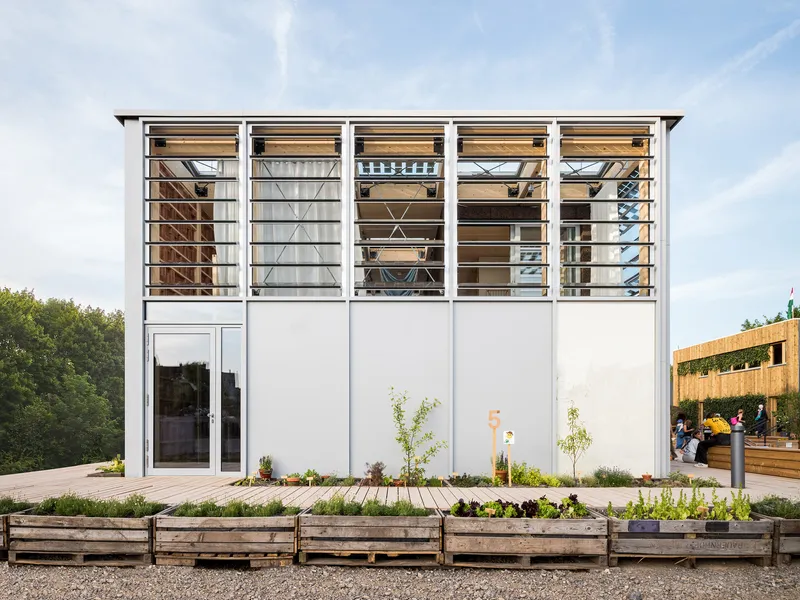
The structure reads from the outside as a corrugated metal box topped by barrel-vaulted roofs, with a screen of horizontal timber louvers layered across the facade. Planted beds at ground level soften the industrial profile and connect the prototype to its warehouse neighbors. What is not immediately visible is that the entire load-bearing system is glue-free solid wood: compact Vollholz modules stacked and braced without synthetic adhesives. This is a meaningful choice. Glue lamination is the standard in modern mass-timber construction for good reason, but eliminating adhesives simplifies disassembly, recycling, and eventual biological decomposition. Team MIMO treats the building as a kit of parts rather than a monolith.
The raised foundation on concrete piers, clearly visible in the section drawings, reinforces the idea of reversibility. The building touches the ground lightly. It could, in principle, be unbolted and relocated, an approach that makes particular sense for a research prototype intended to inform future full-scale projects of 15 or more units.
The Climate Shell as Active Skin
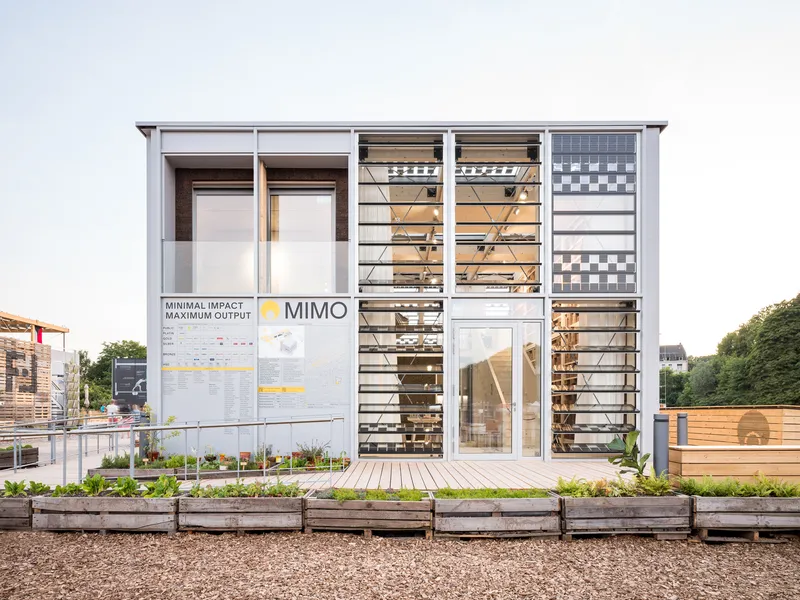
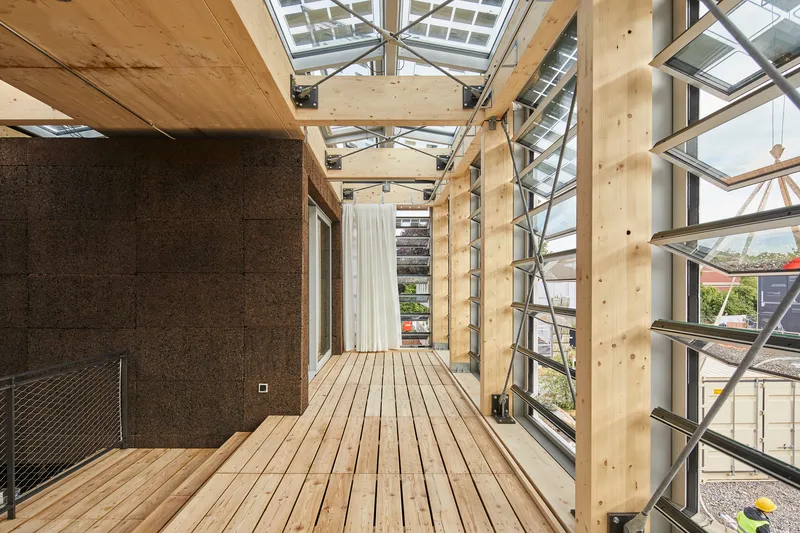
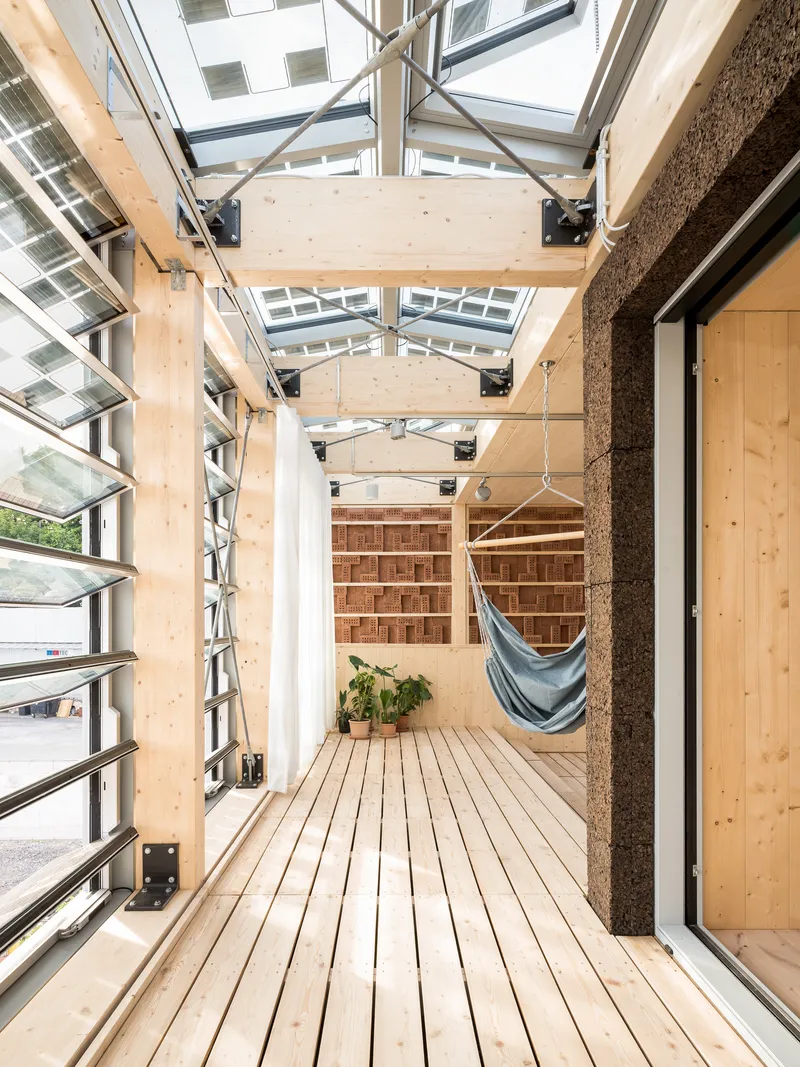
The most technically ambitious element is the climate shell: an intelligent facade of movable glass slats with integrated photovoltaics that wraps the entire structure. On warm days the slats open, allowing cross-ventilation through the intermediate spaces between modules. On cold days they close, converting the terrace decks and gallery corridors into enclosed winter gardens. The roof is shaped to funnel rainwater into a cistern below, while plants distributed throughout the shell clean air and regulate humidity inside the buffer zone.
What lifts this beyond a catalogue of green features is how the climate shell integrates with daily life. The covered timber deck, visible as a generous outdoor corridor with hammock and cork-clad columns, is not a technical plenum hidden behind drywall. It is the communal living room of the building, a space whose character shifts with the seasons. When the shell closes in winter, residents gain usable square meters without adding heated volume. That is a genuinely efficient move.
Living Compactly: The Apartment Interiors
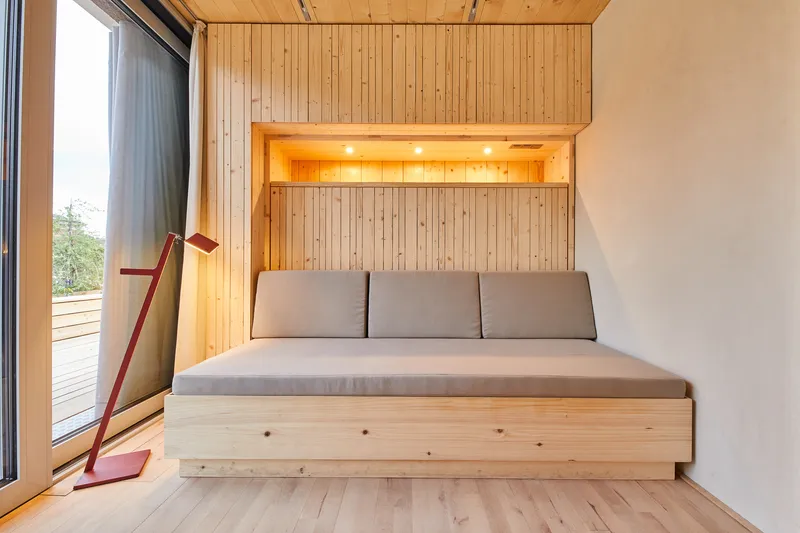

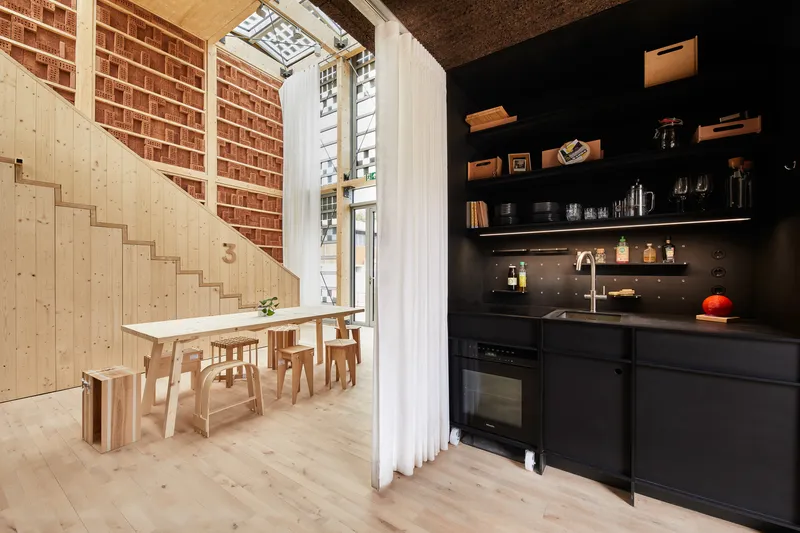
Inside the modules, the material palette narrows to plywood, cork, exposed brick, and white curtains. Sleeping alcoves are tight but considered: recessed lighting above the bed, a glazed door to the adjacent space, and enough ceiling height to sit up comfortably. The kitchenettes are black steel units with open shelving, tucked against cork wall panels and separated from dining areas by simple curtain dividers. Nothing is over-designed, and nothing feels cheap.
The four apartment types, student singles, doubles, maisonettes, and family units, demonstrate that modularity does not have to mean uniformity. Each type gets a balcony facing north, south, or west, and the section through the building reveals how the staircase, mezzanine, and double-height voids create spatial variety within a strict 10-by-10-meter footprint. The perforated brick walls function as both thermal mass and visual anchors, grounding the lightweight timber frame with something heavier and older.
Communal Spaces and the Rooftop Village Square
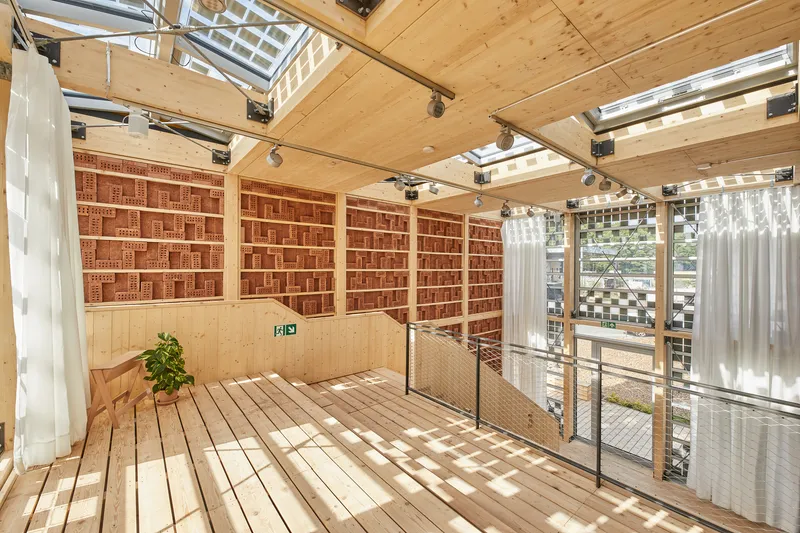
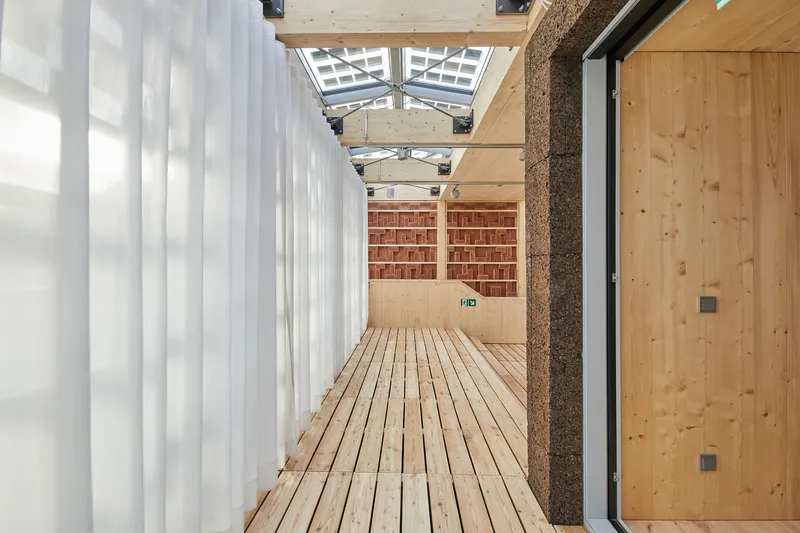
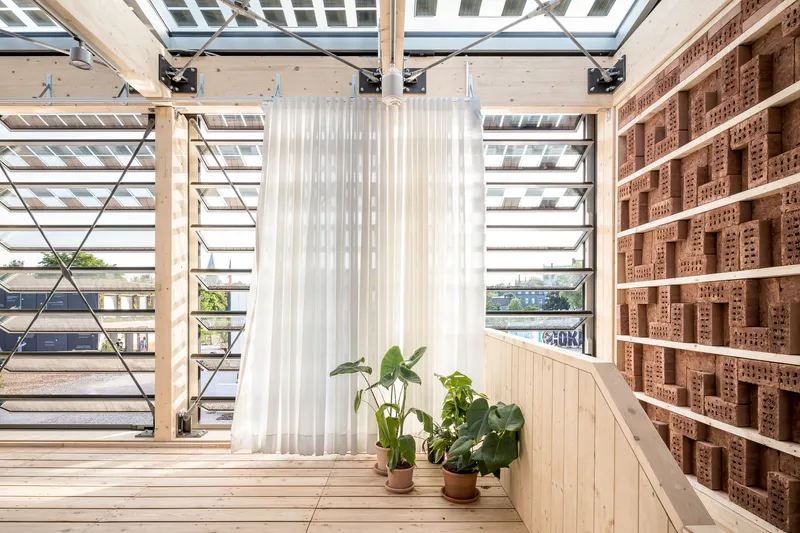
Team MIMO describes the roof terrace as a communal village square, a term that signals ambition beyond the individual unit. The upper-level gallery, with its sawtooth glazing and timber decking, functions as a shared corridor that doubles as a lounge. Planted benches lit by skylights, brick storage walls, and white curtains that can be drawn to create privacy or opened to reveal the full length of the space all reinforce the idea that community is a design decision, not an afterthought.
The greened fire wall and the integration of plants throughout the building are worth noting for their pragmatism. These are not decorative gestures. They are active participants in the climate shell's air-cleaning and humidity-regulation strategy, positioned where they receive daylight from the clerestory glazing above.
Material Honesty Up Close
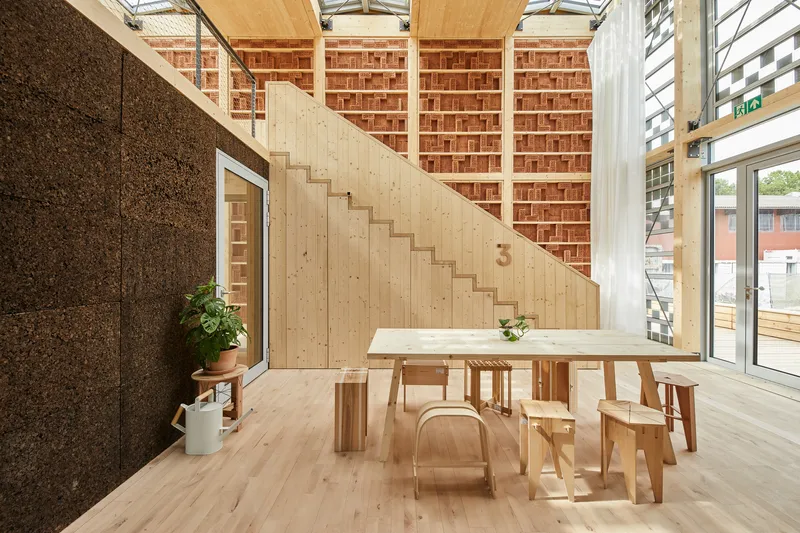
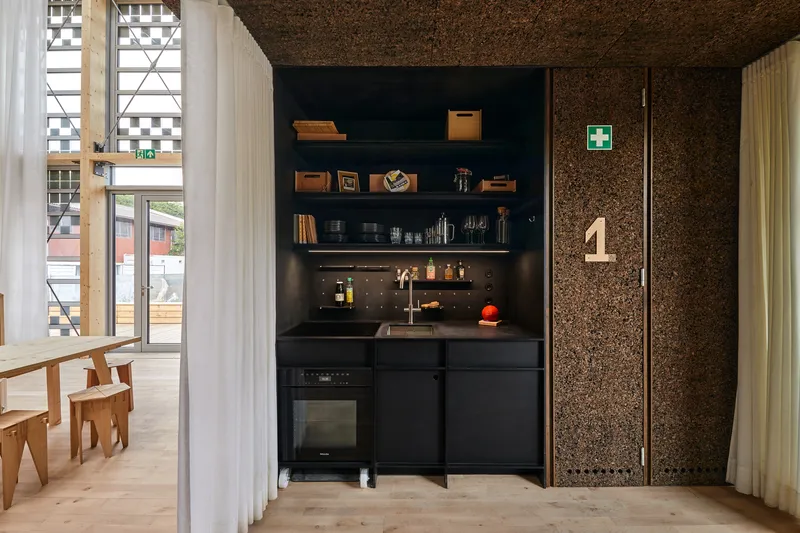
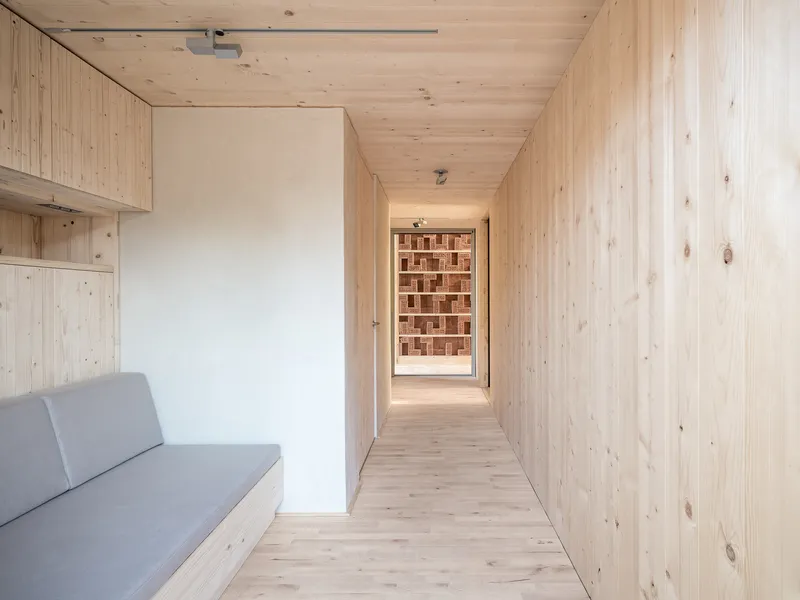
Walk through the building and every surface tells you what it is. The diagonal staircase rises in light timber against a cork wall; the plywood partitions frame views through to the brick beyond; the overhead glazing is visible as structure, not concealed behind a ceiling. This material honesty is not just an aesthetic preference. In a research building designed to be studied, replicated, and eventually disassembled, legibility matters. Future builders need to see the joints.
Cork appears repeatedly as wall cladding and column wrapping. It is an underused material in northern European construction, but it makes sense here: renewable, insulating, acoustically soft, and capable of absorbing the wear that communal circulation spaces inevitably receive. The triple-glazed insulation glass throughout keeps thermal performance high without sacrificing daylight.
Double Height and Diagonal Bracing
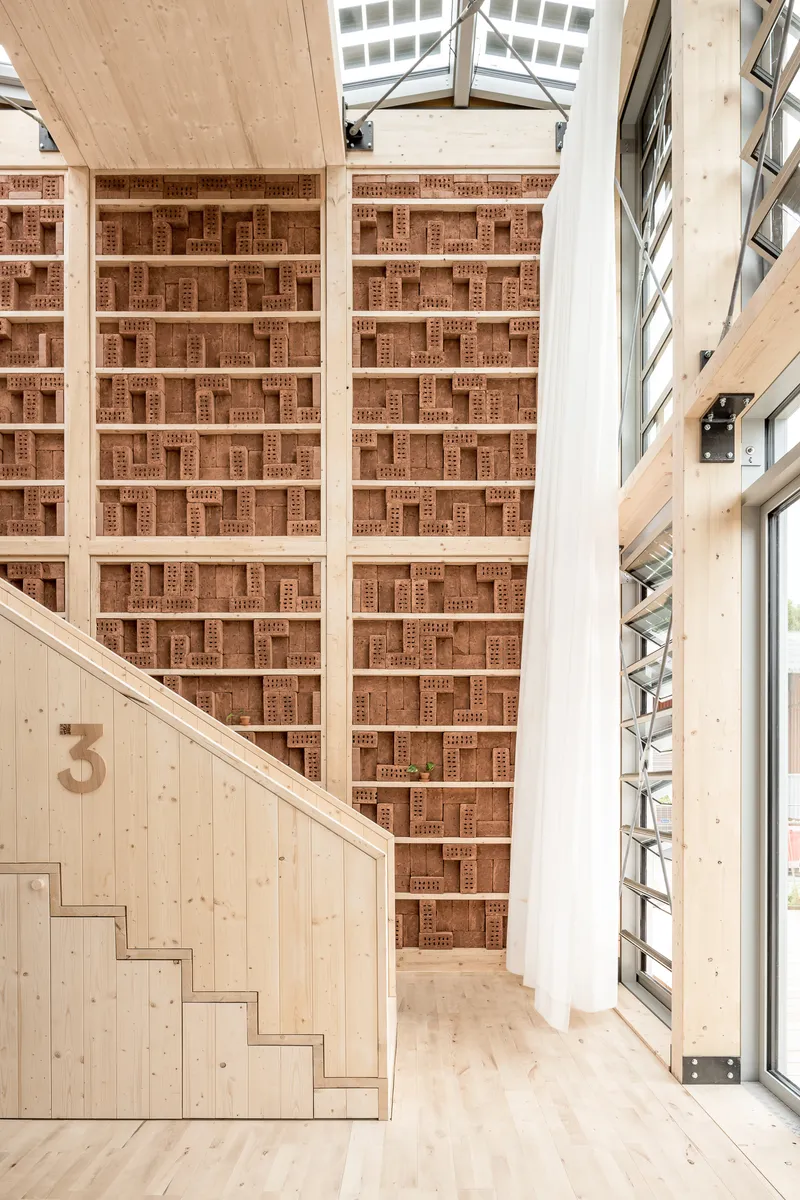
The double-height space anchored by the perforated brick wall is the building's most photogenic moment, and also its most structurally legible. The timber staircase rises diagonally across the void, its trajectory echoed by the cross-bracing visible in the frame. Above, a triangular clerestory window floods the space with diffused light. It is a simple composition, but it demonstrates that a seven-meter-tall modular building can feel generous rather than cramped.
Plans and Drawings

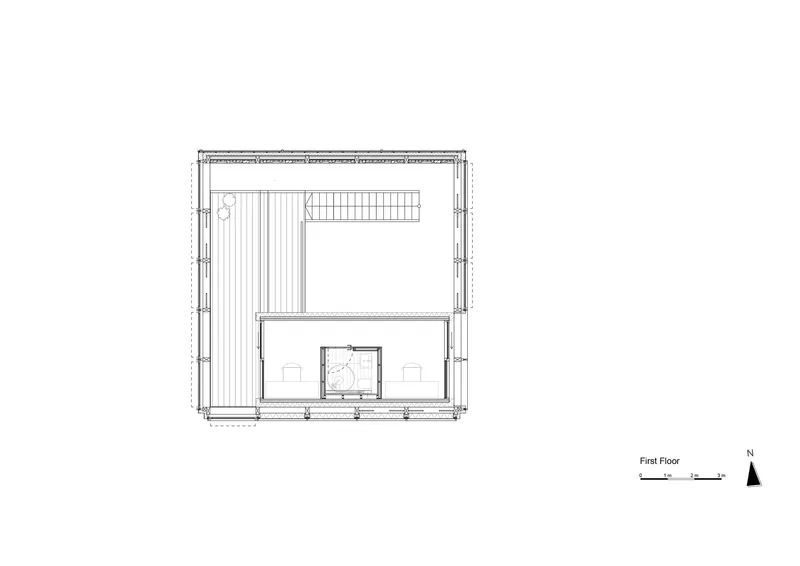
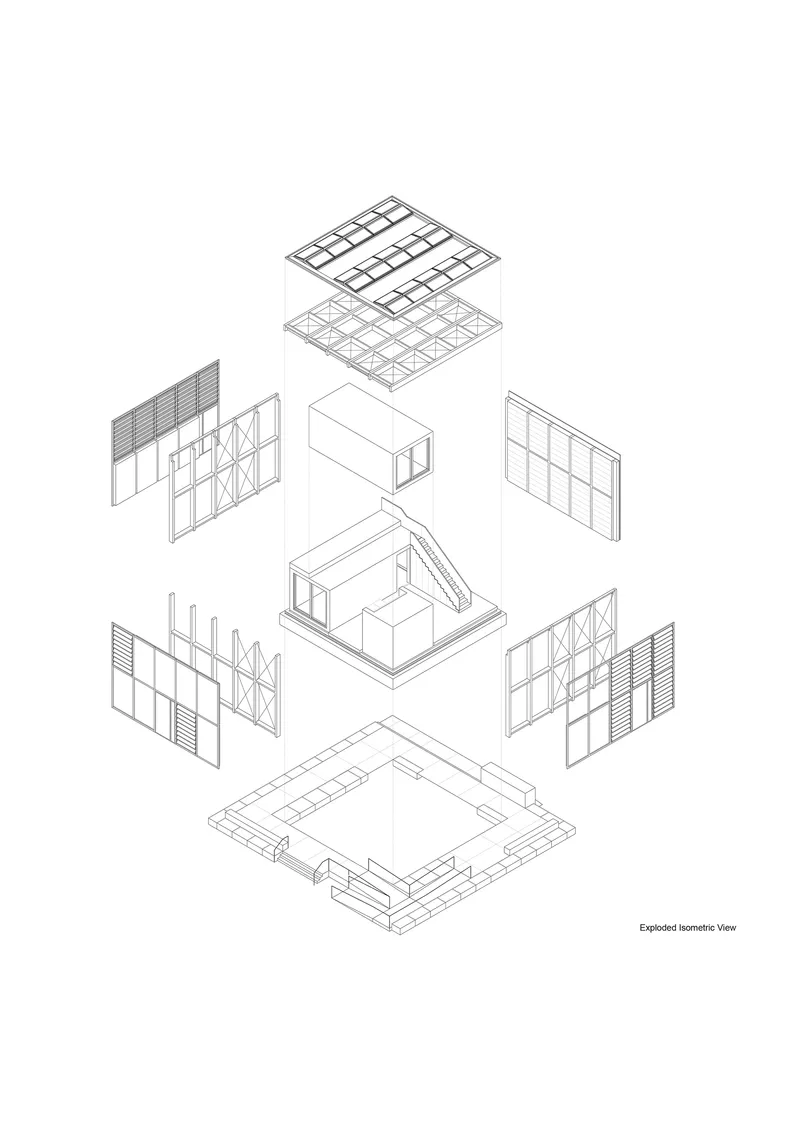
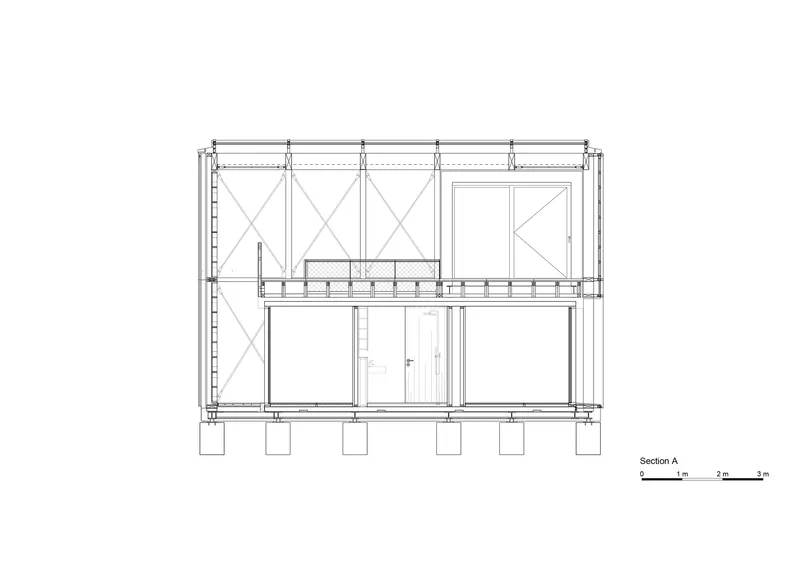

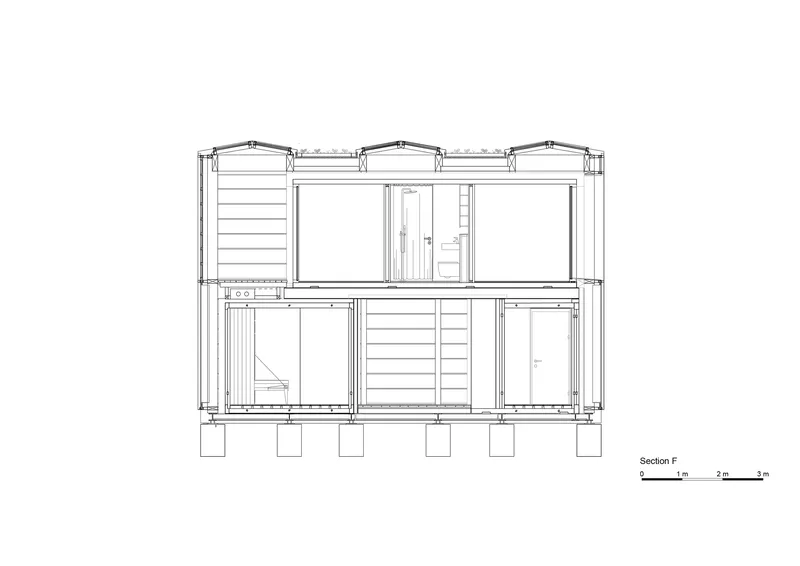
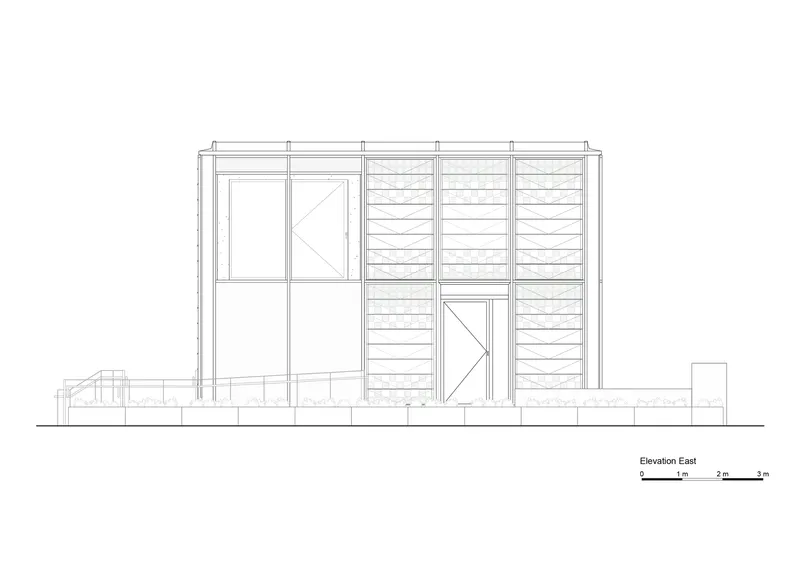
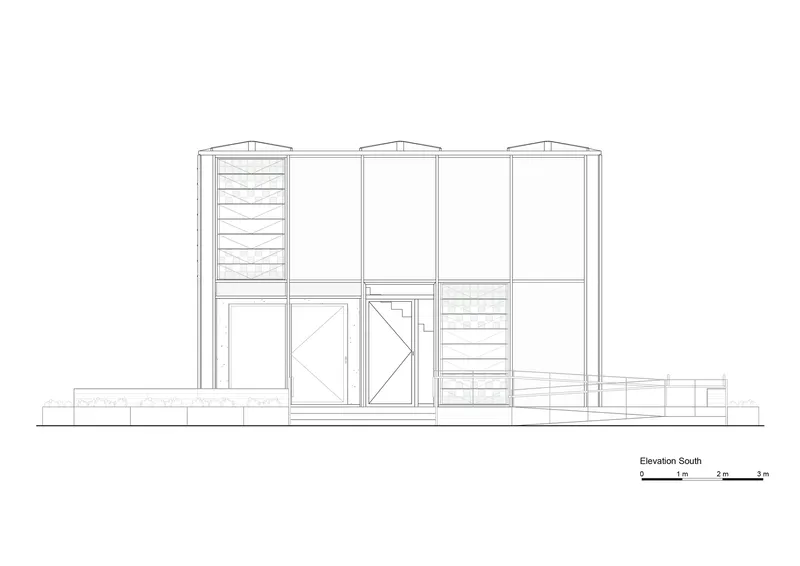
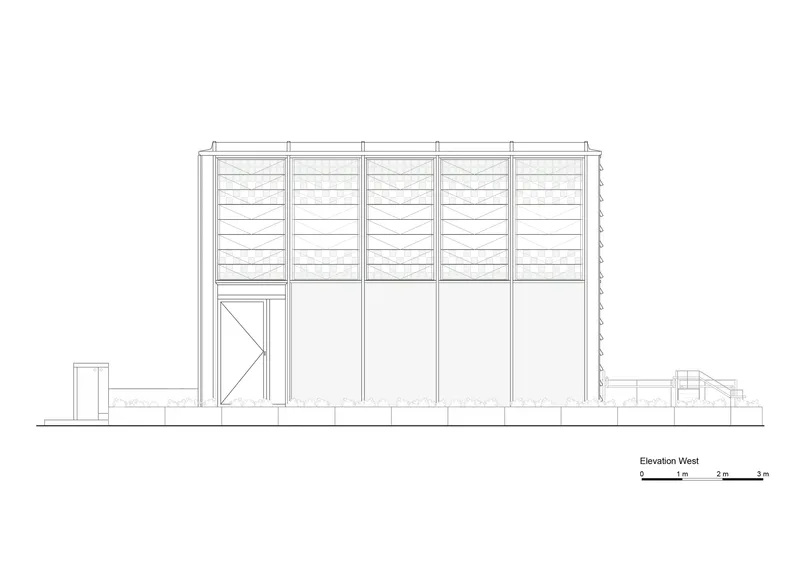
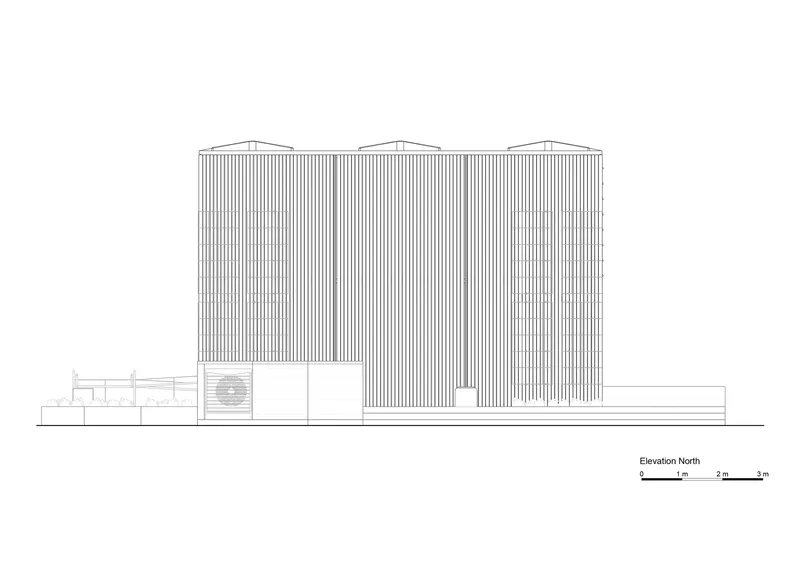
The drawing set reveals how much is packed into the compact footprint. Ground and first floor plans show the stair core, kitchen, and open living area organized around a central service spine. The sections expose the diagonal cross-bracing that gives the timber frame its lateral stiffness, the mezzanine sleeping levels, and the curved vault roof forms that create pockets of volume above the top floor. The exploded isometric is especially instructive: it decomposes the building into its layered assembly of roof, wall, and floor components, making the modular logic legible at a glance. Four elevation drawings confirm the tonal shift between the corrugated metal cladding, the horizontal louver screens, and the glazed entry bays.
Why This Project Matters
The Solar Decathlon has always been better at generating prototypes than at getting them built at scale. Team MIMO's contribution is honest about that tension. The House Demonstration Unit is exactly what its name says: a demonstration, not a finished product. Its value lies in proving that glue-free solid-wood modules, a responsive climate shell, and a tight communal plan can work together as a system. An interdisciplinary team of 18 professors, roughly 70 students, and 10 staff from all seven departments of the university collaborated to produce it. That breadth of input shows in the building's refusal to privilege any single performance metric over the others.
If the full-scale version of this project ever gets built in the Rhein-Ruhr region, it will face real tests that a competition prototype cannot simulate: long-term wear, tenant turnover, maintenance budgets, fire code negotiations over those beautiful curtain dividers. But the thinking is right. Sufficiency, reversibility, and communal generosity are not trends. They are the baseline requirements for housing that deserves to be called sustainable, and Team MIMO has built a credible argument for all three.
Sustainable Research Building (House Demonstration Unit) by Team MIMO and the University of Applied Sciences Düsseldorf. Wuppertal, Germany. Completed 2022. Photography by Marvin Hillebrand.
About the Studio
Share Your Own Work on uni.xyz
If projects like this are the kind of work you want to make, uni.xyz is a place to publish your own, find collaborators, and enter design competitions.


Popular Articles
Popular articles from the community

Faces of the Soviet Avant-Garde: Turning Moscow's Street Names into an Open-Air Museum
A network of sculptural installations across a Moscow residential district transforms forgotten architect names into spatial encounters with cultural memor

The Amber Palace Opera: A Geological Fiction Surfaces on Tallinn's Baltic Waterfront
Pierre Brillard reimagines a Baltic legend as a public landscape, opera house, and waterfront promenade rooted in Tallinn's coastal identity.
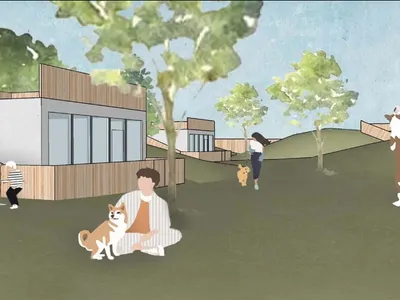
Temporary Home for Dogs: A Reversed Zoo Rethinks Animal Shelter Architecture
In Bucharest, a sinuous corridor and freed landscape flip the logic of containment, designing a shelter that works to make itself unnecessary.

Opera on the Sea: Driftwood Logic Shapes a Timber Opera House on Estonia's Coast
Trevor Orgill's opera house translates the entangled drift of floating timber into a civic building where wood, water, and music converge.

Similar Reads
You might also enjoy these articles

Pixel Gardens: One Repeated Module Stacked Into a Terraced Social Housing Tower for Famagusta
Salem Bader's shortlisted housing tower builds a vertical neighbourhood from one repeated module, offsetting units to carve terraces, light and air.

Bao Huynh Watercolor Atelier: A Serene Art Retreat in Hội An
Bao Huynh Watercolor Atelier in Hội An blends multifunctional art spaces, sustainable design, local materials, and family-friendly living in a serene environment.

Atelier Macri Concept Store Interior Design by CASE-REAL
Atelier Macri store features a "ko" counter, walnut wood details, cork displays, blending retail, gallery, and seamless customer experiences.

Manuel Vargas Izquierdo Stadium and High-Performance Sports Center: Architectural Excellence in Jalpa de Méndez
The Manuel Vargas Izquierdo Stadium blends sustainable design, inclusive sports facilities, and cultural-inspired architecture, revitalizing Jalpa de Méndez’s public spaces.

Explore Green Building Competitions
Discover active competitions in this discipline

Challenge to design public laboratory

Design challenge to reuse E-waste
Comments (0)
Please login or sign up to add comments
No comments yet. Be the first to comment!