

TechnoFarm: A Warehouse Reborn as a Modular Vertical Farm for Urban Food Production
An adaptive warehouse conversion pairs robotic harvesting with public markets and education spaces to close the gap between farm and fork.


What if the warehouse at the edge of town grew your dinner? TechnoFarm takes an existing warehouse shell and fills it with vertical grow beds, robotic harvesting rails, and perforated mesh screens, producing up to 390% more food per square foot than conventional farming. The result is not just a farm but a civic building: part market, part classroom, part urban park, all organized around the premise that food production belongs inside the city, not hours away from it.
Designed by Polina Kirsanova, Daria Zvereva, Sofya Barannik, and Danila Tsarkov, TechnoFarm received an Honorable Mention in the Urban Meal Mine competition. The brief challenged entrants to rethink sustainable urban food systems, and this team responded with a project that treats architecture as infrastructure for both agriculture and public life.
Inside the Section: Grow Beds, Mesh Screens, and Robotic Arms
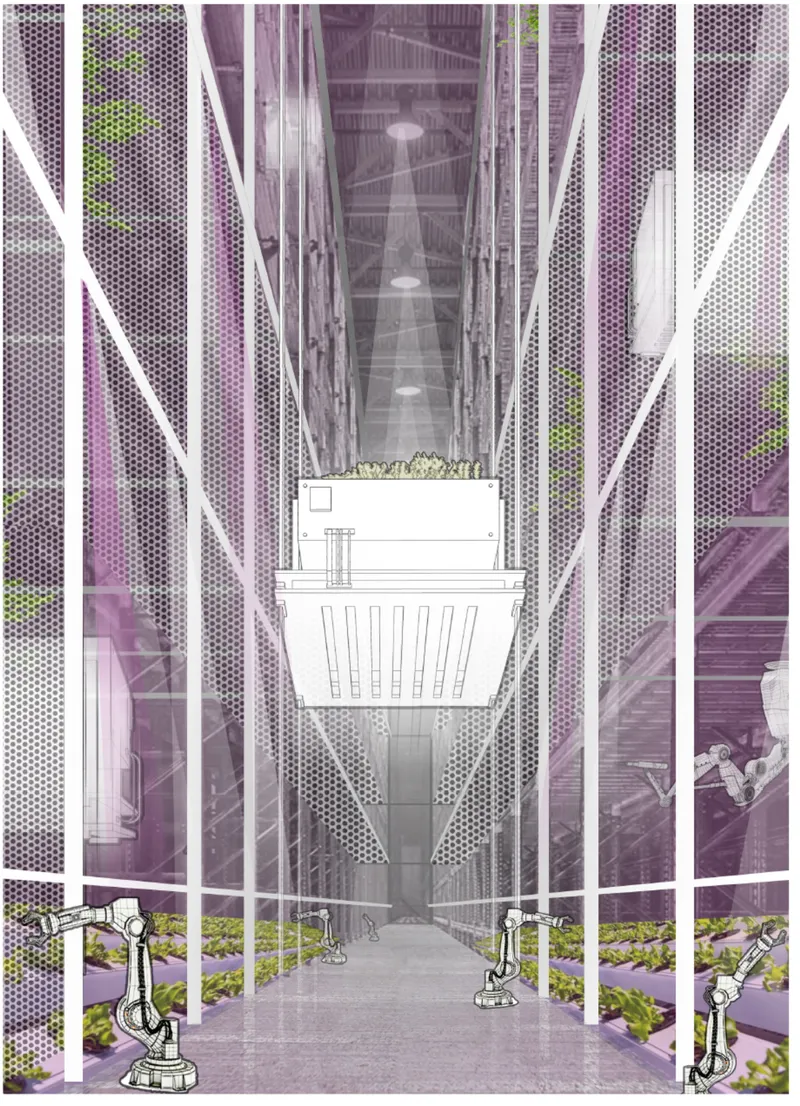
The section drawing reveals the project's operational logic. Stacked grow beds climb the full height of the converted warehouse, separated by perforated mesh screens that allow light and air to circulate while creating visual depth. Robotic harvesting systems run along rails between the tiers, replacing the need for constant human labor with autonomous precision. The architecture reads less like a traditional farm and more like a controlled environment laboratory, yet the openness of the mesh keeps the interior legible from multiple vantage points.
This is where TechnoFarm's claim of 390% increased yield per square foot becomes spatially credible. By going vertical within an existing structural envelope, the designers avoid new construction while dramatically multiplying productive area. The self-sufficient systems, from climate control to automated harvest cycles, reduce reliance on traditional agricultural methods and position the building as a genuinely autonomous food source within the city.
Programme Stacking: From Harvest Rail to Market Floor to Education Center

The axonometric diagram breaks the complex into its programmatic zones, and the layering is deliberate. The harvest rail system occupies the upper and deeper portions of the building, where climate conditions can be most tightly controlled. Below and alongside it sit the retail spaces, wholesale markets, and logistics areas that handle the efficient circulation of goods from grow bed to consumer. An education center provides a public interface, offering cultural programs, knowledge sharing, and direct interaction with the farming process.
What makes this arrangement compelling is the transparency it builds into the food supply chain. Citizens do not just buy produce here; they see it growing, moving along harvest rails, and arriving at market stalls. The designers frame this as a strategy to cultivate what they call the "future consumer," someone conscious of sustainability and health, shaped by the built environment they inhabit. The architecture does not simply house agriculture; it performs it publicly.
Street Life and the Illuminated Greenhouse Roof
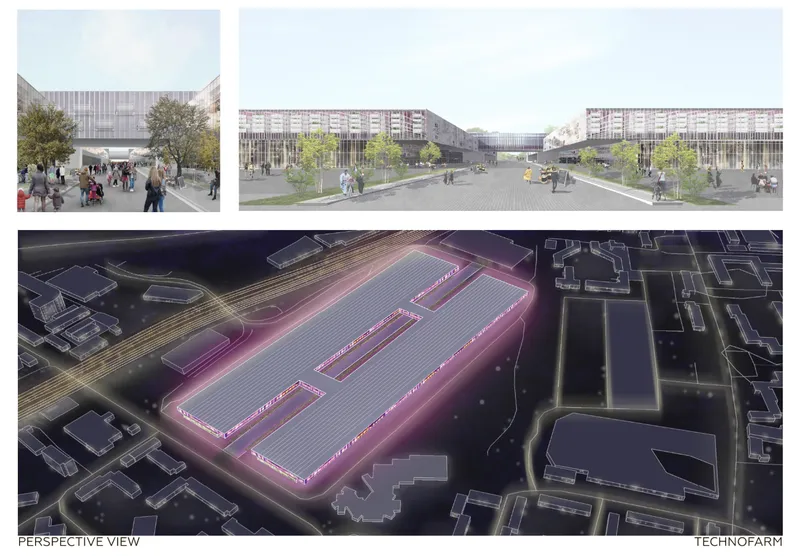
The rendering compilation shows TechnoFarm at three scales: the entrance plaza filled with pedestrians, the street view framed by trees, and the night aerial revealing the greenhouse roof glowing above the city. Together, these views argue that a vertical farm can be a genuine piece of urban fabric. The entrance plaza is generous, suggesting that the building functions as a destination, not just a production facility. Restaurants, parks, and recreational areas reinforce the idea that this is an ecosystem where sustainable living folds into daily routines.
The night aerial is particularly effective. The illuminated roof registers the building's agricultural function from a distance, turning the grow lights into an urban landmark. It is a simple move with a strong signal: food production is happening here, visibly, around the clock. That legibility matters in a project concerned with reconnecting citizens to the systems that feed them.
Modularity as a Long Game
One of TechnoFarm's most pragmatic strengths is its modular framework. The vertical farm components are designed to evolve with technological advancements without requiring major demolition or reconstruction. As grow light efficiency improves, as robotic systems become more capable, or as new crops demand different spatial configurations, the modular structure absorbs those changes. This is not architecture frozen at the moment of completion; it is a chassis built for iteration, and that flexibility gives the project resilience against both environmental and economic uncertainty.
Why This Project Matters
TechnoFarm resists the temptation to treat vertical farming as a standalone technological spectacle. Instead, it embeds production within a larger civic programme of markets, education, and public space, making the case that urban agriculture only succeeds when it is woven into the social life of a city. The warehouse conversion strategy is economical and replicable, and the 390% yield increase offers a concrete metric that moves the conversation beyond speculation.
Kirsanova, Zvereva, Barannik, and Tsarkov demonstrate that sustainable architecture is not only about reducing harm but about building new relationships between people and the systems that sustain them. By making food production visible, accessible, and integrated with commerce and culture, TechnoFarm proposes a future where the distance between farm and table is measured in footsteps, not freight miles.
View the Full Project
About the Designers
Designers: Polina Kirsanova, Daria Zvereva, Sofya Barannik, Danila Tsarkov
Enter a Design Competition on uni.xyz
uni.xyz runs architecture and design competitions year-round that reward proposals with spatial conviction and real site intelligence.
Project credits: TechnoFarm by Polina Kirsanova, Daria Zvereva, Sofya Barannik, Danila Tsarkov Urban Meal Mine (uni.xyz).


Popular Articles
Popular articles from the community


Tsunami Convergenics: Turning Catastrophic Ocean Forces into Underwater Housing Infrastructure
A speculative underwater settlement off the coast of Onagawa, Japan, treats tsunamis and typhoons as energy sources rather than threats.

Opera by the Sea Estonia: Three Shells Dissolving Architecture into Tallinn's Coastline
A winning opera house proposal replaces monumental form with interconnected shells that blur the boundary between building, park and Baltic Sea.

Manzana Morphosis: Stretching Barcelona's Grid into a Living Landscape for 2050
A radical reworking of the Eixample manzana turns density into a tool for generous public space, vertical ecology, and environmental performance.

Opera on the Sea: Driftwood Logic Shapes a Timber Opera House on Estonia's Coast
Trevor Orgill's opera house translates the entangled drift of floating timber into a civic building where wood, water, and music converge.

Similar Reads
You might also enjoy these articles

Pixel Gardens: One Repeated Module Stacked Into a Terraced Social Housing Tower for Famagusta
Salem Bader's shortlisted housing tower builds a vertical neighbourhood from one repeated module, offsetting units to carve terraces, light and air.

Bao Huynh Watercolor Atelier: A Serene Art Retreat in Hội An
Bao Huynh Watercolor Atelier in Hội An blends multifunctional art spaces, sustainable design, local materials, and family-friendly living in a serene environment.

Atelier Macri Concept Store Interior Design by CASE-REAL
Atelier Macri store features a "ko" counter, walnut wood details, cork displays, blending retail, gallery, and seamless customer experiences.

Manuel Vargas Izquierdo Stadium and High-Performance Sports Center: Architectural Excellence in Jalpa de Méndez
The Manuel Vargas Izquierdo Stadium blends sustainable design, inclusive sports facilities, and cultural-inspired architecture, revitalizing Jalpa de Méndez’s public spaces.

Comments (0)
Please login or sign up to add comments
No comments yet. Be the first to comment!