

Technological Cooperatives Headquarters by Carlos Antonio Pérez Hernández: Innovative Adaptive Reuse in San Juan de Los
Technological Cooperatives by Carlos Antonio Pérez Hernández transforms abandoned Venezuelan buildings into a functional, sustainable, and modern technology campus with industrial aesthetics.


In the heart of San Juan de Los Morros, Guárico, Venezuela, the Technological Cooperatives project, designed by Carlos Antonio Pérez Hernández, transforms abandoned urban structures into a cutting-edge technology campus. The initiative, commissioned by the Venezuelan Federal Council of Government, revitalized two previously neglected buildings to create the new headquarters for Alcaraván Technological Systems, a company specializing in software, hardware, and technological innovation.

This ambitious project encompasses an area of 1,750 m² and was photographed extensively by Julio César Mesa, capturing both the raw architectural character and the functional design of the complex.


Adaptive Reuse During a Global Crisis
The project began in July 2020, during one of the most challenging periods of the COVID-19 pandemic, which significantly influenced the planning, execution, and safety protocols. The project was divided into two stages for efficiency:
- Stage One: Refurbishment of two existing buildings, referred to as Buildings 02 and 03, completed within three months.
- Stage Two: Construction of a new annex building, executed over eight months, along with landscaping, exterior areas, and connective infrastructure.
The architects approached the limited resources and pandemic constraints as an opportunity to demonstrate that sustainable, efficient design could be achieved with local materials, simple construction inputs, and a focus on durability and warmth.


Design and Spatial Planning
Programmatically, the complex was designed as a modern office building integrated with collective-use areas including an auditorium, dining hall, multipurpose rooms, and a food production school. Buildings 02 and 03 accommodate the majority of office spaces, services, and vertical circulation, while the annex building focuses on communal and multifunctional spaces.
The development unfolds across four levels: semi-basement, ground floor, level 1, and level 2:
- Semi-basement: Collective-use activities with independent access.
- Ground floor: Institutional internal activities.
- Level 1: Main pedestrian access through an external staircase and multifunctional areas.
- Level 2: Private administrative and presidential areas, intentionally isolated from the annex building.
Originally designed as social housing, Buildings 02 and 03 posed spatial constraints with structural axes every 3 meters and slab heights of 2.50 meters. Nearly all internal walls were demolished to maximize usable space, creating open, adaptable interiors.


Materiality and Aesthetic Approach
The design exposed concrete beams and columns, while mechanical, sanitary, and electrical systems were organized in ceiling trays. This intentional exposure gives the complex a technological-industrial aesthetic while maintaining practicality.
Facades were designed to mitigate solar gain and optimize natural light, using cement block sunshades, rustic friezes, and perforated clay blocks in service areas. Windows vary in height and are strategically positioned to balance sunlight with outdoor views, particularly of the surrounding Los Morros de San Juan natural monument.
The annex building, a unifying square volume of 15 x 15 meters, features structural axes spaced 5.5 meters apart with 2.5-meter overhangs, designed to provide solar protection while maintaining visual and functional cohesion with the existing buildings. Levels vary from 2.50 to 5.60 meters, allowing flexible interior programming.


Sustainability, Functionality, and Contemporary Identity
The project challenges traditional notions of architectural obsolescence, embracing a functionalist approach with minimal ornamentation. Every element: from plan to elevation: is designed for efficiency, practicality, and clarity, creating a contemporary technological hub that respects its context while fostering innovation.
With careful integration of local materials, a commitment to functionality, and respect for the natural surroundings, the Technological Cooperatives campus stands as a model for adaptive reuse, sustainable office design, and resilient architectural planning in Venezuela.


All photographs are works of
Julio César Mesa


Popular Articles
Popular articles from the community


David Ortega Stacks a Two-Story Mexico City Penthouse Around a Steel Stair and a Pergola-Shaded Roof Terrace
In Colonia Roma, a 300 m² penthouse uses oak joinery, a planted steel stair and a slatted roof pergola to make a new-build apartment feel like a house.

Cube Design Draws an Ecological Corridor Between Two Shenzhen Hills with the Nankai Building
Beside Shenzhen's container docks, the Nankai Building pairs stacked balconies with a climbing green screen to connect two hillsides across its height.

GROUP A Strips a 1969 Rotterdam Harbor Headquarters to Its Frame and Wraps It in Timber Louvers
In Rotterdam's M4H harbor district, Ferro Offices reuses a 1969 frame, adds one timber storey and reaches BREEAM-NL Outstanding.

Architekt Andreas Gruber Scatters 23 Dark Timber Chalets Across a South Tyrolean Forest Edge
In Molini di Tures, Amonti Chalets breaks a resort into a hamlet of gabled timber houses, with parking, storage and services pushed into the slope.

Similar Reads
You might also enjoy these articles

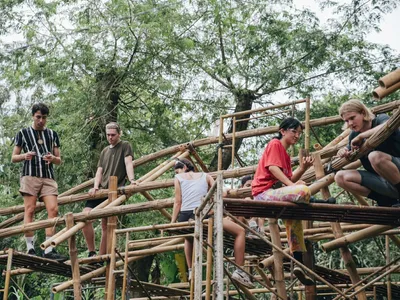
Bamboo Housing Challenge 2026: Design Affordable, Sustainable Homes Using Bamboo
An international design competition by Bamboo U and IBUKU inviting architects and designers to reimagine affordable housing using bamboo — with the winning design built full-scale in Bali.

Computational Design & Education: Beegraphy Design Awards Introduces 7th Category (Featuring Jiyun's Innovative Approach)
Dive into Beegraphy’s 7th Design Awards category, where computational design meets education to create immersive, interactive learning tools, inspired by Jiyun’s work.

From Parametric Lighting to Urban Furniture: Join the 2nd Workshop in Beegraphy’s Computational Design Series
Dive into Cutting-Edge Design Techniques and Practical Applications with Industry Experts

Last Call: Unleash Your Architectural Genius in SHAK's Kindergarten Design Competition
Urgent call for architects to join SHAK's kindergarten design competition before the looming deadline

Explore Office Building Competitions
Discover active competitions in this discipline

Challenge to reimagine the Iron Throne

Photograph architecture without architects

Illustrate the lost glory of Angkor Wat - Render Challenge

Design challenge to reuse E-waste
Comments (0)
Please login or sign up to add comments
No comments yet. Be the first to comment!