
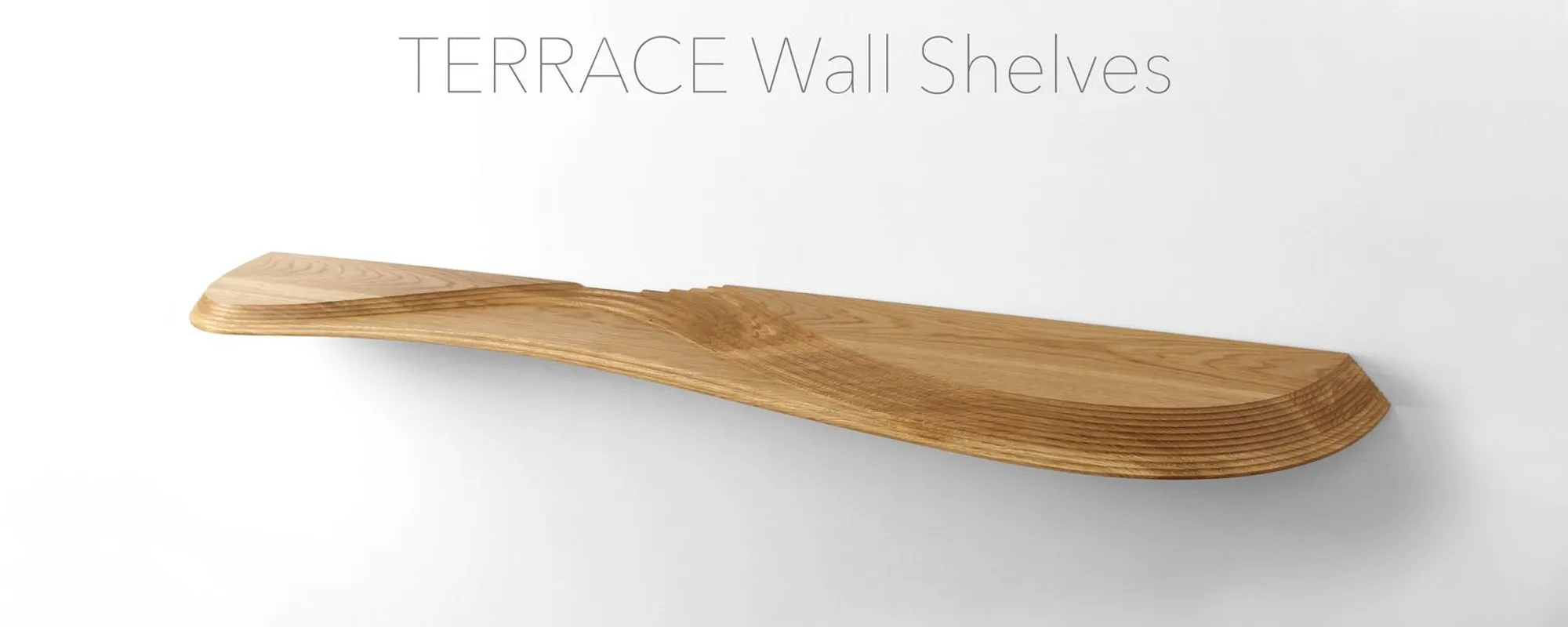
Terrace Wall Shelves: Carved Wooden Topographies for the Domestic Interior
A set of sculptural wall shelves translates the stepped contours of terrace farming into functional, light-responsive furniture.


Terrace farming has shaped mountainous landscapes across the Far East and South America for generations, carving horizontal planes into steep terrain through patient, incremental labour. The Terrace Wall Shelves take that same logic of layered topography and compress it into a domestic object: a set of three solid wood wall shelves whose swept, stepped contours reject the flat plane of conventional shelving in favour of something closer to a miniature landscape mounted on your wall.
Designed by Hemal Patel, the project received an Honorable Mention in the BOUN Furniture Design Awards '18. It sits at the intersection of furniture design, sculpture, and architectural thinking, treating a humble storage element as an opportunity to bring spatial depth, material honesty, and shifting light into the interior.
Carved Contours That Catch the Light
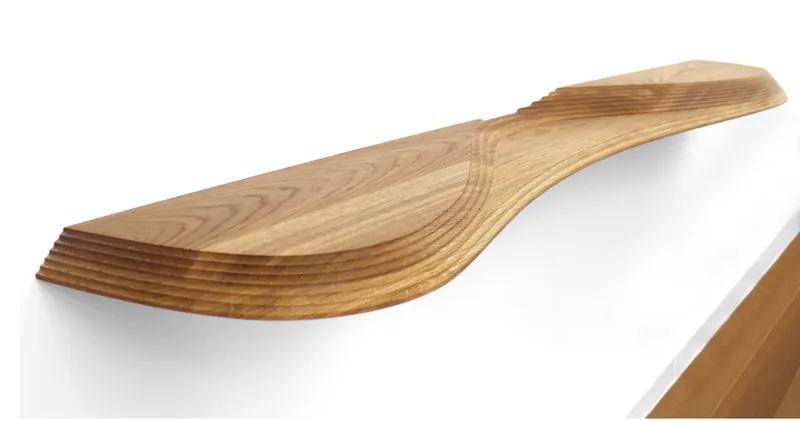
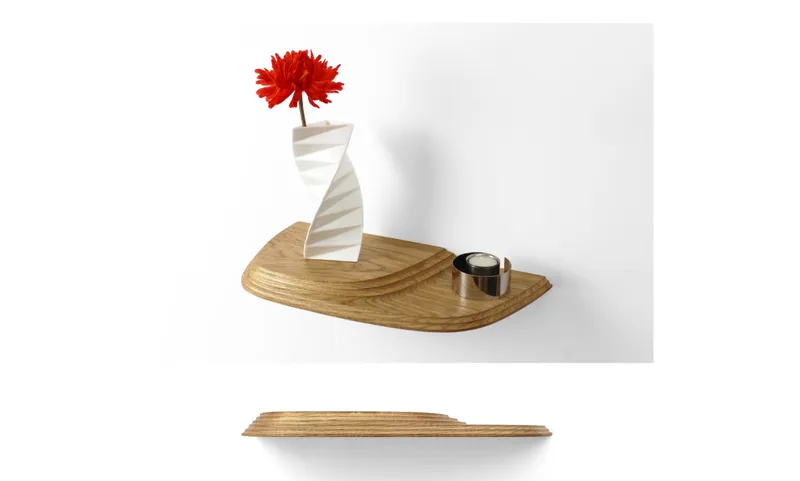
Each shelf is carved from solid wood to produce a sequence of smooth, sweeping contours that step gently across its length. These terraced platforms sit at varying heights, breaking the object free from the single-plane orthodoxy of most wall shelving. The close-up view reveals how the exposed grain follows the carved contours, reinforcing the impression that the form has been shaped rather than assembled. Light and shadow advance and retreat along these layers throughout the day, accentuating the wood's natural character and giving the piece a dynamic quality that static, rectilinear shelves simply cannot offer.
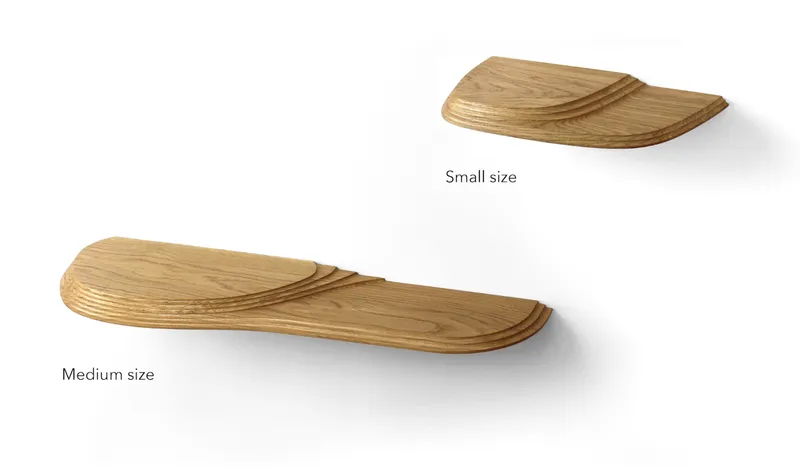
Available in three sizes (Long at approximately 180 × 29 × 5.5 cm, Medium at 100 × 26 × 3.5 cm, and Small at 49 × 21.5 × 3.3 cm), the shelves can operate as individual sculptural accents or combine into clusters that read as a continuous architectural gesture across a wall. Seen together at different scales, the proportional relationships between the pieces become clear: the same topographic language scales gracefully from a compact accent to a substantial horizontal element.
Storage as Spatial Composition
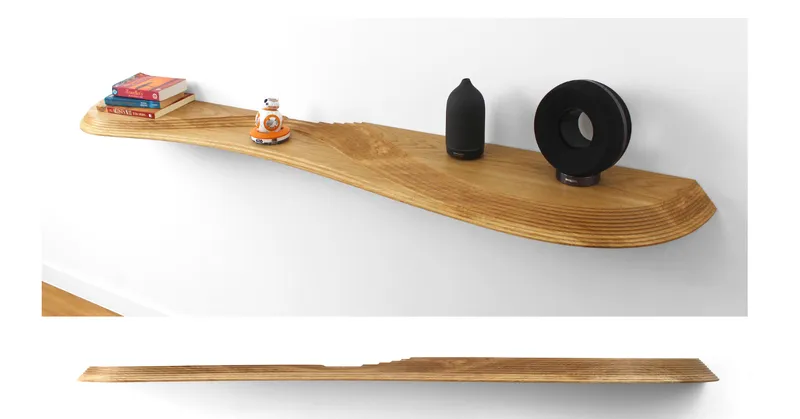
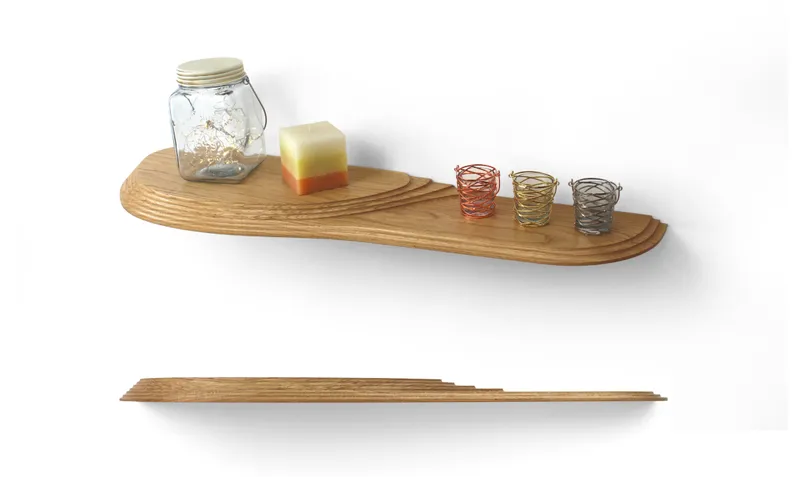
The stepped platforms do more than look interesting; they fundamentally change how objects are displayed. Books, photographs, and keepsakes settle at different levels, creating visual hierarchy and narrative rather than the uniform repetition of a flat shelf. In the profile view, a tapered edge sharpens the silhouette and makes the shelf appear to float against the wall, while the top-down perspective shows everyday objects arranged almost like elements in a curated landscape. A glass jar, a bar of soap, and wire tea light holders each occupy their own terrace, turning routine storage into an act of deliberate composition.
Patel frames this as "functional art furniture," and the term holds up. The shelves invite interaction: users treat their belongings not as items placed for convenience but as participants in a three-dimensional tableau. That shift from passive storage to active curation is what separates the project from decorative shelving that merely looks sculptural without altering behaviour.
Four Wood Species, One Craft-Driven Process
Produced in the UK, the shelves combine computer-aided machining with hand-finishing. Digital tools handle the complex carved geometry with precision and consistency, while manual work preserves the tactile warmth that only direct contact with the material can achieve. The result is a surface that feels shaped by hand even when the underlying form demanded computational accuracy. Four wood species are offered: Sapele, Maple, Oak, and American Black Walnut. Each brings a distinct colour palette and grain structure, letting the shelves adapt to contexts ranging from light, minimal interiors to darker, more intimate rooms.
Material honesty runs through every decision. There are no veneers disguising a substrate, no painted finishes masking the species beneath. The grain itself becomes ornament, following the terraced contours and reinforcing an architectural tradition in which structure, material, and form are unified rather than layered on top of one another.
Why This Project Matters
Most wall shelves aspire to invisibility: thin profiles, neutral finishes, minimal visual weight. The Terrace Wall Shelves do the opposite. They assert themselves as spatial events, bringing the depth, rhythm, and light-responsiveness of a landscape into a domestic room. By grounding the design in the millennia-old practice of terrace farming, Patel gives the object a conceptual anchor that goes beyond stylistic novelty. The form is not arbitrary; it is derived from a proven method of negotiating terrain.
At a time when furniture design frequently oscillates between minimal anonymity and loud formal gestures, the Terrace Wall Shelves occupy a rare middle ground. They are sculptural without sacrificing usability, expressive without demanding attention, and materially honest without feeling austere. For a young designer, that balance is a significant achievement, and it suggests an approach to furniture that treats every domestic surface as an opportunity for architecture at a tactile, human scale.
View the Full Project
About the Designers
Designer: Hemal Patel
Enter a Design Competition on uni.xyz
uni.xyz runs architecture and design competitions year-round that reward proposals with spatial conviction and real site intelligence.
Project credits: Terrace Wall Shelves by Hemal Patel BOUN Furniture Design Awards '18 (uni.xyz).



Popular Articles
Popular articles from the community


The Ocean Hive: Sustainable Architecture for a Self-Sufficient Civilization at Sea
The Ocean Hive imagines sustainable architecture at sea, where modular habitats, algae, wave power and ocean waste sustain a growing colony.

Conexión: Biophilic Design Reimagines High-Rise Living in Hong Kong
Conexión reimagines high-rise living in Hong Kong through biophilic design, green facades, shared spaces, daylight, water and nature within.

Lunar Spiral: Space Architecture Shaped by the Mathematics of the Universe
Lunar Spiral reimagines space architecture through Fibonacci geometry, lunar regolith, levitating habitats, and self-sustaining Moon living.

Hill & Cross Opera: Sculptural Opera House Architecture Shaped by Tallinn’s Landscape and Identity
Hill & Cross Opera reimagines opera house architecture in Tallinn through its sculptural hill, civic plaza, glass wave and a luminous cross.


Similar Reads
You might also enjoy these articles
Sustainable Architecture Design: Embracing Nature and Modernity at Villa Solsidan
The article explores Villa Solsidan by AndrénFogelström, showcasing its sustainable architecture design and integration with the natural surroundings in Saltsjöbaden, Sweden.
Scientific and Educational Monitoring Center of the Yenisei, Krasnoyarsk
Architecture as an instrument for ecological research, education, and environmental awareness along Russia’s largest river.
Development of Andretta Artist’s Village, Palampur, Himachal Pradesh, India
Reimagining Andretta as a living cultural landscape where art, architecture, and community converge to shape a global creative village.
Street Children Rehabilitation Center: A Model of Social Architecture for Community Rehabilitation
An inclusive social architecture project that transforms streets into nurturing environments, restoring dignity, identity, and opportunity for vulnerable children.


Explore Wall Shelves Competitions
Discover active competitions in this discipline


Challenge to merge furniture with learning


Design challenge to equip cities with modern furniture

Competition to design a workstation for architects


Packaging challenge - Design meets sustainability
Comments (0)
Please login or sign up to add comments
No comments yet. Be the first to comment!