

The Anchor: A Space Elevator Terminal as a City
A triangular megastructure at the top of a space elevator cable, combining orbital transit, flying car docks, research labs, and vertical farms.


A space elevator needs two things: a cable and a place to stand on at the top. The Anchor is that place. Designed by Czaka Zoltan, this project proposes a triangular megastructure that serves as the orbital terminal of a space elevator while simultaneously functioning as a vertical city: research labs, offices, vertical farms, flying car terminals, and living quarters, all housed in three interconnected towers tethered to a cable that reaches into orbit.
The project was a People's Choice Award entry in the Hybrid Futures '19: Work x Fly competition on uni.xyz. It is the most literally ambitious entry in the competition: not just a building that accommodates flight, but a building that enables spaceflight.
The Space Elevator: Architecture Beyond Atmosphere


The concept begins with the space elevator itself: a tether extending from Earth's surface through the atmosphere and into orbit. The Anchor sits at the top of this cable, a triangular station visible against the stars. The panoramic render shows the cable stretching from the curved blue horizon upward into darkness. The scale is planetary.
Space elevators have been theorised since the 1960s and remain technically speculative. But the architectural question the project asks is valid regardless of timeline: if we build one, what does the terminal look like? The Anchor answers with a habitable structure rather than a mechanical platform. The terminal is not a dock. It is a city.
The Ground Terminal: A Transit Hub
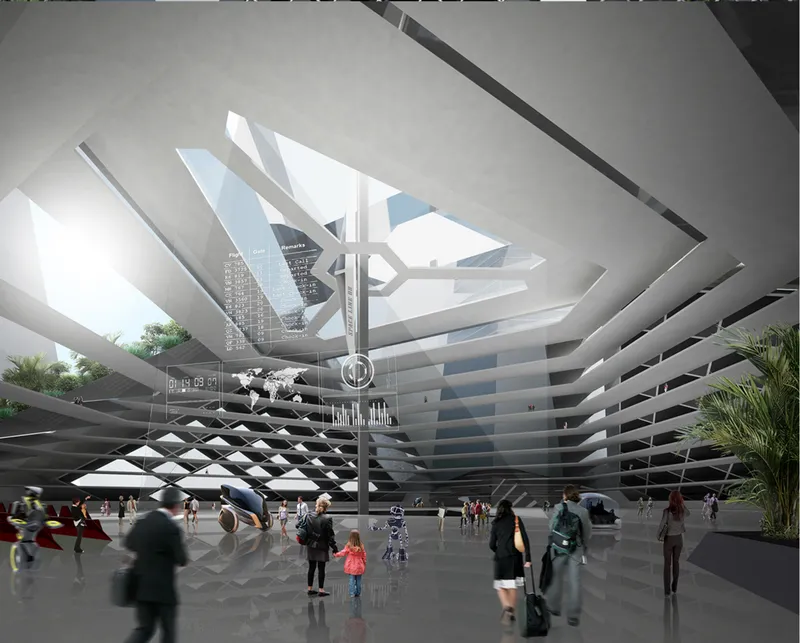
At ground level, The Anchor functions as a major transit hub. The atrium render shows an angular folded ceiling, departure information screens, a central column with global data displays, and crowds of travellers moving through the space. The atmosphere is closer to an international airport than a building lobby.
This is the space where the elevator meets the city. People arrive by flying car, drone taxi, or ground transit, pass through the terminal, and ascend. The architecture has to handle that transition, from horizontal urban movement to vertical orbital movement, in a single spatial sequence. The atrium does this by being large, clear, and directional. You know where to go because the ceiling tells you.
The Flying Car Terminal
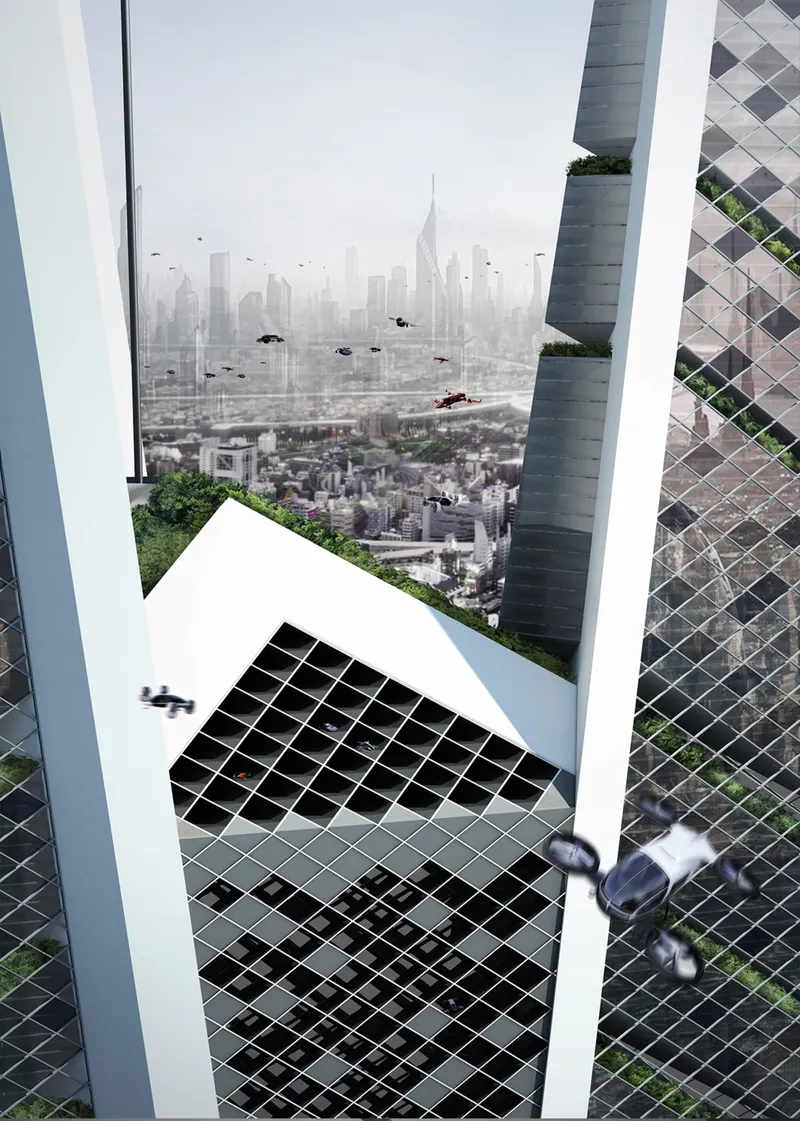
The aerial view shows the flying car infrastructure at the tower's upper levels. A gridded parking deck accommodates dozens of personal vehicles. Green terraces cascade down adjacent tower faces. Drones circle above the city skyline. The image reads as a car park, but vertical and airborne.
The integration of air mobility into the building's fabric rather than onto its roof is the key move. The parking grid is structural. The terraces between parking levels are planted. The drones have designated approach vectors. This is not a helipad bolted onto a skyscraper. It is a transport system built into the architecture from the start.
Fabrication and Smart Materials
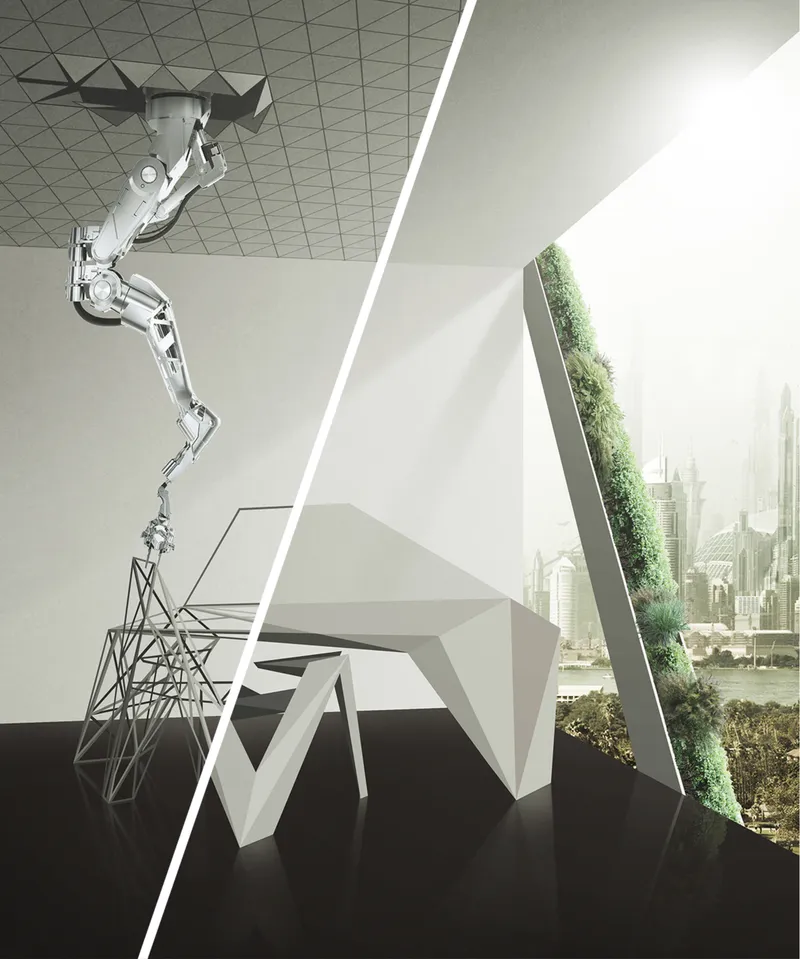
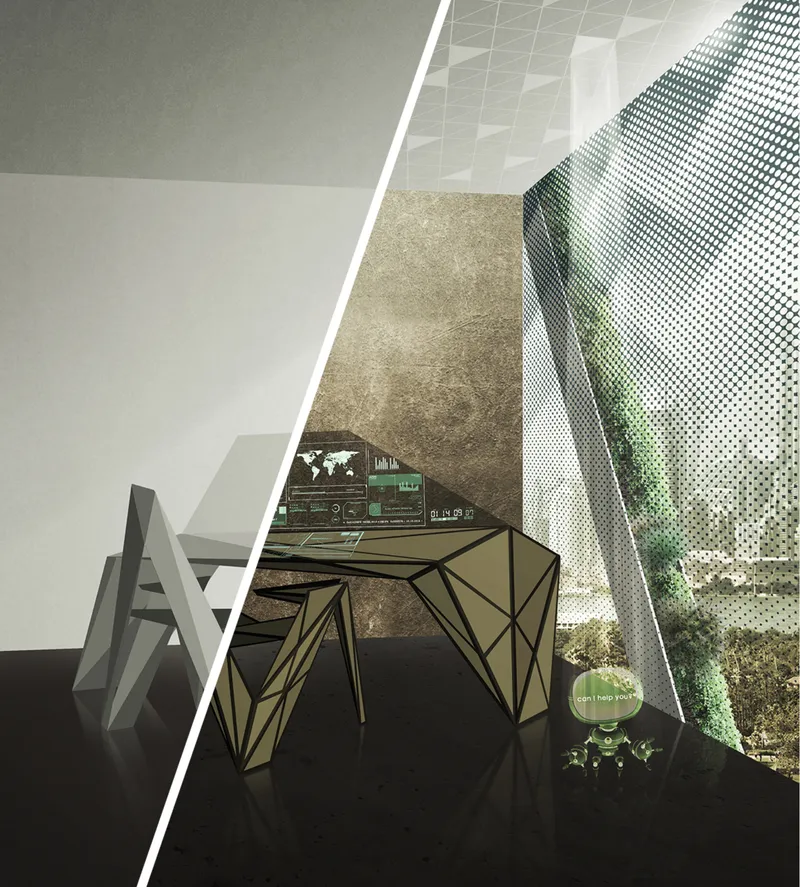
Two split-view renders show the building's technological ambitions. On one side, a robotic arm 3D-prints a structural wireframe in a fabrication lab. On the other, a vertical green facade cascades down the tower exterior. The second pair shows an angular faceted desk in a research workspace alongside a perforated facade with vertical gardens filtering daylight.
These images describe a building that makes things. The 3D printing labs produce modular construction components and recycle materials on site. The smart facades regulate shading autonomously. The vertical farms produce food. The Anchor is not a passive container for programme. It is an active machine that manufactures, grows, and adapts.
Why This Project Matters
The Hybrid Futures competition asked designers to merge work and flight. Most entries stayed within the atmosphere. The Anchor left it. That leap in ambition, from air mobility to space mobility, reframes the entire competition brief. If the future of flight includes orbit, then the building type that serves it must be fundamentally different from anything we currently build.
The project is speculative in the deepest sense. It does not propose a building for next year. It proposes a building type for a century from now and asks what that type should contain. The answer, a vertical city at the top of a cable, with labs, farms, terminals, and homes, is as complete a response as any competition entry has offered.
View the Full Project
About the Designer
Designer: Czaka Zoltan
Enter a Design Competition on uni.xyz
If space architecture, speculative megastructures, or future mobility design is the kind of work that excites you, uni.xyz runs competitions year-round that reward projects at the edge of what architecture can imagine.
Project credits: The Anchor by Czaka Zoltan. People's Choice Award entry, Hybrid Futures '19: Work x Fly (uni.xyz).




Popular Articles
Popular articles from the community


Lunar Spiral: Space Architecture Shaped by the Mathematics of the Universe
Lunar Spiral reimagines space architecture through Fibonacci geometry, lunar regolith, levitating habitats, and self-sustaining Moon living.

Conexión: Biophilic Design Reimagines High-Rise Living in Hong Kong
Conexión reimagines high-rise living in Hong Kong through biophilic design, green facades, shared spaces, daylight, water and nature within.

Riyadh For All: Intergenerational Urban Design for Active Aging in Rabat
Riyadh For All reimagines urban design in Rabat with intergenerational co-living, adaptive courtyards, and Moroccan cultural exchange today.

Hill & Cross Opera: Sculptural Opera House Architecture Shaped by Tallinn’s Landscape and Identity
Hill & Cross Opera reimagines opera house architecture in Tallinn through its sculptural hill, civic plaza, glass wave and a luminous cross.


Similar Reads
You might also enjoy these articles

Day and Night Park: A Time-Based Urban Newsstand in Beijing
A temporary urban newsstand in Beijing blending travel, light, and reading through poetic colors, compact form, and community-focused design.

Modernist Patio Renovation in El Masnou, Barcelona by Oliver Segura Arquitectura + Cebrià Arquitectura
Modernist patio renovation blending tradition and innovation with a movable pool, leveled floors, and Catalan materials in El Masnou.

Alto Residencial Coop: Cooperative Housing Development in Santiago de Compostela by Carbajo Barrios Arquitectos
A linear cooperative housing complex blending white volumes and perforated metal façades, enhancing community living, natural light, privacy, and urban integration.

Vil Genis School by BPA ARCHITECTURE – Massy, France
Vil Genis School in Massy, France, features sustainable design, south-facing classrooms, community integration, accessible spaces, and modern educational architecture.

Comments (0)
Please login or sign up to add comments
No comments yet. Be the first to comment!