

The Black Taj: A Dark Counterpart to the World's Most Famous Monument
Perforated steel, water reflections, and inverted Mughal geometry form an architecture of shadow on the banks of the Yamuna.


What if the Taj Mahal had a twin, not of white marble and light but of dark steel and shadow? The legend of the Black Taj has haunted architectural imagination for centuries: Shah Jahan allegedly planned a mirror mausoleum in black stone across the Yamuna, a structure that would complete a cosmic symmetry of love and loss. This proposal takes that myth seriously, not as historical reconstruction but as a contemporary act of architectural storytelling. The result is a building that absorbs rather than radiates, a structure of depth and interiority set against the luminous perfection of its famous counterpart.
Designed by Vignesh, Shaik Nadeem Furquan, Manthan, and Ansari, the project was shortlisted in The Black Taj competition on uni.xyz. Sited directly opposite the Taj Mahal along the Yamuna's edge, the proposal deploys perforated steel screens, tiered massing, and water-edge promenades to reinterpret Mughal spatial grammar through modern tectonics. Its axial alignment responds to the original monument's geometry of symmetry and reflection, creating what the designers describe as an architectural yin and yang of devotion and remembrance.
Dark Corridors as Mughal Promenades
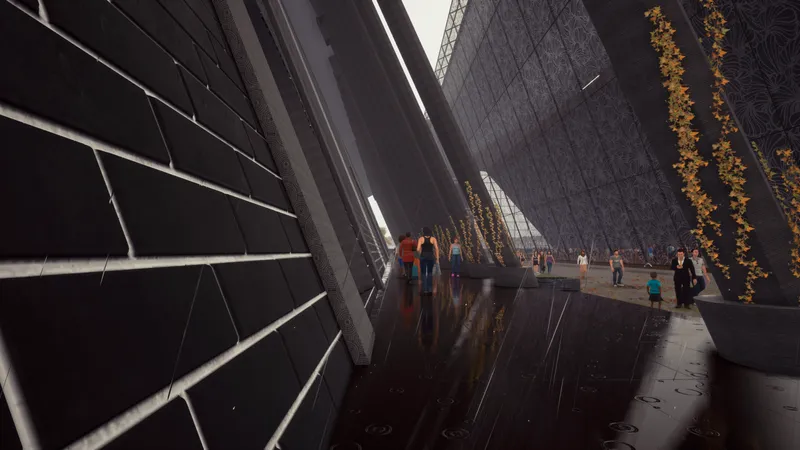
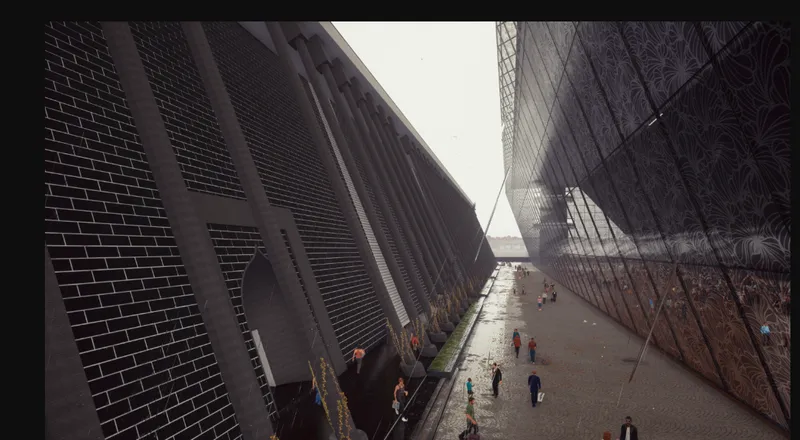
The interior corridors reinterpret the shaded walkways of the traditional charbagh garden system. Angled clerestory windows cut controlled beams of light into dark paneled passages, producing a sensory rhythm that shifts between compression and release. Visitors move through these corridors as they might move through the layered thresholds of a Mughal garden pavilion, experiencing alternating moments of shade and illumination. The materiality here is deliberate: steel and dark cladding replace marble, turning the act of passage into something weighted and contemplative rather than celebratory.
The exterior walkways between angled perforated metal facades function as contemporary jaalis, the geometric screens that defined Mughal architecture's relationship between enclosure and transparency. These perforated planes blur the boundary between interior and exterior, filtering daylight into patterned shadow. The effect is not ornamental but atmospheric; visitors walk within a constantly shifting field of light that recalls the poetic exchange between tangible form and intangible emotion that the designers sought.
A Public Ground Plane Between Monument and City
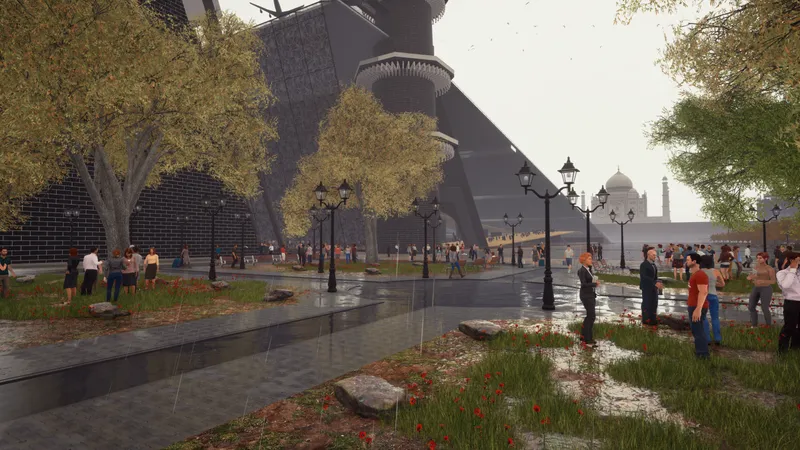

At ground level, the project opens into a public plaza with planted beds and autumn-toned trees arranged at the base of the dark perforated tower. The scale shifts here from monumental to civic, grounding the symbolic weight of the structure in everyday use. This threshold between spectacle and solitude is central to the design's experiential sequence: open courtyards and planted beds transition visitors from the wide waterfront promenade into the building's more intimate, shaded interiors.
The distant view reveals the full silhouette: a pyramidal tower volume rising from a linear waterfront promenade, its dark mass reading clearly against the Agra skyline. Sited along the Yamuna, the building floats at the river's edge, mirroring the Taj across the water while establishing its own distinct formal identity. The designers describe the Black Taj not as a competitor to the original monument's purity but as its completion, a dark mass that gives form to centuries of unspoken history.
Stepped Green Roof and Tiered Massing
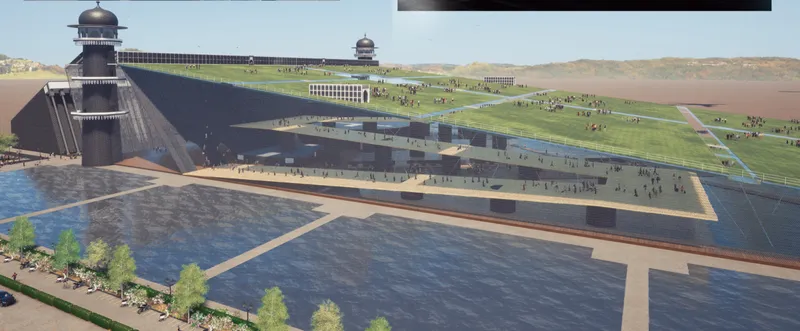
From above, the building reveals a stepped green roof cascading down from the tiered tower volume. This planted topography softens the monolithic quality of the dark facades below and introduces a landscape dimension that extends the charbagh logic vertically. The terracing creates floating outdoor platforms at multiple levels, each offering a different framed relationship to the river and to the Taj Mahal across it. The form itself evolved through a process the designers describe as negation: inversion, mirroring, and folding, beginning from the idea of a reflected negative and arriving at a solid structure suspended above water.
Reading the Full Proposal

The presentation board collages together the waterfront tower, the promenade sequence, and detail images that track the design from early conceptual sketches to the final resolved form. Each plane, ramp, and surface is documented as part of a larger sensory narrative: one that moves from the scale of the city down to the grain of a perforated screen casting shadow on a corridor floor. The central void, visible in cross section, operates as what the designers call a contemplative chamber for reflection, mourning, and rediscovery, giving the building a spatial heart that is absence rather than mass.
Why This Project Matters
The legend of the Black Taj is almost certainly apocryphal, a reflection on dark marble seen in the Yamuna's surface rather than evidence of a planned structure. But the myth persists because it addresses something architecture rarely confronts head on: the idea that a building's most powerful counterpart is not another building but a shadow, a negative, an absence. This proposal takes that provocation and gives it disciplined spatial form, using modern materials and construction logic to produce something that reads as both ancient and forward-looking.
What distinguishes the work of Vignesh, Shaik Nadeem Furquan, Manthan, and Ansari is their refusal to treat the Mughal reference as decoration. The charbagh becomes a sectional landscape. The jaali becomes a structural screen. The axis of symmetry becomes a site strategy that positions the building in literal dialogue with the Taj Mahal across the Yamuna. The result is an architecture where form follows emotion as much as function, turning a myth into a credible proposition for how heritage and contemporary design can occupy the same ground.
View the Full Project
About the Designers
Designers: Vignesh, Shaik Nadeem Furquan, Manthan, Ansari
Enter a Design Competition on uni.xyz
uni.xyz runs architecture and design competitions year-round that reward proposals with spatial conviction and real site intelligence.
Project credits: THE BLACK TAJ - ZWEE40 by Vignesh, Shaik Nadeem Furquan, Manthan, Ansari The Black Taj (uni.xyz).


Popular Articles
Popular articles from the community


Opera on the Sea: Driftwood Logic Shapes a Timber Opera House on Estonia's Coast
Trevor Orgill's opera house translates the entangled drift of floating timber into a civic building where wood, water, and music converge.

Aquadapt: An Underwater Habitat That Rewrites Its Rooms by the Hour
Curved modules ring the seabed while one shell shifts from breakfast room to cinema, farm and football pitch as residents' needs change.


FCC Arquitectura Expands a Portuguese Granite House with a Board-Marked Concrete Wing
In Portugal, JV House pairs a cleaned-up whitewashed and granite dwelling with a timber-shuttered concrete extension, courtyards and a garden pool.

Cube Design Draws an Ecological Corridor Between Two Shenzhen Hills with the Nankai Building
Beside Shenzhen's container docks, the Nankai Building pairs stacked balconies with a climbing green screen to connect two hillsides across its height.

Similar Reads
You might also enjoy these articles
Yenisei Monitoring Center: A Sun-and-Moon Sphere Anchors a Research Campus on Siberia's Great River
In Krasnoyarsk, shifting square blocks, a glazed central sphere and descending window rhythms turn river science into a public spectacle on the Yenisei.
Andretta Artist's Village: A Node-Based Masterplan That Lets the Hills Write the Plan
A cultural landscape strategy for Palampur's artist colony threads studios, residences and stages along a porous spine shaped by the Dhauladhar terrain.
Street Children Rehabilitation Center: A Brick Campus That Eases Children From Street to Safety
A low-rise courtyard campus where learning streets, uthans and shaded verandahs stage a gradual passage from street into protective, family-scale life.

The NEON Culture: A Field of Pavilions Built for the 24-Hour City
Smaran Alva spreads galleries, stages, clubs and markets across a varied site, treating light, sound and ramped movement as the real building materials.

Explore The Black Taj Competitions
Discover active competitions in this discipline

Challenge to reimagine the Iron Throne

Photograph architecture without architects

Illustrate the lost glory of Angkor Wat - Render Challenge

Bring back Drive In's
Comments (0)
Please login or sign up to add comments
No comments yet. Be the first to comment!