
The Frankfurt Prototype: Modular Timber Housing
Barkow Leibinger and Frankfurt students built a modular prototype with a market hall, student housing, and a biodiversity tower from recycled materials.


In a courtyard between historic buildings in Frankfurt, a temporary structure rises on steel columns. The Frankfurt Prototype, developed with Barkow Leibinger and built by students from the Stadelschule and Frankfurt University of Applied Sciences, is a two-storey modular building that combines a ground floor market hall with upper level student housing. It is a prototype: a working test of how modular timber construction, recycled steel, and biodiversity-integrated design can produce urban buildings that are temporary, reusable, and alive.
The project is part research, part architecture, part exhibition. The ground floor is an open market hall for events and cultural exchange. The upper floor holds prefabricated residential modules for students. A vertical tower of stacked timber frames holds plants, screens, and a biodiversity programme developed with the Senckenberg Society. A transparent geodesic dome sits on the roof. Nothing about this building is conventional, and that is the point.
The Structure: Steel, Timber, and Modules
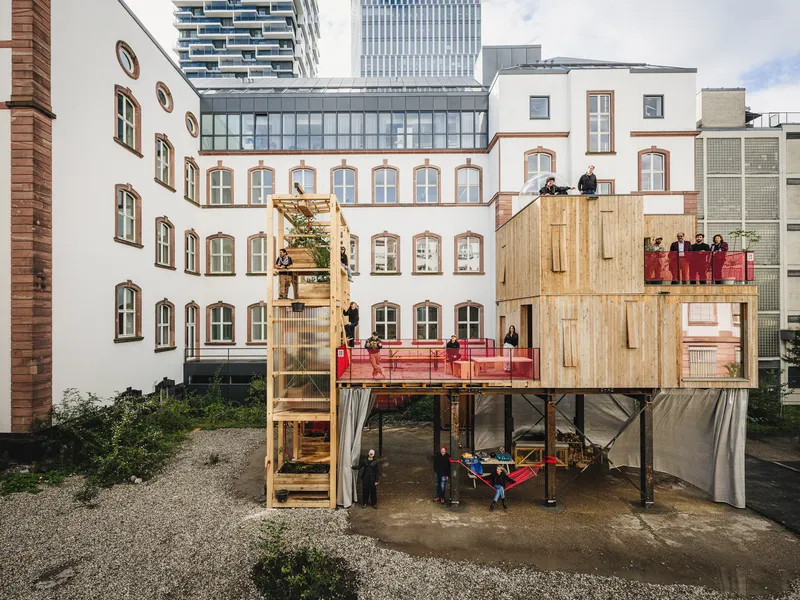
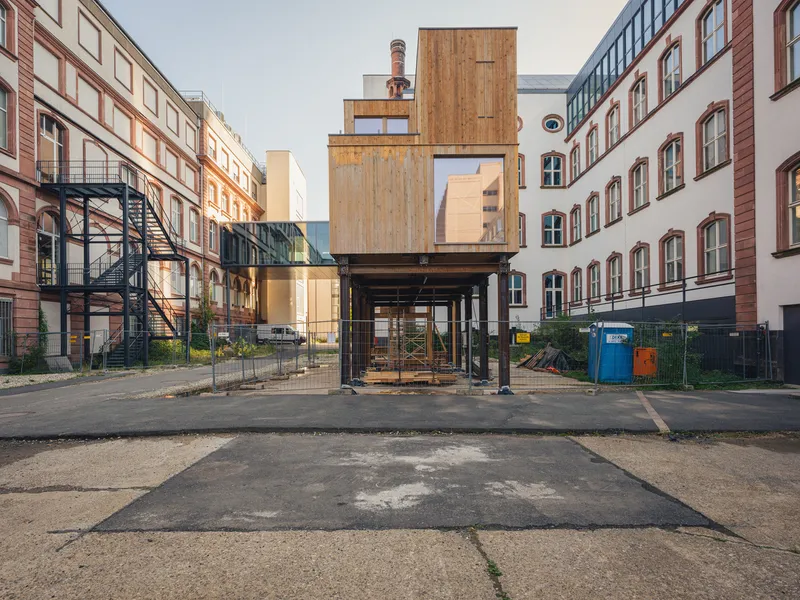
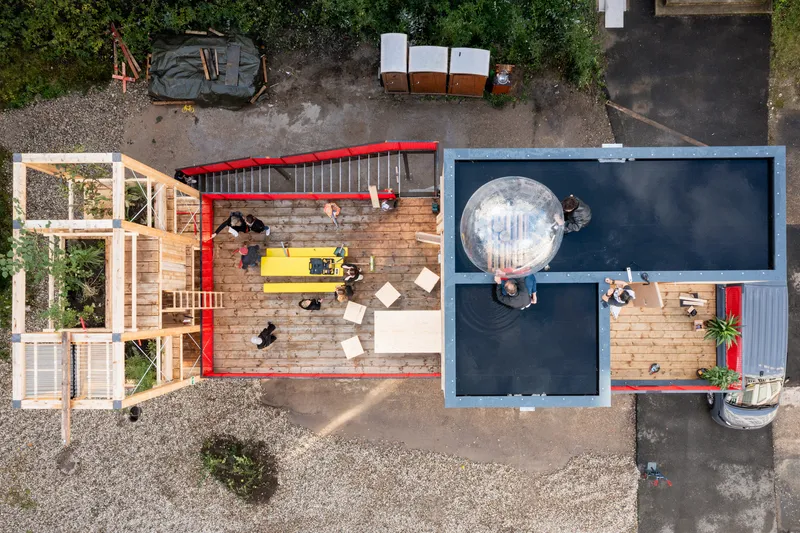
The ground floor is a steel frame raised on columns, creating an open market hall that can be configured for events, exhibitions, and gatherings. The upper floor sits on this frame: prefabricated timber-clad residential modules and an open terrace with a red steel balustrade. The structure is deliberately legible. You can see the steel columns, the timber modules, the connections, and the services. This is a building that shows how it was made because showing how it was made is part of its purpose.
Night: The Prototype as Event
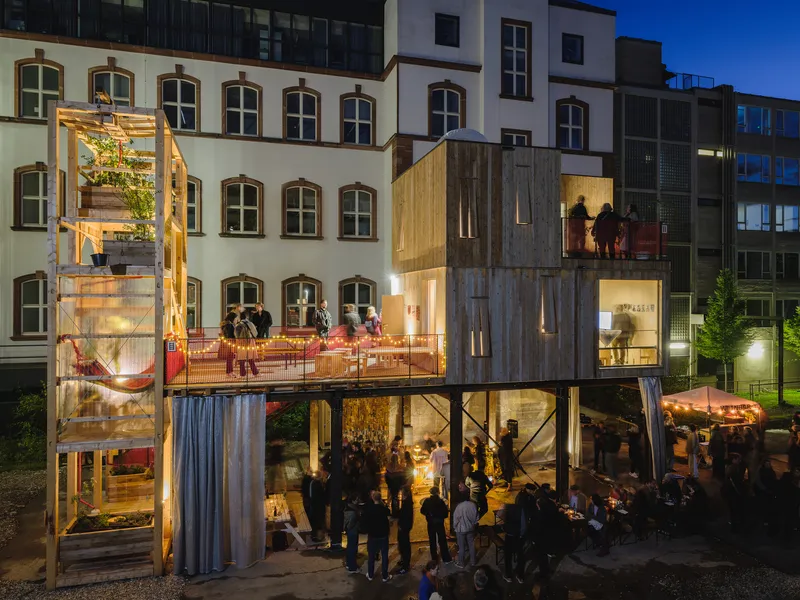
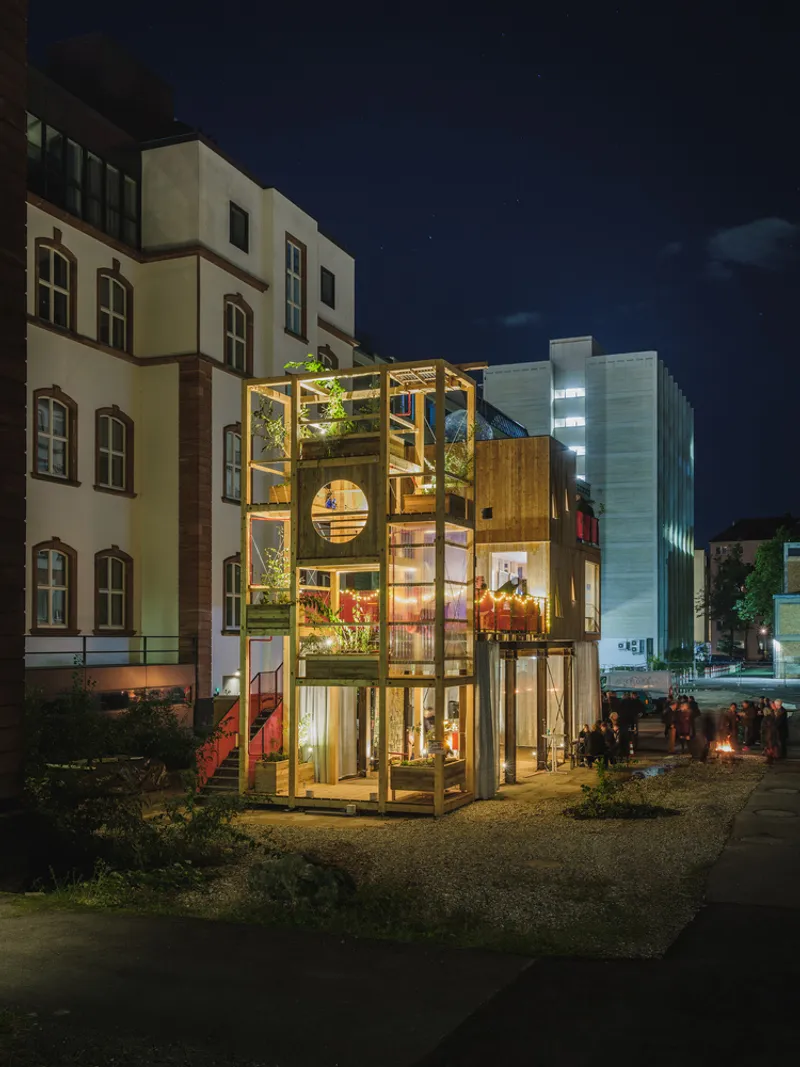
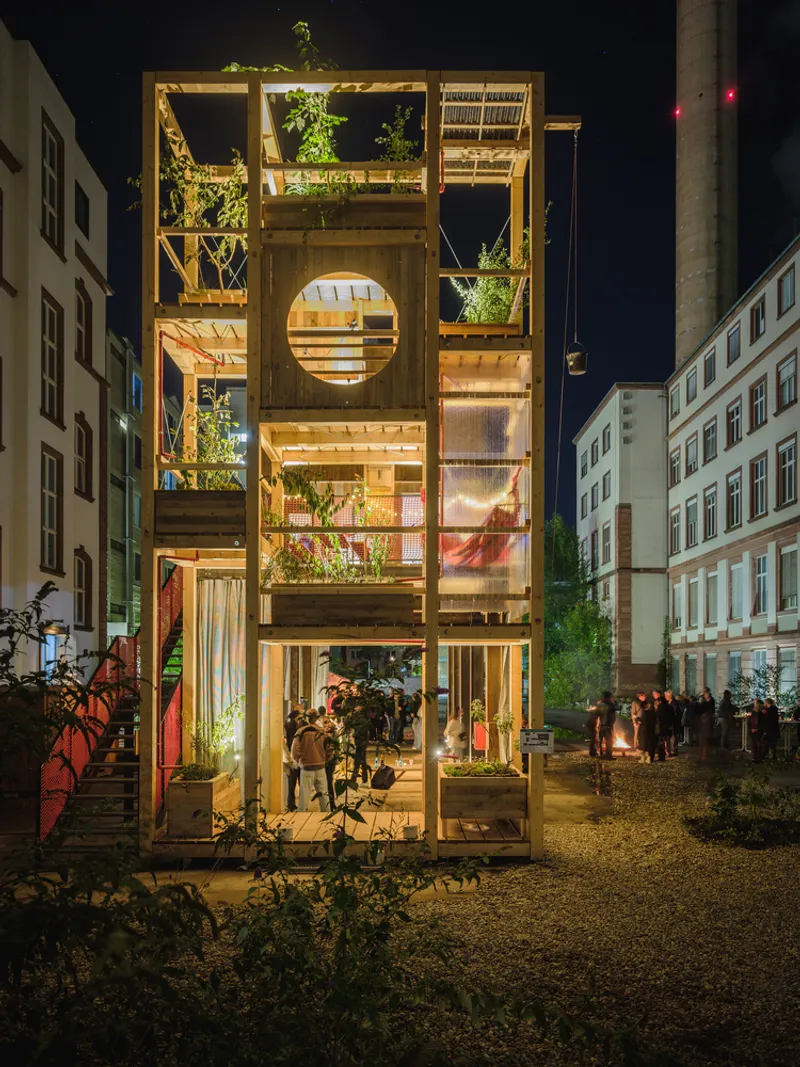
The best photographs are taken at night. The market hall glows with pendant lights. People gather at tables below. The residential modules are lit from within, showing the timber interiors. The tower element is the most theatrical: four levels of open timber frames with plants, decorative screens, and warm light. At night, the Frankfurt Prototype stops being a building and becomes an event. The crowd, the lights, the plants, and the timber create an atmosphere that no finished building could match.
The Tower: Plants and Biodiversity
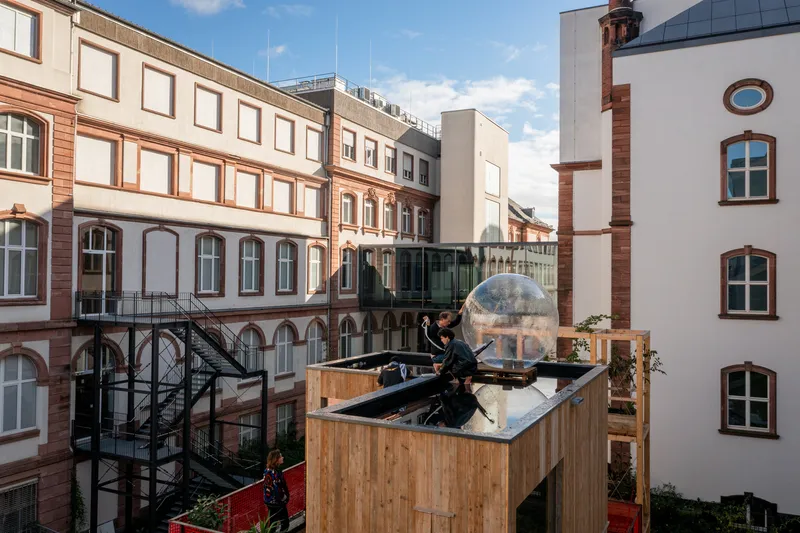
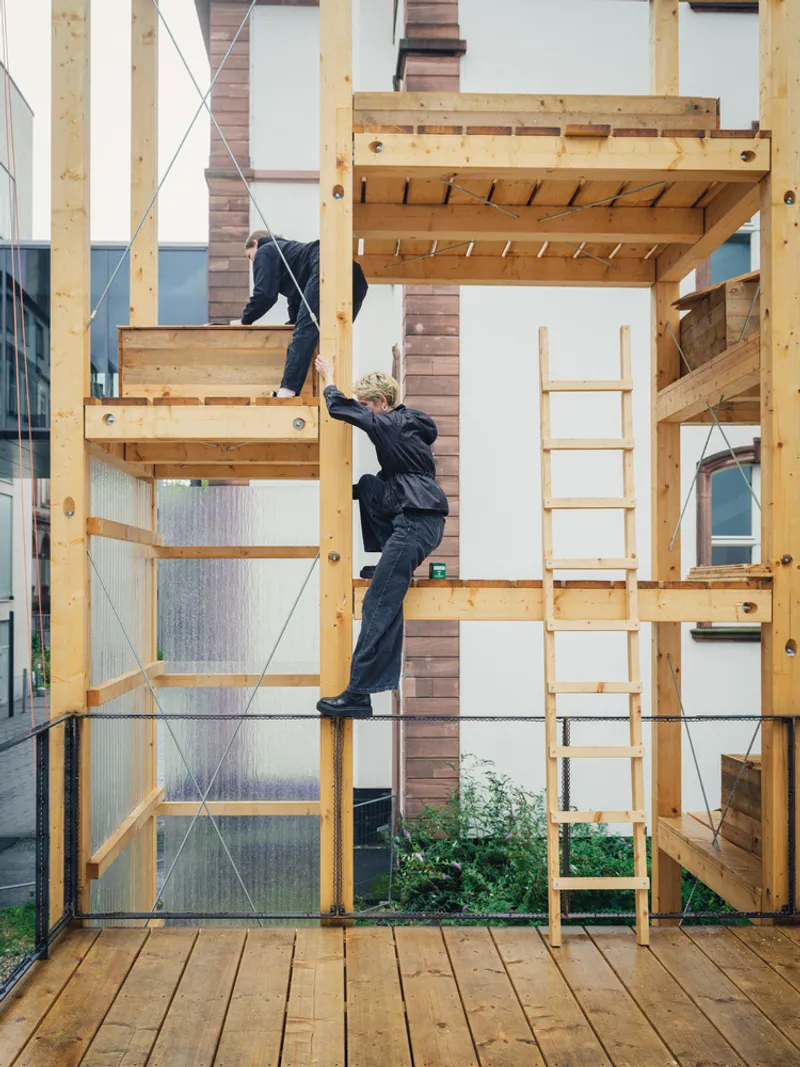
The vertical tower is an open timber frame stacked four levels high. Each level holds a different programme: plants, screens, a small enclosed room, and an open platform. The tower is the biodiversity element, developed with the Senckenberg Society. Plants grow at every level. The timber frames provide habitat. A transparent geodesic dome sits on the roof of the adjacent residential module, creating a greenhouse effect. The tower is not structure. It is landscape, stacked vertically.
Interior: Plywood Gallery
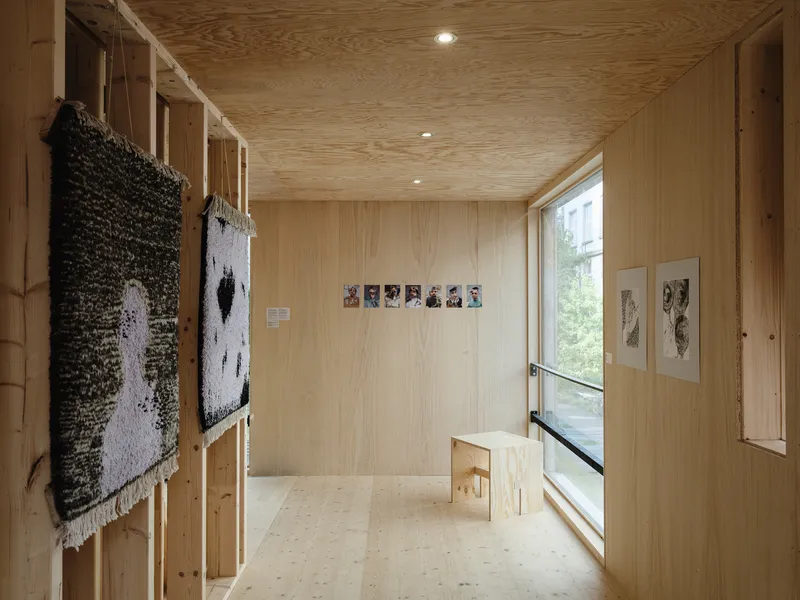
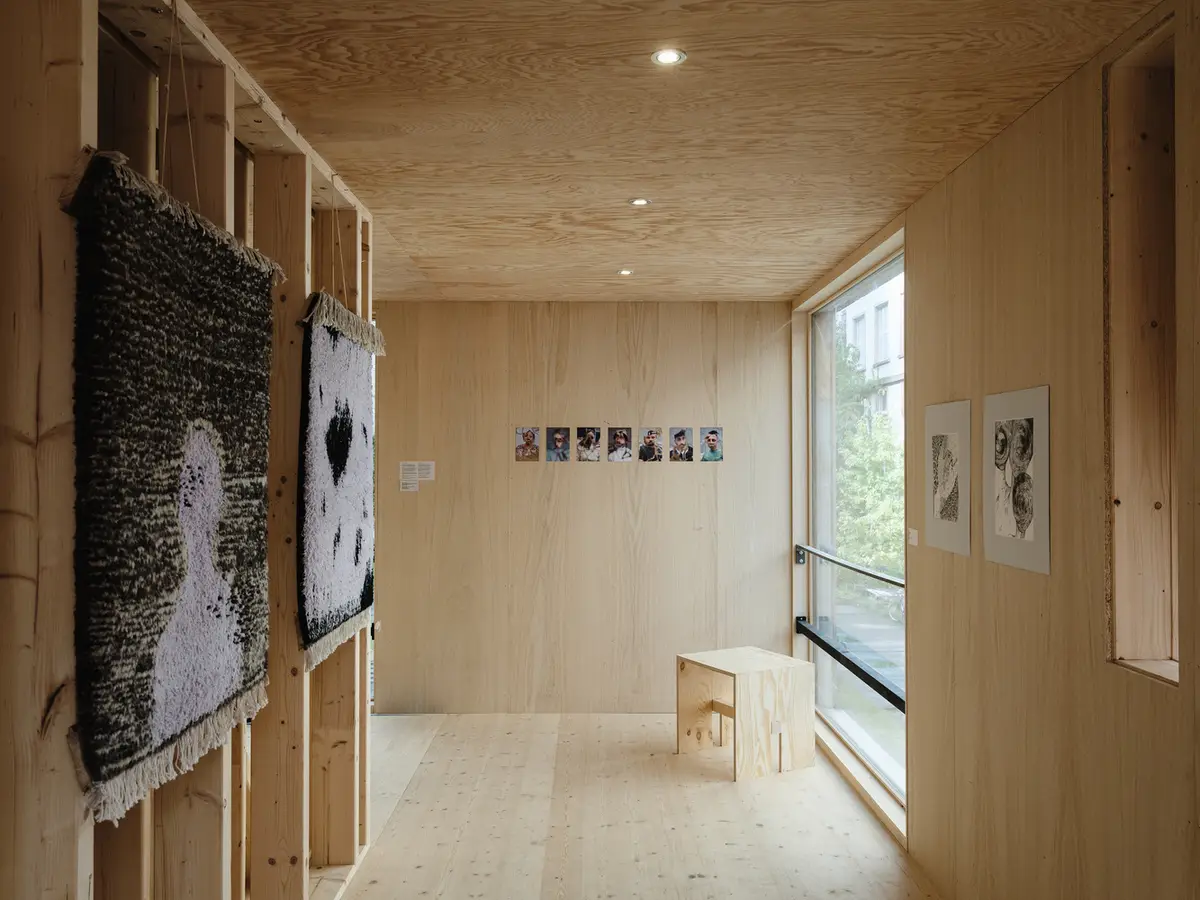
Inside one of the modules, the walls and ceiling are lined in plywood. A textile artwork hangs on one wall. Photographs are pinned along the corridor. A plywood stool sits in the corner. The space is small, warm, and finished entirely in timber. This is the quality of the residential modules: compact, prefabricated, and lined in natural material. The narrow window frames a view back to the courtyard. The module could be a student room, a gallery, or a workshop. That flexibility is the point of a prototype.
The Residential Modules
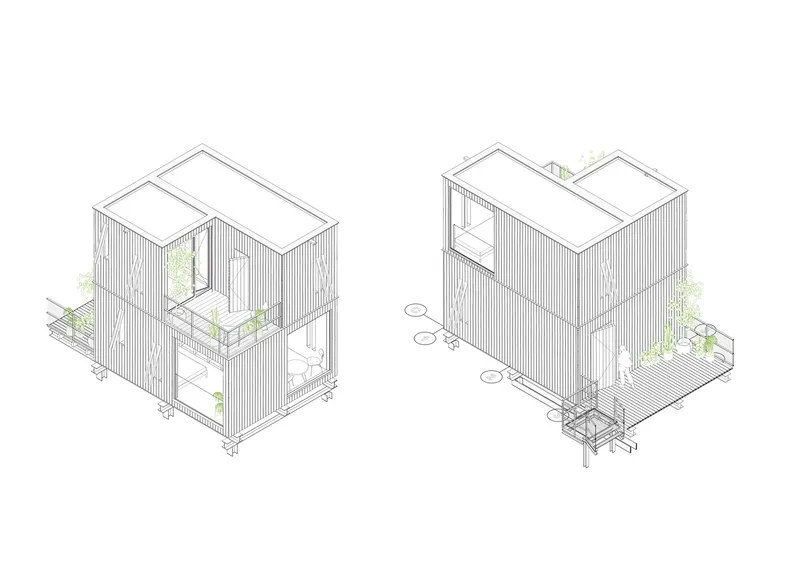
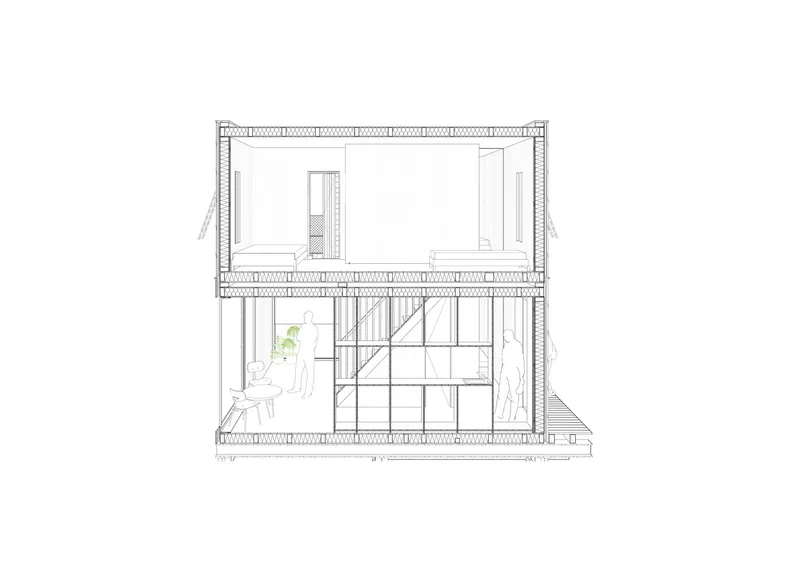
The axonometric drawings show the individual residential modules: timber-clad boxes with windows, balconies, and integrated planting. The section shows the relationship between the ground floor market hall and the upper floor residential unit: figures sit at tables below, a bedroom occupies the module above, and a stair connects the two. The modules are designed to be prefabricated, transported, and reassembled. When the prototype is disassembled, the modules can be reused on another site.
Drawings and Concept
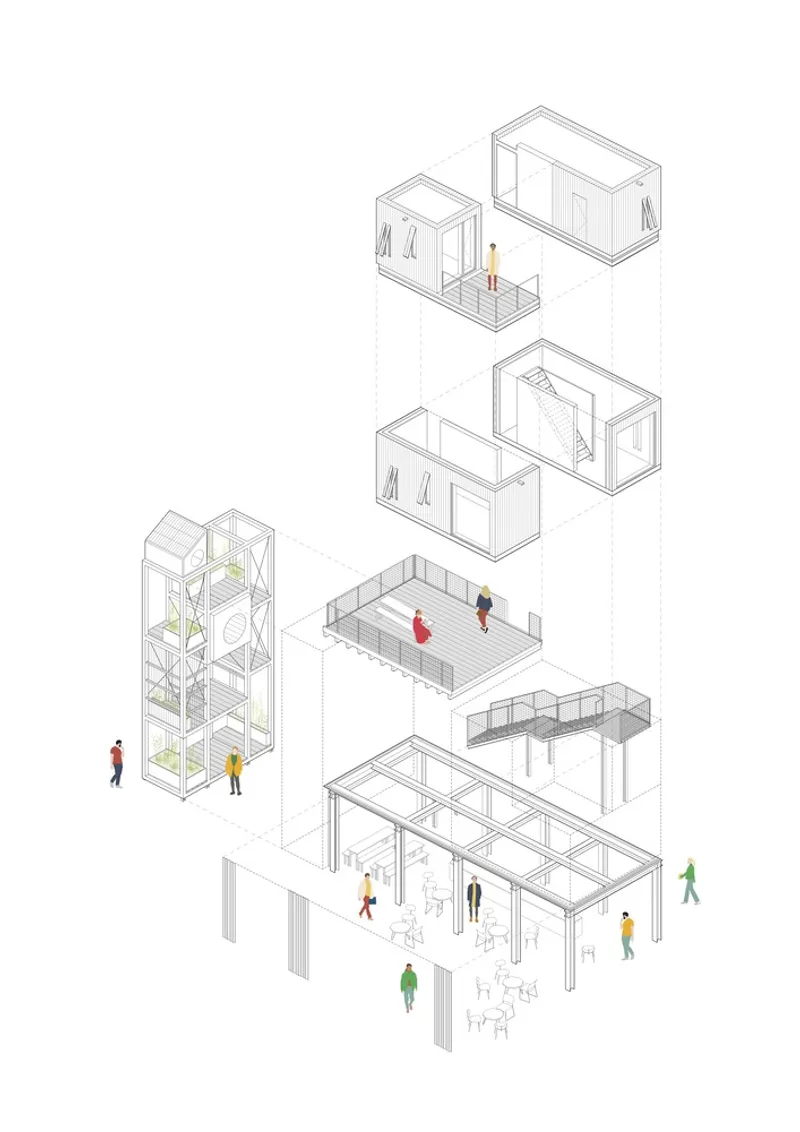
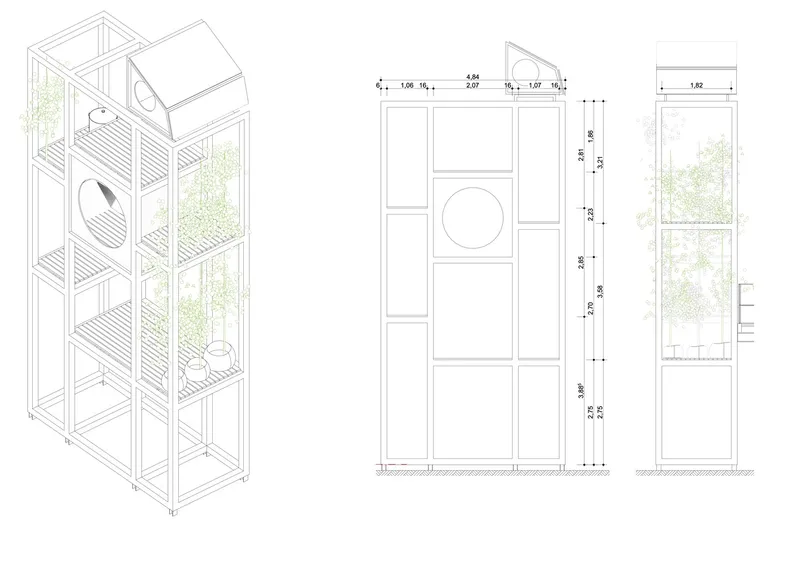
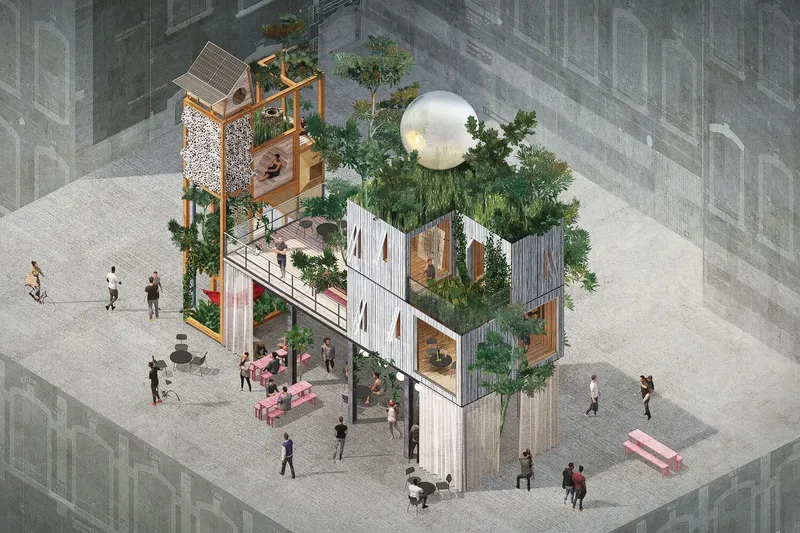
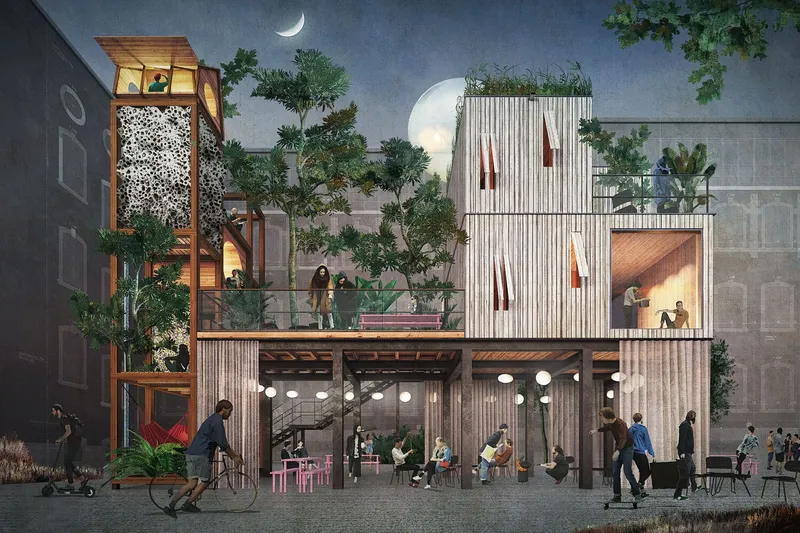
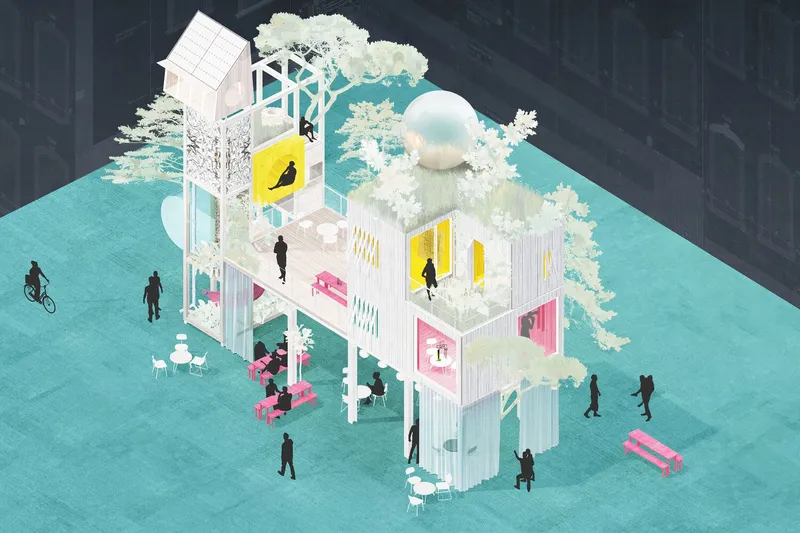
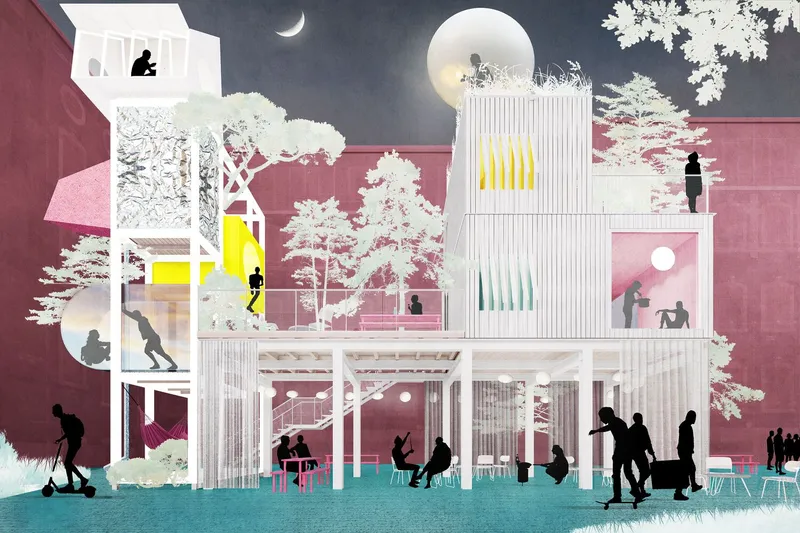
The exploded axonometric shows how the project is assembled: steel columns support the ground floor platform, residential modules and the terrace sit above, and the tower rises alongside. The rendered views show the full vision: a lush, inhabited structure with plants growing from every surface, people at every level, and colourful accents (pink benches, yellow windows) that signal the building's temporary, playful character. The concept diagrams in teal and pink map the programme distribution and show the project as a social diagram, not just a building.
Why This Project Matters
The Frankfurt Prototype is not a finished building. It is a test. It tests whether modular timber construction can produce housing quickly. It tests whether recycled steel can support a multi-storey structure. It tests whether biodiversity can be integrated into a building's structure rather than applied to its surface. It tests whether a temporary building can host a market, a gallery, student housing, and a garden at the same time. The answer to all of these is yes.
If you are working on modular housing, temporary architecture, student-built projects, or any building that needs to prove a concept before it scales, the Frankfurt Prototype is worth studying for how research, construction, and exhibition can happen in the same structure.
About the Studio
Share Your Own Work on uni.xyz
If you are working on modular construction, temporary architecture, or research-driven design, uni.xyz is a place to publish your work and connect with a global design community.
Project credits: The Frankfurt Prototype, developed with Barkow Leibinger. Frankfurt, Germany. Photographs: Wolfgang Stahr.


Popular Articles
Popular articles from the community


GROUP A Strips a 1969 Rotterdam Harbor Headquarters to Its Frame and Wraps It in Timber Louvers
In Rotterdam's M4H harbor district, Ferro Offices reuses a 1969 frame, adds one timber storey and reaches BREEAM-NL Outstanding.

longwave studio Reorganizes a 112 m² Tainan Apartment Around the Daily Routines of a Family and Two Cats
In Tainan, Taiwan, birch plywood, rust-red furniture and a freestanding plaster wall link arrival, storage, work and family life in one apartment.

David Macias Steps a Doorless Stone and Plaster House Down a Tropical Colombian Hillside
In the humid hills of Colombia, Threshold House replaces the front door with an open void and terraces its 850 m² down the slope instead of fighting it.

Cube Design Draws an Ecological Corridor Between Two Shenzhen Hills with the Nankai Building
Beside Shenzhen's container docks, the Nankai Building pairs stacked balconies with a climbing green screen to connect two hillsides across its height.

Similar Reads
You might also enjoy these articles


Hodi-Mandai Geram
Project Function: Preservation and revitalization of the Intangible heritage and socio-spatial identity of the Hodi by Housing, Cultural Memory Center, Sacred Grove, landscape, local tourism economy


Olio Towers: A Mid-Rise for Performers That Fuses Housing, Rehearsal, and Stage
Located blocks from Houston's Theater District, this modular tower stacks living units around a central performance atrium.

Oasis: Modular Green Housing Carved into Dhaka's Urban Fabric
A shortlisted Plugin Housing entry reclaims unauthorized settlements in Dhaka with stepped concrete volumes, green roofs, and ventilation-driven design.

Black Hole: A Floating Megastructure for the Post-Physical Era
Emiliano Mazzarotto envisions a spherical, self-scaling arena where e-sports, digital hotels, and holographic stadiums replace traditional public space.

Explore New Bauhaus Competitions
Discover active competitions in this discipline

Challenge to reimagine the Iron Throne

Photograph architecture without architects

Illustrate the lost glory of Angkor Wat - Render Challenge

Design challenge to reuse E-waste
Comments (0)
Please login or sign up to add comments
No comments yet. Be the first to comment!