
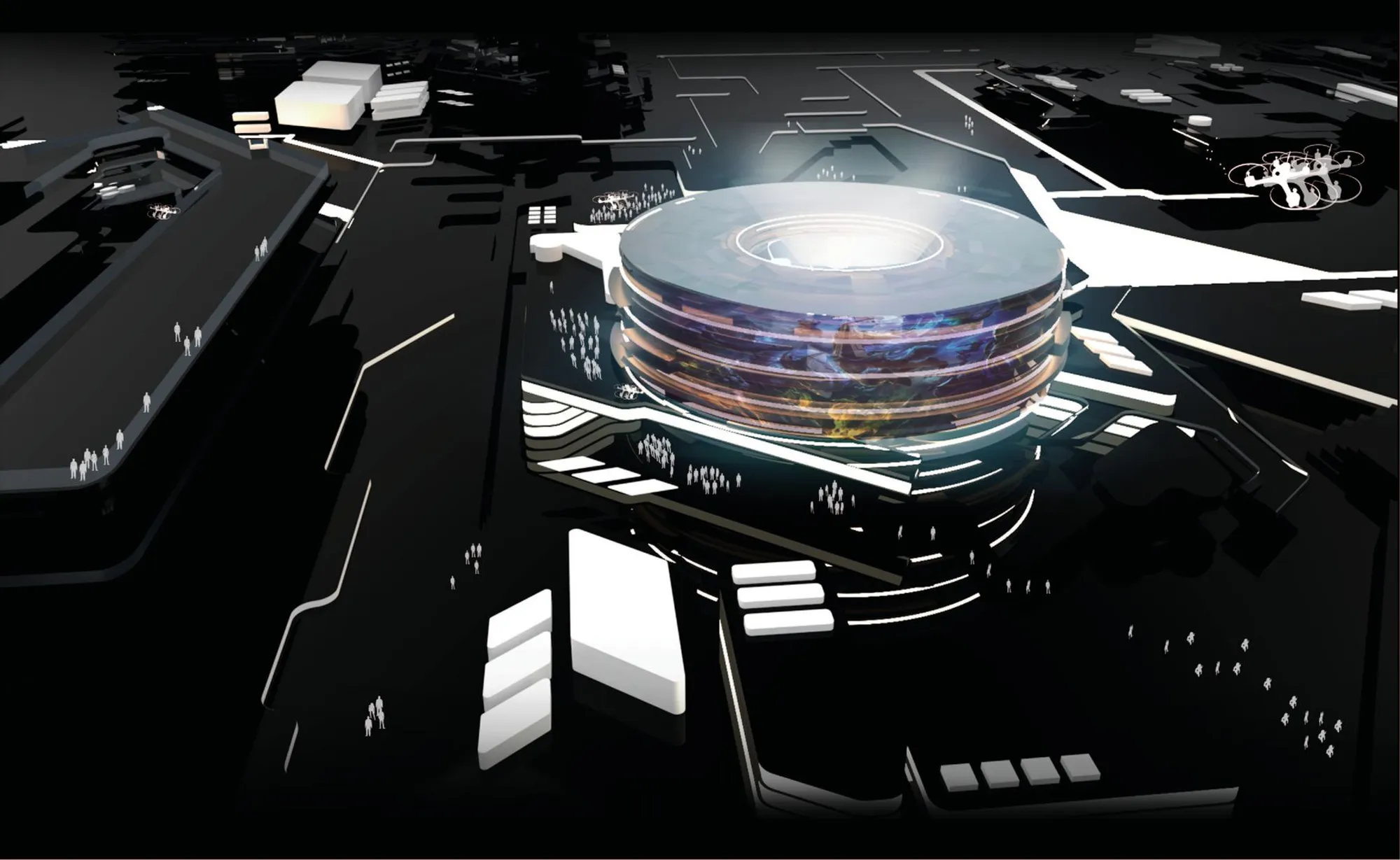
E-Arena of 2050: Where Architecture Becomes the Game
A runner-up entry reimagines the sports venue as a fluid, tech-driven urban anchor built around spectator movement and mixed-reality space.


What happens when the spectator refuses to sit still? When the number of global gamers already exceeds the total U.S. population, the architecture of sport can no longer afford to organize bodies in static rows of fixed seats. The E-Arena of 2050 takes that provocation seriously, proposing a smart arena where spectators drift through stacked floor plates, mixed-reality walkways, and immersive AR/VR lounges rather than watching from a single vantage point. Drawing on Guy Debord's Theory of the Dérive, the design treats movement itself as the primary spatial experience, turning architecture into an active participant in the game rather than a passive container for it.
Designed by Jade Bailey, this project was a runner-up entry in The Digital Colosseum 2020 competition. Set against a 2050 horizon, the proposal envisions a new arena typology that fuses competitive gaming, civic programming, education, and public life into a single year-round urban anchor. It is less a stadium and more a vertically stacked festival ground, one that challenges every assumption about how sports venues occupy cities.
Cantilevered Plates and the Freedom to Wander
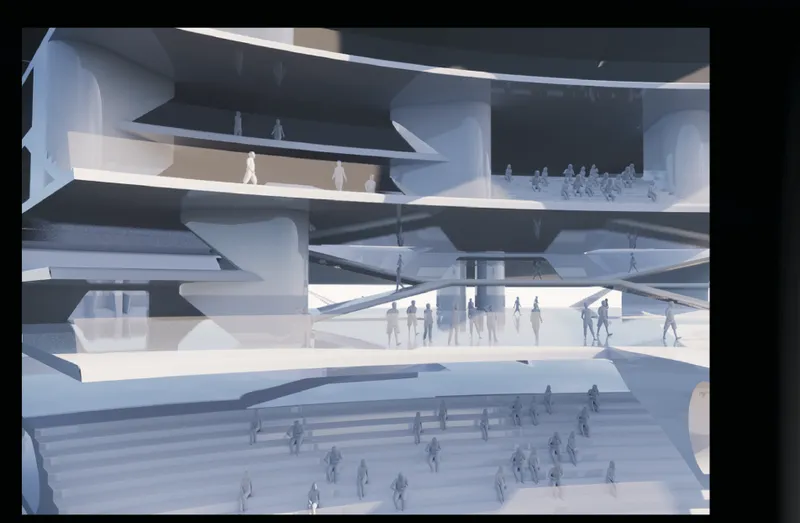
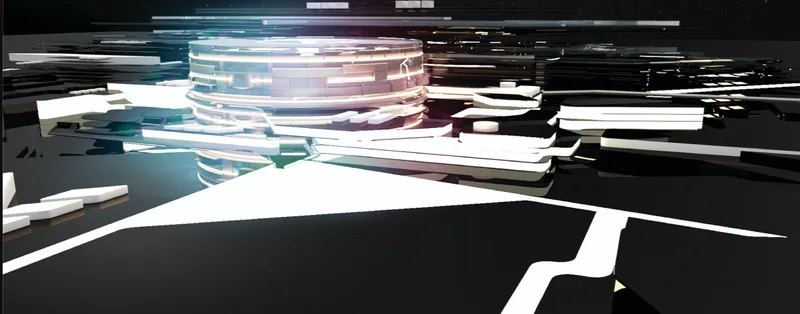
The interior atrium reveals the project's structural logic at a glance: cantilevered floor plates stagger outward from a central core, creating overlapping levels populated by scattered figures. There are no tiered bowls or concourse corridors here. Instead, each plate operates as a semi-autonomous zone where spectators encounter multi-sensory game booths, AR immersive pods, and participatory hubs. The physical model, a cylindrical tower volume with horizontal layered plates, confirms this reading under directional lighting. The form is vertical, the movement is lateral, and the experience is continuous.
Bailey's design mimics the freedom of a festival, blending music, movement, and e-sports into a single spatial loop. Rather than funneling crowds toward a central event, the architecture distributes attention across multiple levels and programs. It is a building you navigate rather than sit inside, and that distinction carries real consequences for how arenas might function when competitive gaming is the dominant spectator sport.
From Flat Planes to Offset Slabs: A Morphological Sequence
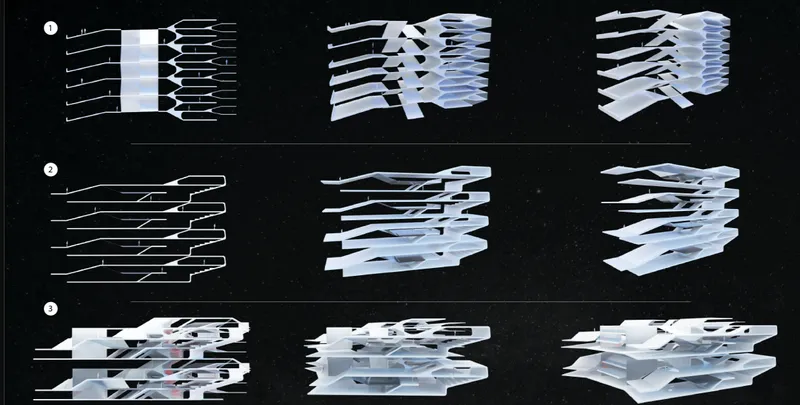
A diagram sequence traces the formal evolution from flat horizontal planes to offset, stacked floor slabs. The transformation is not arbitrary; each step introduces a new spatial relationship between levels, opening sightlines, creating double-height voids, and generating interstitial zones for circulation and gathering. The logic is modular and reconfigurable: seating arrangements, event capacities, and circulation paths can shift to accommodate everything from large-scale tournaments to public exhibitions and training academies. The diagrams make visible the argument that smart arenas should anticipate technological change rather than resist it.
Interlocking Programs in Section
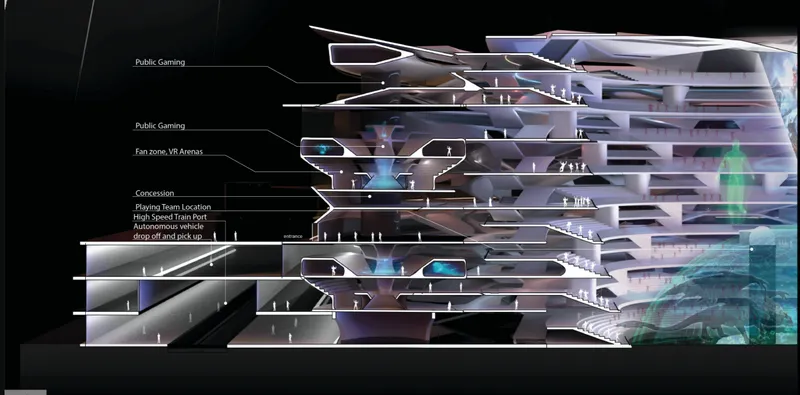
The section drawing is where the project's ambition becomes most legible. Programmatic labels identify game development labs, education centers, public gaming zones, and drone delivery nodes woven through interlocking floor plates. Circulation paths thread between these zones, and figures appear at multiple scales, reinforcing that this is a building designed for density and overlap, not separation. The interlocking geometry ensures that no program is truly isolated; a student moving from an education center to a gaming zone passes through spectator hubs and AR lounges, layering encounters along the way.
Real-time media integration and responsive building systems are embedded throughout, enabling the architecture to adapt its atmosphere, lighting, and information displays to whatever event is taking place. The section reads less like a traditional sports venue and more like a vertical urban district compressed into a single structure, one that operates year-round and attracts visitors, professionals, and students in equal measure.
A Ground Plane That Belongs to the City
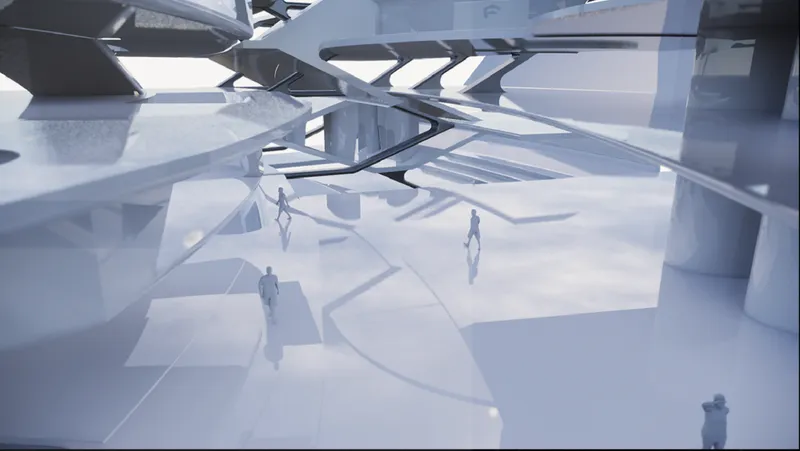
At ground level, an angular canopy structure stretches over a public plaza, casting sharp shadows across figures moving through bright sunlight. The gesture is deliberate: the E-Arena does not begin at a turnstile or a ticketed threshold. It begins at the street, where the building's civic ambition is most visible. Public gaming zones and spectator hubs extend outward, ensuring that even non-ticketed visitors engage with the arena's program. The canopy frames this interaction, offering shade and spatial definition without enclosure. It is a simple move that signals a much larger argument: smart arenas should not be isolated objects on urban edges but cultural landmarks integrated into daily life.
Why This Project Matters
Most arena designs begin with the event and work outward, wrapping a bowl in a skin and plugging it into an infrastructure network. Bailey's E-Arena of 2050 inverts that sequence. It begins with the spectator's body in motion, with civic programming that justifies year-round operation, and with a structural system flexible enough to absorb three decades of technological change. The result is not a stadium in any familiar sense; it is a hybrid of festival ground, tech campus, and public plaza stacked into a single vertical volume.
As the boundaries between digital and physical culture continue to blur, this project offers a credible provocation: the future sports venue might be defined not by the size of its seating bowl but by the richness of its spatial network. By treating architecture as an active layer of the gaming experience rather than its backdrop, the E-Arena positions smart arena design as a genuine catalyst for urban growth, technological exchange, and inclusive public life.
View the Full Project
About the Designers
Designer: Jade Bailey
Enter a Design Competition on uni.xyz
uni.xyz runs architecture and design competitions year-round that reward proposals with spatial conviction and real site intelligence.
Project credits: The Digital Colosseum by Jade Bailey The Digital Colosseum 2020 (uni.xyz).



Popular Articles
Popular articles from the community

EW PARK: Sustainable Architecture Reimagines the Future of Urban Parking
EW PARK reimagines city parking as a modular wooden tower combining automation, solar energy, electric mobility, and adaptable urban design.

The Musturak Paradise: Senior Living Architecture for a Connected Future in Temara, Morocco
The Musturak Paradise reimagines senior living architecture in Temara via private homes, social spaces, culture, community, and shared care.

The Earth Pod: 3D Printed Homes for Resilient Refugee Communities
The Earth Pod reimagines refugee housing through 3D printed homes made from clay, combining resilience, self-sufficiency, and rapid shelter.

Conexión: Biophilic Design Reimagines High-Rise Living in Hong Kong
Conexión reimagines high-rise living in Hong Kong through biophilic design, green facades, shared spaces, daylight, water and nature within.


Similar Reads
You might also enjoy these articles
The Musturak Paradise: Senior Living Architecture for a Connected Future in Temara, Morocco
The Musturak Paradise reimagines senior living architecture in Temara via private homes, social spaces, culture, community, and shared care.

The Leaf Center: Cultural Center Architecture for Social Integration in Amsterdam
Cultural center architecture becomes a bridge at The Leaf Center, connecting international students with Amsterdam through art and exchange.
Conexión: Biophilic Design Reimagines High-Rise Living in Hong Kong
Conexión reimagines high-rise living in Hong Kong through biophilic design, green facades, shared spaces, daylight, water and nature within.

Wander to Wonder: Modular Playground Design for Children in Kutupalong Refugee Camp
Wander to Wonder uses modular playground design to create flexible, imaginative play spaces for children in Kutupalong refugee camp.

Explore E-Sport Arena Competitions
Discover active competitions in this discipline



Challenge to reimagine the Iron Throne


Photograph architecture without architects


Illustrate the lost glory of Angkor Wat - Render Challenge


Design challenge to reuse E-waste
Comments (0)
Please login or sign up to add comments
No comments yet. Be the first to comment!