

The Good Shelter: Turning Public Furniture into Overnight Refuge with 3D-Printed Panels
A modular bench system folds from daytime seating into nighttime shelter, countering hostile urban design with dignity and recyclable materials.


Cities worldwide have spent the last two decades perfecting the art of making public space inhospitable. Spiked ledges, segmented benches, sloped surfaces: a quiet vocabulary of exclusion designed to keep homeless populations moving. The Good Shelter inverts that logic entirely. Rather than engineering discomfort, it proposes a piece of urban furniture that folds from a daytime bench into a nighttime enclosure, offering weather protection, privacy, and rest to anyone who needs it. The mechanism is simple, but the argument it makes is sharp: if cities can engineer hostility into a bench, they can engineer hospitality into one too.
Designed by Daniel Caven and published on uni.xyz, The Good Shelter is a modular seating and shelter system fabricated from recyclable, 3D-printed panels. The project positions itself squarely in the discourse around hostile architecture, responding to a global crisis that leaves more than 100 million people without permanent housing. By treating shelter as a basic right rather than a privilege, Caven reframes public furniture as humanitarian infrastructure.
A Curved Shell That Seats by Day and Shelters by Night

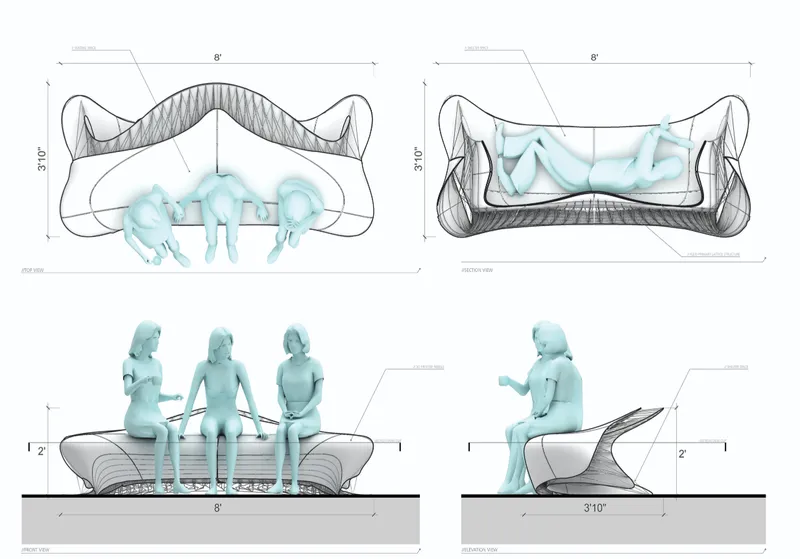
The defining gesture is a sweeping curved form that wraps around the body. By day, it reads as an inviting piece of landscape furniture, its smooth surfaces offering ergonomic seating along park edges and pedestrian corridors. At night, the same geometry becomes protective: the curved enclosure shields occupants from rain, sun, and the exposure that makes sleeping rough so dangerous. Section drawings reveal how carefully the profiles have been calibrated, with dimensional annotations showing clearances for seated, reclining, and sleeping positions. The shell is not a symbolic gesture; it is sized to actual bodies in actual postures.
Multiple Configurations from a Single Modular System
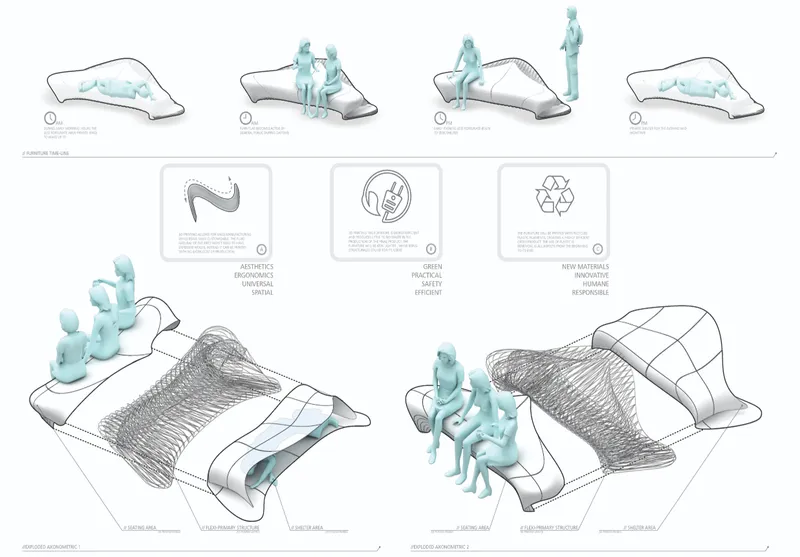
One of the project's strongest moves is its programmatic flexibility. A detailed diagram sheet lays out the range of seating and resting configurations the system can accommodate, each annotated with material callouts and human figures for scale. The same set of 3D-printed panels can be assembled into bench-only arrangements for high-traffic transit stops, semi-enclosed rest stations for parks, or fully wrapped shelters for overnight use. This modularity is not just a fabrication convenience; it is a social strategy. Because every configuration looks like a coherent piece of public furniture, the shelter variant avoids the visual stigma that standalone homeless shelters often carry.
Street-Level Presence Along Pedestrian Corridors
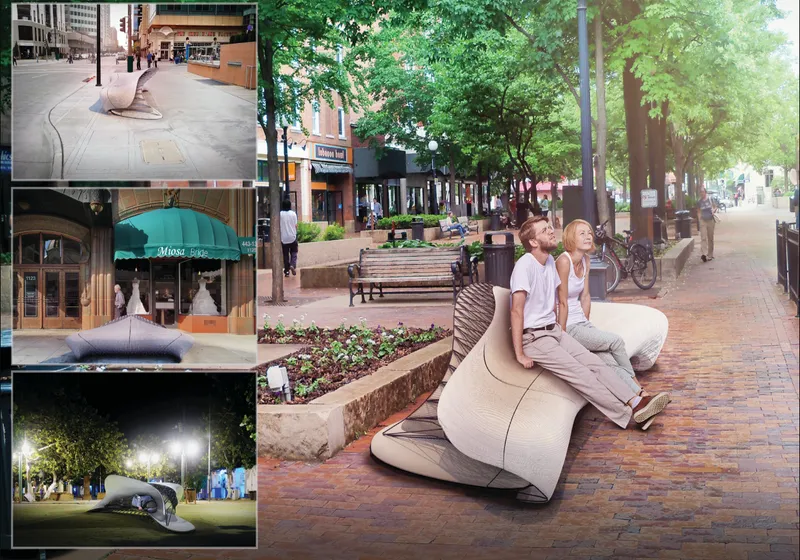
A rendering along a tree-lined pedestrian street shows the bench in its most public-facing mode: two people seated on the curved surface, the form blending naturally into the rhythm of sidewalk trees and paving. It looks like it belongs. That ordinariness is the point. The Good Shelter does not announce itself as crisis infrastructure. It integrates into the existing streetscape, which means municipalities could deploy it without the political friction that comes with visible homelessness interventions. The curved geometry softens the object's profile, making it as approachable to a commuter waiting for coffee as it is to someone seeking overnight rest.
Assembly Logic and the Case for On-Site 3D Printing
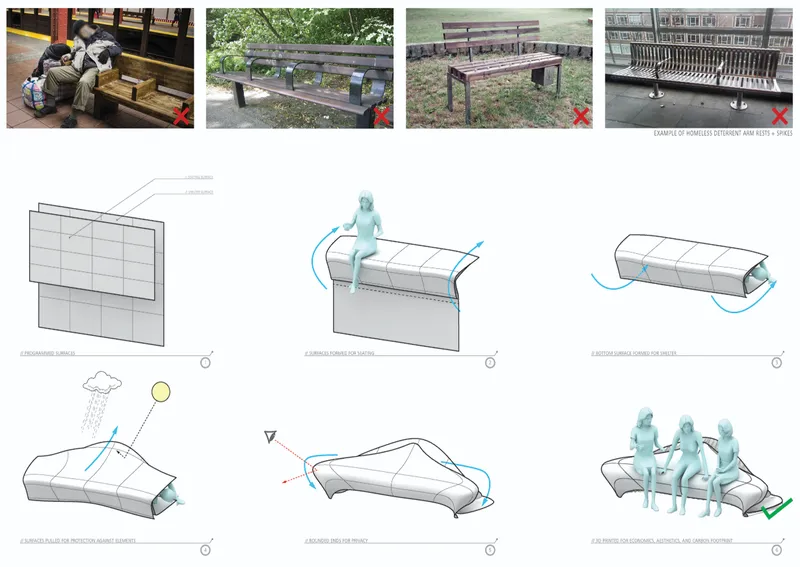
A technical diagram unpacks the assembly and deployment sequence, juxtaposing photographs of existing hostile street furniture with the proposed alternative. The panels are designed for on-site fabrication using additive manufacturing, which reduces transportation costs, minimizes material waste, and allows the system to be adapted to different urban contexts without retooling. Recyclable feedstock keeps the carbon footprint low. The deployment sequence itself is legible: flat panels arrive, fold into ergonomic surfaces, and lock together into the final curved shell. For cities already investing in 3D-printing infrastructure for construction, this represents a logical extension of existing technology into the public realm.
The photographs of existing defensive furniture at the top of the diagram are a deliberate provocation. By placing spikes and segmented armrests directly above the proposed alternative, Caven forces a visual comparison that makes the cruelty of hostile design impossible to ignore. The message is clear: we already manufacture and install street furniture at scale. The question is what values we encode into it.
Why This Project Matters
The Good Shelter works because it refuses the false choice between functional public furniture and humanitarian shelter. Most responses to hostile architecture stay at the level of critique, pointing out the problem without offering a buildable alternative. Caven's project goes further: it provides a modular, fabricable, materially specific system that could be manufactured and deployed within existing municipal procurement frameworks. The 3D-printing strategy is not speculative window-dressing; it directly enables the modularity and site-adaptability that make the concept viable across different cities and climates.
More importantly, the project reframes the design brief itself. Instead of asking how to keep homeless people away from public furniture, it asks how public furniture can serve everyone, including those who need it most. That shift in framing, from exclusion to inclusion, is where the real architectural contribution lies. The Good Shelter suggests that the next generation of urban furniture should be measured not by how many behaviors it prevents, but by how many human needs it accommodates.
View the Full Project
About the Designers
Designer: Daniel Caven
Enter a Design Competition on uni.xyz
uni.xyz runs architecture and design competitions year-round that reward proposals with spatial conviction and real site intelligence.
Project credits: The Good Shelter by Daniel Caven.


Popular Articles
Popular articles from the community

Opera by the Sea Estonia: Three Shells Dissolving Architecture into Tallinn's Coastline
A winning opera house proposal replaces monumental form with interconnected shells that blur the boundary between building, park and Baltic Sea.
Tsunami Convergenics: Turning Catastrophic Ocean Forces into Underwater Housing Infrastructure
A speculative underwater settlement off the coast of Onagawa, Japan, treats tsunamis and typhoons as energy sources rather than threats.
Manzana Morphosis: Stretching Barcelona's Grid into a Living Landscape for 2050
A radical reworking of the Eixample manzana turns density into a tool for generous public space, vertical ecology, and environmental performance.
Faces of the Soviet Avant-Garde: Turning Moscow's Street Names into an Open-Air Museum
A network of sculptural installations across a Moscow residential district transforms forgotten architect names into spatial encounters with cultural memor

Similar Reads
You might also enjoy these articles

The Amber Palace Opera: A Geological Fiction Surfaces on Tallinn's Baltic Waterfront
Pierre Brillard reimagines a Baltic legend as a public landscape, opera house, and waterfront promenade rooted in Tallinn's coastal identity.
Dynamic Modules Shelter: A Telescopic Ring for Mountain Pilgrimage
A circular modular framework of steel, bamboo, and fabric grows vertically with demand, wrapping communal ground in adaptable shelter.

Singing Woman: Contemporary Architecture Inspired by Estonia’s Voice and the Sea
Singing Woman turns Estonia’s song culture into flowing opera house architecture, blending public life, landscape, sea, and national memory.
HYPERBLOCK: Flexible Urban Design for Barcelona’s Future City
HYPERBLOCK reimagines Barcelona as flexible urban design, layering density, daylight, public space and adaptable housing above Cerdà’s grid.

Explore Utilitarian Architecture Competitions
Discover active competitions in this discipline

Design challenge to equip cities with modern furniture

Competition to design a workstation for architects

Packaging challenge - Design meets sustainability
Comments (0)
Please login or sign up to add comments
No comments yet. Be the first to comment!