
The New Organism: Turning Abandoned Oil Rigs into Coral-Inspired Communities at Sea
A winning Proximity Island entry reimagines Italy's decommissioned offshore platforms as modular, self-sustaining marine habitats built on biomimicry.


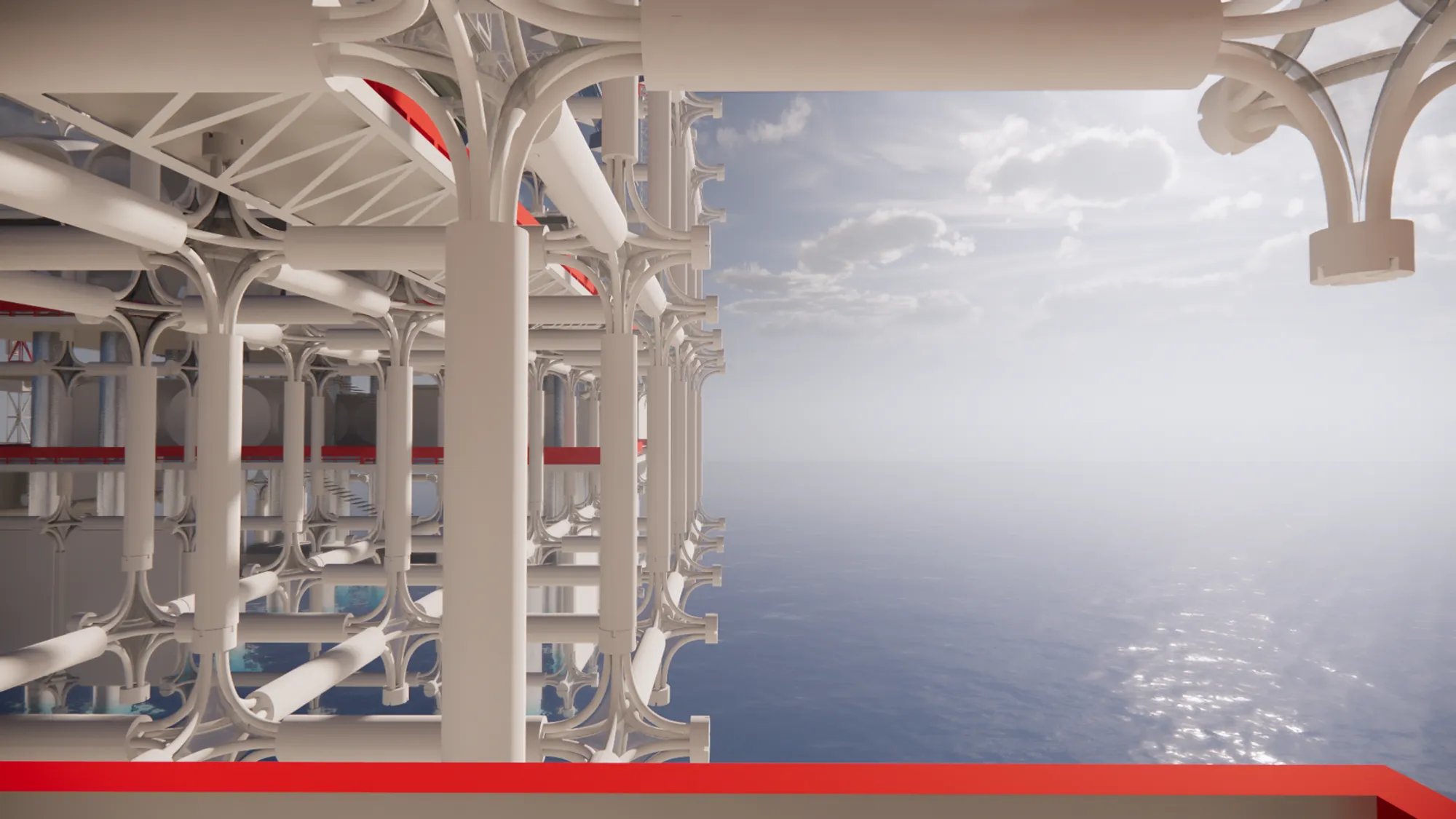
Nearly 200 abandoned oil drilling platforms litter the waters off the Italian coast, relics of an extraction boom that began in the 1950s. Too expensive to dismantle, too toxic to ignore, they sit rusting in the Adriatic like industrial tombstones. "The New Organism" asks a provocative question: what if these skeletal structures could become the scaffolding for an entirely new form of marine life, not biological but architectural, growing and adapting like the coral reefs they once threatened?
Designed by Lemin Fu, NanXin Zeng, Xie Tian, and Chao Feng, the project won the Proximity Island competition. The proposal transforms a decommissioned oil rig into a modular, self-sustaining habitat that hosts scientists, artists, researchers, and climate refugees in a stacked community above the sea. The design takes biomimicry seriously, treating the existing steel frame as a skeleton onto which new living tissue, in the form of replaceable modular cabins, can attach, detach, and regenerate over time.
A Steel Skeleton Dressed in Modular Living Units
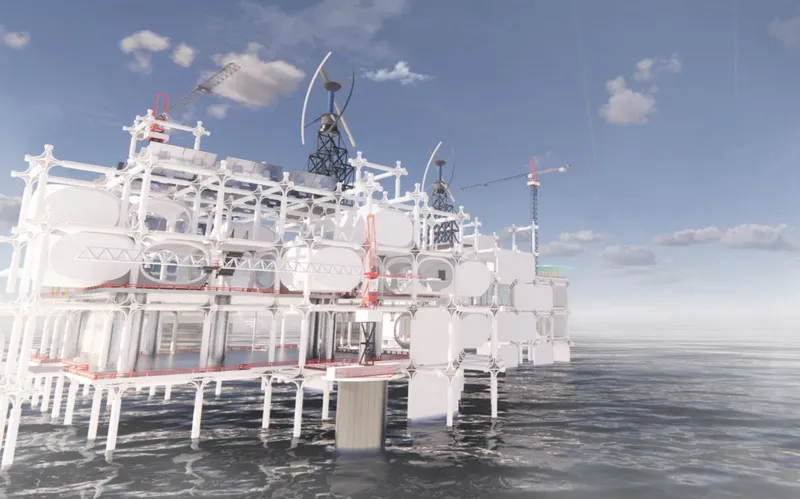
The daytime render reveals the project's core logic: the original oil rig steel frame remains fully intact, repurposed as structural armature for clusters of white modular cabins that cling to it at multiple levels. Construction cranes, still present from the platform's industrial past, are retained and fitted with small wind turbines to harvest offshore winds. The image reads less like a building and more like an organism mid-growth, with cabins appearing to proliferate outward from the frame. Transparent circulation pipes, described by the designers as resembling blood vessels, weave through the structure to transport purified water and essential resources.
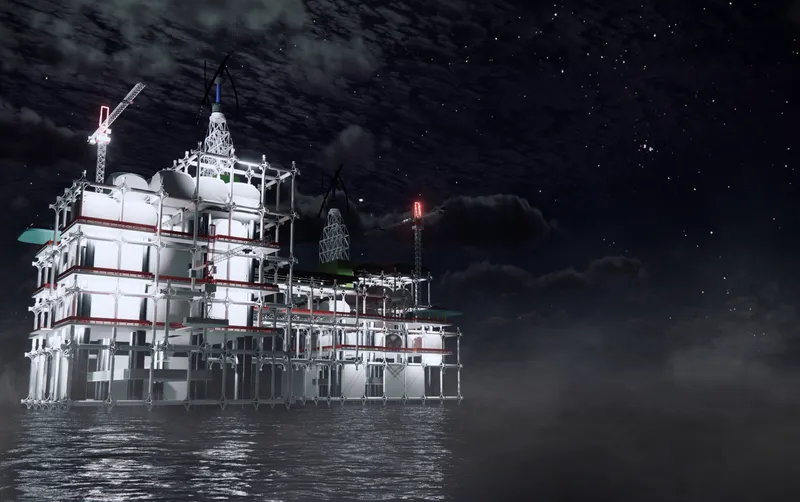
At night, the structure transforms into something closer to a lighthouse or a deep-sea bioluminescent creature. The illuminated modules glow against a star-filled sky, their stacked arrangement on stilts above the waterline emphasizing both their vulnerability and their resilience. Crucially, each cabin is engineered with an emergency detachment system: in the event of a tsunami or typhoon, individual units can separate from the frame and float autonomously, prioritizing the safety of inhabitants over the permanence of the structure.
Three Levels of Program: From Marine Research to Art Pavilions
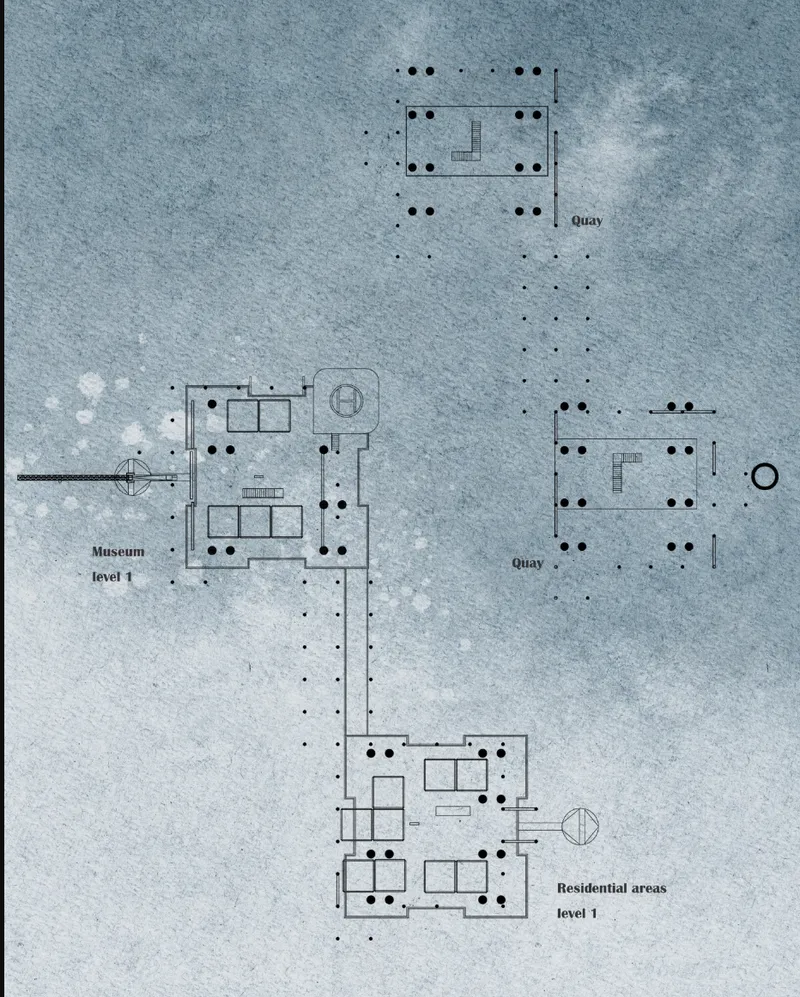
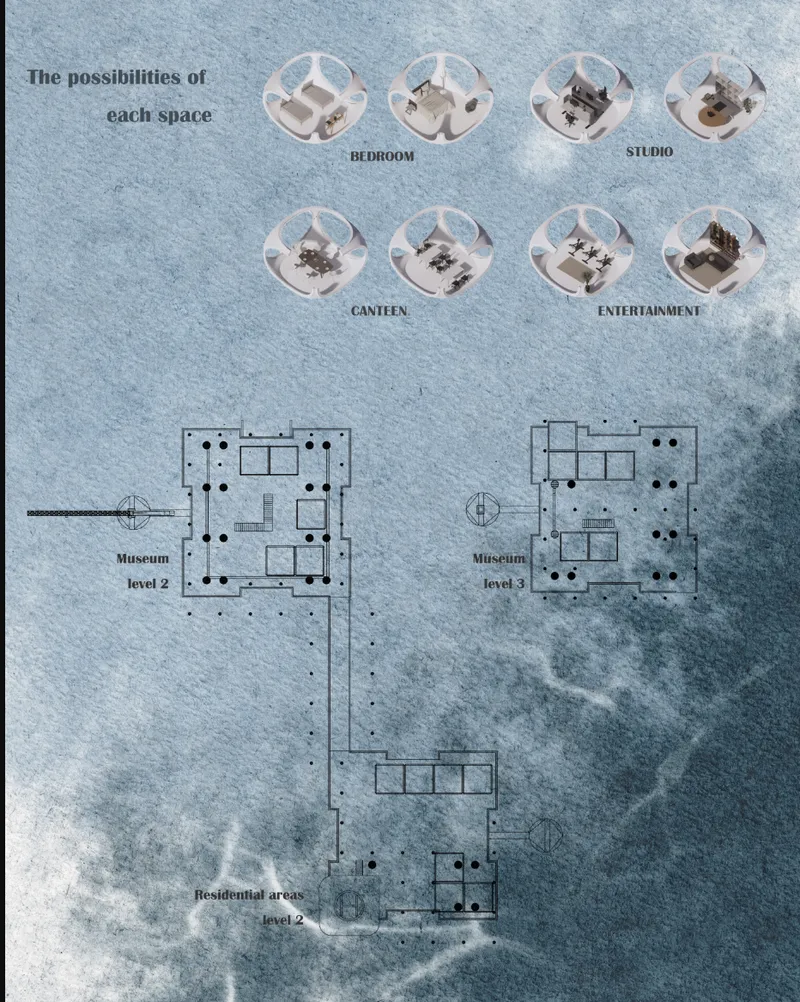
The floor plan drawing makes the programmatic ambition legible. Level 1 houses a marine surveying pavilion alongside residential units, connected by a circulation pier that also serves as a quay for boat access. Level 2 shifts toward knowledge production, with a marine biology science pavilion flanked by studios and entertainment areas. Level 3 crowns the structure with an artwork pavilion and cultural spaces. The plan reveals generous museum spaces and clear circulation routes, suggesting that the designers treated public life at sea with the same rigor as any urban cultural institution.
The axonometric vignettes flesh out the domestic and communal scale of the project. Bedrooms, studios, a canteen, and entertainment spaces are illustrated as distinct modular configurations, each plugging into the larger structural grid. This is the heart of the biomimicry concept: just as a coral reef supports wildly different organisms within a single calcium carbonate structure, the rig's steel frame accommodates radically different programs in interchangeable modules. The mixed-use strategy is not just about architectural flexibility; it is about forging social bonds between scientists, artists, and displaced populations who would otherwise never share a zip code, let alone a platform.
Infrastructure as Anatomy: Energy, Water, and Waste Systems
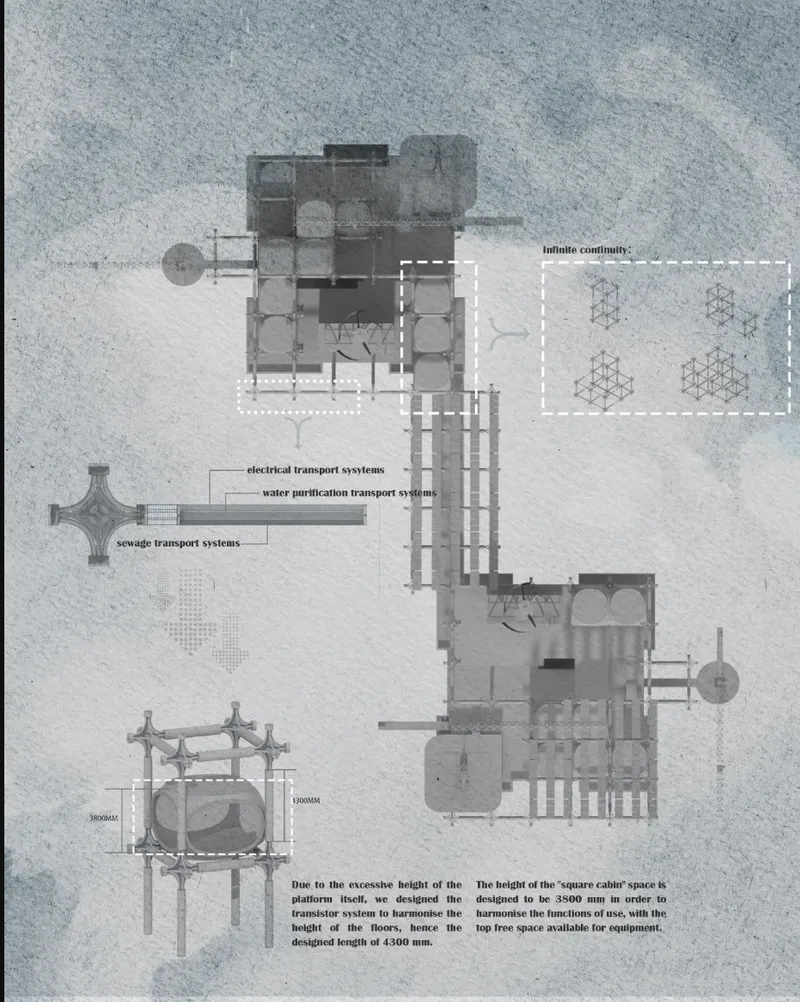
The site plan drawing strips away the architectural spectacle to expose the organism's internal organs. Electrical systems, water purification networks, and sewage transport routes are mapped across multiple levels, demonstrating that the designers thought through the full metabolic cycle of the habitat. Solar panels on the rooftops of outer cabins capture unobstructed sunlight, while wind turbines on the repurposed tower cranes complete the energy generation loop. Together, these renewable sources are intended to make the platform entirely self-sufficient, severed from any mainland grid. The drawing communicates a message the renders alone cannot: that this is not a sculptural fantasy but a systems-level proposal with identifiable infrastructure pathways.
Why This Project Matters
The global inventory of decommissioned offshore platforms is growing, and the default response remains either expensive demolition or indefinite neglect. "The New Organism" offers a third path: adaptive reuse at the architectural scale, where the very infrastructure that damaged marine ecosystems becomes the substrate for their partial restoration and for new human settlement. The coral reef analogy is more than metaphor here; it structures every design decision, from the modular cabin system that mimics polyp growth to the transparent resource pipes that function as a circulatory system.
What makes the project compelling beyond its ecological ambitions is its social imagination. By stacking marine research facilities, artist studios, residential quarters, and cultural pavilions onto a single abandoned platform, the designers propose a community type that does not yet exist: a floating research-and-culture outpost that could, as they envision it, spread from the Adriatic to the Mediterranean and the Atlantic. Whether or not that vision scales, the underlying argument is hard to dismiss. We have hundreds of steel structures standing idle in the ocean. We have communities in need of housing, scientists in need of field stations, and ecosystems in need of stewardship. "The New Organism" connects those dots with structural clarity and real conviction.
View the Full Project
About the Designers
Designers: Lemin Fu, NanXin Zeng, Xie Tian, Chao Feng
Enter a Design Competition on uni.xyz
uni.xyz runs architecture and design competitions year-round that reward proposals with spatial conviction and real site intelligence.
Project credits: The New Organism by Lemin Fu, NanXin Zeng, Xie Tian, Chao Feng Proximity Island (uni.xyz).




Popular Articles
Popular articles from the community


Conexión: Biophilic Design Reimagines High-Rise Living in Hong Kong
Conexión reimagines high-rise living in Hong Kong through biophilic design, green facades, shared spaces, daylight, water and nature within.

Co-life: Sustainable Architecture for Age-Friendly Community Living
Co-life reimagines sustainable architecture for seniors through courtyards, rammed earth, shared gardens, and spaces designed for belonging.

Lunar Spiral: Space Architecture Shaped by the Mathematics of the Universe
Lunar Spiral reimagines space architecture through Fibonacci geometry, lunar regolith, levitating habitats, and self-sustaining Moon living.

The Earth Pod: 3D Printed Homes for Resilient Refugee Communities
The Earth Pod reimagines refugee housing through 3D printed homes made from clay, combining resilience, self-sufficiency, and rapid shelter.

Similar Reads
You might also enjoy these articles

Bao Huynh Watercolor Atelier: A Serene Art Retreat in Hội An
Bao Huynh Watercolor Atelier in Hội An blends multifunctional art spaces, sustainable design, local materials, and family-friendly living in a serene environment.

Atelier Macri Concept Store Interior Design by CASE-REAL
Atelier Macri store features a "ko" counter, walnut wood details, cork displays, blending retail, gallery, and seamless customer experiences.

Manuel Vargas Izquierdo Stadium and High-Performance Sports Center: Architectural Excellence in Jalpa de Méndez
The Manuel Vargas Izquierdo Stadium blends sustainable design, inclusive sports facilities, and cultural-inspired architecture, revitalizing Jalpa de Méndez’s public spaces.
KAKR Buluh Awar Hall: Revitalizing Community and Ecology Through Bamboo Architecture
Community built bamboo hall revitalizes Buluh Awar village, empowering youth, restoring ecology, celebrating vernacular craftsmanship through sustainable architecture and culture.

Explore Ocean Architecture Competitions
Discover active competitions in this discipline



Challenge to design locus for the upliftment of human rights


Design challenge to reuse E-waste
Comments (0)
Please login or sign up to add comments
No comments yet. Be the first to comment!