
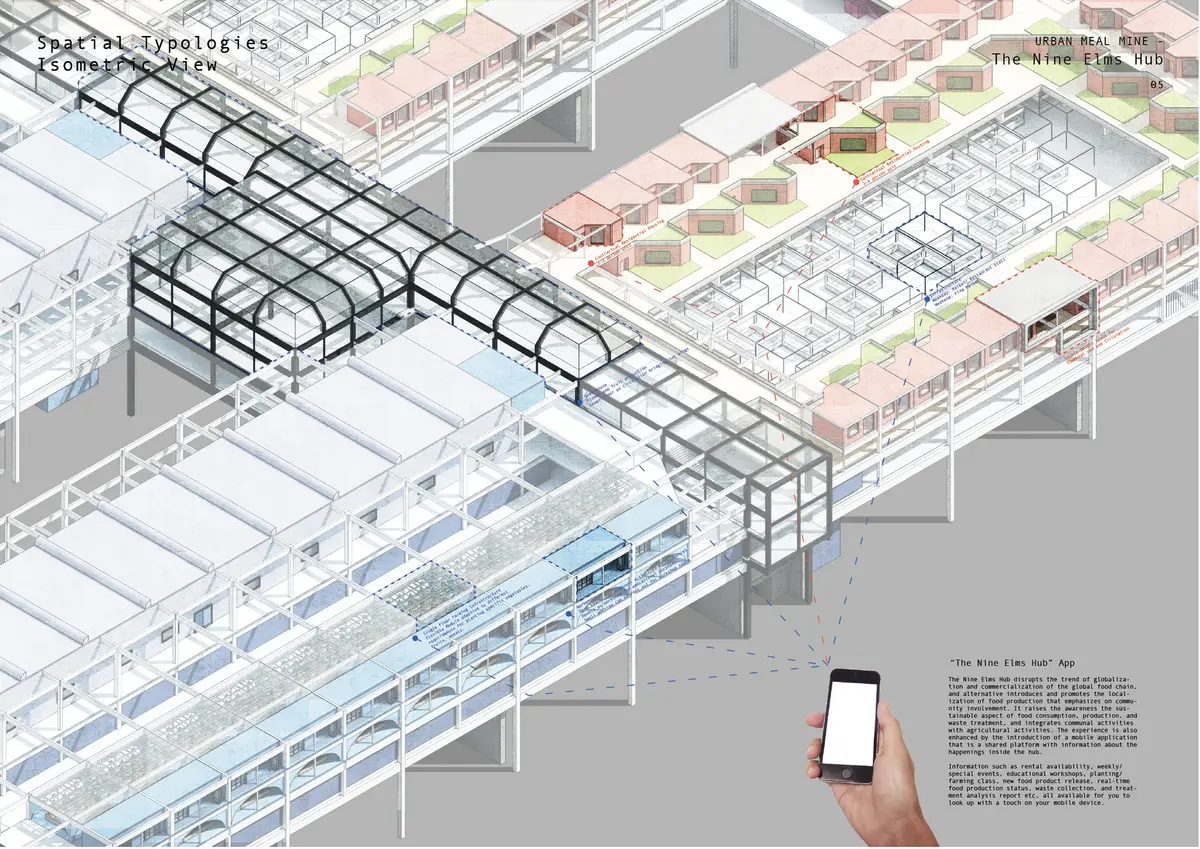
The Nine Elms Hub: Circular Food Systems Embedded in Warehouse Architecture
A phased urban farming intervention transforms London warehouse infrastructure into a closed-loop food production and residential ecosystem.


What if the warehouse next door grew your groceries, processed your food waste, and housed your neighbors? The Nine Elms Hub collapses the entire food supply chain into a single architectural organism, converting an existing warehouse structure into a closed-loop system where vertical farms, food processing facilities, marketplaces, and residences operate as interconnected layers of a circular urban ecosystem. It is a building that refuses to treat food production, housing, and community as separate problems.
Designed by Jonathan Lau and Obed Cheung, the project is a shortlisted entry in the Urban Meal Mine competition. Rather than proposing a clean-slate intervention, Lau and Cheung work with the existing warehouse fabric, phasing their transformation across three stages that preserve functionality while progressively deepening the building's ecological ambitions. The result is an architecture that doesn't just accommodate urban farming; it makes farming the structural logic of the entire program.
Stacking Markets, Farms, and Housing in a Single Urban Block
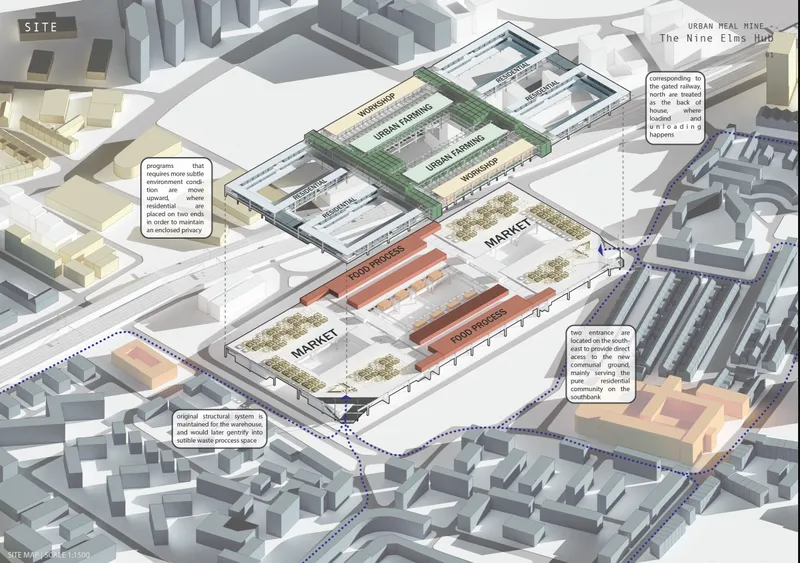
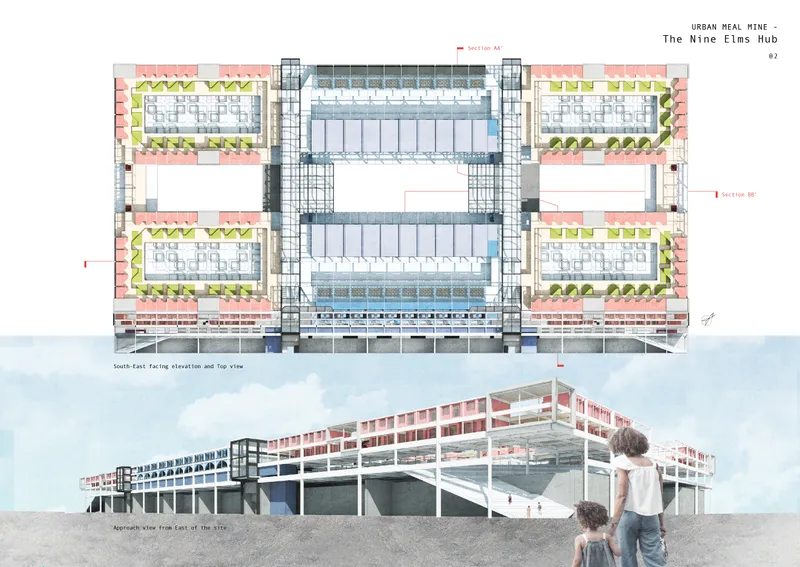
The axonometric site plan reveals how densely the Nine Elms Hub packs its programs within an existing urban block. Market halls anchor the ground plane, ensuring that food processing and retail remain transparent and publicly accessible. Above and around them, vertical farms and greenhouses occupy central zones, positioned to reduce the carbon footprint of distribution by producing food precisely where it will be consumed. Residential and communal spaces sit at the perimeter and upper levels, providing privacy while maintaining visual and physical connections to the productive landscape below.
The section drawing makes the terracing strategy legible. Planted roof gardens cascade downward in stepped layers, creating green circulation pathways that double as growing surfaces. Two children at ground level peer upward into this productive section, a small detail that underscores the project's ambition to make food systems visible and educational rather than hidden behind industrial walls. Workshops and educational spaces are woven into the program, supporting agricultural learning and collaborative innovation alongside the daily rhythms of growing and eating.
Three Phases: From Warehouse Shell to Self-Sustaining Ecosystem
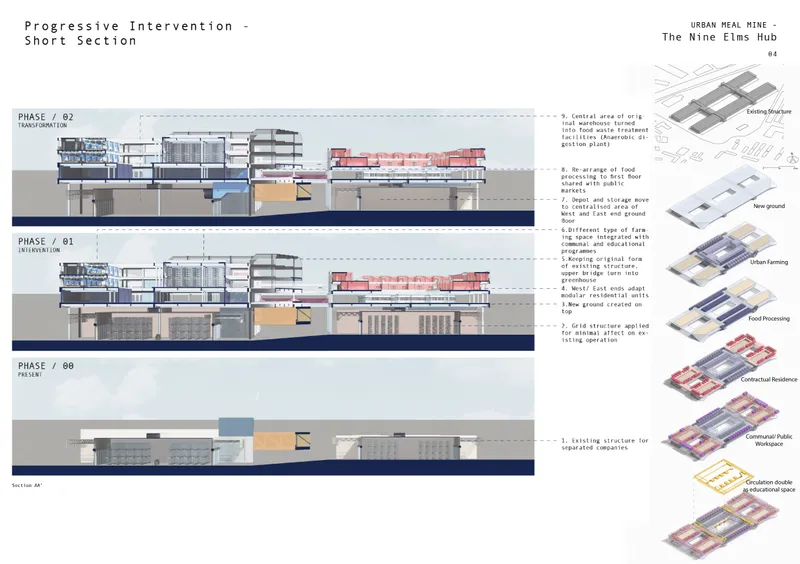
The phasing diagram is where the project's pragmatism becomes clear. Phase 00 retains the original warehouse structure, housing separate companies in their existing configurations. Phase 01 introduces communal programs, food processing areas, and vertical farming modules, inserting new life into the shell without demolishing what already works. Phase 02 is the decisive move: central warehouse zones convert into advanced food waste treatment plants, closing the metabolic loop and creating a fully self-sustaining ecosystem. Each isometric diagram in the series shows the building growing more complex and more integrated, but never losing the legibility of its warehouse bones.
This progressive intervention strategy is critical. Rather than demanding a single, enormous capital expenditure, the phased approach ensures the building remains operational and revenue-generating throughout its transformation. It is adaptive reuse taken to its logical conclusion: the building doesn't just get a new skin or a new program; it evolves into an entirely different species of architecture while maintaining continuity with its industrial past.
Courtyards Where Agriculture Becomes Social Space
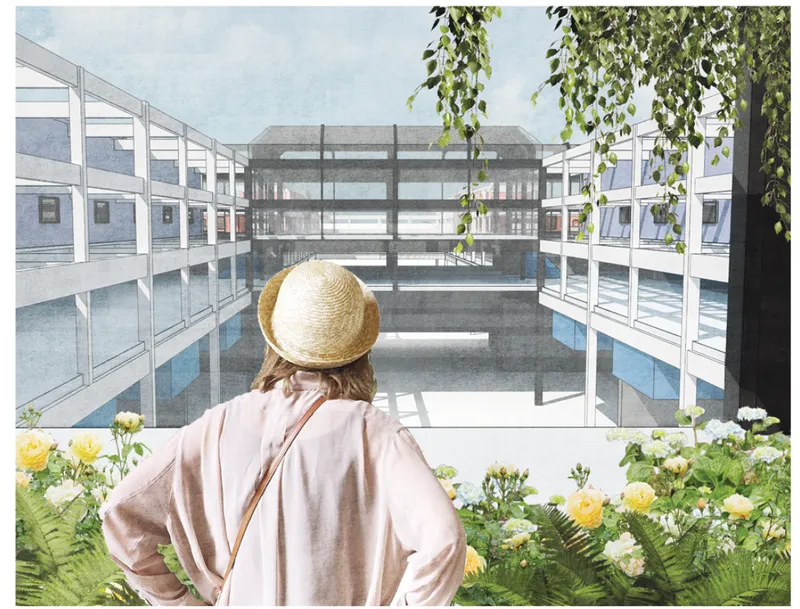
The courtyard rendering is the project's most atmospheric image. Open corridors frame a garden space where hanging willow branches filter light, flowering plants spill from raised beds, and a figure in a straw hat tends the greenery. This is not a decorative atrium; it is a functioning greenhouse zone that doubles as recreational and educational territory. The residential communal zones that Lau and Cheung describe are meant to strengthen social ties precisely through shared productive landscapes like this one. Gardening is the social infrastructure here, not a bench or a fountain.
Purple Grow Lights and Vaulted Greenhouses: Two Faces of Indoor Farming
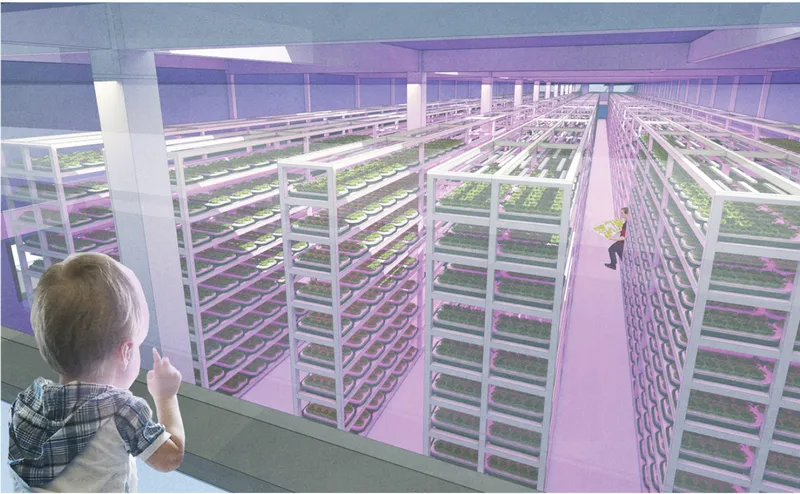
The interior rendering of the hydroponic farming hall is clinical and precise: rows of white vertical racks extend under purple grow lights, maximizing output per square meter in a controlled environment. This is the productive engine of the hub, the space that makes the closed-loop model viable by generating fresh vegetables at scale without relying on external supply chains. The atmosphere is industrial and purposeful, a working room rather than a showpiece.
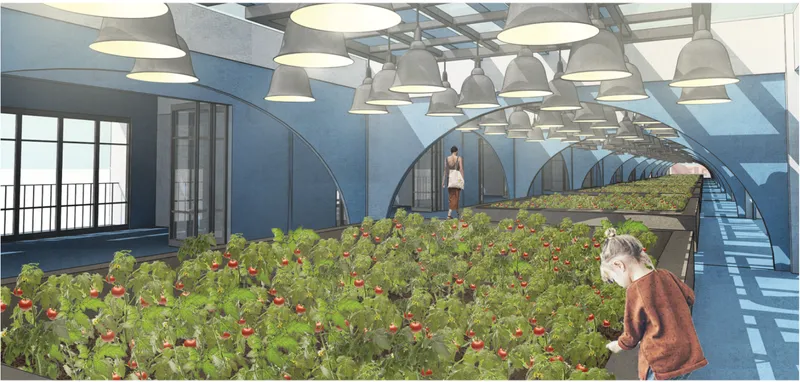
The vaulted interior offers a striking counterpoint. Raised planting beds of leafy greens sit beneath pendant industrial lights and a generous arched ceiling, creating a space that feels closer to a community greenhouse than a factory floor. The juxtaposition between these two interiors captures the project's range: it needs high-tech hydroponic systems to close the food loop, but it also needs warm, inhabitable growing spaces where residents can learn, experiment, and simply enjoy being around plants. Both modes of farming coexist under one roof, serving different functions within the same circular system.
Why This Project Matters
The Nine Elms Hub succeeds because it treats circularity not as a buzzword but as an organizational principle. Every programmatic decision, from the placement of food waste treatment in Phase 02 to the transparency of ground-level marketplaces, serves the closed-loop logic. Waste-to-energy strategies and energy-efficient structures are not added as afterthoughts; they are consequences of the architectural strategy itself. The phased approach, in particular, offers a replicable model for cities that cannot afford to demolish and rebuild but need to radically upgrade their existing building stock.
Lau and Cheung have proposed something genuinely useful: a framework for turning underperforming urban warehouses into integrated food-housing-community ecosystems. The project does not romanticize farming or pretend that architecture alone can solve food insecurity. Instead, it demonstrates how spatial organization, phased investment, and programmatic integration can bring food production back into the daily fabric of city life. As urban populations continue to grow, proposals like the Nine Elms Hub offer a concrete, buildable path toward regenerative urbanism.
View the Full Project
About the Designers
Designers: Jonathan Lau, Obed Cheung
Enter a Design Competition on uni.xyz
uni.xyz runs architecture and design competitions year-round that reward proposals with spatial conviction and real site intelligence.
Project credits: The Nine Elms Hub by Jonathan Lau, Obed Cheung Urban Meal Mine (uni.xyz).


Popular Articles
Popular articles from the community


Cloaked Colonization: A Mobile Underwater Habitat That Moves Like a Fish
Micah Abaya's shortlisted EHC Pacific entry reimagines ocean settlement as a dispersed network of self-sustaining architectural organisms.

Opera on the Sea: Driftwood Logic Shapes a Timber Opera House on Estonia's Coast
Trevor Orgill's opera house translates the entangled drift of floating timber into a civic building where wood, water, and music converge.

Temporary Home for Dogs: A Reversed Zoo Rethinks Animal Shelter Architecture
In Bucharest, a sinuous corridor and freed landscape flip the logic of containment, designing a shelter that works to make itself unnecessary.

Faces of the Soviet Avant-Garde: Turning Moscow's Street Names into an Open-Air Museum
A network of sculptural installations across a Moscow residential district transforms forgotten architect names into spatial encounters with cultural memor

Similar Reads
You might also enjoy these articles

Play: Fragments of Their World: Remembered Architecture Rebuilt as a Modular Playground for Refugee Camps
Tom Gardner abstracts domes, arches and towers from the homelands of displaced families into a kit of child-scaled play parts for camp settlements.
REBIRTH: A Circular Settlement Where Afghan Widows and Their Children Rebuild Life Together
A shortlisted Resile entry turns the circle into a protective ring of timber and brick, gathering homes, classrooms and gardens around a shared landscape.
The Main Dream: A Recycled Plastic Kit That Lets Refugee Children Build Their Own Playground
Thirty-centimetre interlocking cubes that connect on three axes turn play into construction, letting children author the spaces they occupy.

Lunar Spiral: A Fibonacci-Driven Moon Settlement Rising from Shackleton Crater
Golden-spiral geometry organises buried infrastructure and orbiting habitable spheres into a lunar base designed to grow as life on the Moon expands.

Comments (0)
Please login or sign up to add comments
No comments yet. Be the first to comment!