
The Vessel Cafe
Brewed Bali- Beach Cafe Design Challenge

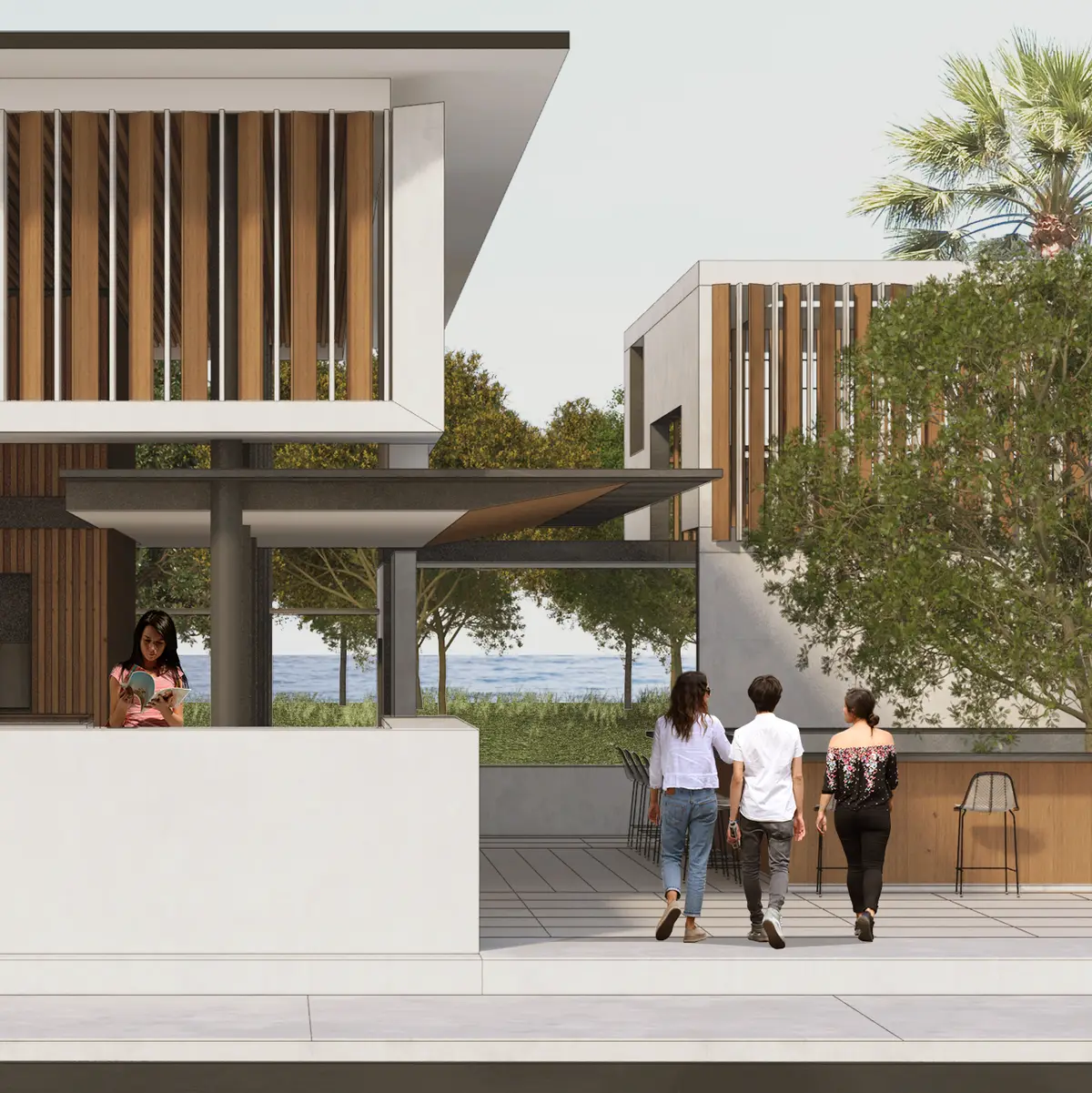
The Vessel Cafe at Bali is an expression of the situation of the current global climate, and informed by its local context, through an examination of spaces and places affected by these factors. The architecture of the Vessel Cafe builds from its namesake and concept, the central “Vessel” volume, which goes beyond the textbook definition of the term and explores its application in the architectural context. The Vessel volume holds the key functions of the cafe, such as the kitchen, service areas, and second level seating, in addition to serving as the visual anchor and expression of concept of the cafe. The cafe was conceptualized from an intent to express a relationship through seamless materiality and transition between the vertical plane (wall) and overhead horizontal plane (ceiling), found in the central “Vessel” volume with the overhead canopy, which serves as the key architectural feature that anchors the other spaces. Secondary spaces are then planned and designed around in reference to the Vessel volume.
The architectural planning of the Vessel Cafe was established through a plan that differentiates the spaces along an organized hierarchy, as an attempt to recall classical architecture planning principles in a contemporary setting. Beyond the core “Vessel” concept and form expression, other elements were integrated to create a more contextual design.
A key consideration was relating the planning of the cafe based on its surroundings. High engagement areas, such as the Vessel volume which served as the cashier and coffee bar, were located facing high traffic areas in the vicinity of the site. A visual connection with the sea line beyond was also established by providing seating extending towards the landscape on the second level. Finally, the secondary volume housing the onsite coffee roastery and coffee studio are set back axially from the Vessel, expressing a planning hierarchy, while maintaining visual identity with the vertical louvers wrapping around the second level of the Roastery + Studio volume.
Seating areas were planned around creating unique experiences within the cafe environment. Seating are oriented to face green courtyards and open areas, expanding the natural environment and microclimate within. In addition to this, seating spaces are also planned to maintain safety measures in light of the COVID-19 pandemic. Seats are oriented away from each other, to minimize face to face interaction. Enclosed spaces are minimized to allow natural ventilation and air flow, key measures in combating the coronavirus.
Materiality and tectonics play a vital role in the expression and design of the Vessel Cafe. Materials were immediately narrowed down based on local availability and ease of construction. In addition, material performance, authenticity, and appropriateness in relation to the context informed the project. By limiting core materials and relying on construction methods to introduce variation, this aided the intent to express a unique yet familiar character, as well as helped relate to the context more appropriately. Prominent architecture works and elements present in Bali Architecture and contemporary tropical design also shaped the project. From these guidelines, local wood and concrete were an obvious decision, accented by local limestone. Wood was expressed in vertical and slim forms, primarily as the main design element of the cafe. This was supported by reinforced concrete finishes and walls, which contrasted with the repeated wood finishes with an unexpected dynamic geometry informed by the planning of spaces. Finally, the local limestone blocks were used in the flooring to evoke tactility and serve as a subtle connectivity to the ground beneath.
In light of the prolonged severity of the COVID-19 pandemic, design solutions that combat the spread of the coronavirus were also explored in the project. Architectural features that promote personal hygiene, social distancing, and natural ventilation became central requirements of the project. These greatly influenced the design output as well as created unique placemaking potential beyond the natural communal draw of coffee shops and cafes. From this, the design solutions in this project may be referenced and even prototyped for more effective and functional countermeasures against COVID-19.
In approaching the design of the project, a number of key paradigms were established in the design approach. While certain architecture and aesthetic elements were reiterated multiple times to arrive at the best possible output, the core architectural form and intent remained the same, as this informed the central exploration and expression of this project. Instead of creating individually unique components in the architecture and design, elements expressed variation through select changes in materiality, orientation, and juxtaposition.
A nonlinear and reiterative approach was accomplished in order to constantly question and improve upon design schemes, with design philosophies and core elements established early on to inform the project’s evolution. Designs and schemes were quickly prototyped, mixed and matched, and revised for the final design to emerge. Spaces and functions were planned around creating unique visitor experiences throughout the cafe, which was made possible through an arrangement of unique open spaces. In addition to this, physical barriers such as walls were reduced and broken down, while circulation was improved and encouraged by linking walkways and constructing overhead canopies for shade.
As the COVID-19 pandemic runs its course and eventually turns for the better, one can imagine a range of additional functions for the cafe and its spaces. Seating areas can be adjusted and added, as the current configuration prioritizes social distancing. Roastery + Studio spaces can be imagined as multifunctional spaces such as for hosting, dining, and entertainment. The outdoor seating area can be converted into a bar space, should the cafe be expanded to add that function, all while maintaining its visual identity and solidifying bonds with its environment and community.
In the years that may come to pass, the Vessel Cafe envisions itself not as an architectural icon or standout, but rather as one of many key destinations and experiences in Bali. As life in Bali adapts to the new circumstance brought upon by the pandemic and the grave but vital lessons with it, opportunities for growth and renewal await. As the coffee shops and cafes fulfill the social role of the contemporary third space, and as third spaces evolve and grow, the Vessel Cafe aims to become one of many key gathering spaces for friends and community, and for one to enjoy a cup of coffee in the island sun.


Popular Articles
Popular articles from the community


Tsunami Convergenics: Turning Catastrophic Ocean Forces into Underwater Housing Infrastructure
A speculative underwater settlement off the coast of Onagawa, Japan, treats tsunamis and typhoons as energy sources rather than threats.

Cloaked Colonization: A Mobile Underwater Habitat That Moves Like a Fish
Micah Abaya's shortlisted EHC Pacific entry reimagines ocean settlement as a dispersed network of self-sustaining architectural organisms.

Manzana Morphosis: Stretching Barcelona's Grid into a Living Landscape for 2050
A radical reworking of the Eixample manzana turns density into a tool for generous public space, vertical ecology, and environmental performance.

Singing Woman: An Opera House That Performs Before the Curtain Rises
Ovidiu Cristian Pavel's conceptual opera house translates Estonia's choral identity into a sculpted waterfront landmark facing the Baltic Sea.

Similar Reads
You might also enjoy these articles

Pixel Gardens: One Repeated Module Stacked Into a Terraced Social Housing Tower for Famagusta
Salem Bader's shortlisted housing tower builds a vertical neighbourhood from one repeated module, offsetting units to carve terraces, light and air.

Bao Huynh Watercolor Atelier: A Serene Art Retreat in Hội An
Bao Huynh Watercolor Atelier in Hội An blends multifunctional art spaces, sustainable design, local materials, and family-friendly living in a serene environment.

Atelier Macri Concept Store Interior Design by CASE-REAL
Atelier Macri store features a "ko" counter, walnut wood details, cork displays, blending retail, gallery, and seamless customer experiences.

Manuel Vargas Izquierdo Stadium and High-Performance Sports Center: Architectural Excellence in Jalpa de Méndez
The Manuel Vargas Izquierdo Stadium blends sustainable design, inclusive sports facilities, and cultural-inspired architecture, revitalizing Jalpa de Méndez’s public spaces.

Explore Cafe and Restaurant Design Competitions
Discover active competitions in this discipline


Challenge to reimagine the Iron Throne

Photograph architecture without architects

Illustrate the lost glory of Angkor Wat - Render Challenge

Design challenge to reuse E-waste
Comments (0)
Please login or sign up to add comments
No comments yet. Be the first to comment!