

Revitalizing the Pedestrian Approach to the City of Panjim: The Social Magnet
Project type: Urban revitalization architectural thesis

Location : Panjim, Goa, India
The thesis worked around revitalizing a frequented pedestrian approach to the city of Panjim. It was focused on the T.B. Cunha stretch, with the area of intervention being the National Theatre. Through documentation, mapping and analysis, the main concern was neglected and abandoned areas. A large number of such areas were present in the city fabric, which were seen as ‘lost spaces’.
In order to tackle this issue of urban decay, various urban designs and architectural strategies were studied, to turn these neglected areas into assets of the city. Further analysis also revealed lack of identity and pause points for daily commuters along this stretch, with the common issue of unorganized street parking. Since this stretch had the potential of being more than mere circulation, the question: ‘What strategies can help activate this urban corridor?’ and ‘How can architecture activate and enhance the stretch and the public realm?’ arose.
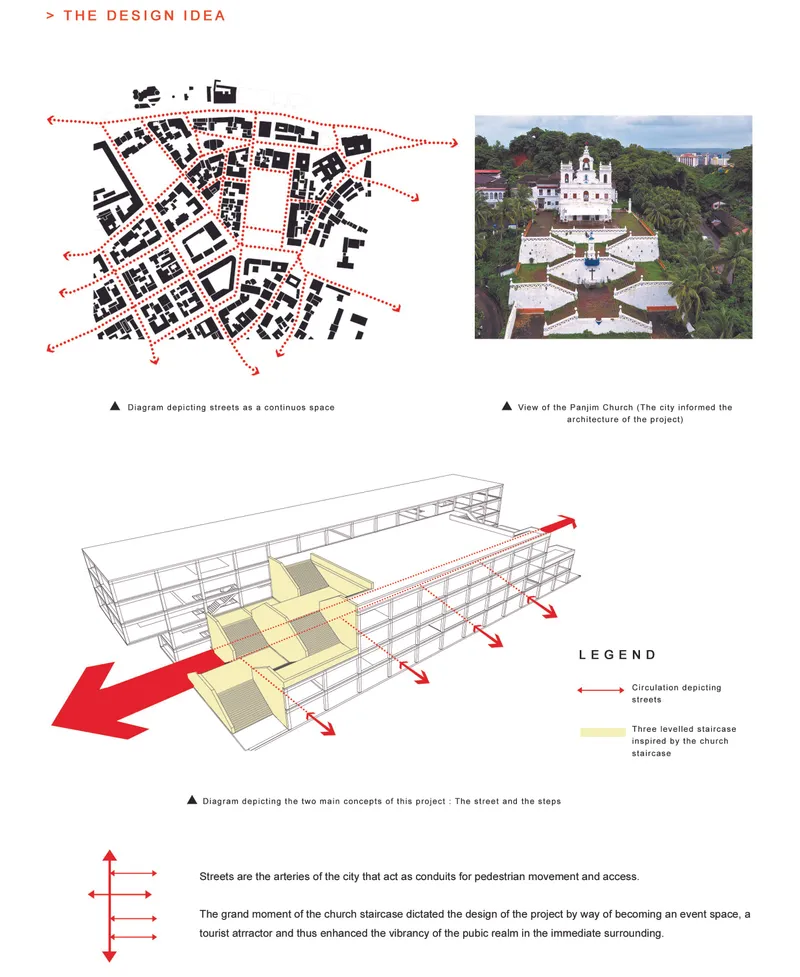
With the intention of giving the public realm more flexibility, the T.B. Cunha stretch was proposed to be pedestrianized, with spaces for exhibitions, church fests, art festivals, pop up stores, street food carts etc. Moving on the architectural intervention, the city itself informed the architecture of the project. The grandeur of the Panjim church dictated the design of the project by becoming an even space and an excellent tourist attractor. The project was also designed with the concept of a continuous street with many entry points for easy access. Every level was strategically planned to have a visual connect to the church. The project was also designed with many places for people to meet, interact and hang out. A number of energy efficient techniques and strategies to bring in natural light and ventilation were worked on. Various design details were also created, to give more clarity and understanding of the project.
This thesis can be carried forward by introducing many such interventions in the city fabric, either along this pedestrian conduit itself or other routes in Panjim. This will enhance the identity of the city of Panjim, so as to make it a city for people first, then buildings and lastly vehicles.


Popular Articles
Popular articles from the community


FCC Arquitectura Expands a Portuguese Granite House with a Board-Marked Concrete Wing
In Portugal, JV House pairs a cleaned-up whitewashed and granite dwelling with a timber-shuttered concrete extension, courtyards and a garden pool.

graciastudio Turns a Viewless Tijuana Lot Inward Around a Courtyard of Concrete, Timber and Trees
In Tijuana, Jorge Gracia's GA2 House stacks a timber-clad private floor over exposed concrete and replaces a missing view with a planted interior patio.

Cube Design Draws an Ecological Corridor Between Two Shenzhen Hills with the Nankai Building
Beside Shenzhen's container docks, the Nankai Building pairs stacked balconies with a climbing green screen to connect two hillsides across its height.


The Amber Palace Opera: A Geological Fiction Surfaces on Tallinn's Baltic Waterfront
Pierre Brillard reimagines a Baltic legend as a public landscape, opera house, and waterfront promenade rooted in Tallinn's coastal identity.

Similar Reads
You might also enjoy these articles
The Rhythm of Seasons
A Farmers' Market Connecting Nature and the City

More Than a Building-Designing a Living System
More Than a Building-Designing a Living System
Base Beyond
DESERT COMPOUND ARID: TOURISM OF ABSENCE AND ABUNDANCE

Comments (0)
Please login or sign up to add comments
No comments yet. Be the first to comment!