

TRACKS Builds a School from Site Earth, Straw, and Five Centuries of Craft in Mordelles
Clairière School uses 469 tonnes of unstabilized earth from its own ground to shelter 16 classrooms in a clearing near Rennes.


Mordelles sits southwest of Rennes in a landscape scored by water over centuries, its sunken lanes and wooded edges forming a topography that feels older than the suburban houses now lining its streets. When the town's obsolete Gretay school group needed replacing, TRACKS chose not to fight that geography but to amplify it. The result is Clairière School, a 3,450 m² campus for 11 primary classrooms and 5 extracurricular rooms, organized as a constellation of low gabled volumes around planted courtyards. The name, French for "clearing," is literal: the school carves a protected interior landscape out of a vast meadow in the urban core, bordered by pedestrian paths and impressive mature trees.
What makes the project worth close attention is not its formal language, which is restrained to the point of self-effacement, but the radical commitment to material. Five distinct earth construction techniques appear in a single public building: load-bearing rammed earth, wattle and daub partitions, light earth-straw, earth-hemp projected insulation, and earth plaster on both interior and exterior surfaces. A total of 469 tonnes of unstabilized earth were sourced directly from the construction site. Straw bales came from local agriculture. The school carries France's Level 3 biosourced certification and already meets the RE2020 2028 energy threshold, with a summer comfort scenario modeled to 2050. It is reportedly the first public building with structural rammed earth documented in Brittany. At 10.44 million euros excluding tax, it also demolishes the assumption that building this way must cost more.
A Campus Shaped Like a Clearing


Seen from the air, the campus reads as a cluster of pitched-roof volumes linked by covered walkways, their metal roofing catching the low light of dusk. The arrangement is deliberately anti-monumental. Rather than one large building, TRACKS distributed the program into wings that frame courtyards, playgrounds, and planting beds. Children move between spaces along a circulation spine that doubles as a sheltered social corridor. The wooded edge of the site acts as a backdrop visible from every classroom, collapsing the boundary between interior learning and exterior landscape.
The suburban neighborhood wraps tightly around the site, and the aerial views make the contrast stark: the school's rooflines and planted beds form a green pocket in a field of individual houses and cul-de-sacs. That inversion, a public institution as the most generous piece of landscape in the quarter, is an argument for what schools can be when they take their ground seriously.
Rammed Earth as Structure and Identity
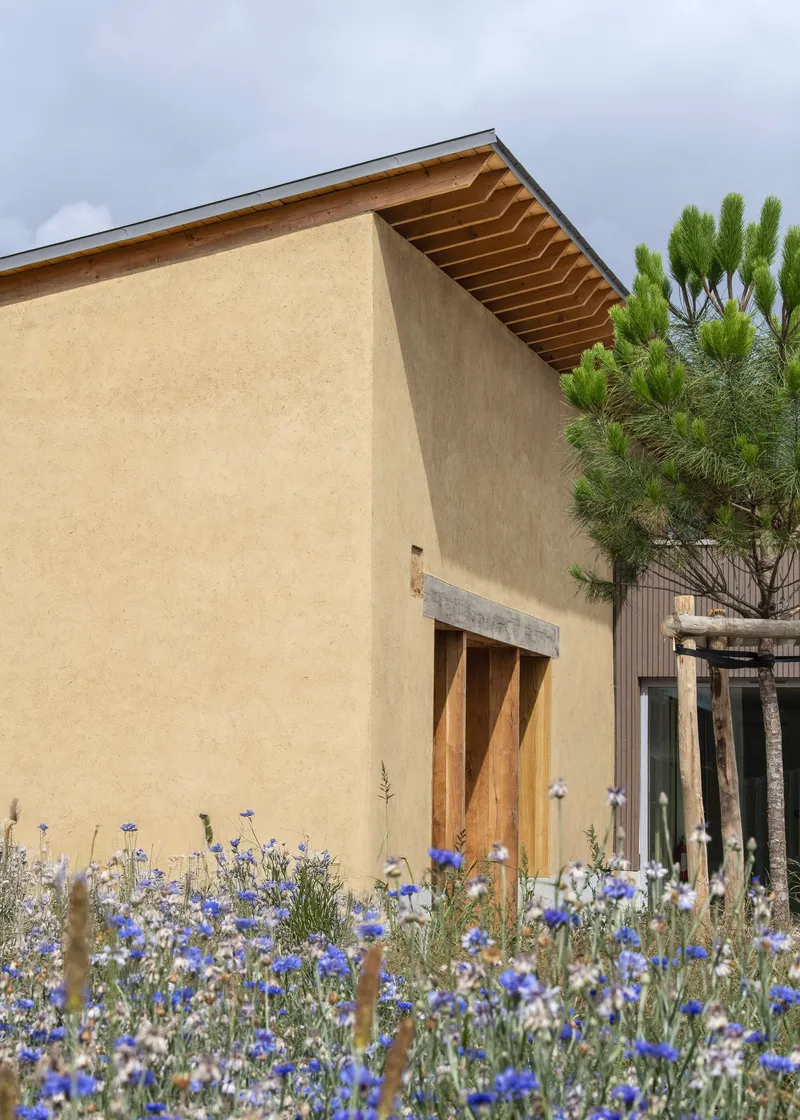
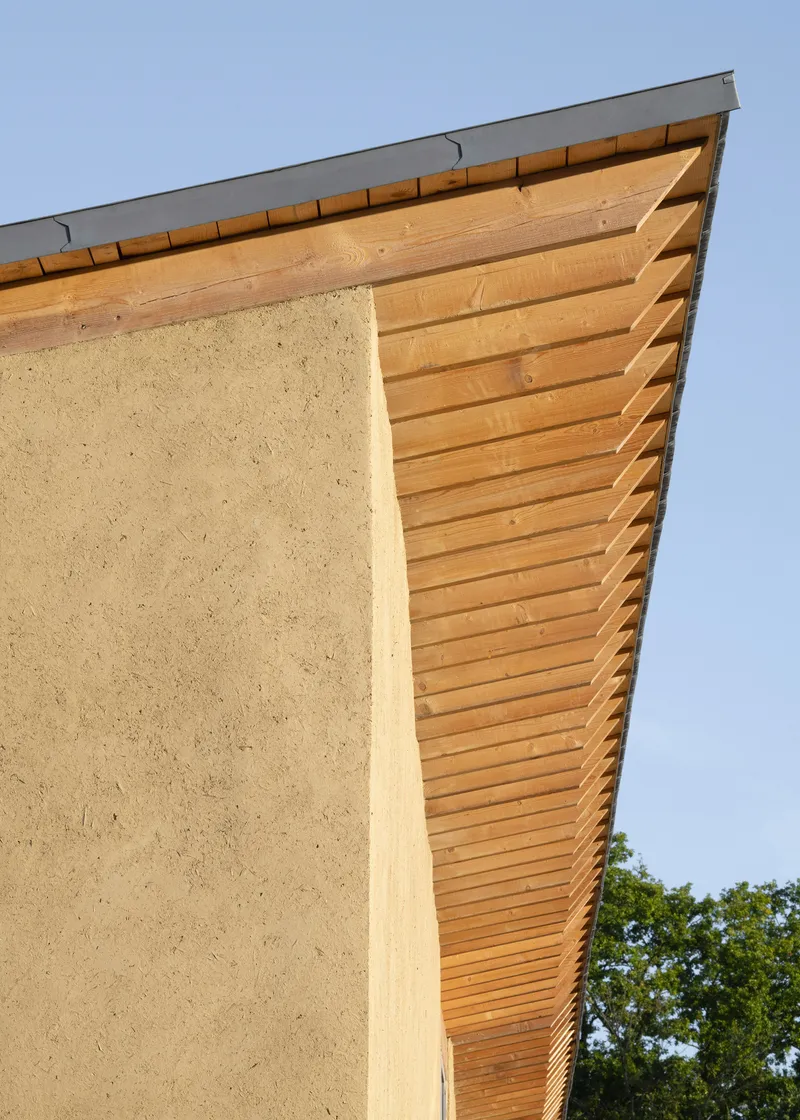
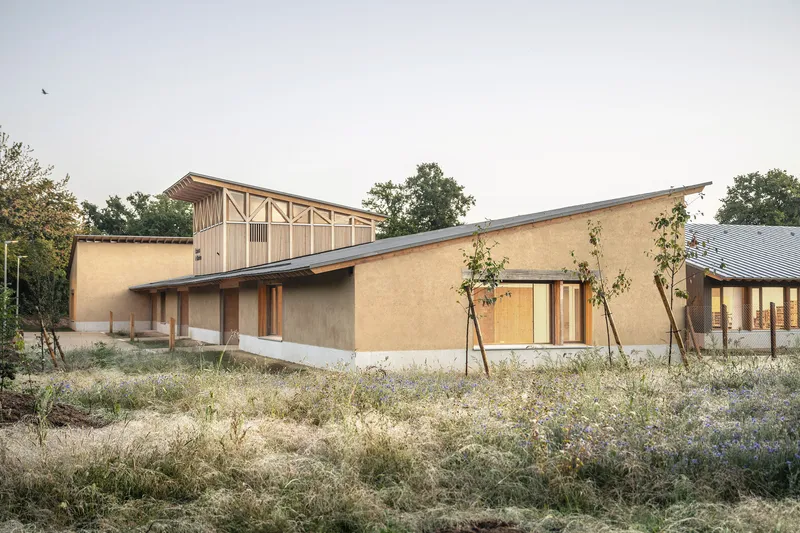
Four large volumes at the school's entrance are built entirely in load-bearing rammed earth using the "paton" technique, a traditional patting method for compacting unstabilized earth into formwork. The resulting walls show horizontal banding that records the construction process layer by layer, each stratum a slightly different tone depending on moisture content and soil composition. These are not decorative veneers. They carry loads. The earth was dug from the site itself, meaning the building is, in a straightforward physical sense, made of its own ground.
At close range, the junction between rammed earth wall and timber eave is handled with precision. The sloped roof overhangs protect the earth from direct rain, a critical detail for unstabilized construction in Brittany's wet climate. Timber columns stand adjacent to the earth walls without competing; the two materials share the structural duty with clear legibility. The construction required pooling the expertise of four artisan companies, a logistical challenge that speaks to how rare this kind of work remains, even in France where earth building has deep roots.
Timber Frame and the Logic of the Envelope
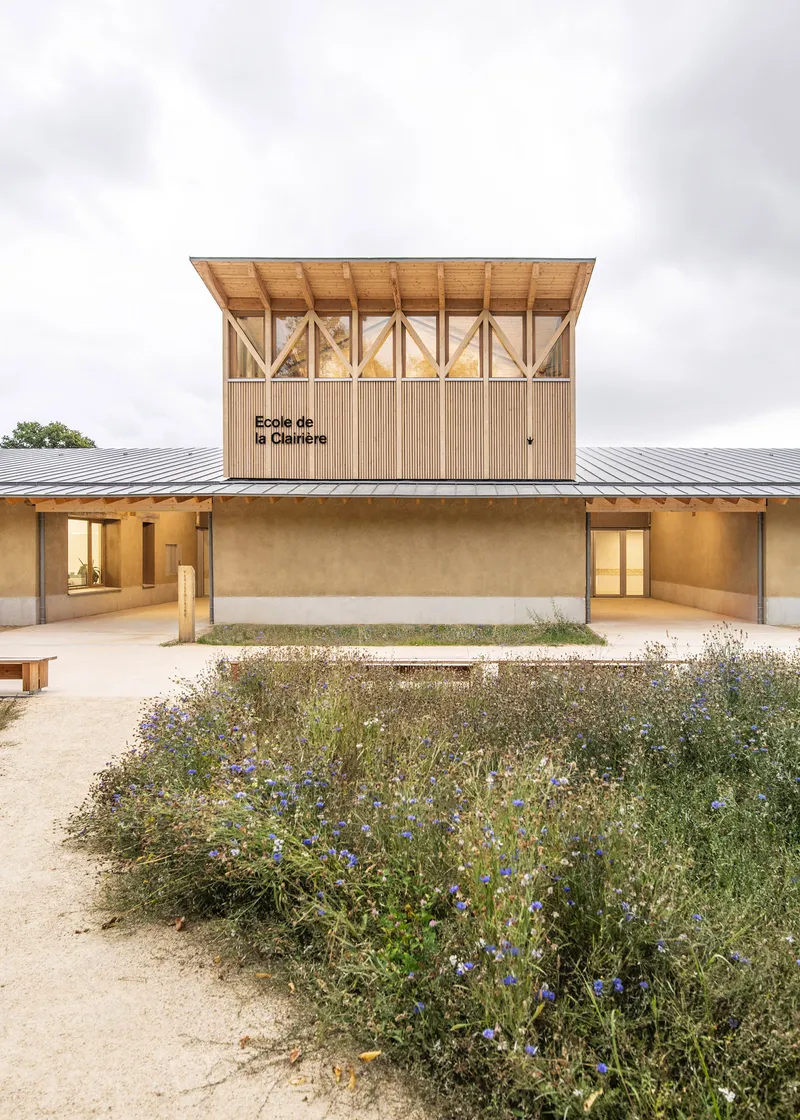
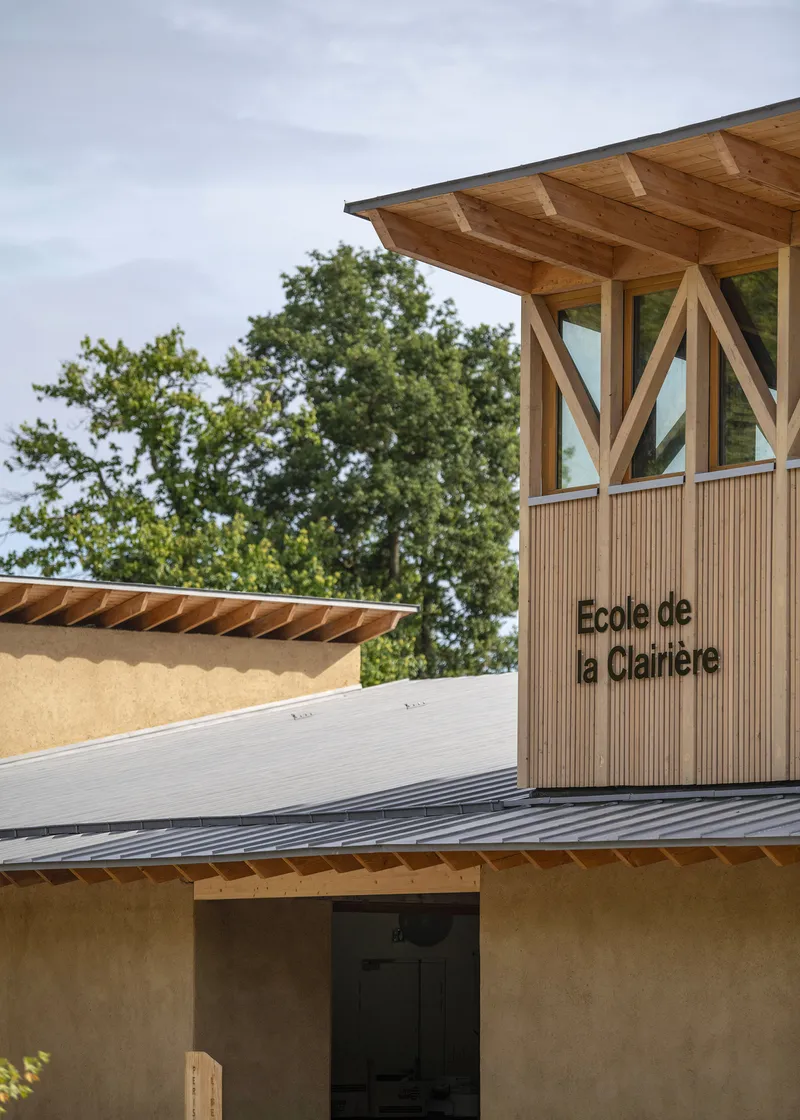
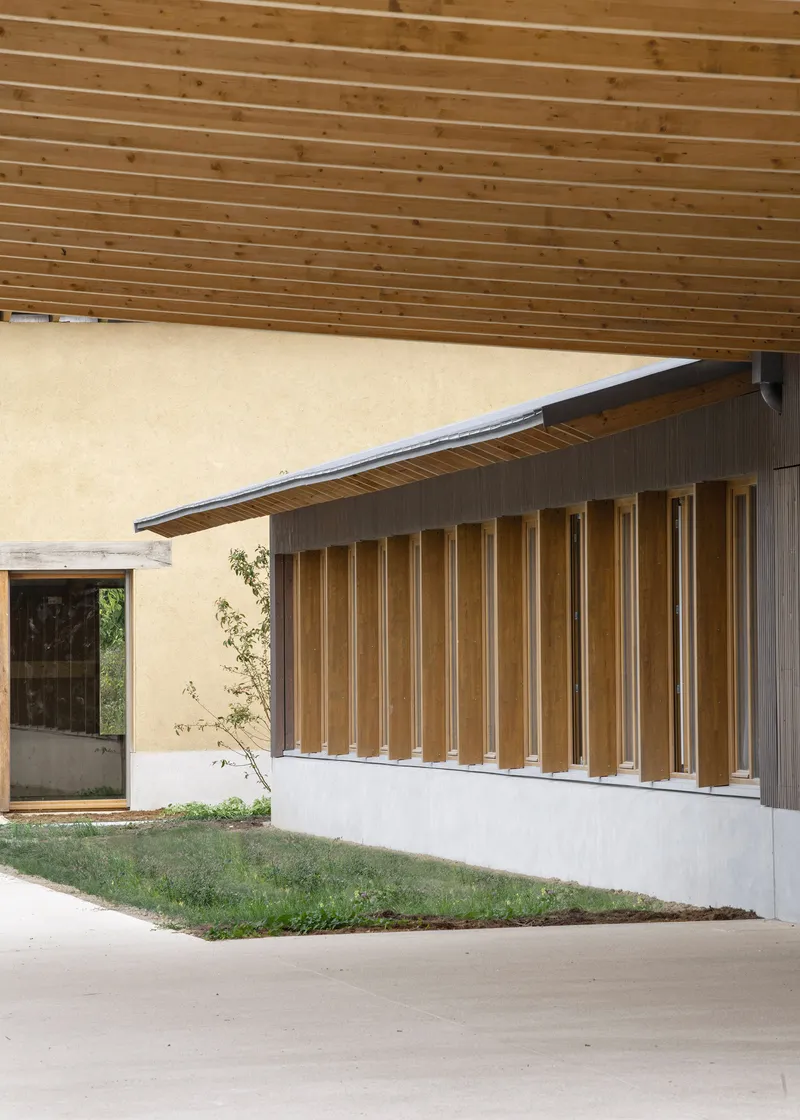
Beyond the rammed earth entrance volumes, the school's structure shifts to timber post-and-beam frames and mass timber panels. Vertical timber fins on the facades create a rhythmic screen that modulates daylight and gives the long elevations a textile quality. The cladding is unapologetic about being wood: no paint, no composite panels, just sawn sections that will silver over time. A two-story tower with diagonal bracing rises above the courtyard, marking the entrance and housing the school's vertical circulation. Its exposed structure reads as a teaching moment, the forces visible in the geometry of the cross-bracing.
The envelope layers are worth cataloging: 22 cm straw bale insulation supplemented by biofib, earth-hemp projected insulation on the interior face of rammed earth walls, wood fiber and hemp fiber elsewhere, and compressed earth brick partitions that regulate humidity and temperature passively. Together these layers deliver 243 kg/m² of biosourced material across the campus, totaling 807 tonnes. The building breathes. Night ventilation provides passive cooling, and the thermal mass of the earth walls smooths temperature swings through the school day.
Thresholds and Covered Passages
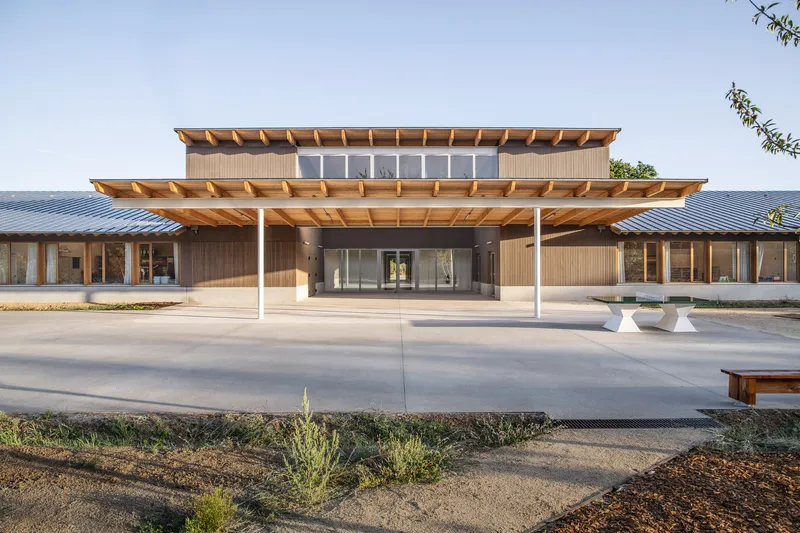


TRACKS invests significant design energy in the spaces between inside and outside. The main entrance is layered: cantilevered timber soffits, white columns, and a concrete plaza create a generous threshold that can absorb the daily surge of parents and children without feeling cramped. Covered porches with vertical timber slat walls filter light into angular shadow patterns on the ground. These are not mere circulation leftovers. They are designed rooms open to the weather, places where children can linger before and after school, where parents wait, where the transition from street to classroom is gradual rather than abrupt.
The covered passage leading to the garden, with its exposed timber joists and polished concrete floor, functions as a framed view toward the landscape. It is one of the most effective spatial moments in the project: a simple corridor that feels like an invitation.
Courtyards and the Ground Plane

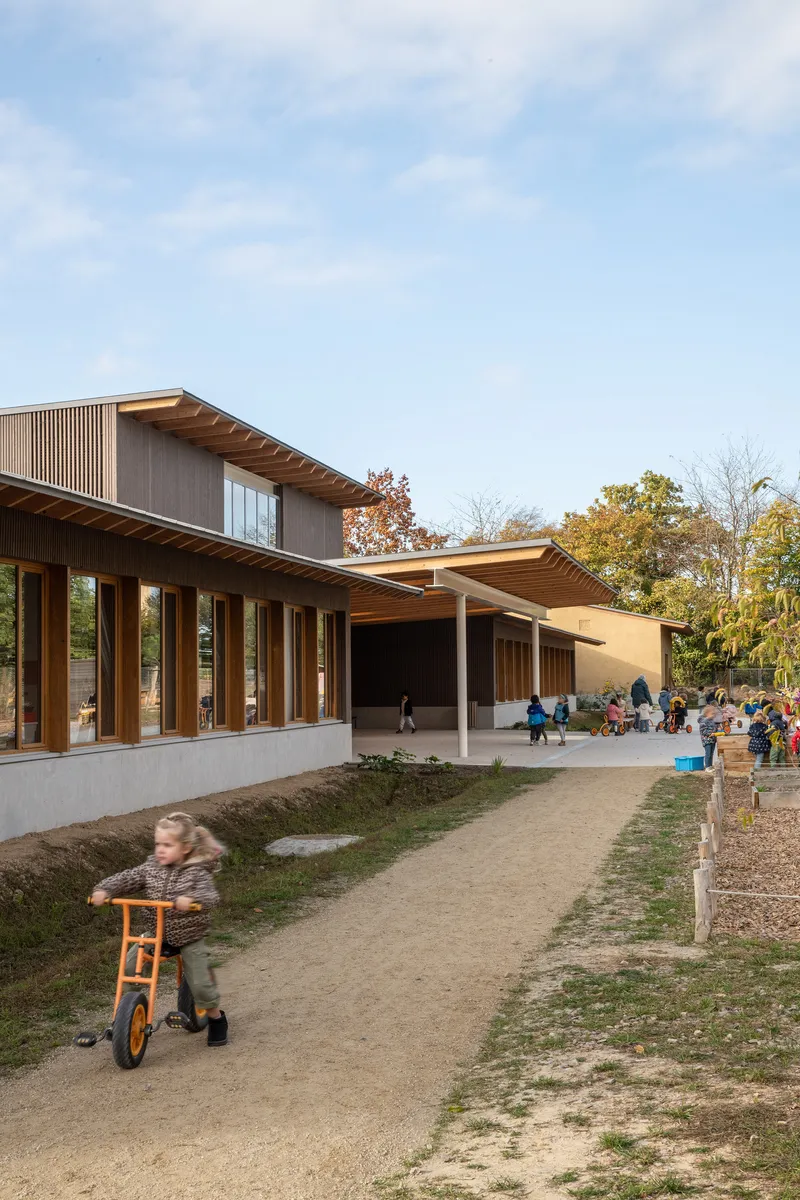

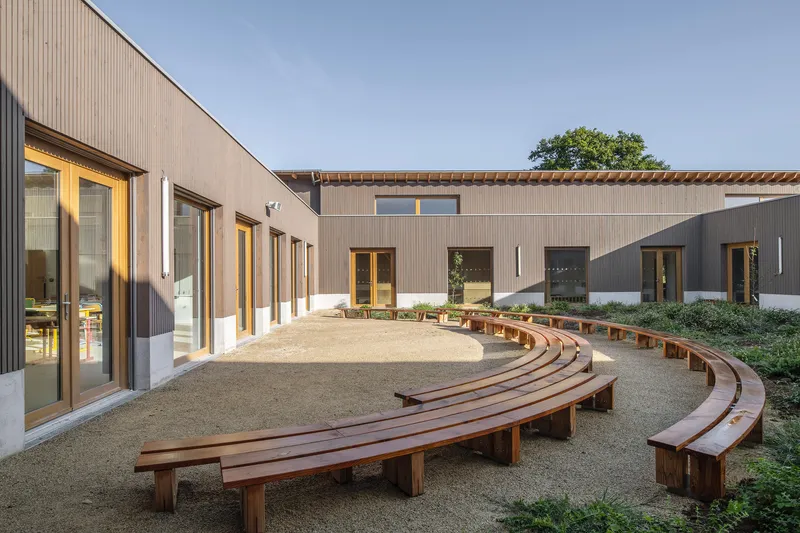
The courtyards are gravel and wildflower, not manicured lawn. Curved timber benches anchor gathering spots. Children walk along paths that feel more like garden routes than institutional corridors. Autumn trees provide shade and seasonal change. The meadow approach from the south, visible in the opening image, sets up the school as a destination reached through landscape rather than parking lot. This is an intentional inversion of the typical school arrival sequence, which tends to privilege cars over feet.
The playgrounds are generous and visible from the classrooms, ensuring that teachers can supervise from inside while children have the psychological benefit of being surrounded by trees rather than chain-link. It is a simple strategy, but the commitment to keeping the wooded edge intact and using it as a spatial boundary rather than a clearing limit is what gives the campus its particular atmosphere.
Interior Rooms for Learning and Rest
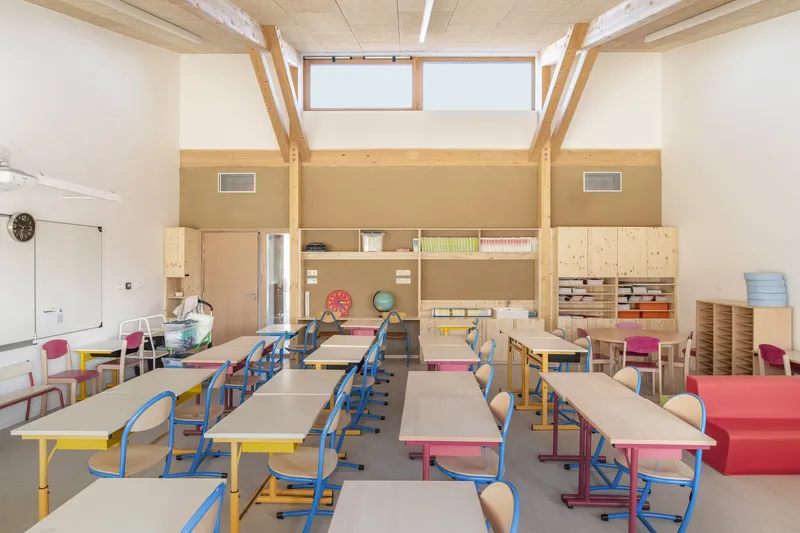
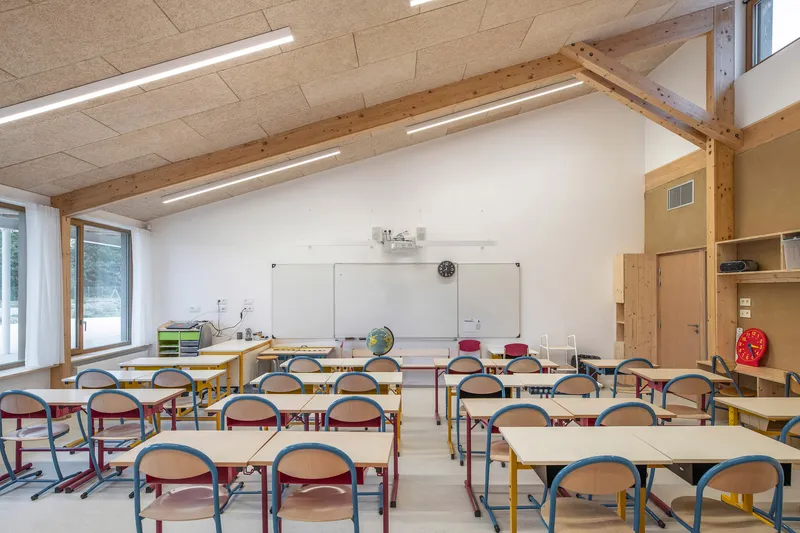

Inside, the classrooms are calm and legible. Exposed timber frames, plywood ceilings, and clerestory windows deliver even daylight across rows of colorful desks. The structure is always visible, never hidden behind suspended ceilings: children can see the beams that hold their roof. The dining hall, where a central kitchen produces 600 meals per day, is a tall room under exposed timber rafters with sphere pendant lights and full-height glazing onto the courtyard. It feels like a communal hall, not a cafeteria.


The extracurricular rooms include a playroom with hempcrete ceiling panels and colorful climbing frames, and a rest room with blue mats under circular pendant lights. These are spaces designed for younger bodies: low, soft, warm in tone. The corridor connecting them uses built-in benches and timber columns to create a sequence of alcoves rather than a featureless hallway. Wattle and daub partitions between classrooms and circulation provide thermal and humidity regulation while giving the walls a tactile, handmade quality that distinguishes them from the precision of the timber structure.
Detail and Material Honesty
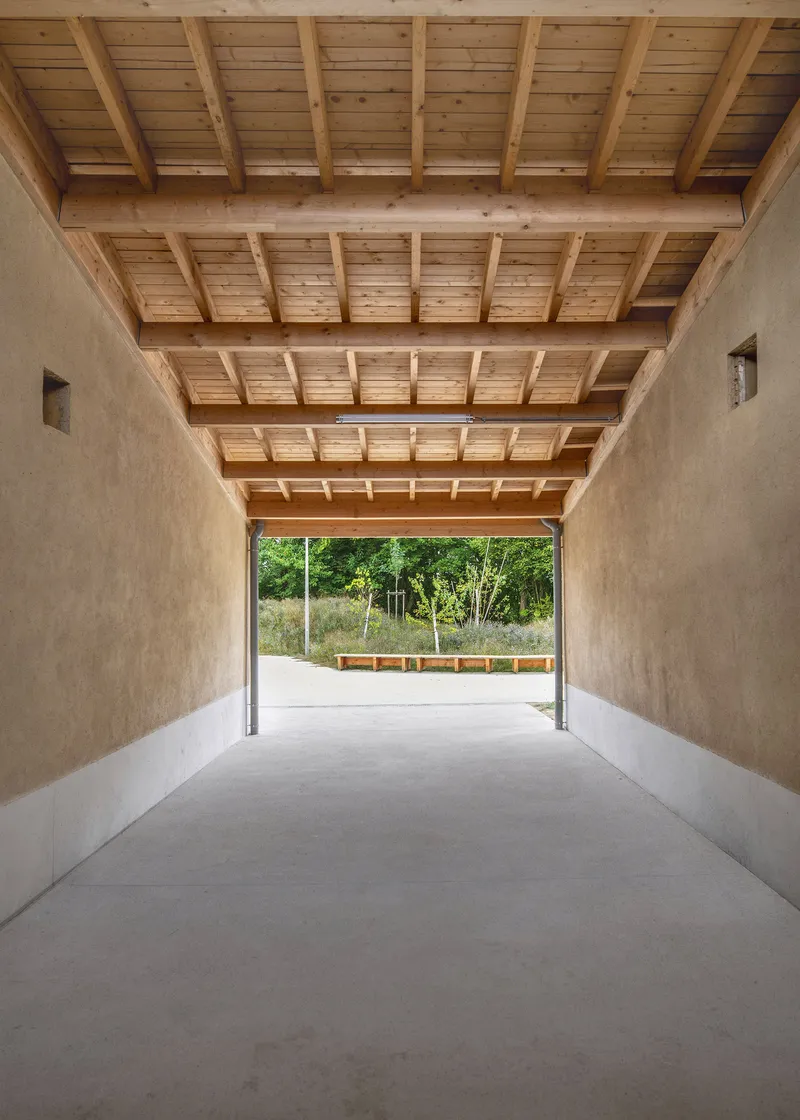
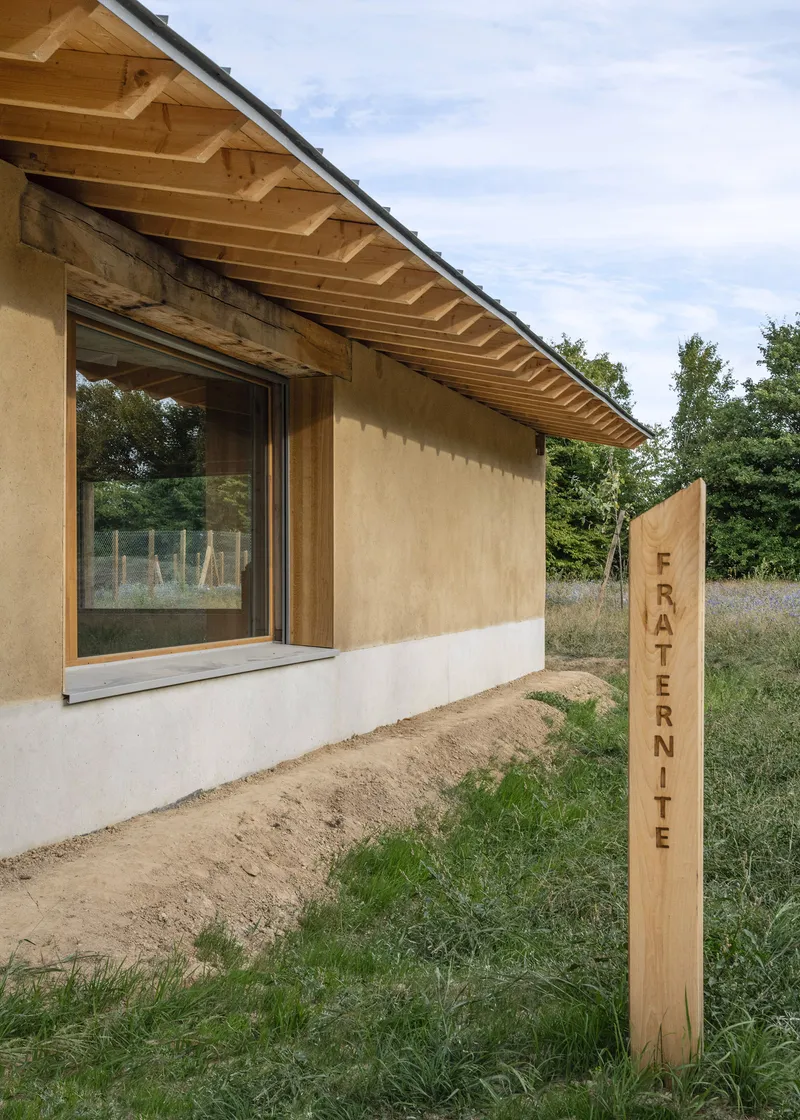
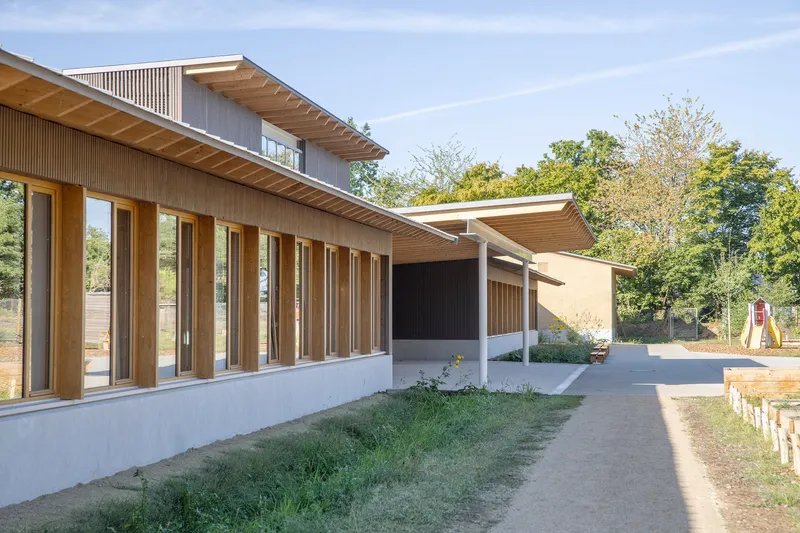
The project's details are consistently honest about what each material is doing. Plywood walls meet exposed rafters without trim; white plaster bases protect earth walls from splashing at grade; timber signposts are left raw. The long view of the linked volumes under deep eaves shows how the repetition of a simple pitched form, varied slightly in height and width, creates a campus that reads as a village rather than a single institution. The eaves are deep enough to shelter the facades and create shade, but not so deep that they darken the interiors.
There is a discipline here that resists the temptation to make the earth construction into spectacle. The rammed earth walls are powerful, but they are not spotlit or isolated as art objects. They are walls. They hold up roofs. They keep rain out. The architecture treats material performance and aesthetic expression as the same thing, which is what material honesty actually means when it is not just a slogan.
The Evening Campus
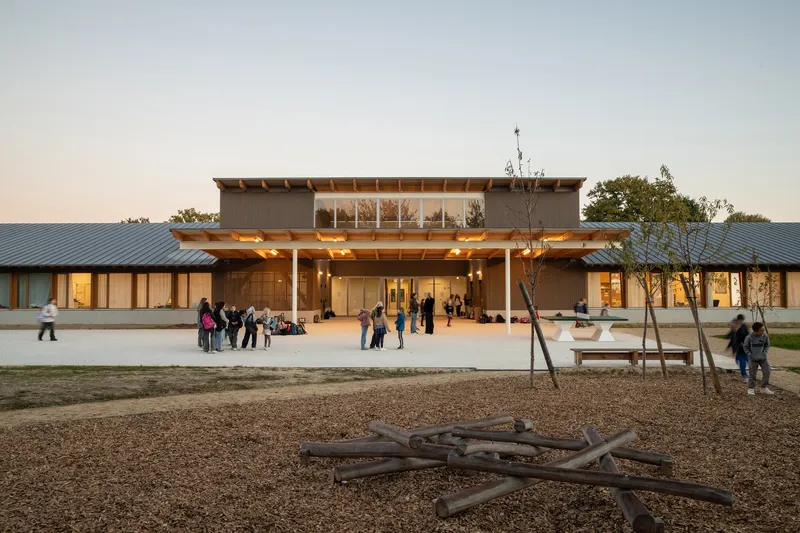
At dusk, the two-story central volume glows from within, its glazed upper floor becoming a lantern that orients the campus. People gather at the base. The school transforms from a daytime learning environment into an evening landmark for the neighborhood. The warmth of the timber and the softness of the light give it a domestic scale that belies the building's public function. Schools that can hold this double identity, institutional by day and neighborly by night, tend to earn the loyalty of their communities.
Plans and Drawings


The floor plans reveal the organizational logic: classroom wings extend from a central circulation spine, framing courtyards on both sides. The linear arrangement keeps every room on the perimeter with direct access to outdoor space and cross-ventilation. The section drawings show how the varying roof pitches create different interior volumes, from the tall dining hall to the lower, more intimate classrooms. The landscape context drawing confirms that the site is a clearing in the truest sense: the building occupies the middle of a meadow, surrounded by trees that define its edges without enclosing it.
Why This Project Matters
Clairière School matters because it proves, in a public commission with real budgets and real regulatory hurdles, that earth construction can be structural, scalable, and code-compliant in contemporary France. Five earth techniques in a single building is not a research pavilion exercise; it is a 600-meal-per-day, 16-classroom, RE2020-compliant school. The fact that it is the first documented public building with load-bearing rammed earth in Brittany says more about the conservatism of the construction industry than about the viability of the technique, which is centuries old. TRACKS and the four artisan companies who built the walls have created a precedent that removes excuses.
The deeper lesson is about frugality as a design position, not a constraint. The project's guiding principles of sobriety, efficiency, and durability are visible in every decision: local straw, site earth, passive cooling, honest detailing. Nothing here is performatively austere. The spaces are warm, generous, and full of light. The courtyards are planted. The dining hall has sphere pendant lights. Frugality, when it is genuine, does not mean deprivation. It means knowing where to spend and where to stop. Clairière School stops in all the right places.
Clairière School, designed by TRACKS, Mordelles, France. 3,450 m². Completed 2025. Photography by Guillaume Amat.
About the Studio
Share Your Own Work on uni.xyz
If projects like this are the kind of work you want to make, uni.xyz is a place to publish your own, find collaborators, and enter design competitions.


Popular Articles
Popular articles from the community


longwave studio Reorganizes a 112 m² Tainan Apartment Around the Daily Routines of a Family and Two Cats
In Tainan, Taiwan, birch plywood, rust-red furniture and a freestanding plaster wall link arrival, storage, work and family life in one apartment.

David Macias Steps a Doorless Stone and Plaster House Down a Tropical Colombian Hillside
In the humid hills of Colombia, Threshold House replaces the front door with an open void and terraces its 850 m² down the slope instead of fighting it.

GROUP A Strips a 1969 Rotterdam Harbor Headquarters to Its Frame and Wraps It in Timber Louvers
In Rotterdam's M4H harbor district, Ferro Offices reuses a 1969 frame, adds one timber storey and reaches BREEAM-NL Outstanding.

Jaramillo Van Sluys Arquitectura and Urbanismo Turn a Demolished Registry Lot in Quito into an Orchard Plaza
In Quito's Centro Histórico, a 2,800 m² plaza exposes the San Agustín convent wall and redraws its lost Augustinian orchard in volcanic stone.

Similar Reads
You might also enjoy these articles


LAVA Architecten Gives Vocational Education a Sawtooth-Roofed Face on a Mechelen School Campus
In Mechelen, Belgium, a 2,053 m² STEM school on a 6×6 m grid turns workshops and classrooms into rooms that can be rearranged as teaching changes.

KEMA Studio Turns a Derelict Marvila Attic into a 60 m² Lighthouse Apartment Above Lisbon
In Lisbon's Marvila district, a rebuilt roof, four skylights and two plywood volumes turn an unlivable attic into a bright home facing the Tagus.

Pixel Gardens: One Repeated Module Stacked Into a Terraced Social Housing Tower for Famagusta
Salem Bader's shortlisted housing tower builds a vertical neighbourhood from one repeated module, offsetting units to carve terraces, light and air.

Bao Huynh Watercolor Atelier: A Serene Art Retreat in Hội An
Bao Huynh Watercolor Atelier in Hội An blends multifunctional art spaces, sustainable design, local materials, and family-friendly living in a serene environment.

Explore Pont-Aven School Competitions
Discover active competitions in this discipline

Challenge to design public laboratory

Design challenge to reuse E-waste
Comments (0)
Please login or sign up to add comments
No comments yet. Be the first to comment!