

Trahan Architects Anchors a 150-Foot Weathering Steel Canopy on Just Two Points in Arkansas
A monocoque pavilion built with shipbuilding techniques becomes Springdale's new civic stage along the Ozark foothills.


A 150-foot span of weathering steel touches the ground at only two points. That single fact should be enough to make you pay attention to what Trahan Architects has accomplished at Luther George Park in Springdale, Arkansas. The pavilion is a monocoque structure, meaning the shell itself carries all the load, an approach borrowed from ship-building rather than conventional architecture. Fabricated in sections by Netherlands-based CIG Architecture from hand-bent steel plates ranging from a quarter-inch to three-quarters of an inch thick, the canopy swoops upward from a stage on one side, twists over a central path, and lands at a single delicate point on the opposite side, with one wing section flying outward diagonally into space.
What makes this more than a structural stunt is the way the pavilion organizes civic life at two scales simultaneously. One face addresses a great lawn capable of hosting 3,000 people for concerts and public events. The other side leans back toward the earth, fronting a smaller lawn scaled for intimate gatherings of 50 to 100. The shell integrates performance power, theatrical rigging, acoustic tuning, and lighting into its ruled-surface geometry, so there is no bolt-on infrastructure cluttering the form. Supported by the Walton Family Foundation's Northwest Arkansas Design Excellence Program and situated along Spring Creek in the heart of downtown Springdale, the pavilion connects the town to the Razorback Greenway, a regional trail system spanning over 40 miles.
A Shell That Earns Its Form
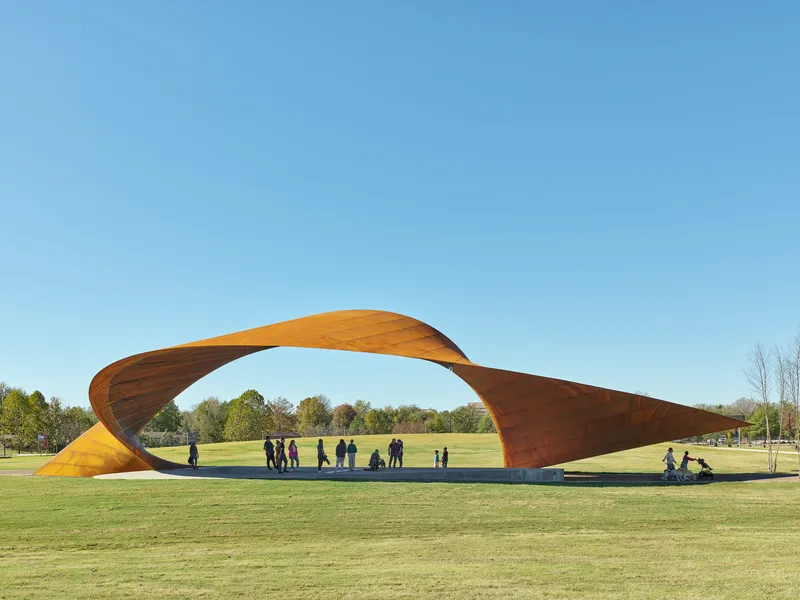
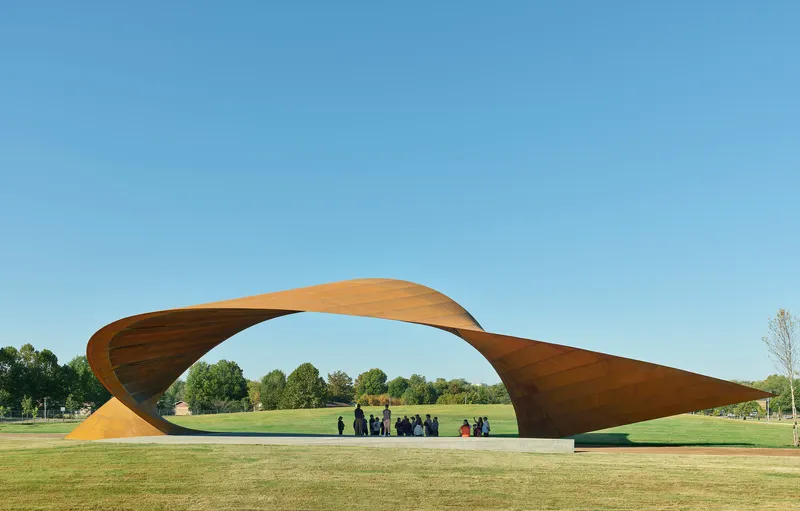
Trahan's design takes explicit inspiration from the gentle rolling hills of the Ozarks that surround Springdale, but the canopy never reads as mimicry. The twist in the shell is structurally generative: it stiffens the monocoque section, redirects loads to the two ground contacts, and creates a gateway condition on the park's central axis. The form is working hard, and the landscape reference is a bonus, not a premise.
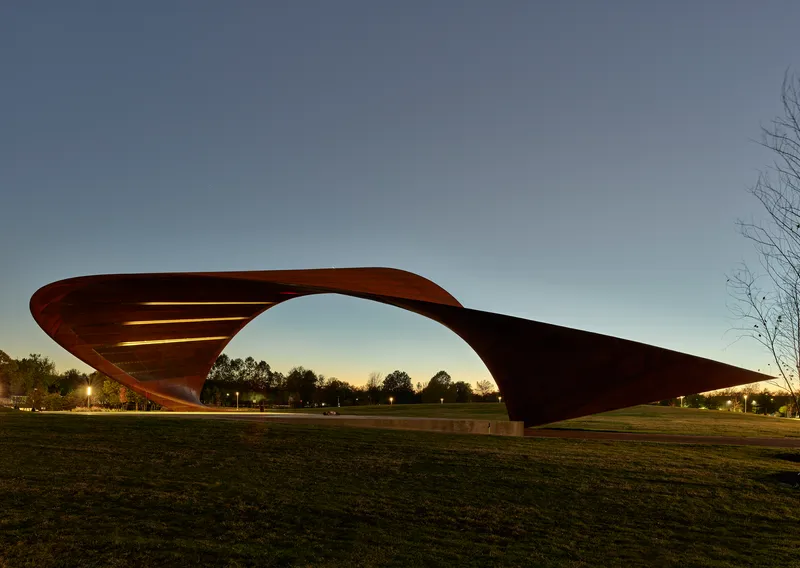
Seen from a distance at dusk, the silhouette registers as a single sweeping gesture, almost calligraphic. Up close, the materiality takes over. The weathering steel is already developing its characteristic patina of deep orange and brown, and the design embraces this explicitly. Rainwater leaves visible stains and traces as it moves from roof to earth, so the building is literally recording its own weather history on its skin.
Two Grounds of Contact
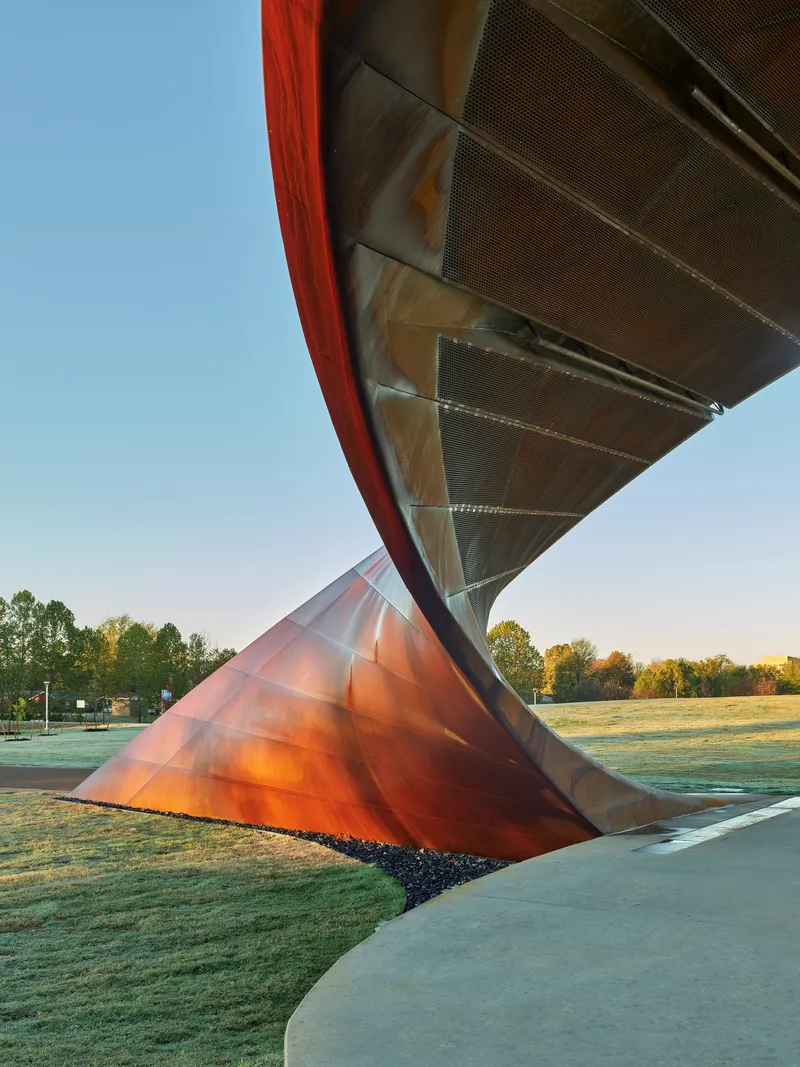

The structural economy here is extreme. Anchoring a 150-foot canopy at two points demanded custom non-linear structural analysis, performed by Nous Engineering as engineer of record with CIG providing calculations for peer review. The monocoque shell distributes forces through its curved surface rather than through a conventional frame of beams and columns. The result is a canopy that appears to hover, its mass contradicted by the thinness of its ground connections.
At the stage end, the shell roots itself into a curving ramp and earth berm designed in collaboration with landscape architects Spackman Mossop Michaels, merging architecture and topography. At the opposite end, a single twisted support column meets the perforated metal soffit with a precision that reads as almost fragile. The asymmetry between these two landings gives the pavilion its kinetic quality: it looks like it is still in motion.
The Underside as Instrument
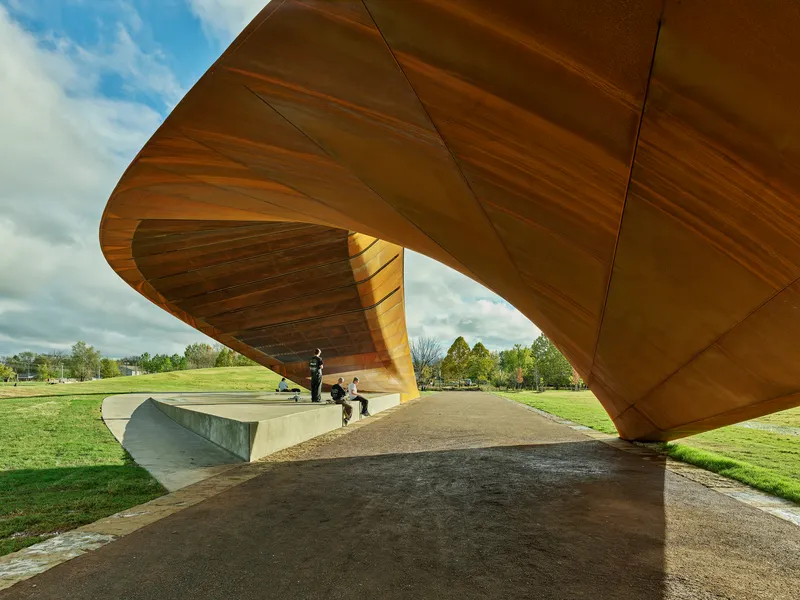
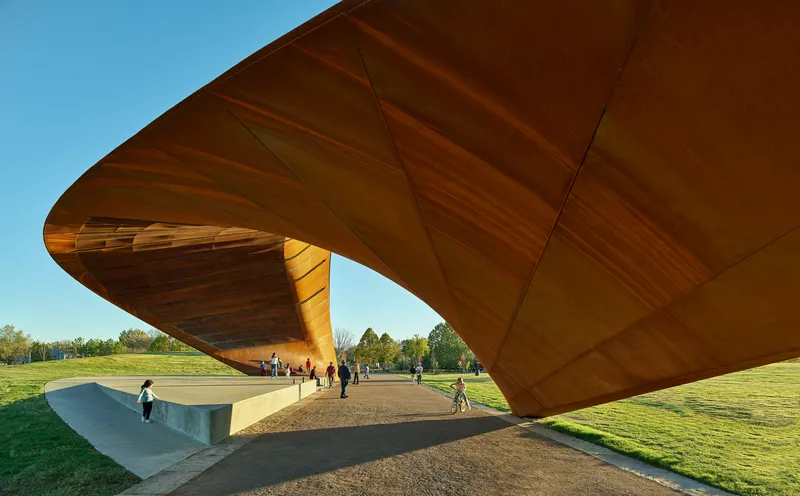
The underside of the canopy is where the real design intelligence resides. Warped steel panels and structural ribs create a ruled surface whose geometry was developed through acoustic collaboration between Threshold Acoustics and Trahan Architects using Rhino and Grasshopper. Thin "rule lines" score the soffit, and integrated lighting stripes run along these joints, so the structure glows from within at night without any visible fixtures breaking the surface.
For a performance venue, this is critical. The underside is simultaneously structure, acoustic reflector, and luminaire. The ribbed metal surface visible in overhead views reveals the density of the ruled-surface logic: every panel joint follows a mathematical line derived from the intersection of the structural shell and the acoustic requirements. Nothing here is decorative.
Performance at Two Scales
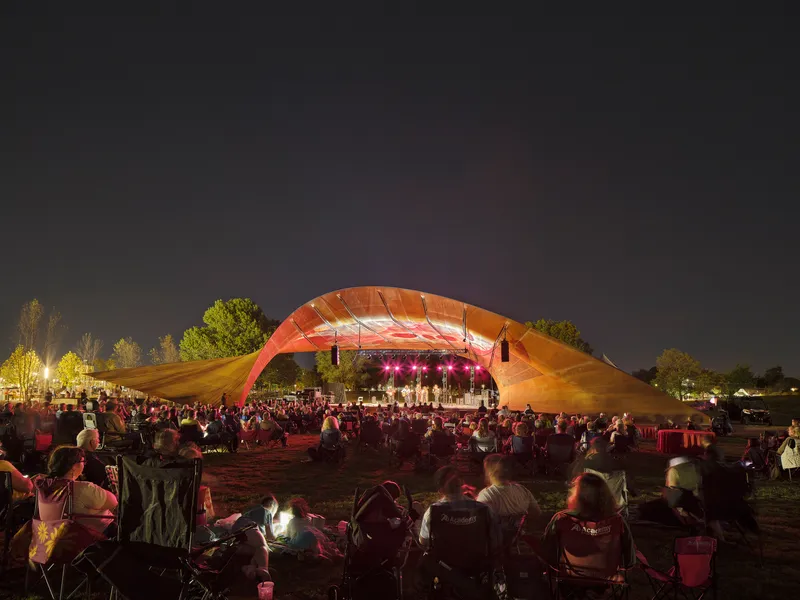
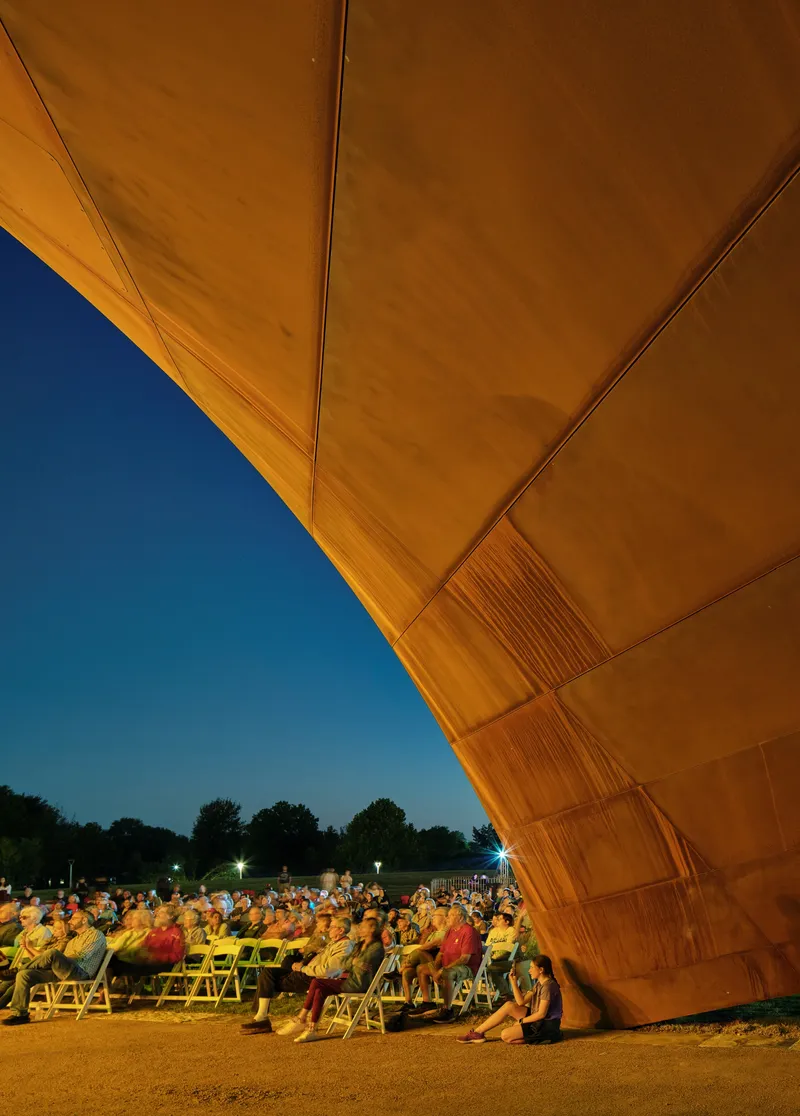
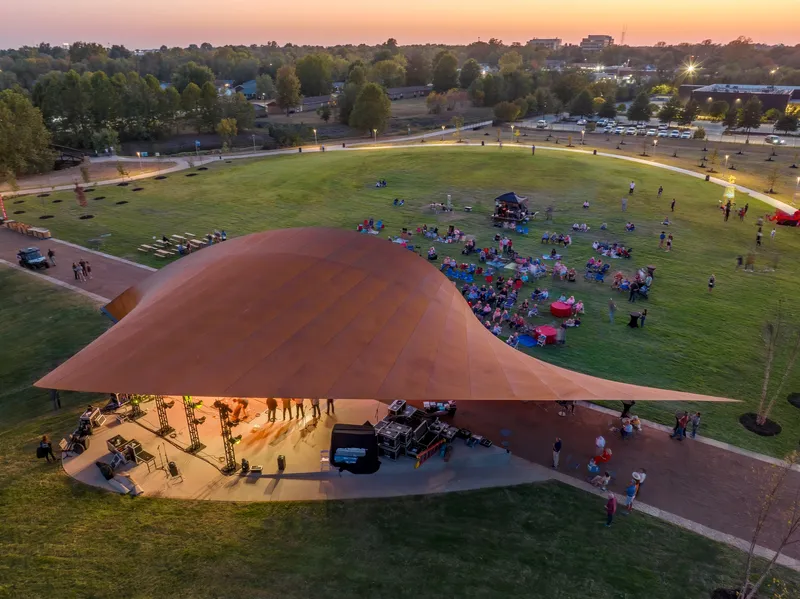
The pavilion's dual-sided organization is its most generous civic gesture. The great lawn side hosts large-scale concerts, with audiences spreading across the grass facing the stage that sits beneath the deepest part of the shell. At night, the illuminated canopy becomes a lantern in the park, its warm glow drawing people from the Razorback Greenway and downtown. The integration of theatrical rigging and power into the shell itself means the stage can support professional productions without temporary infrastructure.
On the intimate side, the canopy leans back toward the earth, creating a lower, more sheltered condition suited to small gatherings, readings, or community meetings. The architecture gives the city two venues in one structure, and the transition between them happens as you pass beneath the twisted spine.
Park as Infrastructure
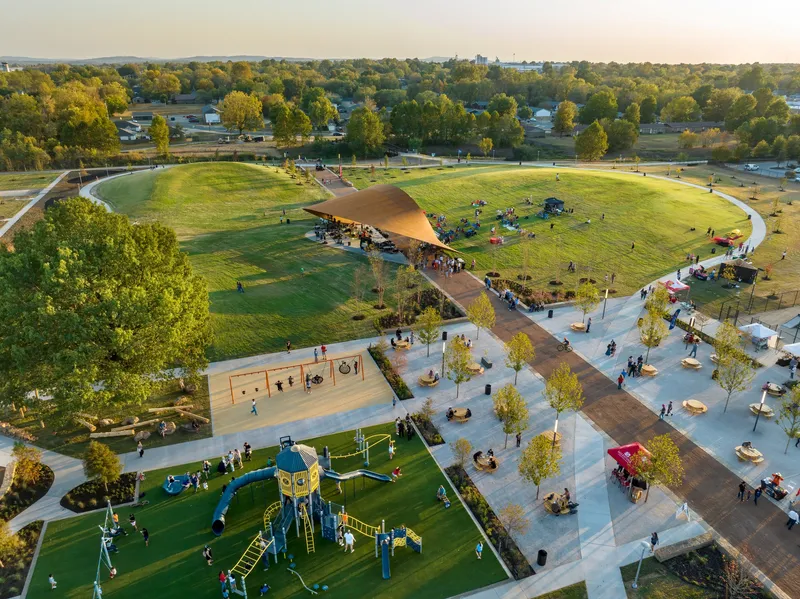
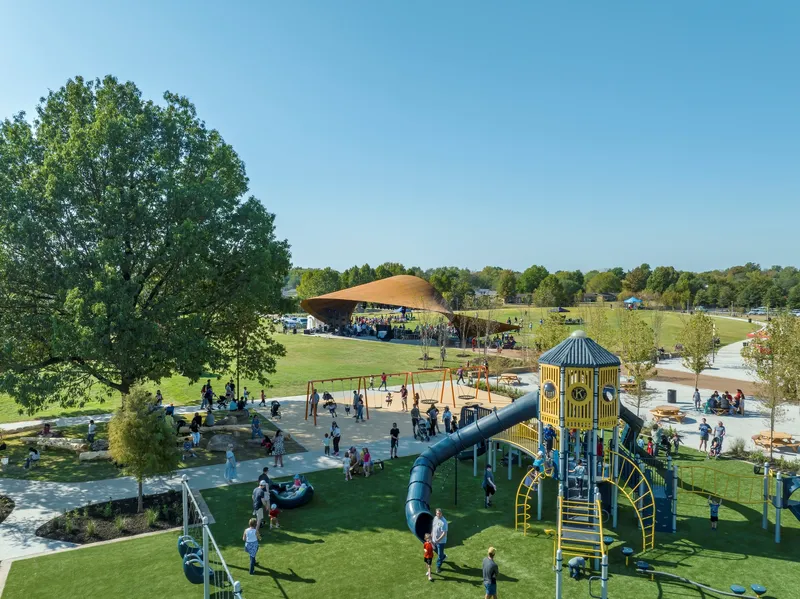
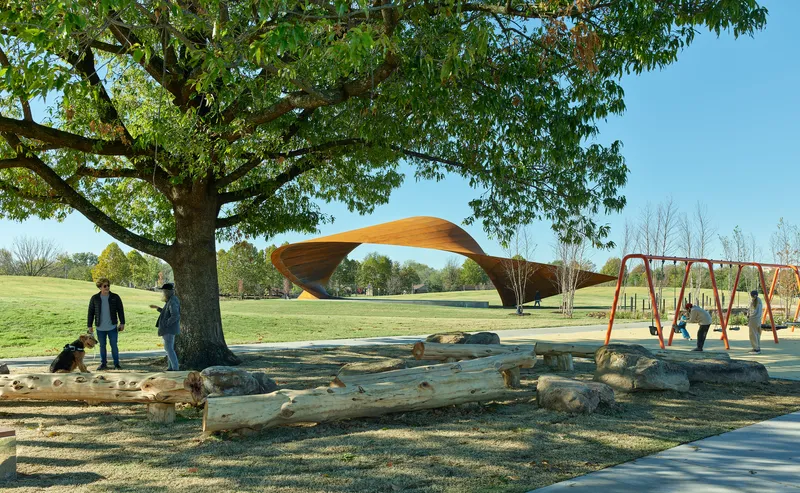
Luther George Park sits on 14 acres along Spring Creek in downtown Springdale, donated by the George family years before this renovation. The park is part of the Downtown Springdale Alliance's masterplan to create vibrant public spaces, and the pavilion is its anchor. Over 200 new trees have been planted as part of the landscape strategy, and the site connects directly to the Razorback Greenway.
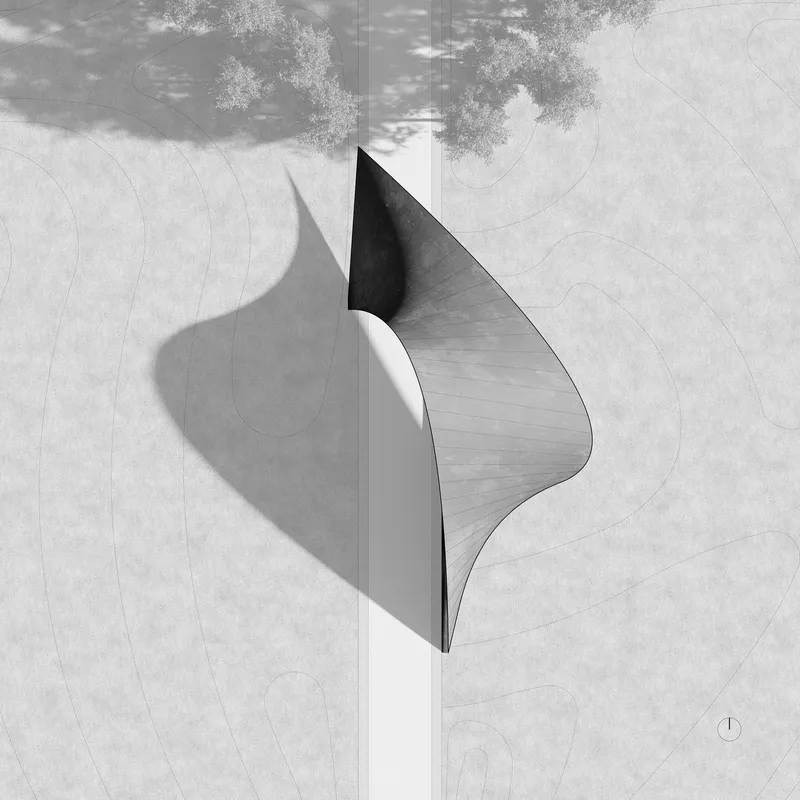
The playground, plaza, and lawn visible in aerial views are not afterthoughts. They form a sequence of scaled public spaces that the pavilion organizes without dominating. The canopy sits on the park's central axis, straddling the main pathway so that passing through it is unavoidable. It functions simultaneously as shade structure, performance stage, and park marker, collapsing three infrastructure types into a single gesture.
Living on the Ground

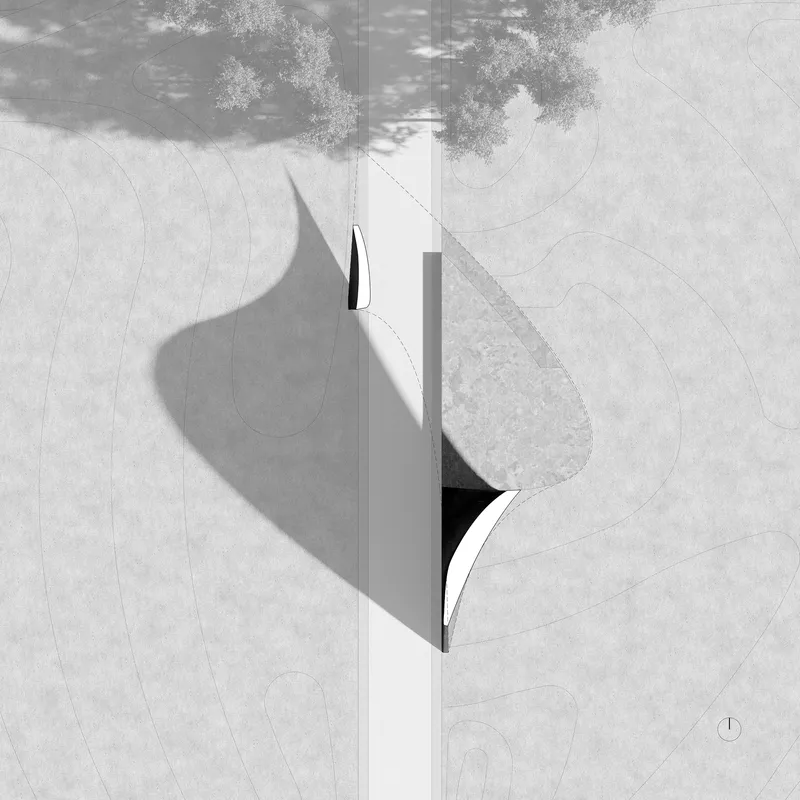
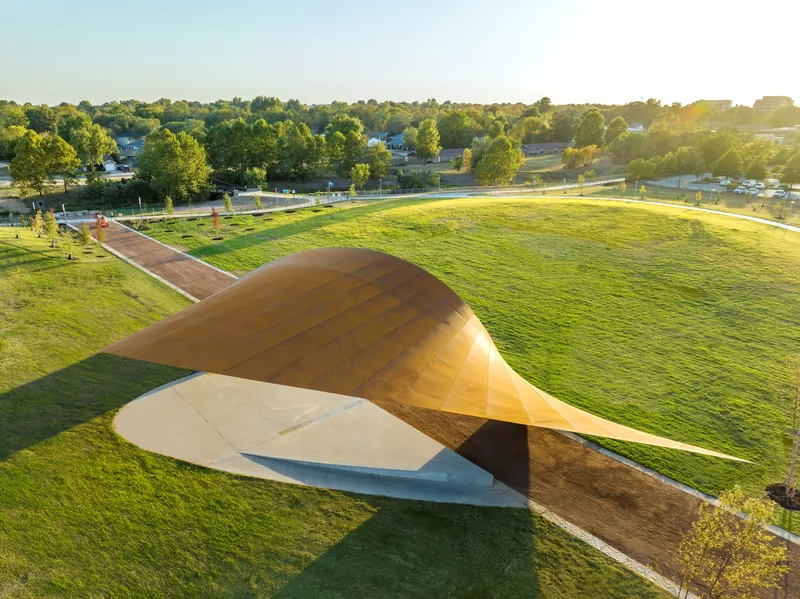
The concrete plaza beneath the canopy is the project's quietest success. Families walk through it in late afternoon. People sit on concrete benches at the sloping canopy edge, sheltered but not enclosed. The elevated plaza condition lifts visitors slightly above the surrounding lawn, creating a sense of stage even when no performance is happening. You are always a little bit on display here, and that is the point: the pavilion makes public life visible to itself.
From above, the curved canopy casts sharp geometric shadows on the plaza, and these shadows shift through the day, marking time on the concrete. The weathering steel will continue to darken and stain the surfaces below it, so the ground plane will eventually carry the building's chromatic signature. Trahan conceived of this as living infrastructure, and the material evidence supports the claim.
Plans and Drawings
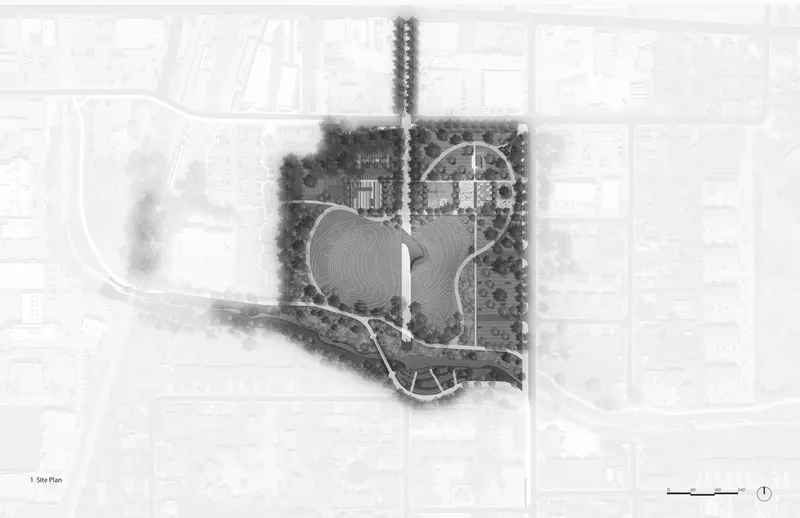
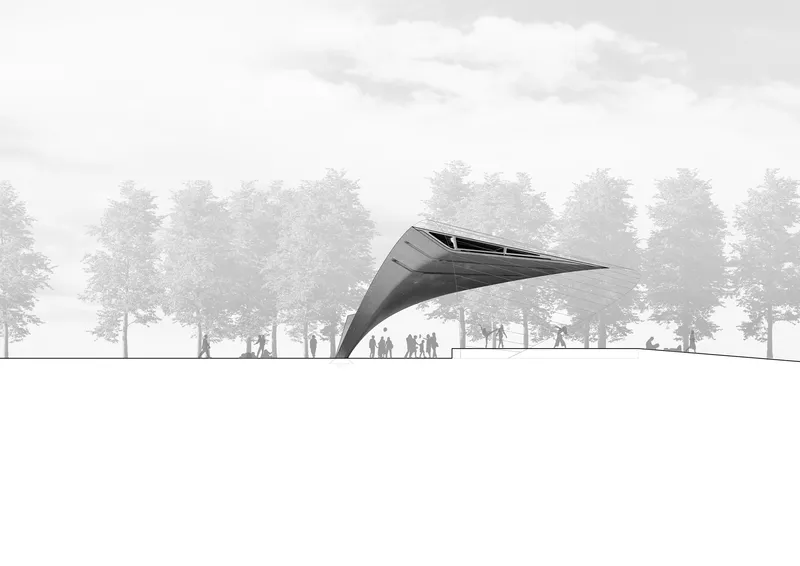


The site plan reveals how precisely the pavilion is positioned on the park's central axis, straddling the primary path and mediating between the two lawns. The elevation drawing confirms the extreme cantilever: the shell rises from its rooted stage end, peaks at the twist, and descends to a single point of contact that barely seems sufficient to hold it. The axonometric rendering exposes the stippled surface texture that results from the ruled-surface panelization, while the section drawing shows the latticed structural framework hidden within the undulating shell. Together, these drawings make clear that the pavilion's apparent simplicity is the result of deeply resolved geometric and structural logic.
Why This Project Matters
The Luther George Park Performance Pavilion demonstrates that civic architecture in small American cities does not have to be cautious. Springdale, Arkansas, is not a major cultural capital, but Trahan Architects and the Walton Family Foundation's Design Excellence Program have produced a structure here that rivals anything built in larger metropolitan contexts. The monocoque shell, fabricated in the Netherlands and assembled using shipbuilding techniques, represents a level of ambition and technical commitment that most public commissions in towns of this size never approach.
More importantly, the pavilion works as public space. It is not a sculpture dropped onto a lawn. It organizes movement, creates shade, hosts events at two scales, and marks the park's identity from the regional trail system. The weathering steel will continue to evolve over decades, accumulating the traces of rain and time, so the building will never look exactly the same twice. That kind of temporal depth is rare in contemporary architecture, and it gives this structure a lifespan that extends well beyond its opening.
Luther George Park Performance Pavilion by Trahan Architects, Springdale, Arkansas, United States. Completed 2024. Photography by Tim Hursley.
About the Studio
Share Your Own Work on uni.xyz
If projects like this are the kind of work you want to make, uni.xyz is a place to publish your own, find collaborators, and enter design competitions.


Popular Articles
Popular articles from the community

Tsunami Convergenics: Turning Catastrophic Ocean Forces into Underwater Housing Infrastructure
A speculative underwater settlement off the coast of Onagawa, Japan, treats tsunamis and typhoons as energy sources rather than threats.

Temporary Home for Dogs: A Reversed Zoo Rethinks Animal Shelter Architecture
In Bucharest, a sinuous corridor and freed landscape flip the logic of containment, designing a shelter that works to make itself unnecessary.

The Amber Palace Opera: A Geological Fiction Surfaces on Tallinn's Baltic Waterfront
Pierre Brillard reimagines a Baltic legend as a public landscape, opera house, and waterfront promenade rooted in Tallinn's coastal identity.

Cloaked Colonization: A Mobile Underwater Habitat That Moves Like a Fish
Micah Abaya's shortlisted EHC Pacific entry reimagines ocean settlement as a dispersed network of self-sustaining architectural organisms.

Similar Reads
You might also enjoy these articles

Bao Huynh Watercolor Atelier: A Serene Art Retreat in Hội An
Bao Huynh Watercolor Atelier in Hội An blends multifunctional art spaces, sustainable design, local materials, and family-friendly living in a serene environment.

Atelier Macri Concept Store Interior Design by CASE-REAL
Atelier Macri store features a "ko" counter, walnut wood details, cork displays, blending retail, gallery, and seamless customer experiences.

Manuel Vargas Izquierdo Stadium and High-Performance Sports Center: Architectural Excellence in Jalpa de Méndez
The Manuel Vargas Izquierdo Stadium blends sustainable design, inclusive sports facilities, and cultural-inspired architecture, revitalizing Jalpa de Méndez’s public spaces.

KAKR Buluh Awar Hall: Revitalizing Community and Ecology Through Bamboo Architecture
Community built bamboo hall revitalizes Buluh Awar village, empowering youth, restoring ecology, celebrating vernacular craftsmanship through sustainable architecture and culture.

Explore Public Park Competitions
Discover active competitions in this discipline

Challenge to design a portable theatre

Challenge to design a portable music platform

Challenge to design an open learning module for the elderly
Comments (0)
Please login or sign up to add comments
No comments yet. Be the first to comment!