

Tropos: An Airborne Architecture That Refuses to Land
A swarm-intelligence prototype reimagines urban space as a dynamic, autonomous, and perpetually shifting atmospheric system.


What if architecture never touched the ground? Tropos begins with that provocation, proposing an aerial prototypical system where buildings are not fixed but airborne, not permanent but perpetually reconfiguring. Rooted in parametric architecture, swarm intelligence, and AI-driven navigation, the project treats urban space as an evolving ecosystem rather than a collection of static objects. The result is a speculative framework that challenges the most fundamental assumption in architecture: that a structure must stay where you put it.
Tropos is the work of Evangelos Polykandriotis, Giulia Arienzo, Shiri Dobrinsky, and Tao Yu, developed as an entry for Elevate 2019, where it received Editor's Choice recognition. The competition brief called for work that could redefine the relationship between architectural quality and permanence, and this team answered by dissolving that relationship entirely.
Between the Historic and the Speculative
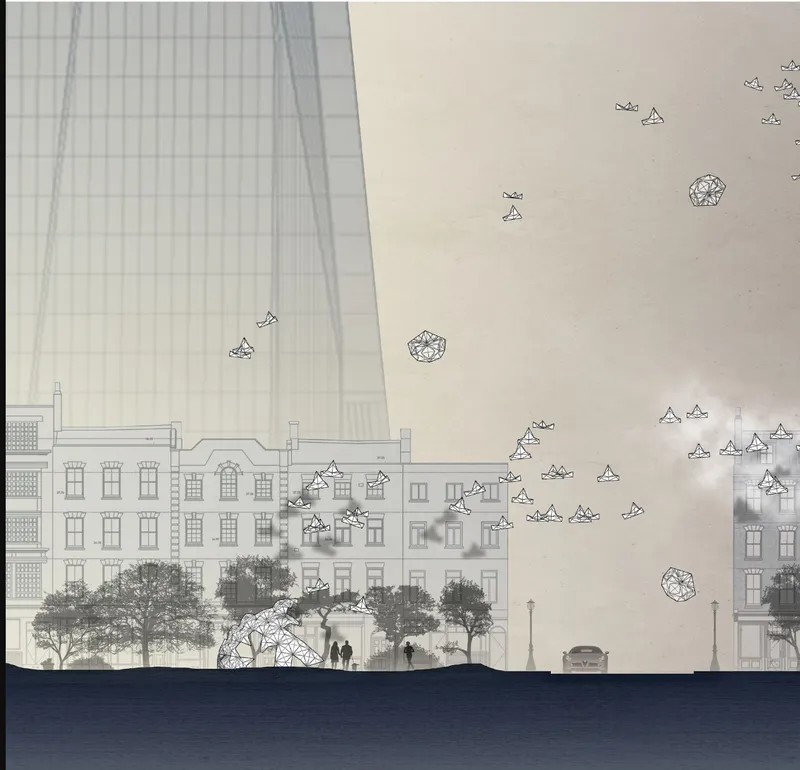
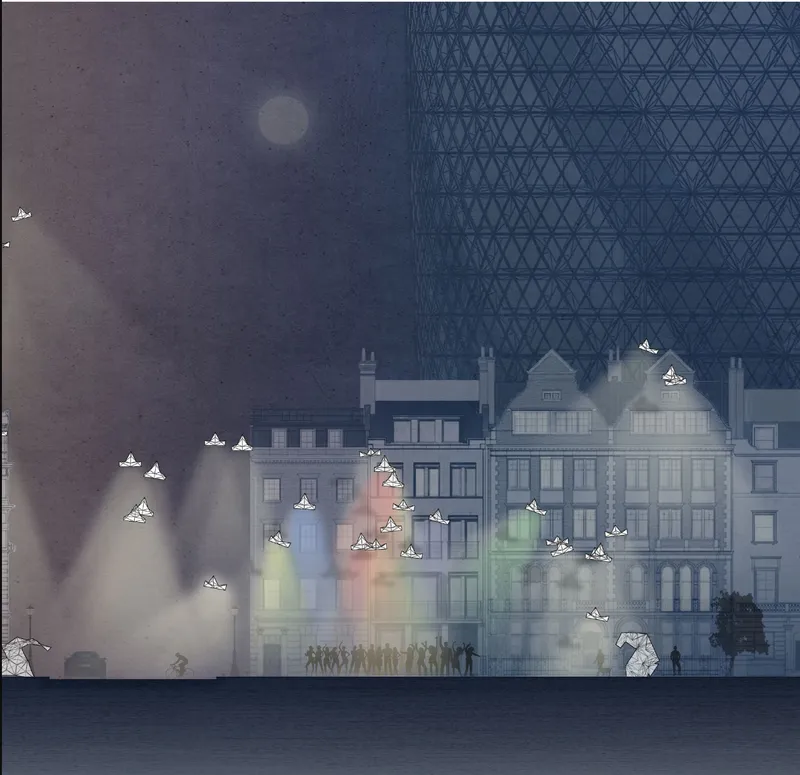
The project's earliest drawings situate its ambitions against familiar urban fabric. An elevation drawing places a glazed, diamond-patterned tower behind a row of historic houses along a waterfront, while a companion section renders the same composition at night, the rowhouses glowing with colour beneath a full moon. These images do not illustrate a building proposal so much as they frame a question: what happens when a parametric structure occupies the same skyline as centuries-old typologies? The juxtaposition is deliberate, establishing the tension between architectural permanence and the adaptive systems Tropos ultimately pursues.
Lattice Canopies and Suspended Grids
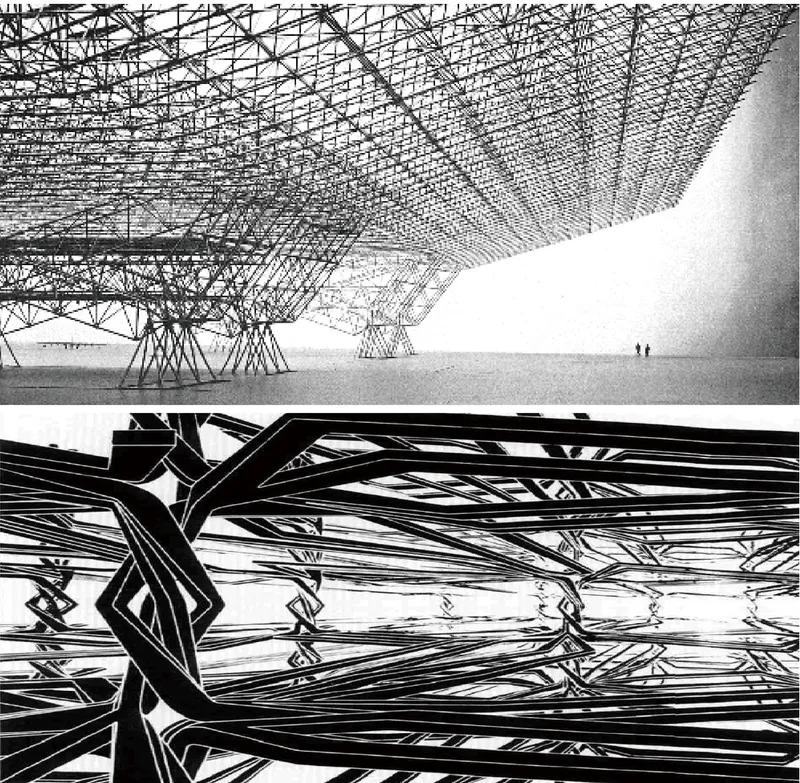
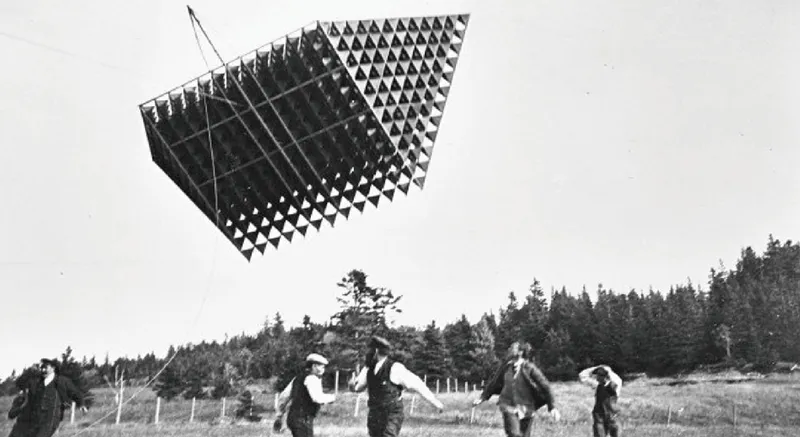
Two key studies explore how Tropos might manifest as inhabitable space. A rendered view shows a branching lattice canopy held aloft by tree-like columns, with two figures walking beneath it, suggesting a scale somewhere between pavilion and public infrastructure. An axonometric drawing takes the concept further, suspending a triangulated grid structure above figures standing in a field of evergreen trees. Neither image depicts a finished building. Instead, they present modular, scalable spatial structures, flexible enough to reconfigure in response to environment and programme.
The structural logic here is critical. The branching columns and triangulated grids are not decorative; they represent the minimum material needed to create maximum spatial coverage. The geometry anticipates the project's later move toward fully autonomous, airborne configurations by establishing that these forms are inherently lightweight and adaptable.
Water, Tension, and the Urban Grid
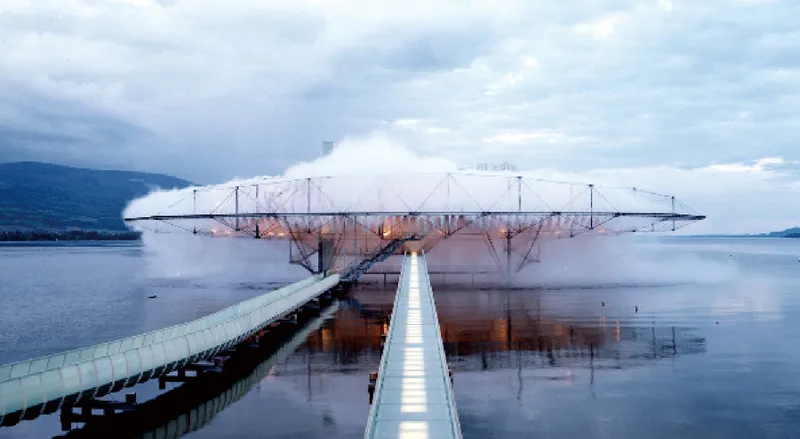
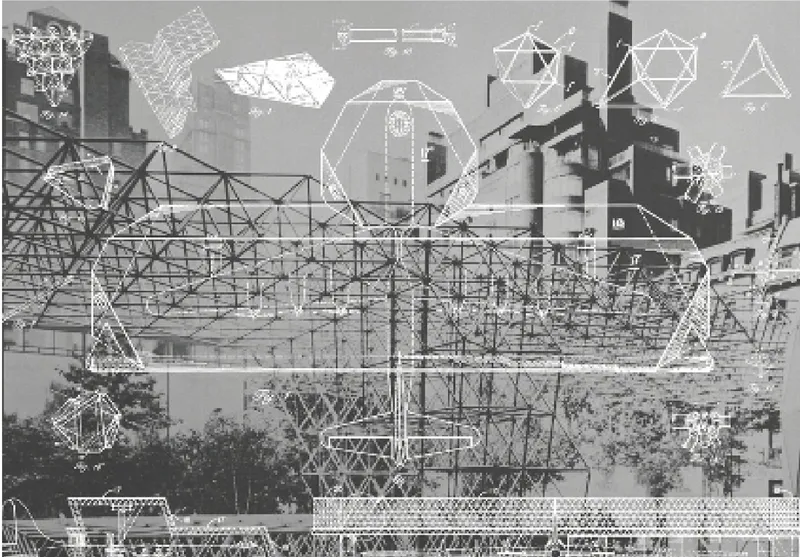
A floating platform with a tensile canopy anchored to a pier over calm water demonstrates Tropos operating in a landscape condition, detached from any urban grid. Distant mountains and overcast skies reinforce the sense of isolation, as if the structure could drift. A collage of a gridded canopy in an urban plaza, overlaid with wireframe geometric diagrams, pulls the concept back into the city. Together, these images argue that the system is site-agnostic: it works on water, in plazas, wherever people gather and spatial definition is needed.
From Robotic Units to Swarm Formation
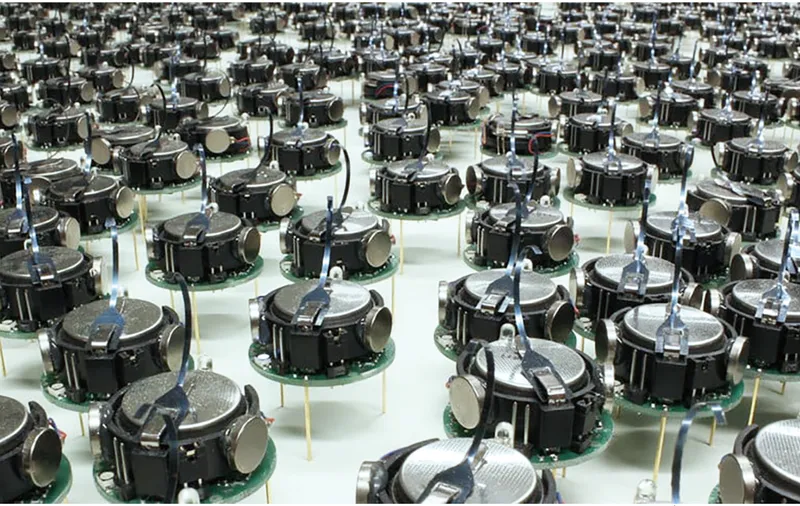
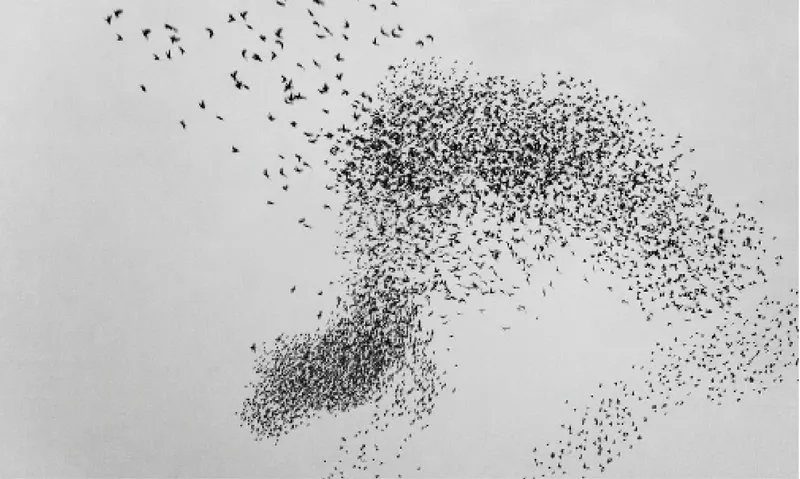
Here is where Tropos makes its most radical move. An image of black cylindrical robotic units arranged in precise rows on a white floor reveals the project's building blocks: autonomous agents, each capable of independent navigation and collective coordination. The next image shows these units in action, a swarm of small flying drones forming a shifting cloud formation against a grey sky. This is architecture as flock behaviour, drawing on swarm intelligence to produce spatial configurations that emerge from the bottom up rather than being imposed from a master plan.
The shift from static lattice to airborne swarm is the conceptual hinge of the entire project. AI-driven navigation allows each unit to respond to urban dynamics in real time, engaging with people and public spaces as a form of interactive urbanism. The architectural envelope is no longer a surface but a population of coordinated objects, constantly negotiating their positions relative to one another and to the city below.
Interlocking Geometries from Above
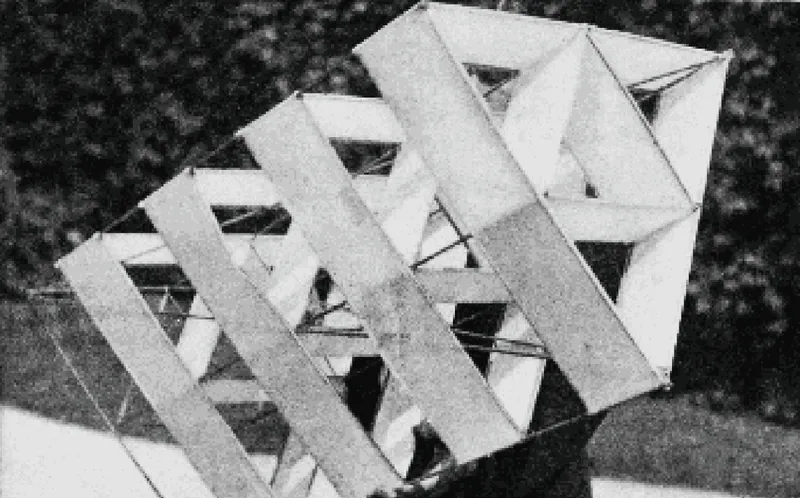
An aerial view of interlocking white geometric roof planes, punctuated by triangular voids over forested terrain, reads as the logical outcome of the swarm system at rest. The planes lock together like tectonic plates, creating a continuous canopy that filters light through its gaps. Seen from above, the composition is both ordered and organic, a product of algorithmic logic rather than conventional drafting. It suggests a future in which entire districts could be sheltered by self-assembling aerial structures that reconfigure with the seasons or the programme.
Why This Project Matters
Tropos operates at the far edge of architectural speculation, but it grounds its provocations in real technologies: drone autonomy, computational parametrics, swarm intelligence. The team does not simply imagine flying buildings; they trace a clear lineage from modular lattice structures through tensile canopies to fully autonomous airborne agents. Each step is documented and logically sequenced, which is what separates this work from science fiction.
More importantly, the project reframes a question that architecture has struggled with for decades. If permanence is architecture's defining quality, what do we lose when we insist on it? Tropos suggests that we lose responsiveness, adaptability, and an entire category of spatial experience that only exists when buildings are allowed to move. As an Editor's Choice entry at Elevate 2019, it earned recognition not for solving a problem but for identifying a new one, and for proposing, with clarity and rigour, what architecture might become when it finally takes flight.
View the Full Project
About the Designers
Designers: Evangelos Polykandriotis, Giulia Arienzo, , Shiri Dobrinsky, Tao Yu
Enter a Design Competition on uni.xyz
uni.xyz runs architecture and design competitions year-round that reward proposals with spatial conviction and real site intelligence.
Project credits: Tropos by Evangelos Polykandriotis, Giulia Arienzo, , Shiri Dobrinsky, Tao Yu Elevate 2019 (uni.xyz).


Popular Articles
Popular articles from the community


Opera on the Sea: Driftwood Logic Shapes a Timber Opera House on Estonia's Coast
Trevor Orgill's opera house translates the entangled drift of floating timber into a civic building where wood, water, and music converge.

Singing Woman: An Opera House That Performs Before the Curtain Rises
Ovidiu Cristian Pavel's conceptual opera house translates Estonia's choral identity into a sculpted waterfront landmark facing the Baltic Sea.


ETEH Reworks the Shared Spaces of São Domingos School in Brazil Around Timber, Color and Hanging Plants
At São Domingos School in Brazil, 436 m² of hall, refectory and library are recast with timber joinery, a yellow and blue code and trailing greenery.

Cube Design Draws an Ecological Corridor Between Two Shenzhen Hills with the Nankai Building
Beside Shenzhen's container docks, the Nankai Building pairs stacked balconies with a climbing green screen to connect two hillsides across its height.

Similar Reads
You might also enjoy these articles

Vereda Arquitetos Renovates a 40-Square-Meter Apartment Inside Niemeyer's Copan Building
A compact unit in São Paulo's most iconic residential tower gets a material overhaul that pairs exposed concrete with bold blue Formica.

Shakur's House: Exposed Brick as an Interior Organiser in a 168 m² Mashhad Residence
Brick moves indoors in this Mashhad residence, where masonry walls, glass partitions and teal planes sequence a compact home without closing it off.

Day and Night Park: A Time-Based Urban Newsstand in Beijing
A temporary urban newsstand in Beijing blending travel, light, and reading through poetic colors, compact form, and community-focused design.

Modernist Patio Renovation in El Masnou, Barcelona by Oliver Segura Arquitectura + Cebrià Arquitectura
Modernist patio renovation blending tradition and innovation with a movable pool, leveled floors, and Catalan materials in El Masnou.


Comments (0)
Please login or sign up to add comments
No comments yet. Be the first to comment!