
Unemori Architects Builds Two Family Houses That Share a Courtyard Garden in Japan
A pair of plywood-clad houses for relatives uses split levels, courtyards, and exposed timber to dissolve the boundary between dwelling and garden.


There is a particular challenge in placing two houses side by side for related families: close enough to share daily life, separate enough to preserve autonomy. Unemori Architects takes on that challenge directly with this pair of 156 m² residences in a quiet, verdant Japanese neighborhood. One house belongs to the architect's own family, the other to a sister-in-law's. Rather than duplicating a single plan or walling off two plots, the practice treats the project as a single organism of clustered volumes and shared landscape.
What makes the project genuinely interesting is the way it refuses the typical binary of inside and outside. The houses are broken into offset rectangular volumes that create pockets of courtyard, terrace, and garden between them. Plywood surfaces run continuously from interior walls to exterior cladding, and split levels stagger sight lines so that a person standing in one room is always visually connected to a planted space, a skylight, or the other household's daily activity. The architecture is quiet, almost self-effacing, but the spatial complexity is serious.
Clustered Volumes at the Street
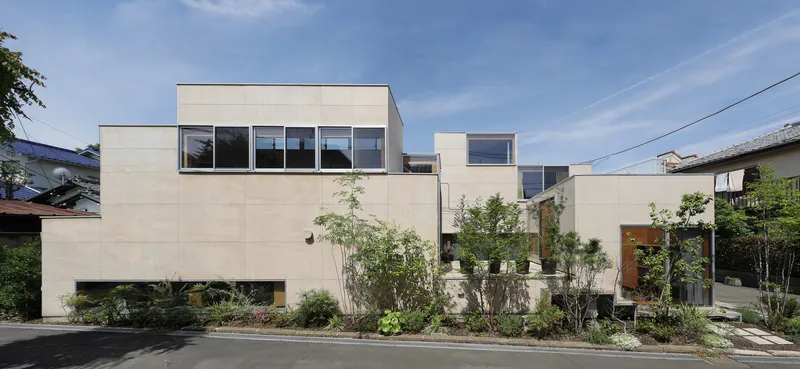
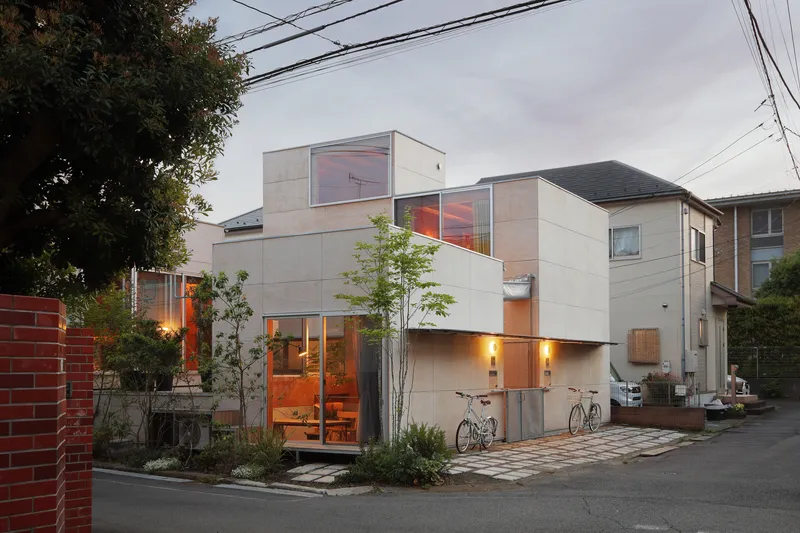
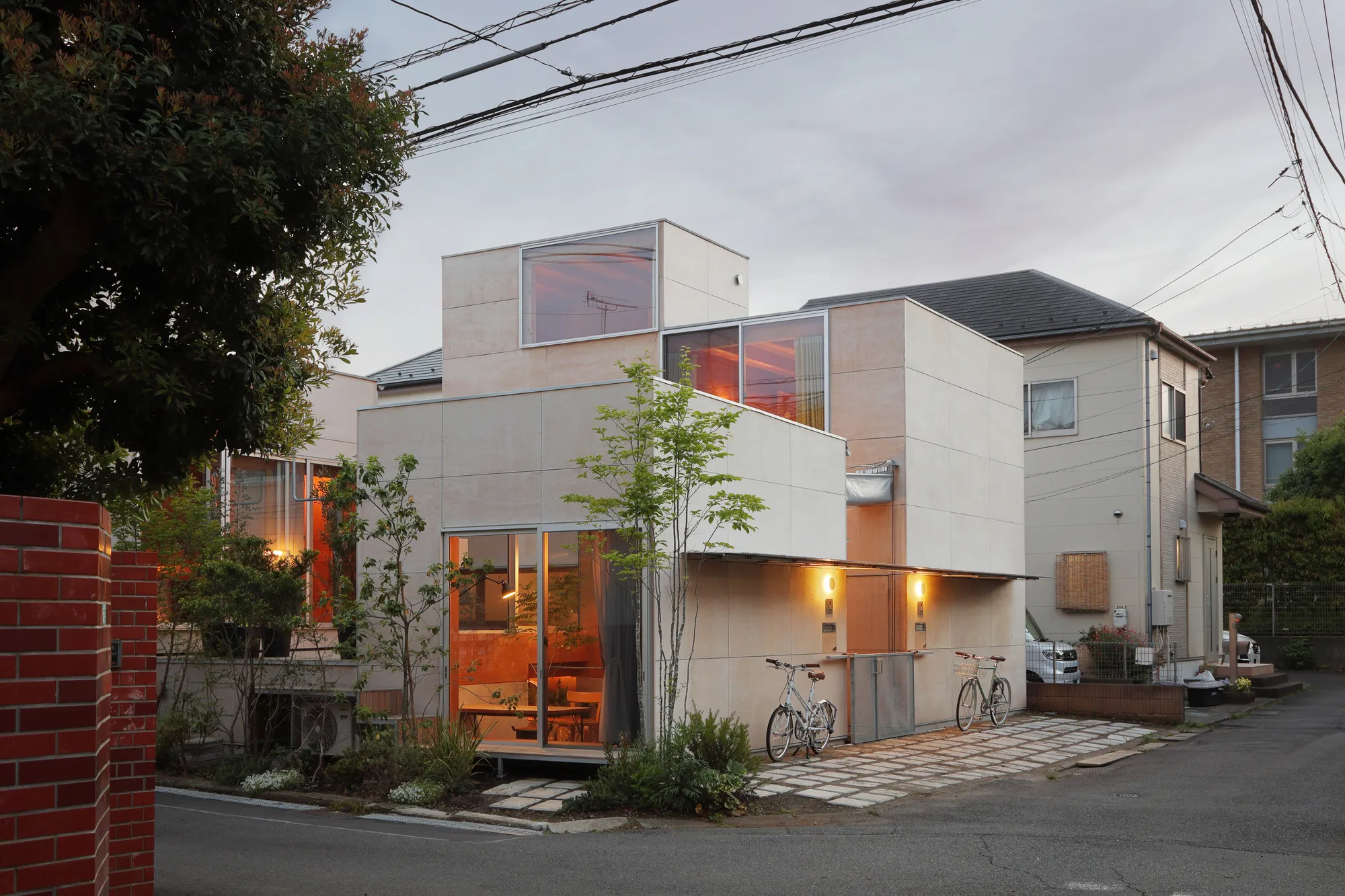
From the street, the project reads not as two houses but as a loose cluster of pale volumes. The facade panels are light-toned and understated, punctuated by ribbon windows that hint at the split levels inside without revealing the full spatial game. At dusk, the glazed walls between volumes glow, and the interstitial courtyards become legible as the project's true organizing principle. Bicycles parked at the entry, landscaped frontage, and the staggered rooflines all reinforce a sense of informality: two households living as neighbors, not as a compound.
The decision to break the program into multiple smaller boxes rather than two monolithic ones has clear consequences for the streetscape. The project avoids the sealed-off feeling of a suburban house and instead presents porous gaps and planted edges. It is generous to its context in a way that many family houses are not.
The Courtyard as Shared Room
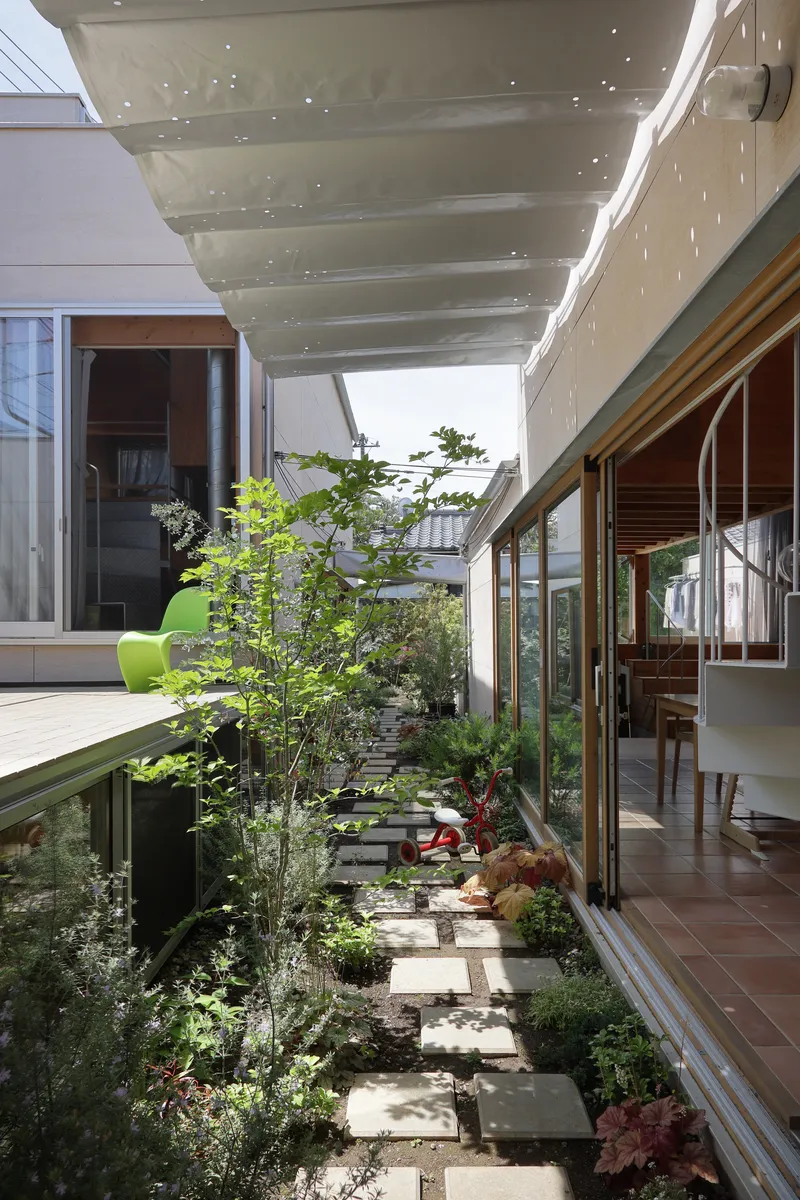
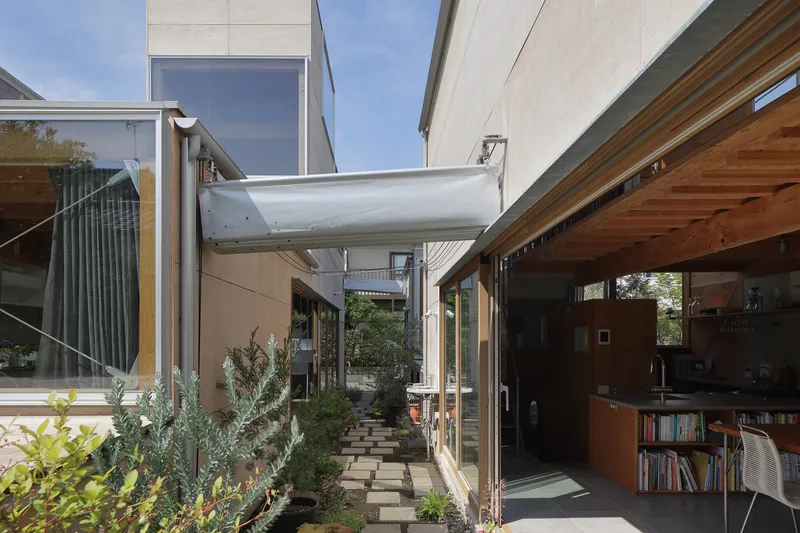
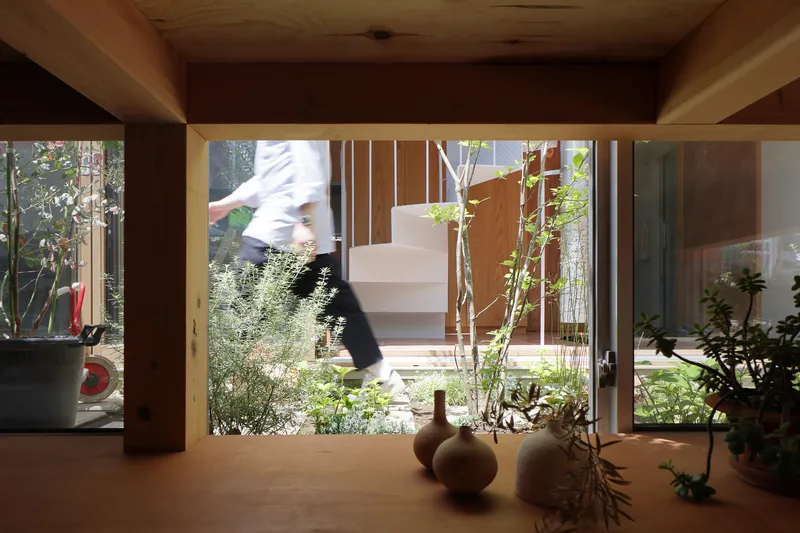
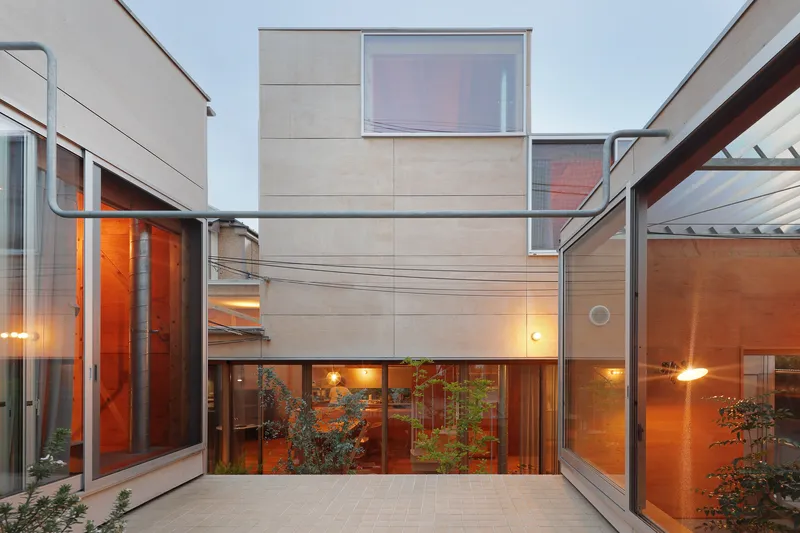
The courtyard spaces between the volumes are the heart of the project. Stepping stones wind through planted beds, and a white fabric canopy stretches between the houses to filter light and define an outdoor room without enclosing it. These are not leftover gaps; they are designed with the same precision as any interior. The perforated concrete canopy over one narrow garden passage creates a dappled light condition that changes through the day, making the garden feel larger than its physical dimensions.
The planting is deliberate: potted trees on balconies, ground-level beds visible from both houses, and greenery placed at window sills so that interior spaces always have a living foreground. The courtyard is the social buffer between the two families, a space where interaction is possible but never forced. It is a more sophisticated version of the traditional Japanese tsuboniwa, scaled up and woven through a split-level section.
Timber Structure on Display
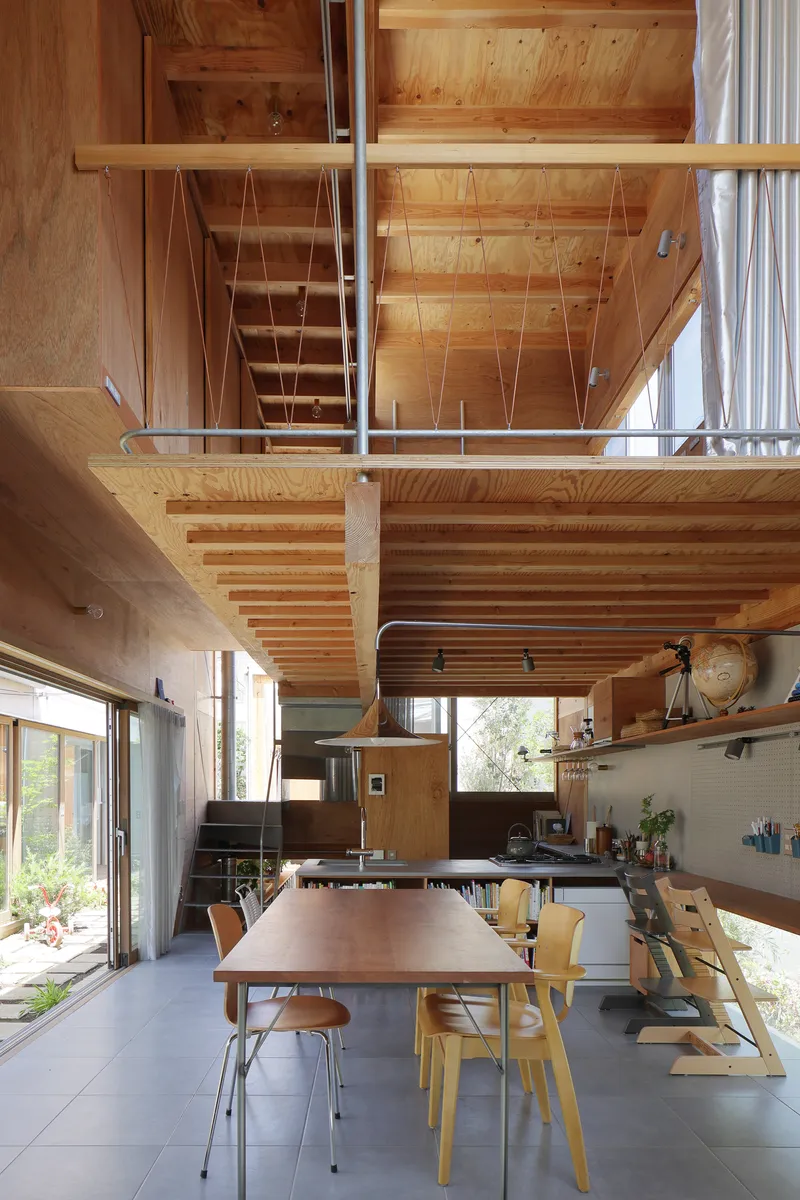
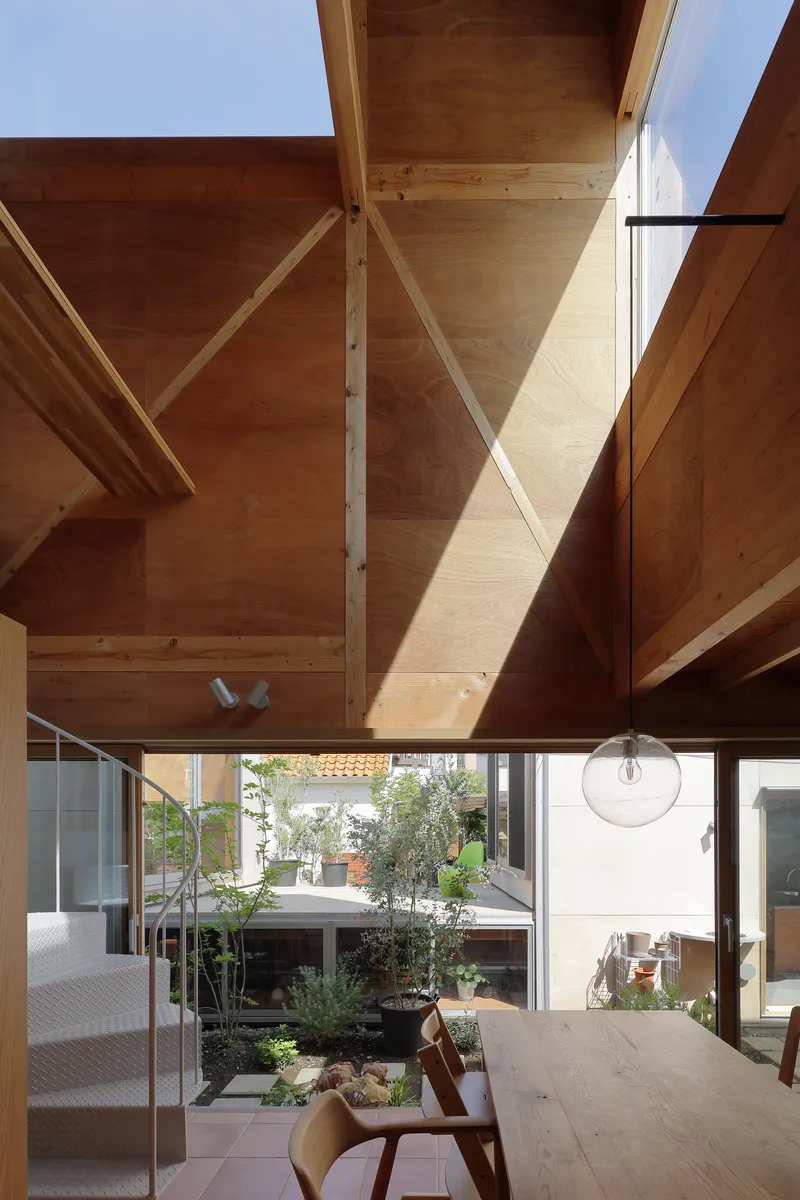
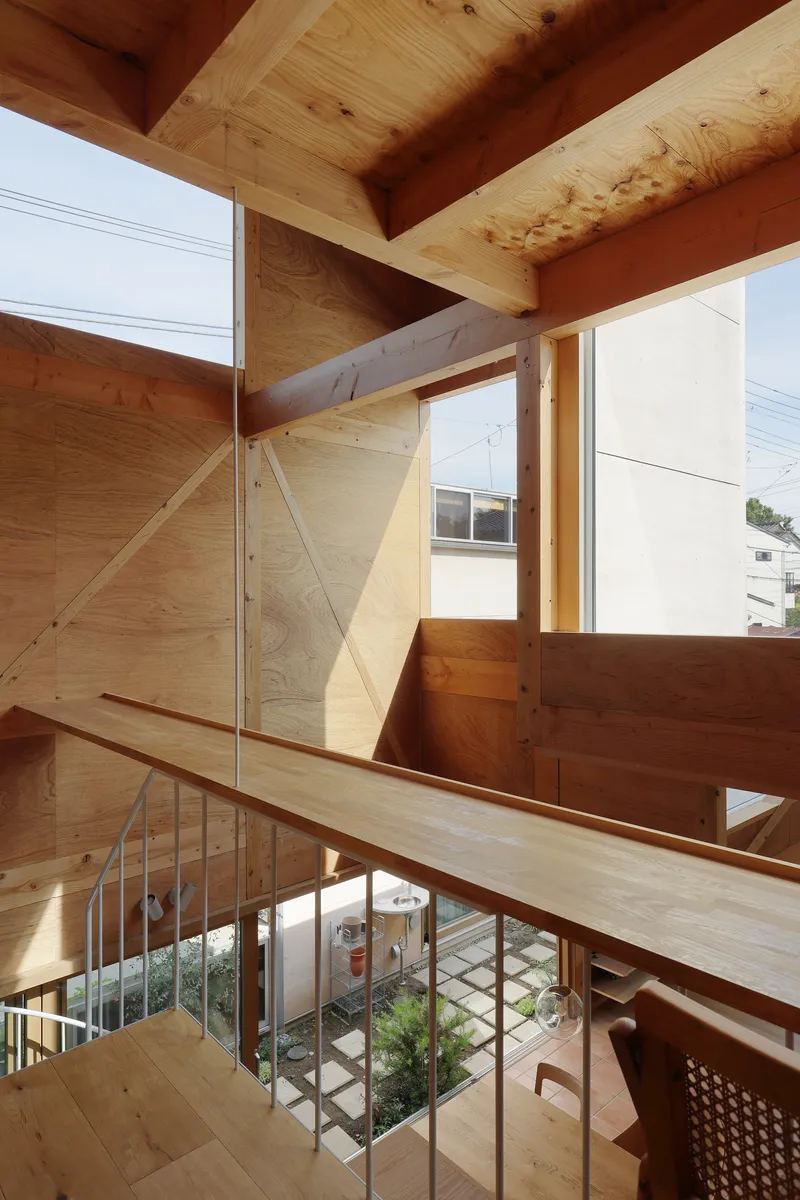
Unemori Architects has a long-standing interest in making structure legible, and here the exposed timber frame does much of the visual work. Posts, beams, and diagonal bracing are left visible in plywood-lined interiors, giving the rooms a workshop clarity. The double-height dining space is particularly effective: an open timber mezzanine floats above the eating area, its structure acting simultaneously as ceiling, balustrade, and spatial divider.
Diagonal bracing, visible from the mezzanine landing, frames views down into the planted courtyard below. The timber is not decorative; it is the actual structural skeleton of the house, and its exposure creates a reading of the building as an honest, almost didactic assembly of parts. The plywood lining reinforces this: warm, tactile, and unapologetically utilitarian.
Split Levels and Layered Views
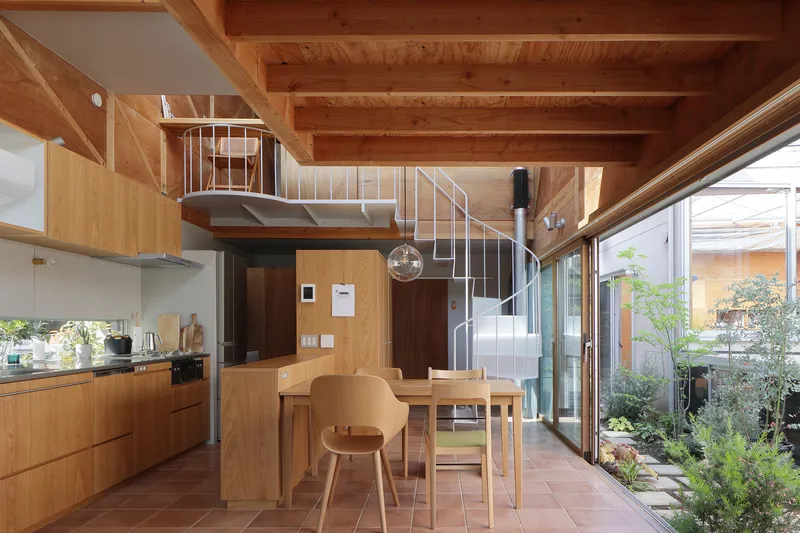
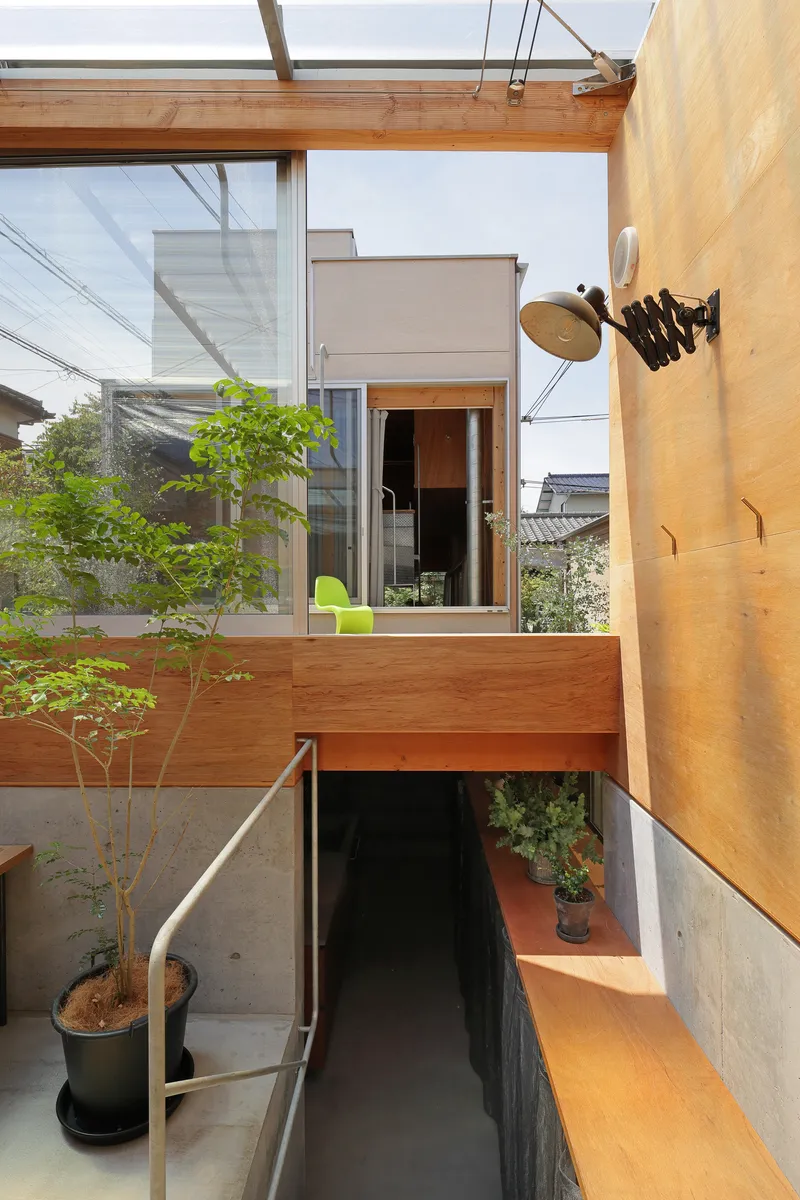
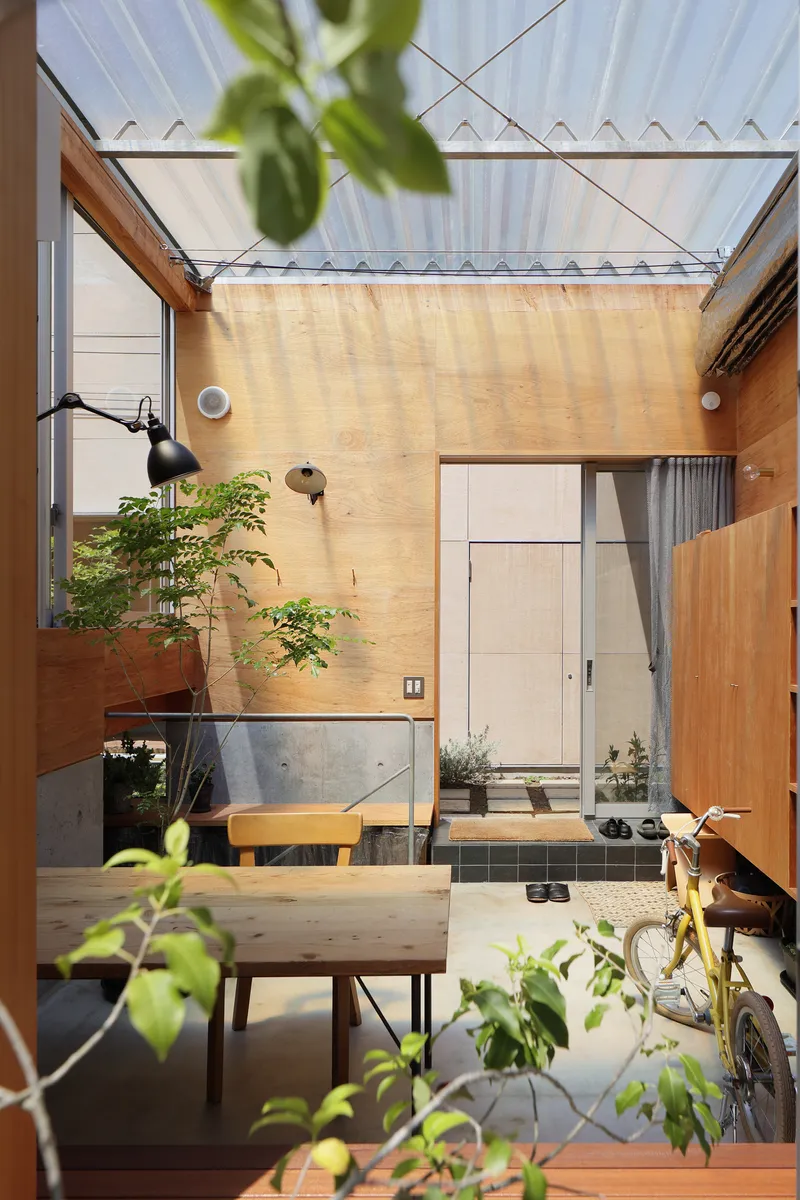
The split-level section is the project's most consequential move. By offsetting floor plates between the two houses and within each house, Unemori Architects creates a continuous visual field that links dining areas, courtyards, mezzanines, and upper bedrooms. Standing in the open-plan dining area, you look through glazed doors to the courtyard, up past a timber balcony with a potted tree, and through a clerestory to the sky. These are not accidental alignments; they are carefully composed sequences that make 156 m² feel expansive.
The corrugated skylight over one courtyard introduces a quality of diffused, industrial light that contrasts with the warm plywood interiors. The effect is of an architecture that is always mediating between conditions: between inside and outside, between one household and the other, between the ground and the canopy of trees above.
Interior Details and Material Consistency
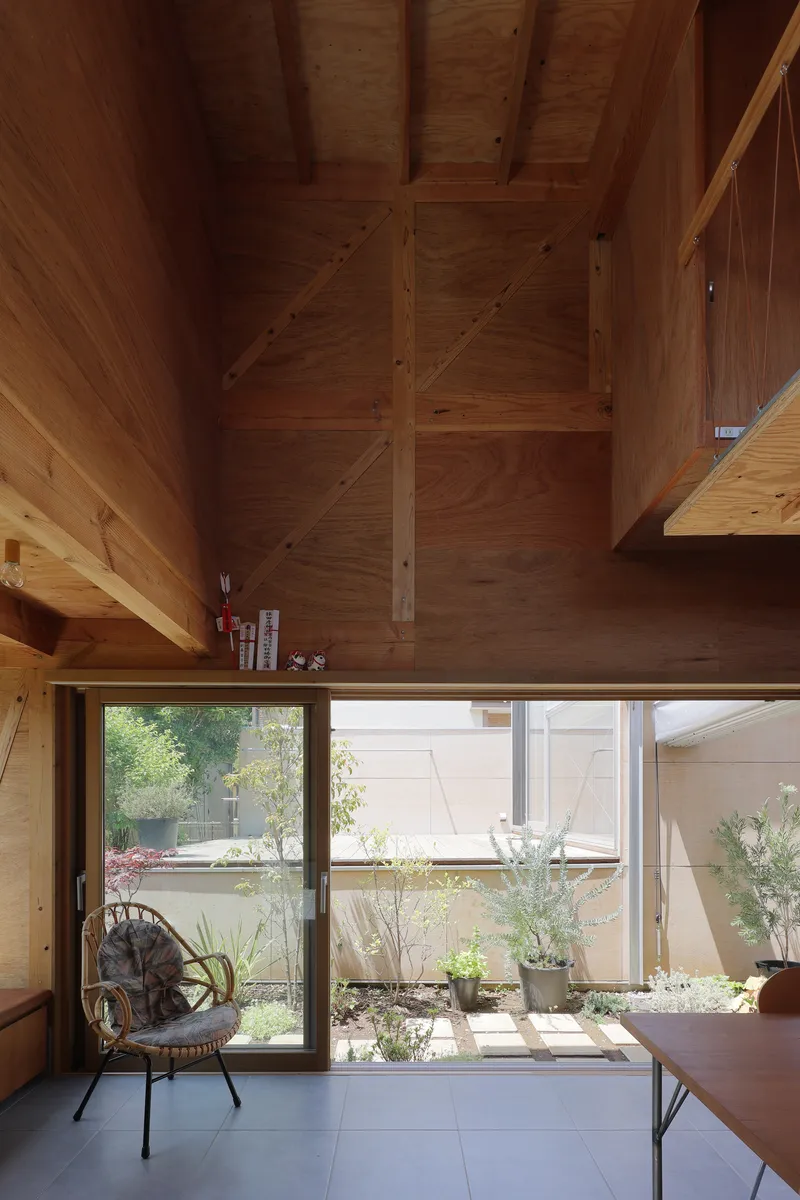
The material palette is deliberately restrained. Plywood ceilings with exposed beams, light timber framing, and white surfaces run through both houses, creating a visual continuity that reinforces the idea of a single project rather than two separate dwellings. Window sills are deep enough to hold potted greenery, blurring the edge between furniture and architecture. The spiral staircase in the dining area is a compact, almost sculptural element that connects floors while allowing light to pass through the section.
This consistency matters. In projects for related families, there is always a temptation to differentiate the houses to give each identity. Unemori Architects goes the other direction, using material uniformity to reinforce the shared ground between the households. The differences are spatial, not decorative: each house has its own orientation, its own sequence of levels, and its own relationship to the courtyards.
Plans and Drawings
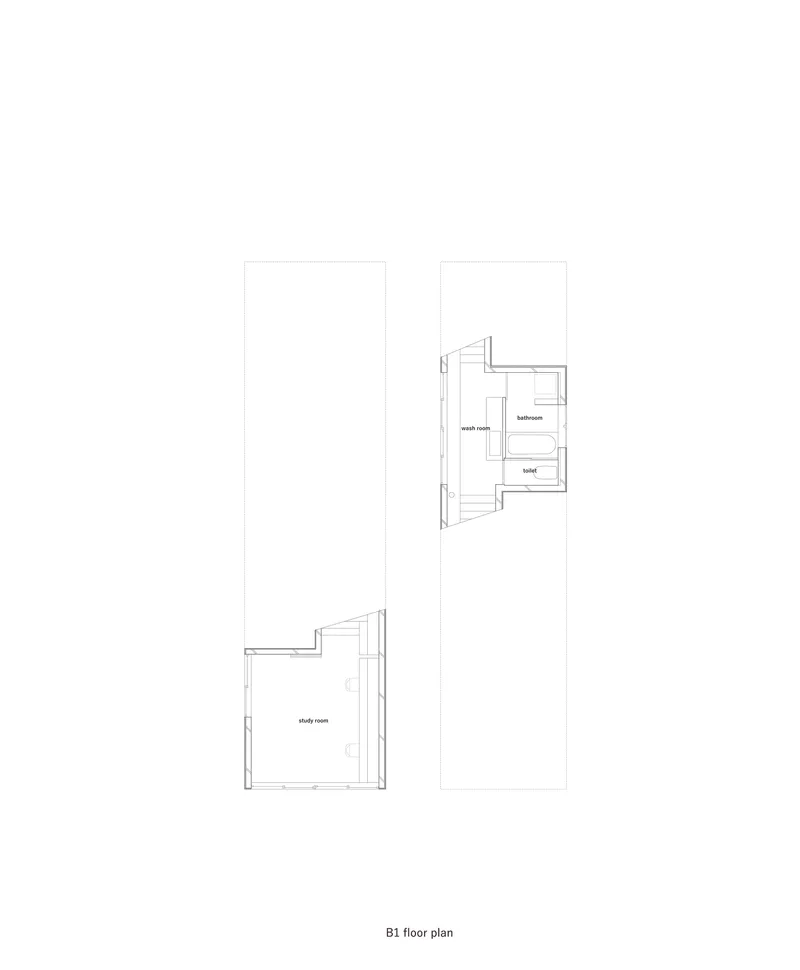
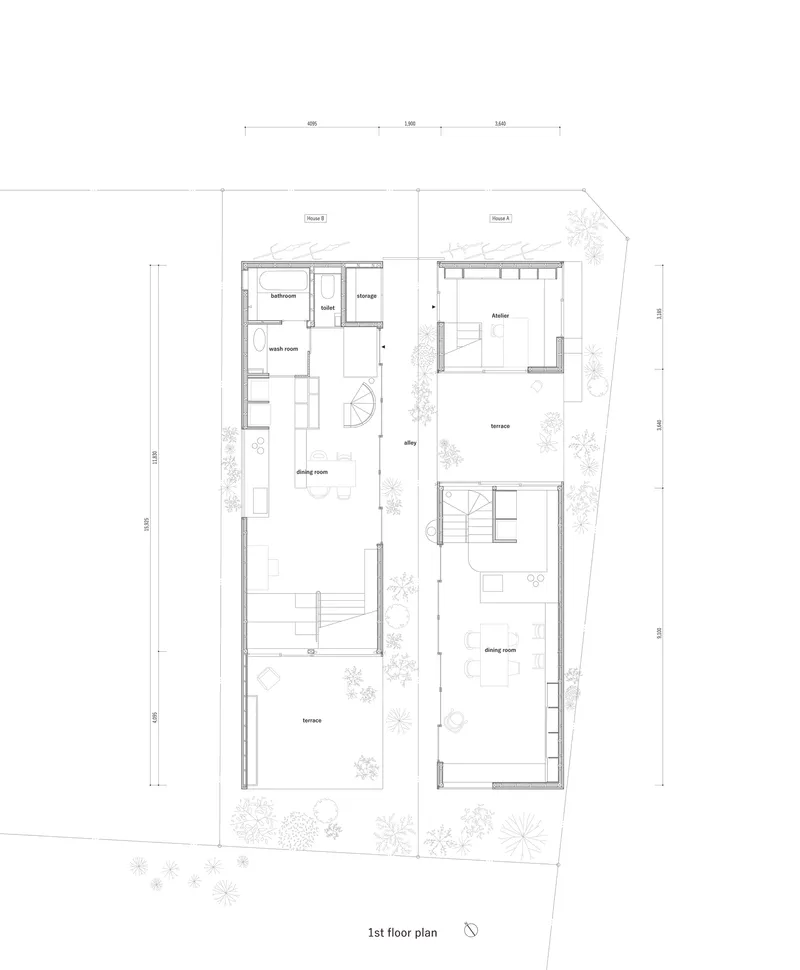
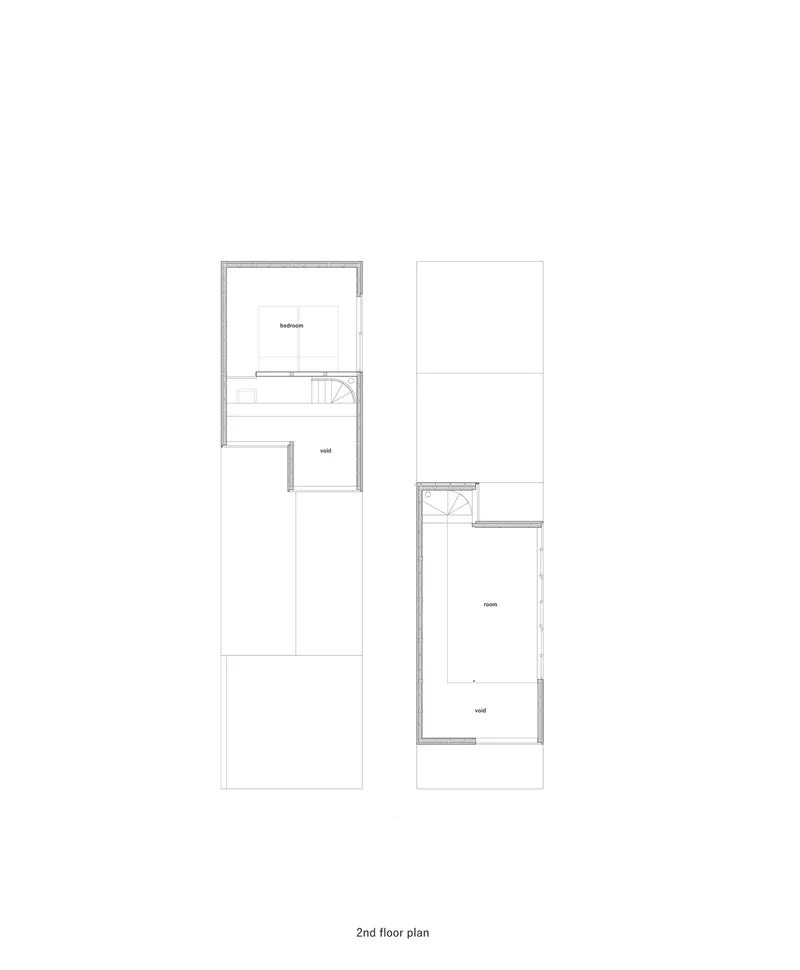
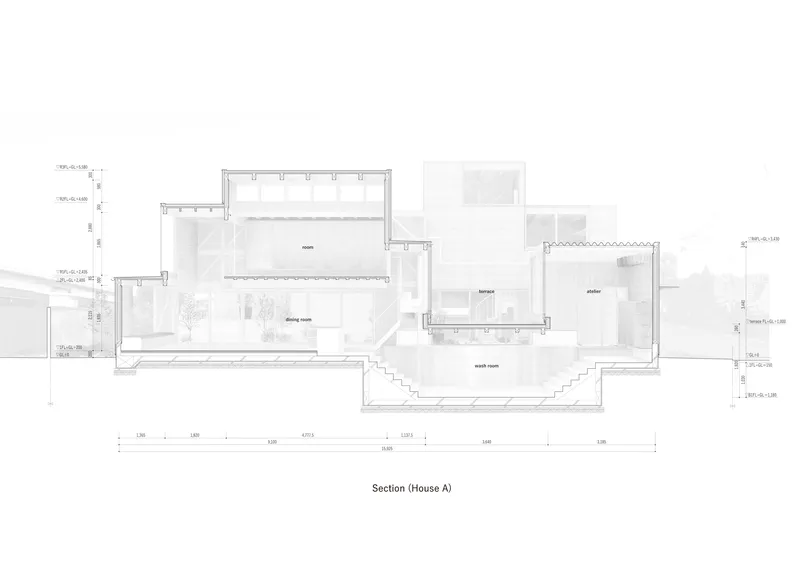
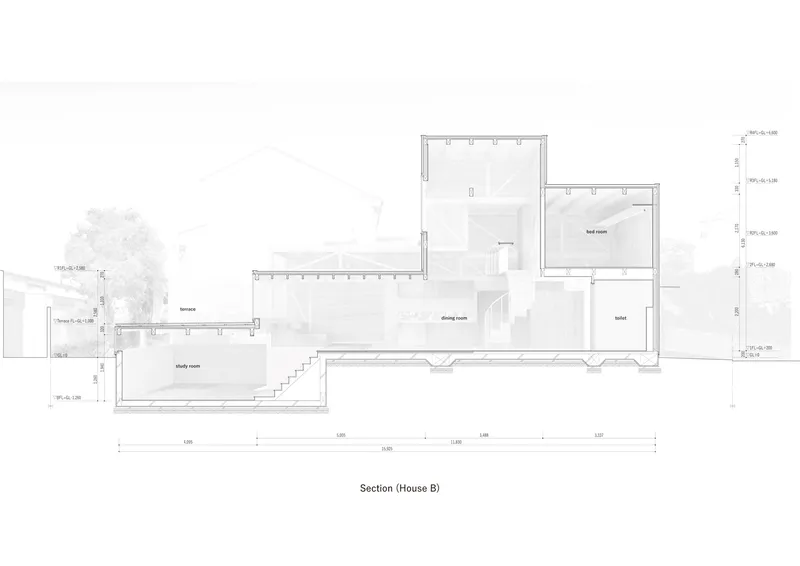
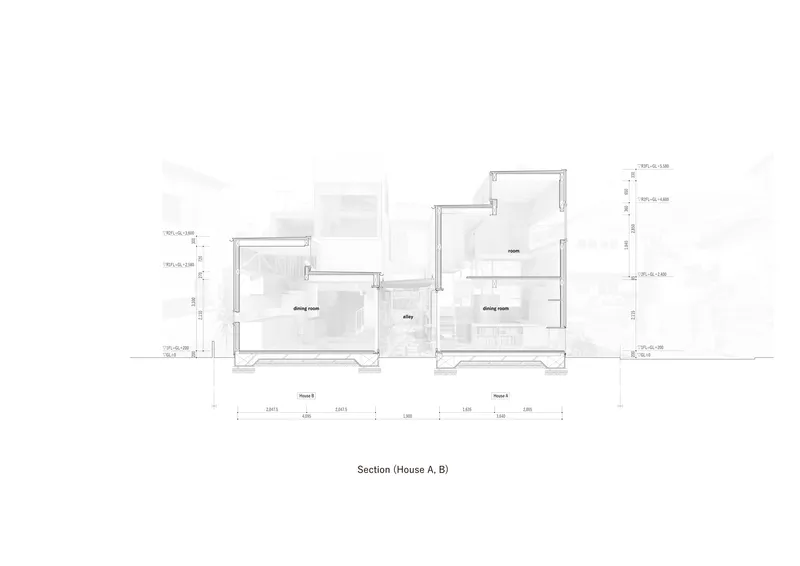
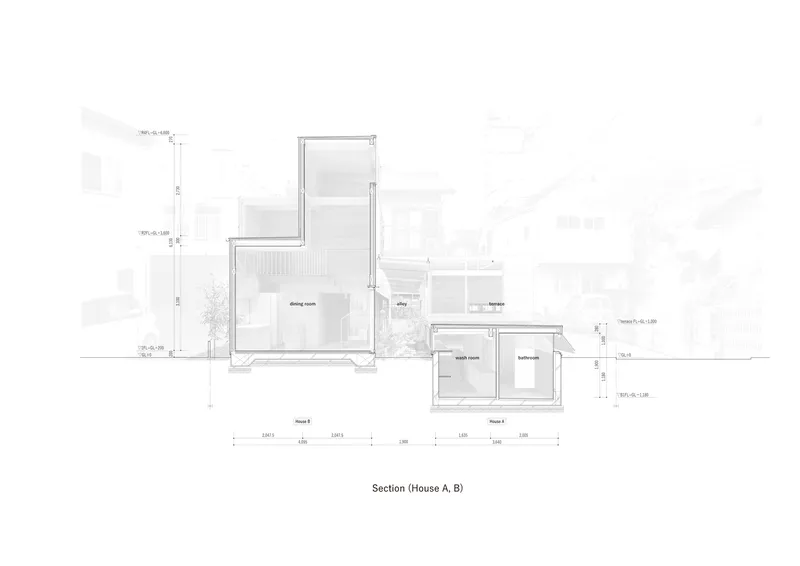
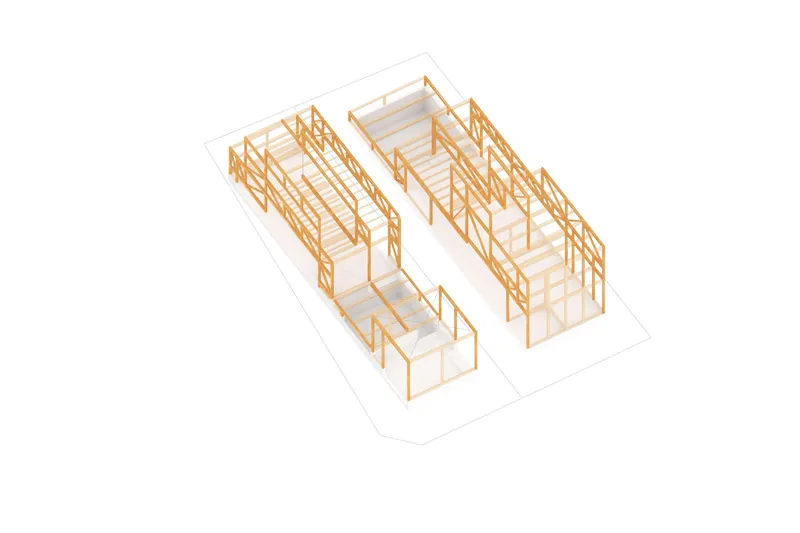
The drawings reveal the full extent of the project's complexity. The floor plans show two offset rectangular volumes with courtyards carved between them, while the sections expose the split-level strategy in all its layered ambiguity. Ceiling heights vary dramatically across the section, from compressed bedroom spaces to double-height dining volumes. The axonometric of the timber frame is especially telling: it shows a dense lattice of posts, beams, and floor plates that reads more like a small infrastructure than a pair of houses. The structural frame generates the spatial variety, not just supports it.
The sections through both houses together are the most revealing drawings. They show how the stepped roof volumes and split floors create interlocking sight lines between the two dwellings and the courtyards. The relationship between the two households is, quite literally, built into the section.
Why This Project Matters
Multi-generational and extended-family housing is one of the most pressing questions in contemporary residential architecture, yet it rarely receives this level of spatial attention. Most solutions default to duplexes or side-by-side plans that share a wall and little else. Unemori Architects proposes something more nuanced: a shared landscape that is neither private nor fully communal, a structural system that makes spatial variety inevitable, and a material language that binds two households without erasing their independence.
The project succeeds because it treats the space between the houses with the same rigor as the rooms inside them. The courtyards, terraces, and planted gaps are not amenities; they are the architecture. In a discipline that too often equates intimacy with enclosure, this pair of houses makes a persuasive case for porosity, for letting light, air, and family life flow through the gaps in the frame.
Houses by Unemori Architects. Located in Japan. 156 m². Completed in 2021. Photography by Kai Nakamura.
About the Studio
Share Your Own Work on uni.xyz
If projects like this are the kind of work you want to make, uni.xyz is a place to publish your own, find collaborators, and enter design competitions.




Popular Articles
Popular articles from the community


Lunar Spiral: Space Architecture Shaped by the Mathematics of the Universe
Lunar Spiral reimagines space architecture through Fibonacci geometry, lunar regolith, levitating habitats, and self-sustaining Moon living.

The Ocean Hive: Sustainable Architecture for a Self-Sufficient Civilization at Sea
The Ocean Hive imagines sustainable architecture at sea, where modular habitats, algae, wave power and ocean waste sustain a growing colony.

Riyadh For All: Intergenerational Urban Design for Active Aging in Rabat
Riyadh For All reimagines urban design in Rabat with intergenerational co-living, adaptive courtyards, and Moroccan cultural exchange today.

Co-Life: Senior Housing Design That Reconnects Older Adults With the City
Co-Life reimagines senior housing design through healing gardens, shared streets, workshops, and a sustainable community across generations.


Similar Reads
You might also enjoy these articles

Bao Huynh Watercolor Atelier: A Serene Art Retreat in Hội An
Bao Huynh Watercolor Atelier in Hội An blends multifunctional art spaces, sustainable design, local materials, and family-friendly living in a serene environment.

Atelier Macri Concept Store Interior Design by CASE-REAL
Atelier Macri store features a "ko" counter, walnut wood details, cork displays, blending retail, gallery, and seamless customer experiences.

Manuel Vargas Izquierdo Stadium and High-Performance Sports Center: Architectural Excellence in Jalpa de Méndez
The Manuel Vargas Izquierdo Stadium blends sustainable design, inclusive sports facilities, and cultural-inspired architecture, revitalizing Jalpa de Méndez’s public spaces.
KAKR Buluh Awar Hall: Revitalizing Community and Ecology Through Bamboo Architecture
Community built bamboo hall revitalizes Buluh Awar village, empowering youth, restoring ecology, celebrating vernacular craftsmanship through sustainable architecture and culture.


Explore Ai Generated Competitions
Discover active competitions in this discipline



Challenge to reimagine the Iron Throne


Photograph architecture without architects


Illustrate the lost glory of Angkor Wat - Render Challenge


Design challenge to reuse E-waste
Comments (0)
Please login or sign up to add comments
No comments yet. Be the first to comment!