
unseenbird Fills a Pangyo Tech Office with Red Brick, Greenery, and Communal Wellsides
Woowa Brothers' 5,965-square-meter workspace in Seongnam-si, South Korea rethinks the corporate floor plate as a village of social gathering points.


The tech office has become the most over-designed room type of the last decade, yet most results still feel like decorated open plans. For Woowa Brothers, the food delivery giant headquartered in South Korea's Pangyo tech corridor, unseenbird and lead architect Bioh Seon have taken a different starting position. Rather than scattering amenities across a neutral floor plate, they organized the entire 5,965-square-meter interior around what they call "wellsides," social nodes planted on every level where employees pause, talk, and build the informal bonds that remote work has eroded.
The real interest here is material. Where most Korean tech interiors default to white surfaces and blonde wood, unseenbird committed to red brick, terracotta tile, and stainless steel, then pushed the palette further with auditorium paving stones made from crushed plastic mixed with pea gravel, a nod to Woowa Brothers' delivery business and the waste it generates. The result is an office that feels less like a startup playground and more like a small civic building: warm, grounded, and legible.
The Courtyard as Organizing Principle


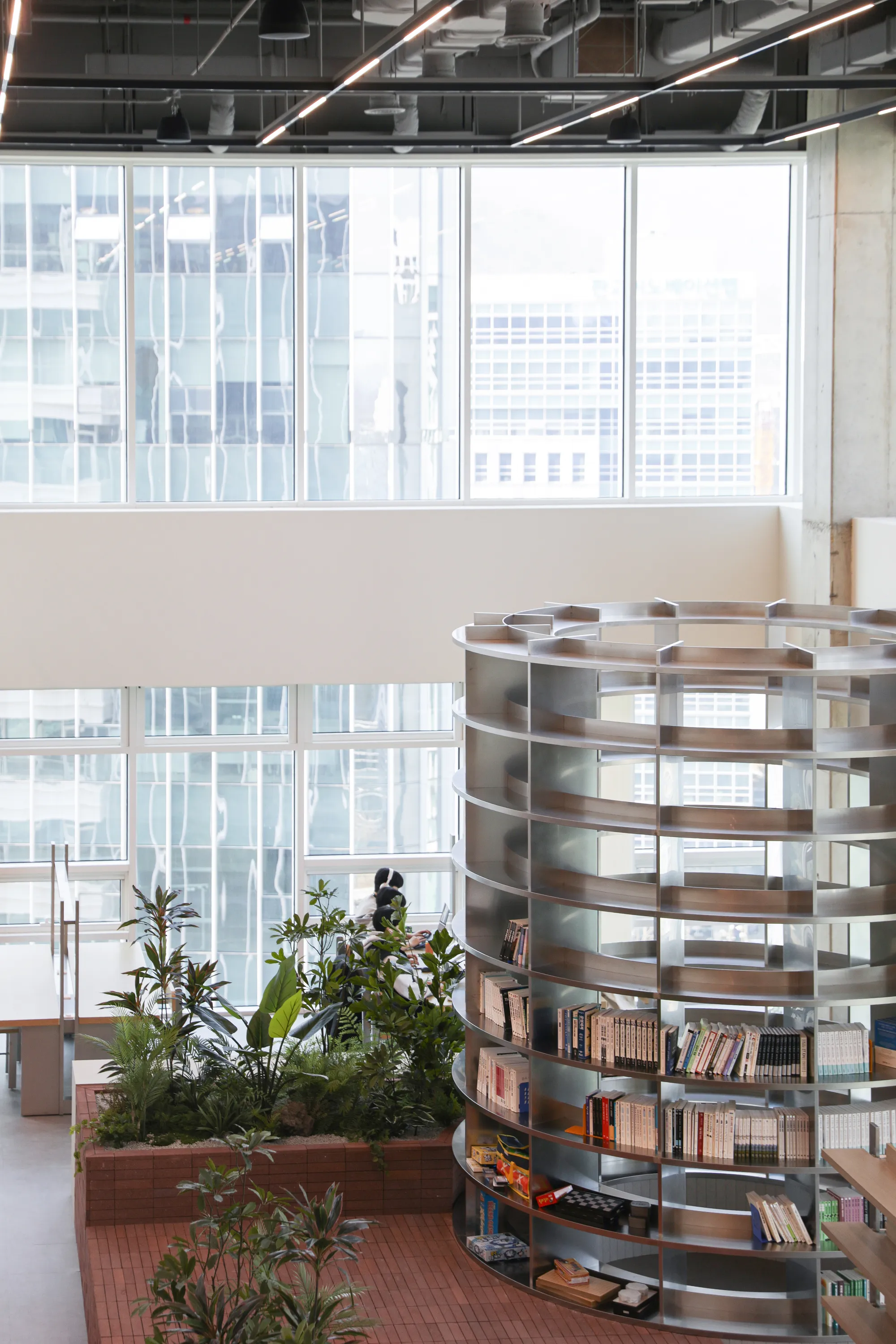
At the center of the plan sits a planted interior courtyard, ringed by circular steel benches and visible from the open office floors above. This is not a decorative atrium. The void punches through multiple levels, pulling natural light deep into the plan and giving every desk row a sightline to living greenery. The circular glass balustrade at the upper levels turns circulation into spectatorship: you look down at colleagues gathering on terracotta seating platforms, and the building feels inhabited in a way that cubicle farms never do.
The courtyard also solves an acoustic problem. By giving the noisiest social activity a dedicated vertical volume, the surrounding work zones stay quieter without requiring the sealed glass pods that have become corporate interior wallpaper.
Red Brick and Terracotta as Corporate Identity

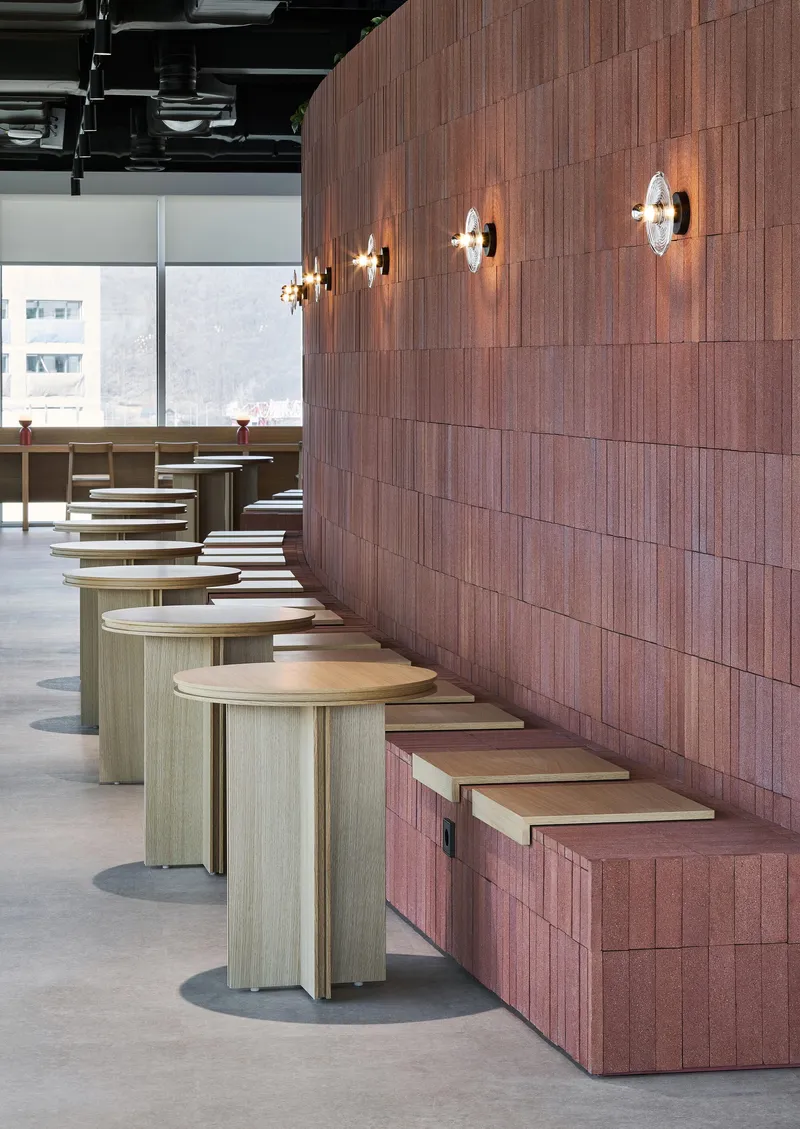

unseenbird's choice of red textured block and terracotta tile is quietly radical in a market saturated with neutral palettes. The material recurs everywhere: column cladding, wall surfaces, planter boxes, even booth alcoves in the dining areas. It unifies disparate program zones without relying on signage or color-coded wayfinding. Walk past a monstera plant beside a red block column, round a corner into a corridor of wall sconces mounted on the same masonry, and you always know you are inside the same building.
The terracotta tones also age well. Unlike painted drywall, which shows every scuff, brick and tile develop character over time. For a company that cycles through spatial reconfigurations as teams grow and shrink, that durability is not a luxury; it is an operating expense decision.
The Tower Library and Learning Spaces
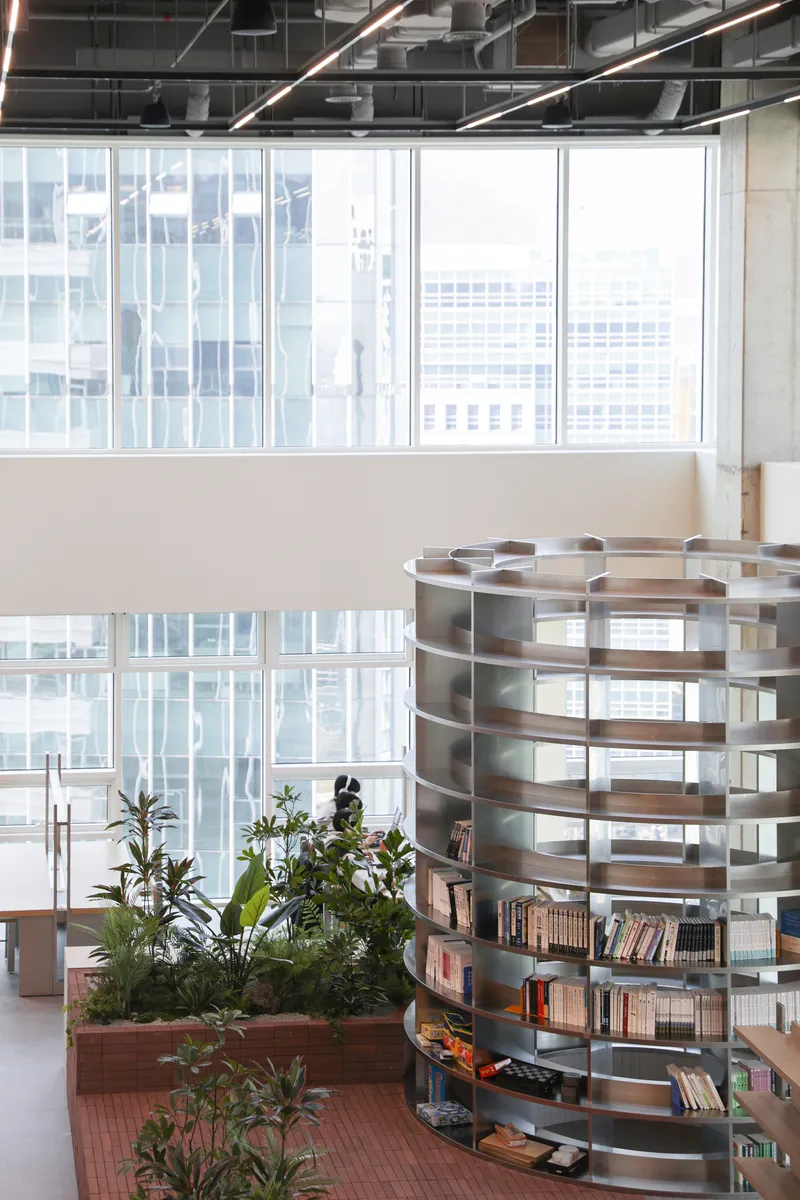


A tower-shaped library rises through the double-height space, its spiral bookshelves surrounded by planters and curtain wall windows. This is the symbolic heart of unseenbird's design: Woowa Brothers operates a Tech Course Academy inside the building, offering free IT training, and the library anchors that educational mission in physical form. Timber benches, planted beds, and exposed ceiling ducts keep the reading room from becoming precious. It reads as a workshop, not a monument.
The tiered seating platforms nearby, ascending toward open-riser shelving units in white, double as informal lecture halls. The gradient from terracotta to burgundy tile on the risers gives the steps a warmth that conventional auditorium seating never achieves.
Wellsides: Social Infrastructure on Every Floor
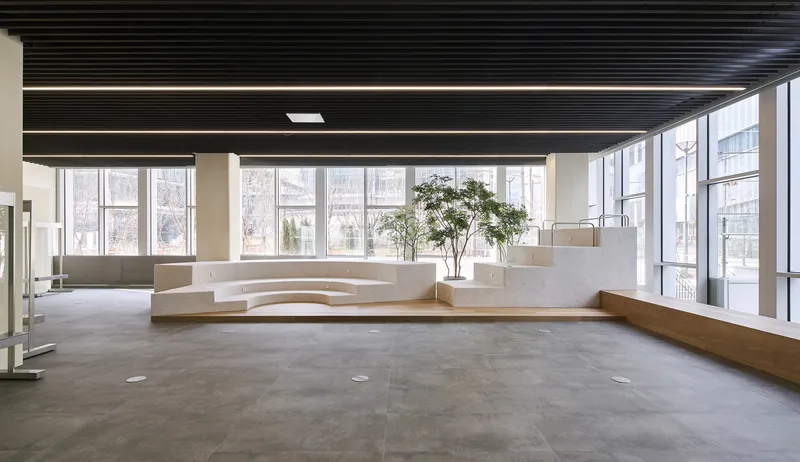
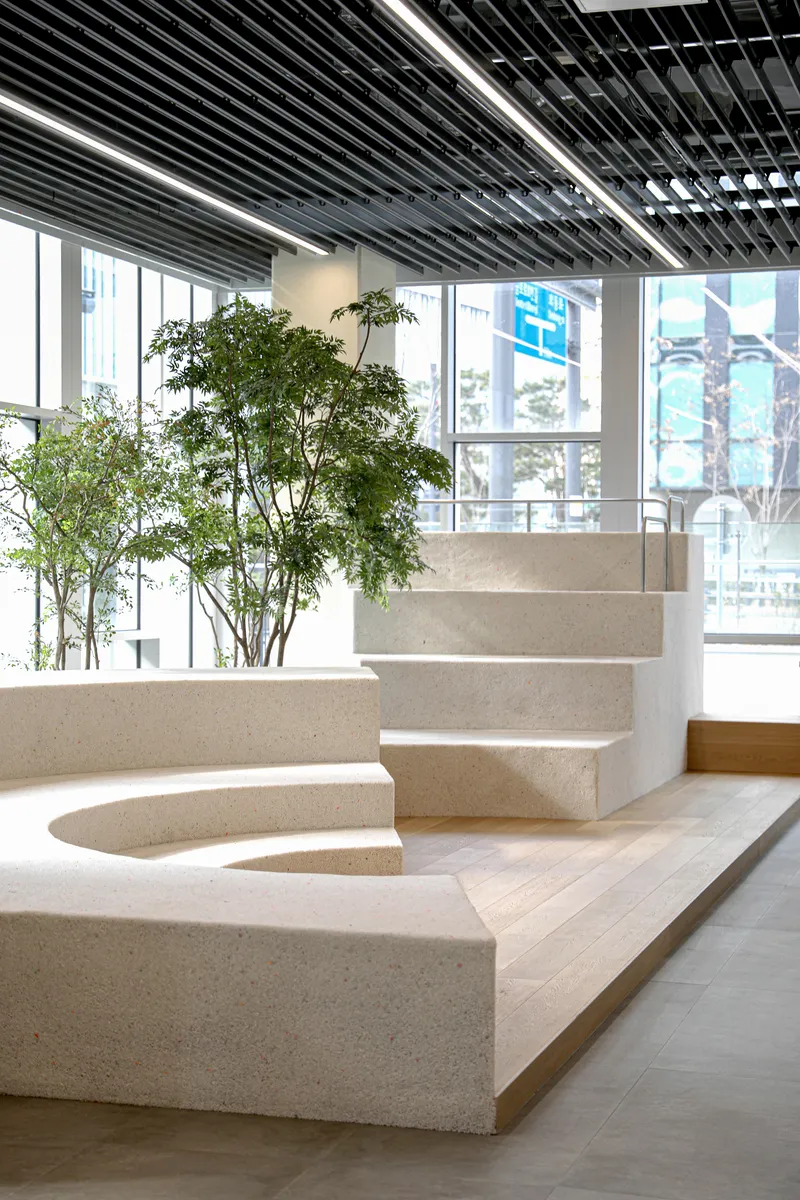

The wellside concept is the project's most transferable idea. Each floor gets at least one gathering node, but no two are identical. One features a curved white concrete seating plinth beside floor-to-ceiling windows under a black slatted ceiling. Another offers terrazzo seating steps with integrated planter boxes. A third tucks copper-tiled booth alcoves behind curved white counters. The variety prevents the kind of spatial monotony that makes employees default to their desks.
What distinguishes these from the typical breakout space is their positioning. They sit along primary circulation paths, not in dead-end corners. You encounter them as you move through the building, which increases the chance of unplanned conversation. This is an argument for architecture over furniture: you cannot achieve the same effect by dropping a sofa into a corridor.
Dining and Community Spaces
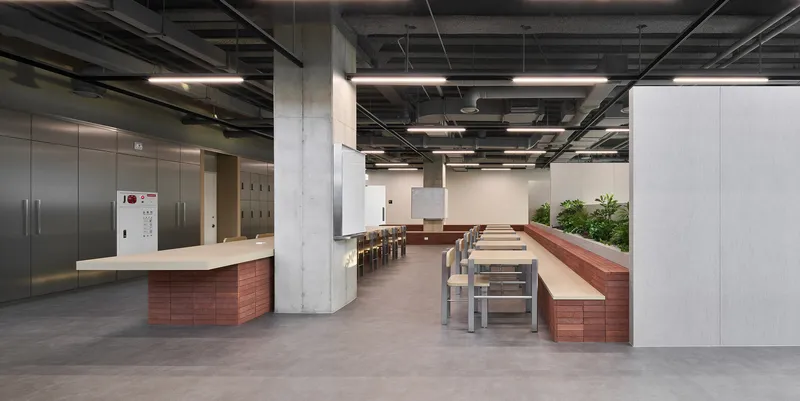
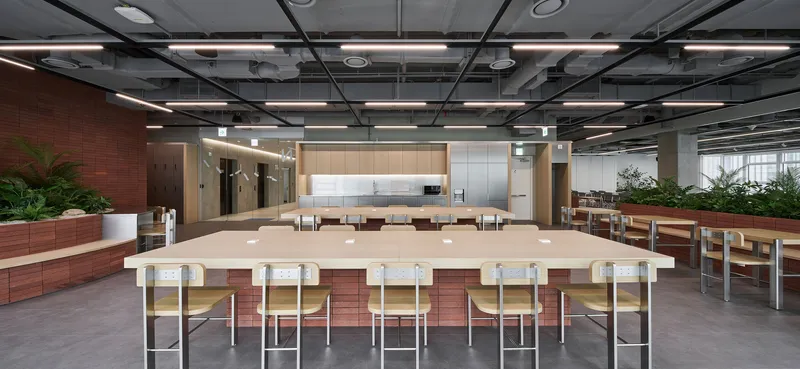

The dining areas continue the brick-and-metal palette with timber bench seating, large communal tables with metal stools, and copper tile feature walls. The exposed mechanical systems overhead are left honest rather than concealed behind a drop ceiling, a decision that adds ceiling height and reinforces the industrial warmth of the material strategy. Wall sconces along the copper tile walls bring the light level down to something approaching a restaurant, not a cafeteria.
Detail and Craft


The detailing repays close attention. A ceiling pulley system with steel cables and pendant weights suggests adjustable partitions or screens, adding a layer of flexibility without motors or electronics. Curved plywood desk edges with metal screen panels expose the laminated construction as ornament. Junction details where light wood table edges meet metal brackets and red textured block bases show how carefully the material transitions were resolved.
These are not flashy gestures. They are the kind of quietly competent joinery and hardware decisions that determine whether an interior holds up after five years of daily use.
Green Infrastructure and the Vaulted Ceiling
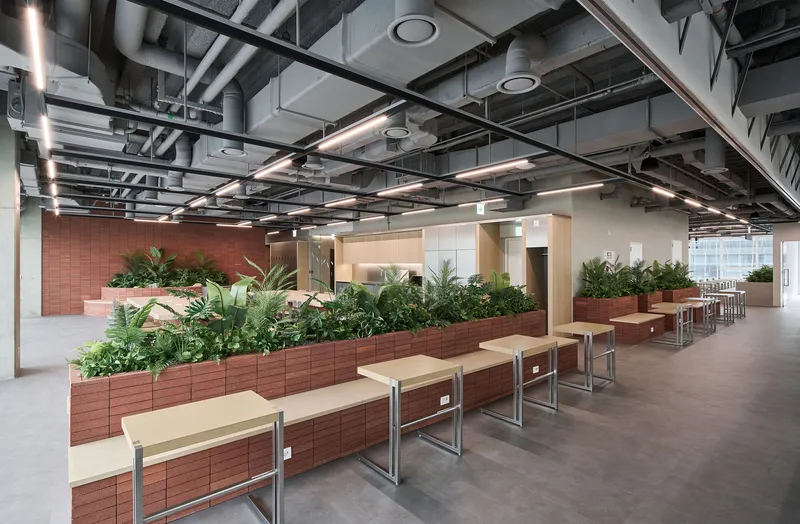


Rows of terracotta tile planters filled with greenery run beneath the exposed ductwork grid, turning otherwise dead zones into interior landscapes. Along the corridors, planted beds line glass walls beside board-formed concrete surfaces, creating thresholds that feel like garden paths. The vegetation is not sparse or token; it is dense enough to register as an environment, not decoration.
Perhaps the most striking single moment is the vaulted red tile ceiling with recessed lights, framing an exterior view through a concrete column. It compresses the building's entire material argument into one image: masonry above and below, structure as frame, daylight as finish.
Plans and Drawings

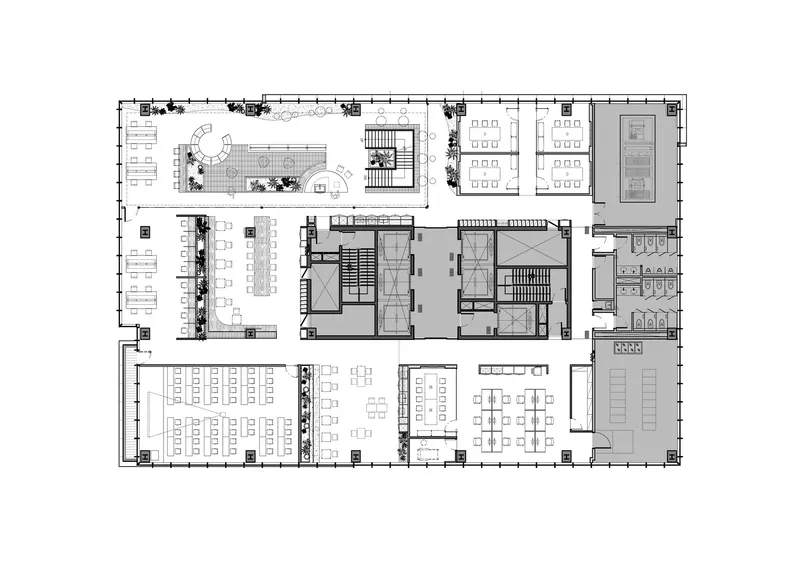


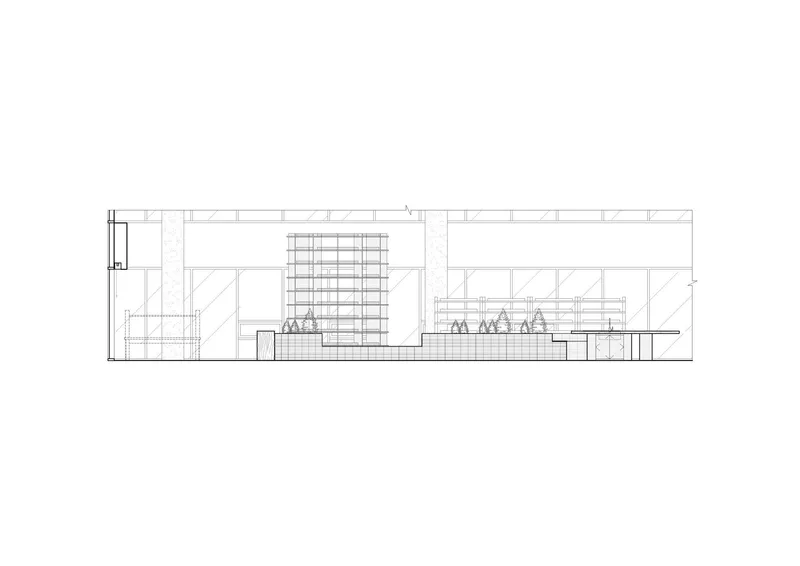
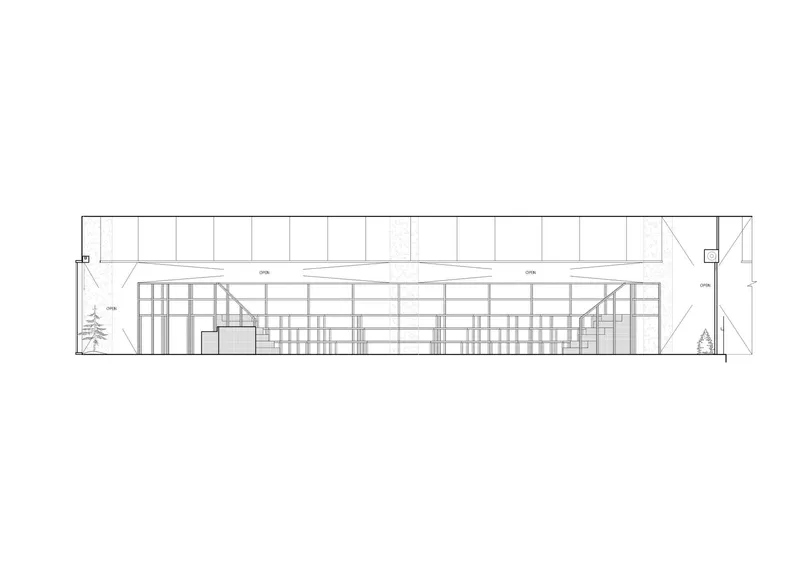
The floor plans reveal the logic behind the experience. Central cores handle vertical circulation and services, freeing the perimeter for continuous glazing and workstation runs. The curved seating areas and scattered furniture layouts visible in the lower-level plans show how the wellsides are carved out of the open plan rather than appended to it. Sections confirm the generosity of the double-height spaces and the relationship between the tiered seating zones and the gridded ceiling systems above them. The elevation drawing shows a restrained horizontal facade where the structural bracing reads as pattern, not ornament.
Why This Project Matters
The post-pandemic office debate has often been framed as a binary: open plan versus enclosed rooms, remote versus in-person. Woowa Brothers' workspace sidesteps that argument by investing in the connective tissue between work zones. The wellsides, the courtyard, the library tower, and the dining areas are not perks bolted onto a conventional layout. They are the layout. The work desks fill in around them, reversing the usual hierarchy.
unseenbird's material commitment matters too. In a market where interior fit-outs are typically demolished and rebuilt every lease cycle, choosing brick, terracotta, and crushed-plastic paving stones signals a longer time horizon. It is a bet that the building's character will outlast its current org chart, and that the right materials can make an office feel less like a product and more like a place.
Woowa Brothers Office by unseenbird (lead architect: Bioh Seon), Seongnam-si, South Korea. 5,965 m², completed 2026. Photography by Lee Pyojoon.
About the Studio
Share Your Own Work on uni.xyz
If projects like this are the kind of work you want to make, uni.xyz is a place to publish your own, find collaborators, and enter design competitions.




Popular Articles
Popular articles from the community


The Musturak Paradise: Senior Living Architecture for a Connected Future in Temara, Morocco
The Musturak Paradise reimagines senior living architecture in Temara via private homes, social spaces, culture, community, and shared care.
AL-JANNAH: Sustainable Architecture and Permaculture for Afghan Widows
AL-JANNAH uses sustainable architecture and permaculture to create resilient oasis of housing, learning, work and renewal for Afghan widows.

EW PARK: Sustainable Architecture Reimagines the Future of Urban Parking
EW PARK reimagines city parking as a modular wooden tower combining automation, solar energy, electric mobility, and adaptable urban design.

Co-Life: Senior Housing Design That Reconnects Older Adults With the City
Co-Life reimagines senior housing design through healing gardens, shared streets, workshops, and a sustainable community across generations.

Similar Reads
You might also enjoy these articles

Bao Huynh Watercolor Atelier: A Serene Art Retreat in Hội An
Bao Huynh Watercolor Atelier in Hội An blends multifunctional art spaces, sustainable design, local materials, and family-friendly living in a serene environment.

Atelier Macri Concept Store Interior Design by CASE-REAL
Atelier Macri store features a "ko" counter, walnut wood details, cork displays, blending retail, gallery, and seamless customer experiences.

Manuel Vargas Izquierdo Stadium and High-Performance Sports Center: Architectural Excellence in Jalpa de Méndez
The Manuel Vargas Izquierdo Stadium blends sustainable design, inclusive sports facilities, and cultural-inspired architecture, revitalizing Jalpa de Méndez’s public spaces.

KAKR Buluh Awar Hall: Revitalizing Community and Ecology Through Bamboo Architecture
Community built bamboo hall revitalizes Buluh Awar village, empowering youth, restoring ecology, celebrating vernacular craftsmanship through sustainable architecture and culture.





Comments (0)
Please login or sign up to add comments
No comments yet. Be the first to comment!