

Urban Meal Mine: Rice Terraces Reimagined as Megacity Food Infrastructure
A speculative architecture project fuses traditional rice terrace farming with urban programming to create self-sustaining food ecosystems in dense cities.


What if the terraced rice paddies of Southeast Asia could be folded into the fabric of a megacity? Urban Meal Mine takes this provocation seriously, proposing an architecture that treats food production not as a rural afterthought but as a core urban programme. The design borrows the stepped geometry and gravity-fed water logic of traditional rice terraces, then scales and adapts them into rooftops, building platforms, and landscaped circulation networks that serve millions.
Developed by Kittithat Phubunjerdsak and published on uni.xyz, the project is grounded in the principle of the sufficiency economy: moderation, reasonableness, and self-immunity. Rather than proposing a single landmark building, Urban Meal Mine imagines a holistic urban ecosystem where vertical farms, livestock spaces, markets, educational zones, and recreational areas coexist with productive agricultural land, all organized around the question of how to design architecture and farming areas in the same place effectively.
Agricultural Geometry Carved into the Urban Ground
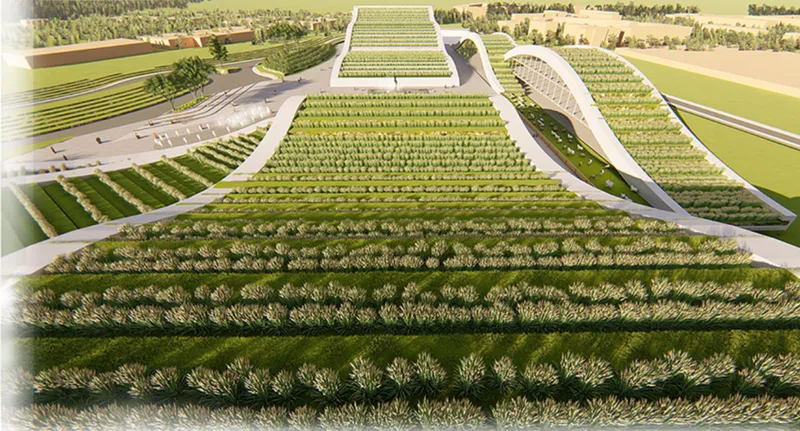
Seen from above, the scheme reads like a working farm that has swallowed a city block. Linear planted beds stretch in parallel rows, separated by curved pedestrian pathways that double as drainage channels. The geometry is not arbitrary; it responds to sun direction, wind patterns, and the natural terrain of the site. Terraces follow the land's existing contour, ensuring rainwater moves slowly across planted surfaces before being captured and recirculated. The result is a landscape that looks productive because it genuinely is: every planted strip contributes to food output while also managing stormwater and improving the local microclimate.
By expanding farming areas within dense urban conditions, the design sidesteps the usual binary between built-up land and agricultural land. The curving paths invite foot traffic through the fields, turning daily commutes into encounters with food production. It is urban planning that treats soil as infrastructure.
Planted Roofs, Public Plazas, and Canopy Walkways
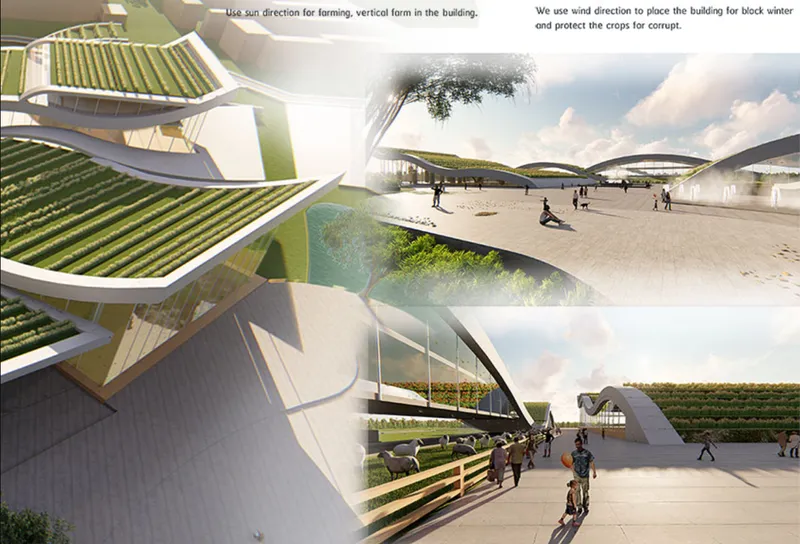
At eye level, the project reveals a second layer of activity. Planted roof terraces cascade over building volumes, extending the agricultural surface well beyond ground level. A central plaza gathers visitors beneath curved canopies, creating a shaded threshold between market zones and the terraced growing areas above. The covered walkways are not ornamental; they channel airflow and provide rain protection, reinforcing the climate-responsive logic that runs through the entire scheme.
What makes this collage rendering convincing is the density of programme visible in a single frame: food markets, workshops, gathering space, and greenery all layered within the same architectural section. The project's ambition to merge agricultural production with social infrastructure becomes legible here. People are not just passing through a building; they are inhabiting a food system.
A Closed-Loop Section: Water, Soil, and Circulation
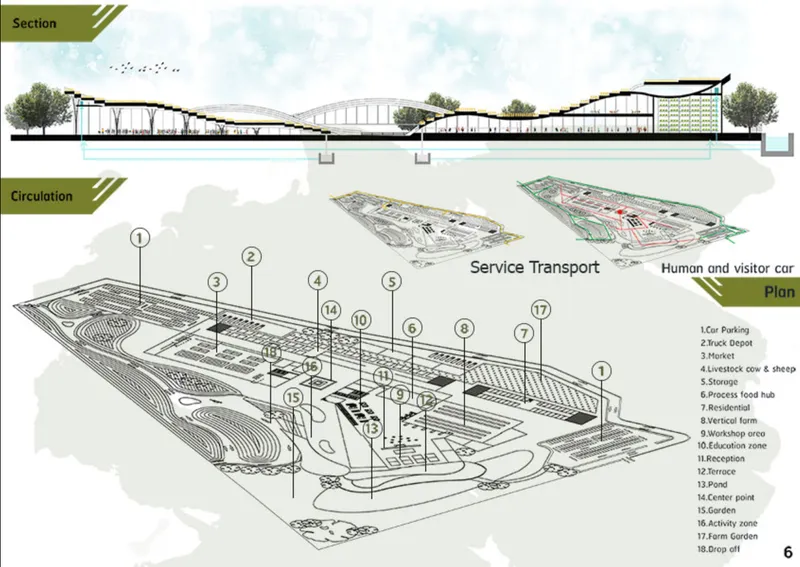
The sectional drawing and axonometric circulation plan expose the engineering logic that holds the scheme together. Numbered zones identify farm areas, parking, visitor facilities, and service transport corridors, each carefully distributed so the complex functions simultaneously as a food hub and a community center. The rice terrace profile works like a dam: rainwater is captured at the highest level and allowed to flow downward through gravity-fed channels, irrigating successive planting beds before being cleaned and recycled in a closed-loop system. Soil water never leaves the site; it is filtered and reintroduced, reducing energy consumption and external water dependency.
Circulation is equally deliberate. Pedestrian-friendly layouts separate service transport from public movement, ensuring that agricultural logistics do not conflict with the social life of the complex. The section reveals vertical farms stacked alongside livestock spaces and education zones, compressing a food cycle that would normally require hectares of rural land into a compact urban footprint.
Why This Project Matters
Urban Meal Mine does not propose a futuristic aesthetic for its own sake. Its value lies in the directness of its premise: traditional agricultural knowledge, specifically the terraced water management and soil protection techniques refined over centuries, can be transplanted into contemporary city building. The sufficiency economy framework gives the design an ethical spine, pushing it beyond formal experimentation toward a genuine argument about resilience, food security, and community self-reliance.
For a speculative project, it is remarkably specific about how things work. Gravity-fed irrigation, closed-loop water recycling, integrated livestock and vertical farming, and a zoned circulation system all appear in the drawings. Kittithat Phubunjerdsak demonstrates that architecture can be regenerative rather than merely sustainable, designing cities that produce as much as they consume. In a world of accelerating urbanization and thinning agricultural margins, that is not a utopian fantasy; it is a design brief waiting to be built.
View the Full Project
About the Designers
Designer: Kittithat Phubunjerdsak
Enter a Design Competition on uni.xyz
uni.xyz runs architecture and design competitions year-round that reward proposals with spatial conviction and real site intelligence.
Project credits: Rice Terraces by Kittithat Phubunjerdsak.


Popular Articles
Popular articles from the community


Juan García Correa, John González and Claudia Rueda Sink a Circular Amphitheater into a Manizales Engineering Building
On the La Nubia campus in Manizales, Colombia, the S1 Building folds labs and offices into a hillside of ramped lawns that double as a campus route.

Jaramillo Van Sluys Arquitectura and Urbanismo Turn a Demolished Registry Lot in Quito into an Orchard Plaza
In Quito's Centro Histórico, a 2,800 m² plaza exposes the San Agustín convent wall and redraws its lost Augustinian orchard in volcanic stone.

U.GA Architects Wraps an Oval Rooftop Pool in Curved Board-Formed Concrete on Busan's Jeollidan-gil
In Busan's Jeonpo-dong, a 454 m² mixed-use block stacks a neighborhood facility, guest rooms and an oval rooftop pool inside spiraling concrete walls.

David Ortega Stacks a Two-Story Mexico City Penthouse Around a Steel Stair and a Pergola-Shaded Roof Terrace
In Colonia Roma, a 300 m² penthouse uses oak joinery, a planted steel stair and a slatted roof pergola to make a new-build apartment feel like a house.

Similar Reads
You might also enjoy these articles


Aquadapt: An Underwater Habitat That Rewrites Its Rooms by the Hour
Curved modules ring the seabed while one shell shifts from breakfast room to cinema, farm and football pitch as residents' needs change.

Play: Fragments of Their World: Remembered Architecture Rebuilt as a Modular Playground for Refugee Camps
Tom Gardner abstracts domes, arches and towers from the homelands of displaced families into a kit of child-scaled play parts for camp settlements.
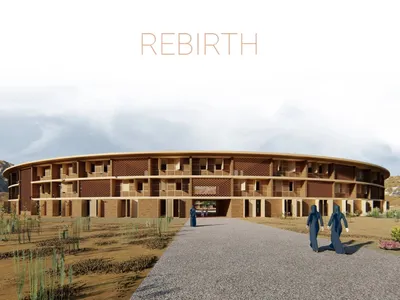
REBIRTH: A Circular Settlement Where Afghan Widows and Their Children Rebuild Life Together
A shortlisted Resile entry turns the circle into a protective ring of timber and brick, gathering homes, classrooms and gardens around a shared landscape.
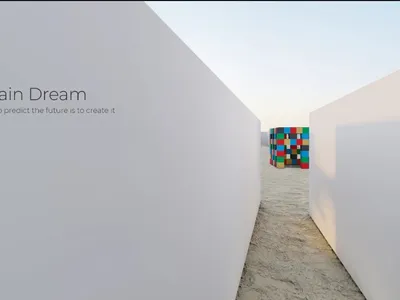
The Main Dream: A Recycled Plastic Kit That Lets Refugee Children Build Their Own Playground
Thirty-centimetre interlocking cubes that connect on three axes turn play into construction, letting children author the spaces they occupy.


Comments (0)
Please login or sign up to add comments
No comments yet. Be the first to comment!