

Urban Regeneration in Subotica: Reconnecting Monument, Landscape, and Cityscape
An urban regeneration project in Subotica reconnects a fractured modernist axis, transforming monument, memory, and landscape into civic life.


Project by Desire Tilinger
"The city, that artefact, in the beginning a tool like any other ... began to turn itself into a tool of seeing and understanding the world, into a means of intelligence." If this is true, then the city requires a brain, an urban institute capable of interpreting its past and directing its future.
This urban regeneration "MONUMENT : LANDSCAPE : CITYSCAPE" project in Subotica, Serbia, addresses the lingering spatial and psychological impact of an unfinished modernist axis that has shaped, and fragmented, the city for decades. Positioned between monument, landscape, and cityscape, the proposal transforms an unresolved urban scar into a cultural and civic catalyst.
The Unfinished Modernist Axis: A Barrier to Urban Continuity
Subotica, located in northern Serbia near the Hungarian border, is renowned for its Hungarian Secession (Art Nouveau) architecture and richly ornamented facades. Yet beneath its historic identity lies the legacy of a 20th-century modernist intervention that was never fully realized.
Radijalac and Prozivka, two modern settlements built during socialist expansion, were intended to be connected by a grand urban boulevard cutting through the city. While Radijalac developed as planned, Prozivka remained spatially detached. The proposed axis stopped short of completion, leaving a rupture in the urban fabric.
This unresolved gesture continues to divide Subotica: physically, socially, and symbolically. The project identifies this unfinished axis as the primary obstacle to the city’s cohesive development and positions urban regeneration as the strategy for healing this divide.
From Monument to Urban Institute: Reframing Memory
Prozivka, whose name loosely translates to "roll-call," carries heavy historical connotations linked to wartime executions during World War II. Today, a park and monument mark this space. However, the surrounding urban structure lacks integration and civic vitality.
Rather than treating the monument as an isolated memorial object, the project expands it into a broader cultural landscape. At its core stands a new Urban Institute, conceived as the intellectual engine of Subotica. This institute serves architects, urbanists, designers, archivists, anthropologists, programmers, and citizens alike.
The building is not introverted or institutional in the conventional sense. Transparent, open, and porous, it invites public interaction. The surrounding park becomes an extension of civic life: a place where memory, education, and everyday activities intersect.
Urban Design Strategy: Stitching the Two Suboticas Together
The proposal works at multiple scales:
- Urban Scale: Completing and redefining the axis not as a rigid boulevard, but as a green, cultural corridor.
- Architectural Scale: Introducing modular pavilions, exhibition spaces, archives, and lecture halls.
- Landscape Scale: Transforming the central void into an active public realm.
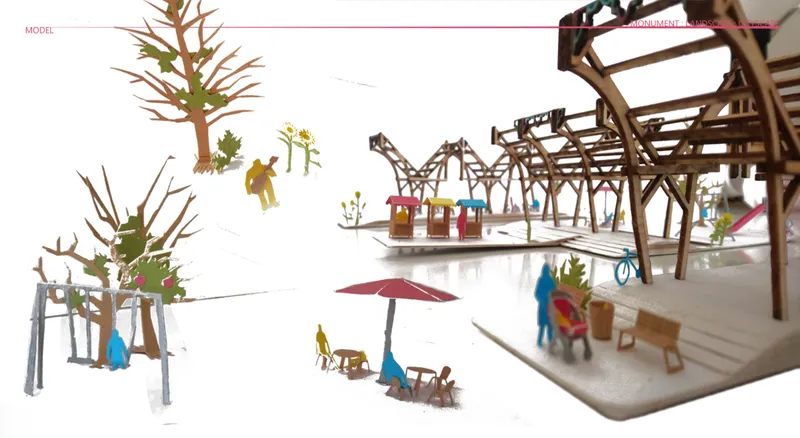
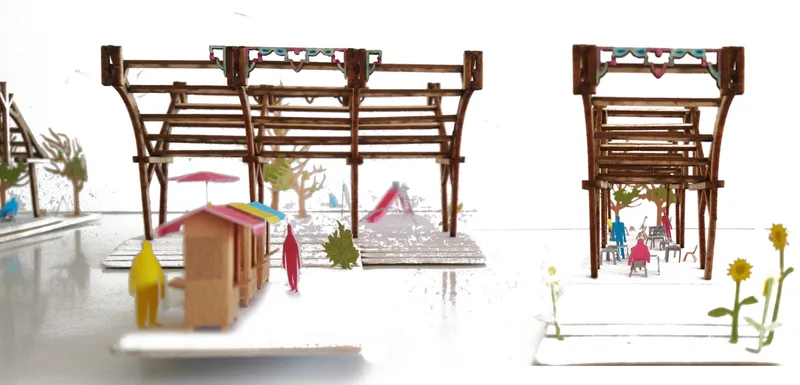
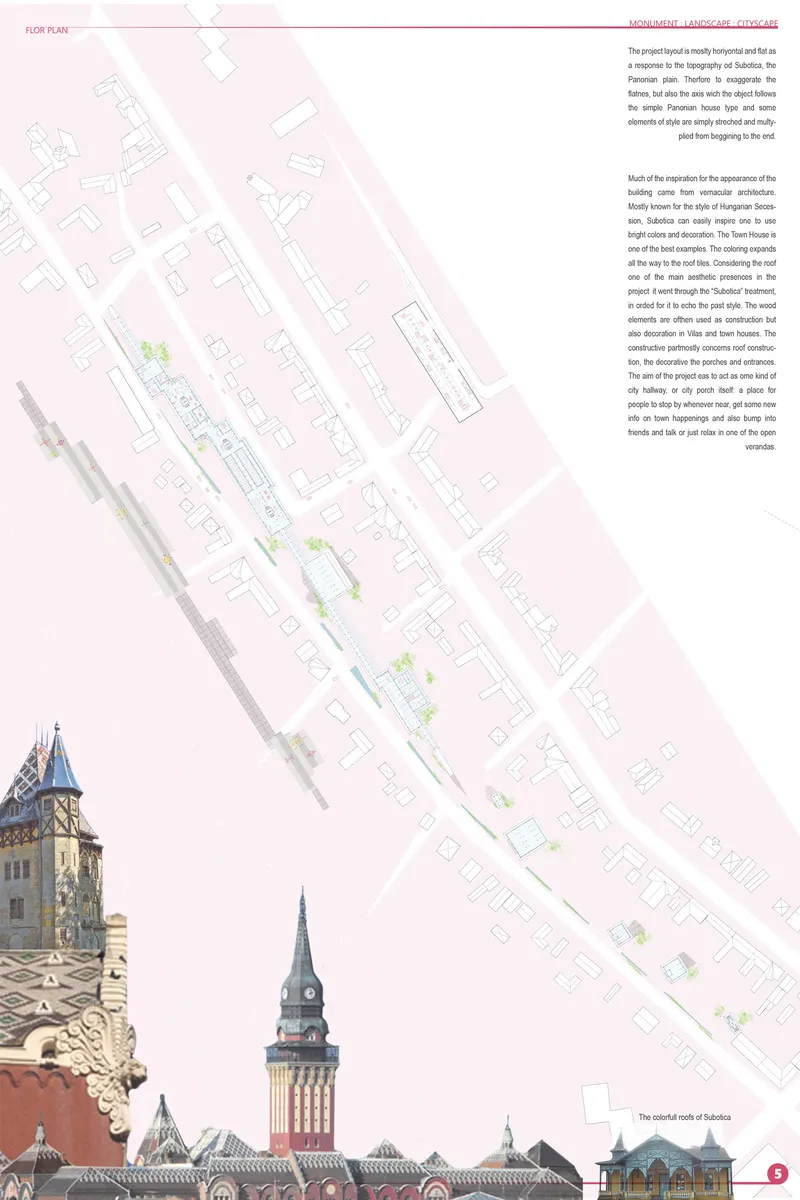
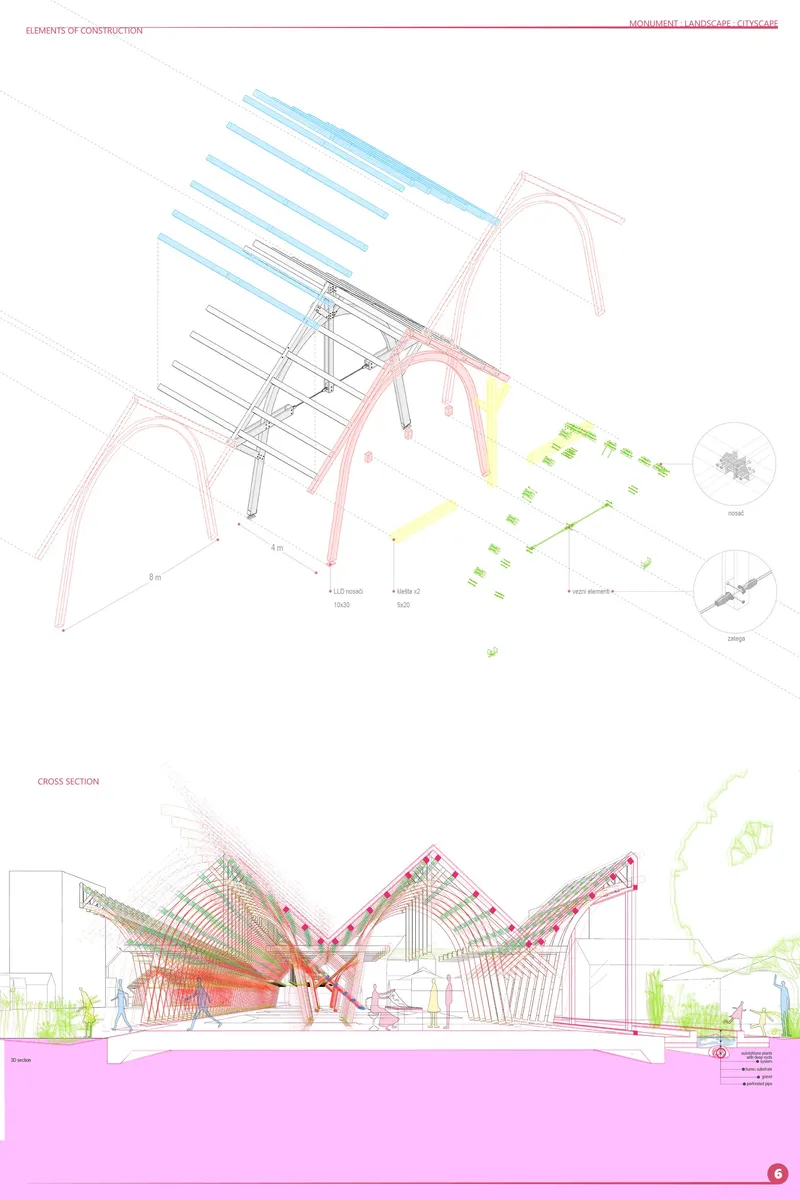
Instead of imposing a singular monumental structure, the design unfolds horizontally, responding to the flat Pannonian plain. The composition exaggerates horizontality while punctuating it with rhythmic wooden structural frames that reinterpret vernacular porch ornamentation found throughout Subotica.
This translation of decorative wooden "lace" into a structural system bridges past and present, shifting ornament from surface embellishment to constructive logic.
Programmatic Intelligence: Architecture as Civic Infrastructure
The Urban Institute functions as a hybrid between archive, cultural center, research hub, and public forum. Its program includes:
- Urban research and management offices
- Exhibition and archive spaces
- Cultural and educational facilities
- Public pavilions and open-air gathering zones
By embedding these programs within a continuous landscape, the project dissolves the boundary between building and city. The axis becomes a living civic spine, not merely a transit route but a social condenser.
Constructive Expression and Spatial Experience
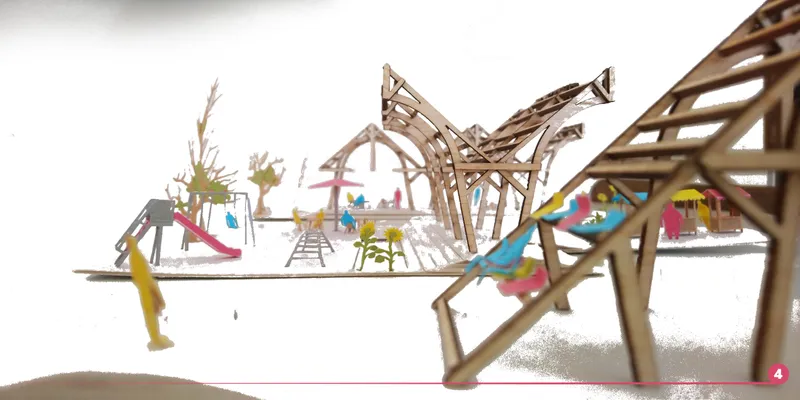
The exploded structural diagrams reveal a layered system of arches, beams, mounts, and roof elements that generate a dynamic canopy. In section, the wooden frames bend and converge, forming sheltered public zones beneath.
This structural rhythm creates moments of compression and expansion: guiding pedestrians through shaded passages, open plazas, and framed views toward the monument and surrounding neighborhood.
The architecture is both infrastructural and poetic: infrastructural in its modular repetition and material clarity; poetic in its reinterpretation of vernacular motifs and its commitment to civic openness.
Toward 21st-Century Urban Regeneration
Subotica’s challenge is not merely architectural, it is temporal. The city must reconcile its Art Nouveau identity with its socialist modernist layer and its contemporary aspirations.
By addressing the unfinished axis, the symbolic and spatial scar, this urban regeneration project proposes a way forward. It does not erase history; instead, it layers memory, landscape, and program into a cohesive civic framework.
In doing so, the project suggests that true urban regeneration is not about replacing the past, but about understanding it, and building the institutional intelligence necessary to navigate the future.
Monument becomes landscape. Landscape becomes cityscape. And the city, once fragmented, begins to think as one.




Popular Articles
Popular articles from the community


Conexión: Biophilic Design Reimagines High-Rise Living in Hong Kong
Conexión reimagines high-rise living in Hong Kong through biophilic design, green facades, shared spaces, daylight, water and nature within.

Lunar Spiral: Space Architecture Shaped by the Mathematics of the Universe
Lunar Spiral reimagines space architecture through Fibonacci geometry, lunar regolith, levitating habitats, and self-sustaining Moon living.

Co-Life: Senior Housing Design That Reconnects Older Adults With the City
Co-Life reimagines senior housing design through healing gardens, shared streets, workshops, and a sustainable community across generations.

Riyadh For All: Intergenerational Urban Design for Active Aging in Rabat
Riyadh For All reimagines urban design in Rabat with intergenerational co-living, adaptive courtyards, and Moroccan cultural exchange today.

Similar Reads
You might also enjoy these articles

Eco Chapel: A Green Architecture Pavilion Designed in Symbiosis with the Forest
Eco Chapel uses green architecture to weave prayer, learning and reuse into a forest pavilion shaped by modular hexagonal canopies for life.
Kaffeebühnen: Coffee Shop Architecture Designed as a Civic Stage Between Vienna’s City and Park
Kaffeebühnen turns coffee shop architecture into a civic stage, linking Vienna’s park edge, urban life, warm timber yards, and coffee craft.
Healing Façade: Sustainable Architecture for Reforestation, Community, and Sacred Ecology in Ethiopia
Healing Façade reimagines sustainable architecture as a living wall that restores soil, catches water and renews Ethiopia's forest churches.


Urban Forest: A Vertical Ecosystem for 5,000 Workers in Singapore's Changi Business Park
Radially stacked pods and layered green decks turn a 7-acre plot into 47 acres of ecological workspace projected for 2040.

Comments (0)
Please login or sign up to add comments
No comments yet. Be the first to comment!