

VAK Architecten Builds a Porous Research Hangar for Marine Biology at the University of Antwerp
A lockable yet open pavilion on Campus Drie Eiken filters sunlight and collects rainwater for aquatic experiments in 450 square meters.


Research buildings rarely get to be this honest about what they are. VAK architecten's new research hangar for the Department of Biology at the University of Antwerp is, at its core, a shed: an 18-by-18-meter steel frame sitting on concrete pedestals, clad in stretched metal mesh and corrugated red panels, designed to shelter water basins that can weigh up to a ton. It does not pretend to be anything more. That restraint is what makes it compelling.
Sited on Campus Drie Eiken and completed in 2026, The Lab houses experiments on sea and river water in relation to air, soil, and maritime biotopes. The building does not need air conditioning. It does not need finished interiors. What it needs is protection from rain and direct sun, the ability to move heavy equipment freely across its floor, and security for ongoing research setups. VAK's response is a structure whose every detail, from the 3-meter grid to the signal-colored gutters, is legible as a direct answer to one of those requirements.
An Industrial Silhouette on Academic Ground

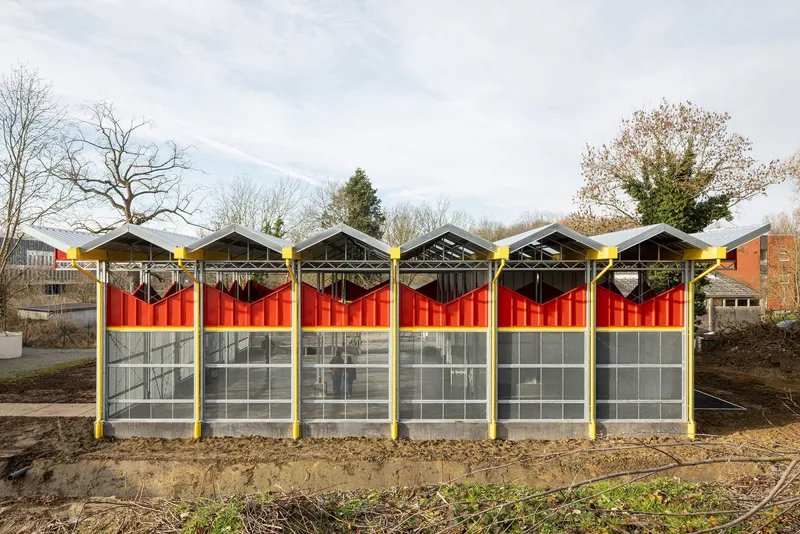

The sawtooth roof is the building's strongest gesture. Six bays of inclined saddles pitched at 25 degrees march across the square plan, giving the hangar a profile that reads as openly industrial. From a distance, against the bare winter trees of the campus, the structure could pass for a Victorian workshop or a small goods depot. The yellow steel columns and red corrugated panels add a deliberate splash of color that prevents the building from receding into anonymity.
The 1.5-meter overhanging cornice on all four sides extends the roof well past the facade plane, creating a deep shadow line that shelters the perimeter from driving rain. It is a simple move with outsized consequences: the overhang allows the lower panels to remain open or mesh-screened without exposing the interior to weather damage.
A Grid That Does Everything


The structural logic is relentlessly regular. Concrete pedestals on a 3-by-3-meter grid rise 1.10 meters to form an impact-resistant plinth, and a metal framework takes over from there. The concrete bases are not just structural: they double as collection vessels for rainwater, which can be reused via hand pump or channeled underground to an infiltration ditch east of the hangar. The foundation slab is finished in red asphalt, kept completely flat so that one-ton water basins can be repositioned without obstruction.
Checker plate completes the lower perimeter between the concrete pedestals, creating a continuous, damage-resistant wall at the level most likely to take a hit from moving equipment. It is a detail born entirely from use, but it gives the base a visual weight that anchors the lighter mesh and corrugated panels above.
Filtering Light, Not Blocking It


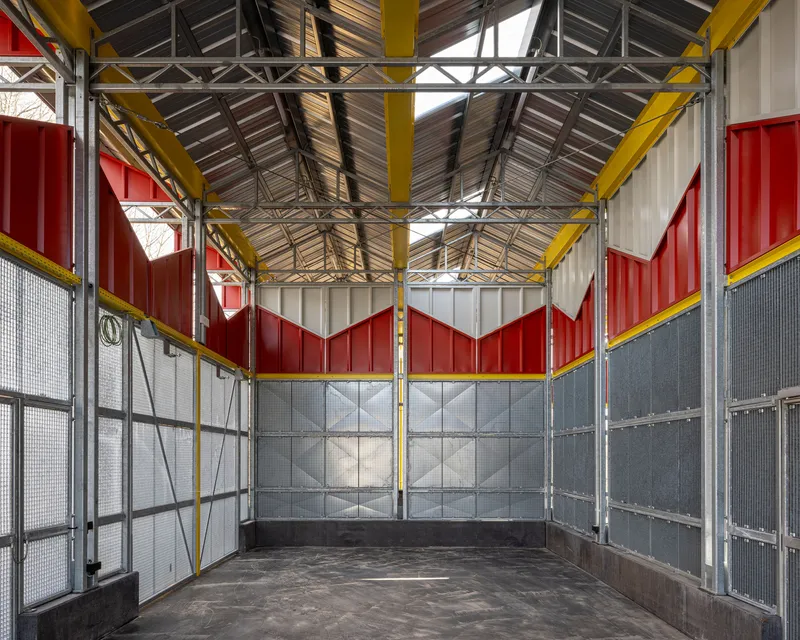
Inside, the sawtooth profile earns its keep. Strip skylights run along the north-facing pitches, washing the interior with even, indirect daylight. The yellow steel trusses and diagonal bracing are fully exposed, turning the ceiling into a kind of structural canopy that frames the light rather than concealing the means by which it arrives.
The stretched metal mesh panels that fill much of the facade play a parallel role on the vertical plane. They filter sunlight into a shifting moiré of shadow and reduce wind impact without sealing the interior from the campus outside. For aquatic biology experiments sensitive to environmental conditions, this calibrated porosity matters more than a hermetically sealed envelope ever could.
Red Chevrons and Signal Colors


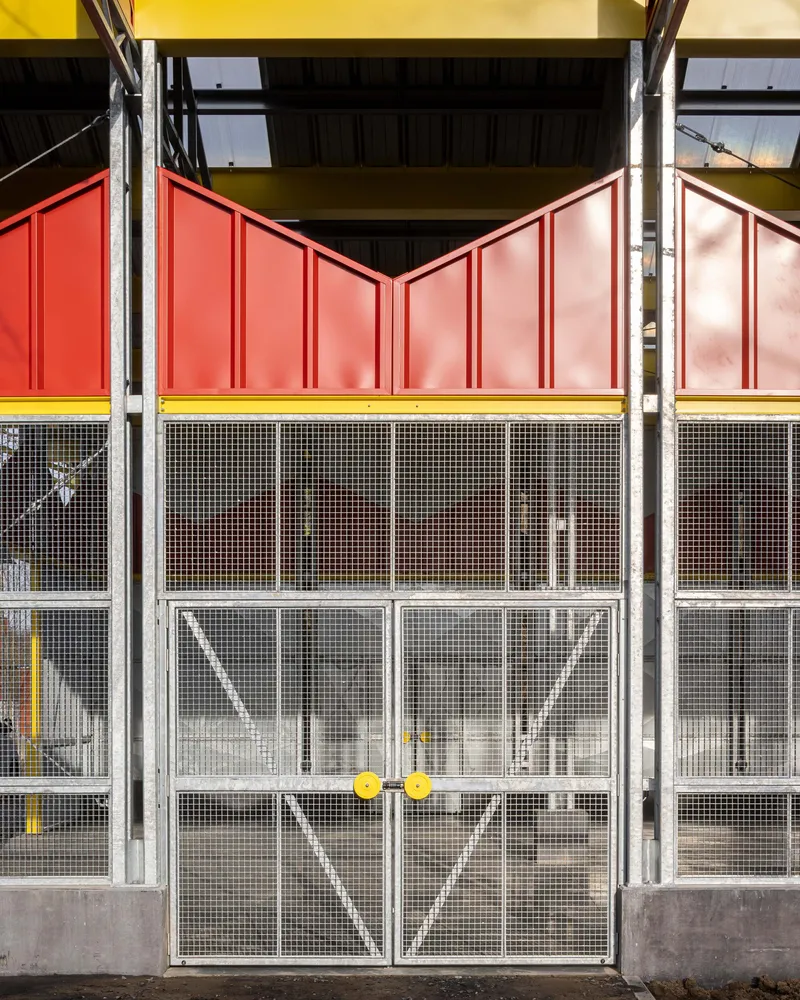
VAK treats the infill panels as a kit of parts rather than a uniform skin. Large gates, 4 meters wide by 3.3 meters tall, allow forklifts and heavy equipment through. Walking doors and escape doors are placed where circulation demands them. Between these openings, the architects alternate between closed corrugated panels, stretched metal screens, and chevron-patterned red and white infill that reads as frankly decorative in the best sense: it signals entry points and orientates users within the repetitive grid.
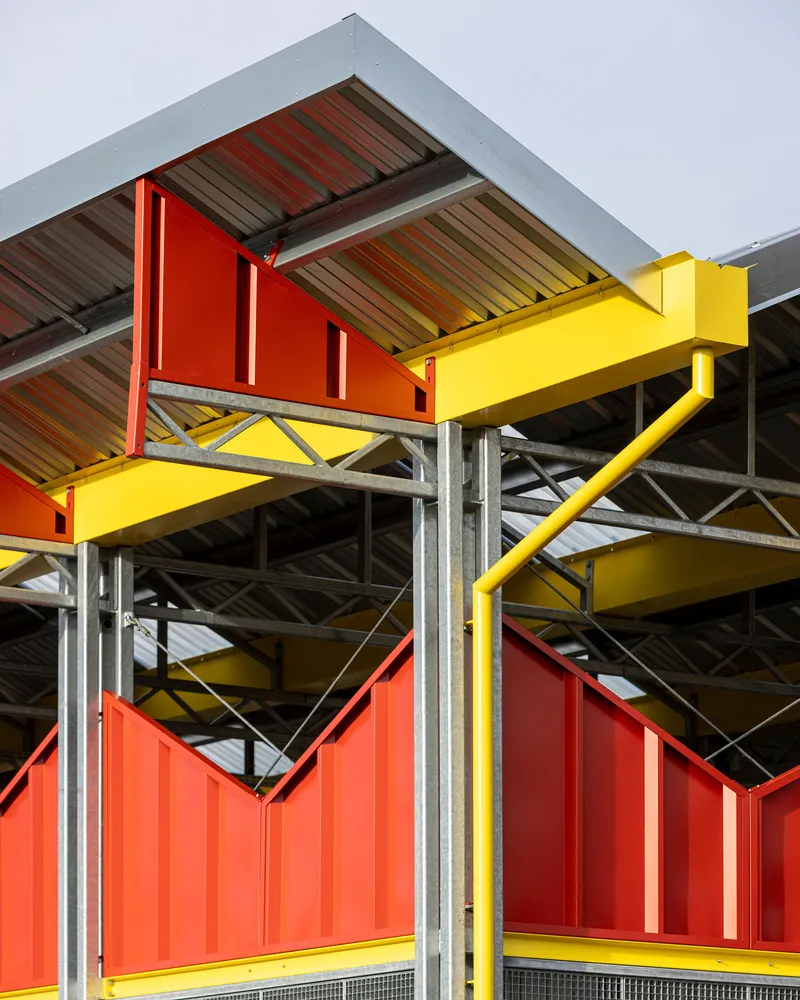
The gutters and downpipes are highlighted in a signal color, visually integrated into the shed's character rather than hidden. It is a small decision that communicates a design philosophy: nothing in this building pretends to be something it is not. Water management is part of the program, so its infrastructure gets to be visible.
Perimeter Condition


The hangar sits on a gravel forecourt with minimal landscaping, and the winter photographs by Tim Van de Velde capture the building in its most exposed state: bare trees, flat ground, grey sky. Under these conditions, the red and yellow palette punches through with the clarity of a railway signal. The building does not try to blend into its campus surroundings. It announces its presence as infrastructure, as a working tool.
The surrounding landscape strategy is intentionally minimal. Drainage pipes run underground to an infiltration ditch on the east side, and the flat red asphalt slab extends to the building perimeter without a conventional threshold. You walk in at grade. The absence of ceremony at the entrance reinforces the hangar's identity as a place of continuous use rather than occasional visit.
Interior as Open Field
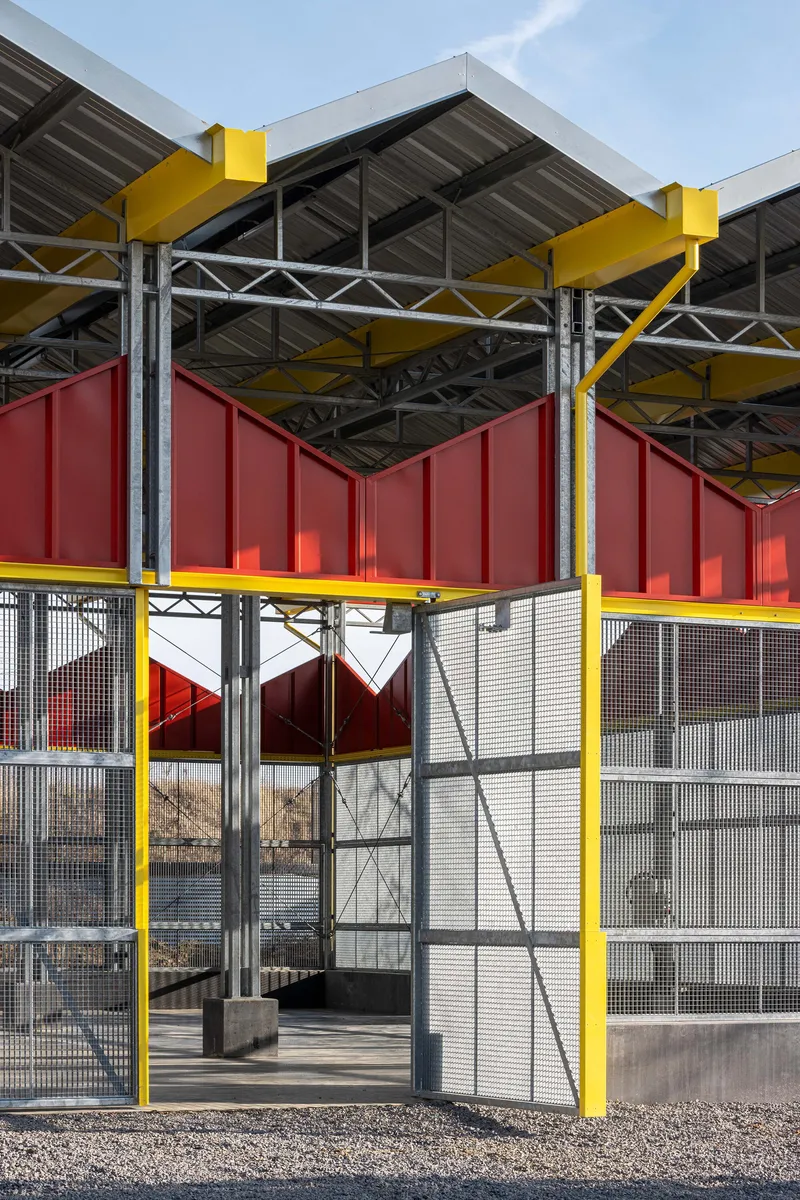

The interior is deliberately unpartitioned. The entire 450-square-meter floor plate is available as a single open field for arranging water basins, monitoring equipment, and test setups. The concrete pedestals punctuate the space at regular intervals but do not obstruct sightlines or movement. There are no fixed walls, no corridors, no offices. The researchers define the plan through the placement of their experiments.
This radical openness is the building's most consequential decision. By refusing to impose a layout, VAK gives the biology department a structure that can accommodate research programs that do not yet exist. The grid provides order; the emptiness provides freedom.
Plans and Drawings
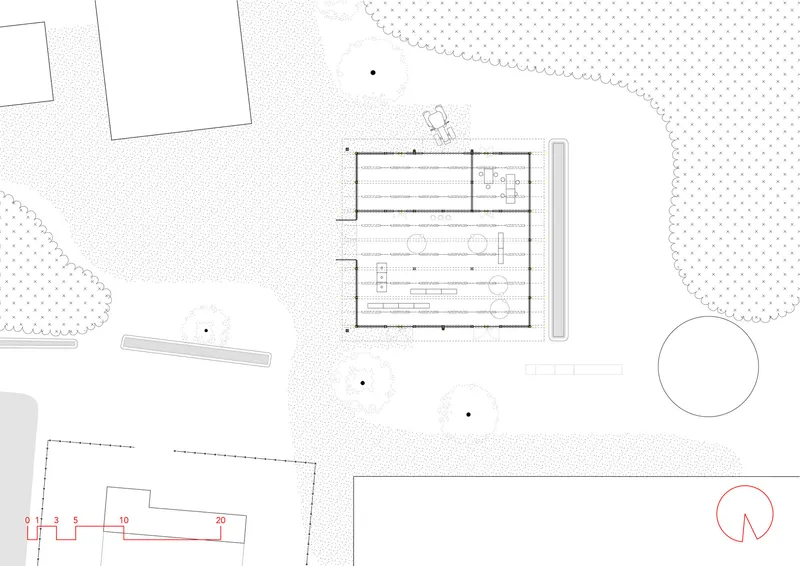


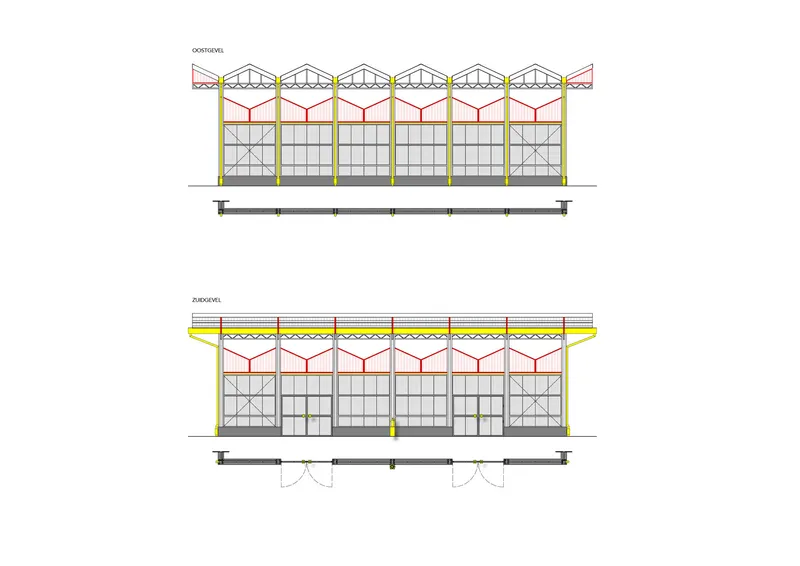
The site plan reveals the hangar's isolation on Campus Drie Eiken, set apart from the main academic buildings and positioned to allow service access on multiple sides. The floor plan confirms the open interior: the 3-meter grid is visible as a regular array of column points, with circulation and seating zones suggested but not walled. Elevation and section drawings make the sawtooth profile legible in technical terms, showing how the 25-degree pitch catches north light while the corrugated metal roof sheds rain toward the perimeter gutters. The layering of mesh, checker plate, and corrugated panel across the facade is drawn with the specificity of an industrial assembly manual.
Why This Project Matters
The Lab is a reminder that not every research building needs to look like a research building. The contemporary tendency toward sleek, sealed laboratories with controlled environments has its place, but aquatic biology demands something different: a semi-open structure that mediates between interior and exterior, captures and reuses rainwater, and tolerates the physical demands of heavy, wet equipment. VAK architecten found a typology, the industrial shed, that was already optimized for these conditions and refined it with precision rather than reinventing it.
What elevates the project beyond competent problem-solving is its willingness to let the pragmatic decisions become the architecture. The signal-colored downpipes, the checker plate plinth, the stretched metal screens: each of these elements exists because the program required it, and each contributes to a building with genuine visual identity. In a 450-square-meter hangar on the edge of a Belgian campus, VAK demonstrates that economy of means and architectural ambition are not opposites. They are, when handled well, the same thing.
The Lab, designed by VAK architecten, is located on Campus Drie Eiken, Antwerpen, Belgium. The research hangar has an area of 450 m² and was completed in 2026. Photography by Tim Van de Velde.
About the Studio
Share Your Own Work on uni.xyz
If projects like this are the kind of work you want to make, uni.xyz is a place to publish your own, find collaborators, and enter design competitions.


Popular Articles
Popular articles from the community

Tsunami Convergenics: Turning Catastrophic Ocean Forces into Underwater Housing Infrastructure
A speculative underwater settlement off the coast of Onagawa, Japan, treats tsunamis and typhoons as energy sources rather than threats.
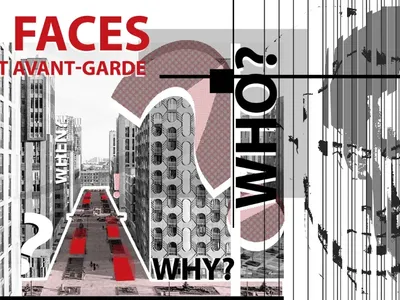
Faces of the Soviet Avant-Garde: Turning Moscow's Street Names into an Open-Air Museum
A network of sculptural installations across a Moscow residential district transforms forgotten architect names into spatial encounters with cultural memor
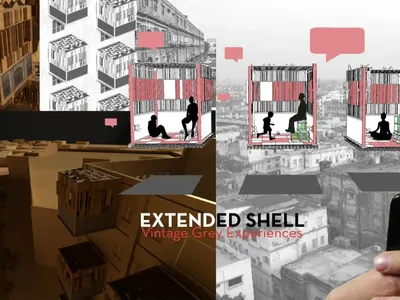
Extended Shell: Retrofitting Kolkata's Balconies as Living Urban Thresholds
A modular retrofit system recovers the social and environmental intelligence of Kolkata's historic verandas for contemporary Park Street residents.
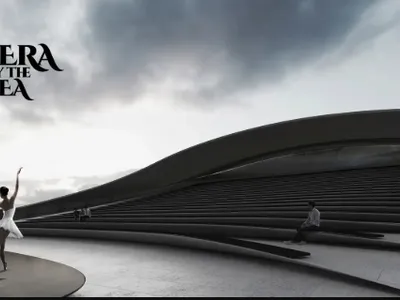
Opera by the Sea Estonia: Three Shells Dissolving Architecture into Tallinn's Coastline
A winning opera house proposal replaces monumental form with interconnected shells that blur the boundary between building, park and Baltic Sea.

Similar Reads
You might also enjoy these articles

Bao Huynh Watercolor Atelier: A Serene Art Retreat in Hội An
Bao Huynh Watercolor Atelier in Hội An blends multifunctional art spaces, sustainable design, local materials, and family-friendly living in a serene environment.

Atelier Macri Concept Store Interior Design by CASE-REAL
Atelier Macri store features a "ko" counter, walnut wood details, cork displays, blending retail, gallery, and seamless customer experiences.

Manuel Vargas Izquierdo Stadium and High-Performance Sports Center: Architectural Excellence in Jalpa de Méndez
The Manuel Vargas Izquierdo Stadium blends sustainable design, inclusive sports facilities, and cultural-inspired architecture, revitalizing Jalpa de Méndez’s public spaces.

KAKR Buluh Awar Hall: Revitalizing Community and Ecology Through Bamboo Architecture
Community built bamboo hall revitalizes Buluh Awar village, empowering youth, restoring ecology, celebrating vernacular craftsmanship through sustainable architecture and culture.


Comments (0)
Please login or sign up to add comments
No comments yet. Be the first to comment!