

Verstas Architects Folds a Timber Daycare Center into Helsinki's Rocky Terrain
In the new Postipuisto district, a paper-fold roof and preserved rock outcrop turn a former logistics site into a child-scaled landscape.


Helsinki's Postipuisto district is one of those post-industrial rewrites that cities love to announce but rarely get right at the neighborhood scale. A former logistics terminal and railway depot has been carved into residential blocks, and with them comes the usual civic infrastructure: a daycare center, dropped at the intersection of Kollikatu and Lavakatu streets, where the new urban grid collides with a stubborn piece of natural bedrock called Kollikallio. Verstas Architects, led by principal Ilkka Salminen, chose not to flatten or ignore that collision. They designed around it.
What makes Postiljooni Daycare Center genuinely interesting is how it uses section to reconcile the ambitions of a dense residential neighborhood with the intimate world of a three-year-old. The building's paper-fold roof, timber-clad upper volume, and generous canopies compress the courtyard into something that feels enclosed without feeling walled off. Meanwhile, the rocky outcrop, the highest natural feature on the site, becomes the playground's centerpiece rather than a grading problem. At 1500 square meters, it is a small building doing heavy topographic and urban work.
An Urban Corner, Not an Object Building
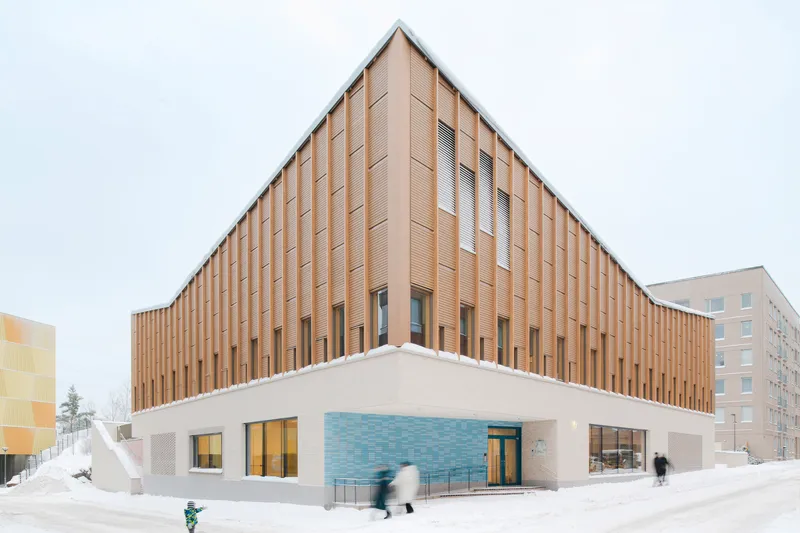
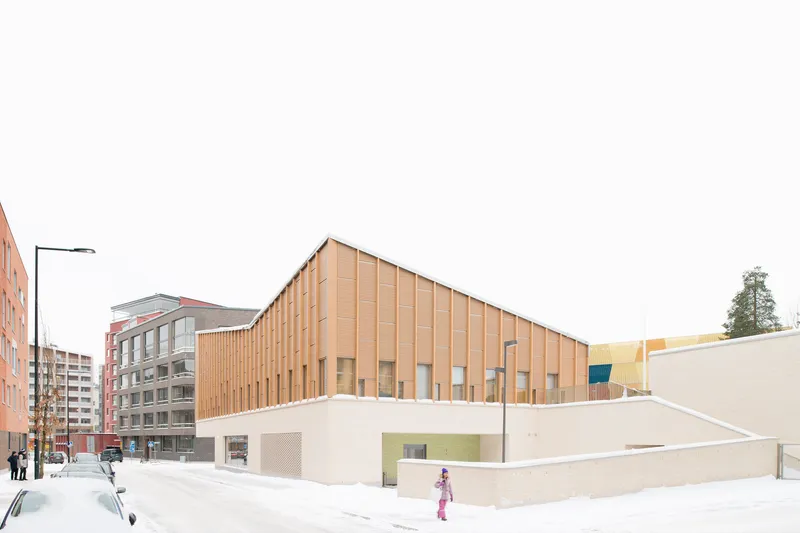
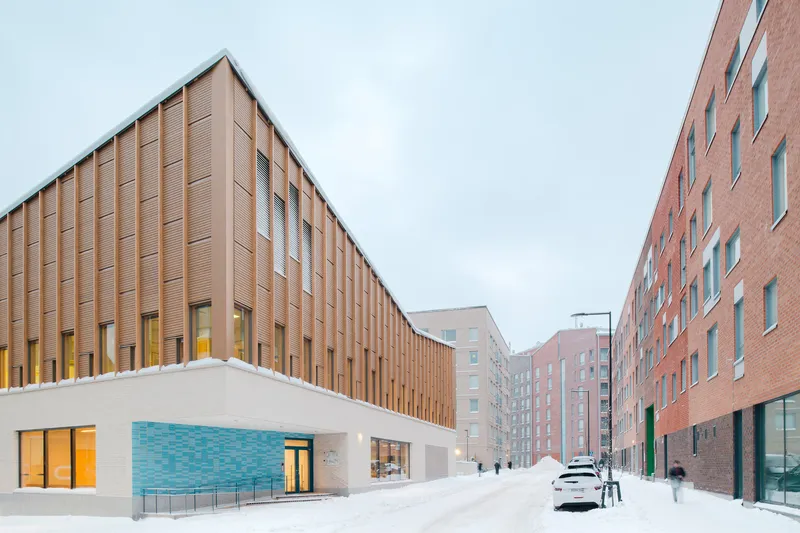
The building occupies a prominent corner, and Verstas treats it accordingly. The ground floor is white brick and concrete, establishing a firm datum that aligns with the street edge and reads as part of the surrounding residential fabric. Above that, the vertical timber cladding lifts off like a separate register, warmer and more tactile, signaling that something different is happening inside. The turquoise-tiled entry wall punches through this duality with a deliberate flash of color, marking the main entrance with an overhanging canopy that creates a sheltered threshold without any fuss.
Critically, the building does not try to be a sculptural icon dropped into a housing estate. Its massing follows the street lines, deferring to the block structure while still asserting presence at the intersection. The angled plan is a direct response to the site geometry, not an arbitrary formal gesture.
Timber Cladding as a Double Register
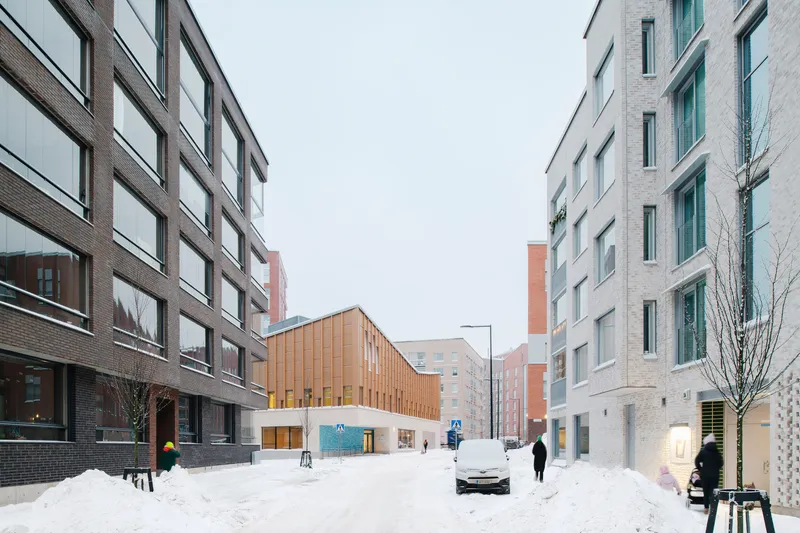
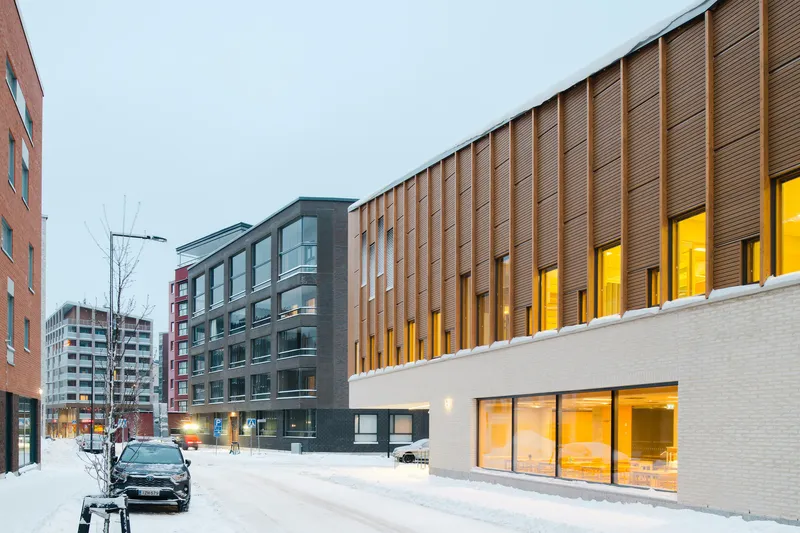
Seen from down the street, especially in snowfall, the ribbed timber volume reads as a single warm mass floating above a pale base. The vertical slats create a rhythm that shifts as you move: tighter when seen head-on, opening up at oblique angles to reveal the glazing behind. It is a simple device, but it does two things well. First, it gives the children's spaces on the upper floor a degree of visual privacy from the surrounding apartment buildings. Second, it establishes a material identity that distinguishes the daycare from its brick and plaster neighbors without competing with them.
The choice of wood for the upper volume, housing the children's rooms, while reserving masonry for the ground floor is not just aesthetic. It signals a hierarchy of use. The ground level handles arrival, circulation, and the institutional interface with the street. The upper level belongs to the children, and it feels like it.
The Courtyard as Protected World
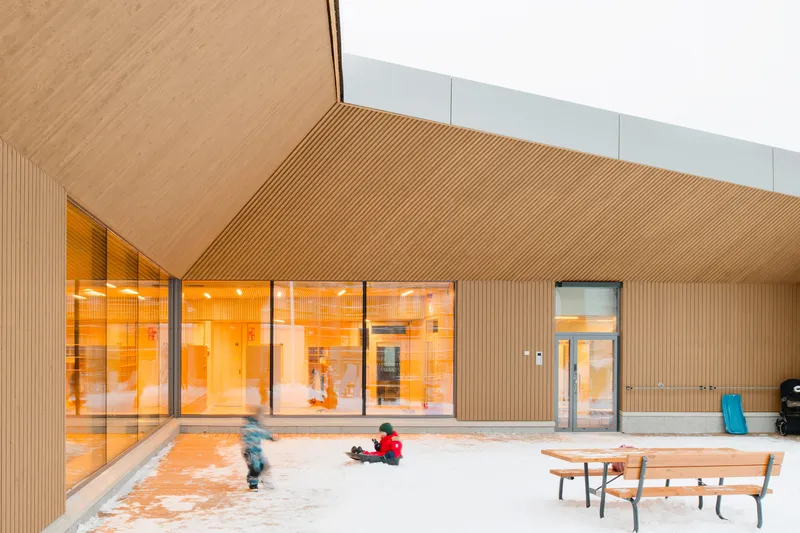
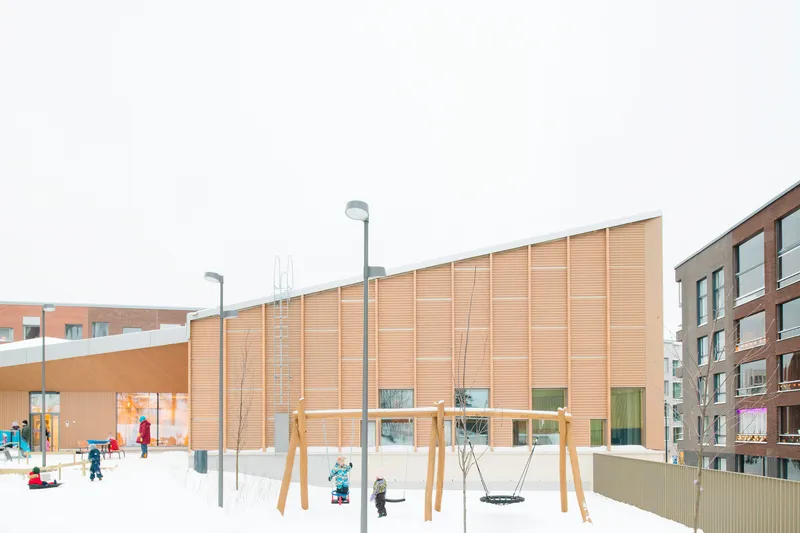
The courtyard is where the building's section strategy pays off. Deep timber soffits extend from the upper volume to create covered zones along the edges of the outdoor space, so children can play outside even in Helsinki's long winters. In the image taken at twilight, with kids running through the snow beneath ribbed wood overhangs and backlit orange glass, the space has the quality of a lantern: warm, contained, visible from inside but sheltered from the wider city.
The preserved rock outcrop, Kollikallio, rises within or adjacent to this courtyard zone, turning geological accident into a climbing surface and orientation point. Rather than importing playground equipment to simulate nature, the architects let the actual terrain do the work. It is a small decision with large pedagogical implications: the landscape is not decoration, it is the primary play infrastructure.
Interior Warmth Without Sentimentality
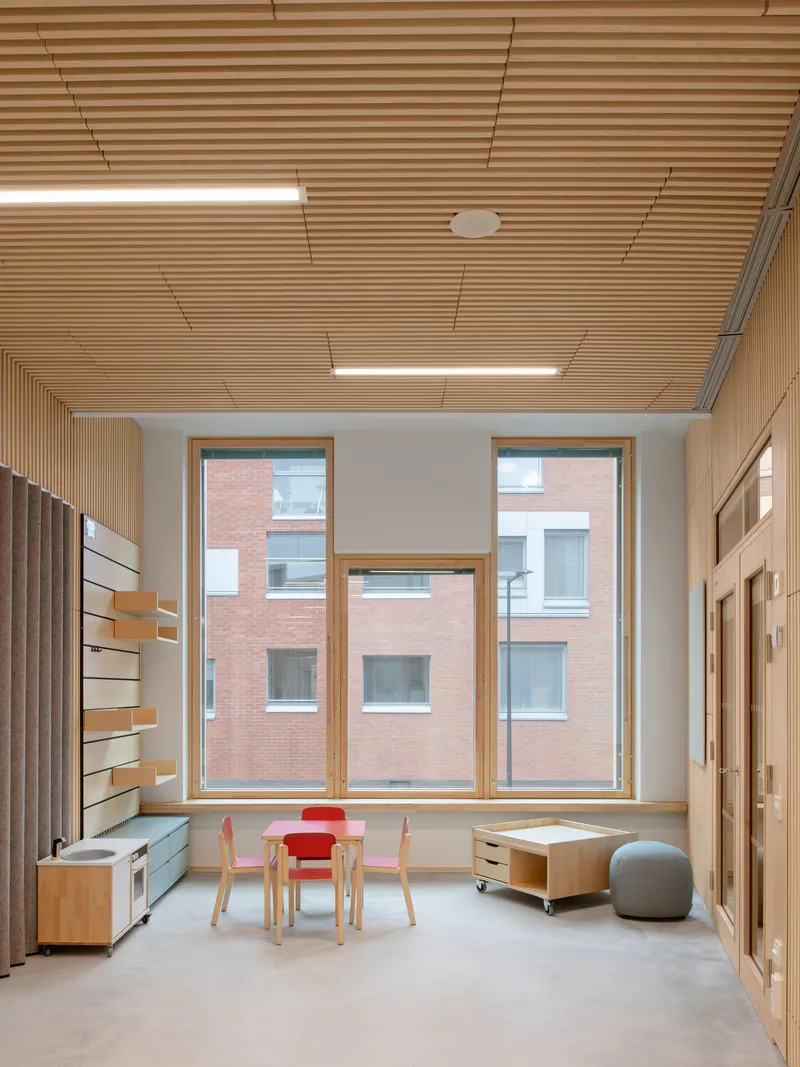
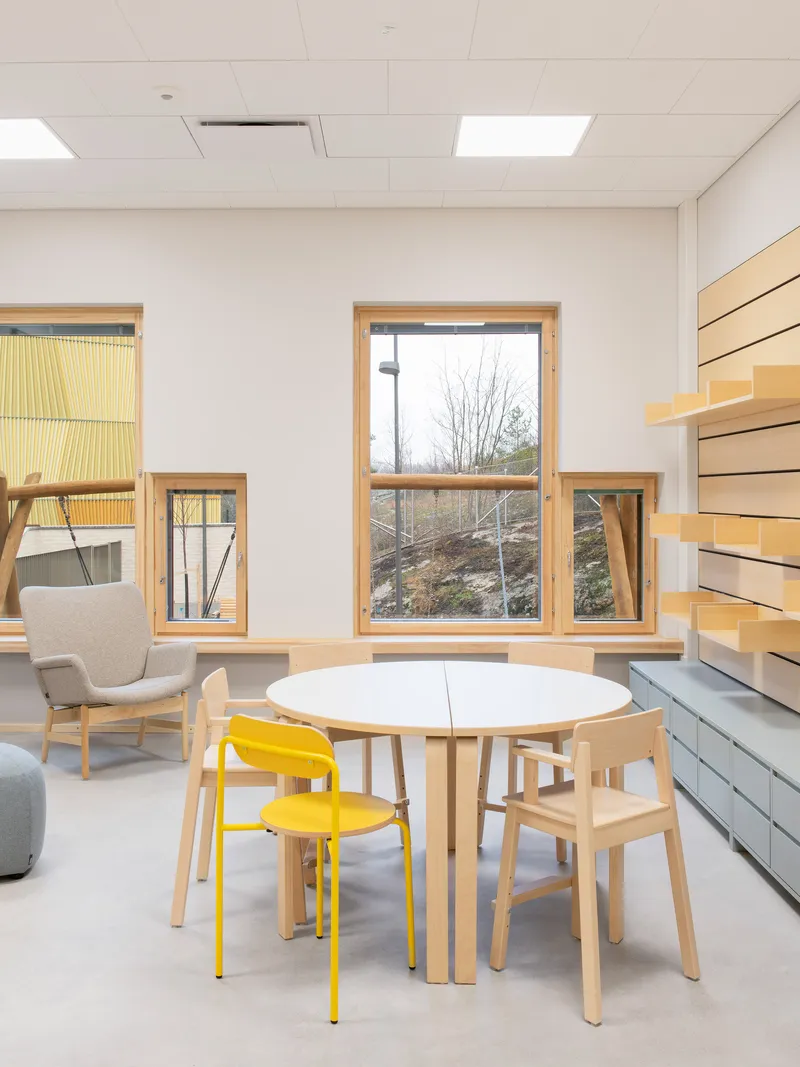
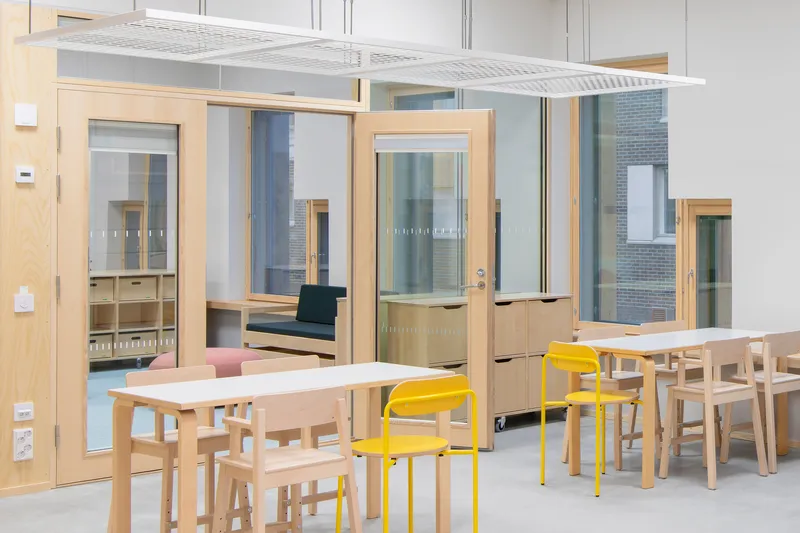
Inside, the material palette narrows to light wood, white surfaces, and carefully placed color accents. The slatted timber ceilings in the children's rooms manage acoustics while maintaining the visual continuity of the wood theme. Floor-to-ceiling windows face the rock surface and surrounding trees, pulling the landscape directly into the rooms. Furniture is scaled appropriately: round white tables, low timber benches, yellow metal chairs that read as cheerful without being patronizing.
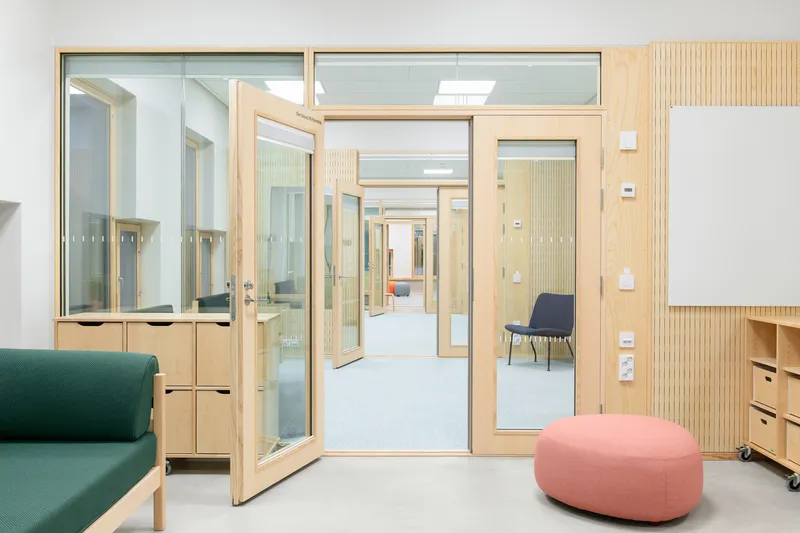
The glazed partitions between rooms allow visual connection while providing acoustic separation, a practical detail that lets staff monitor multiple groups simultaneously. Natural light enters from multiple directions, and the recessed linear lighting supplements without dominating. There is no whimsy here, no cartoon colors or decorative motifs. The architecture itself provides the sensory richness.
Circulation as Spatial Event
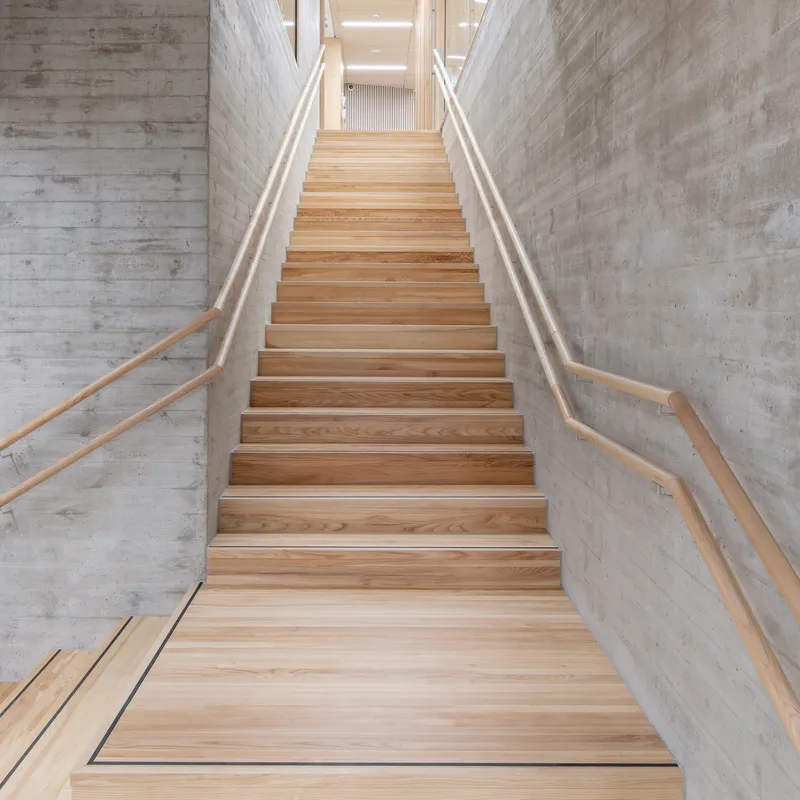
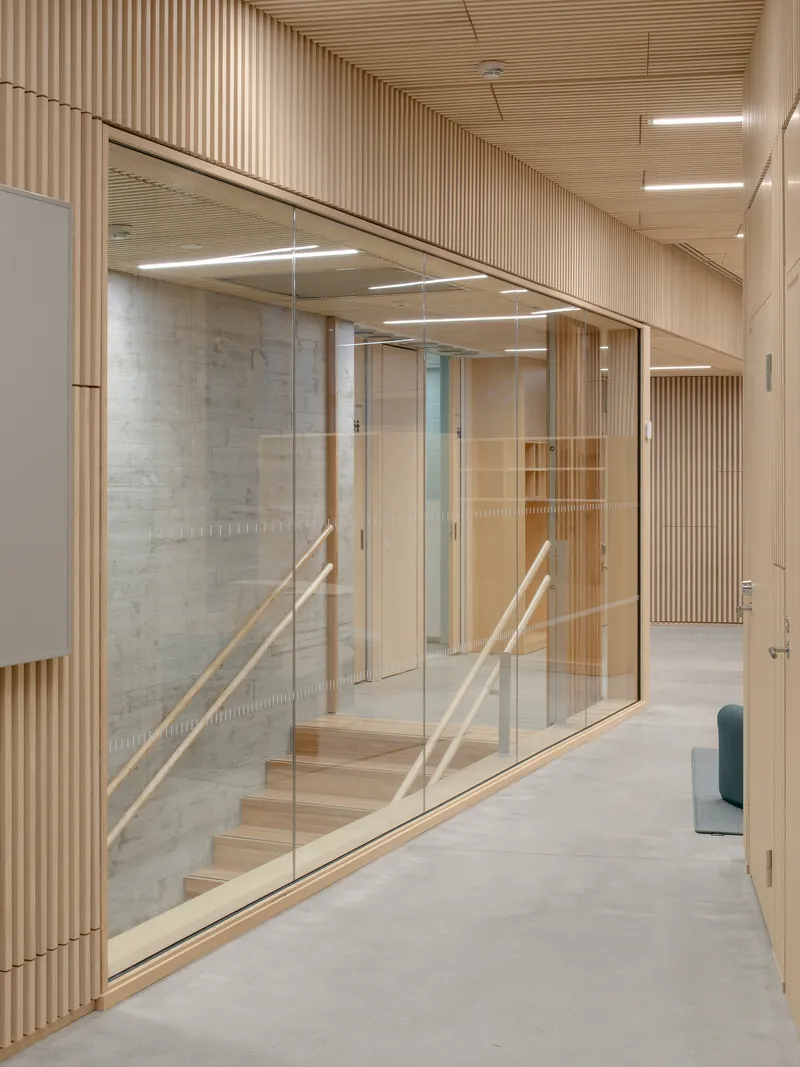
The timber staircase between levels is set between board-formed concrete walls, a deliberate material shift that marks the transition from the institutional ground floor to the domestic upper level. Natural light enters from above, washing the textured concrete and warm wood handrails with diffused brightness. It is a compact stairwell, but it feels generous because of the light strategy.
The corridors on the upper floor use slatted wood screens and timber-framed glass doors to maintain transparency between spaces. You can see through the building in several directions, which gives even a 1500-square-meter plan a sense of spatial depth. For children who spend full days here, that permeability matters: it reduces the feeling of being enclosed in discrete rooms and creates a sense of belonging to a larger, connected environment.
Between Blocks: The Urban Passage
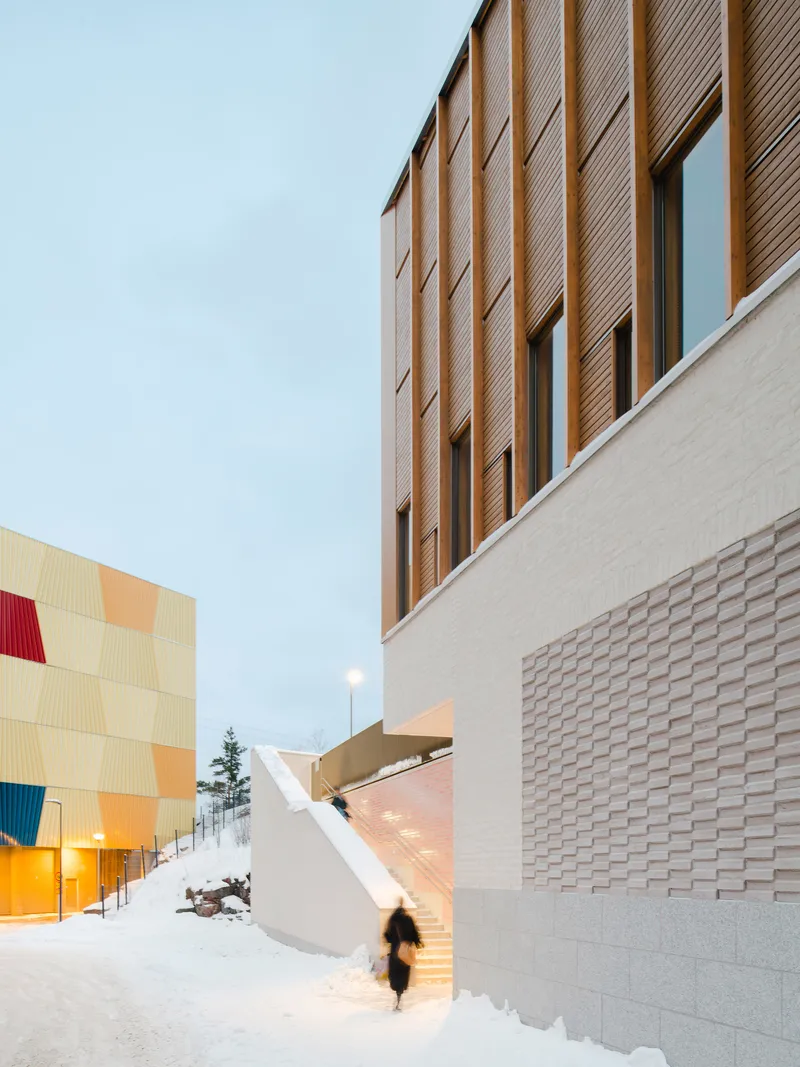
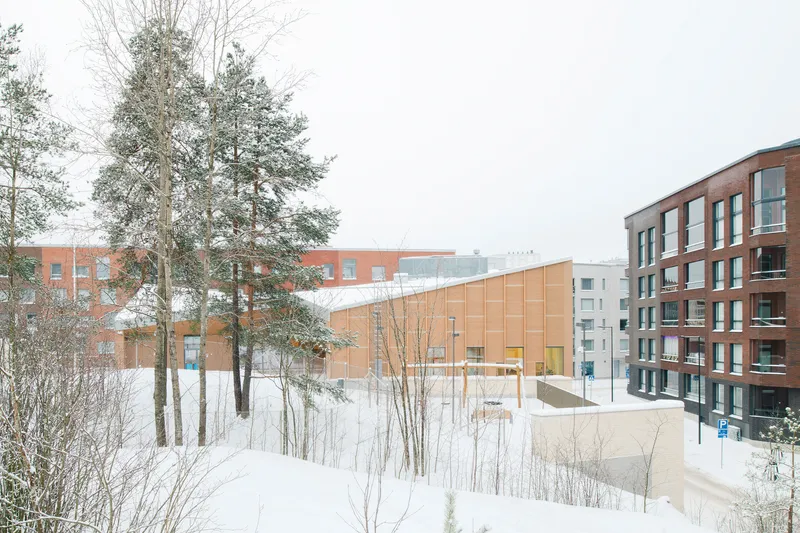
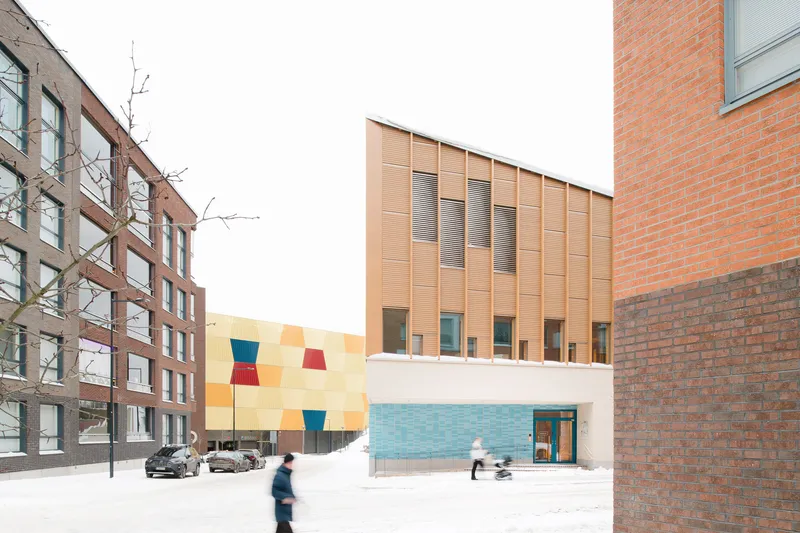
The gap between the daycare and its neighboring buildings creates a passage that is both functional and atmospheric. The textured brick base on one side and the vertical timber cladding on the other frame a narrow winter corridor that connects the street to the courtyard zone. At twilight, this passage glows with reflected light from the snow and the building's interior, becoming an almost cinematic threshold between the public city and the private world of the school.
Wider views across the site reveal how the building negotiates between the flat, gridded residential blocks and the rocky, pine-covered terrain beyond. The angled volume pivots between these two conditions, simultaneously belonging to the street and acknowledging the landscape. It is a site-specific move that would not work anywhere else.
Flexible Rooms for Changing Programs
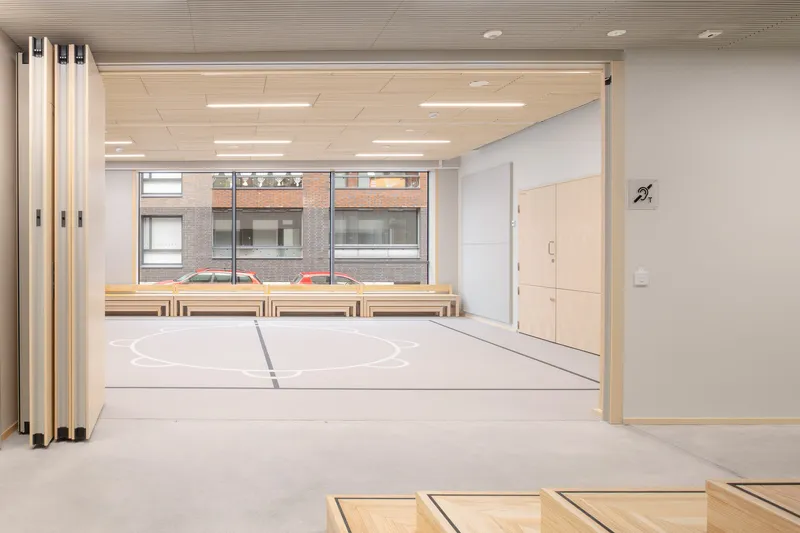
The multipurpose room on the ground floor demonstrates Verstas's pragmatic streak. Folding partitions, built-in timber benches along the perimeter, and acoustic ceiling panels create a space that can shift from group assembly to quiet activity to parent meeting without any furniture shuffling. The fluorescent lighting is honest, perhaps even austere, but the acoustic treatment keeps the room from becoming a noise box during high-energy sessions.
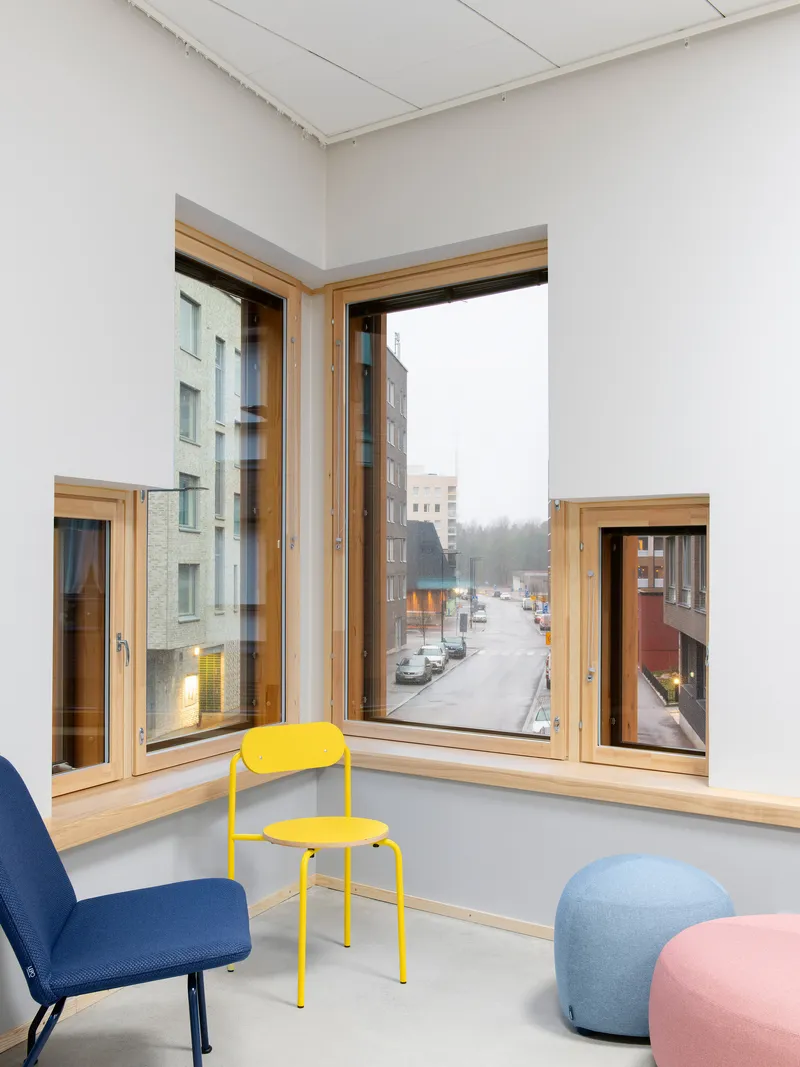
Upstairs, corner window seats offer children places to sit and watch the street below, a small gesture that connects the interior life of the school to the rhythms of the neighborhood. These moments of pause, designed into the architecture rather than added through furniture, suggest an understanding of how young children actually use space: in bursts, in retreats, and in observation.
Plans and Drawings
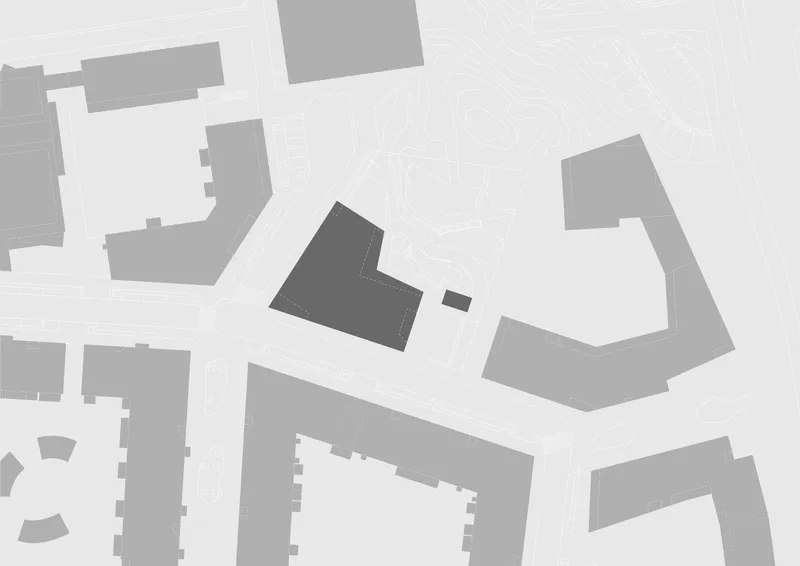
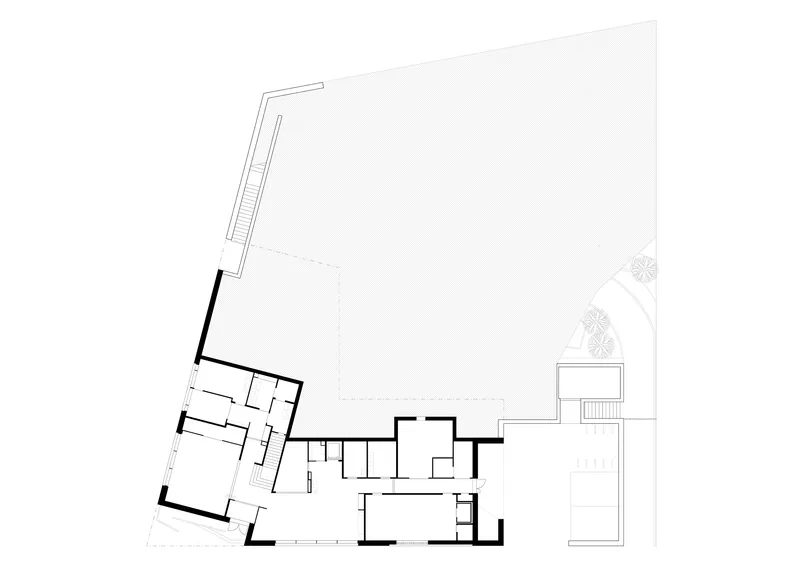
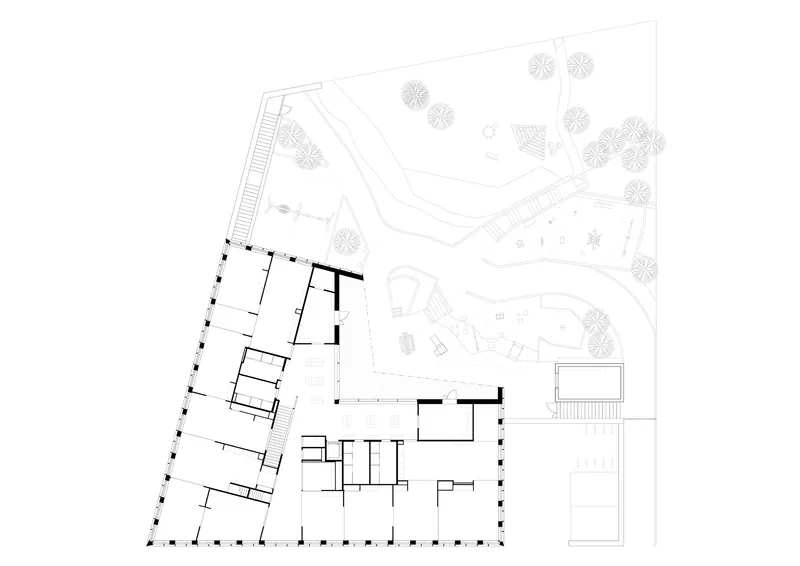
The site plan reveals the angled footprint in relation to the surrounding urban blocks, confirming that the building's geometry is driven by the intersection of two street lines rather than arbitrary formal experimentation. The ground floor plan shows a large open courtyard carved out of the building mass, with angled interior rooms wrapping around it. The upper floor plan places children's spaces adjacent to a landscaped terrace planted with trees, extending the outdoor play environment to the second level.
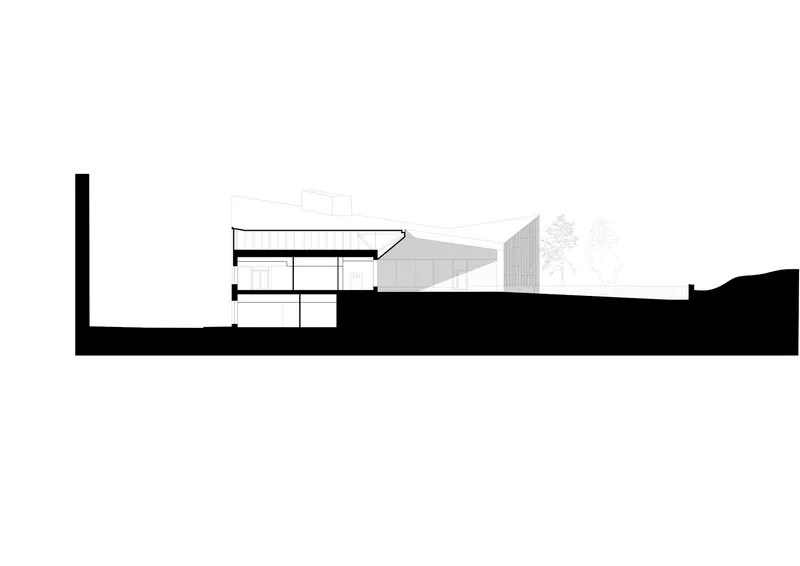
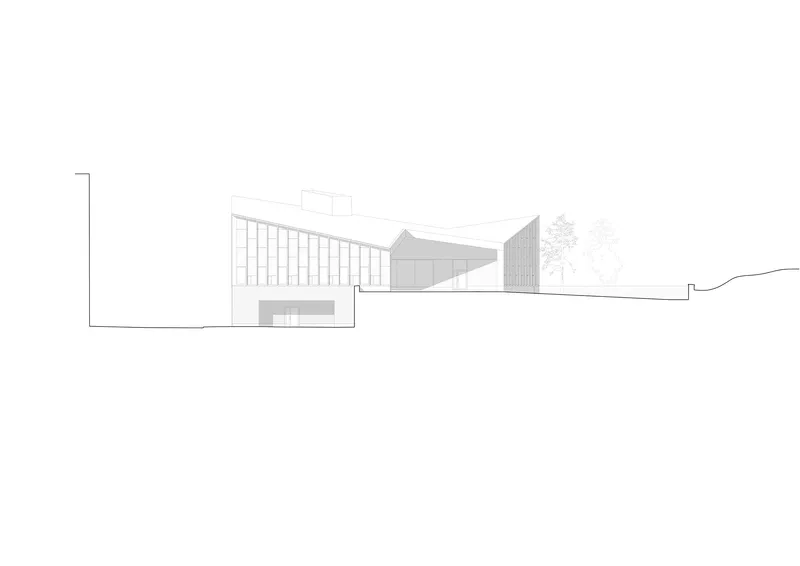
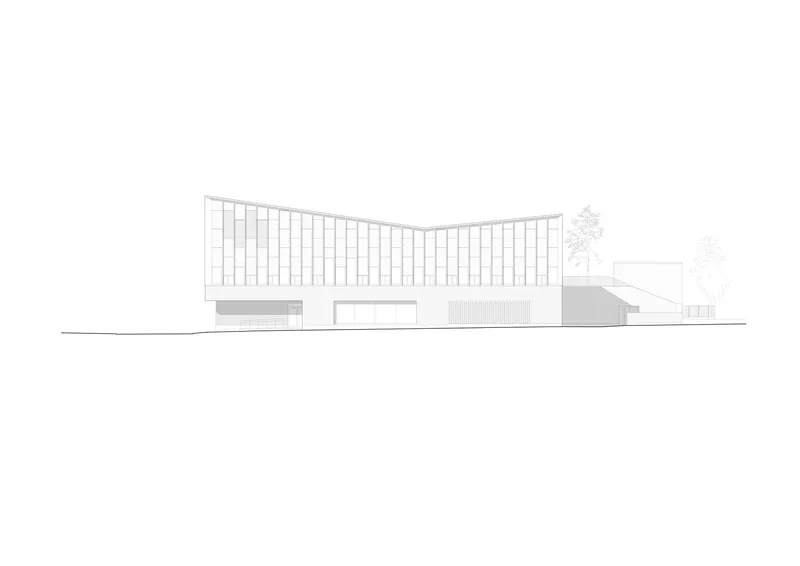
The section drawing is the most revealing. It shows tiered interior levels embedded into the sloping terrain, with the rock surface and trees rising above the building at the rear. The relationship between the roof profile and the ground topography becomes legible here: the paper-fold roof dips and rises to accommodate both the intimate courtyard scale and the taller street-facing facade. The elevations confirm the dual-register strategy, with glazed vertical bays above a recessed ground floor opening, and lower volumes stepping down to meet the terrain.
Why This Project Matters
Daycare centers are among the most underestimated building types in contemporary practice. They are small, budget-constrained, and rarely attract the kind of critical attention given to museums or housing. Yet they shape the spatial awareness of people at the most formative stage of their lives. Postiljooni succeeds because it takes the type seriously without inflating it. There are no grand gestures, no signature curves, no attempt to make a 1500-square-meter building punch above its weight. Instead, there is a precise reading of a difficult site, a coherent material strategy, and a clear hierarchy of spaces from public to intimate.
The decision to preserve Kollikallio and build around it is the project's strongest move, both practically and symbolically. In a district defined by the erasure of its industrial past, the daycare insists that some things should remain. The rock was here before the railway depot, before the logistics terminal, and now before the apartment blocks. Letting children climb it every day is a quiet argument for a kind of architecture that adapts to what it finds rather than clearing the ground and starting over. Verstas has delivered a building that is modest in scale, rigorous in its details, and genuinely responsive to its place.
Postiljooni Daycare Center by Verstas Architects (principal Ilkka Salminen). Helsinki, Finland. 1500 m². Completed 2025. Photography by Niclas Mäkelä.
About the Studio
Share Your Own Work on uni.xyz
If projects like this are the kind of work you want to make, uni.xyz is a place to publish your own, find collaborators, and enter design competitions.


Popular Articles
Popular articles from the community

Extended Shell: Retrofitting Kolkata's Balconies as Living Urban Thresholds
A modular retrofit system recovers the social and environmental intelligence of Kolkata's historic verandas for contemporary Park Street residents.

Opera on the Sea: Driftwood Logic Shapes a Timber Opera House on Estonia's Coast
Trevor Orgill's opera house translates the entangled drift of floating timber into a civic building where wood, water, and music converge.

Tsunami Convergenics: Turning Catastrophic Ocean Forces into Underwater Housing Infrastructure
A speculative underwater settlement off the coast of Onagawa, Japan, treats tsunamis and typhoons as energy sources rather than threats.

Temporary Home for Dogs: A Reversed Zoo Rethinks Animal Shelter Architecture
In Bucharest, a sinuous corridor and freed landscape flip the logic of containment, designing a shelter that works to make itself unnecessary.

Similar Reads
You might also enjoy these articles

Bao Huynh Watercolor Atelier: A Serene Art Retreat in Hội An
Bao Huynh Watercolor Atelier in Hội An blends multifunctional art spaces, sustainable design, local materials, and family-friendly living in a serene environment.

Atelier Macri Concept Store Interior Design by CASE-REAL
Atelier Macri store features a "ko" counter, walnut wood details, cork displays, blending retail, gallery, and seamless customer experiences.

Manuel Vargas Izquierdo Stadium and High-Performance Sports Center: Architectural Excellence in Jalpa de Méndez
The Manuel Vargas Izquierdo Stadium blends sustainable design, inclusive sports facilities, and cultural-inspired architecture, revitalizing Jalpa de Méndez’s public spaces.
KAKR Buluh Awar Hall: Revitalizing Community and Ecology Through Bamboo Architecture
Community built bamboo hall revitalizes Buluh Awar village, empowering youth, restoring ecology, celebrating vernacular craftsmanship through sustainable architecture and culture.

Comments (0)
Please login or sign up to add comments
No comments yet. Be the first to comment!