
VIASCAPE Design Builds a 70 m² Community Pavilion for 480 Families in a Dense Shanghai Village
A sculpted concrete micro-building gives XiangDong village its first dedicated public interior along the Huangpu River.


In XiangDong village, a dense Huangpu riverside settlement where 480 families each occupy roughly 10 square meters of floor space, the idea of a community room is less amenity than necessity. VIASCAPE design, led by architect Yijia Sun, answered that need with a 70 m² pavilion slipped into the narrow gaps between grungy apartment blocks and warehouse roofs. The building is small. Its ambition is not.
What makes The Pavilion worth studying is the method behind it as much as the object itself. VIASCAPE started not with a sketch but with questionnaires and interviews, mapping who lives here, what they lack, and how they already use the streets and alleys that function as their only shared space. The resulting architecture is a response calibrated to a very specific population, not a generic insertion of civic form into an underserved neighborhood. It folds glass, steel, concrete, and timber screens into a compact volume that manages to feel generous despite its footprint.
A White Fold in a Gray Neighborhood


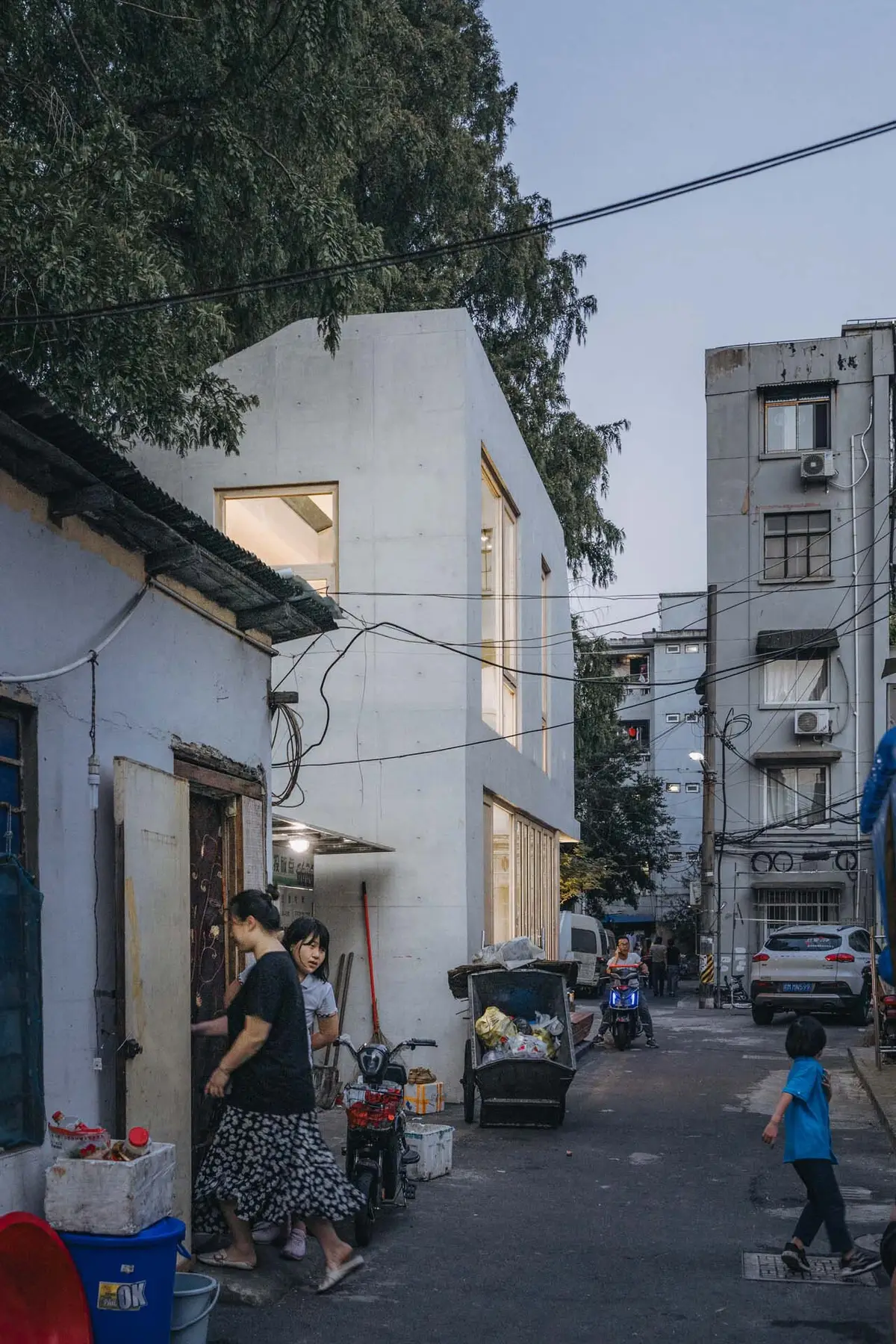
The pavilion reads as a series of folded concrete planes, white and angular against the muted tones of the surrounding single-storey buildings. There is no front facade in the conventional sense. Each elevation turns a corner or opens a slit, refusing the flatness that a 70 m² box might otherwise impose. Vertical slit windows puncture the concrete at strategic points, pulling daylight into narrow interiors while maintaining a degree of privacy from the alley traffic just outside.
The whiteness is deliberate and, frankly, risky in a neighborhood where grime accumulates quickly. But it performs an urban role: it signals that something different is happening here, that this slot between buildings is no longer residual space. The curved wall visible at the corner softens what could be an aggressive insertion, while the folded planes above create a skyline event at a scale the village has never had.
Timber Screens and the Threshold Condition
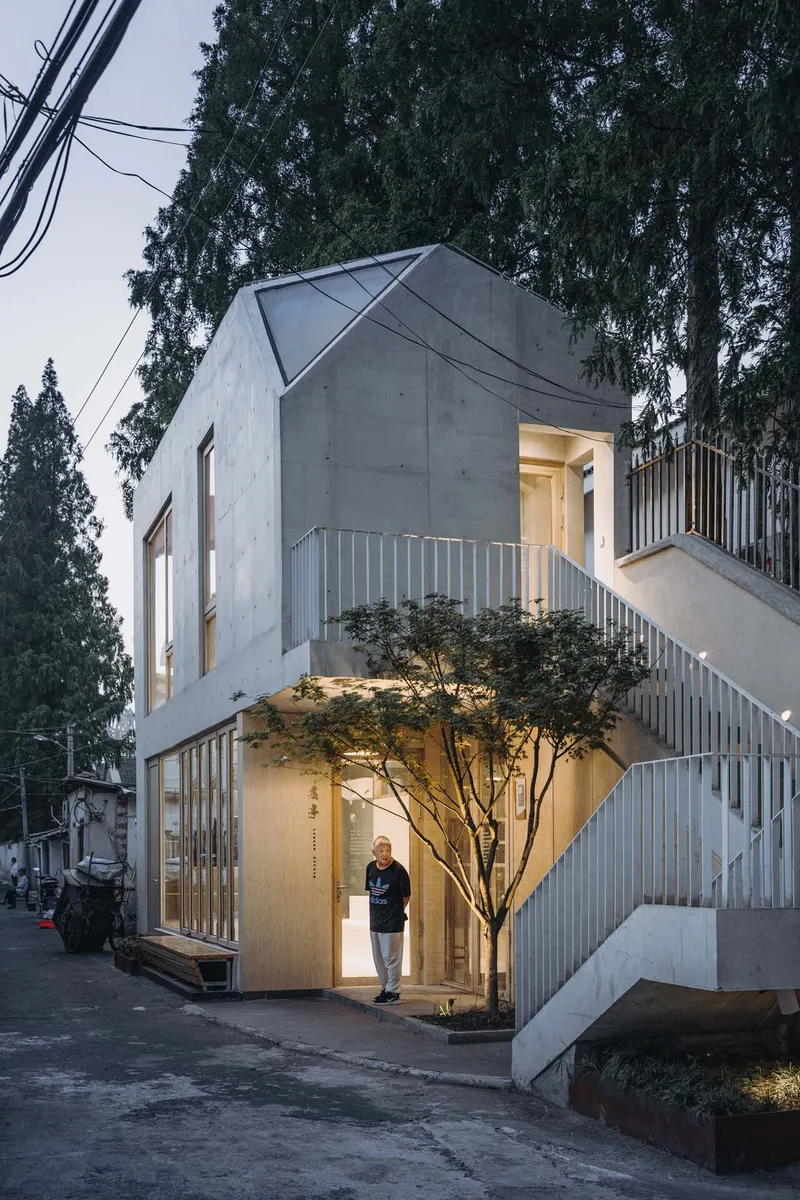

Timber-slatted screens wrap portions of the ground level, mediating between the hard concrete shell and the life of the alley. In a neighborhood where the street is the living room, this threshold matters enormously. Residents lean against the entrance, bicycles roll past, and the timber framing reads less as a decorative gesture than as an invitation: the building breathes where its neighbors do not.
The entrance itself sits at the corner, angled to catch foot traffic from two directions. At twilight the screens glow from within, turning the pavilion into a lantern visible from the narrow lanes that thread through XiangDong. It is a piece of wayfinding as much as architecture, giving the village a legible center where none previously existed.
Reading the Site from Above
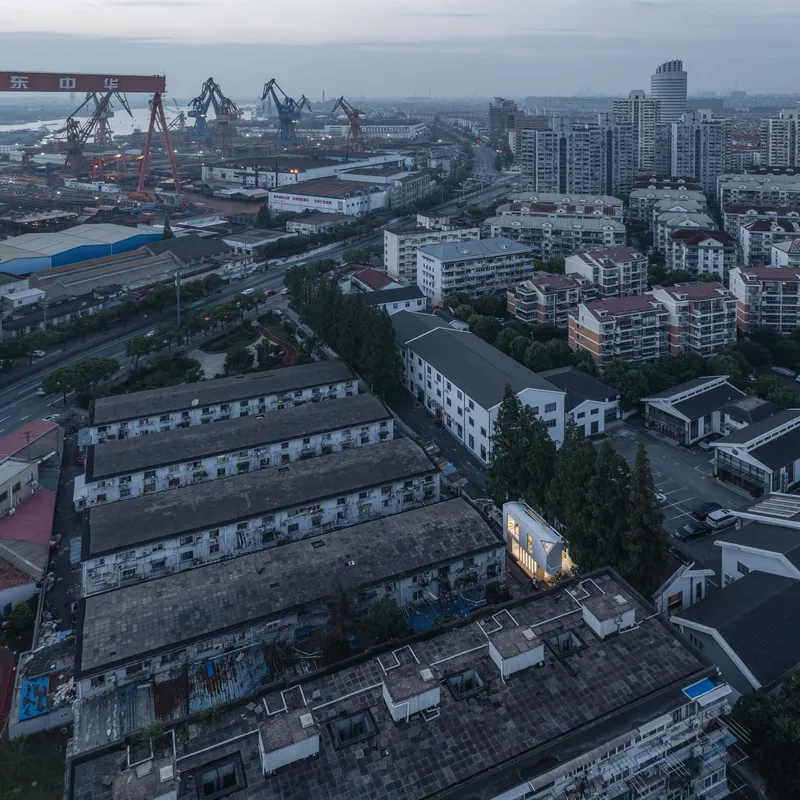
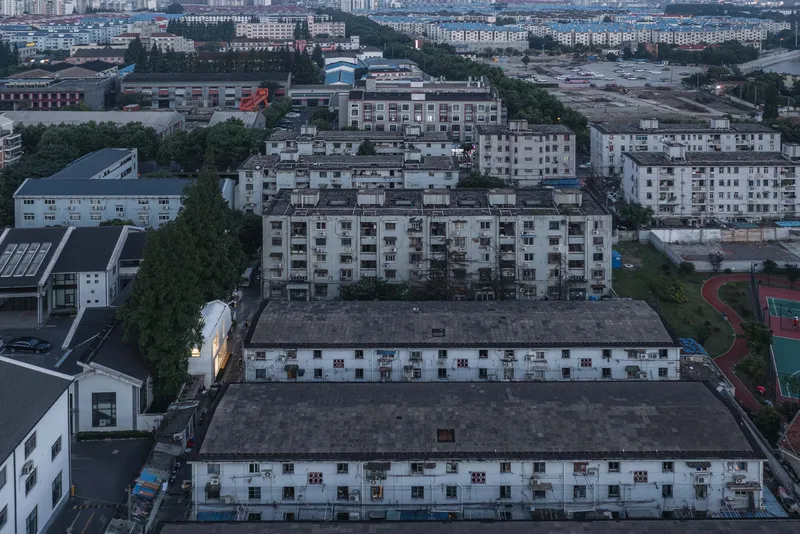
The aerial views reveal what ground-level photography cannot: just how compressed the urban fabric is. The pavilion sits between residential blocks, a sports court, and a row of warehouse structures whose rooftops stretch toward shipyard cranes on the Huangpu. The building occupies what looks like a leftover parcel, the kind of gap that in most Chinese urban villages gets filled with informal storage or simply ignored.
Seen from a drone at dusk, the illuminated pavilion registers as the only point of architectural intention in a field of accidental adjacencies. Its compact footprint is honest about the constraints; there was no room for a plaza, no space for setbacks. The architecture had to work at the exact scale of the gap it fills.
Interior as Public Room


Inside, the pavilion flips the proportional logic of its surroundings. Where residents live in 10 m² rooms, this 70 m² space offers a communal volume with exposed concrete ceilings, track lighting, and white grid shelving that suggests a library, a meeting room, and a gallery simultaneously. The timber-framed glazing wraps the interior in filtered daylight, and the spatial sequence from entrance to upper levels keeps the eye moving through what is, in plan, a very tight footprint.
There is a pragmatism to the material palette: concrete, steel, glass, timber. Nothing exotic, nothing that requires specialized maintenance. The lighting consultant, OUI light, clearly understood that in a space this small, luminaire placement is spatial design. Track lights on the exposed ceiling keep the floor free, while the tall windows ensure the building never feels sealed off from its context.
Designing from Data, Not from Assumption
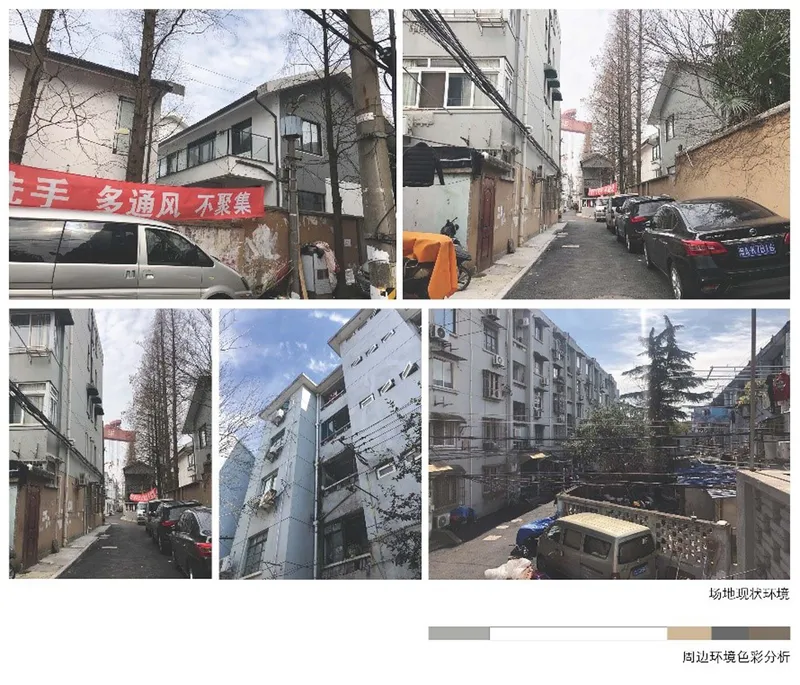
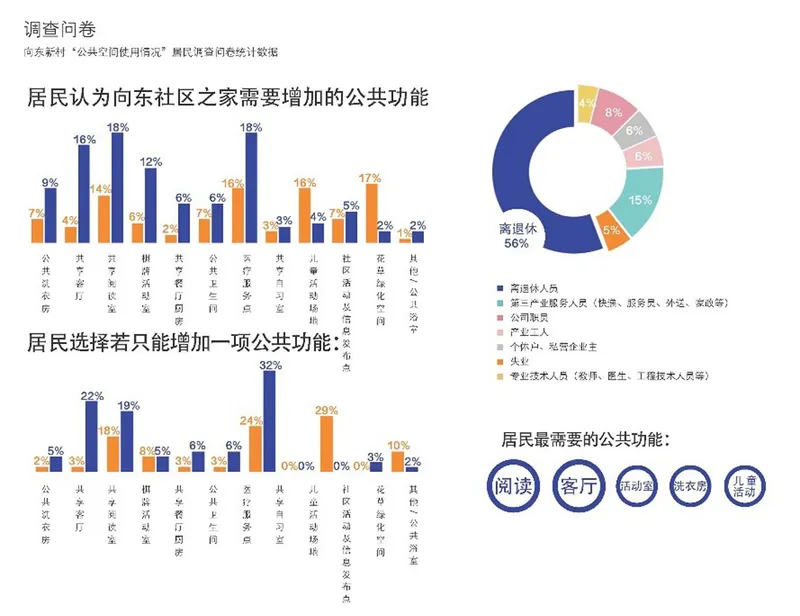
The most revealing images in the project documentation are not photographs at all. The site collage shows the existing alley context: low-rise buildings, informal commerce, walls in various states of repair. Next to it, a set of survey infographics lays out bar charts and pie charts of community needs and demographic breakdowns. VIASCAPE treated this data not as a footnote but as a design driver, and the pavilion's program responds directly to the gaps the surveys identified.
Concept consultant Almostectonic Design and material consultant Igreen buy platform contributed to a process that was collaborative by necessity. When you are designing for 480 families who have never had a shared indoor space, getting the program wrong is not an aesthetic failure; it is a social one. The questionnaire-first approach deserves more attention from architects working in similar contexts across China and beyond.
Plans and Drawings
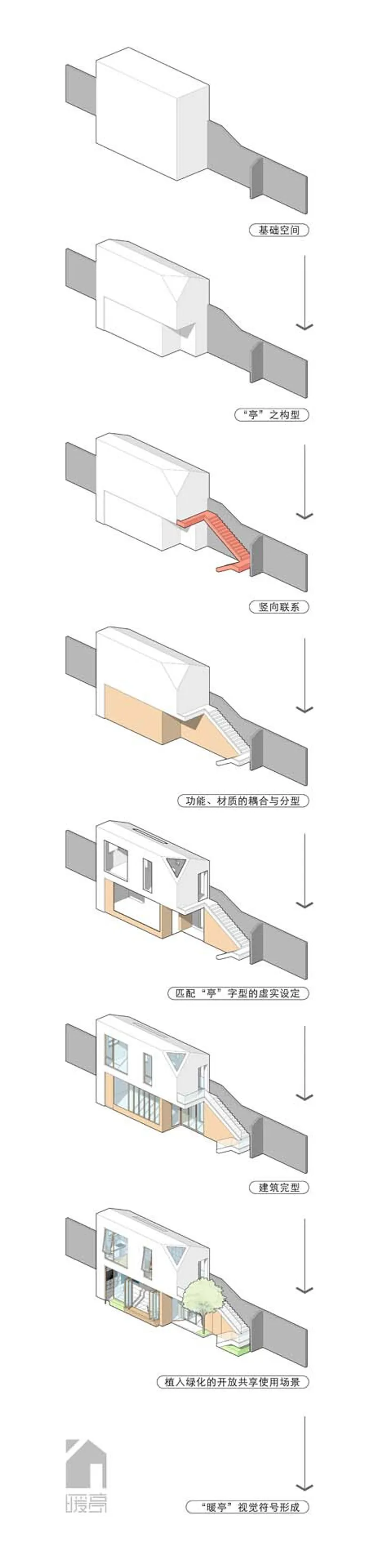
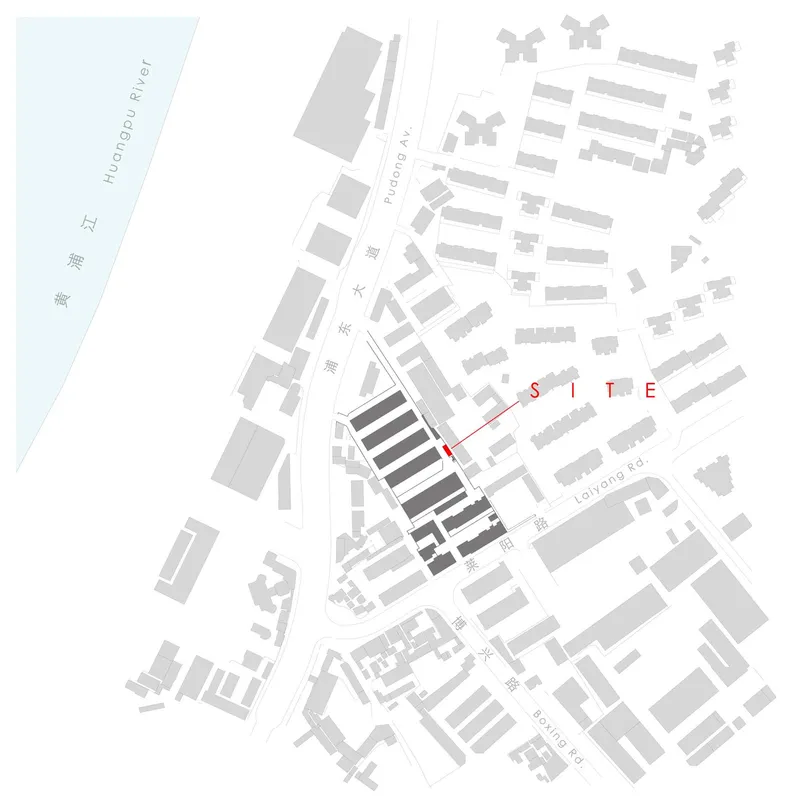
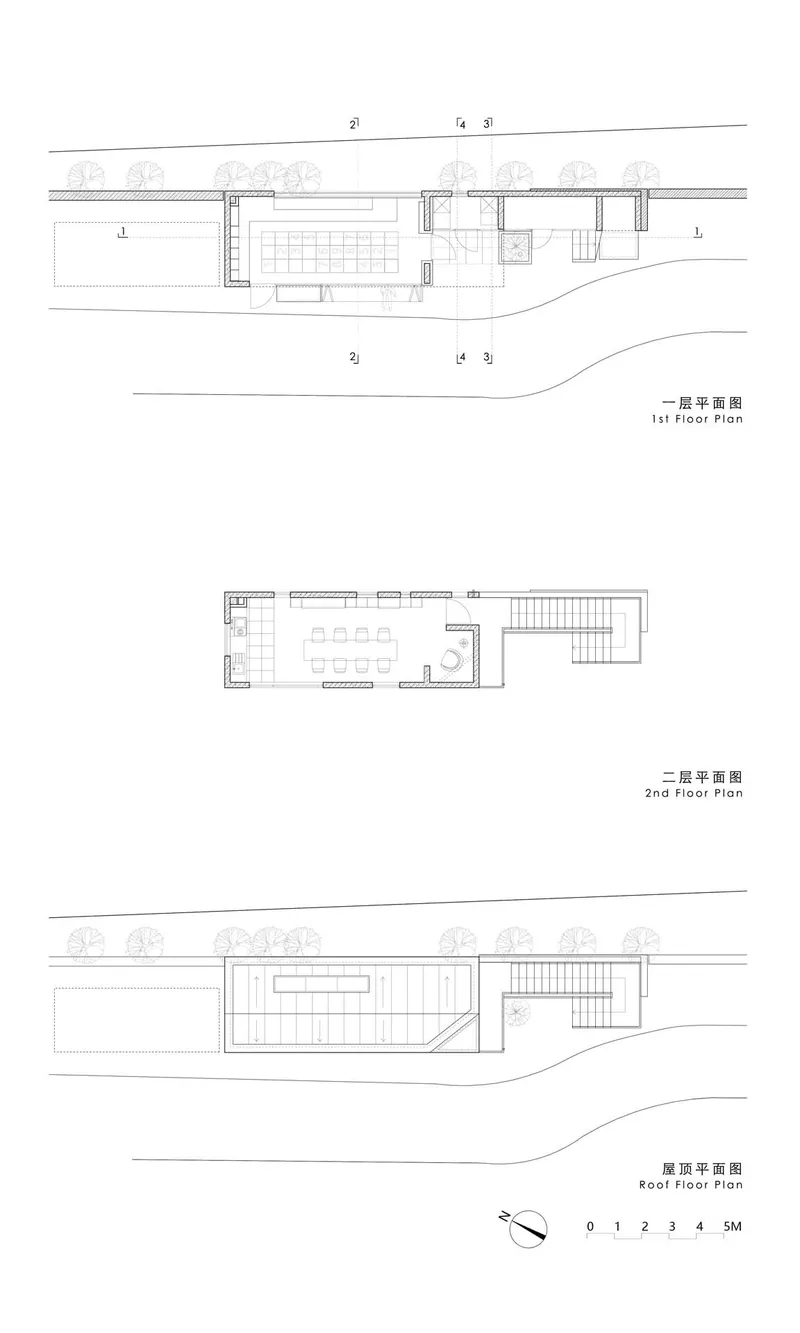

The axonometric sequence is the most instructive drawing in the set. It walks through the design process from massing to interior spatial arrangement, showing how the angular exterior is not arbitrary formalism but a direct consequence of fitting a multi-level program into a constrained footprint while maintaining sightlines and access from the surrounding alleys. The site plan confirms the pavilion's position along a narrow street between the Huangpu River and surrounding urban blocks, a linear condition that the building exploits by presenting active faces to both sides.
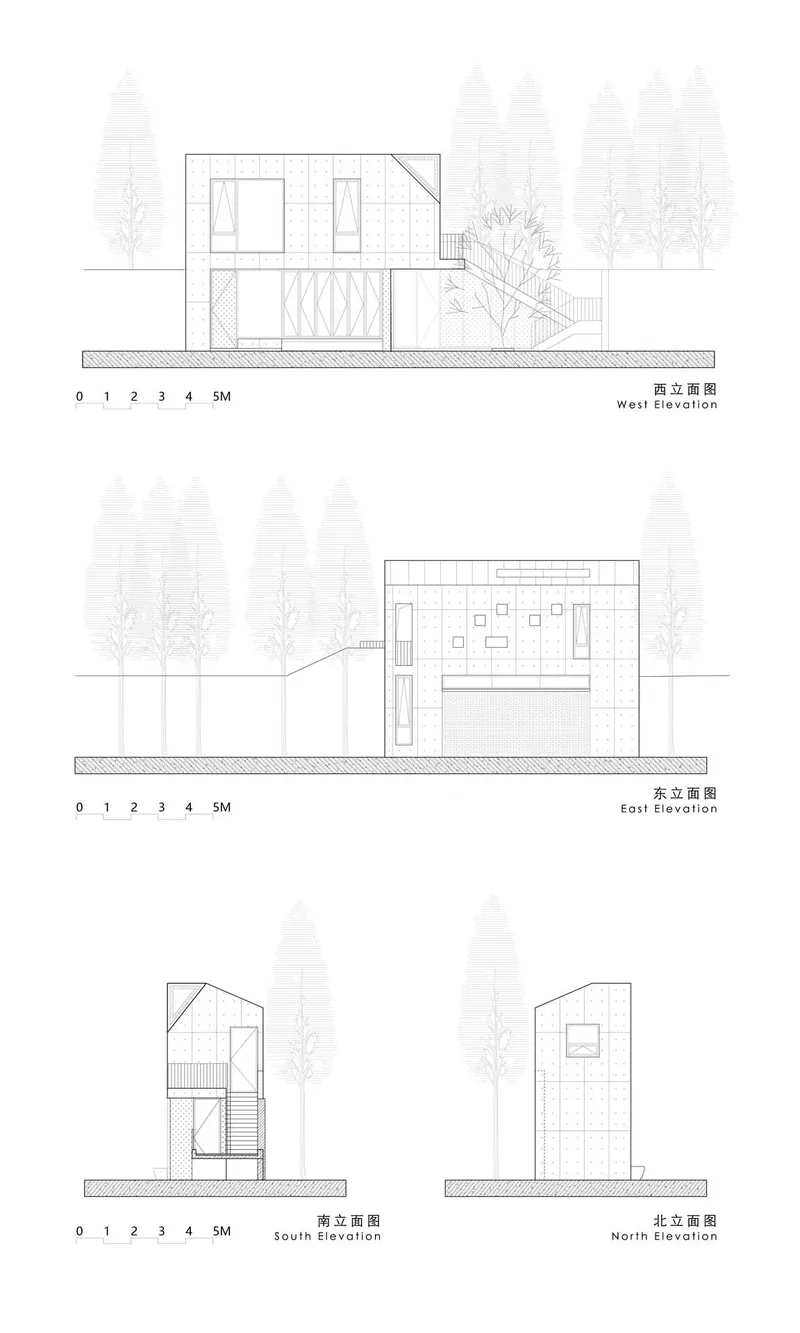
Floor plans at three levels reveal a surprisingly layered interior for 70 m², with the staircase configurations visible in the sections acting as the spatial spine around which communal areas rotate. The elevations show all four facades as distinct compositions, each responding to a different adjacency: street, alley, neighboring wall, open sky. Roof-level drawings indicate the placement of street-facing trees, a modest landscape gesture that nonetheless softens the building's insertion into the village grain.
Why This Project Matters
The Pavilion is not a spectacle. It is 70 square meters of concrete, glass, and timber for a community that had no indoor public space at all. In a discipline that often equates impact with scale, VIASCAPE's project is a reminder that the most consequential architecture can be the smallest: a single room where 480 families can finally gather, read, meet, or simply sit inside a space that was designed with them in mind.
What elevates the project beyond a well-executed micro-building is the process. Starting with surveys and interviews, working with lighting and material consultants to stretch a tiny budget, and producing a form that is both contextually sensitive and unmistakably new: this is a model for urban village intervention that other architects should study closely. Shanghai's riverside communities deserve more of this kind of attention, and The Pavilion proves it can be done at the scale of a single gap between buildings.
The Pavilion, designed by VIASCAPE design (lead architect: Yijia Sun), XiangDong village, Shanghai, China. 70 m², completed 2021. Photography by CreatAR Images.
Share Your Own Work on uni.xyz
If projects like this are the kind of work you want to make, uni.xyz is a place to publish your own, find collaborators, and enter design competitions.


Popular Articles
Popular articles from the community


Temporary Home for Dogs: A Reversed Zoo Rethinks Animal Shelter Architecture
In Bucharest, a sinuous corridor and freed landscape flip the logic of containment, designing a shelter that works to make itself unnecessary.

Cloaked Colonization: A Mobile Underwater Habitat That Moves Like a Fish
Micah Abaya's shortlisted EHC Pacific entry reimagines ocean settlement as a dispersed network of self-sustaining architectural organisms.

Opera on the Sea: Driftwood Logic Shapes a Timber Opera House on Estonia's Coast
Trevor Orgill's opera house translates the entangled drift of floating timber into a civic building where wood, water, and music converge.

Faces of the Soviet Avant-Garde: Turning Moscow's Street Names into an Open-Air Museum
A network of sculptural installations across a Moscow residential district transforms forgotten architect names into spatial encounters with cultural memor

Similar Reads
You might also enjoy these articles

Bao Huynh Watercolor Atelier: A Serene Art Retreat in Hội An
Bao Huynh Watercolor Atelier in Hội An blends multifunctional art spaces, sustainable design, local materials, and family-friendly living in a serene environment.

Atelier Macri Concept Store Interior Design by CASE-REAL
Atelier Macri store features a "ko" counter, walnut wood details, cork displays, blending retail, gallery, and seamless customer experiences.

Manuel Vargas Izquierdo Stadium and High-Performance Sports Center: Architectural Excellence in Jalpa de Méndez
The Manuel Vargas Izquierdo Stadium blends sustainable design, inclusive sports facilities, and cultural-inspired architecture, revitalizing Jalpa de Méndez’s public spaces.

KAKR Buluh Awar Hall: Revitalizing Community and Ecology Through Bamboo Architecture
Community built bamboo hall revitalizes Buluh Awar village, empowering youth, restoring ecology, celebrating vernacular craftsmanship through sustainable architecture and culture.

Explore Pavilion Competitions
Discover active competitions in this discipline

Challenge to design a portable theatre

Challenge to design a portable music platform

Challenge to design an open learning module for the elderly

Challenge to design mud housing for contemporary communities
Comments (0)
Please login or sign up to add comments
No comments yet. Be the first to comment!