
Vincent Callebaut Wraps 113 Montpellier Homes in Shell-Like Bioclimatic Facades
On the site of a former military school near Montpellier's historic center, sinuous exoskeletons breathe with the Mediterranean climate.


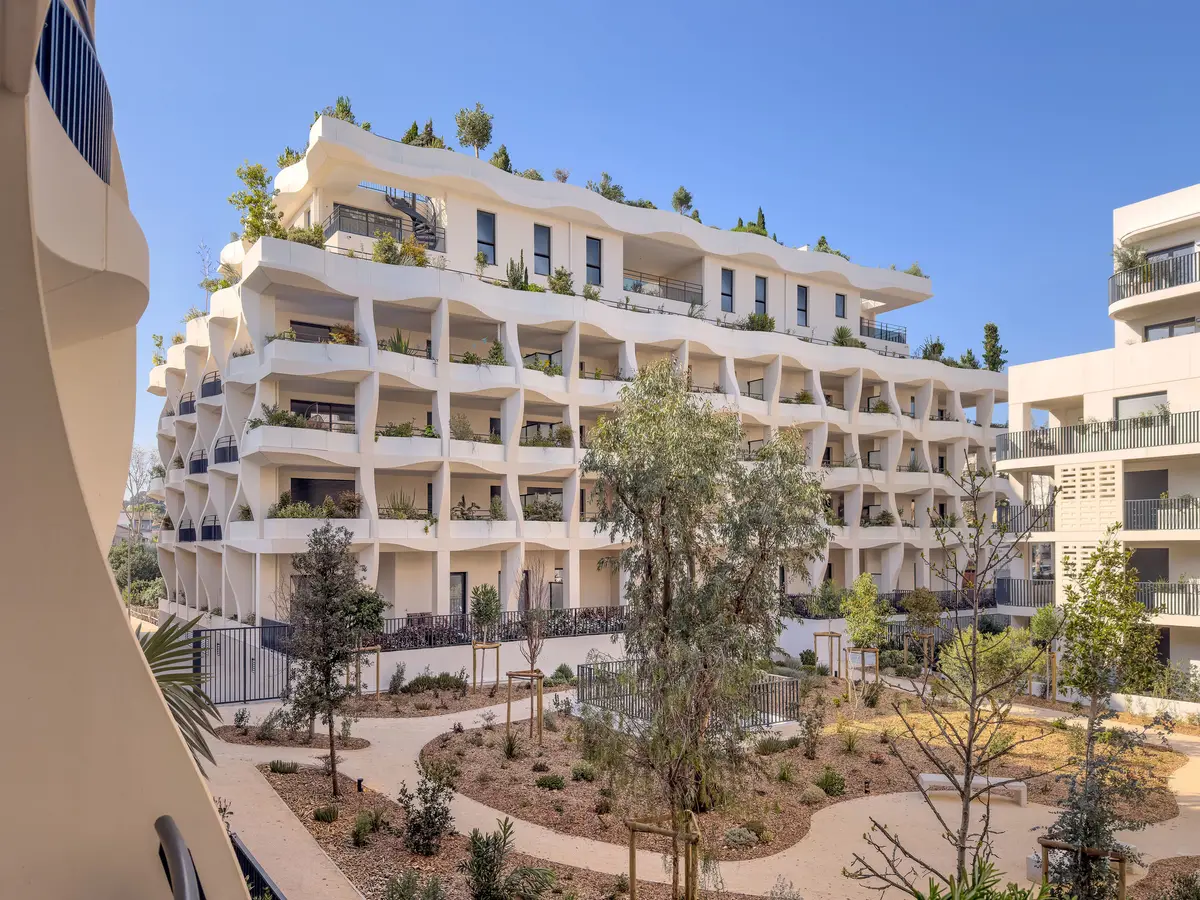
Housing projects rarely get to be this expressive. Vincent Callebaut Architectures won a 2021 competition launched by the City of Montpellier for this site on the former École d'Application de l'Infanterie, less than a kilometer from the historic Ecusson district. The brief demanded density, affordability, and environmental performance. The answer was a pair of buildings, Théia and Opale & Sens, that together deliver 113 units wrapped in continuously undulating white facades. Every curve is parametric, calibrated to the sun's path and prevailing winds. The result is not decoration but climate infrastructure: a giant moucharabieh that filters light, drives ventilation, and reduces cooling loads without mechanical intervention.
What makes the project genuinely interesting is the way it collapses the distance between structural ambition and passive strategy. The shell metaphor is not rhetorical. These facades are exoskeletons, load-bearing screens composed entirely of convex and concave curves in low-carbon concrete. They create deep loggias that reference Haussmannian balconies while functioning as thermal buffers, rain gardens, and privacy screens. Twenty-eight of the 113 homes are affordable, representing a full quarter of the development, and they occupy the same sculptural envelope as the market-rate units. The architecture does not distinguish between the two.
A Facade That Works for a Living

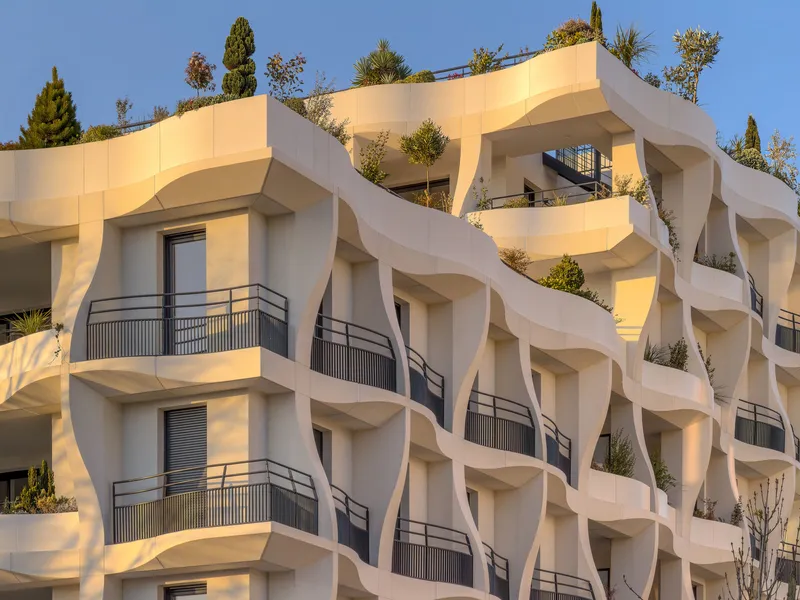
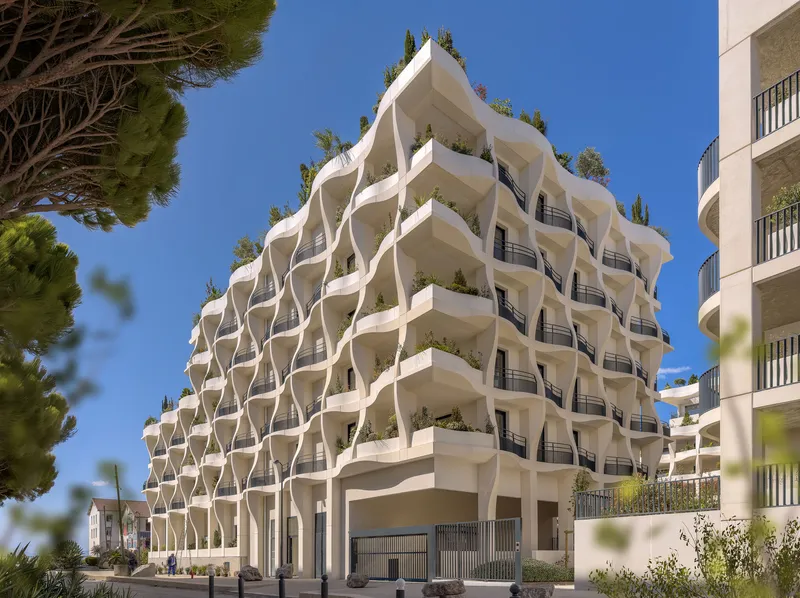
The undulating white ribbons that define the street presence of Jardins Secrets are not ornamental. They are the building's primary climate device. Composed of mineral lace, the exoskeleton wraps each volume in a continuous field of curves that shift in depth and porosity according to orientation. South-facing sections are deeper and more shaded; north-facing sections open wider to capture diffused light. The parametric logic follows the solar arc and the prevailing wind axis of the Tramontane and Mediterranean sea breeze, meaning the facade performs differently on every elevation.
The references that Callebaut cites, from Horta to Gaudí to Gallé, are visible in the sinuous language, but the real debt is to vernacular Mediterranean screens and mashrabiya traditions. The perforated envelope enhances thermal inertia by shading the structural mass during the day and allowing it to release stored heat at night through assisted natural ventilation. Combined with high-performance insulation and RE2020 compliance, the building achieves comfort without the energy penalties that typically accompany this level of formal complexity.
Depth and Detail at Close Range
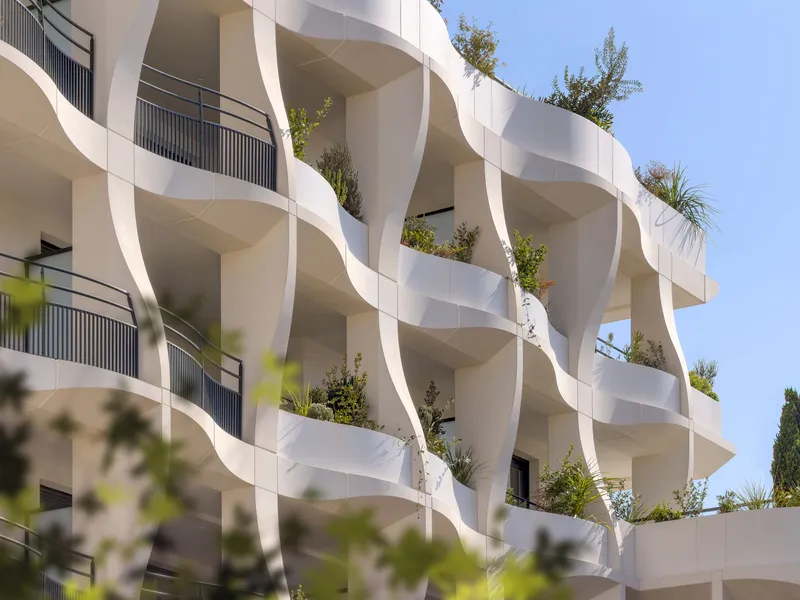
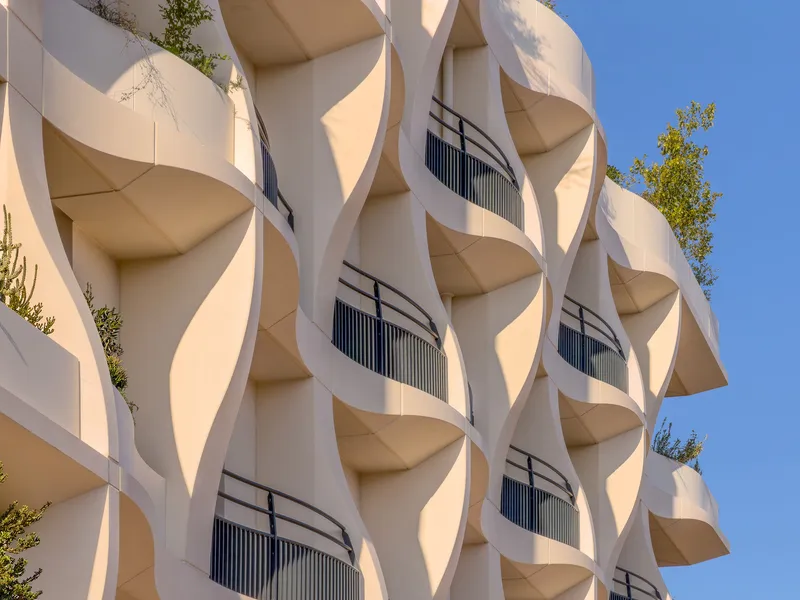

Up close, the facades reveal their true sophistication. Each balcony edge is a ribbon of precast concrete with no straight segments, produced by facade contractor Rampa Prefa in collaboration with structural engineer André Verdier Ingénieur Conseil. The metal railings follow the curves faithfully, creating a layered reading of structure, screen, and planting. Greenery emerges from integrated planters at every level, fed by a closed-loop greywater recycling system that takes water from bathrooms and kitchens and returns it to the suspended gardens.
The detail photographs make clear that the planting is not afterthought landscaping bolted to a finished building. The planters are structural, cast into the exoskeleton, and their irrigation is part of the building's water cycle from the outset. This integration matters because it means the vegetation will mature and thicken over time, progressively increasing the facade's shading capacity and the microclimate effect in the courtyards below.
The Courtyard as Climate Engine

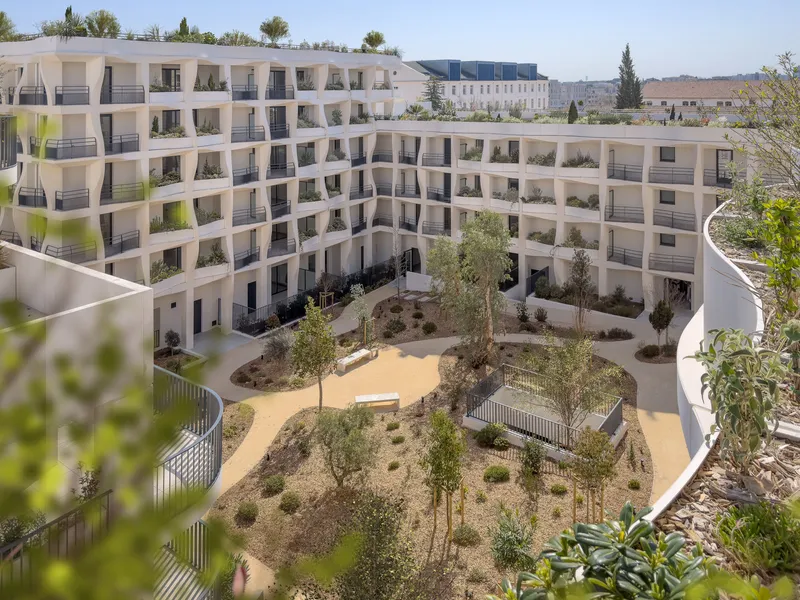
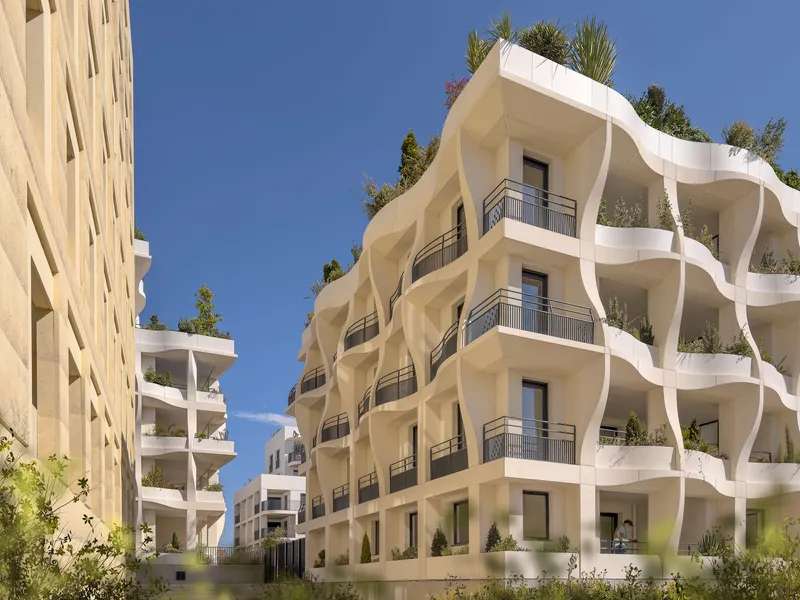
Théia is organized in an L-shape, and Opale & Sens wraps around a central patio. Both strategies create protected courtyard voids that serve as the lungs of the complex. The aerial view reveals a gravel-and-planted ground plane with young trees and permeable surfaces, designed by landscape firm Land'Act Paysages & Territoires with Mediterranean garrigue planting. Underground parking keeps the ground level free of vehicles, preserving soil permeability and allowing rainwater to infiltrate into a mini-forest at the heart of the block.
The courtyard void framed from below, with a single tree visible against open sky, demonstrates the stack-ventilation principle at work. Warm air rises through the courtyard, drawing cooler air through the perforated facades and the ground-level openings. The effect is a breathable microclimate that reduces the temperature differential between the street and the interior spaces, a measurable benefit in Montpellier's increasingly hot summers.
Rooftop and Threshold Landscapes

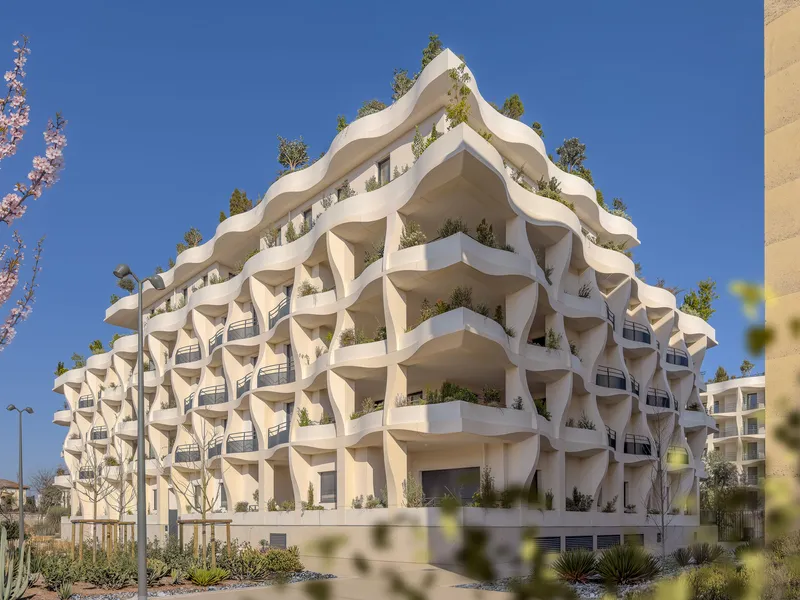

The upper levels introduce a different character. Opale & Sens rises to three floors, then steps back 3.5 meters at levels R+4 and R+5 to form recessed duplexes that read as a separate volume against the sky. These setbacks create generous private terraces with timber decking and slatted privacy screens, offering residents outdoor rooms that feel detached from the street. The rooftops host photovoltaic arrays alongside biodiversity gardens with beehives maintained by a local beekeeper, turning the fifth facade into a productive landscape.
At golden hour, the planted balconies and flowering jacaranda trees create a layered silhouette that softens what could otherwise be a monolithic white mass. The terraced greenery cascading down the facade connects visually to the neighboring Parc Montcalm, forming an ecological corridor that extends biodiversity from the park into the residential block. Urban permaculture plots and composting stations at ground level complete the loop, making the complex a small but functioning ecosystem.
Circulation and the Spiral Stair
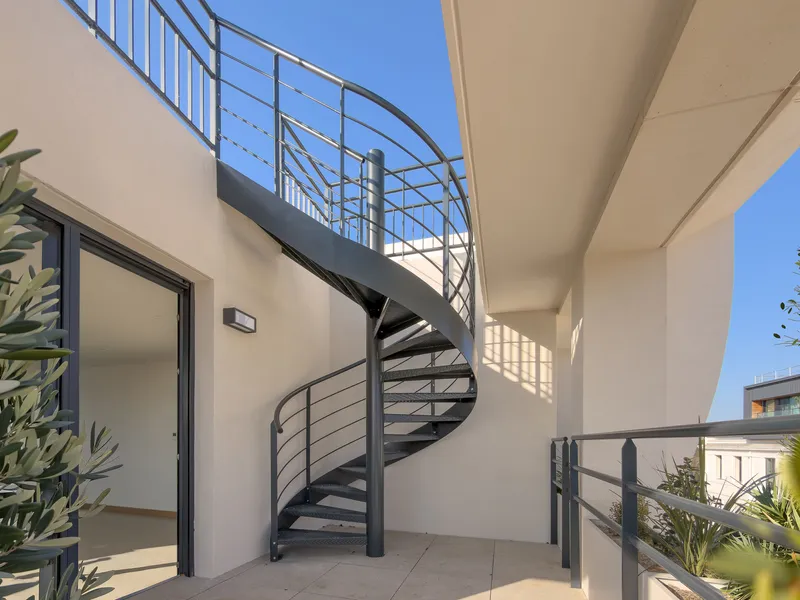
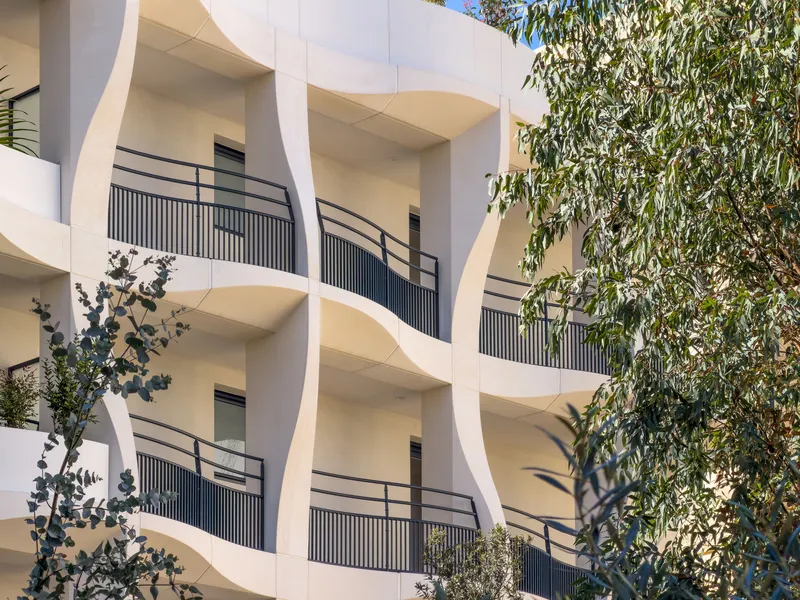
An exterior spiral staircase in bright steel connects the balcony levels on the courtyard side, its geometric regularity forming a deliberate counterpoint to the organic curves of the facade. It is a practical element, providing secondary egress and access to the planted terraces, but it also reveals the structural logic of the project. The stair is separate from the exoskeleton, confirming that the curving facade carries its own loads independently of the interior structure. The curved balcony soffits visible through eucalyptus foliage further demonstrate the depth of the envelope, which extends well beyond the glass line to create inhabitable outdoor thresholds.
Street Presence and Urban Fit
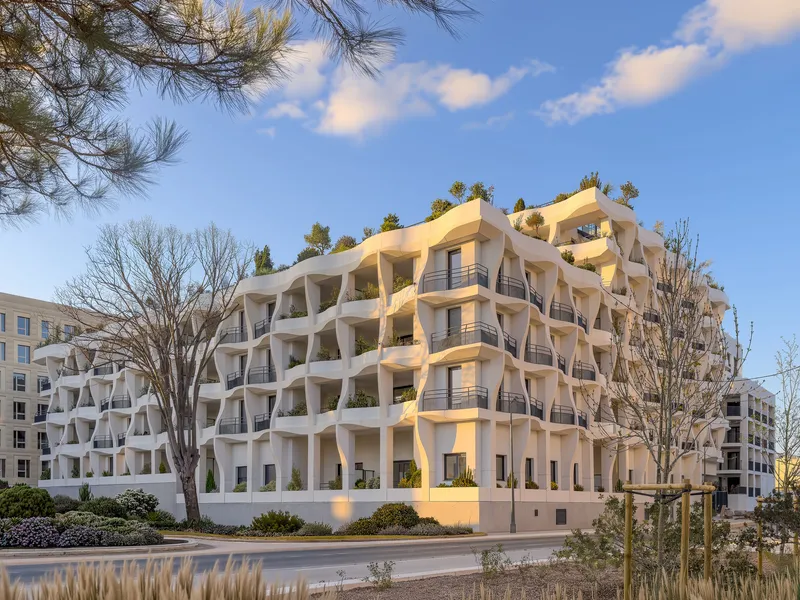
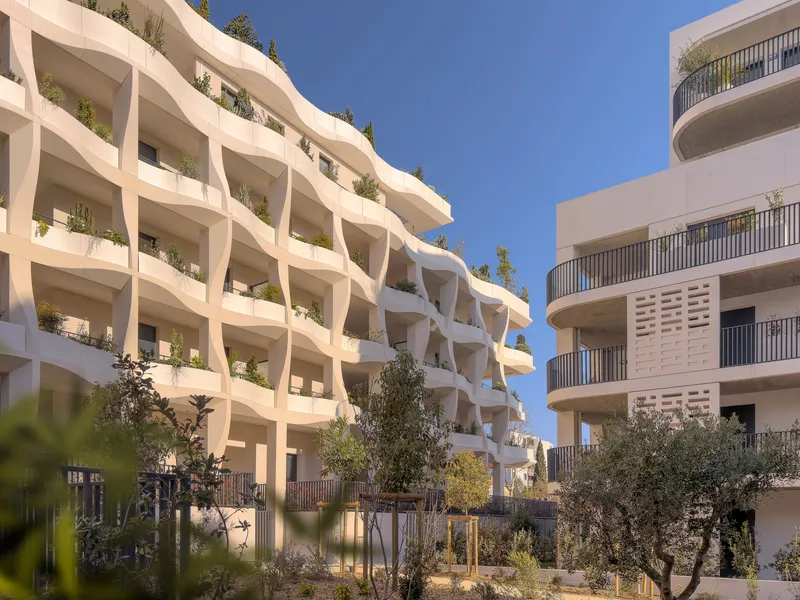

From the street, the buildings hold the urban edge firmly. Elevated ground floors lift private space above the pedestrian zone without creating dead frontage, a detail that keeps the streetscape active. The bare winter trees in the street view underscore an important point: the building must perform as architecture even when the planting is dormant. The white mineral lace reads as a coherent surface year-round, gaining additional richness in summer when the vegetation fills in.
At dusk, vertical slat screens embedded in the facade glow softly from interior light, turning the rippling surface into a lantern. The neighboring residential blocks visible in the diagonal views are conventional plaster-and-balcony housing, the default typology of southern French urbanism. Jardins Secrets does not reject that typology so much as upgrade it. The deep loggia, the planted balcony, the elevated ground floor: these are all local conventions, here amplified through computational form-finding and bioclimatic engineering into something richer.
Garden at Ground Level


The shared garden with olive trees and curved planting beds mediates between the two buildings and the surrounding neighborhood. Rainwater harvested from roofs and grey water recycled from apartments irrigate these plantings in a closed loop, reducing municipal water consumption. The landscape design by Land'Act references the local garrigue ecology, favoring drought-tolerant species that require minimal maintenance while providing habitat for pollinators. Bicycle rooms at the ground floor of each building reinforce the car-light ambition, and the naturally ventilated underground parking further reduces the energy footprint.
Plans and Drawings

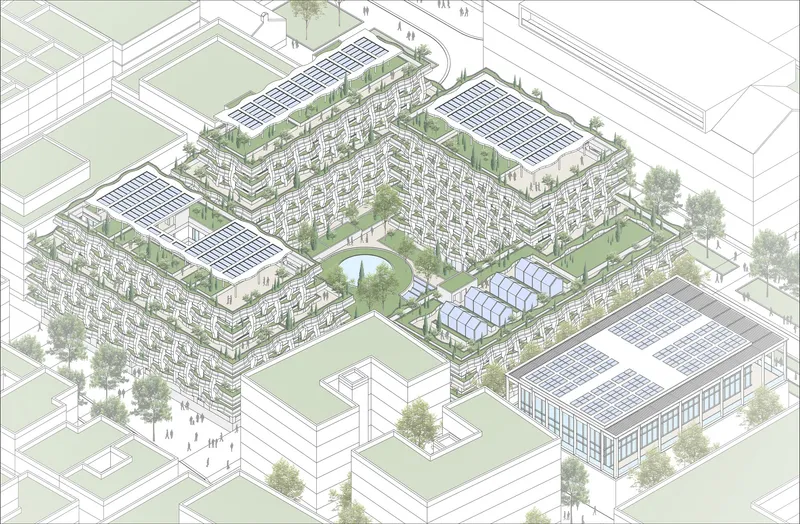
The axonometric drawings reveal the full scope of the urban strategy. The two buildings occupy a shared block with complementary geometries: Théia's L-shape opens toward the park, while Opale & Sens wraps inward around its patio. Rooftop solar arrays are visible on every surface not occupied by biodiversity gardens, and the stepped massing of the upper floors is clearly legible. The drawings also show how the project connects to its urban context, with continuous ground-level planting linking the block to the adjacent parkland and forming the ecological corridor that is central to the landscape concept.
Why This Project Matters
Bioclimatic design in housing has historically meant modest, almost invisible interventions: orientation, shading, ventilation openings. Vincent Callebaut's Jardins Secrets argues that these strategies can also be formally ambitious, that the performance logic of a climate-responsive envelope can generate architecture of genuine expressive power. The parametric facade is not a surface applied to a standard residential slab. It is the structure, the climate system, and the identity of the building, all in one element. That integration is rare, and it is what elevates the project above the many recent housing schemes that claim sustainability credentials through checkbox compliance.
Equally significant is the social dimension. Twenty-five percent affordable housing is not a footnote here but a fundamental design constraint that the architecture absorbs without differentiation. Every resident, regardless of income, lives behind the same exoskeleton, in the same deep loggias, with the same access to suspended gardens, rooftop beehives, and permaculture plots. In a moment when European cities are struggling to reconcile density with livability and environmental ambition with affordability, Montpellier now has a demonstration project that refuses to treat those goals as contradictions.
Jardins Secrets Bioclimatic Shells by Vincent Callebaut Architectures. Montpellier, France. 8,209 m². Completed 2026. Images by Vincent Callebaut Architectures.
About the Studio
Share Your Own Work on uni.xyz
If projects like this are the kind of work you want to make, uni.xyz is a place to publish your own, find collaborators, and enter design competitions.


Popular Articles
Popular articles from the community

Temporary Home for Dogs: A Reversed Zoo Rethinks Animal Shelter Architecture
In Bucharest, a sinuous corridor and freed landscape flip the logic of containment, designing a shelter that works to make itself unnecessary.

Singing Woman: Contemporary Architecture Inspired by Estonia’s Voice and the Sea
Singing Woman turns Estonia’s song culture into flowing opera house architecture, blending public life, landscape, sea, and national memory.

Extended Shell: Retrofitting Kolkata's Balconies as Living Urban Thresholds
A modular retrofit system recovers the social and environmental intelligence of Kolkata's historic verandas for contemporary Park Street residents.

Manzana Morphosis: Stretching Barcelona's Grid into a Living Landscape for 2050
A radical reworking of the Eixample manzana turns density into a tool for generous public space, vertical ecology, and environmental performance.

Similar Reads
You might also enjoy these articles

Bao Huynh Watercolor Atelier: A Serene Art Retreat in Hội An
Bao Huynh Watercolor Atelier in Hội An blends multifunctional art spaces, sustainable design, local materials, and family-friendly living in a serene environment.

Atelier Macri Concept Store Interior Design by CASE-REAL
Atelier Macri store features a "ko" counter, walnut wood details, cork displays, blending retail, gallery, and seamless customer experiences.

Manuel Vargas Izquierdo Stadium and High-Performance Sports Center: Architectural Excellence in Jalpa de Méndez
The Manuel Vargas Izquierdo Stadium blends sustainable design, inclusive sports facilities, and cultural-inspired architecture, revitalizing Jalpa de Méndez’s public spaces.

KAKR Buluh Awar Hall: Revitalizing Community and Ecology Through Bamboo Architecture
Community built bamboo hall revitalizes Buluh Awar village, empowering youth, restoring ecology, celebrating vernacular craftsmanship through sustainable architecture and culture.

Explore Green Houses Competitions
Discover active competitions in this discipline

Challenge to reimagine the Iron Throne

Photograph architecture without architects

Illustrate the lost glory of Angkor Wat - Render Challenge

Design challenge to reuse E-waste
Comments (0)
Please login or sign up to add comments
No comments yet. Be the first to comment!