
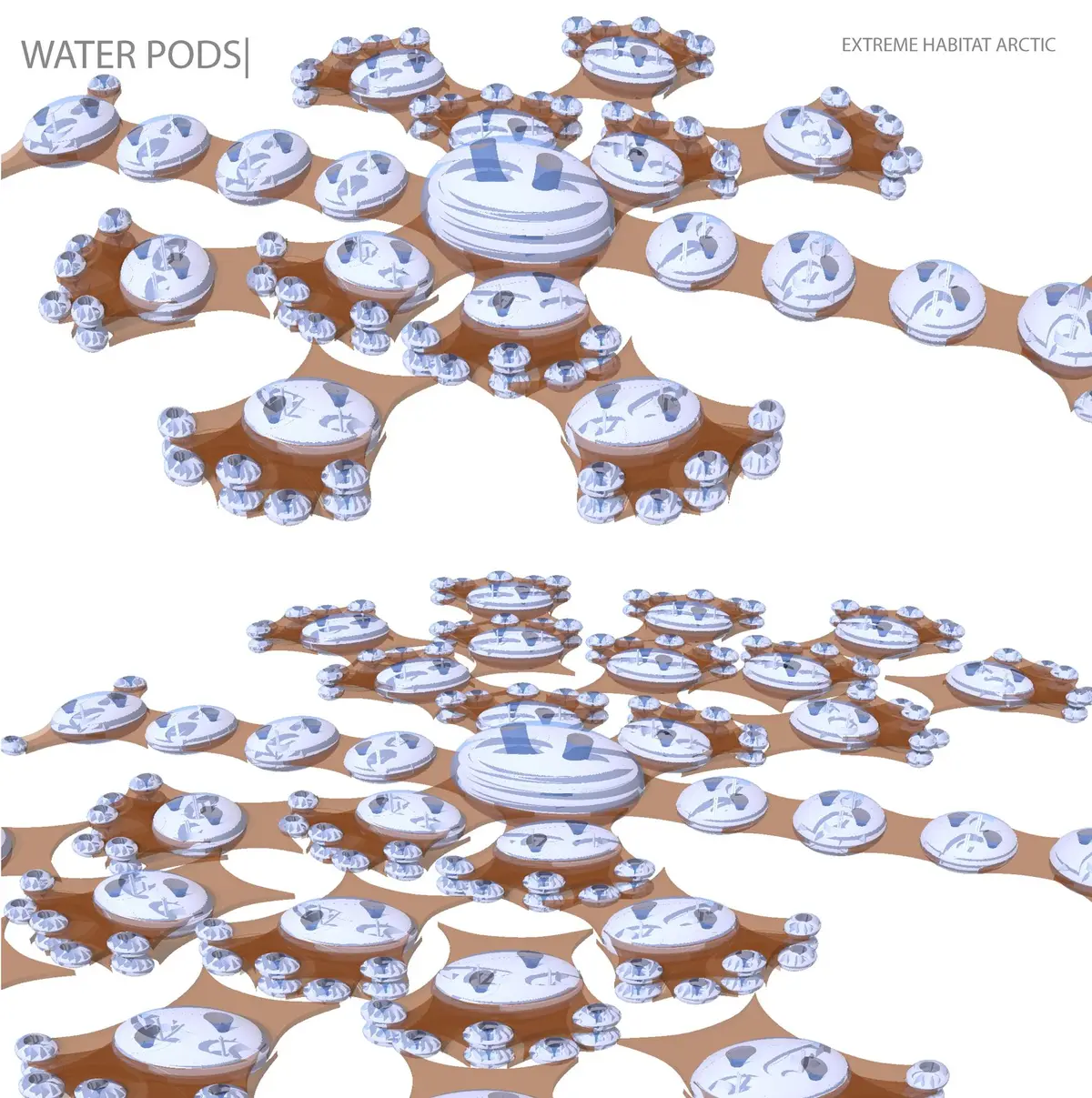
Water Pods: Modular Arctic Habitats with Climate-Responsive Porous Skins
A fractal network of 3D-printed pods uses layered pore systems and advanced materials to create a thriving urban ecology in extreme cold.


Building in the Arctic means confronting a paradox: the environment demands maximum enclosure, yet any viable long-term settlement needs porosity, light, and the capacity to grow. Water Pods resolves that tension with a facade system derived directly from climatic data, where pore sizes shift across surfaces in response to thermal exposure, and a modular plan that replicates outward from a central unit like a fractal grid. The result is not a bunker but an expanding urban organism, one that channels meltwater toward twin reservoirs and houses residential, educational, commercial, and public programmes within an interconnected network of domed volumes.
Designed by Reine Fernandes and Nishiki Varma, Water Pods was shortlisted in the EHC - Arctic competition. The project tackles the full scope of extreme-climate settlement: material selection, fabrication logistics, envelope performance, and social programming. Rather than treating the Arctic as a site for isolated survival shelters, the designers propose a blueprint for a complete, adaptive community.
3D-Printed Assembly: From Site Mapping to Hoisted Units
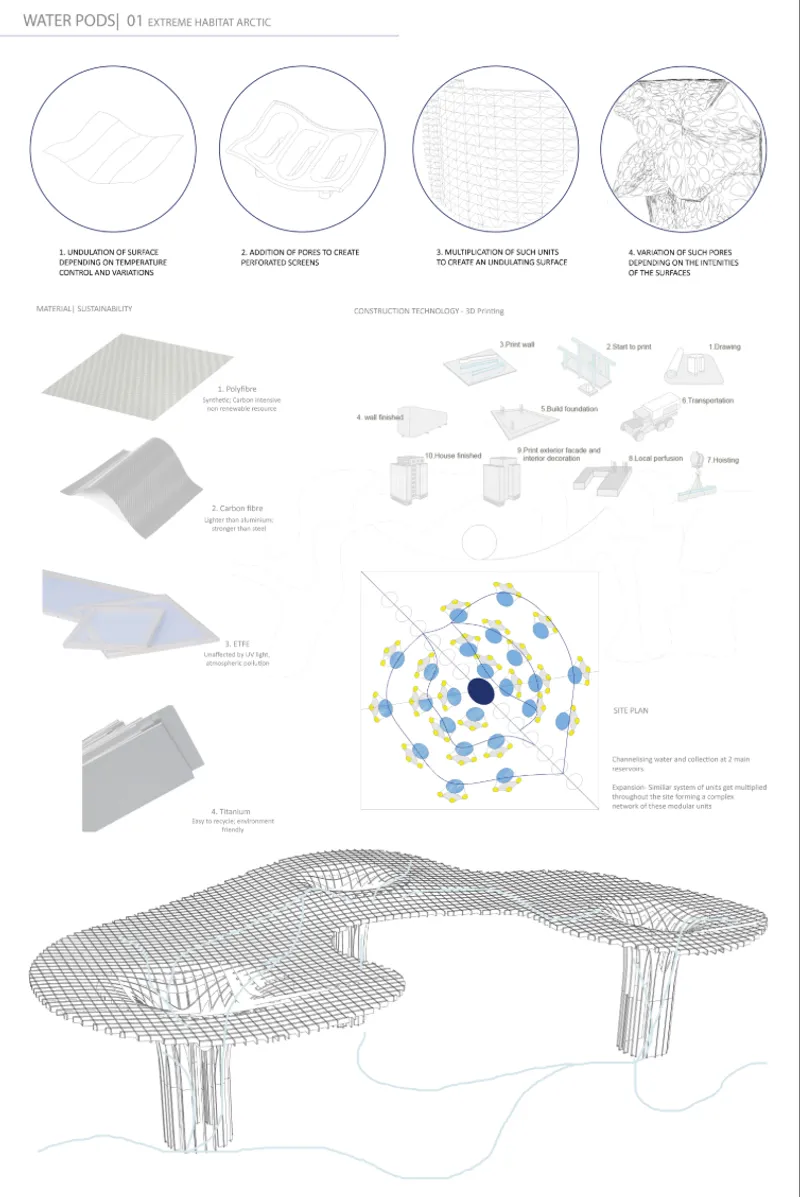
The technical diagram above unpacks the construction methodology for Water Pods' characteristic three-lobed roof structure. Carbon fibre, lighter than aluminum and stronger than steel, forms the primary structural skeleton. ETFE panels provide a transparent, UV-resistant skin, while titanium connectors offer recyclability and environmental safety. The entire assembly sequence is designed around 3D printing technology: automated stages move from site mapping through wall printing, facade detailing, and finally the hoisting of pre-designed units into position. For a terrain as logistically punishing as the Arctic, this approach collapses the gap between design intent and buildability.
What makes the material palette significant is not just individual performance but the way these components integrate. The diagram shows connecting elements linking lobed volumes together, creating structural continuity across the grid. Each joint is a point of potential expansion, reinforcing the project's core principle: the habitat is never finished, only growing.
Programmatic Zones Mapped Across a Fractal Grid
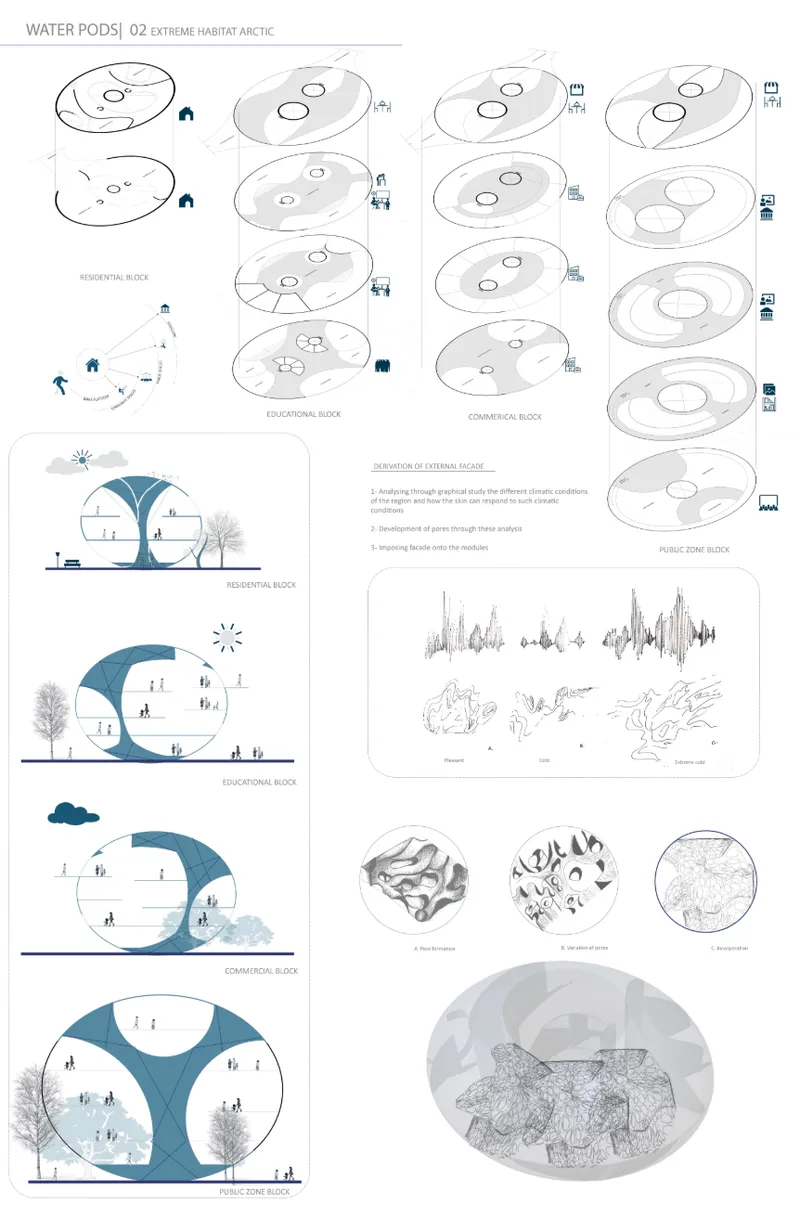
The plan and section drawings reveal how Water Pods organizes its diverse programme across multiple building blocks. Residential units occupy sheltered positions within the network, connected yet private. Educational zones sit centrally, prioritizing visibility and openness. Commercial hubs take the form of modular workspaces, while public blocks provide gathering spaces intended to foster shared culture. Water channels run through the plan toward two primary reservoirs, turning the entire settlement into a resource collection system that addresses the Arctic's scarcity of accessible freshwater.
The zoning strategy balances autonomy and interdependence. Each pod sustains the larger whole, but no single unit is so specialized that its failure compromises the network. This redundancy is critical for extreme environments where isolation from supply chains can last months. The sections show how the climate-responsive skin varies across programme types: surface undulation responds to thermal conditions, and pores multiply and shift in size based on the intensity of exposure at each facade orientation.
Domed Volumes and Stepped Terraces in Snow
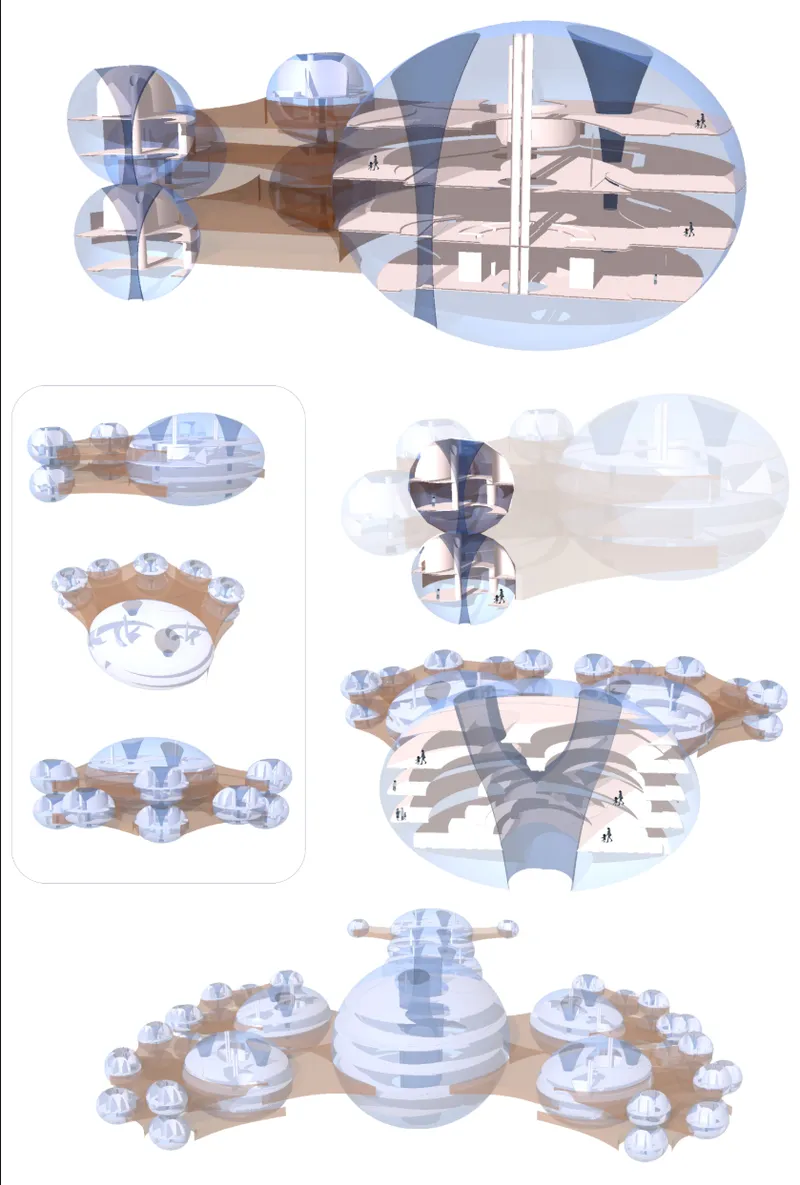
The axonometric renderings bring the spatial ambition of Water Pods into sharp focus. Multi-level domed volumes, connected by stepped terraces, form a settlement that reads as terrain rather than architecture. The porous skin is visible here as a textured envelope that admits light while maintaining insulation, a direct consequence of the layered design process the team developed from regional climatic graphs. Pleasant, cold, and extreme cold conditions each produce a different pore density, so the facade is effectively a thermal map rendered in material.
Snow accumulates around and between the domes, and the terraced connections suggest that circulation between pods happens partially in the open air, partially sheltered. This is a deliberate design choice: rather than sealing inhabitants inside a hermetic system, Water Pods negotiates with its environment, allowing controlled exposure to Arctic conditions where the data supports it.
Why This Project Matters
Water Pods takes the question of Arctic habitation seriously enough to address it at every scale: the molecular (material selection), the tectonic (3D-printed assembly), the atmospheric (pore-regulated facades), and the urban (fractal zoning with integrated water management). Most speculative Arctic proposals stop at the shelter. Fernandes and Varma push past that threshold to ask what a community looks like when the ground is frozen and the sun disappears for months.
As polar regions gain geopolitical, scientific, and environmental significance, projects like this shift from academic exercise to genuine necessity. The strength of Water Pods is its refusal to treat adaptability as a metaphor. The skin literally changes with the climate. The plan literally grows module by module. The materials are literally printable on site. That operational specificity, layered over a clear spatial vision, makes it a serious proposition for a future that is arriving faster than most design disciplines are prepared to handle.
View the Full Project
About the Designers
Designers: Reine Fernandes, Nishiki Varma
Enter a Design Competition on uni.xyz
uni.xyz runs architecture and design competitions year-round that reward proposals with spatial conviction and real site intelligence.
Project credits: Water Pods by Reine Fernandes, Nishiki Varma EHC - Arctic (uni.xyz).


Popular Articles
Popular articles from the community


U.GA Architects Wraps an Oval Rooftop Pool in Curved Board-Formed Concrete on Busan's Jeollidan-gil
In Busan's Jeonpo-dong, a 454 m² mixed-use block stacks a neighborhood facility, guest rooms and an oval rooftop pool inside spiraling concrete walls.

Jaramillo Van Sluys Arquitectura and Urbanismo Turn a Demolished Registry Lot in Quito into an Orchard Plaza
In Quito's Centro Histórico, a 2,800 m² plaza exposes the San Agustín convent wall and redraws its lost Augustinian orchard in volcanic stone.

Juan García Correa, John González and Claudia Rueda Sink a Circular Amphitheater into a Manizales Engineering Building
On the La Nubia campus in Manizales, Colombia, the S1 Building folds labs and offices into a hillside of ramped lawns that double as a campus route.

GROUP A Strips a 1969 Rotterdam Harbor Headquarters to Its Frame and Wraps It in Timber Louvers
In Rotterdam's M4H harbor district, Ferro Offices reuses a 1969 frame, adds one timber storey and reaches BREEAM-NL Outstanding.

Similar Reads
You might also enjoy these articles


Vereda Arquitetos Renovates a 40-Square-Meter Apartment Inside Niemeyer's Copan Building
A compact unit in São Paulo's most iconic residential tower gets a material overhaul that pairs exposed concrete with bold blue Formica.

Shakur's House: Exposed Brick as an Interior Organiser in a 168 m² Mashhad Residence
Brick moves indoors in this Mashhad residence, where masonry walls, glass partitions and teal planes sequence a compact home without closing it off.

Day and Night Park: A Time-Based Urban Newsstand in Beijing
A temporary urban newsstand in Beijing blending travel, light, and reading through poetic colors, compact form, and community-focused design.

Modernist Patio Renovation in El Masnou, Barcelona by Oliver Segura Arquitectura + Cebrià Arquitectura
Modernist patio renovation blending tradition and innovation with a movable pool, leveled floors, and Catalan materials in El Masnou.

Explore Extreme Architecture Competitions
Discover active competitions in this discipline

Challenge to design a shop stop sunk in the city

Design challenge to equip cities with modern furniture
Comments (0)
Please login or sign up to add comments
No comments yet. Be the first to comment!