
Waterfrom Design Turns Its Own Taipei Studio into a Manifesto of Material Intuition
A 218-square-meter office in Taipei pairs green marble floors with plywood joinery to argue that design starts with the hands, not the screen.


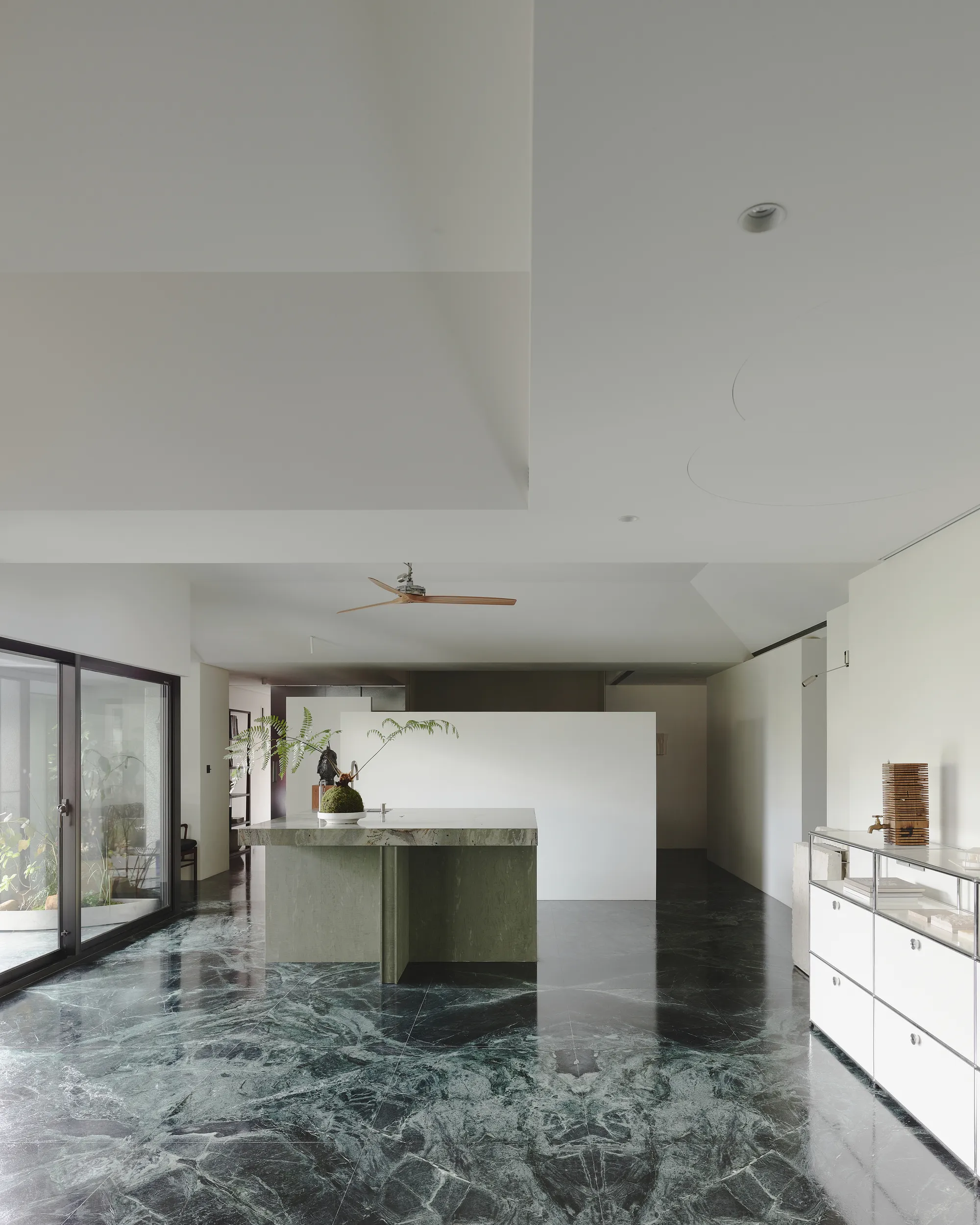
When architects design their own offices, the result tends to reveal more about their actual priorities than any client project ever could. Waterfrom Design, the Taipei firm led by Nic Lee, spent eight months building out a 218-square-meter workspace that doubles as a testing ground for the kind of material-first thinking the studio applies to its commissions. The 2024 project is compact, opinionated, and remarkably legible: every surface, from the veined green marble floors to the raw plywood cabinetry, reads as a deliberate choice rather than a mood board exercise.
What makes the office worth examining is its insistence on intuition over documentation. The studio has described its process as one where drawings take a back seat to instinct refined through years of on-site decision-making. That ethos is visible here in the way materials meet without excessive detailing, the way volumes shift from warm to cool without any single threshold announcing the change. It is an interior that trusts its own eye and expects you to do the same.
Green Marble as a Ground Plane
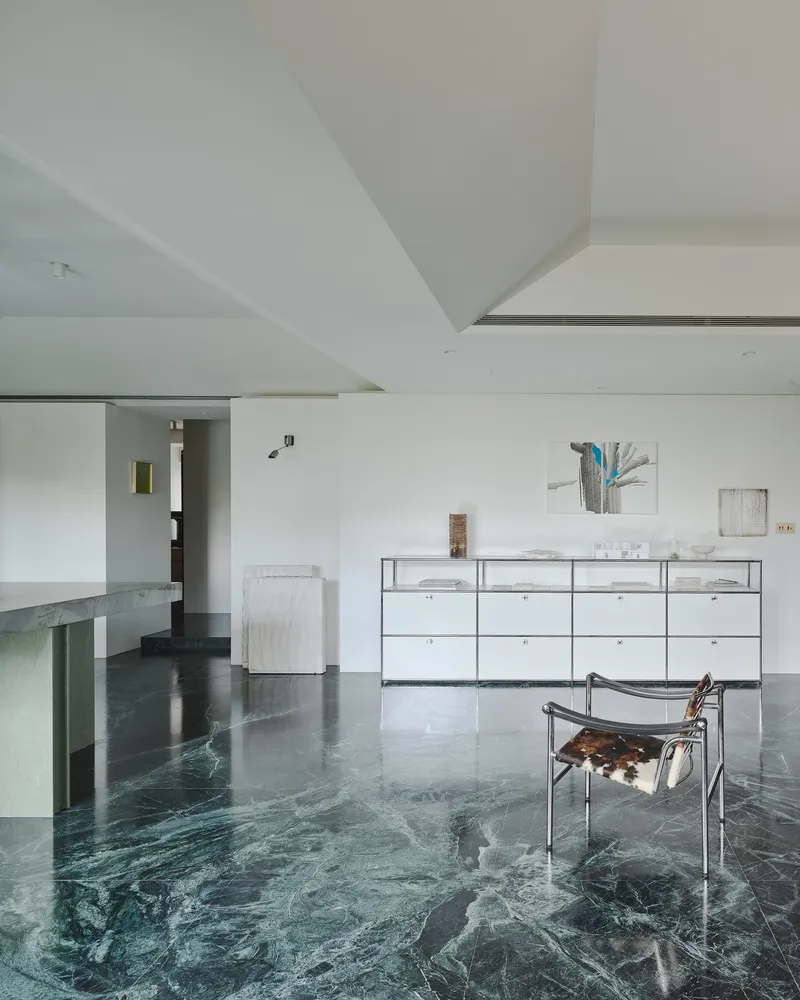
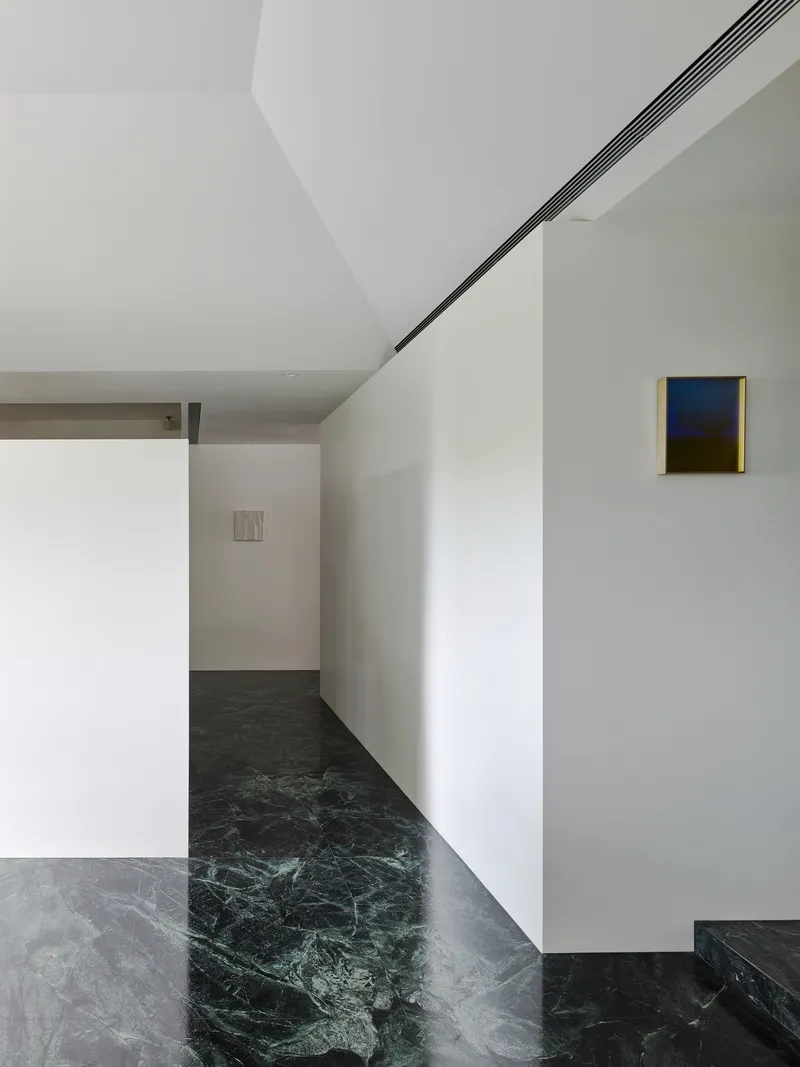
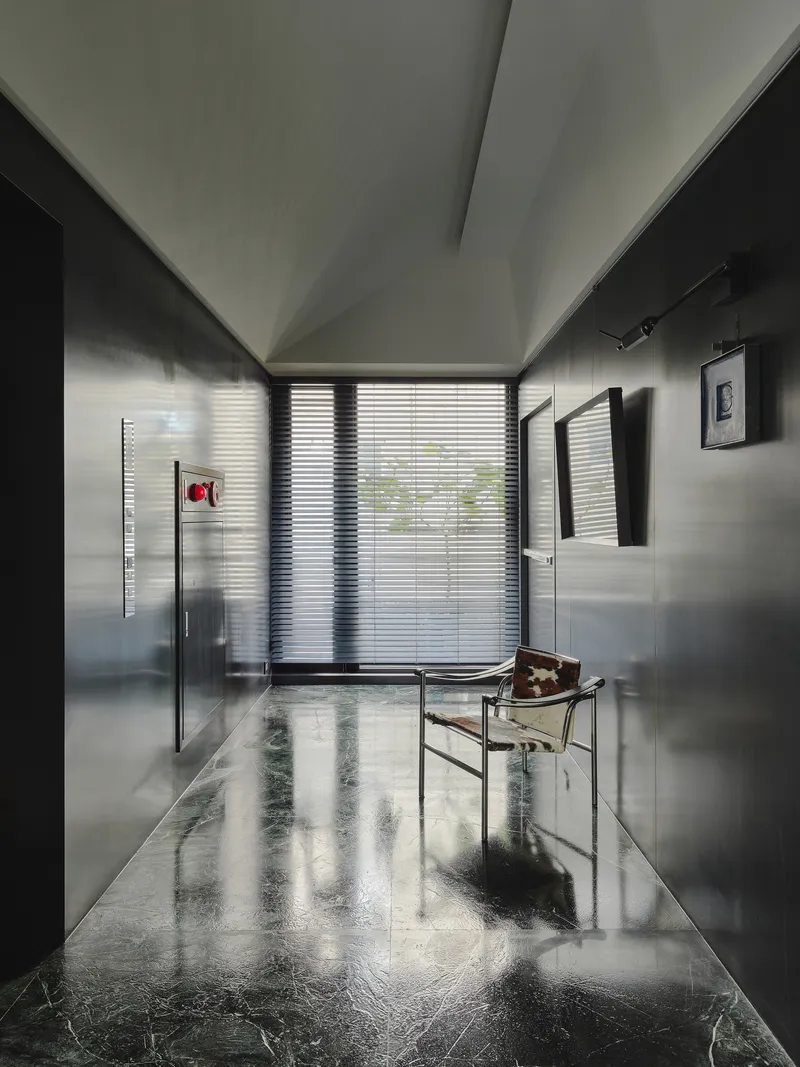
The green marble floor is the single most assertive gesture in the entire office. Its veining is wild, geological, and impossible to fake with a render. Waterfrom laid it wall to wall through the main corridor and the open living-workspace zone, creating continuity across what would otherwise be a series of disconnected rooms in a narrow floorplate. The stone's surface reflects recessed ceiling lights in soft pools, turning the floor into an active participant in the lighting scheme rather than just a backdrop.
Green marble is a polarizing choice for a workspace. It signals luxury, yes, but in this context it also functions as a kind of permanent material sample: a reminder that the studio works in stone, wood, and metal every day and wants those materials underfoot, not just pinned to a board. The polished finish amplifies the veining's depth and gives the corridors a slightly surreal quality, as though the office floor were a slab of cross-sectioned earth.
Plywood Joinery and the Workshop Ethos
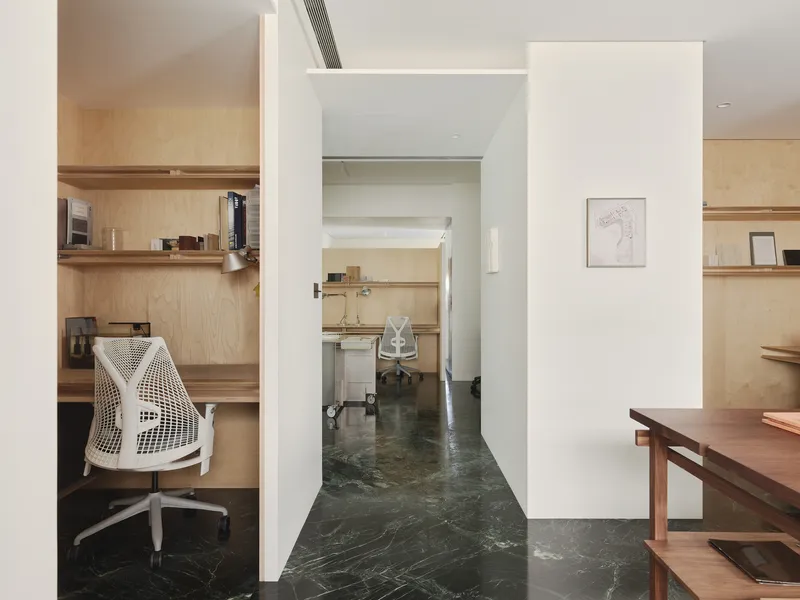
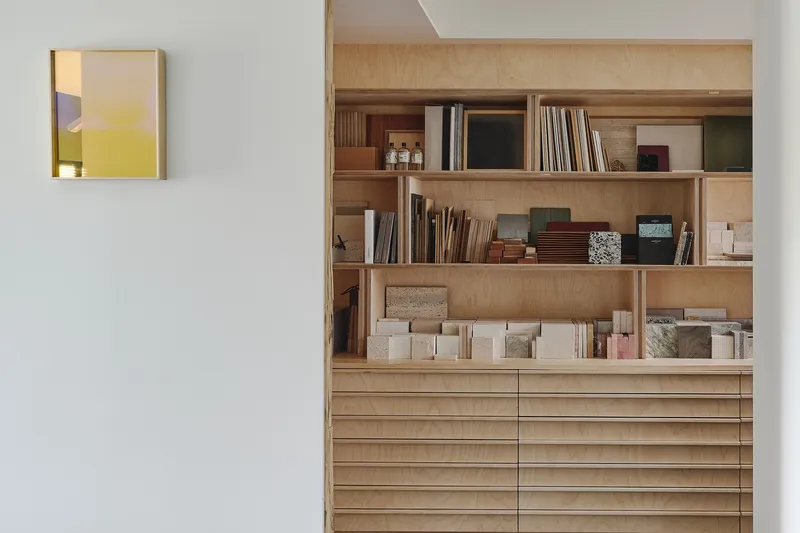
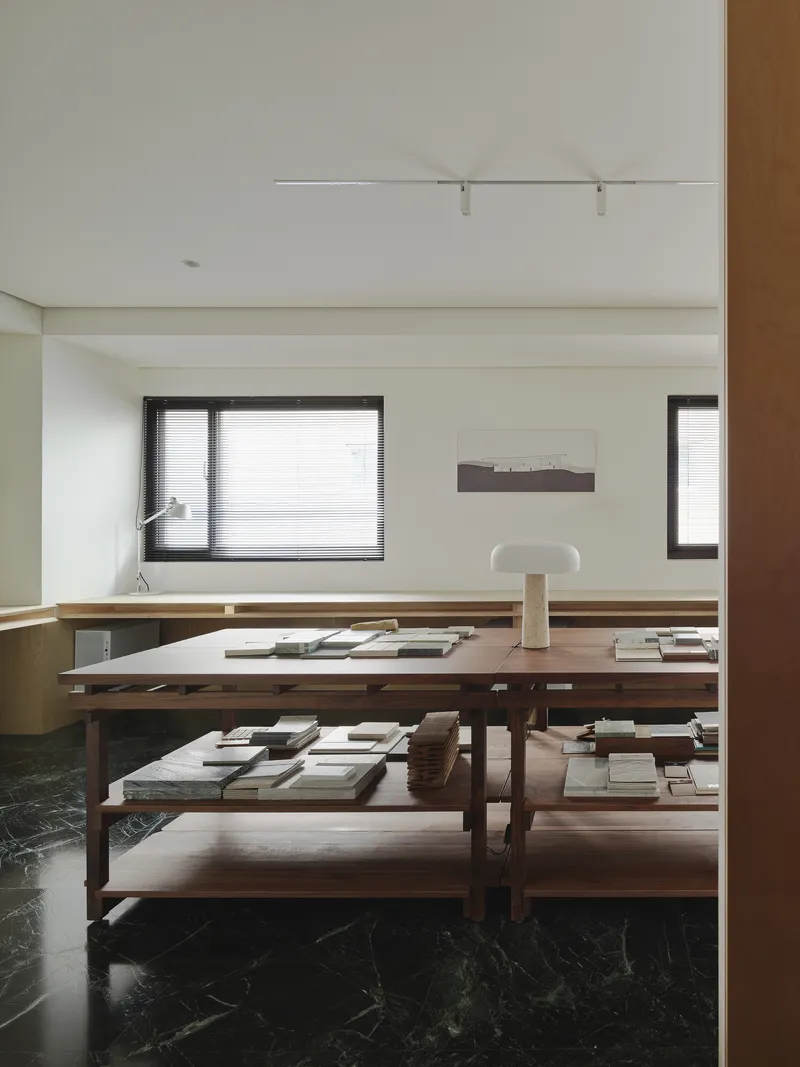
Against that polished stone, Waterfrom deploys a second material language: raw plywood, edge-banded and screwed into shelving units, desks, and built-in storage. The contrast is immediate and deliberate. Where the marble is geological and ancient, the plywood is industrial and present-tense. Bookshelves packed with samples, fabric swatches, and reference volumes sit inside plywood niches that recall a workshop more than a design boutique.
The large wooden tables in the working areas serve as communal surfaces rather than individual desks, reinforcing the collaborative nature of Waterfrom's practice. Shelving is integrated directly into the table structures in some cases, keeping tools and references within arm's reach. The joinery is honest: you can see the layers of ply, the fastener logic, the way each unit was sized to its contents. Nothing pretends to be something it isn't.
The Kitchen Island as Social Core
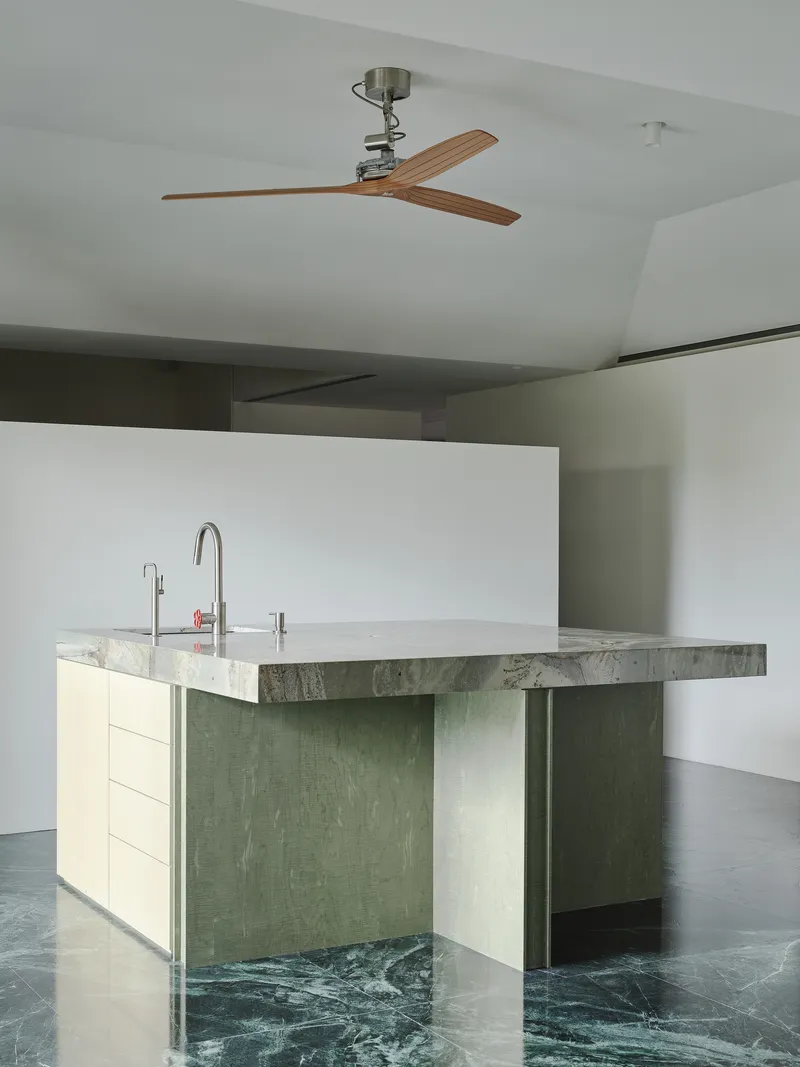
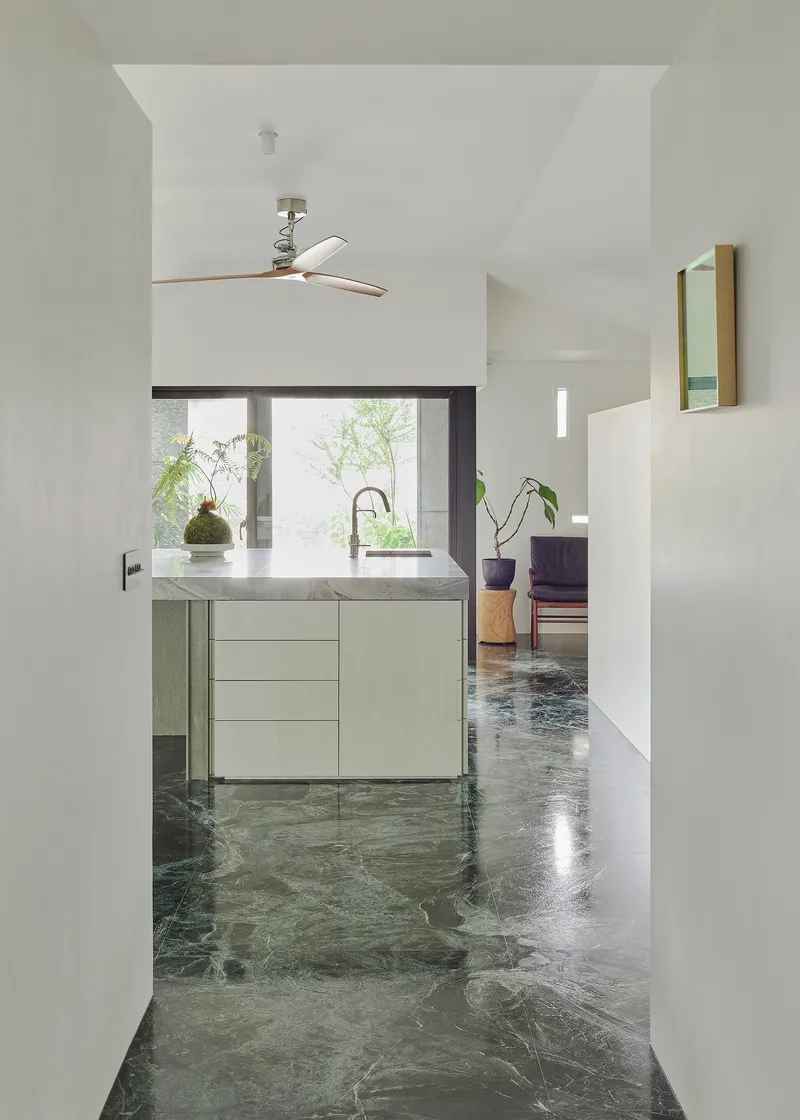
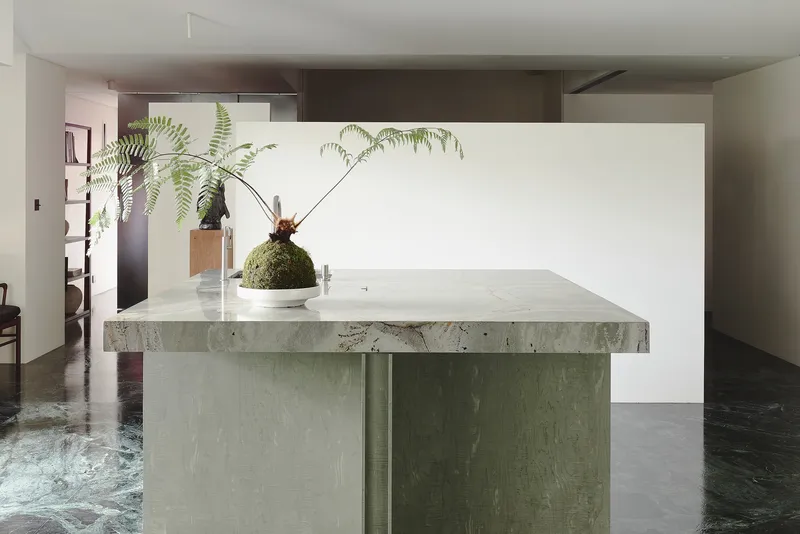
Offices that include a serious kitchen island are making a statement about how work actually happens. Waterfrom's version, clad in stone with a marble countertop, sits in the open zone between the corridor and the communal tables. It anchors the social life of the studio: coffee, lunch, and the informal conversations that often produce better ideas than any scheduled review.
A kokedama plant sits on the counter like a small sculpture, its organic form softening the hard geometry around it. The cabinetry below is wood-fronted and carefully proportioned. One drawer, when opened, reveals rows of stone samples organized by color and finish, a detail that transforms the kitchen into a literal material library. It is a functional choice that also happens to be witty.
Threshold Conditions and Tonal Shifts
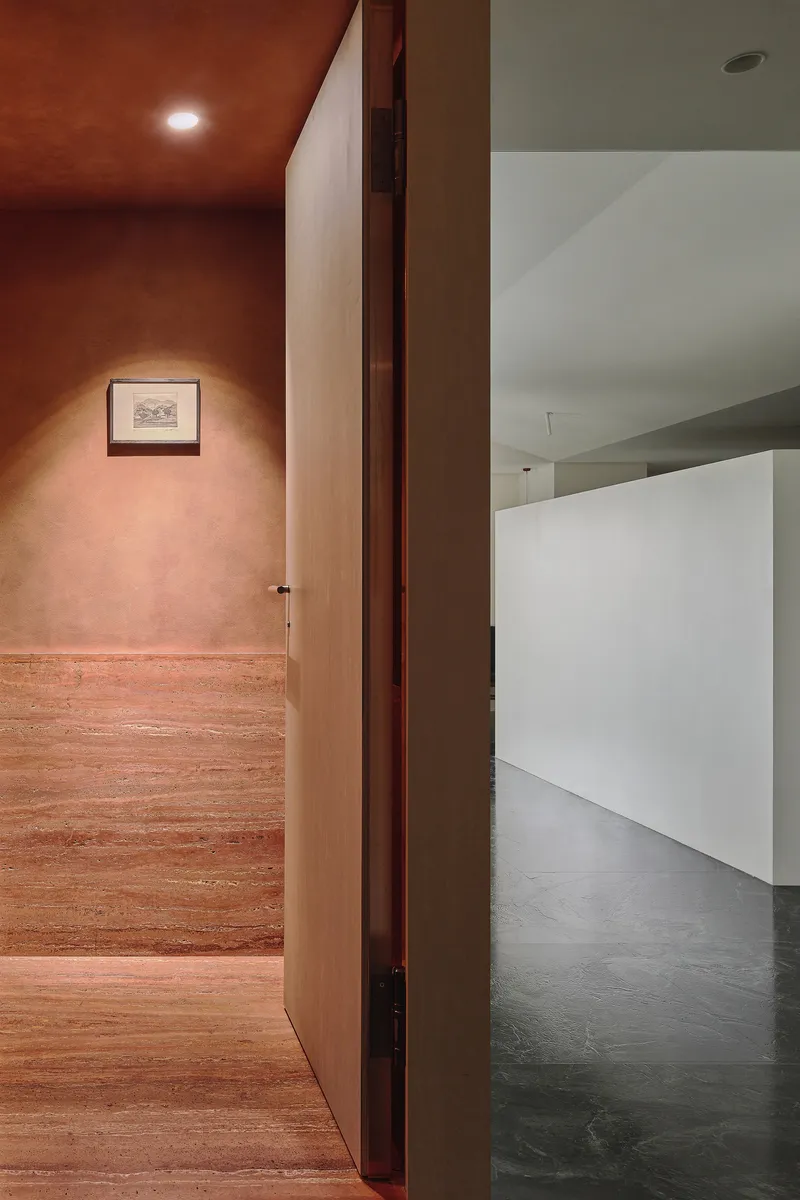
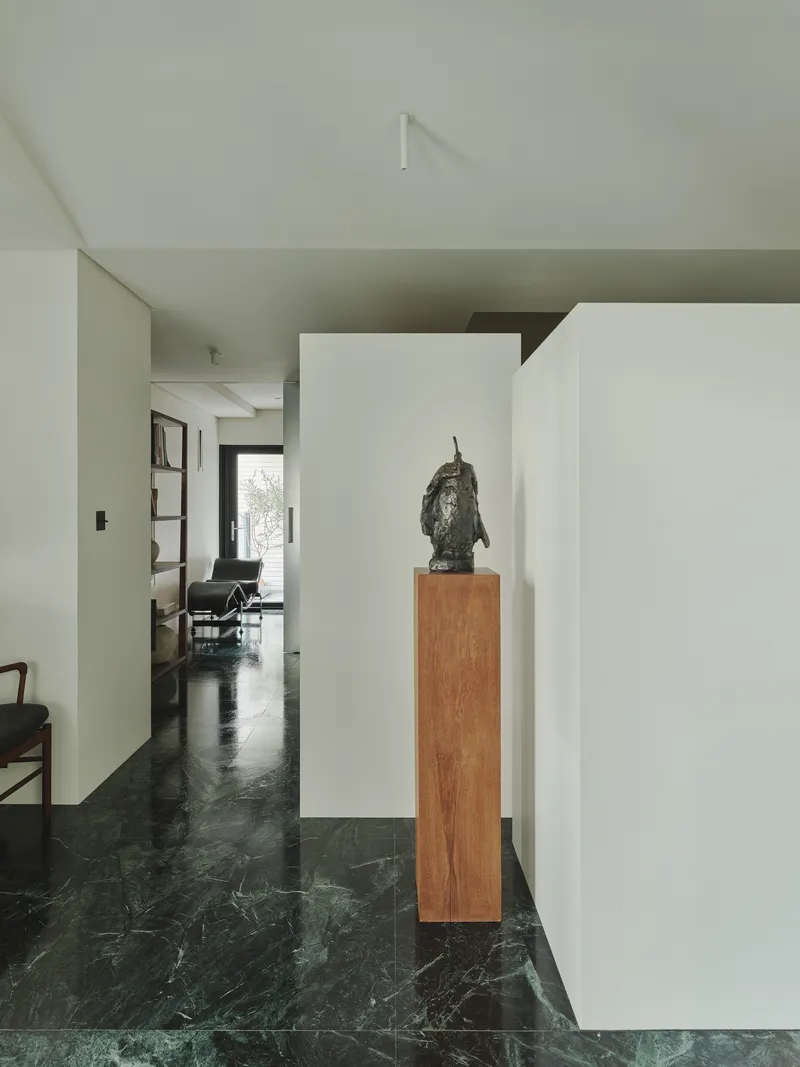
Waterfrom handles transitions between zones with quiet precision. A doorway between the warm, textured entry corridor and the white gallery-like workspace creates a tonal shift that you feel before you consciously register it. The warm tones of the front half give way to the cooler, more clinical palette of the working zones, a move that mirrors the psychological shift from arrival to focus.
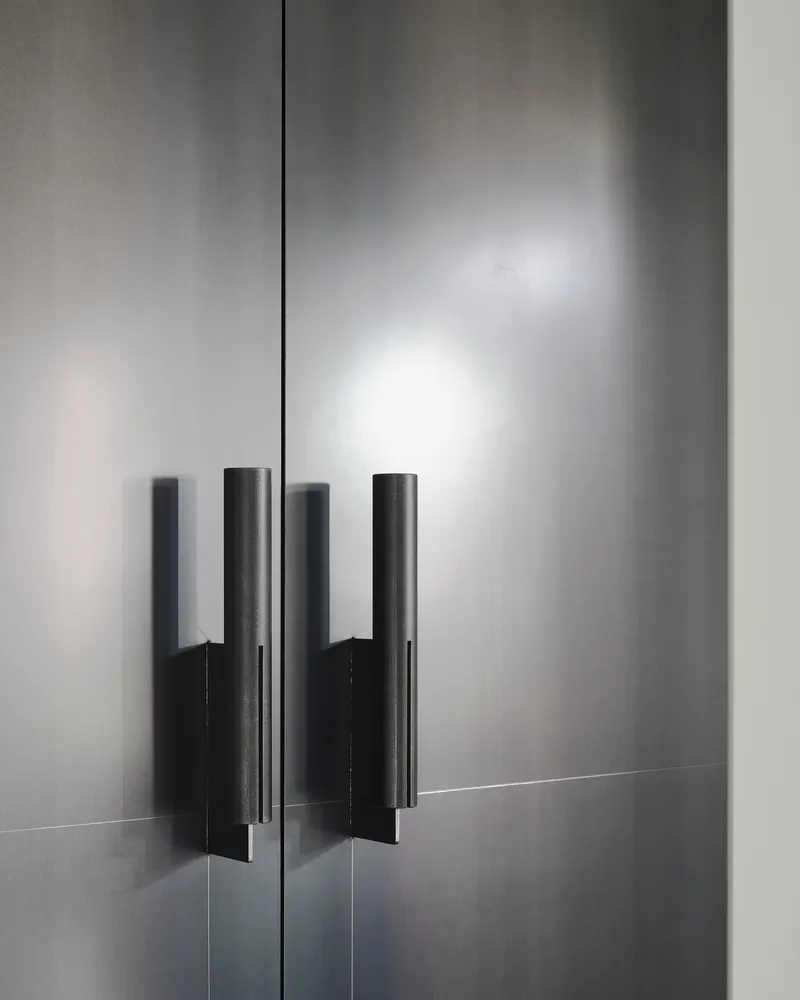
Metal paneling and cylindrical door handles introduce an industrial materiality at certain thresholds, while the geometric ceiling planes overhead compress or release height depending on the zone. The corridor featuring metal paneling and sculpted forms reads almost as a gallery passage, curating the experience of moving through the office. These are small moves, but they accumulate into a clear spatial narrative.
The Dining Table as Conference Room
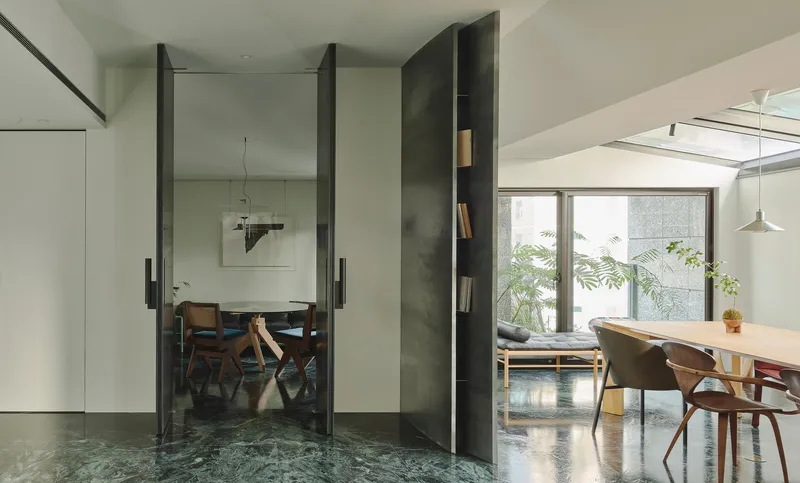

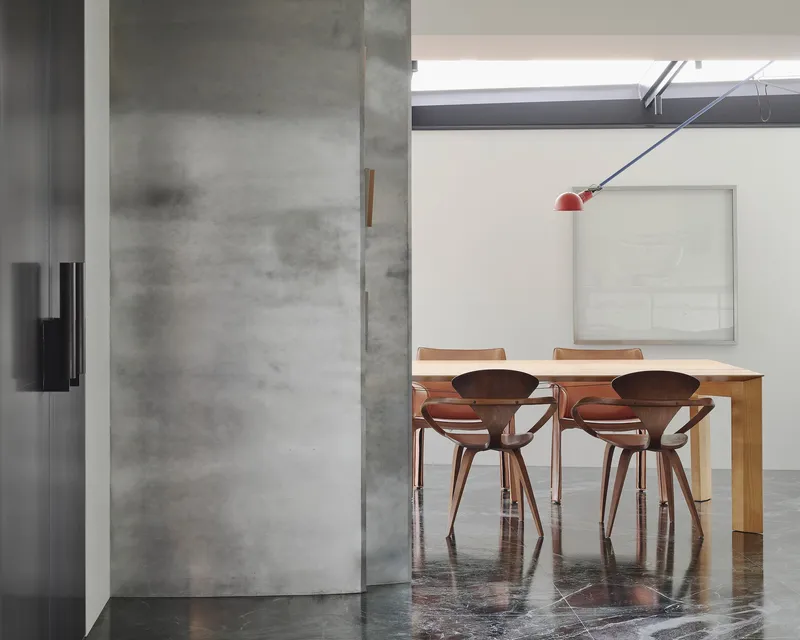
Rather than carving out a formal meeting room, Waterfrom centers its client-facing activity around a long wooden dining table. The chairs are a mix of styles, some modern with leather upholstery, others simpler, lending the space a collected rather than curated quality. A concrete wall with a sliding door provides the option to close off the dining zone when privacy is needed, but the default condition is open.
Natural light enters from one end and is supplemented by pendant and recessed fixtures that keep the table evenly illuminated without harshness. The message is clear: meetings here happen over a meal or a drink, not across a boardroom. For a studio whose process relies on intuition and conversation, this spatial choice is philosophically consistent.
Facade and Identity
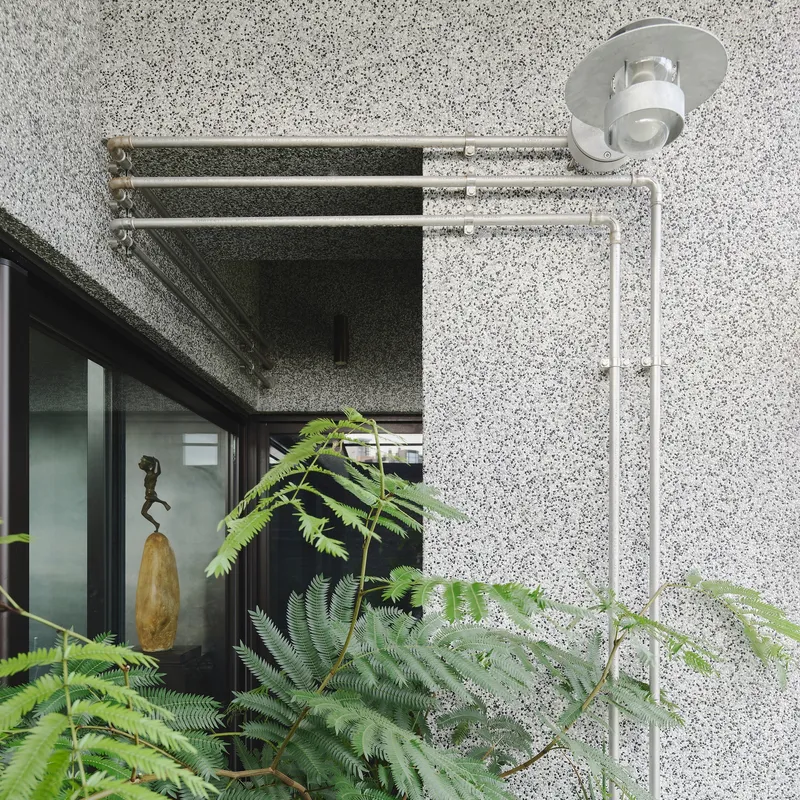
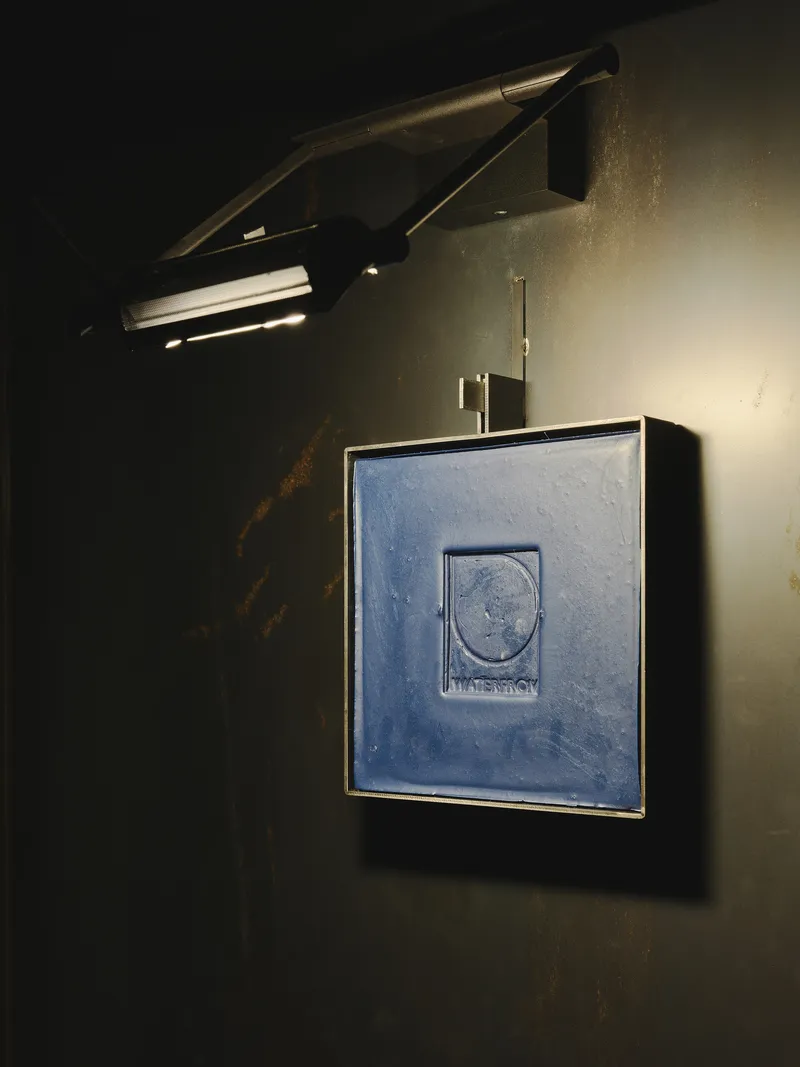

The exterior announces Waterfrom's presence with a textured terrazzo facade, metal piping, and an outdoor fixture that reads as utilitarian rather than decorative. Inside, a framed blue panel bearing the Waterfrom logo is lit by a wall lamp, turning branding into something closer to an art installation. The dark, textured wall behind it absorbs light and gives the logotype an almost cinematic glow.
A chrome and cowhide chair positioned against a minimal wall captures the studio's taste for mixing eras: midcentury furniture against contemporary surfaces, warm hides against cold metal. These vignettes are scattered throughout the office, and together they suggest a design sensibility that values texture, contrast, and a willingness to let objects speak.
Material Details Up Close
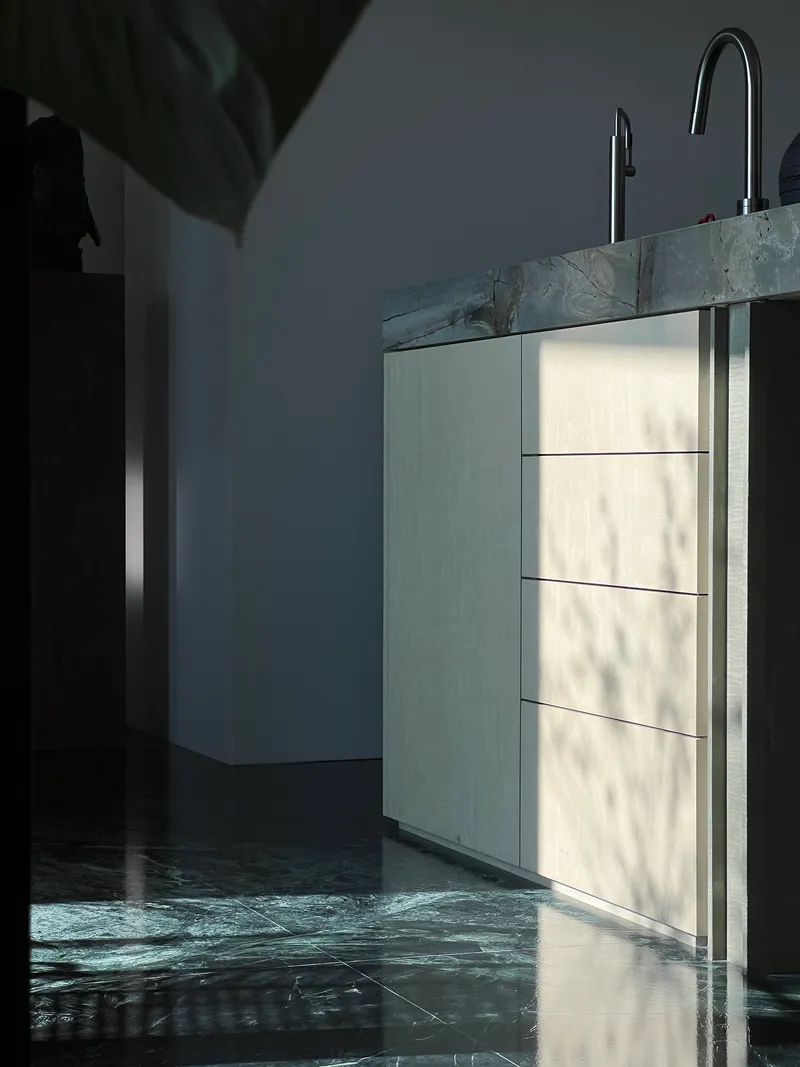
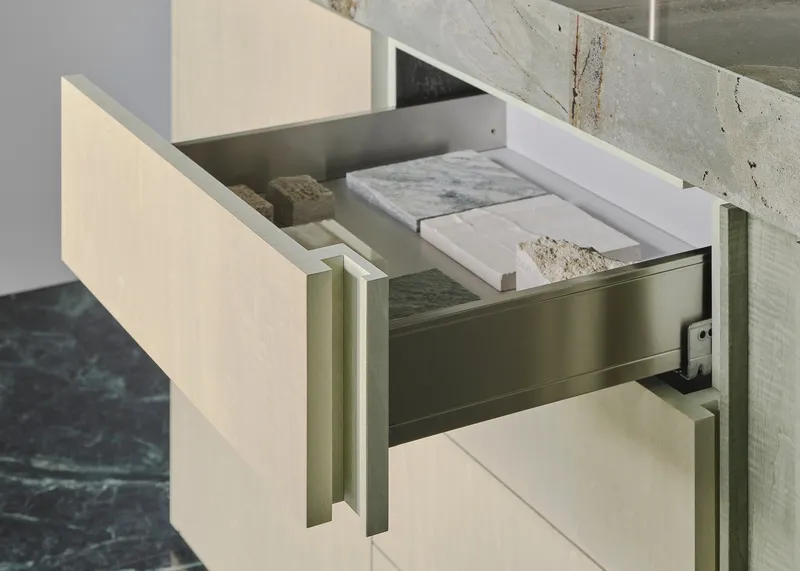
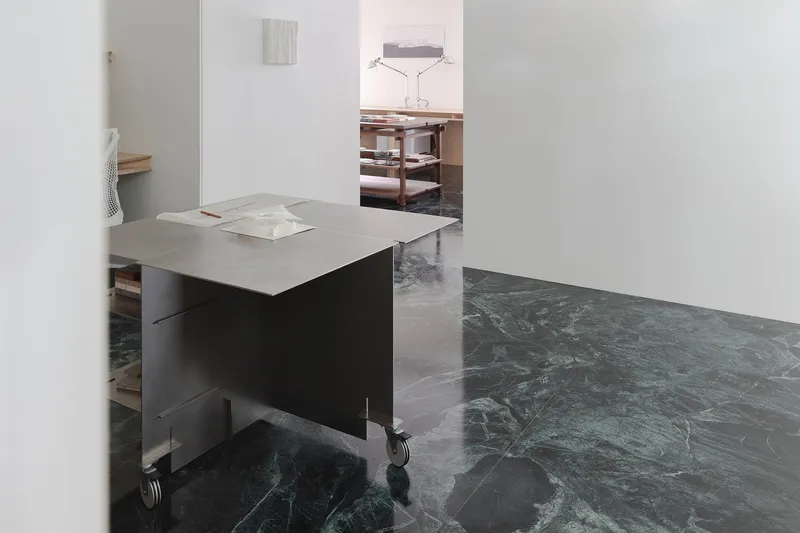
Waterfrom's attention to detail is most evident in the close-up moments: the interplay of light and shadow across kitchen cabinetry, the drawer of stone samples organized with archival care, the minimalist studio space where marble flooring meets white walls without fuss. These are not decorative flourishes. They are evidence of a studio that treats every junction as an opportunity to learn something about how materials behave.
The result is an office that functions simultaneously as a workplace, a showroom, and a laboratory. It is 218 square meters of argument: that good design comes from handling things, not just drawing them.
Plans and Drawings
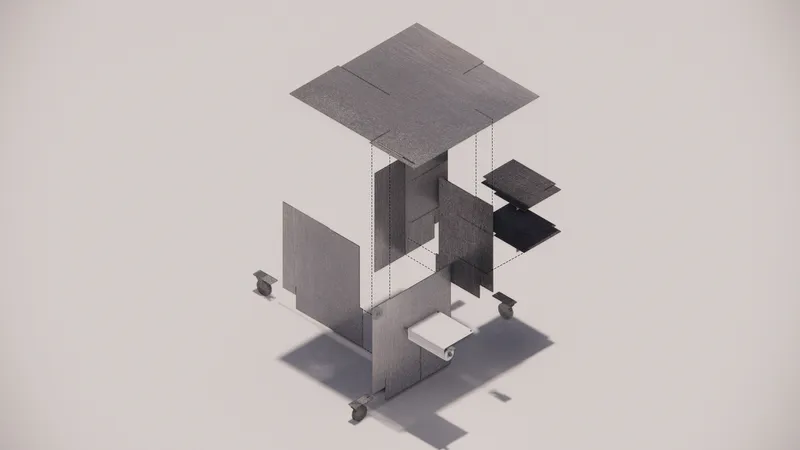

The axonometric drawing reveals how Waterfrom organized interlocking volumes within the narrow footprint, stacking roof planes and circulation elements to create spatial variety without wasting a centimeter. The floor plan confirms the irregular layout, with zones defined more by material change and furniture placement than by walls. Multiple functional areas, from kitchen to library to workspace, coexist within a single open envelope, connected by the continuous marble ground plane.
Why This Project Matters
Architect-designed offices are often self-indulgent or self-conscious, trying too hard to impress visitors or too eager to project a brand identity. Waterfrom's Taipei studio avoids both traps. It is a workspace built around the actual rhythms of a design practice: communal tables for collaboration, a kitchen for informal exchange, plywood shelving for the physical artifacts of the design process. The green marble floors are the one extravagant gesture, and they earn their place by grounding everything else in geological reality.
More importantly, the project embodies a position on how design should happen. By prioritizing material intuition over drawing completeness, Waterfrom has built an office that is less a showroom and more a workshop with good taste. In a profession increasingly mediated by screens and renders, a studio that insists on touching its materials, storing stone samples in kitchen drawers, and making decisions on site rather than in Revit is making a quietly radical argument. The office is the proof.
Waterfrom Design's Office, designed by Waterfrom Design with lead architect Nic Lee. Taipei, Taiwan. 218 m². Completed 2024. Photography by Studio Millspace.
About the Studio
Share Your Own Work on uni.xyz
If projects like this are the kind of work you want to make, uni.xyz is a place to publish your own, find collaborators, and enter design competitions.



Popular Articles
Popular articles from the community


Co-Life: Senior Housing Design That Reconnects Older Adults With the City
Co-Life reimagines senior housing design through healing gardens, shared streets, workshops, and a sustainable community across generations.

Co-life: Sustainable Architecture for Age-Friendly Community Living
Co-life reimagines sustainable architecture for seniors through courtyards, rammed earth, shared gardens, and spaces designed for belonging.

Hill & Cross Opera: Sculptural Opera House Architecture Shaped by Tallinn’s Landscape and Identity
Hill & Cross Opera reimagines opera house architecture in Tallinn through its sculptural hill, civic plaza, glass wave and a luminous cross.

Conexión: Biophilic Design Reimagines High-Rise Living in Hong Kong
Conexión reimagines high-rise living in Hong Kong through biophilic design, green facades, shared spaces, daylight, water and nature within.
Similar Reads
You might also enjoy these articles

Bao Huynh Watercolor Atelier: A Serene Art Retreat in Hội An
Bao Huynh Watercolor Atelier in Hội An blends multifunctional art spaces, sustainable design, local materials, and family-friendly living in a serene environment.

Atelier Macri Concept Store Interior Design by CASE-REAL
Atelier Macri store features a "ko" counter, walnut wood details, cork displays, blending retail, gallery, and seamless customer experiences.

Manuel Vargas Izquierdo Stadium and High-Performance Sports Center: Architectural Excellence in Jalpa de Méndez
The Manuel Vargas Izquierdo Stadium blends sustainable design, inclusive sports facilities, and cultural-inspired architecture, revitalizing Jalpa de Méndez’s public spaces.

KAKR Buluh Awar Hall: Revitalizing Community and Ecology Through Bamboo Architecture
Community built bamboo hall revitalizes Buluh Awar village, empowering youth, restoring ecology, celebrating vernacular craftsmanship through sustainable architecture and culture.


Comments (0)
Please login or sign up to add comments
No comments yet. Be the first to comment!